<?xml version="1.0" encoding="ISO-8859-1"?><article xmlns:mml="http://www.w3.org/1998/Math/MathML" xmlns:xlink="http://www.w3.org/1999/xlink" xmlns:xsi="http://www.w3.org/2001/XMLSchema-instance">
<front>
<journal-meta>
<journal-id>0717-5000</journal-id>
<journal-title><![CDATA[CLEI Electronic Journal]]></journal-title>
<abbrev-journal-title><![CDATA[CLEIej]]></abbrev-journal-title>
<issn>0717-5000</issn>
<publisher>
<publisher-name><![CDATA[Centro Latinoamericano de Estudios en Informática]]></publisher-name>
</publisher>
</journal-meta>
<article-meta>
<article-id>S0717-50002012000100006</article-id>
<title-group>
<article-title xml:lang="en"><![CDATA[Assessing Computer Education in Costa Rica: Results of a Supply and Demand Study of ICT Human Resources]]></article-title>
</title-group>
<contrib-group>
<contrib contrib-type="author">
<name>
<surname><![CDATA[Mata]]></surname>
<given-names><![CDATA[Francisco J]]></given-names>
</name>
<xref ref-type="aff" rid="A01"/>
</contrib>
<contrib contrib-type="author">
<name>
<surname><![CDATA[Matarrita]]></surname>
<given-names><![CDATA[Rosaura]]></given-names>
</name>
<xref ref-type="aff" rid="A01"/>
</contrib>
<contrib contrib-type="author">
<name>
<surname><![CDATA[Pinto]]></surname>
<given-names><![CDATA[Claudio]]></given-names>
</name>
<xref ref-type="aff" rid="A01"/>
</contrib>
</contrib-group>
<aff id="A01">
<institution><![CDATA[,Universidad Nacional de Costa Rica Escuela de Informática ]]></institution>
<addr-line><![CDATA[ ]]></addr-line>
</aff>
<pub-date pub-type="pub">
<day>00</day>
<month>04</month>
<year>2012</year>
</pub-date>
<pub-date pub-type="epub">
<day>00</day>
<month>04</month>
<year>2012</year>
</pub-date>
<volume>15</volume>
<numero>1</numero>
<fpage>6</fpage>
<lpage>6</lpage>
<copyright-statement/>
<copyright-year/>
<self-uri xlink:href="http://www.scielo.edu.uy/scielo.php?script=sci_arttext&amp;pid=S0717-50002012000100006&amp;lng=en&amp;nrm=iso"></self-uri><self-uri xlink:href="http://www.scielo.edu.uy/scielo.php?script=sci_abstract&amp;pid=S0717-50002012000100006&amp;lng=en&amp;nrm=iso"></self-uri><self-uri xlink:href="http://www.scielo.edu.uy/scielo.php?script=sci_pdf&amp;pid=S0717-50002012000100006&amp;lng=en&amp;nrm=iso"></self-uri><abstract abstract-type="short" xml:lang="en"><p><![CDATA[In the last decade, Costa Rica has established a reputation for being a global provider of information and communication technology (ICT) products and services. Several important multinational companies have begun outsourcing operations in the country. In addition, a growing number of local firms have been created to provide ICT products and services worldwide. As a consequence, the country is experiencing a shortage of ICT qualified workers. To understand the ICT human resource situation and improve the country’s capacity in computer education, a supply and demand study was conducted from 2007 to 2009. This paper presents the results of this study and its implications for the educational system. In addition, policy recommendations for computer education are proposed in order to support the country´s competiveness in the global ICT market and advances related to these recommendations are discussed]]></p></abstract>
<abstract abstract-type="short" xml:lang="es"><p><![CDATA[En los últimos años, Costa Rica se ha convertido en un proveedor global de productos y servicios de tecnología de información y comunicación (TIC). Varias compañías multinacionales han iniciado operaciones en el país. Además, un número creciente de empresas nacionales han sido creadas con el fin de proveer mundialmente productos y servicios TIC. Como consecuencia, el país está experimentado un déficit de personal TIC calificado. Con el fin de comprender la situación de los recursos humanos en el sector TIC y de mejorar la capacidad del país en materia de educación en computación, un estudio de oferta y demanda fue llevado a cabo durante el periodo 2007 a 2009. Este artículo presenta los resultados de este estudio y sus implicaciones para el sistema educacional. Además, se proponen recomendaciones de política para la educación en computación con el fin de apoyar la competitividad del país en el mercado global de las TIC y se presentan avances relacionados con estas recomendaciones]]></p></abstract>
<kwd-group>
<kwd lng="en"><![CDATA[ICT human resources]]></kwd>
<kwd lng="en"><![CDATA[computer education programs]]></kwd>
<kwd lng="en"><![CDATA[Costa Rica]]></kwd>
<kwd lng="es"><![CDATA[Recursos humanos en TIC]]></kwd>
<kwd lng="es"><![CDATA[programas educativos en computación]]></kwd>
<kwd lng="es"><![CDATA[Costa Rica]]></kwd>
</kwd-group>
</article-meta>
</front><body><![CDATA[ <div type="HEADER"> 	     <p style="margin-bottom: 0.35cm;" align="center" lang="en-US"> 	</p>  	     <p style="margin-bottom: 0.65cm;" lang="en-US"> 	</p>  </div>      <p style="margin-left: 1cm; margin-right: 1.08cm; margin-bottom: 0cm; line-height: 100%;" align="center" lang="en-US"> <font size="4" face="Verdana"><b>Assessing Computer Education in Costa Rica:</b></font></p>      <p style="margin-left: 1cm; margin-right: 1.08cm; margin-bottom: 0cm; line-height: 100%;" align="center" lang="en-US">  </p>      <p style="margin-left: 1cm; margin-right: 1.08cm; margin-bottom: 0cm; line-height: 100%;" align="center" lang="en-US"> <font face="Verdana"><b>Results of a Supply and Demand Study of ICT Human Resources</b></font></p>      <p style="margin-left: 1cm; margin-right: 1.08cm; margin-bottom: 0cm; line-height: 100%;" align="center" lang="en-US">  </p>      <p style="margin-left: 1cm; margin-right: 1.08cm; margin-bottom: 0cm; line-height: 100%;" align="center" lang="es-CR"> <font size="2" face="Verdana"><b>Francisco J. Mata</b></font></p>      <p style="margin-left: 1cm; margin-right: 1.08cm; margin-bottom: 0cm; line-height: 100%;" align="center" lang="es-CR"> <font size="2" face="Verdana">Programa de Investigaci&oacute;n y Extensi&oacute;n en Tecnolog&iacute;a de Informaci&oacute;n y Comunicaci&oacute;n</font></p>      <p style="margin-left: 1cm; margin-right: 1.08cm; margin-bottom: 0cm; line-height: 100%;" align="center" lang="es-CR"> <font size="2" face="Verdana">Posgrado en Gesti&oacute;n de la Tecnolog&iacute;a de Informaci&oacute;n y Comunicaci&oacute;n</font></p>      ]]></body>
<body><![CDATA[<p style="margin-left: 1cm; margin-right: 1.08cm; margin-bottom: 0cm; line-height: 100%;" align="center" lang="es-CR"> <font size="2" face="Verdana">Escuela de Inform&aacute;tica</font></p>      <p style="margin-left: 1cm; margin-right: 1.08cm; margin-bottom: 0cm; line-height: 100%;" align="center" lang="en-US"> <font size="2" face="Verdana"><span lang="es-CR">Universidad Nacional de Costa Rica</span></font></p>      <p style="margin-left: 1cm; margin-right: 1.08cm; margin-bottom: 0cm; line-height: 100%;" align="center" lang="es-CR"> <font size="2" face="Verdana">Heredia, Costa Rica</font></p>      <p style="margin-left: 1cm; margin-right: 1.08cm; margin-bottom: 0cm; line-height: 100%;" align="center" lang="en-US"> <font color="#0000ff"><u><a class="western" href="mailto:fmata@una.ac.cr"> <font size="2" face="Verdana"><span lang="es-CR"><i>fmata@una.ac.cr</i></span></font></a></u></font></p>      <p style="margin-left: 1cm; margin-right: 1.08cm; margin-bottom: 0cm; line-height: 100%;" align="center" lang="es-CR">  </p>      <p style="margin-left: 1cm; margin-right: 1.08cm; margin-bottom: 0cm; line-height: 100%;" align="center" lang="es-CR"> <font size="2" face="Verdana"><b>Rosaura Matarrita</b></font></p>      <p style="margin-left: 1cm; margin-right: 1.08cm; margin-bottom: 0cm; line-height: 100%;" align="center" lang="es-CR"> <font size="2" face="Verdana">C&aacute;mara de Tecnolog&iacute;a de Informaci&oacute;n y Comunicaci&oacute;n</font></p>      <p style="margin-left: 1cm; margin-right: 1.08cm; margin-bottom: 0cm; line-height: 100%;" align="center" lang="es-CR"> <font size="2" face="Verdana">San Jos&eacute;, Costa Rica</font></p>      <p style="margin-left: 1cm; margin-right: 1.08cm; margin-bottom: 0cm; line-height: 100%;" align="center" lang="en-US"> <font color="#0000ff"><u><a class="western" href="mailto:rmatarri@yahoo.com"> <font size="2" face="Verdana"><span lang="es-CR"><i>rmatarri@yahoo.com</i></span></font></a></u></font></p>      <p style="margin-left: 1cm; margin-right: 1.08cm; margin-bottom: 0cm; line-height: 100%;" align="center" lang="es-CR">  </p>      ]]></body>
<body><![CDATA[<p style="margin-left: 1cm; margin-right: 1.08cm; margin-bottom: 0cm; line-height: 100%;" align="center" lang="es-CR"> <font size="2" face="Verdana"><b>and</b></font></p>      <p style="margin-left: 1cm; margin-right: 1.08cm; margin-bottom: 0cm; line-height: 100%;" align="center" lang="es-CR">  </p>      <p style="margin-left: 1cm; margin-right: 1.08cm; margin-bottom: 0cm; line-height: 100%;" align="center" lang="es-CR"> <font size="2" face="Verdana"><b>Claudio Pinto</b></font></p>      <p style="margin-left: 1cm; margin-right: 1.08cm; margin-bottom: 0cm; line-height: 100%;" align="center" lang="es-CR"> <font size="2" face="Verdana">C&aacute;mara de Tecnolog&iacute;a de Informaci&oacute;n y Comunicaci&oacute;n</font></p>      <p style="margin-left: 1cm; margin-right: 1.08cm; margin-bottom: 0cm; line-height: 100%;" align="center" lang="es-CR"> <font size="2" face="Verdana">San Jos&eacute;, Costa Rica</font></p>      <p style="margin-left: 1cm; margin-right: 1.08cm; margin-bottom: 0cm; line-height: 100%;" align="center" lang="en-US"> <font color="#0000ff"><u><a class="western" href="mailto:claudio.pinto@fairplaylabs.com"> <font size="2" face="Verdana"><span lang="es-CR"><i>claudio.pinto@fairplaylabs.com</i></span></font></a></u></font></p>      <p style="margin-left: 1cm; margin-right: 1.08cm; margin-bottom: 0cm; line-height: 100%;" align="center" lang="es-CR">  </p>      <p style="margin-left: 1cm; margin-right: 1.08cm; margin-bottom: 0cm; line-height: 100%;" align="center" lang="es-CR">  </p>      <p style="margin-left: 1cm; margin-right: 1.08cm; margin-bottom: 0cm; line-height: 100%;" lang="en-US"> <font size="2" face="Verdana"><b>Abstract</b></font></p>       <p style="margin-left: 1cm; margin-right: 1.09cm; margin-bottom: 0cm; line-height: 100%;" align="justify" lang="en-US"> <font size="2" face="Verdana">In the last decade, Costa Rica has established a reputation for being a global provider of information and communication technology (ICT) products and services.  Several important multinational companies have begun outsourcing operations in the country.  In addition, a growing number of local firms have been created to provide ICT products and services worldwide.  As a consequence, the country is experiencing a shortage of ICT qualified workers.</font></p>       ]]></body>
<body><![CDATA[<p style="margin-left: 1cm; margin-right: 1.09cm; margin-bottom: 0cm; line-height: 100%;" align="justify" lang="en-US"> <font size="2" face="Verdana">To understand the ICT human resource situation and improve the country&rsquo;s capacity in computer education, a supply and demand study was conducted from 2007 to 2009.  This paper presents the results of this study and its implications for the educational system.  In addition, policy recommendations for computer education are proposed in order to support the country&acute;s competiveness in the global ICT market and advances related to these recommendations are discussed.</font></p>       <p style="margin-left: 1cm; margin-right: 1.09cm; margin-bottom: 0cm; line-height: 100%;" align="justify" lang="en-US"> <font size="2" face="Verdana"><b>Keywords: </b>ICT human resources, computer education programs, Costa Rica</font></p>      <p style="margin-left: 1cm; margin-right: 1.09cm; margin-bottom: 0cm; line-height: 100%;" align="justify" lang="en-US">  </p>      <p style="margin-left: 1cm; margin-right: 1.09cm; margin-bottom: 0cm; line-height: 100%;" align="justify" lang="en-US"> <b><font size="2" face="Verdana">Resumen</font></b></p>      <p style="margin-left: 1cm; margin-right: 1.09cm; margin-bottom: 0cm; line-height: 100%;" align="justify" lang="en-US"> </p>      <p style="margin-left: 1cm; margin-right: 1.09cm; margin-bottom: 0cm; line-height: 100%;" align="justify" lang="en-US"> <font size="2" face="Verdana">En los &uacute;ltimos a&ntilde;os, Costa Rica se ha convertido en un proveedor global de productos y servicios de tecnolog&iacute;a de informaci&oacute;n y comunicaci&oacute;n (TIC). Varias compa&ntilde;&iacute;as multinacionales han iniciado operaciones en el pa&iacute;s.  Adem&aacute;s, un n&uacute;mero creciente de empresas nacionales han sido creadas con el fin de proveer mundialmente productos y servicios TIC.  Como consecuencia, el pa&iacute;s est&aacute; experimentado un d&eacute;ficit de personal TIC calificado.</font></p>      <p style="margin-left: 1cm; margin-right: 1.09cm; margin-bottom: 0cm; line-height: 100%;" align="justify" lang="en-US"> </p>      <p style="margin-left: 1cm; margin-right: 1.09cm; margin-bottom: 0cm; line-height: 100%;" align="justify" lang="en-US"> <font size="2" face="Verdana">Con el fin de comprender la situaci&oacute;n de los recursos humanos en el sector TIC y de mejorar la capacidad del pa&iacute;s en materia de educaci&oacute;n en computaci&oacute;n, un estudio de oferta y demanda fue llevado a cabo durante el periodo 2007 a 2009.  Este art&iacute;culo presenta los resultados de este estudio y sus implicaciones para el sistema educacional.  Adem&aacute;s, se proponen recomendaciones de pol&iacute;tica para la educaci&oacute;n en computaci&oacute;n con el fin de apoyar la competitividad del pa&iacute;s en el mercado global de las TIC y se presentan avances relacionados con estas recomendaciones.</font></p>      <p style="margin-left: 1cm; margin-right: 1.09cm; margin-bottom: 0cm; line-height: 100%;" align="justify" lang="en-US">  </p>      <p style="margin-left: 1cm; margin-right: 1.09cm; margin-bottom: 0cm; line-height: 100%;" align="justify" lang="en-US"> <font size="2" face="Verdana"><b>Palabras clave:</b> Recursos humanos en TIC, programas educativos en computaci&oacute;n, Costa Rica</font></p>      ]]></body>
<body><![CDATA[<p style="margin-left: 1cm; margin-right: 1.08cm; margin-bottom: 0cm; line-height: 100%;" lang="en-US"> <font face="Verdana" size="2">Received 2011-08-01, Revised 2011-12-30, Accepted 2012-03-01 </font> </p>      <p style="margin-bottom: 0cm; line-height: 100%;" align="center" lang="en-US">  </p>  <ol>  	    <li>         <p style="margin-bottom: 0cm; line-height: 100%;" lang="en-US"> 	<font size="2" face="Verdana"><b>Introduction</b></font></p>    </li>     </ol>      <p style="margin-bottom: 0cm; line-height: 100%;" lang="en-US">  </p>      <p style="margin-bottom: 0cm; line-height: 100%;" align="justify" lang="en-US"> <font size="2" face="Verdana">Costa Rica has become a global provider of information and communication technology (ICT) products and services.  Several important multinational companies, including Hewlett Packard, IBM, Intel, Procter and Gamble and Western Union, decided to start operations in the country.  In addition, a growing number of local firms have been created in order to provide ICT products and services globally.  As a result of this situation, the country has experienced a shortage of ICT qualified workers during the first decade of the new millennium, particularly in careers related to computer sciences and informatics <a href="#c1">(1)</a><a href="#c2">(2)</a><a href="#c3">(3)</a><a name="c1."></a><a name="c2."></a><a name="c3."></a>.</font></p>      <p style="margin-bottom: 0cm; line-height: 100%;" align="justify" lang="en-US">  </p>      <p style="margin-bottom: 0cm; line-height: 100%;" align="justify" lang="en-US"> <font size="2" face="Verdana">Several factors constrain the capacity of the country to keep up with the growing demand of qualified computer trained personnel: the country&acute;s small population, the reduced coverage of upper secondary and tertiary education, the limited capacity of the private universities to graduate computer professionals, and the weak technical and para-academic educational programs in the country <a href="#c4">(4)</a><a href="#c5">(5)</a>.<a name="c4."></a><a name="c5."></a></font></p>      <p style="margin-bottom: 0cm; line-height: 100%;" align="justify" lang="en-US">  </p>      ]]></body>
<body><![CDATA[<p style="margin-bottom: 0cm; line-height: 100%;" align="justify" lang="en-US"> <font size="2" face="Verdana">To understand the ICT human resource situation and improve the country&acute;s computer education, a demand and supply study was conducted from 2007 to 2009 by the Costa Rican Association of ICT Companies (CAMTIC) in conjunction with the Program in Information Technology and Development of the Universidad Nacional de Costa Rica (UNA).  This study was funded by the International Development Research Centre (IDRC) of Canada through the Research Program on the Knowledge Economy in Latin American and the Caribbean of the Latin American Faculty in Social Sciences (FLACSO-Mexico).</font></p>      <p style="margin-bottom: 0cm; line-height: 100%;" align="justify" lang="en-US">  </p>      <p style="margin-bottom: 0cm; line-height: 100%;" align="justify" lang="en-US"> <font size="2" face="Verdana">Based on previous studies (Mata and Jofr&eacute; <a href="#c6">(6)</a><a name="c6."></a>, Mata <i>et al. </i><a href="#c7">(7)</a><a href="#c8">(8)</a><a href="#c9">(9)</a><a href="#c10">(10)</a> <a name="c7."></a><a name="c8."></a><a name="c9."></a><a name="c10."></a>and Araya <i>et al. </i><a href="#r11">(11)</a><a href="#c12">(12)</a><a href="#c13">(13)</a>)<a name="c11."></a><a name="c12."></a><a name="c13."></a> &nbsp; &nbsp; &nbsp; &nbsp; &nbsp; &nbsp;, eight ICT occupations were considered on the demand side of the study: 1) Software Engineers (this occupation was referred by Mata et al. <a href="#r8">(8)</a> to as Software Engineers/System Analysts; however, for the sake of simplicity it is denoted in this work simply as Software Engineers) 2) Application Programmers, 3) Project Managers, 4) Technical Support Specialists, 5) End-User Technical Supporters (this occupation was referred by Araya et al. <a href="#c13">(13)</a> to as End-User Technical Supporters/Computer Technicians), 6) Specialists in Quality Assurance, 7) Specialists in Software Testing, and 8) Specialists in Marketing and Sales of Software Services and Products.  These occupations are focused on software development and technical support.</font></p>      <p style="margin-bottom: 0cm; line-height: 100%;" align="justify" lang="en-US">  </p>      <p style="margin-bottom: 0cm; line-height: 100%;" align="justify" lang="en-US"> <font size="2" face="Verdana">An electronic survey was conducted to 83 organizations obtained from a judgment sample of 160 organizations (52% response rate).  Questionnaires were addressed to the persons in the organizations in charge of recruiting ICT staff.  The sample obtained had the following structure: ICT companies (76%), private organizations not related to the ICT sector (11%), public and non-profit organizations (2%), other types of organizations (9%) and organizations that did not disclose their sector (2%).  Subsidiaries of multinational corporations (MNC) constituted 19% of the final sample.</font></p>      <p style="margin-bottom: 0cm; line-height: 100%;" align="justify" lang="en-US">  </p>      <p style="margin-bottom: 0cm; line-height: 100%;" align="justify" lang="en-US"> <font size="2" face="Verdana">The number of total employees in the final sample of organizations ranged from 2 to 44,000 with an average of 870 employees per organization.  A large standard deviation for the total number of employees was obtained (4,197), which can be explained by the fact that 46% of these organizations can be classified as small organizations (11 to 35 employees) and 26% as large (more than 100 workers).  Micro organizations (1 to 10 employees) accounted for 12% of the sample and medium organizations (35 to 99 workers) to 16%.</font></p>      <p style="margin-bottom: 0cm; line-height: 100%;" align="justify" lang="en-US">  </p>      <p style="margin-bottom: 0cm; line-height: 100%;" align="justify" lang="en-US"> <font size="2" face="Verdana">On the supply side, computer graduates in programs related to software development and technical support were considered at the technical, para-academic (The para-academic level is comprised by public and private &ldquo;Colegios Universitarios&rdquo;, which are the equivalent of the community colleges in the U.S., and public universities which offer diplomate degrees, equivalent to associate degrees), and academic levels of the educational system of Costa Rica for the decennium 1997-2006 (due to the delay in reporting graduation statistics, the study had to rely on data available until 2006).  Data was obtained from the National Council of Rectors (CONARE) and from the National Council for University Higher Education (CONESUP) for 23 universities, public as well as private, and from the Ministry of Public Education (MEP) for 7 community colleges and 91 technical colleges (although information on degrees granted was available for this study, the same was not centralized.  For this reason, that information had to be extracted from several spreadsheets containing information about the degrees granted for all the programs offered by each educational center.  Furthermore, given the variety of names that these programs have, a list for them had to be compiled, requiring in some cases a review of the programs, prior to extracting and organizing the data).</font></p>      <p style="margin-bottom: 0cm; line-height: 100%;" align="justify" lang="en-US">  </p>      ]]></body>
<body><![CDATA[<p style="margin-bottom: 0cm; line-height: 100%;" align="justify" lang="en-US"> <font size="2" face="Verdana">This work presents a summary of the results of the supply and demand study conducted and discusses policy recommendations based on these results to improve computer education and support Costa Rica&acute;s competitiveness in the global ICT market (ore information about this study can be found in Herrera et al. <a href="#c5">(5)</a> and Mata et al. <a href="#c14">(14)</a><a href="#c15">(15)</a>)<a name="c14."></a><a name="c15."></a>.  Furthermore, actions already undertaken towards those policies are also presented.</font></p>      <p style="margin-bottom: 0cm; line-height: 100%;" align="justify" lang="en-US">  </p>      <p style="margin-bottom: 0cm; line-height: 100%;" align="justify" lang="en-US"> <font size="2" face="Verdana">This paper is organized in five sections.  Section 2 presents a brief description of the ICT sector in Costa Rica.  The results of the supply and demand study are discussed in section 3 and policy recommendations based on the findings are presented in section 4.  Section 5 contains the conclusions.</font></p>      <p style="margin-bottom: 0cm; line-height: 100%;" lang="en-US">  </p>  <ol start="2">  	    <li>         <p style="margin-bottom: 0cm; line-height: 100%;" lang="en-US"> 	<font size="2" face="Verdana"><b>Costa Rica&rsquo;s 	ICT Sector</b></font></p>    </li>     </ol>      <p style="margin-bottom: 0cm; line-height: 100%;" lang="en-US">  </p>      <p style="margin-bottom: 0cm; line-height: 100%;" align="justify" lang="en-US"> <font size="2" face="Verdana">An indigenous ICT cluster began to develop in Costa Rica in the 1980s <a href="#c6">(6),</a> mainly in the Central Valley.  Later, Intel decided in 1997 to build an assembly and testing plant in Costa Rica.  Even though local ICT companies precede the installation of Intel&acute;s plant, the decision of this company to invest in the country represented a milestone for creating a national ICT cluster.  This decision induced other MNCs to establish operations in the country.  Following Intel, Procter and Gamble decided to open a global business services center in 2000, Western Union established a customer interaction center in 2000, and Hewlett Packard decided to install a business process outsourcing center in 2003 <a href="#c4">(4)</a>.  Recently, IBM announced the opening of a new ICT service center in Costa Rica with an expected investment of US$300 million for the next 10 years and the generation of 1,000 new jobs from 2011 to 2014 <a href="#c16">(16)</a><a name="c16."></a>.</font></p>      <p style="margin-bottom: 0cm; line-height: 100%;" align="justify" lang="en-US">  </p>      ]]></body>
<body><![CDATA[<p style="margin-bottom: 0cm; line-height: 100%;" align="justify" lang="en-US"> <font size="2" face="Verdana">According to statistics from the Ministry of Science and Technology <a href="#c17">(17)</a>, <a name="c17."></a>ICT imports in Costa Rica amounted US$2,340 million in 2007, which represents a reduction from the US$2,508 million reported in 2006.  However, ICT exports were US$2,878 million in 2007, an increase from the US$2,345 level registered in 2006.  Furthermore, employment in the ICT sector has been estimated at 49,901 jobs in 2007 (2.47% of the economically active population) and 45,066 employees in 2006 (2.32% of the economically active population), reflecting an increase of 10.72% of the employment in this sector.</font></p>      <p style="margin-bottom: 0cm; line-height: 100%;" align="justify" lang="en-US">  </p>      <p style="margin-bottom: 0cm; line-height: 100%;" align="justify" lang="en-US"> <font size="2" face="Verdana">Related to the structure of the ICT sector in Costa Rica, Mata and Mata Marin <a href="#c4">(4)</a> indicate that the same can be divided into two subsectors.  The first subsector, and most important in employment and production, is that composed of subsidiaries of MNCs established in the country.  In 2006, this subsector was composed of approximately 95 large and medium companies, mainly related to the industries of electronic components (production of microprocessors, design and production of electronic circuits, etc.) and IT-enabled services (global business services, customer interaction services or contact centers, back-office operation services, business process outsourcing, etc.).  These companies generated US$2,200 million in total sales and employed 24,000 workers, resulting in approximately US$92,000 of sales per employee.  In contrast, the second subsector is composed of domestic companies, amounting to around 600 in 2006, mainly micro, small and medium enterprises.  These local companies focus on IT direct services (database services, network services, customized software development, consulting, and other related services) and development of horizontal and vertical software solutions, being the majority of them software companies which offer outsourcing services.  Companies in this second group produced US$300 million in sales and generated 9,400 jobs, with an average of US$32,000 of sales per employee.  Consequently, there is an asymmetrical profile between these two ICT subsectors, and as a result of this, MNCs are able to pay higher wages to ICT employees.</font></p>      <p style="margin-bottom: 0cm; line-height: 100%;" lang="en-US">  </p>  <ol start="3">  	    <li>         <p style="margin-bottom: 0cm; line-height: 100%;" lang="en-US"> 	<font size="2" face="Verdana"><b>Results of the 	Demand and Supply Study</b></font></p>    </li>     </ol>      <p style="margin-bottom: 0cm; line-height: 100%;" lang="en-US">  </p>  <ol>  	   <ol>  		    <li>           <p style="margin-bottom: 0cm; line-height: 100%;" lang="en-US"> 		<font size="2" face="Verdana"><b>Demand for ICT 		Workers Classified by Occupations</b></font></p>  	</li>       ]]></body>
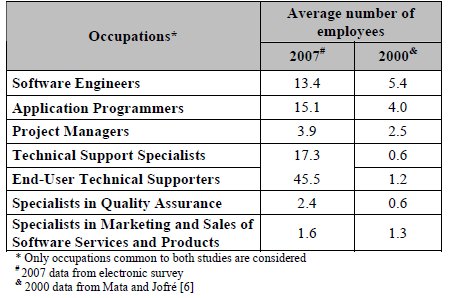
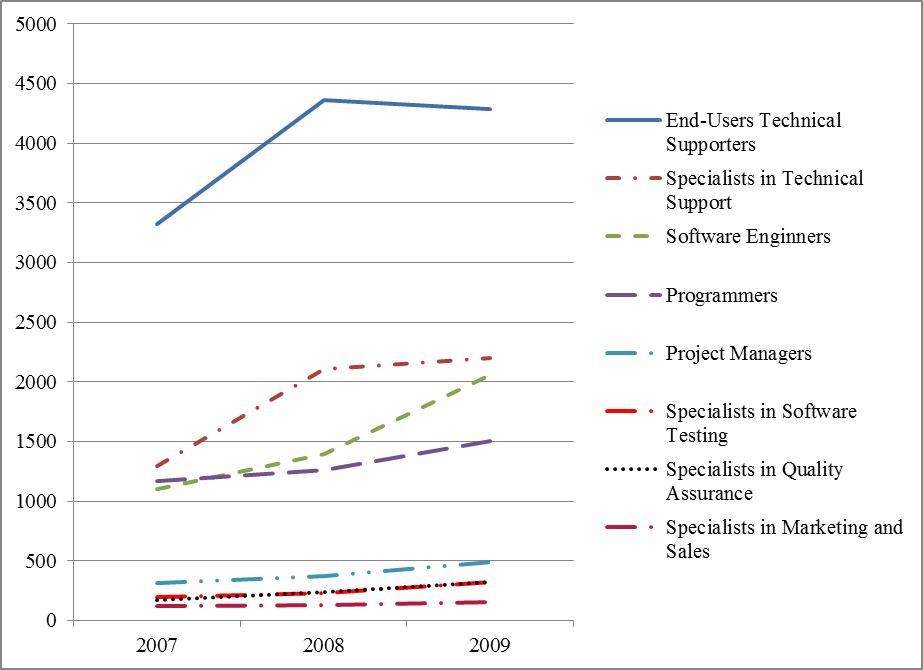
<body><![CDATA[</ol>      </ol>      <p style="margin-bottom: 0cm; line-height: 100%;" lang="en-US">  </p>      <p style="margin-bottom: 0cm; line-height: 100%;" align="justify" lang="en-US"> <font size="2" face="Verdana">In the year 2007, most of the ICT employees in the organizations surveyed were End-User Technical Supporters (43%), followed by Specialists in Technical Support (17%), Programmers (15%),  Software Engineers (14%), Project Managers (4%), Specialists in Software Testing (3%), Specialists in Quality Assurance (2%) and Specialists in Marketing and Sales of Software Services and Products (2%).</font></p>      <p style="margin-bottom: 0cm; line-height: 100%;" align="justify" lang="en-US">  </p>      <p style="margin-bottom: 0cm; line-height: 100%;" align="justify" lang="en-US"> <font size="2" face="Verdana"><a href="#f1">Figure 1</a> presents data on the demand for ICT workers, classified by the occupations studied, from the organizations surveyed.  Data for 2007 corresponds to actual figures, while data for 2008 and 2009 are estimations.  The growth for the occupations for the period 2007-2009 can be classified as <i>high</i> for the Specialists in Quality Assurance (92%), Software Engineers (86%), and Specialists in Technical Support  (70%), <i>medium</i> for the Specialists in Software Testing (62%) and Project Managers (56%) and l<i>ow</i> for the Specialists in Marketing and Sales (30%), End-User Technical Supporters (29%) and Programmers (29%).  From all the eight occupations, the only ones that show a reduction in growth from 2008 to 2009 are the End-User Technical Supporters (31% versus -2%) and Specialists in Technical Support (63% versus 4%).</font></p>      <p style="margin-bottom: 0cm; line-height: 100%;" align="justify" lang="en-US">  </p>      <p align="center"> <a name="f" href="/img/revistas/cleiej/v15n1/1a06f1.png"> <font size="2" face="Verdana">Figure 1: Actual (2007) and estimated (2008 and 2009) number of total employees by occupation </font> </a> </p>       <p style="margin-bottom: 0cm; line-height: 100%;" align="justify" lang="en-US">   <font size="2" face="Verdana">End-User Technical Supporters and Specialists in Technical Support account for more than 50% of the employees in the eight occupations for the years 2007, 2008 and 2009.  Furthermore, as <a href="#t1">Table 1</a> presents, the average number of employees in the organizations surveyed for this study is greater than the average observed in a previous study carried out in 2000 by Mata and Jofr&eacute; <a href="#r6">(6)</a>, particularly in the case of the previous two occupations (it is important to highlight that the two studies rely on different samples).  These facts indicate a notable change in the ICT occupational profile in Costa Rica: from software development, in 2000, to technical support, in 2007.</font></p>       <p align="center"> <font face="Verdana" size="2"> <a name="t1">Table 1: Average number of employees by occupations (2007 and 2000)    ]]></body>
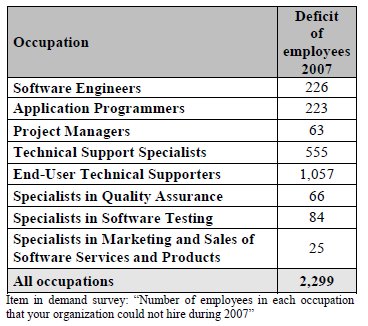
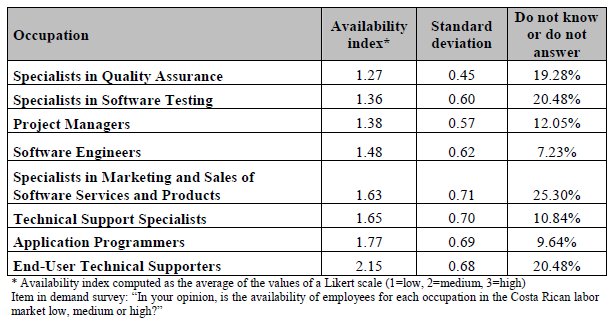
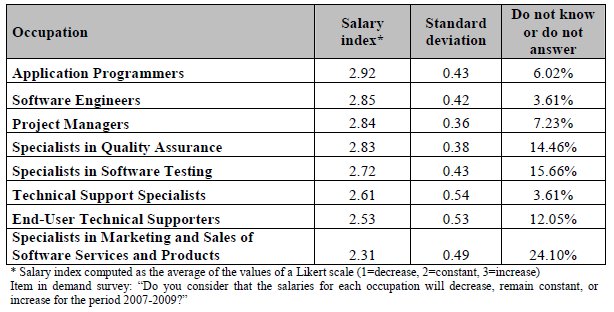
<body><![CDATA[<br>  <img src="/img/revistas/cleiej/v15n1/1a06t1.jpg"> </a> </font> </p>        <p style="margin-bottom: 0cm; line-height: 100%;" lang="en-US"> <font size="2" face="Verdana"><b>3.2 Tightness of the Labor Market</b></font></p>      <p style="margin-bottom: 0cm; line-height: 100%;" lang="en-US">  </p>      <p style="margin-bottom: 0cm; line-height: 100%;" align="justify" lang="en-US"> <font size="2" face="Verdana">As <a href="#t2">Table 2</a> shows, the organizations surveyed indicated that they were not able to hire 2,299 employees for the eight occupations in 2007.  This situation reveals a tight labor market in Costa Rica for the occupations considered, as there are more positions available than employees to fill them.</font></p>       <p align="center"> <font face="Verdana" size="2"> <a name="t2">Table 2:Deficit of employees in 2007     <br>  <img src="/img/revistas/cleiej/v15n1/1a06t2.jpg"> </a> </font> </p>         <p style="margin-bottom: 0cm; line-height: 100%;" align="justify" lang="en-US"> <font size="2" face="Verdana">In addition to the previously presented evidence, the organizations participating in this study expressed a generalized opinion that availability of employees was low for these occupations and that their salaries would likely increase over the next three years (2007-2009) (evidence of such situation had been already reported in the newspapers <a href="#c18">(18)</a><a name="c18."></a>, see Tables <a href="#t3">3</a> and <a href="#t4">4</a>).</font></p>       <p align="center"> <a name="t3" href="/img/revistas/cleiej/v15n1/1a06t3.jpg"> <font size="2" face="Verdana">Table 3: Perceived availability for occupations (2007-2009) </font> </a> </p>       <p align="center"> <a name="t4" href="/img/revistas/cleiej/v15n1/1a06t4.jpg"> <font size="2" face="Verdana">Table 4: Perceived situation of salaries for occupations (2007-2009)  </font> </a> </p>         <p style="margin-bottom: 0cm; line-height: 100%;" lang="en-US"> <font size="2" face="Verdana"><b>3.3 Academic Requirements for the Occupations</b></font></p>      ]]></body>
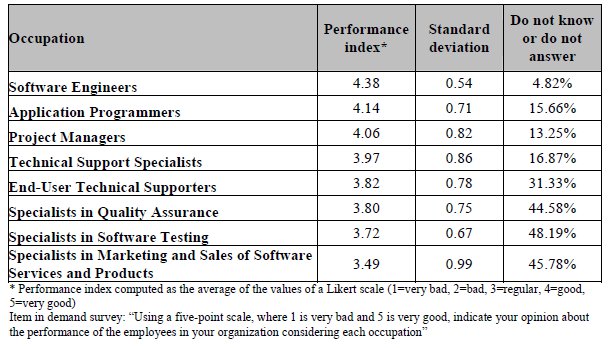
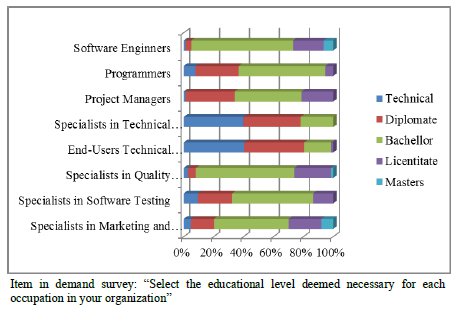
<body><![CDATA[<p style="margin-bottom: 0cm; line-height: 100%;" lang="en-US">  </p>      <p style="margin-bottom: 0cm; line-height: 100%;" align="justify" lang="en-US"> <font size="2" face="Verdana">The ideal degree for most occupations is a bachelor&rsquo;s degree, according to the organizations surveyed (see <a href="#f2">Figure 2</a>).  Exceptions are the case of the Project Managers &ndash; for which a licentiate degree (his degree is above the bachelor degree yet below the master) is mostly mentioned &ndash;, and Specialists in Technical Support and End-User Technical Supporters &ndash; which require more often a diplomate (as previously indicated, this degree can be considered equivalent to an associate degree in the U.S.) or a technical degree.</font></p>      <p style="margin-bottom: 0cm; line-height: 100%;" align="justify" lang="en-US">  </p>      <p align="center"> <a name="f2" href="/img/revistas/cleiej/v15n1/1a06f2.jpg"> <font size="2" face="Verdana">Figure 2: Ideal degree for the occupations  </font> </a> </p>        <p style="margin-bottom: 0cm; line-height: 100%;" align="justify" lang="en-US"> <font size="2" face="Verdana">The importance of the diplomate and technical degrees for the above-mentioned occupations represent a major difference between this study and the one previously carried out by Mata and Jofr&eacute; <a href="#r6">(6)</a>, which found that the bachelor degree was ideal for all the occupations considered.</font></p>      <p style="margin-bottom: 0cm; line-height: 100%;" align="justify" lang="en-US">  </p>      <p style="margin-bottom: 0cm; line-height: 100%;" lang="en-US"> <font size="2" face="Verdana"><b>3.4 Performance of Workers Classified by Occupations</b></font></p>      <p style="margin-bottom: 0cm; line-height: 100%;" lang="en-US">  </p>      <p style="margin-bottom: 0cm; line-height: 100%;" align="justify" lang="en-US"> <font size="2" face="Verdana">According to the organizations surveyed, Software Engineers, Programmers and Project Managers are perceived to have a performance above &ldquo;good&rdquo;, whereas the other occupations just have a performance above the &ldquo;regular&rdquo; level (see <a href="#t5">Table 5</a>).  This situation could be explained by the fact that profiles for the first occupations have been traditionally considered in educational programs in Costa Rica, particularly at the university level.</font></p>        <p align="center"> <font face="Verdana"> <a name="t5" href="/img/revistas/cleiej/v15n1/1a06t5.jpg"> <font size="2">Table 5:  Perceived performance for the occupations </font> </a> </font> </p>        ]]></body>
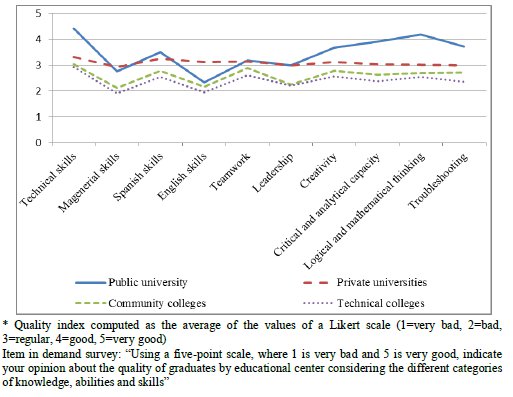
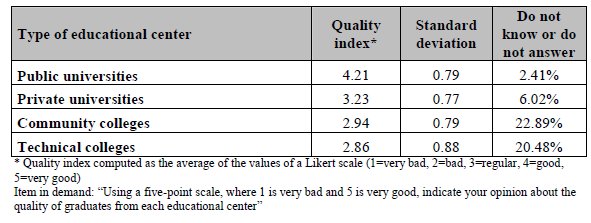
<body><![CDATA[<p style="margin-bottom: 0cm; line-height: 100%;" lang="en-US"> <font size="2" face="Verdana"><b>3.5 Educational Quality</b></font></p>      <p style="margin-bottom: 0cm; line-height: 100%;" lang="en-US">  </p>      <p style="margin-bottom: 0cm; line-height: 100%;" align="justify" lang="en-US"> <font size="2" face="Verdana">Educational quality was first evaluated by grouping educational centers into public universities, private universities, community colleges, and technical colleges.  According to these groups, the organizations surveyed perceived the quality of the public universities above the &ldquo;good&rdquo; level, whereas the quality of the private universities was deemed just above the &ldquo;regular&rdquo; mark.  On the other hand, the quality of the community colleges, which exclusively offer diplomate degrees, and of the technical colleges, which only grant technical degrees, were perceived below &ldquo;regular&rdquo; (see <a href="#t6">Table 6</a>).</font></p>       <p align="center"> <a name="t6" href="/img/revistas/cleiej/v15n1/1a06t6.jpg"> <font size="2" face="Verdana">Table 6: Perceived quality by type of educational center </font> </a> </p>        <p style="margin-bottom: 0cm; line-height: 100%;" align="justify" lang="en-US"> <font size="2" face="Verdana">In terms of knowledge, abilities and skills, public universities show higher values in all categories considered than private universities (above the &ldquo;regular&rdquo; level), except in English skills and managerial knowledge, abilities and skills (values both below &ldquo;regular&rdquo;), as depicted in <a href="#f3">Figure 3</a>.  These values are perceptions of the respondents, as in the previous case.  In particular, public universities excel in technical competences and logic and mathematical thinking (values above the &ldquo;good&rdquo; level).  Furthermore, public universities have better perceptions of quality than community and technical colleges for all the types of knowledge, abilities and skills considered.</font></p>       <p align="center"> <a name="f3" href="/img/revistas/cleiej/v15n1/1a06f3.jpg"> <font size="2" face="Verdana">Figure 3: Perceived quality by type of educational center considering categories of knowledge, abilities and skills </font> </a> </p>       <p style="margin-bottom: 0cm; line-height: 100%;" align="justify" lang="en-US"> <font size="2" face="Verdana">Private universities appear just above the &ldquo;regular&rdquo; level for all categories of knowledge, abilities and skills considered, yet they have values higher than community colleges, which in turn have values higher than technical colleges.  These two last types of educational centers have marks below &ldquo;regular&rdquo;.</font></p>      <p style="margin-bottom: 0cm; line-height: 100%;" align="justify" lang="en-US">  </p>      <p style="margin-bottom: 0cm; line-height: 100%;" align="justify" lang="en-US"> <font size="2" face="Verdana">When evaluating educational quality of centers individually, two public universities obtained marks above &ldquo;good&rdquo;. A group composed by the other two public universities, two private universities and a private para-academic institution were deemed moderately above &ldquo;regular&rdquo; Meanwhile, the remaining six private universities received values below &ldquo;regular" (due to the large number of educational centers in the country, only those granting more diplomas or which are better known were evaluated individually in terms of quality). </font> </p>      <p style="margin-bottom: 0cm; line-height: 100%;" align="justify" lang="en-US">  </p>      ]]></body>
<body><![CDATA[<p style="margin-bottom: 0cm; line-height: 100%;" align="justify" lang="en-US"> <font size="2" face="Verdana">These quality perceptions were related to the selection and recruitment processes of the organizations surveyed.  The higher the evaluation of quality of an individual center, the more its graduates were taken into account during these processes.  Therefore, in spite of the scarcity of human resources, the organizations surveyed are selective in their selection and recruitment processes and these processes seem to be influenced by the perceived quality of the educational centers.</font></p>      <p style="margin-bottom: 0cm; line-height: 100%;" lang="en-US">  </p>      <p style="margin-bottom: 0cm; line-height: 100%;" lang="en-US"> <font size="2" face="Verdana"><b>3.6 Supply of Degrees</b></font></p>      <p style="margin-bottom: 0cm; line-height: 100%;" lang="en-US">  </p>      <p style="margin-bottom: 0cm; line-height: 100%;" align="justify" lang="en-US"> <font size="2" face="Verdana">The ratio of private universities offering programs in computer sciences or informatics to public universities was almost 5 to 1 (19 versus 4) in 2007. However, between 1997 and 2006 public universities supplied 42% of total bachelor degrees, 19% of licentiate degrees and 69% of master degrees.  In the case of licentiate degrees from the public universities, there is evidence that it is being substituted by licentiate degrees from private universities o by master degrees, from both public and private universities.  In the case of diplomate degrees, public universities granted 47% of such degrees during 2004-2005, period for which there was information available for para-academic institutions.   Therefore, in addition to have better quality perceptions about their programs, public universities grant more academic degrees than private universities, and a similar number of diplomate degrees to community colleges.</font></p>      <p style="margin-bottom: 0cm; line-height: 100%;" lang="en-US">  </p>      <p style="margin-bottom: 0cm; line-height: 100%;" align="justify" lang="en-US"> <font size="2" face="Verdana"><a href="#t7">Table 7</a> presents forecasts for the supply of degrees for the years 2007, 2008 and 2009 using the data obtained from 1997 to 2006.  In the case of bachelor, licentiate and master degrees, linear regression models were used for such forecasts.  Due to limitations with the data for diplomate (ata for diplomate degrees were obtained for public universities from 1997 to 2006, yet only for 2004 and 2005 for community colleges, which contribute significantly to the total number of graduates with this degree) and technical degrees (data for technical degrees were obtained only for 2004, 2005 and 2006), averages were used as forecasts.</font></p>      <p align="center"> <a name="t7" href="/img/revistas/cleiej/v15n1/1a06t7.jpg"> <font size="2" face="Verdana">Table 7: Forecast and real supply of degrees for 2007, 2008 and 2009 </font> </a> </p>        <p style="margin-bottom: 0cm; line-height: 100%;" align="justify" lang="en-US"> <font size="2" face="Verdana">As this table shows, the educational system in Costa Rica was expected to supply a total of 2,611 graduates in ICT related careers in 2007, 2,734 in 2008, and 2,857 in 2009.  Given the fact that the 83 organizations surveyed indicated that there was a deficit of 2,299 employees in 2007 (see <a href="#t2">Table 2</a>), the educational system should at least double the supply of graduates that year to cover this deficit (this conclusion is based on the assumptions that all graduates for that year were hired and that other organizations not participating in the survey had also problems recruiting ICT employees)</font></p>      <p style="margin-bottom: 0cm; line-height: 100%;" align="justify" lang="en-US">  </p>      ]]></body>
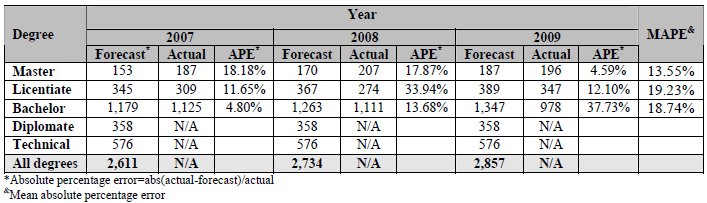
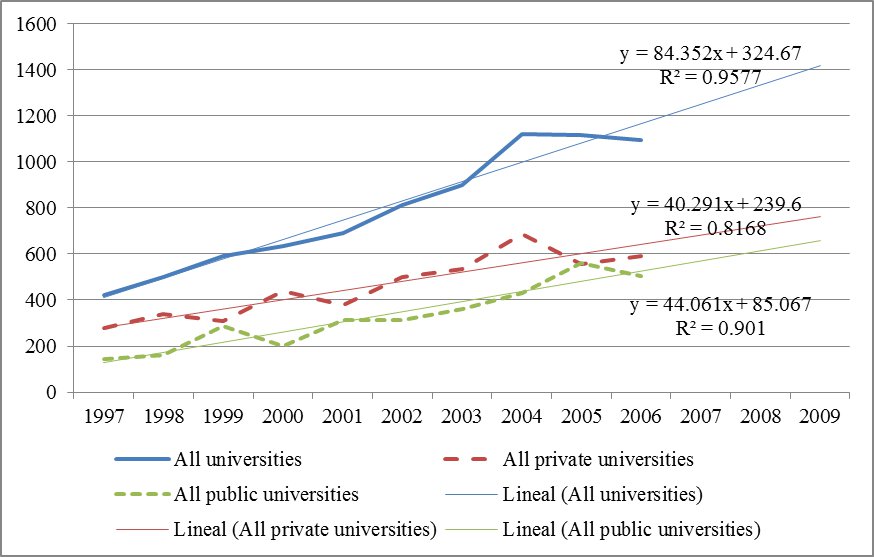
<body><![CDATA[<p style="margin-bottom: 0cm; line-height: 100%;" align="justify" lang="en-US"> <font size="2" face="Verdana">Actual values (actual data for 2007, 2008 and 2009 were obtained from CONARE and CONESUP in 2011, after the supply estimations were made) and forecast errors are presented in the same table for master, licentiate and bachelor degrees (actual data for diplomate and technical degrees were not available for 2007, 2008 and 2009).</font><sup><font size="2" face="Verdana">  </font></sup><font size="2" face="Verdana">These data show that the best forecast (13.55% mean absolute percentage error) was obtained for the master degree and the worst (19.23% mean absolute percentage error) for the licentiate degree.  Furthermore, the forecast values for the master degree series are consistently below the actual values for 2007, 2008 and 2009.  In contrast, the forecast values for the licentiate and bachelor series are above the real values for those years.  Therefore, supply is falling below expectations for academic degrees, except the master&acute;s.</font></p>      <p style="margin-bottom: 0cm; line-height: 100%;" lang="en-US">  </p>      <p style="margin-bottom: 0cm; line-height: 100%;" align="justify" lang="en-US"> <font size="2" face="Verdana">As mentioned in section 3.3, the bachelor degree is the most important for the ICT occupations considered.  <a href="#f4">Figure 4</a> shows the actual and estimated supply for this degree by public and private universities.  As depicted in this figure, public universities present a greater linear annual growth for bachelor degrees for the period from 1997 to 2006 (44 per year) than private universities (40 per year).  On the other hand, private universities show a large variability in the number of bachelor degrees across time compared to public universities, and individual data for the majority of private universities indicate a reduction in the number of bachelor degrees granted.  Considering the reduced number of public universities in the country and the high demand for the bachelor degree, the pressure on such degree is then passed to the public universities.</font></p>      <p style="margin-bottom: 0cm; line-height: 100%;" lang="en-US">  </p>     <p align="center"> <a name="f4" href="/img/revistas/cleiej/v15n1/1a06f4.jpg"> <font size="2" face="Verdana">Figure 4: Supply of bachellor degrees, including linear trends </font> </a> </p>       <p style="margin-bottom: 0cm; line-height: 100%;" lang="en-US"> <font size="2" face="Verdana"><b>3.7 Demand versus Supply</b></font></p>      <p style="margin-bottom: 0cm; line-height: 100%;" lang="en-US">  </p>      <p style="margin-bottom: 0cm; line-height: 100%;" align="justify" lang="en-US"> <font size="2" face="Verdana">The demand for ICT workers classified by occupations, stated by each organization surveyed, was converted into demand for academic degrees using the academic requirements for each occupation, indicated by the same organization (see section 3.3).  Although this procedure provides an easy way to compare demand with supply, it assumes that any degree from an educational center can be used to fill any occupation, which might not be valid in all cases.</font></p>      <p style="margin-bottom: 0cm; line-height: 100%;" align="justify" lang="en-US">  </p>      <p style="margin-bottom: 0cm; line-height: 100%;" align="justify" lang="en-US"> <font size="2" face="Verdana">By doing this conversion for the years 2008 and 2009, taking into consideration the estimations for the occupational demand obtained from the survey (see section 3.1) and the forecasts for the supply of degrees (see previous section), it is possible to obtain the expected utilization for a given degree &#9472;defined as the proportion of the demand for the degree to its supply.  As shown in <a href="#f5">Figure 5</a>, the utilization for 2008 is higher to 65% for the majority of degrees, with the exception of the master, whose utilization is just 19%.  In particular, the utilization of the diplomate degree for that year was expected to exceed 200% (this very large utilization is consistent with the deficit of Specialists in Technical Support and End-User Technical Supporters in the organizations surveyed (see section 3.2), for which the diplomate degree is important).  The large utilization of most of the degrees provides further evidence of the tightness in the labor market (see section 3.2), especially since the values for utilization only consider the demand of the 83 organizations that participated in the survey; however, it does take into account all the supply of degrees in the country.</font></p>       ]]></body>
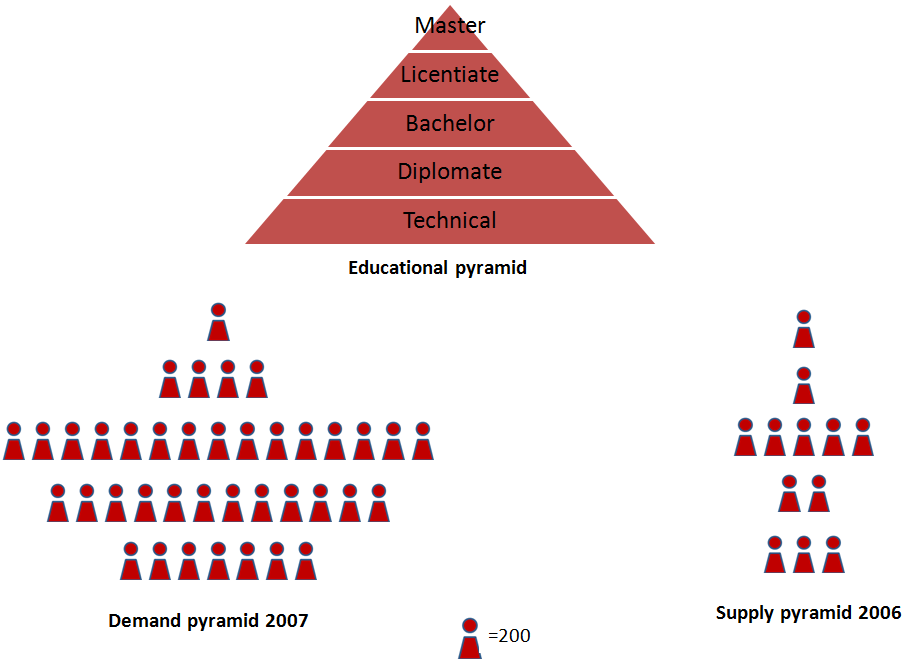
<body><![CDATA[<p align="center"> <a name="f5" href="/img/revistas/cleiej/v15n1/1a06f5.png"> <font size="2" face="Verdana">Figure 5: Expected utilization of degrees </font> </a> </p>       <p style="margin-bottom: 0cm; line-height: 100%;" align="justify" lang="en-US"> <font size="2" face="Verdana">Although the expected degree utilization was anticipated to decrease for the year 2009, as depicted in <a href="#f5">Figure 5</a>, it remained above 50% for the bachelor and licentiate degrees and above 30% for the master, only degree whose utilization increased from 2008 to 2009.  In the case of technical degrees, the expected utilization dramatically dropped to 2%, and it decreased to 38% in the case of the diplomate.  The drop observed for technical and diplomate degrees could be explained by the reduction in the growth rate from the year 2008 to 2009 in the demand for Specialists in Technical Support and End-User Technical Supporters, for which these degrees are particularly relevant (see section 3.3).</font></p>      <p style="margin-bottom: 0cm; line-height: 100%;" align="justify" lang="en-US">  </p>      <p style="margin-bottom: 0cm; line-height: 100%;" align="justify" lang="en-US"> <font size="2" face="Verdana"><a href="#f6">Figure 6</a> presents a graphical comparison of the demand of ICT human resources in 2007 and the supply of degrees in software development and technical support careers in 2006.  It is interesting to note that while the base of the pyramid for the 2007 demand is located between the bachelor and diplomate degrees, the base of the supply pyramid for 2006 is located exclusively at the bachelor degree.  This shows a mismatch between supply and demand in relation to the diplomate degree, which seems consistent with the high utilization for this degree in the year 2008, previously mentioned.  Given the scarcity of diplomate degrees in the labor market, it seems logical to presume that organizations tend to hire more persons than needed with a bachelor degree in order to fill positions requiring diplomate degrees.  This situation puts additional pressure on universities to graduate more bachelors, given the fact that they are the only educational centers authorized to grant such degrees.</font></p>      <p style="margin-bottom: 0cm; line-height: 100%;" align="justify" lang="en-US">  </p>       <p align="center"> <a name="f6" href="/img/revistas/cleiej/v15n1/1a06f6.png"> <font size="2" face="Verdana">Figure 6: Demand and supply pyramids (doctoral degrees are not yet offered in Costa Rica) </font> </a> </p>        <p style="margin-bottom: 0cm; line-height: 100%;" align="justify" lang="en-US"> <font size="2" face="Verdana">Metaphorically speaking, graduates with technical and diplomate degrees can be denoted as the &ldquo;digital infantry&rdquo; of the ICT industry.  This expression does not only coincide with the less time required to graduate them but also with the larger expected number of them, in comparison to the other degrees.  The fact that neither the technical nor the diplomate degree constitutes the base of the supply pyramid, might affect the opinion that the bachelor degree is the ideal for most of the occupations studied (see section 3.3).</font></p>      <p style="margin-bottom: 0cm; line-height: 100%;" align="justify" lang="en-US">  </p>  <ol start="4">  	    <li>         <p style="margin-bottom: 0cm; line-height: 100%;" lang="en-US"> 	<font size="2" face="Verdana"><b>Policy 	Recommendations</b></font></p>    </li>     ]]></body>
<body><![CDATA[</ol>      <p style="margin-bottom: 0cm; line-height: 100%;" lang="es-MX"> </p>      <p style="margin-bottom: 0cm; line-height: 100%;" align="justify" lang="en-US"> <font size="2" face="Verdana">With the aim of having more qualified human resources and taking into consideration the results of the demand and supply study, four strategic objectives and nine policies areas are proposed to improve the country&rsquo;s computer educational capacity and thus support the competitiveness of the Costa Rican ICT sector (see <a href="#f7">Figure 7</a>).  These objectives and policies are discussed below along with actions already taken towards them.</font></p>      <p style="margin-bottom: 0cm; line-height: 100%;" align="justify" lang="en-US">  </p>  <ol>  	   <ol>  		    <li>           <p style="margin-bottom: 0cm; line-height: 100%;" lang="en-US"> 		<font size="2" face="Verdana"><b>Strengthening 		of Technical and Para-academic Education</b></font></p>  	</li>       </ol>      </ol>      <p style="margin-bottom: 0cm; line-height: 100%;" lang="en-US">  </p>      <p style="margin-bottom: 0cm; line-height: 100%;" align="justify" lang="en-US"> <font size="2" face="Verdana">The strengthening of the technical and para-academic education is recommended with the purpose of balancing the demand with regard to the supply (see <a href="#f6">Figure 6</a>).  By doing so, the pressure on the bachelor degrees will be reduced, particularly from the public universities.  In addition, this objective could help to trickle-down the benefits of ICT to more disadvantaged socioeconomic sectors, since the time and financial resources required to obtain the technical and diplomate degrees are less than for the bachelor degree and also the entry requirements for such degrees are reduced.  To achieve this objective, the following policies are proposed to increase the number of diplomate graduates:</font></p>      ]]></body>
<body><![CDATA[<p style="margin-bottom: 0cm; line-height: 100%;" align="justify" lang="en-US">  </p>  <ul>  	    <li>         <p style="margin-bottom: 0cm; line-height: 100%;" align="justify" lang="en-US"> 	  <font size="2" face="Verdana"><i>Clarifying the 	role of the most recently created public university, the Universidad 	T&eacute;cnica Nacional (created in 2008)</i></font><sup><font size="2" face="Verdana"><i>,</i></font></sup><font size="2" face="Verdana"><i> 	which brought together several of the community colleges in the 	country granting diplomate degrees in computer education</i>. 	 In this regard, it is necessary that the community colleges that 	are part of this new university continue to offer diplomate degrees, 	and do not eliminate this degree in lieu of the bachelors, as other 	public universities have done in the past.  As of August 2011, the 	Universidad T&eacute;cnica Nacional still offers a diplomate in 	Information Technology.</font></p>    </li>     </ul>      <p align="center"> <a name="f7" href="/img/revistas/cleiej/v15n1/1a06f7.png"> <font size="2" face="Verdana">Figure 7: Objectives and policies for improving computer educational system in Costa Rica </font> </a> </p>   <ul>  	    <li>         <p style="margin-bottom: 0cm; line-height: 100%;" align="justify" lang="en-US"> 	  <font size="2" face="Verdana"><i>Promoting the 	creation of more para-academic and technical computer education 	centers and programs in the country, particularly private ones</i>. 	 The Costa Rica Specialist Program, launched in 2009 by the Costa 	Rican Association of ICT companies (CAMTIC) with several private 	universities as a pilot program to train ICT technicians, is a good 	example of this policy <a href="#c19">(19)</a><a name="c19."></a>.  One hundred and eighteen students 	graduated from this program at the beginning of 2011 <a href="#c20">(20)</a><a name="c20."></a>.</font></p>    </li>     </ul>      <p style="margin-bottom: 0cm; line-height: 100%;" align="justify" lang="en-US">  </p>  <ul>  	    <li>         ]]></body>
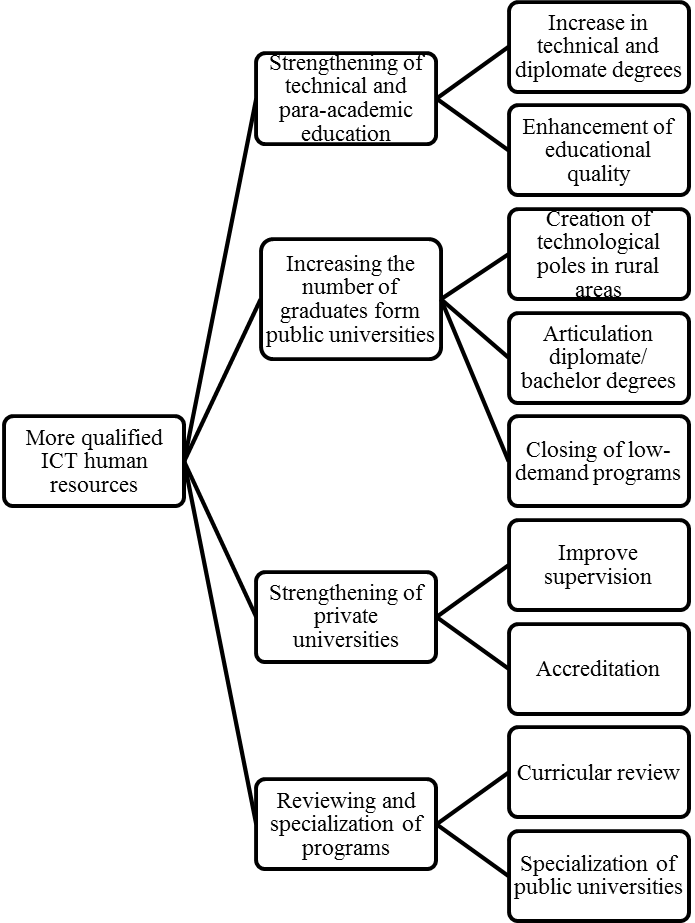
<body><![CDATA[<p style="margin-bottom: 0cm; line-height: 100%;" align="justify" lang="en-US"> 	  <font size="2" face="Verdana"><i>Creating 	diplomate degrees in public universities as lateral exits of 	bachelor degree programs</i>. 	 The Universidad Nacional de Costa Rica presents a good example of 	such option.  Discussions are underway between this university and 	the National Institute of Training (INA), organization in charge of 	technical education in the country, to jointly offer a diplomate 	program in computer programming based on the one currently offered 	by the Universidad Nacional. </font> 	</p>    </li>     </ul>      <p style="margin-bottom: 0cm; line-height: 100%;" align="justify" lang="en-US">  </p>      <p style="margin-bottom: 0cm; line-height: 100%;" align="justify" lang="en-US"> <font size="2" face="Verdana">Furthermore, to enhance the quality of the technical and para-academic education, the creation of programs for training trainers was proposed.  In this vein, the Universidad Nacional de Costa Rica offered in 2009 training courses to professors of the technical colleges, particularly focusing on programming and databases.</font></p>      <p style="margin-bottom: 0cm; line-height: 100%;" lang="en-US">  </p>      <p style="margin-bottom: 0cm; line-height: 100%;" lang="en-US"> <font size="2" face="Verdana"><b>4.2 Increasing the Number of Graduates in Public Universities</b></font></p>      <p style="margin-bottom: 0cm; line-height: 100%;" lang="en-US">  </p>      <p style="margin-bottom: 0cm; line-height: 100%;" align="justify" lang="en-US"> <font size="2" face="Verdana">While the perception in quality in private universities is improved and taking into consideration that organizations are selective in their personnel selection and recruitment processes, the increase in the number of graduates at the beginning should come primarily from the public universities.  To achieve this objective, the following policies are proposed:</font></p>      <p style="margin-bottom: 0cm; line-height: 100%;" align="justify" lang="en-US">  </p>  <ul>  	    <li>         ]]></body>
<body><![CDATA[<p style="margin-bottom: 0cm; line-height: 100%;" align="justify" lang="en-US"> 	  <font size="2" face="Verdana"><i>Creating 	technological poles in rural areas with the aim of taking advantage 	of benefits in infrastructure and budget capacities of the public 	universities in their regional campuses</i>. 	 All public universities have regional campuses which offer programs 	related to software development and technical support.  Given the 	fact that the admission of new students in computer science and 	informatics programs in the main campuses of the public universities 	seems to be constrained by the available infrastructure and budget, 	options should be explored to increase the admission in regional 	campuses.  The creation of technological poles in rural areas is one 	of such options.  This would allow having computer professionals in 	the regions as professors, solving in part the lack of qualified 	lecturers in the rural areas.  Furthermore, it will trickle-down the 	benefits of ICT to rural areas.  The case of the area of San Carlos, 	in conjunction with the Tecnol&oacute;gico de Costa Rica, provides a 	good example of how these technological poles could be developed.  	In this policy, however, the use of ICT is fundamental to avoid the 	immigration of graduates to the capital.  Therefore, ICT should be 	proactively used to link graduates, as well as new companies, in the 	rural zones to existing companies in the metropolitan areas.</font></p>    </li>     </ul>      <p style="margin-left: 1.5cm; margin-bottom: 0cm; line-height: 100%;" align="justify" lang="en-US">  </p>  <ul>  	    <li>         <p style="margin-bottom: 0cm; line-height: 100%;" align="justify" lang="en-US"> 	  <font size="2" face="Verdana"><i>Achieving a 	better articulation of the diplomate and bachelor degree programs, 	increasing the pipeline of bachelor students in the public 	universities</i>. 	 To achieve this goal, it is necessary to develop diplomate programs 	that effectively articulate with the bachelor degree.  An example of 	this process is provided by Mata <i>et 	al.</i> 	<a href="#c21">(21)</a><a name="c21."></a>, in which first-level courses in the bachelor program are 	shared with the diplomate.  The joint project to offer a diplomate 	program in computer programming by the Universidad Nacional de Costa 	Rica and the INA, discussed in the previous objective, is another 	example of how articulation mechanisms between the para-academic and 	academic education can be achieved.  Graduates from this program 	might be able to continue studying the bachelor degree in this 	university.</font></p>    </li>     </ul>      <p style="margin-bottom: 0cm; line-height: 100%;" align="justify" lang="en-US">  </p>  <ul>  	    <li>         <p style="margin-bottom: 0cm; line-height: 100%;" align="justify" lang="en-US"> 	  <font size="2" face="Verdana"><i>Closing 	low-demand programs and re-orienting the use of the resources 	allocated to them to higher demand degrees</i>. 	 A good example is licentiate programs in public universities, which 	have master programs related to the bachelor degree.  This is 	justified by the substitution process of the licentiate degrees in 	public universities, previously mentioned.  By closing such 	licentiate programs, existing resources could be channeled to 	bachelor programs, which have greater demand.  A related example is 	provided by the Universidad Nacional de Costa Rica, which decided in 	2011 to close its program in Educational Informatics due to its low 	demand, and reoriented its allocated resources to its Systems 	Engineering program, increasing the admission for new students from 	180 in 2011 to 300 for 2012.</font></p>    </li>     </ul>      ]]></body>
<body><![CDATA[<p style="margin-bottom: 0cm; line-height: 100%;" lang="en-US">  </p>  <ol start="4">  	   <ol start="3">  		    <li>           <p style="margin-bottom: 0cm; line-height: 100%;" lang="en-US"> 		 <font size="2" face="Verdana"><b>Strengthening</b><span lang="es-MX"><b> 		of Pr&iacute;vate</b></span><b> 		Universities</b></font></p>  	</li>       </ol>      </ol>      <p style="margin-bottom: 0cm; line-height: 100%;" lang="es-MX">  </p>      <p style="margin-bottom: 0cm; line-height: 100%;" align="justify" lang="en-US"> <font size="2" face="Verdana">To improve the perception of quality of private universities, and thus increasing the base for selecting and recruiting ICT graduates from Costa Rican organizations, the following policies are proposed:</font></p>      <p style="margin-bottom: 0cm; line-height: 100%;" align="justify" lang="en-US">   </p>  <ul>  	    <li>         <p style="margin-bottom: 0cm; line-height: 100%;" align="justify" lang="en-US"> 	   <font size="2" face="Verdana"><i>Improving the 	supervision of private universities, clearly defining and 	strengthening the role of the National Council of Private 	Higher-Education (CONESUP).</i></font></p>    </li>     ]]></body>
<body><![CDATA[</ul>      <p style="margin-left: 1.5cm; margin-bottom: 0cm; line-height: 100%;" align="justify" lang="en-US">  </p>  <ul>  	    <li>         <p style="margin-bottom: 0cm; line-height: 100%;" align="justify" lang="en-US"> 	   <font size="2" face="Verdana"><i>Fostering 	accreditation processes by private universities as a mechanism to 	assure quality in the computer education programs, and in doing so, 	establishing quality requirements which are internationally 	accepted</i>. 	 As of August 2011, only five universities in the country, three 	public and two private, have accredited computer science and 	informatics programs by the National System of Accreditation 	(SINAES).</font></p>    </li>     </ul>      <p style="margin-bottom: 0cm; line-height: 100%;" lang="en-US"> </p>      <p style="margin-bottom: 0cm; line-height: 100%;" lang="en-US"> <font size="2" face="Verdana"><b>4.4 Reviewing and Specialization of Programs</b></font></p>      <p style="margin-bottom: 0cm; line-height: 100%;" lang="en-US">  </p>      <p style="margin-right: 0.35cm; margin-bottom: 0cm; line-height: 100%;" align="justify" lang="en-US"> <font size="2" face="Verdana">The previous policies should be accompanied by an assessment of the existing educational programs <i>vis-&agrave;-vis</i> the competences required for the different occupations and programs available in other educational centers.  With this aim, the following policies are recommended:</font></p>      <p style="margin-right: 0.35cm; margin-bottom: 0cm; line-height: 100%;" align="justify" lang="en-US">  </p>  <ul>  	    ]]></body>
<body><![CDATA[<li>         <p style="margin-bottom: 0cm; line-height: 100%;" align="justify" lang="en-US"> 	  <font size="2" face="Verdana"><i>Conducting a 	curricular review of existing programs to obtain a better match 	between such programs and the needs of the organizations and to 	update knowledge areas and strengthen abilities and skills due to 	new technological developments</i>. 	 As part of this process, new educational programs might be devised, 	particularly focusing on occupations that have demand yet are not 	well embraced in existing programs, for example Specialists in 	Software Testing (see sections 3.1 and 3.4).  It is important to 	mention that the proposed curricular review should not be guided 	only by industry considerations; suggestions and recommendations 	from professional organizations, such as the ACM or the IEEE, and 	the academic community should also be considered.</font></p>    </li>     </ul>      <p style="margin-bottom: 0cm; line-height: 100%;" align="justify" lang="en-US">  </p>  <ul>  	    <li>         <p style="margin-bottom: 0cm; line-height: 100%;" align="justify" lang="en-US"> 	  <font size="2" face="Verdana"><i>Specializing 	educational programs in public universities to certain occupations.</i> 	 This policy would favor a better use of public funds, as well as 	foster collaboration, instead of competition, among public 	universities.  Nevertheless this policy requires first establishing 	coordination mechanisms within the framework of the National Council 	of Rectors (CONARE) (this organization coordinates the activities of 	the public universities in Costa Rica).</font></p>    </li>     </ul>      <p style="margin-bottom: 0cm; line-height: 100%;" lang="en-US">  </p>  <ol start="4">  	    <li>         <p style="margin-bottom: 0cm; line-height: 100%;" lang="en-US"> 	 <font size="2" face="Verdana"><b>Conclusions</b></font></p>    </li>     ]]></body>
<body><![CDATA[</ol>      <p style="margin-bottom: 0cm; line-height: 100%;" lang="es-MX">  </p>      <p style="margin-bottom: 0cm; line-height: 100%;" align="justify" lang="en-US"> <font size="2" face="Verdana">The demand and supply study found that there is a notable change in the ICT occupational profile in Costa Rica, from software development in 2000 to technical support in 2007.  This situation is the result of the establishment of subsidiaries of MNCs in the country, particularly those operating technical support contact centers.  This situation requires analysis of the existing computer curricula in the country, since traditionally they have been focused towards software careers such as Software Engineers, Applications Programmers and Project Managers.  For this reason, policies are proposed for reviewing and specializing curricula, particularly in public universities.</font></p>      <p style="margin-bottom: 0cm; line-height: 100%;" align="justify" lang="en-US">  </p>      <p style="margin-bottom: 0cm; line-height: 100%;" align="justify" lang="en-US"> <font size="2" face="Verdana">Furthermore, this study provides evidence of a tight market labor in Costa Rica for the ICT occupations considered.  This situation is the result of a greater growth in demand than in supply for these occupations.  Such condition is worsened by differences in the perception of quality for different types of educational centers in the country, which appears to influence the selection and recruitment processes of the organizations.</font></p>      <p style="margin-bottom: 0cm; line-height: 100%;" align="justify" lang="en-US">  </p>      <p style="margin-bottom: 0cm; line-height: 100%;" align="justify" lang="en-US"> <font size="2" face="Verdana">A tight labor market in the ICT sector is likely to continue as long as MNCs establish new ICT operations and broaden existing ones in Costa Rica, which is the result of government policies focused towards an aggressive foreign direct investment attraction strategy <a href="#r4">(4)</a>.  This assumption is supported by a recent presentation of the Costa Rican Investment Promotion Agency (CINDE), which indicates that the demand for ICT human resources is likely to grow for the MNCs established in the country <a href="#c22">(22)</a><a name="c22."></a>.</font></p>      <p style="margin-bottom: 0cm; line-height: 100%;" align="justify" lang="en-US">  </p>      <p style="margin-bottom: 0cm; line-height: 100%;" align="justify" lang="en-US"> <font size="2" face="Verdana">To ameliorate the deficit, an increase in the number of graduates is necessary.  Policies are proposed to increase the number of graduates in public universities, like creating technological poles in rural areas, articulating diplomate and bachelor programs, and closing low-demand programs.  Furthermore, due to the perception of higher quality of public universities and the apparent preference by organizations of graduates from these educational centers, it is necessary to strengthen private universities and technical and para-academic education.  In this regard, policies related to improving supervision and to conducting accreditation processes are proposed, in the case of the private universities, and to increasing the number of diplomate and technical degrees and to enhancing educational quality in technical and para-academic institutions are proposed, in the case of community and technical colleges. </font> </p>      <p style="margin-bottom: 0cm; line-height: 100%;" align="justify" lang="en-US">  </p>      ]]></body>
<body><![CDATA[<p style="margin-bottom: 0cm; line-height: 100%;" align="justify" lang="en-US"> <font size="2" face="Verdana">Although there is preference in the labor market for graduates with a bachelor degree, there is also evidence that organizations are beginning to consider diplomate and technical degrees.  This is a major difference with the previous demand and supply study conducted by Mata and Jofr&eacute; <a href="#c6">(6)</a>.  However, the supply of diplomate and technical degrees is low and the perception of quality of community and technical colleges that offer them is also low.  Therefore, policies are proposed to strengthen technical and para-academic education in the country.  Such policies are expected to contribute to balance the supply pyramid, and in doing so, pressure will be released from the universities, particularly the public ones, which at the time of conducting the study seem to bear most of the burden of keeping up with the demand.</font></p>      <p style="margin-bottom: 0cm; line-height: 100%;" align="justify" lang="en-US">  </p>      <p style="margin-bottom: 0cm; line-height: 100%;" align="justify" lang="en-US"> <font size="2" face="Verdana">Software Engineers, Applications Managers and Project Managers are perceived in this study as the occupations with better performance.  This reinforces the need for conducting a curricular review in order to ensure that knowledge, abilities and skills necessary for other occupations are also embraced in the educational programs.</font></p>      <p style="margin-bottom: 0cm; line-height: 100%;" align="justify" lang="en-US">  </p>      <p style="margin-bottom: 0cm; line-height: 100%;" align="justify" lang="en-US"> <font size="2" face="Verdana">Even though some actions have been taken by several stakeholders in support of the proposed policies, the lack of a national coordination mechanism makes it difficult to implement a national plan to increase the number of qualified ICT human resources in Costa Rica.  The participation of the government is essential in this regard.  As the United Nations Economic and Social Commission for Asia and the Pacific (UNESCAP) indicates in its report on human resources development for information technology <a href="#c23">(23)</a><a name="c23."></a>: &ldquo;The construction of the information society &hellip; cannot be done without active governmental involvement in the creation of an information infrastructure and the reformation of the education system.  In particular, human resources development (HRD) is seen throughout the world as crucial to the development of information-based economies and the achievement of global competitiveness&rdquo; (p. 18).</font></p>      <p style="margin-bottom: 0cm; line-height: 100%;" align="justify" lang="en-US">  </p>      <p style="margin-bottom: 0cm; line-height: 100%;" align="justify" lang="en-US"> <font size="2" face="Verdana">Finally, to track differences in the demand and supply patters across time, it is necessary to conduct similar studies periodically.  Nevertheless resources are needed to do so.  This study was possible due to funding from the International Development Research Centre (IDRC) of Canada.  The previous study <a href="#c6">(6)</a> was undertaken with financial assistance from the Inter-American Development Bank (IADB).</font></p>      <p style="margin-bottom: 0cm; line-height: 100%;" align="justify" lang="en-US">  </p>      <p style="margin-bottom: 0cm; line-height: 100%;" lang="en-US"> <font size="2" face="Verdana"><b>Acknowledgements</b></font></p>      <p style="margin-bottom: 0cm; line-height: 100%;" lang="en-US">  </p>      ]]></body>
<body><![CDATA[<p style="margin-bottom: 0cm; line-height: 100%;" align="justify" lang="en-US"> <font size="2" face="Verdana">This research was possible thanks to a grant from the Latin American Faculty in Social Sciences (FLACSO-Mexico) and the International Development Research Centre (IDRC) of Canada.  We also thank Ariella Quesada for her support.</font></p>      <p style="margin-bottom: 0cm; line-height: 100%;" lang="en-US">  </p>      <p style="margin-bottom: 0cm; line-height: 100%;" lang="es-CR"> <font size="2" face="Verdana"><b>References</b></font></p>      <p style="margin-bottom: 0cm; line-height: 100%;" lang="es-CR">  </p>      <!-- ref --><p style="margin-left: 0.75cm; text-indent: -0.75cm; margin-bottom: 0cm; line-height: 100%;" align="justify" lang="en-US"> <font size="2" face="Verdana"><span lang="es-CR"><a name="c1"></a><a href="#c1.">(1)</a>	La Naci&oacute;n, <i>Trece Nuevas Empresas se Instalan Aqu&iacute;, </i>San Jos&eacute;, Costa Rica, newspaper article, 25 July 2007. </span></font><font color="#0000ff"><u><a class="western" href="http://www.nacion.com/ln_ee/2007/julio/25/%20economia1179219.html"> <font size="2" face="Verdana"><span lang="es-CR">http://www.nacion.com/ln_ee/2007/julio/25/ economia1179219.html</span></font></a></u></font><p style="margin-left: 0.75cm; text-indent: -0.75cm; margin-bottom: 0cm; line-height: 100%;" align="justify" lang="es-CR">  </p>      <!-- ref --><p style="margin-left: 0.75cm; text-indent: -0.75cm; margin-bottom: 0cm; line-height: 100%;" align="justify" lang="en-US"> <font size="2" face="Verdana"><span lang="es-CR"><a name="c2"></a>(<a href="#c2.">2</a>)	La Prensa Libre, <i>Empresas de Tecnolog&iacute;a Enfrentan Carencia de Recurso Humano, </i>San Jos&eacute;, Costa Rica, newspaper article, 13 July 2007, p. 10.    </span></font></p>      <p style="margin-left: 0.75cm; text-indent: -0.75cm; margin-bottom: 0cm; line-height: 100%;" align="justify" lang="es-CR">  </p>      <!-- ref --><p style="margin-left: 0.75cm; text-indent: -0.75cm; margin-bottom: 0cm; line-height: 100%;" align="justify" lang="en-US"> <font size="2" face="Verdana"><span lang="es-CR"><a name="c3"></a>(<a href="#c3.">3</a>)	La Rep&uacute;blica, <i>Industria del Software Necesita M&aacute;s Personal para Crecer, </i>San Jos&eacute;, Costa Rica, newspaper article, 31 July 2007, pp. 10-11.    </span></font></p>      <p style="margin-left: 0.75cm; text-indent: -0.75cm; margin-bottom: 0cm; line-height: 100%;" align="justify" lang="es-CR">  </p>      <p style="margin-left: 0.75cm; text-indent: -0.75cm; margin-bottom: 0cm; line-height: 100%;" align="justify" lang="en-US"> <font size="2" face="Verdana"><a name="c4"></a>(<a href="#c4.">4</a>)	F.J. Mata and G. Mata Mar&iacute;n, &ldquo;Foreign Direct Investment and the ICT Cluster in Costa Rica: Chronicle of a Death Foretold?, in <i>Proc. Sixth international Conference 2008 of the Global Network for the Economics of Learning, Innovation and Competence Building Systems (Globelics), </i>Mexico, D.F., Mexico, 2008.</font></p>      <p style="margin-left: 0.65cm; text-indent: 0.1cm; margin-bottom: 0cm; line-height: 100%;" align="justify" lang="en-US"> <font color="#0000ff"><u><a class="western" href="http://smartech.gatech.edu/bitstream/handle/1853/36914/Francisco_Mata_Foreign_Direct.pdf?sequence=1"> <font size="2" face="Verdana">http://smartech.gatech.edu/bitstream/handle/1853/36914/Francisco_Mata_Foreign_Direct.pdf?sequence=1</font></a></u></font></p>      <p style="margin-left: 0.75cm; text-indent: -0.75cm; margin-bottom: 0cm; line-height: 100%;" align="justify" lang="en-US">  </p>      <p style="margin-left: 0.75cm; margin-right: 0.35cm; text-indent: -0.75cm; margin-bottom: 0cm; line-height: 100%;" align="justify" lang="en-US"> <font size="2" face="Verdana" color="#000000"><span lang="es-CR"><a name="c5"></a>(<a href="#c5.">5</a>)</span></font><font size="2" face="Verdana" color="#000000"><span lang="es-CR"> R. Herrera, F. Mata, R. Matarrita, I. Salas, and E. Jara, </span></font> <font size="2" face="Verdana" color="#000000"><span lang="es-CR"><i>Formaci&oacute;n de Capital Humano en el Sector TIC en Costa Rica. </i></span></font> <font size="2" face="Verdana" color="#000000"><span lang="es-CR">Mexico: FLACSO Mexico-Centro Internacional de Investigaciones para el Desarrollo</span></font><font size="2" face="Verdana" color="#000000"><span lang="es-CR"><i>,</i></span></font><font size="2" face="Verdana" color="#000000"><span lang="es-CR"> 2009.</span></font></p>      <p style="margin-left: 0.75cm; margin-right: 0.35cm; text-indent: -0.75cm; margin-bottom: 0cm; line-height: 100%;" lang="en-US"> <font color="#0000ff"><u><a class="western" href="http://idl-bnc.idrc.ca/dspace/handle/10625/46111"> <font size="2" face="Verdana"><span lang="es-CR">http://idl-bnc.idrc.ca/dspace/handle/10625/46111</span></font></a></u></font></p>      <p style="margin-left: 0.75cm; text-indent: -0.75cm; margin-bottom: 0cm; line-height: 100%;" align="justify" lang="es-CR">  </p>      <p style="margin-left: 0.75cm; text-indent: -0.75cm; margin-bottom: 0cm; line-height: 100%;" align="justify" lang="en-US"> <font size="2" face="Verdana"><span lang="es-CR"><a name="c6"></a>(<a href="#c6.">6</a>)	F.J. Mata and A. Jofr&eacute;,  </span><span lang="es-MX"><i>Informe Final Estudio de Oferta y Demanda del Recurso Humano</i>, </span></font> <font size="2" face="Verdana" color="#000000"><span lang="es-CR">Programa de Apoyo a la Competitividad del Sector de Desarrollo de Software de Costa Rica (PROSOFTWARE)</span></font><font size="2" face="Verdana"><span lang="es-MX">, San Jos&eacute;, Costa Rica, Tech. </span>Rep., 2001.</font></p>      <p style="margin-left: 0.75cm; text-indent: -0.75cm; margin-bottom: 0cm; line-height: 100%;" align="justify" lang="en-US"> <font color="#0000ff"><u><a class="western" href="http://www.camtic.org/ES/phtml/descargarDoc.phtml?arc=EE_002.pdf%7C47.pb.arc.241.pdf"> <font size="2" face="Verdana">http://www.camtic.org/ES/phtml/descargarDoc.phtml?arc=EE_002.pdf|47.pb.arc.241.pdf</font></a></u></font></p>      ]]></body>
<body><![CDATA[<p style="margin-left: 0.75cm; text-indent: -0.75cm; margin-bottom: 0cm; line-height: 100%;" align="justify" lang="en-US">  </p>      <p style="margin-left: 0.75cm; text-indent: -0.75cm; margin-bottom: 0cm; line-height: 100%;" align="justify" lang="en-US"> <font size="2" face="Verdana"><span lang="es-MX"><a name="c7"></a><a href="#c7.">(7</a>)	F.J. </span><span lang="es-CR">Mata, R. Matarrita, and E. Araya, &ldquo;Idoneidad del Recurso Humano para la Industria de Desarrollo de Software de Costa Rica: Metodolog&iacute;a y Resultados del Estudio para el Fortalecimiento de los Centros de Ense&ntilde;anza y la Actualizaci&oacute;n Curricular,&rdquo; in <i>Proc. XII Jornadas Chilenas de Computaci&oacute;n</i> <i>y VI Congreso Chileno de Educaci&oacute;n Superior en Computaci&oacute;n,</i> Arica, Chile, 2004.</span></font></p>      <p style="margin-left: 0.75cm; margin-right: 0.35cm; text-indent: -0.75cm; margin-bottom: 0cm; line-height: 100%;" align="justify" lang="es-CR">  </p>      <p style="margin-left: 0.75cm; text-indent: -0.75cm; margin-bottom: 0cm;" align="justify" lang="en-US"> <font size="2" face="Verdana"><span lang="es-ES"><a name="c8"></a>(<a href="#c8.">8</a>)	F.J. Mata, R. Matarrita Bacc&aacute;, and E., Araya, &ldquo;Estudio de Fortalecimiento de los Centros de Ense&ntilde;anza en Computaci&oacute;n e Inform&aacute;tica y la Actualizaci&oacute;n Curricular: Perfil  de Desempe&ntilde;o Ocupacional y Perfil Acad&eacute;mico Profesional para los Ingenieros de Sistemas/Analistas y Dise&ntilde;adores de Sistemas&rdquo;<i>, </i>Programa de Apoyo a la Competitividad del Sector de Desarrollo de Software de Costa Rica (PROSOFTWARE), San Jos&eacute;, Costa Rica, Tech. </span>Rep., 2003.</font></p>      <p style="margin-left: 1.27cm; text-indent: -0.52cm; margin-bottom: 0.35cm;" align="justify" lang="en-US"> <font color="#0000ff"><u><a class="western" href="http://www.camtic.org/ES/caprosoft/material/ANALISTAS%20Y%20DISE%D1ADORES.zip"> <font size="2" face="Verdana">http://www.camtic.org/ES/caprosoft/material/ANALISTAS%20Y%20DISE%D1ADORES.zip</font></a></u></font><font size="2" face="Verdana"> </font> </p>      <p style="margin-left: 0.75cm; text-indent: -0.75cm; margin-bottom: 0cm;" align="justify" lang="en-US"> <font size="2" face="Verdana"><span lang="es-ES"><a name="c9"></a>(<a href="#c9.">9</a>)	F.J. Mata, R., Matarrita Bacc&aacute;, and E., Araya, &ldquo;Estudio de Fortalecimiento de los Centros de Ense&ntilde;anza en Computaci&oacute;n e Inform&aacute;tica y la Actualizaci&oacute;n Curricular: Perfil de Desempe&ntilde;o Ocupacional y Perfil Acad&eacute;mico Profesional para los Programadores de Aplicaciones,&rdquo;<i> </i>Programa de Apoyo a la Competitividad del Sector de Desarrollo de Software de Costa Rica (PROSOFTWARE), San Jos&eacute;, Costa Rica, Tech. Rep., 2003.</span></font></p>      <p style="margin-left: 1.27cm; text-indent: -0.52cm; margin-bottom: 0.35cm;" align="justify" lang="en-US"> <font color="#0000ff"><u><a class="western" href="http://www.camtic.org/ES/caprosoft/material/PROGRAMADORES.zip"> <font size="2" face="Verdana"><span lang="es-ES">http://www.camtic.org/ES/caprosoft/material/PROGRAMADORES.zip</span></font></a></u></font><font size="2" face="Verdana"><span lang="es-ES"> </span></font> </p>      <p style="margin-left: 0.75cm; text-indent: -0.75cm; margin-bottom: 0cm;" align="justify" lang="en-US"> <font size="2" face="Verdana"><span lang="es-ES"><a name="c10"></a>(<a href="#c10.">10)</a>	F.J. Mata, R., Matarrita Bacc&aacute;, and E., Araya, &ldquo;Estudio de Fortalecimiento de los Centros de Ense&ntilde;anza en Computaci&oacute;n e Inform&aacute;tica y la Actualizaci&oacute;n Curricular: Perfil de Desempe&ntilde;o Ocupacional y Perfil Acad&eacute;mico Profesional para los Especialistas en Mercadeo y Ventas de Software,&rdquo; Programa de Apoyo a la Competitividad del Sector de Desarrollo de Software de Costa Rica (PROSOFTWARE), San Jos&eacute;, Costa Rica, Tech. </span>Rep., 2003.</font></p>      <p style="margin-left: 1.27cm; text-indent: -0.52cm; margin-bottom: 0.35cm;" align="justify" lang="en-US"> <font color="#0000ff"><u><a class="western" href="http://www.camtic.org/ES/caprosoft/material/ESPECIALISTA%20MERCADEO.zip"> <font size="2" face="Verdana">http://www.camtic.org/ES/caprosoft/material/ESPECIALISTA%20MERCADEO.zip</font></a></u></font><font size="2" face="Verdana"> </font> </p>      <p style="margin-left: 0.75cm; text-indent: -0.75cm; margin-bottom: 0cm; line-height: 100%;" align="justify" lang="es-ES"> <font size="2" face="Verdana"><span style="font-weight: normal;"><a name="c11"></a>(<a href="#c11.">11</a>)	E. Araya, E., R. Matarrita Bacc&aacute;, and F.J. Mata, &ldquo;Estudio de Fortalecimiento de los Centros de Ense&ntilde;anza en Computaci&oacute;n e Inform&aacute;tica y la Actualizaci&oacute;n Curricular: Perfil de Desempe&ntilde;o Ocupacional y Perfil Acad&eacute;mico Profesional para los Administradores de Proyectos de Desarrollo de Software,&rdquo;</span><i><span style="font-weight: normal;"> </span></i><span style="font-weight: normal;">Programa de Apoyo a la Competitividad del Sector de Desarrollo de Software de Costa Rica (PROSOFTWARE), San Jos&eacute;, Costa Rica,</span><span style="font-weight: normal;" lang="es-ES"> </span><span style="font-weight: normal;">Tech. Rep., </span><span style="font-weight: normal;" lang="en-US">2003.</span></font></p>      ]]></body>
<body><![CDATA[<p style="margin-left: 1.25cm; text-indent: -0.5cm; margin-bottom: 0cm; line-height: 100%;" align="justify" lang="es-ES"> <font size="5" face="Verdana"><b><font color="#0000ff"><u><a class="western" href="http://www.camtic.org/ES/caprosoft/material/ADMINISTRADORES%20DE%20PROYECTOS.zip"><font size="2">http://www.camtic.org/ES/caprosoft/material/ADMINISTRADORES%20DE%20PROYECTOS.zip</font></a></u></font></b><font size="2"><span style="font-weight: normal;"> </span></font></font> </p>      <p style="margin-left: 1.25cm; text-indent: -1.25cm; margin-bottom: 0cm; font-weight: normal; line-height: 100%;" align="justify" lang="es-ES">  </p>      <p style="margin-left: 0.75cm; text-indent: -0.75cm; margin-bottom: 0cm; line-height: 100%;" align="justify" lang="es-ES"> <font size="2" face="Verdana"><span style="font-weight: normal;"><a name="c12"></a>(<a href="#c12.">12</a>)	E. Araya, R., Matarrita Bacc&aacute;, and F.J. Mata, &ldquo;Estudio de Fortalecimiento de los Centros de Ense&ntilde;anza en Computaci&oacute;n e Inform&aacute;tica y la Actualizaci&oacute;n Curricular: Perfil de Desempe&ntilde;o Ocupacional y Perfil Acad&eacute;mico Profesional para los Especialistas en Soporte T&eacute;cnico,&rdquo; Programa de Apoyo a la Competitividad del Sector de Desarrollo de Software de Costa Rica (PROSOFTWARE), San Jos&eacute;, Costa Rica, Tech. Rep., </span><span style="font-weight: normal;" lang="en-US">2003.</span></font></p>      <p style="margin-left: 1.25cm; text-indent: -0.5cm; margin-bottom: 0cm; line-height: 100%;" align="justify" lang="es-ES"> <font size="5" face="Verdana"><b><font color="#0000ff"><u><a class="western" href="http://www.camtic.org/ES/caprosoft/material/ESPEC-SOPORTE%20TECNICO.zip"><font size="2"><span lang="en-US">http://www.camtic.org/ES/caprosoft/material/ESPEC-SOPORTE%20TECNICO.zip</span></font></a></u></font></b><font size="2"><span style="font-weight: normal;" lang="en-US"> </span></font></font> </p>      <p style="margin-left: 1.25cm; text-indent: -1.25cm; margin-bottom: 0cm; font-weight: normal; line-height: 100%;" align="justify" lang="en-US">  </p>      <p style="margin-left: 0.75cm; text-indent: -0.75cm; margin-bottom: 0cm; line-height: 100%;" align="justify" lang="es-ES"> <font size="2" face="Verdana"><span style="font-weight: normal;"><a name="c13"></a>(<a href="#c13.">13</a>)	E. Araya, R., Matarrita Bacc&aacute;, and F.J., Mata, &ldquo;Estudio de Fortalecimiento de los Centros de Ense&ntilde;anza en Computaci&oacute;n e Inform&aacute;tica y la Actualizaci&oacute;n Curricular: Perfil de Desempe&ntilde;o Ocupacional y Perfil Acad&eacute;mico Profesional para los T&eacute;cnicos de Apoyo a Usuarios Finales/T&eacute;cnicos en Computaci&oacute;n,&rdquo;</span><i><span style="font-weight: normal;"> </span></i><span style="font-weight: normal;">Programa de Apoyo a la Competitividad del Sector de Desarrollo de Software de Costa Rica (PROSOFTWARE), San Jos&eacute;, Costa Rica, Tech. Rep., </span><span style="font-weight: normal;" lang="en-US">2003.</span></font></p>      <p style="margin-left: 1.25cm; text-indent: -0.5cm; margin-bottom: 0cm; line-height: 100%;" align="justify" lang="es-ES"> <font size="5" face="Verdana"><b><font color="#0000ff"><u><a class="western" href="http://www.camtic.org/ES/caprosoft/material/TECNICO%20APOYO%20A%20USUARIOS%20FINALES.zip"><font size="2"><span lang="en-US">http://www.camtic.org/ES/caprosoft/material/TECNICO%20APOYO%20A%20USUARIOS%20FINALES.zip</span></font></a></u></font></b><font size="2"><span style="font-weight: normal;" lang="en-US"> </span></font></font> </p>      <p style="margin-left: 0.75cm; margin-right: 0.35cm; text-indent: -0.75cm; margin-bottom: 0cm; line-height: 100%;" align="justify" lang="en-US">  </p>      <p style="margin-left: 0.75cm; text-indent: -0.75cm; margin-bottom: 0cm; line-height: 100%;" align="justify" lang="en-US"> <font size="2" face="Verdana"><span lang="es-CR"><a name="c14"></a>(<a href="#c14.">14</a>)	F.J. Mata and R. Matarrita, &ldquo;Componente de Oferta y Demanda: An&aacute;lisis de la Demanda de Ocupaciones Relacionadas con Software y/o Soporte T&eacute;cnico para el Decenio 1997-2006,&rdquo;<i> </i>C&aacute;mara de Tecnolog&iacute;a de Informaci&oacute;n y Comunicaci&oacute;n-Universidad de Costa Rica-Universidad Nacional, San Jos&eacute;, Costa Rica, Tech. Rep., 2008.</span></font></p>      <p style="margin-left: 0.75cm; margin-bottom: 0cm; line-height: 100%;" align="justify" lang="en-US"> <font color="#0000ff"><u><a class="western" href="http://idl-bnc.idrc.ca/dspace/handle/10625/44723"> <font size="2" face="Verdana"><span lang="es-CR">http://idl-bnc.idrc.ca/dspace/handle/10625/44723</span></font></a></u></font></p>      ]]></body>
<body><![CDATA[<p style="margin-left: 0.75cm; text-indent: -0.75cm; margin-bottom: 0cm; line-height: 100%;" align="justify" lang="es-CR">  </p>      <p style="margin-left: 0.75cm; text-indent: -0.75cm; margin-bottom: 0cm; line-height: 100%;" align="justify" lang="en-US"> <font size="2" face="Verdana"><span lang="es-CR"><a name="c15"></a>(<a href="#c15.">15</a>)	F.J. Mata and R. Matarrita, &ldquo;Componente de Oferta y Demanda: An&aacute;lisis de la Oferta de Graduados en Carreras Relacionadas con Software y Soporte T&eacute;cnico de los Diferentes Niveles de Educaci&oacute;n para el Decenio 2007-2009,&rdquo;<i> </i>C&aacute;mara de Tecnolog&iacute;a de Informaci&oacute;n y Comunicaci&oacute;n-Universidad de Costa Rica-Universidad Nacional, San Jos&eacute;, Costa Rica, Tech. Rep., 2008.</span></font></p>      <p style="margin-left: 0.75cm; margin-bottom: 0cm; line-height: 100%;" align="justify" lang="en-US"> <font color="#0000ff"><u><a class="western" href="http://idl-bnc.idrc.ca/dspace/handle/10625/44724"> <font size="2" face="Verdana"><span lang="es-CR">http://idl-bnc.idrc.ca/dspace/handle/10625/44724</span></font></a></u></font></p>      <p style="margin-left: 0.75cm; text-indent: -0.75cm; margin-bottom: 0cm; line-height: 100%;" align="justify" lang="es-CR">  </p>      <p style="margin-left: 0.75cm; text-indent: -0.75cm; margin-bottom: 0cm; line-height: 100%;" align="justify" lang="en-US"> <font size="2" face="Verdana"><span lang="es-CR"><a name="c16"></a>(<a href="#c16.">16</a>)</span><span lang="es-MX">	La Nacion, &ldquo;IBM invertir&aacute; $300 millones en el pa&iacute;s en los pr&oacute;ximos 10 a&ntilde;os,&rdquo; San Jos&eacute;, Costa Rica, newspaper article, 1 de julio del 2011.</span></font></p>      <p style="margin-left: 0.75cm; margin-bottom: 0cm; line-height: 100%;" align="justify" lang="en-US"> <font color="#0000ff"><u><a class="western" href="http://www.nacion.com/2011-07-01/Economia/IBM-invertira-$300-millones-en-el-pais-en-los-proximos-10-anos.aspx"> <font size="2" face="Verdana"><span lang="es-MX">http://www.nacion.com/2011-07-01/Economia/IBM-invertira-$300-millones-en-el-pais-en-los-proximos-10-anos.aspx</span></font></a></u></font></p>      <p style="margin-left: 0.75cm; margin-right: 0.35cm; text-indent: -0.75cm; margin-bottom: 0cm; line-height: 100%;" align="justify" lang="es-MX">  </p>      <!-- ref --><p style="margin-left: 0.75cm; margin-right: 0.35cm; text-indent: -0.75cm; margin-bottom: 0cm; line-height: 100%;" align="justify" lang="en-US"> <font size="2" face="Verdana"><span lang="es-MX"><a name="c17"></a>(<a href="#c17.">17</a>)	</span><span lang="es-CR">Ministerio de Ciencia y Tecnolog&iacute;a, <i>Indicadores Nacionales de Ciencia, Tecnolog&iacute;a e Innovaci&oacute;n 2006-2007, </i>San Jos&eacute;, Costa Rica, 2008.    </span></font></p>      <p style="margin-left: 0.75cm; margin-right: 0.35cm; text-indent: -0.75cm; margin-bottom: 0cm; line-height: 100%;" align="justify" lang="es-CR">  </p>      ]]></body>
<body><![CDATA[<p style="margin-left: 0.75cm; text-indent: -0.75cm; margin-bottom: 0cm; line-height: 100%;" align="justify" lang="en-US"> <font size="2" face="Verdana"><span lang="es-CR"><a name="c18"></a>(<a href="#c18.">18)</a>	La Naci&oacute;n, &ldquo;Inversi&oacute;n Extrajera y Ritmo de la Econom&iacute;a Estimulan Salarios,&rdquo; newspaper article,<i> </i>San Jos&eacute;, Costa Rica, 7 de julio del 2007.</span></font></p>      <p style="margin-left: 0.75cm; margin-bottom: 0cm; line-height: 100%;" align="justify" lang="en-US"> <font color="#0000ff"><u><a class="western" href="http://www.nacion.com/ln_ee/%202007/julio/07/%20economia1159209.html"> <font size="2" face="Verdana"><span lang="es-CR">http://www.nacion.com/ln_ee/ 2007/julio/07/ economia1159209.html</span></font></a></u></font></p>      <p style="margin-left: 0.75cm; text-indent: -0.75cm; margin-bottom: 0cm; line-height: 100%;" align="justify" lang="es-CR">  </p>      <p style="margin-left: 0.75cm; margin-right: 0.35cm; text-indent: -0.75cm; margin-bottom: 0cm; line-height: 100%;" align="justify" lang="en-US"> <font size="2" face="Verdana"><span lang="es-CR"><a name="c19"></a>(<a href="#c19.">19)</a> Ministerio de Competitividad, &ldquo;Costa Rica Specialist.&rdquo;</span></font></p>      <p style="margin-left: 0.75cm; margin-right: 0.35cm; margin-bottom: 0cm; line-height: 100%;" align="justify" lang="en-US"> <font color="#0000ff"><u><a class="western" href="http://www.competitividad.go.cr/bibliotecaimages/presentaciones/SPECIALISTCR.pdf"> <font size="2" face="Verdana"><span lang="es-CR">http://www.competitividad.go.cr/bibliotecaimages/presentaciones/SPECIALISTCR.pdf</span></font></a></u></font></p>      <p style="margin-left: 0.75cm; margin-right: 0.35cm; text-indent: -0.75cm; margin-bottom: 0cm; line-height: 100%;" align="justify" lang="es-CR">  </p>      <p style="margin-left: 0.75cm; margin-right: 0.35cm; text-indent: -0.75cm; margin-bottom: 0cm; line-height: 100%;" align="justify" lang="en-US"> <font size="2" face="Verdana"><span lang="es-CR"><a name="c20"></a>(<a href="#c20.">20)</a>	CAMTIC, &ldquo;118 J&oacute;venes Becados se Grad&uacute;an del Programa Specialist Costa Rica,&rdquo; Blog, C&aacute;mara de Tecnolog&iacute;as de Informaci&oacute;n y Comunicaci&oacute;n, San Jos&eacute;, Costa Rica.</span></font></p>      <p style="margin-left: 0.75cm; margin-right: 0.35cm; margin-bottom: 0cm; line-height: 100%;" align="justify" lang="en-US"> <font color="#0000ff"><u><a class="western" href="http://www.camtic.org/clic/tag/programa-specialist-costa-rica/"> <font size="2" face="Verdana"><span lang="es-CR">http://www.camtic.org/clic/tag/programa-specialist-costa-rica/</span></font></a></u></font><font size="2" face="Verdana"><span lang="es-CR">  </span></font> </p>      <p style="margin-left: 0.75cm; margin-right: 0.35cm; text-indent: -0.75cm; margin-bottom: 0cm; line-height: 100%;" align="justify" lang="es-CR">  </p>      <p style="margin-left: 0.75cm; text-indent: -0.75cm; margin-bottom: 0cm; line-height: 100%;" align="justify" lang="en-US"> <font size="2" face="Verdana"><span lang="es-MX"><a name="c21"></a>(<a href="#c21.">21</a>)	F.J. Mata, R. Matarrita, and  E.  Araya, &ldquo;Recomendaciones Curriculares para Planes de Estudio de Bachillerato y Diplomado Terminal tendientes a la Formaci&oacute;n de Analistas/Programadores,&rdquo;<i> </i></span></font><font size="2" face="Verdana" color="#000000"><span lang="es-CR">Programa de Apoyo a la Competitividad del Sector de Desarrollo de Software de Costa Rica (PROSOFTWARE)</span></font><font size="2" face="Verdana"><span lang="es-MX">, San Jos&eacute;, Costa Rica, Tech. Rep., 2003.</span></font></p>      ]]></body>
<body><![CDATA[<p style="margin-left: 0.75cm; text-indent: -0.75cm; margin-bottom: 0cm; line-height: 100%;" align="justify" lang="es-MX">  </p>      <p style="margin-left: 0.75cm; text-indent: -0.75cm; margin-bottom: 0cm; line-height: 100%;" align="justify" lang="es-MX"> <font size="2" face="Verdana"><a name="c22"></a>(<a href="#c22.">22</a>)	CINDE, &ldquo;Capital Humano para la Competitividad: Necesidad de Capital Humano 2011-2016&rdquo;, Coalici&oacute;n de Iniciativas para el Desarrollo, San Jos&eacute;, Costa Rica, presentation, 2011.</font></p>      <p style="margin-left: 0.75cm; text-indent: -0.75cm; margin-bottom: 0cm; line-height: 100%;" align="justify" lang="es-MX">  </p>      <p style="margin-left: 0.75cm; text-indent: -0.75cm; margin-bottom: 0cm; line-height: 100%;" align="justify" lang="en-US"> <font size="2" face="Verdana"><a name="c23"></a>(<a href="#c23.">23</a>)	United Nations Economic and Social Commission for Asia and the Pacific, &ldquo;Human Resources Development for Information Technology,&rdquo; United Nations, New York, Tech. Rep. 2001.</font></p>      <p style="margin-left: 0.75cm; margin-bottom: 0cm; line-height: 100%;" align="justify" lang="en-US"> <font color="#0000ff"><u><a class="western" href="http://www.unescap.org/tid/projects/hrd_it_f1.pdf"> <font size="2" face="Verdana">http://www.unescap.org/tid/projects/hrd_it_f1.pdf</font></a></u></font></p>      <div type="FOOTER"> 	     <p style="margin-top: 1.15cm; margin-bottom: 0.35cm;" align="center" lang="en-US"> 	 	</p>  	     <p style="margin-bottom: 0.35cm;" lang="en-US"> 	</p>  </div>       ]]></body><back>
<ref-list>
<ref id="B1">
<label>1</label><nlm-citation citation-type="book">
<source><![CDATA[Trece Nuevas Empresas se Instalan Aquí]]></source>
<year>25 J</year>
<month>ul</month>
<day>y </day>
<publisher-loc><![CDATA[San José ]]></publisher-loc>
<publisher-name><![CDATA[La Nación]]></publisher-name>
</nlm-citation>
</ref>
<ref id="B2">
<label>2</label><nlm-citation citation-type="book">
<source><![CDATA[Empresas de Tecnología Enfrentan Carencia de Recurso Humano]]></source>
<year>13 J</year>
<month>ul</month>
<day>y </day>
<publisher-loc><![CDATA[San José ]]></publisher-loc>
<publisher-name><![CDATA[La Prensa Libre]]></publisher-name>
</nlm-citation>
</ref>
<ref id="B3">
<label>3</label><nlm-citation citation-type="book">
<source><![CDATA[Industria del Software Necesita Más Personal para Crecer]]></source>
<year>31 J</year>
<month>ul</month>
<day>y </day>
<page-range>10-11</page-range><publisher-loc><![CDATA[San José ]]></publisher-loc>
<publisher-name><![CDATA[La República]]></publisher-name>
</nlm-citation>
</ref>
<ref id="B4">
<label>4</label><nlm-citation citation-type="confpro">
<person-group person-group-type="author">
<name>
<surname><![CDATA[Mata]]></surname>
<given-names><![CDATA[F.J]]></given-names>
</name>
<name>
<surname><![CDATA[Mata Marín]]></surname>
<given-names><![CDATA[G]]></given-names>
</name>
</person-group>
<article-title xml:lang="en"><![CDATA[Foreign Direct Investment and the ICT Cluster in Costa Rica: Chronicle of a Death Foretold]]></article-title>
<source><![CDATA[]]></source>
<year></year>
<conf-name><![CDATA[ Proc. Sixth international Conference 2008 of the Global Network for the Economics of Learning, Innovation and Competence Building Systems (Globelics)]]></conf-name>
<conf-date>2008</conf-date>
<conf-loc>Mexico, D.F </conf-loc>
</nlm-citation>
</ref>
<ref id="B5">
<label>5</label><nlm-citation citation-type="">
<person-group person-group-type="author">
<name>
<surname><![CDATA[Herrera]]></surname>
<given-names><![CDATA[R]]></given-names>
</name>
<name>
<surname><![CDATA[Mata]]></surname>
<given-names><![CDATA[F]]></given-names>
</name>
<name>
<surname><![CDATA[Matarrita]]></surname>
<given-names><![CDATA[R]]></given-names>
</name>
<name>
<surname><![CDATA[Salas]]></surname>
<given-names><![CDATA[I]]></given-names>
</name>
<name>
<surname><![CDATA[Jara]]></surname>
<given-names><![CDATA[E]]></given-names>
</name>
</person-group>
<source><![CDATA[Formación de Capital Humano en el Sector TIC en Costa Rica.: Mexico: FLACSO Mexico-Centro Internacional de Investigaciones para el Desarrollo]]></source>
<year>2009</year>
</nlm-citation>
</ref>
<ref id="B6">
<label>6</label><nlm-citation citation-type="">
<person-group person-group-type="author">
<name>
<surname><![CDATA[Mata]]></surname>
<given-names><![CDATA[F.J]]></given-names>
</name>
<name>
<surname><![CDATA[Jofré]]></surname>
<given-names><![CDATA[A]]></given-names>
</name>
</person-group>
<source><![CDATA[Informe Final Estudio de Oferta y Demanda del Recurso Humano: Programa de Apoyo a la Competitividad del Sector de Desarrollo de Software de Costa Rica (PROSOFTWARE), San José, Costa Rica, Tech. Rep., 2001]]></source>
<year></year>
</nlm-citation>
</ref>
<ref id="B7">
<label>7</label><nlm-citation citation-type="confpro">
<person-group person-group-type="author">
<name>
<surname><![CDATA[Mata]]></surname>
<given-names><![CDATA[F.J]]></given-names>
</name>
<name>
<surname><![CDATA[Matarrita]]></surname>
<given-names><![CDATA[R]]></given-names>
</name>
<name>
<surname><![CDATA[Araya]]></surname>
<given-names><![CDATA[E]]></given-names>
</name>
</person-group>
<article-title xml:lang="es"><![CDATA[Idoneidad del Recurso Humano para la Industria de Desarrollo de Software de Costa Rica: Metodología y Resultados del Estudio para el Fortalecimiento de los Centros de Enseñanza y la Actualización Curricular]]></article-title>
<source><![CDATA[]]></source>
<year></year>
<conf-name><![CDATA[ Proc. XII Jornadas Chilenas de Computación y VI Congreso Chileno de Educación Superior en Computación]]></conf-name>
<conf-date>2004</conf-date>
<conf-loc>Arica </conf-loc>
</nlm-citation>
</ref>
<ref id="B8">
<label>8</label><nlm-citation citation-type="">
<person-group person-group-type="author">
<name>
<surname><![CDATA[Mata]]></surname>
<given-names><![CDATA[F.J]]></given-names>
</name>
<name>
<surname><![CDATA[Matarrita Baccá]]></surname>
<given-names><![CDATA[R]]></given-names>
</name>
<name>
<surname><![CDATA[Araya]]></surname>
<given-names><![CDATA[E]]></given-names>
</name>
</person-group>
<source><![CDATA[Estudio de Fortalecimiento de los Centros de Enseñanza en Computación e Informática y la Actualización Curricular: Perfil de Desempeño Ocupacional y Perfil Académico Profesional para los Ingenieros de Sistemas/Analistas y Diseñadores de Sistemas]]></source>
<year></year>
</nlm-citation>
</ref>
<ref id="B9">
<label>9</label><nlm-citation citation-type="">
<person-group person-group-type="author">
<name>
<surname><![CDATA[Mata]]></surname>
<given-names><![CDATA[F.J]]></given-names>
</name>
<name>
<surname><![CDATA[Matarrita Baccá]]></surname>
</name>
<name>
<surname><![CDATA[Araya]]></surname>
<given-names><![CDATA[E]]></given-names>
</name>
</person-group>
<source><![CDATA[Estudio de Fortalecimiento de los Centros de Enseñanza en Computación e Informática y la Actualización Curricular: Perfil de Desempeño Ocupacional y Perfil Académico Profesional para los Programadores de Aplicaciones]]></source>
<year></year>
</nlm-citation>
</ref>
<ref id="B10">
<label>10</label><nlm-citation citation-type="">
<person-group person-group-type="author">
<name>
<surname><![CDATA[Mata]]></surname>
<given-names><![CDATA[F.J]]></given-names>
</name>
<name>
<surname><![CDATA[Matarrita Baccá]]></surname>
<given-names><![CDATA[R]]></given-names>
</name>
<name>
<surname><![CDATA[Araya]]></surname>
<given-names><![CDATA[E]]></given-names>
</name>
</person-group>
<source><![CDATA[Estudio de Fortalecimiento de los Centros de Enseñanza en Computación e Informática y la Actualización Curricular: Perfil de Desempeño Ocupacional y Perfil Académico Profesional para los Especialistas en Mercadeo y Ventas de Software]]></source>
<year></year>
</nlm-citation>
</ref>
<ref id="B11">
<label>11</label><nlm-citation citation-type="">
<person-group person-group-type="author">
<name>
<surname><![CDATA[Araya]]></surname>
<given-names><![CDATA[E]]></given-names>
</name>
<name>
<surname><![CDATA[Matarrita Baccá]]></surname>
<given-names><![CDATA[E., R]]></given-names>
</name>
<name>
<surname><![CDATA[Mata]]></surname>
<given-names><![CDATA[F.J]]></given-names>
</name>
</person-group>
<source><![CDATA[Estudio de Fortalecimiento de los Centros de Enseñanza en Computación e Informática y la Actualización Curricular: Perfil de Desempeño Ocupacional y Perfil Académico Profesional para los Administradores de Proyectos de Desarrollo de Software]]></source>
<year></year>
</nlm-citation>
</ref>
<ref id="B12">
<label>12</label><nlm-citation citation-type="">
<person-group person-group-type="author">
<name>
<surname><![CDATA[Araya]]></surname>
<given-names><![CDATA[E]]></given-names>
</name>
<name>
<surname><![CDATA[Matarrita Baccá]]></surname>
<given-names><![CDATA[R]]></given-names>
</name>
<name>
<surname><![CDATA[Mata]]></surname>
<given-names><![CDATA[F.J]]></given-names>
</name>
</person-group>
<source><![CDATA[Estudio de Fortalecimiento de los Centros de Enseñanza en Computación e Informática y la Actualización Curricular: Perfil de Desempeño Ocupacional y Perfil Académico Profesional para los Especialistas en Soporte Técnico]]></source>
<year></year>
</nlm-citation>
</ref>
<ref id="B13">
<label>13</label><nlm-citation citation-type="">
<person-group person-group-type="author">
<name>
<surname><![CDATA[Araya]]></surname>
<given-names><![CDATA[E]]></given-names>
</name>
<name>
<surname><![CDATA[Matarrita Baccá]]></surname>
<given-names><![CDATA[R]]></given-names>
</name>
<name>
<surname><![CDATA[Mata]]></surname>
<given-names><![CDATA[F.J]]></given-names>
</name>
</person-group>
<source><![CDATA[Estudio de Fortalecimiento de los Centros de Enseñanza en Computación e Informática y la Actualización Curricular: Perfil de Desempeño Ocupacional y Perfil Académico Profesional para los Técnicos de Apoyo a Usuarios Finales/Técnicos en Computación]]></source>
<year></year>
</nlm-citation>
</ref>
<ref id="B14">
<label>14</label><nlm-citation citation-type="">
<person-group person-group-type="author">
<name>
<surname><![CDATA[Mata]]></surname>
<given-names><![CDATA[F.J]]></given-names>
</name>
<name>
<surname><![CDATA[Matarrita]]></surname>
<given-names><![CDATA[R]]></given-names>
</name>
</person-group>
<source><![CDATA[Componente de Oferta y Demanda: Análisis de la Demanda de Ocupaciones Relacionadas con Software y/o Soporte Técnico para el Decenio 1997-2006]]></source>
<year></year>
</nlm-citation>
</ref>
<ref id="B15">
<label>15</label><nlm-citation citation-type="">
<person-group person-group-type="author">
<name>
<surname><![CDATA[Mata]]></surname>
<given-names><![CDATA[F.J]]></given-names>
</name>
<name>
<surname><![CDATA[Matarrita]]></surname>
<given-names><![CDATA[R]]></given-names>
</name>
</person-group>
<source><![CDATA[Componente de Oferta y Demanda: Análisis de la Oferta de Graduados en Carreras Relacionadas con Software y Soporte Técnico de los Diferentes Niveles de Educación para el Decenio 2007-2009]]></source>
<year></year>
</nlm-citation>
</ref>
<ref id="B16">
<label>16</label><nlm-citation citation-type="book">
<source><![CDATA[IBM invertirá $300 millones en el país en los próximos 10 años]]></source>
<year>1 de</year>
<month> j</month>
<day>ul</day>
<publisher-loc><![CDATA[San José ]]></publisher-loc>
<publisher-name><![CDATA[La Nacion]]></publisher-name>
</nlm-citation>
</ref>
<ref id="B17">
<label>17</label><nlm-citation citation-type="">
<source><![CDATA[Ministerio de Ciencia y Tecnología, Indicadores Nacionales de Ciencia, Tecnología e Innovación 2006-2007]]></source>
<year>2008</year>
<publisher-loc><![CDATA[San José ]]></publisher-loc>
</nlm-citation>
</ref>
<ref id="B18">
<label>18</label><nlm-citation citation-type="book">
<source><![CDATA[Inversión Extrajera y Ritmo de la Economía Estimulan Salarios]]></source>
<year>7 de</year>
<month> j</month>
<day>ul</day>
<publisher-loc><![CDATA[San José ]]></publisher-loc>
<publisher-name><![CDATA[La Nación]]></publisher-name>
</nlm-citation>
</ref>
<ref id="B19">
<label>19</label><nlm-citation citation-type="">
<collab>Ministerio de Competitividad</collab>
<source><![CDATA[Costa Rica Specialist]]></source>
<year></year>
</nlm-citation>
</ref>
<ref id="B20">
<label>20</label><nlm-citation citation-type="">
<collab>CAMTIC</collab>
<source><![CDATA[118 Jóvenes Becados se Gradúan del Programa Specialist Costa Rica: Blog, Cámara de Tecnologías de Información y Comunicación]]></source>
<year></year>
<publisher-loc><![CDATA[San José ]]></publisher-loc>
</nlm-citation>
</ref>
<ref id="B21">
<label>21</label><nlm-citation citation-type="">
<person-group person-group-type="author">
<name>
<surname><![CDATA[Mata]]></surname>
<given-names><![CDATA[F.J]]></given-names>
</name>
<name>
<surname><![CDATA[Matarrita]]></surname>
<given-names><![CDATA[R]]></given-names>
</name>
<name>
<surname><![CDATA[Araya]]></surname>
<given-names><![CDATA[E]]></given-names>
</name>
</person-group>
<source><![CDATA[Recomendaciones Curriculares para Planes de Estudio de Bachillerato y Diplomado Terminal tendientes a la Formación de Analistas/Programadores]]></source>
<year></year>
</nlm-citation>
</ref>
<ref id="B22">
<label>22</label><nlm-citation citation-type="">
<collab>CINDE</collab>
<source><![CDATA[Capital Humano para la Competitividad: Necesidad de Capital Humano 2011-2016]]></source>
<year></year>
</nlm-citation>
</ref>
<ref id="B23">
<label>23</label><nlm-citation citation-type="">
<source><![CDATA[United Nations Economic and Social Commission for Asia and the Pacific: Human Resources Development for Information Technology]]></source>
<year></year>
<publisher-loc><![CDATA[New York ]]></publisher-loc>
</nlm-citation>
</ref>
</ref-list>
</back>
</article>