<?xml version="1.0" encoding="ISO-8859-1"?><article xmlns:mml="http://www.w3.org/1998/Math/MathML" xmlns:xlink="http://www.w3.org/1999/xlink" xmlns:xsi="http://www.w3.org/2001/XMLSchema-instance">
<front>
<journal-meta>
<journal-id>0717-5000</journal-id>
<journal-title><![CDATA[CLEI Electronic Journal]]></journal-title>
<abbrev-journal-title><![CDATA[CLEIej]]></abbrev-journal-title>
<issn>0717-5000</issn>
<publisher>
<publisher-name><![CDATA[Centro Latinoamericano de Estudios en Informática]]></publisher-name>
</publisher>
</journal-meta>
<article-meta>
<article-id>S0717-50002012000100003</article-id>
<title-group>
<article-title xml:lang="en"><![CDATA[Using GQM and TAM to evaluate StArt - a tool that supports Systematic Review]]></article-title>
</title-group>
<contrib-group>
<contrib contrib-type="author">
<name>
<surname><![CDATA[Hernandes]]></surname>
<given-names><![CDATA[Elis]]></given-names>
</name>
<xref ref-type="aff" rid="A01"/>
</contrib>
<contrib contrib-type="author">
<name>
<surname><![CDATA[Zamboni]]></surname>
<given-names><![CDATA[Augusto]]></given-names>
</name>
<xref ref-type="aff" rid="A01"/>
</contrib>
<contrib contrib-type="author">
<name>
<surname><![CDATA[Fabbri]]></surname>
<given-names><![CDATA[Sandra]]></given-names>
</name>
<xref ref-type="aff" rid="A01"/>
</contrib>
<contrib contrib-type="author">
<name>
<surname><![CDATA[Thommazo]]></surname>
<given-names><![CDATA[André Di]]></given-names>
</name>
<xref ref-type="aff" rid="A02"/>
</contrib>
</contrib-group>
<aff id="A01">
<institution><![CDATA[,Universidade Federal de São Carlos Computing Department ]]></institution>
<addr-line><![CDATA[São Carlos ]]></addr-line>
<country>Brazil</country>
</aff>
<aff id="A02">
<institution><![CDATA[,Instituto Federal de Educação Computing Department Instituto Ciência e Tecnologia]]></institution>
<addr-line><![CDATA[São Carlos ]]></addr-line>
<country>Brazil</country>
</aff>
<pub-date pub-type="pub">
<day>00</day>
<month>04</month>
<year>2012</year>
</pub-date>
<pub-date pub-type="epub">
<day>00</day>
<month>04</month>
<year>2012</year>
</pub-date>
<volume>15</volume>
<numero>1</numero>
<fpage>3</fpage>
<lpage>3</lpage>
<copyright-statement/>
<copyright-year/>
<self-uri xlink:href="http://www.scielo.edu.uy/scielo.php?script=sci_arttext&amp;pid=S0717-50002012000100003&amp;lng=en&amp;nrm=iso"></self-uri><self-uri xlink:href="http://www.scielo.edu.uy/scielo.php?script=sci_abstract&amp;pid=S0717-50002012000100003&amp;lng=en&amp;nrm=iso"></self-uri><self-uri xlink:href="http://www.scielo.edu.uy/scielo.php?script=sci_pdf&amp;pid=S0717-50002012000100003&amp;lng=en&amp;nrm=iso"></self-uri><abstract abstract-type="short" xml:lang="en"><p><![CDATA[Background: Although Systematic Literature Review (SLR) is a reliable way of conducting literature review, its process is laborious and composed of repetitive activities. Hence, aiming to facilitate and support the conduction of such a process, the StArt tool was developed. Objective: As any new technology should be evaluated before its use, the objective of this paper is to present an overview of this tool and describe an evaluation that was carried out aiming at characterizing its usefulness and its ease of use. Method: The evaluation, applied twice, was designed through GQM paradigm and TAM model. The participants were graduate students who had a previous knowledge on SLR and have already applied the SLR process manually. Results: In both the evaluations the results were concentrated on the answers “extremely agree” or “quite agree” both for the usefulness and for the ease of use. Conclusion: Based on the results the further actions are: improvements related to the “quite agree” answers and the conduction of an experiment for evaluating the StArt in a deeper way. Despite these needed improvements, the results provide insights that StArt indeed helps the conduction of SLR and facilitates the application of its process.]]></p></abstract>
<abstract abstract-type="short" xml:lang="pt"><p><![CDATA[Resumo Contexto: Embora Revisões Sistemáticas da Literatura (SLR) sejam confiáveis para conduzir revisões bibliográficas, seu processo é árduo e composto por atividades repetitivas. Sendo assim, a ferramenta StArt foi desenvolvida com o objetivo de facilitar e dar suporte a condução desse processo. Objetivo: Como toda nova tecnologia deve ser avaliada antes de ser disponibilizada para uso, o objetivo deste estudo é apresentar uma visão geral da ferramenta e descrever a avaliação conduzida para caracterizar sua utilidade e facilidade de uso. Método: A avaliação, conduzida em dois momentos, foi planejada usando o paradigma GQM e o modelo TAM. Os participantes foram alunos de pós-graduação com prévio conhecimento em SLR e que já haviam conduzido SLRs manualmente. Resultado: Em ambas as avaliações as respostas estão concentradas em"concordo plenamente" ou "concordo muito", tanto para utilidade quanto para facilidade de uso. Conclusão: Com base nos resultados, ações futuras para o aprimoramento da StArt foram planejadas: realizar as sugestões de melhorias atreladas às respostas "concordo um pouco" e conduzir novos estudos experimentais para avaliar a StArt de uma maneira mais específica. Apesar da necessidade de melhorias, os resultados indicam que a StArt ajuda a condução do processo de SLR e facilita sua aplicação.]]></p></abstract>
<kwd-group>
<kwd lng="en"><![CDATA[systematic literature review]]></kwd>
<kwd lng="en"><![CDATA[SLR]]></kwd>
<kwd lng="en"><![CDATA[evidence-based software engineering]]></kwd>
<kwd lng="en"><![CDATA[tool]]></kwd>
<kwd lng="en"><![CDATA[literature review]]></kwd>
<kwd lng="pt"><![CDATA[revisão sistemática da literatura]]></kwd>
<kwd lng="pt"><![CDATA[SLR]]></kwd>
<kwd lng="pt"><![CDATA[engenharia de software baseada em evidência]]></kwd>
<kwd lng="pt"><![CDATA[ferramenta]]></kwd>
<kwd lng="pt"><![CDATA[software]]></kwd>
<kwd lng="pt"><![CDATA[revisão da literatura]]></kwd>
<kwd lng="pt"><![CDATA[revisão bibliográfica]]></kwd>
</kwd-group>
</article-meta>
</front><body><![CDATA[ <div type="HEADER"> 	     <p style="margin-bottom: 0.66cm;" align="center"><font face="Verdana" size="2">    <br>    	</font>    	</p>    </div>        <p style="line-height: 0.64cm; widows: 2; orphans: 2;" align="center" lang="en-US"> <font size="4" face="Verdana"><b>Using GQM and TAM to evaluate StArt &ndash; a tool that supports Systematic Review </b></font> </p>        <div id="Secci&oacute;n1" dir="ltr"> 	     <p style="font-style: normal; widows: 2; orphans: 2;" align="center" lang="en-US"> 	<font face="Verdana" size="2"> 	    <br>    	</font>    	</p>    	     <p style="font-style: normal; widows: 2; orphans: 2;" align="center" lang="en-US"> 	<font face="Verdana" size="2"> 	    <br>    	</font>    	</p>    	     <p style="font-style: normal; widows: 2; orphans: 2;" align="center"> <font size="2" face="Verdana"><b>Elis 	Hernandes, Augusto Zamboni, Sandra Fabbri</b></font></p>    	     ]]></body>
<body><![CDATA[<p style="widows: 2; orphans: 2;" align="center" lang="en-US"> <font size="2" face="Verdana"><span style="font-style: normal;" lang="es-ES">Universidade 	Federal de S&atilde;o Carlos, 	Computing Department</span></font></p>    	     <p style="widows: 2; orphans: 2;" align="center" lang="en-US"> <font size="2" face="Verdana"><span style="font-style: normal;" lang="pt-BR">S&atilde;o 	Carlos, Brazil, 	13565-905</span></font></p>    	     <p style="widows: 2; orphans: 2;" align="center" lang="en-US"> <font size="2" face="Verdana"><i><span lang="pt-BR">{<a href="mailto:elis_hernandes@dc.ufscar.br">elis_hernandes</a>, 	<a href="mailto:sfabbri@dc.ufscar.br">sfabbri</a>}@dc.ufscar.br, <a href="mailto:augusto_zamboni@comp.ufscar.br">augusto_zamboni@comp.ufscar.br</a></span></i></font></p>    	     <p style="font-style: normal; widows: 2; orphans: 2;" align="center" lang="pt-BR"> 	<font face="Verdana" size="2"> 	    <br>    	</font>    	</p>    	     <p style="font-style: normal; widows: 2; orphans: 2;" align="center" lang="pt-BR"> 	<font size="2" face="Verdana">and</font></p>    	     <p style="font-style: normal; widows: 2; orphans: 2;" align="center" lang="pt-BR"> 	<font face="Verdana" size="2"> 	    <br>    	</font>    	</p>    	     <p style="font-style: normal; widows: 2; orphans: 2;" align="center" lang="pt-BR"> 	<font size="2" face="Verdana"><b>Andr&eacute; Di 	Thommazo</b></font></p>    	     <p style="font-style: normal; widows: 2; orphans: 2;" align="center" lang="pt-BR"> 	<font size="2" face="Verdana">Instituto Federal 	de Educa&ccedil;&atilde;o, Ci&ecirc;ncia e Tecnologia de S&atilde;o 	Paulo (IFSP)</font></p>    	     ]]></body>
<body><![CDATA[<p style="font-style: normal; widows: 2; orphans: 2;" align="center" lang="pt-BR"> 	<font size="2" face="Verdana">S&atilde;o Carlos, 	Brazil, 13565-905</font></p>    	     <p style="widows: 2; orphans: 2;" align="center" lang="en-US"> <font size="2" face="Verdana"><i><span lang="pt-BR"><a href="mailto:andredt@ifsp.edu.br">andredt@ifsp.edu.br</a></span></i></font></p>    </div>        <div id="Secci&oacute;n2" dir="ltr"> 	     <p style="margin-bottom: 0.21cm; widows: 0; orphans: 0;" lang="en-US"> 	<font face="Verdana" size="2"> 	    <br>       <br>    	</font>    	</p>    </div>        <div id="Secci&oacute;n3" dir="ltr"> 	     <p style="margin: 0.42cm 1.59cm 0.21cm; page-break-inside: avoid; widows: 0; orphans: 0; page-break-after: avoid;" align="left" lang="en-US"> 	<font face="Verdana" size="2"><b>Abstract</b></font></p>    	     <p style="margin-left: 1.59cm; margin-right: 1.59cm;" align="justify"> 	<font size="2" face="Verdana"><span lang="en-GB"><i>Background</i>: 	Although Systematic Literature Review (SLR) is a reliable way of 	conducting literature review, its process is laborious and composed 	of repetitive activities. Hence, aiming to facilitate and support 	the conduction of such a process, the StArt tool was developed. <i>Objective</i>: 	As any new technology should be evaluated before its use, the 	objective of this paper is to present an overview of this tool and 	describe an evaluation that was carried out aiming at characterizing 	its usefulness and its ease of use. <i>Method</i>: 	The evaluation, applied twice, was designed through GQM paradigm and 	TAM model. The participants were graduate students who had a 	previous knowledge on SLR and have already applied the SLR process 	manually. <i>Results</i>: 	In both the evaluations the results were concentrated on the answers 	&ldquo;extremely agree&rdquo; or &ldquo;quite agree&rdquo; both for 	the usefulness and for the ease of use. <i>Conclusion</i>: 	Based on the results the further actions are: improvements related 	to the &ldquo;quite agree&rdquo; answers and the conduction of an 	experiment for evaluating the StArt in a deeper way. Despite these 	needed improvements, the results provide insights that StArt indeed 	helps the conduction of SLR and facilitates the application of its 	process.</span></font></p>    	     <p style="margin-left: 1.59cm; margin-right: 1.59cm;" align="justify" lang="en-GB"> 	  	</p>    	     ]]></body>
<body><![CDATA[<p style="margin-left: 1.59cm; margin-right: 1.59cm;" align="justify"> 	<font size="2" face="Verdana"><span lang="en-GB">Keywords: 	</span><span style="font-weight: normal;" lang="en-GB">systematic 	literature review, SLR, evidence-based software engineering, tool, 	literature review.</span></font></p>    	     <p style="margin-left: 1.59cm; margin-right: 1.59cm;" align="justify"> 	<font face="Verdana" size="2"> 	    <br>    	</font>    	</p>    	     <p style="margin-left: 1.59cm; margin-right: 1.59cm;" align="justify" lang="en-GB"> 	<font size="2" face="Verdana"><b>Resumo</b></font></p>    	     <p style="margin-left: 1.59cm; margin-right: 1.59cm; font-weight: normal;" align="justify" lang="en-GB"> 	<font size="2" face="Verdana">Contexto: Embora 	Revis&otilde;es Sistem&aacute;ticas da Literatura (SLR) sejam 	confi&aacute;veis para conduzir revis&otilde;es bibliogr&aacute;ficas, 	seu processo &eacute; &aacute;rduo e composto por atividades 	repetitivas. Sendo assim, a ferramenta StArt foi desenvolvida com o 	objetivo de facilitar e dar suporte a condu&ccedil;&atilde;o desse 	processo. Objetivo: Como toda nova tecnologia deve ser avaliada 	antes de ser disponibilizada para uso, o objetivo deste estudo &eacute; 	apresentar uma vis&atilde;o geral da ferramenta e descrever a 	avalia&ccedil;&atilde;o conduzida para caracterizar sua utilidade e 	facilidade de uso. M&eacute;todo: A avalia&ccedil;&atilde;o, 	conduzida em dois momentos, foi planejada usando o paradigma GQM e o 	modelo TAM. Os participantes foram alunos de p&oacute;s-gradua&ccedil;&atilde;o 	com pr&eacute;vio conhecimento em SLR e que j&aacute; haviam 	conduzido SLRs manualmente. Resultado: Em ambas as avalia&ccedil;&otilde;es 	as respostas est&atilde;o concentradas em"concordo plenamente" 	ou "concordo muito", tanto para utilidade quanto para 	facilidade de uso. Conclus&atilde;o: Com base nos resultados, a&ccedil;&otilde;es 	futuras para o aprimoramento da StArt foram planejadas: realizar as 	sugest&otilde;es de melhorias atreladas &agrave;s respostas 	"concordo um pouco" e conduzir novos estudos experimentais 	para avaliar a StArt de uma maneira mais espec&iacute;fica. Apesar 	da necessidade de melhorias, os resultados indicam que a StArt ajuda 	a condu&ccedil;&atilde;o do processo de SLR e facilita sua 	aplica&ccedil;&atilde;o.</font></p>    	     <p style="margin-left: 1.59cm; margin-right: 1.59cm; font-weight: normal;" align="justify" lang="en-GB"> 	  	</p>    	     <p style="margin-left: 1.59cm; margin-right: 1.59cm;" align="justify"> 	<font size="2" face="Verdana"><span lang="en-GB"><b>Palabras-chave</b></span><span style="font-weight: normal;" lang="en-GB">: 	revis&atilde;o sistem&aacute;tica da literatura, SLR, engenharia de 	software baseada em evid&ecirc;ncia, ferramenta, software, revis&atilde;o 	da literatura, revis&atilde;o bibliogr&aacute;fica.</span></font></p>    	     <p style="margin-left: 1.59cm; margin-right: 1.59cm;" align="justify"> 	<font face="Verdana" size="2"> 	    <br>    	</font>    	</p>    	     <p style="margin-left: 1.59cm; margin-right: 1.59cm; font-weight: normal;" align="justify" lang="en-GB"> 	<font size="2" face="Verdana">Received: 	2011-08-01 Revised: 2011-12-30 Accepted: 2011-12-30</font></p>    	     ]]></body>
<body><![CDATA[<p style="margin-left: 1.59cm; margin-right: 1.59cm;" align="justify"> 	<font face="Verdana" size="2"> 	    <br>    	</font>    	</p>    	     <p align="justify" lang="en-GB"><font face="Verdana" size="2">    <br>    	</font>    	</p>    	     <p style="margin-bottom: 0.21cm;" align="justify" lang="en-GB"> 	<font size="2" face="Verdana"><b>1 Introduction</b></font></p>    	     <p align="justify"><font size="2" face="Verdana"><span lang="en-US">Evidence-based 	software engineering (EBSE) has received great attention nowadays. 	It focuses on the identification of the best research evidences, 	aiming at integrating them with practical experience and 	human value. In addition, EBSE focuses on the application of this 	knowledge in the decision making process regarding software 	development and maintenance <a href="#c1">(1)</a> <a href="#c2">(2)</a> <a href="#c3">(3)</a><a name="c1."></a><a name="c2."></a><a name="c3."></a>.</span></font></p>    	     <p style="text-indent: 0.64cm;" align="justify" lang="en-US"> 	<font size="2" face="Verdana">According to 	Kitchenham et al. <a href="#r1">(1)</a>, the term evidence corresponds to the 	synthesis of the best studies on a research topic provided in 	primary studies of literature. A way to compose this synthesis is 	applying Systematic Literature Review (SLR), which is a type of 	secondary study, and makes use of a process that is reliable, 	rigorous and that allows auditing <a href="#c4">(4)</a><a name="c4."></a>. If on one hand this process 	provides advantages to SLRs in relation to the traditional 	literature review, on the other hand, it is laborious and error 	prone when applied only manually. Therefore, the support of a tool 	is essential to achieve the expected results of a SLR.</font></p>    	     <p style="text-indent: 0.64cm;" align="justify"><font size="2" face="Verdana"><span lang="en-US">Based 	on this context, the objective of this paper is to present a tool 	that supports the SLR process and comment two viability 	studies carried out aiming to evaluate its perceived usefulness and 	ease of use. This tool is named StArt - State of the Art through 	Systematic Review and has been developed at Federal University of 	S&atilde;o Carlos (UFSCar), in the Software Engineering Research 	Laboratory (LaPES).</span></font></p>    	     <p style="text-indent: 0.64cm;" align="justify"><font size="2" face="Verdana"><span lang="en-US">The 	paper is organized as follows: 	Section 2 presents a summary on Systematic Literature Review and the 	characteristics that differentiate it from traditional literature 	review. Section 3 presents the tool StArt by exploring its 	functionalities and the way it supports the SLR process, as well as 	how it facilitates some tasks that should be executed during that 	process. Section 4 provides an overview of related tools found in 	literature, Section 5 presents some preliminary studies that were 	carried out to evaluate StArt and finally, Section 6 presents the 	final remarks and further work.</span></font></p>    	     <p align="justify" lang="en-GB"><font face="Verdana" size="2">    ]]></body>
<body><![CDATA[<br>    	</font>    	</p>    	     <p style="margin-bottom: 0.21cm;" align="justify"><font size="2" face="Verdana"><span lang="en-GB"><b>2 Systematic 	Literature Review</b></span></font></p>    	     <p align="justify"><font size="2" face="Verdana"><span lang="en-GB">According 	<a href="#c5">(5)</a><a name="c5."></a>, the Systematic 	Literature Review is supported by a well-defined process that makes 	it different from the traditional literature review. Some 	characteristics of the SLR are: starts by defining a Protocol which 	must contain a set of information used during the process execution, 	including the question being addressed; is based on a search 	strategy carefully defined for identifying as much of the relevant 	literature related to the research question; documents its search 	strategy such that it can be followed rigorously; requires that the 	inclusion and exclusion criteria used to evaluate each potential 	primary study are explicitly defined in the Protocol; requires the 	specification of the quality criteria that should be used to 	evaluate the content of each primary study; and must always be 	conducted when a quantitative meta-analysis is required.</span></font></p>    	     <p style="text-indent: 0.64cm;" align="justify"><font size="2" face="Verdana"><span lang="en-GB">Despite the advantages of a 	SLR, as good coverage, replicability and reliability, its process is 	more laborious than the one related to an informal literature 	research <a href="#c5">(5)</a>. Thus, considering that there are several stages to be 	executed and several documents to be managed, computational support 	can facilitate the work and enable higher quality in the execution 	process. Although there are slight differences among the SLR 	processes commented in literature, they all involve planning, 	execution, analysis and dissemination of results <a href="#c5">(5)</a> <a href="#c6">(6)</a><a name="c6."></a>. 	</span></font> 	</p>    	     <p style="text-indent: 0.64cm;" align="justify"><font size="2" face="Verdana"><span lang="en-GB">In 	the <i>Planning</i> 	stage, the aim is to define a Protocol which contains all the 	information and the necessary procedures for the execution of the 	following stages. Examples of the information and the procedures 	needed are: the research question, the keywords, the search engines 	and the studies inclusion and exclusion criteria.</span></font></p>    	     <p style="text-indent: 0.64cm;" align="justify"><font size="2" face="Verdana"><span lang="en-GB">In 	the <i>Execution</i> 	stage, three steps must be conducted: the Studies Identification on 	the search engines defined in the Protocol, the Selection of these 	studies, based on the inclusion and the exclusion criteria, and the 	Extraction of data from the selected studies.</span></font></p>    	     <p style="text-indent: 0.64cm;" align="justify"><font size="2" face="Verdana"><span lang="en-GB">In 	the <i>Summarization</i> 	stage, the data extracted from the studies are analysed and 	summarized aiming at answering the research question defined in the 	Protocol.</span></font></p>    	     <p style="text-indent: 0.64cm;" align="justify" lang="en-GB"> 	<font size="2" face="Verdana">After the 	conclusion of these three stages, it is important to report the 	results through technical reports or scientific papers to show the 	state of the art of the topic in focus.</font></p>    	     <p style="text-indent: 0.64cm;" align="justify" lang="en-GB"> 	<font face="Verdana" size="2"> 	    <br>    	</font>    	</p>    	     ]]></body>
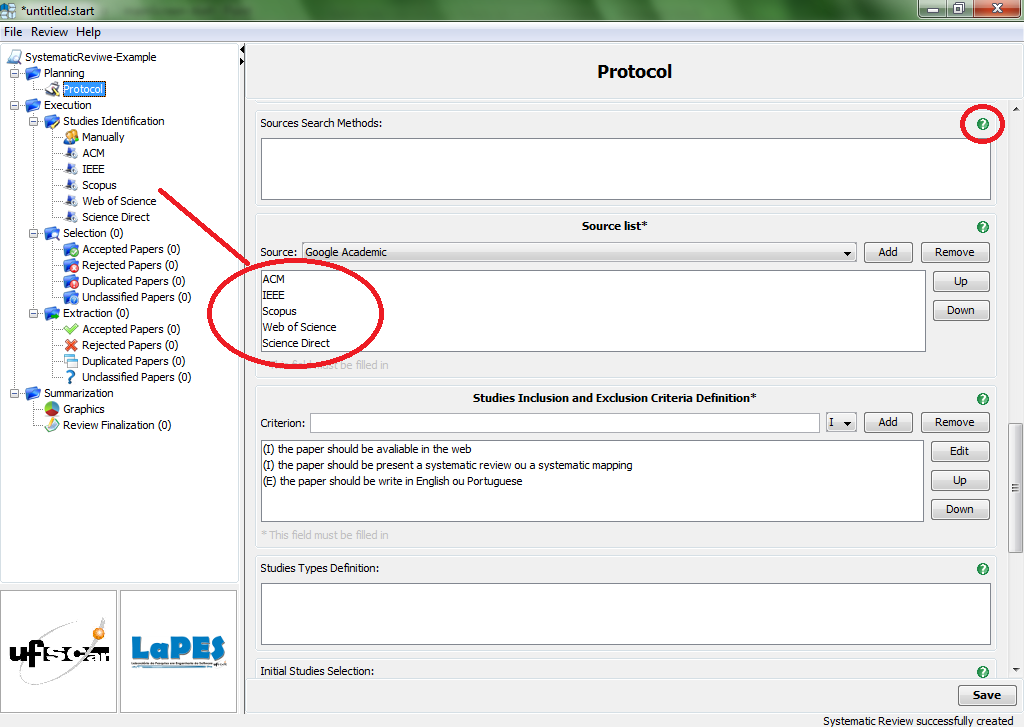
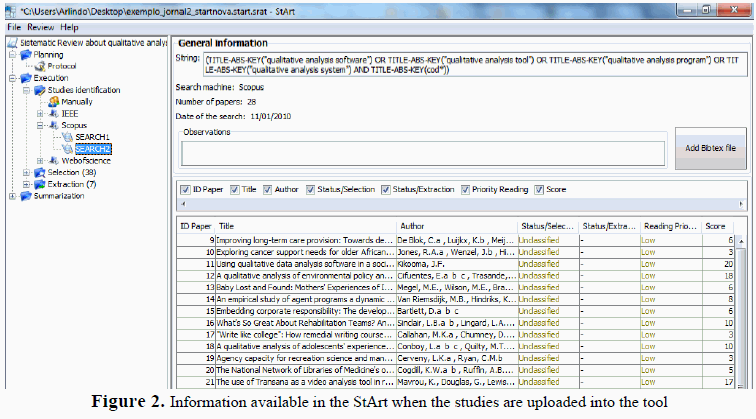
<body><![CDATA[<p style="margin-bottom: 0.21cm;" align="justify"><font size="2" face="Verdana"><span lang="en-GB"><b>3 	The 	Tool StArt</b></span></font></p>    	     <p align="justify"><font size="2" face="Verdana"><span lang="en-US">Some 	activities in the SLR process are repetitive and require discipline 	and systematic practice by the researcher. The information must be 	registered in an organized way so that the SLR provides the expected 	results, is replicable, and allows that all the information can be 	packed. StArt provides support to the SLR process activities, except 	to the automated search of primary studies in electronic databases, 	since this is considered as a robot action, which is blocked by 	these mechanisms. Therefore, the researcher must do the search 	manually through the search engines registered in the <i>Protocol</i> 	every time a search is necessary. The search result must be exported 	from the search engine as a BibTex file which must be imported into 	StArt.</span></font></p>    	     <p style="text-indent: 0.64cm;" align="justify"><font size="2" face="Verdana"><span lang="en-US">Figure 	1 presents a screen of 	the tool. In the left side a hierarchical tree shows the process 	stages to be followed. Some pieces of information in this tree are 	filled out dynamically, as the researcher defines the Protocol or as 	the process steps are carried out. This resource of StArt helps the 	researcher in keeping the information updated and consistent.</span></font></p>    	     <p style="text-indent: 0.64cm;" align="justify"><font size="2" face="Verdana"><span lang="en-GB">The 	following subsections describe the way each SLR stage is supported 	by the tool.</span></font></p>    	     <p style="text-indent: 0.64cm;" align="justify" lang="en-GB"> 	<font face="Verdana" size="2"> 	    <br>    	</font>    	</p>    	     <p style="margin-bottom: 0.21cm;" align="justify" lang="en-GB"> 	<font size="2" face="Verdana">3.1 Planning</font></p>    	     <p align="justify"><font size="2" face="Verdana"><span lang="en-GB">In 	this stage, the researcher must 	define the Protocol that will support the other SLR stages. The <i>Protocol</i> 	fields available in the tool are the ones suggested by <a href="#c5">(5)</a>. StArt 	has a help icon that provides the description and example of each 	field. As some fields have influence over other process stages, the 	tool assists in keeping these relations controlled. For instance: </span></font> 	</p>    	     <p style="text-indent: 0.64cm;" align="justify"><font size="2" face="Verdana"><span lang="en-GB">- <i>Source List</i>: 	this field contains the list of all the search engines which will be 	used to gather the studies. Meanwhile they are inserted in the 	Protocol, the name of the search engines are automatically added in 	the side-tree of the main screen (<a href="#f1">Figure 1</a>). The separation of the 	search engines allows a better organization of the studies as well 	as the information control in the studies identification step;</span></font></p>    	     <p style="text-indent: 0.64cm;" align="justify"><font size="2" face="Verdana"><span lang="en-GB">- <i>Keywords</i>: 	this field contains the keywords that will be used to compose the 	search strings. When the studies are uploaded into the StArt, it 	uses the keywords to score the studies according to the number of 	occurrences of these words in their title, abstract and keywords. 	This score, showed in <a href="#f2">Figure 2</a>, suggests the studies relevance 	order;</span></font></p>    	     ]]></body>
<body><![CDATA[<p style="text-indent: 0.64cm;" align="justify"><font size="2" face="Verdana"><span lang="en-GB">- <i>Studies Inclusion 	and Exclusion Criteria Definition</i>: 	this field, as showed in <a href="#f1">Figure 1</a>, contains the criteria that will 	be used to accept or reject each study during the selection step. 	StArt makes them available in this step and allows the researcher to 	register the ones were applied to each of the studies, as showed in 	<a href="#f2">Figure 2</a>;</span></font></p>    	     <p style="text-indent: 0.64cm;" align="justify"><font size="2" face="Verdana"><span lang="en-GB">- <i>Information 	Extraction Form Attributes</i>: 	this field contains the attributes that will compose the form which 	must be filled in by the researcher in the Extraction stage, as 	explained in subsection 3.2.3.</span></font></p>    	     <p style="text-indent: 0.64cm;" align="justify" lang="en-GB"> 	<font face="Verdana" size="2"> 	    <br>    	</font>    	</p>        <p align="center"> <font face="Verdana"> <a name="f1"> <font size="2"></font> </a><a href="/img/revistas/cleiej/v15n1/1a03f1.png" name="f1"> <font size="2"><span lang="en-GB">Figure 1: Part of the <i>Protocol</i> 	highlighting the source list that is added dynamically to the 	side-tree</span> </font> </a> </font> </p>        <p align="center"> <font face="Verdana"> <a name="f2" href="/img/revistas/cleiej/v15n1/1a03f2.gif"> <font size="2">Figure 2: Information available in the StArt when the 	studies are uploaded into the tool </font> </a> </font> </p>       	     <p align="justify" lang="en-GB"><font face="Verdana" size="2">    <br>    	</font>    	</p>    	     <p style="margin-bottom: 0.21cm;" align="justify"><font size="2" face="Verdana"><span lang="en-GB">3.2 Execution</span></font></p>    	     <p align="justify"><font size="2" face="Verdana"><span lang="en-GB">Once 	the Protocol is concluded, the researcher is able to perform 	the <i>Execution</i> 	stage that is composed of three steps: Studies Identification, 	Selection and Extraction.</span></font></p>    	     ]]></body>
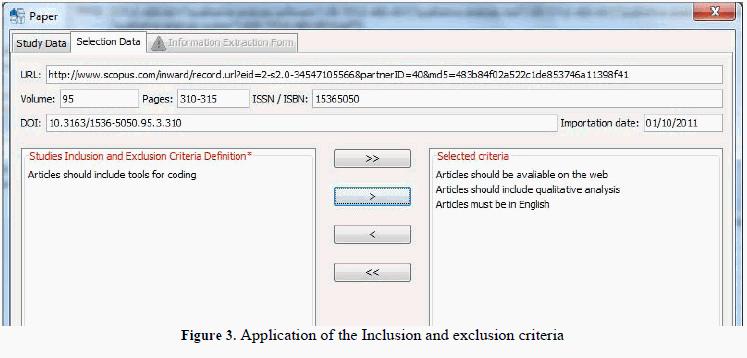
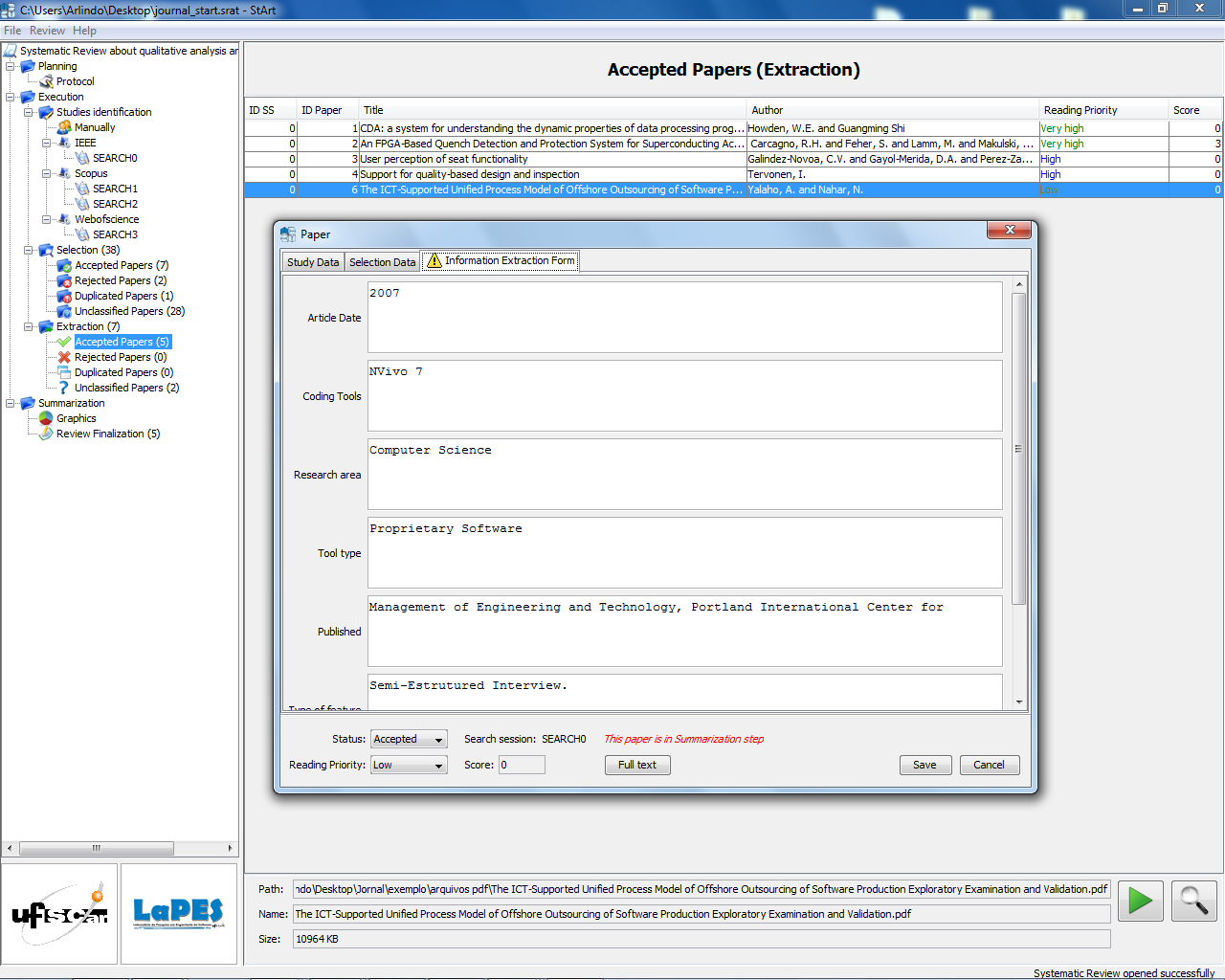
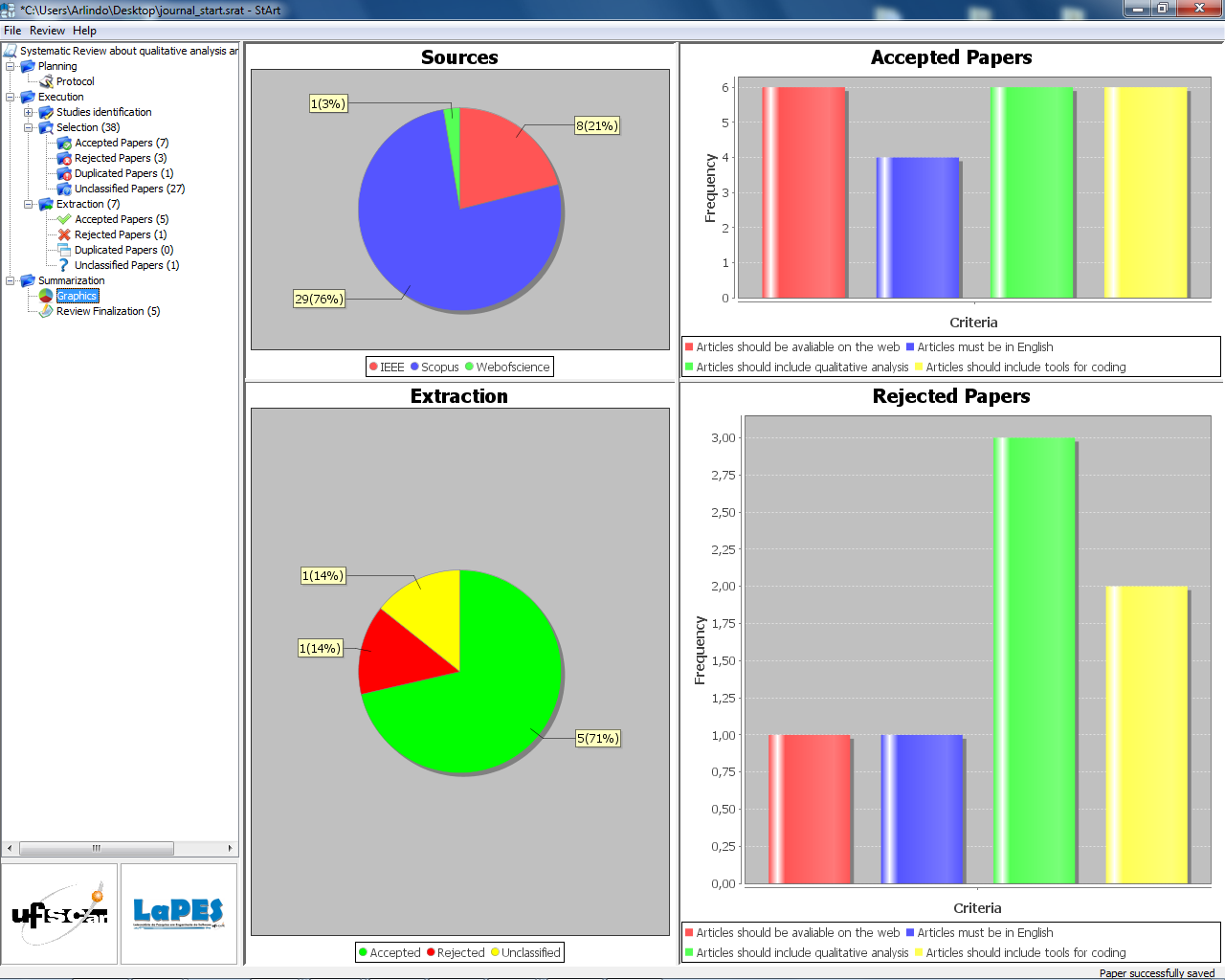
<body><![CDATA[<p align="justify" lang="en-GB"><font face="Verdana" size="2">    <br>    	</font>    	</p>    	     <p style="margin-bottom: 0.21cm; text-decoration: none;" align="justify" lang="en-GB"> 	<font size="2" face="Verdana"><i>3.2.1 Studies 	Identification</i></font></p>    	     <p align="justify"><font size="2" face="Verdana"><span lang="en-GB">In 	this step the objective is to gather a set of studies that is 	related to the 	research question. Thus, the researcher should: (i) apply the search 	strings to each of the search engines specified in the Protocol and 	export the results in a BibTex format, and (ii) import into StArt 	the BibTex and store the search string used by the search engine, 	since the search string that allows a faithful replication of the 	SLR. The tool also allows manually insertion of studies.</span></font></p>    	     <p style="text-indent: 0.64cm;" align="justify"><font size="2" face="Verdana"><span lang="en-GB">Once 	the BibTex file was 	imported, all the information presented in <a href="#f2">Figure 2</a> is available in 	the StArt. This screen shows the search string used in this session, 	the number of studies identified, and a table with some attributes 	of each study, as its identification, title, author(s), status at 	the Selection step, status at the Extraction step, <i>Reading 	Priority</i> and <i>Score</i>. 	The score, as mentioned before, is automatically calculated 	according to the number of times the keywords defined in the <i>Protocol</i> 	Duplicated studies are also automatically identified by the tool. 	The two fields <i>Status</i> 	must be filled by the researcher, according to the process step.</span></font></p>    	     <p align="justify" lang="en-GB"><font face="Verdana" size="2">    <br>    	</font>    	</p>    	     <p style="margin-bottom: 0.21cm; text-decoration: none;" align="justify" lang="en-GB"> 	<font size="2" face="Verdana"><i>3.2.2 Selection</i></font></p>    	     <p align="justify"><font size="2" face="Verdana"><span lang="en-GB">In 	this step the primary studies uploaded into the 	Start must be accepted or rejected according to the inclusion and 	exclusion criteria defined in the <i>Protocol</i>. 	<a href="#f3">Figure 3</a> illustrates the facility provided by the tool for doing 	this activity. The decision should be made after reading the title, 	abstract and keywords of the study, which are available for each 	study, as shown in <a href="#f4">Figure 4</a>. At the end of this step all the 	accepted studies are automatically transferred to the <i>Extraction</i> 	step. <a href="#f5">Figure 5</a> exemplifies this fact: see that there are seven 	papers as <i>Accepted 	Papers</i> in the <i>Selection</i> 	step and a total of seven papers in the <i>Extraction</i> 	step.</span></font></p>    	     <p align="justify" lang="en-GB"><font face="Verdana" size="2">    ]]></body>
<body><![CDATA[<br>    	</font>    	</p>    	     <p style="margin-bottom: 0.21cm; text-decoration: none;" align="justify" lang="en-GB"> 	<font size="2" face="Verdana"><i>3.2.3 Extraction</i></font></p>    	     <p align="justify"><font size="2" face="Verdana"><span lang="en-GB">In 	this step, all the studies that have been accepted in the <i>Selection</i> 	step should be read in full and be analyzed again a study is 	rejected if they are not relevant to answer the main question 	defined in the <i>Protocol 	</i>it must be 	rejected in this step. The <i>Reading</i> <i>Priority</i> 	field that can be filled during the Selection step may help the 	researcher with the reading order. Although the full studies must be 	downloaded by the researcher, they can be linked to the SLR, which 	facilitates the access to the document. For the papers classified as <i>Accepted</i> 	in this step, the researcher must extract the information 	correspondent to the attributes of the <i>Information 	Extraction Form</i>, 	defined in the <i>Protocol</i>. 	This form is available in this step as shown in <a href="#f5">Figure 5</a>. This 	facility promotes a systematic way for extracting information.</span></font></p>    	     <p align="justify" lang="en-GB"><font face="Verdana" size="2">    <br>    	</font>    	</p>    	     <p style="margin-bottom: 0.21cm;" align="justify" lang="en-GB"> 	<font size="2" face="Verdana">3.3 Summarization</font></p>    	     <p align="justify"><font size="2" face="Verdana"><span lang="en-GB">In 	this stage the researcher should describe the state of the art of 	the topic in focus. StArt facilitates the access to the information 	extracted during the <i>Extraction</i> 	step and provides a text editor to help in a first version of the 	summarization document when this stage is reached some data on the 	whole SLR are available, as shown in <a href="#f6">Figure 6</a>. 	In addition, Start provides some reports that also facilitate the 	conduction of a SLR.</span></font></p>        <p align="center"> <a name="f3" href="/img/revistas/cleiej/v15n1/1a03f3.jpg"> <font size="2" face="Verdana">Figure 3: Application of the Inclusion 	and exclusion criteria  </font> </a> </p>            <p align="center"> <a name="f4" href="/img/revistas/cleiej/v15n1/1a03f4.jpg"> <font size="2" face="Verdana">Figure 4: General data of each study </font> </a> </p>        <p align="center"> <a name="f5" href="/img/revistas/cleiej/v15n1/1a03f5.png"> <font size="2" face="Verdana">Figure 5: Information Extraction 	Form </font> </a> </p>        ]]></body>
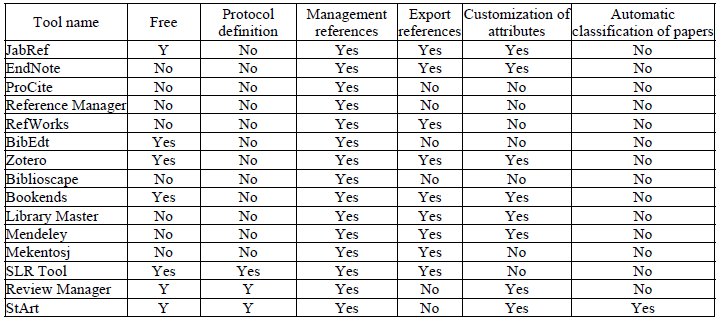
<body><![CDATA[<p align="center"> <a name="f6" href="/img/revistas/cleiej/v15n1/1a03f6.png"> <font size="2" face="Verdana">Figure 6: Some final data provided at Summarization stage </font> </a> </p>        <p></p>     	     <p style="margin-bottom: 0.21cm;" align="justify" lang="en-GB"> 	<font size="2" face="Verdana"><b>4 Related tools</b></font></p>    	     <p align="justify"><font size="2" face="Verdana"><span lang="en-GB">In 	the literature, there are some tools to support the management of 	bibliographic references, which are commonly used by researchers to 	aid in the SLR process. The purpose and the coverage of these tools 	are different and they 	are not related to the SLR process proposed by <a href="#c5">(5)</a>, except for SLR 	Too<a href="#c7">l (7)</a>.<a name="c7."></a></span></font></p>    	     <p style="text-indent: 0.64cm;" align="justify"><font size="2" face="Verdana"><span lang="en-GB">Only 	SLR Tool <a href="#c7">(7)</a> focuses on Systematic Literature Review. However, its 	installation requires the availability of a specific database 	management system and a pre-configuration of the environment, which 	can restrict its use, mainly by researchers of other research areas 	such as Medicine and Nursing, who are also users of the SLR process 	Another characteristic of the SLR Tool is that it only works with 	the English and the Spanish versions of the Windows operating 	system. On the other hand, StArt does not have this restriction and 	can be easily installed<span style="background: rgb(0, 255, 0) none repeat scroll 0% 50%; -moz-background-clip: initial; -moz-background-origin: initial; -moz-background-inline-policy: initial;"> 	</span>through a 	wizard interface. <a href="#t1">Table 1</a> presents the main characteristics of tools 	that are being used in the context of literature review.</span></font></p>         <p align="center"> <a name="t1" href="/img/revistas/cleiej/v15n1/1a03t1.jpg"> <font size="2" face="Verdana">Table 1:Characterization of related tools  </font> </a> </p>   		 	     <p style="text-indent: 0.64cm;" align="justify" lang="en-US"> 	<font face="Verdana" size="2"> 	    <br>    	</font>    	</p>     	     <p style="margin-bottom: 0.21cm;" align="justify"><font size="2" face="Verdana"><span lang="en-GB"><b>5 	StArt evaluation: preliminary data on the Usefulness and Ease of Use</b></span></font></p>    	     <p align="justify"><font size="2" face="Verdana"><span lang="en-GB">According 	to <a href="#c8">(8)</a>,<a name="c8."></a> all proposed 	technology (method, technique, tool, etc.) should be evaluated 	before being made available for use. The objective of the evaluation 	described bellow was to characterize the two aspects of the TAM 	model (Technology Acceptance Model) <a href="#c9">(9)</a>,<a name="c9."></a> to get preliminary data on 	the tool viability of use.</span></font></p>    	     ]]></body>
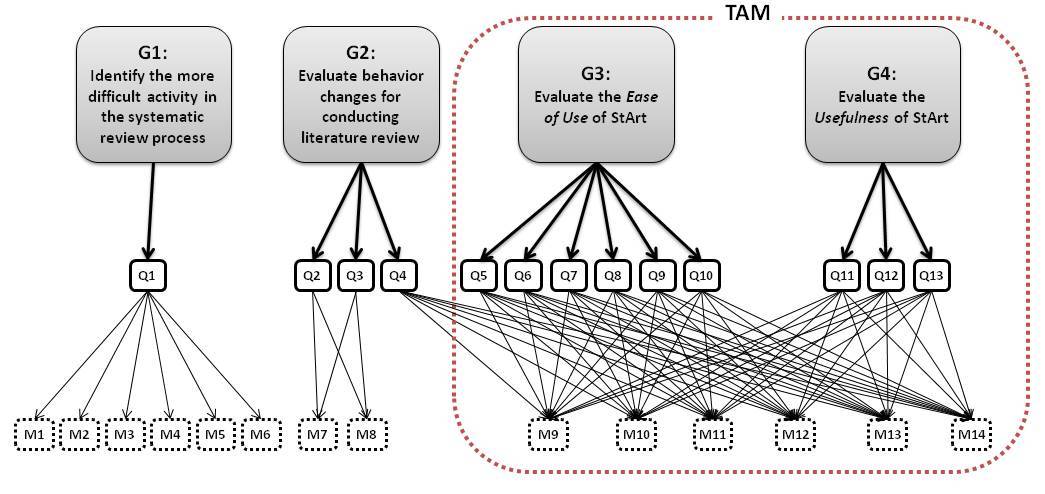
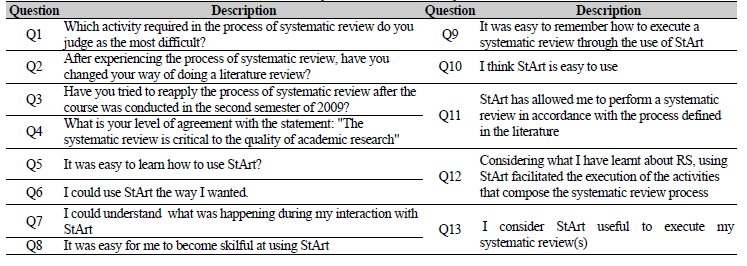
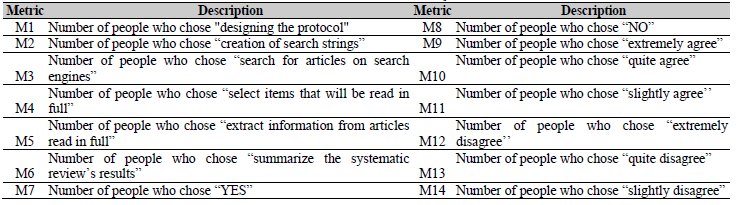
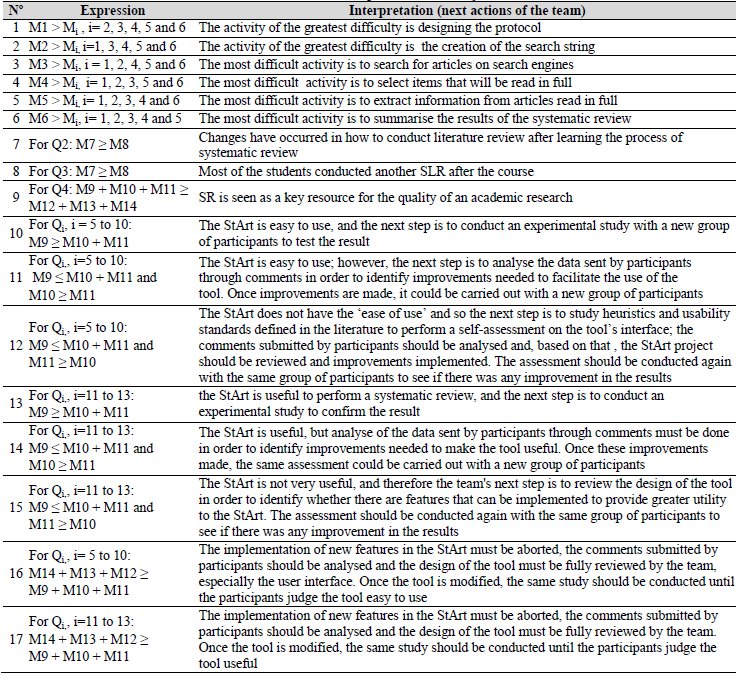
<body><![CDATA[<p style="text-indent: 0.64cm;" align="justify"><font size="2" face="Verdana"><span lang="en-GB">The 	evaluation was applied twice. 	In both occurrences the participants were graduate students in 	Computer Science (MSc. and PhD.) who had applied the SLR process, 	manually, during the Research Methodology course. Fourteen students 	participated of the first evaluation and thirty five participated of 	the second one.</span></font></p>    	     <p style="text-indent: 0.64cm;" align="justify"><font size="2" face="Verdana"><span lang="en-GB">The 	evaluation was planned through the GQM 	(Goal, Question, Metric) paradigm <a href="#c10">(10)</a><a href="#c11">(11)</a>,<a name="c10."></a><a name="c11."></a> which is composed of 	four steps: Planning, Definition; Data Collection; and 	Interpretation that are described below. </span></font> 	</p>    	     <p style="text-indent: 0.64cm;" align="justify" lang="en-GB"> 	<font face="Verdana" size="2"> 	    <br>    	</font>    	</p>    	     <p style="margin-bottom: 0.21cm;" align="justify" lang="en-GB"> 	<font size="2" face="Verdana">5.1. Planning and 	Definition</font></p>    	     <p align="justify"><font size="2" face="Verdana"><span lang="en-GB">The 	GQM model constructed 	for planning the evaluation consists of four goals, thirteen 	questions (<a href="#t2">Table 2</a>) and fourteen metrics (<a href="#t3">Table 3</a>), according to 	details presented in <a href="#f7">Figure 7</a>. Based on that model, two 	questionnaires were used in the evaluation: Questinonnaire1 (Q1 to 	Q4) for collecting data on student&rsquo;s opinion and their current 	contact with systematic review; and Questionnaire2 (Q5 to Q13) for 	characterizing the usefulness and ease of use of the tool, according 	to TAM. The questions related to TAM were inspired on the study 	presented in <a href="#c12">(12)</a><a name="c12."></a> and were evaluated according to the Likert scale 	<a href="#c13">(13)</a><a name="c13."></a>. Both questionnaires contained blank fields for comments. Table 	6 presents the interpretation model of the GQM, which should be read 	as follows: "If Expression then Interpretation". Taking 	line 9 as an example where the question is Q4, " If M9 + M10 + 	M11 &ge; M12 + M13 + M14 then the SR is seen as a key resource for 	the quality of academic research.&rdquo;</span></font></p>        <p align="center"> <a name="f7" href="/img/revistas/cleiej/v15n1/1a03f7.jpg"> <font size="2" face="Verdana">Figure 7: GQM to evaluate the StArt  </font> </a> </p>   	      <p align="center"> <a name="t2" href="/img/revistas/cleiej/v15n1/1a03t2.jpg"> <font size="2" face="Verdana">Table 2: Questions used in the GQM  </font> </a> </p>         <p align="center"> <a name="t3" href="/img/revistas/cleiej/v15n1/1a03t3.jpg"> <font size="2" face="Verdana">Table 3: Metrics used in the GQM </font> </a> </p>            <p align="center"> <a name="t4" href="/img/revistas/cleiej/v15n1/1a03t4.jpg"> <font size="2" face="Verdana">Table 4: Model interpretation of the GQM  </font> </a> </p>        ]]></body>
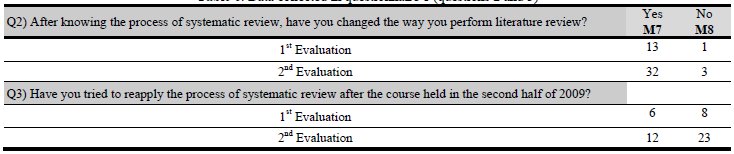
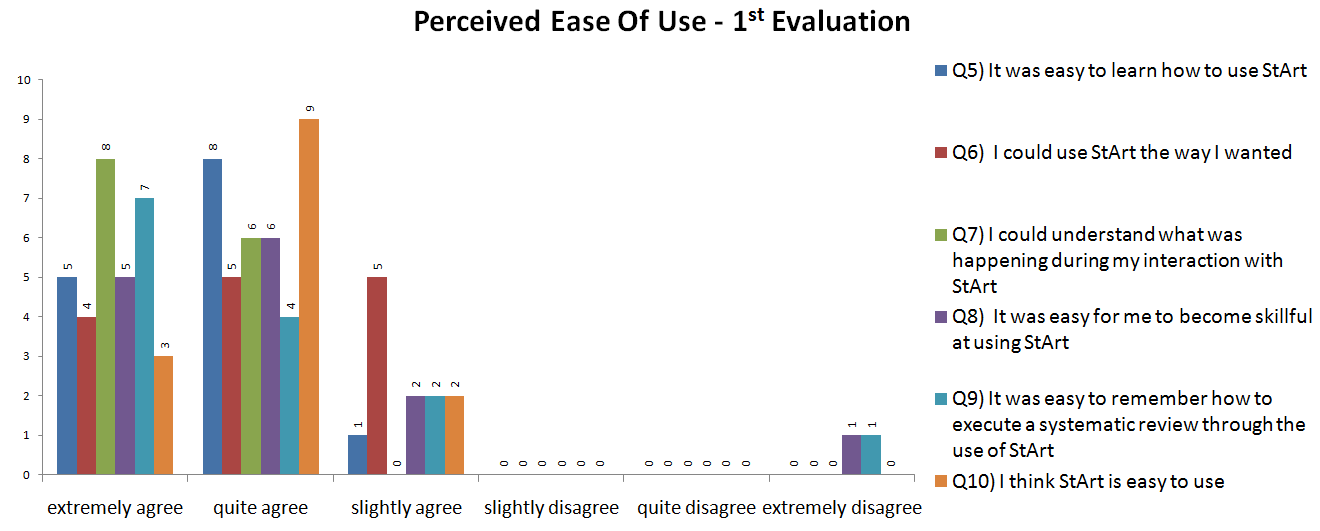
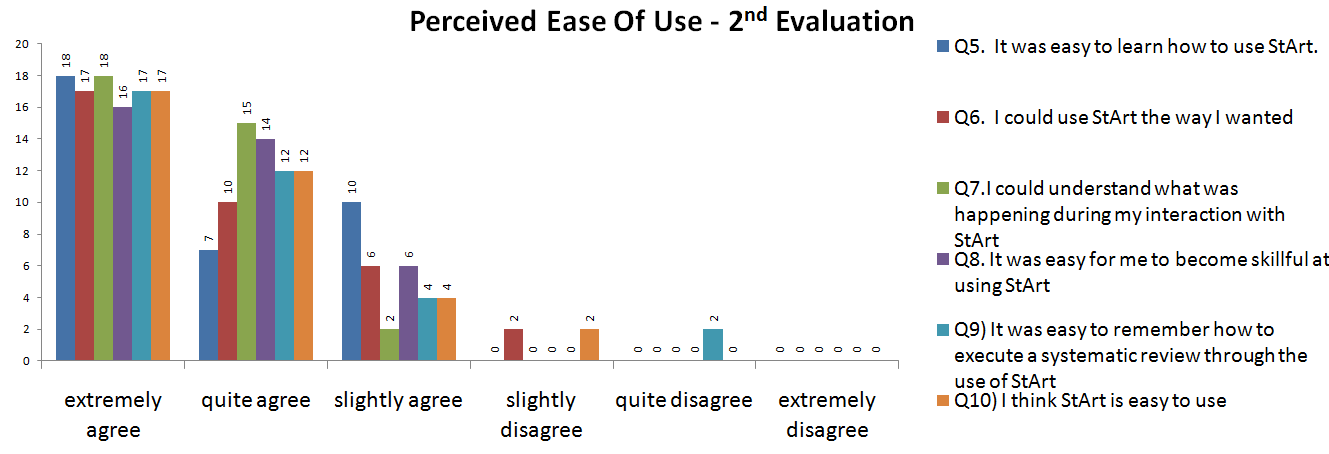
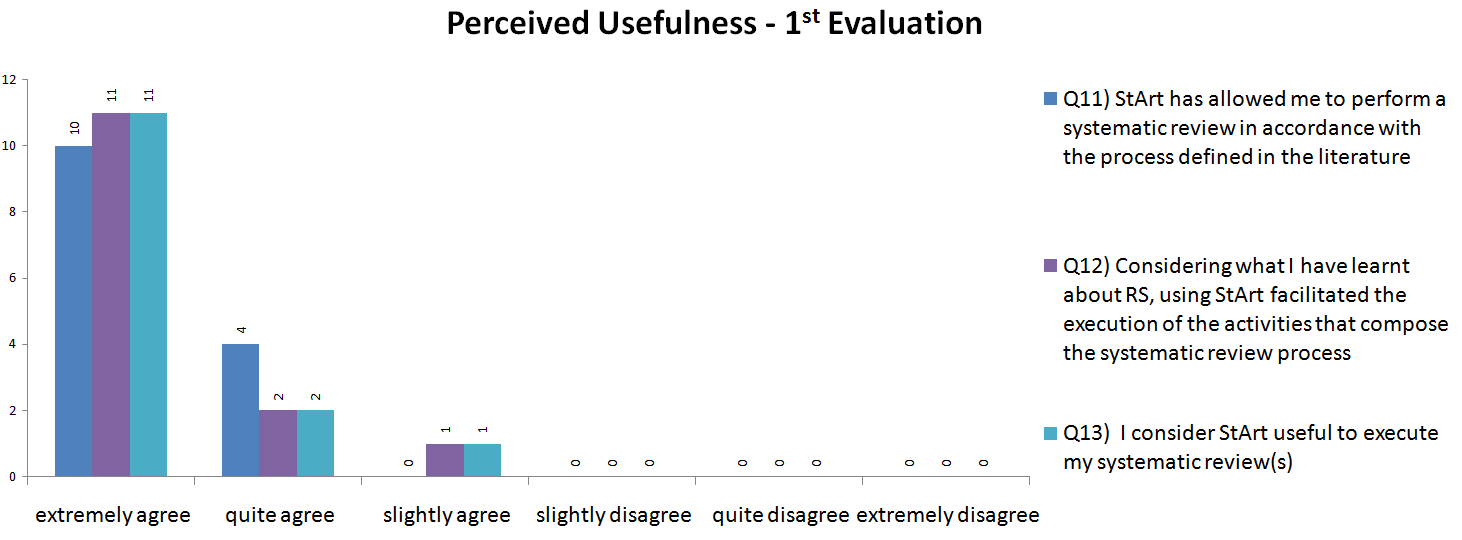
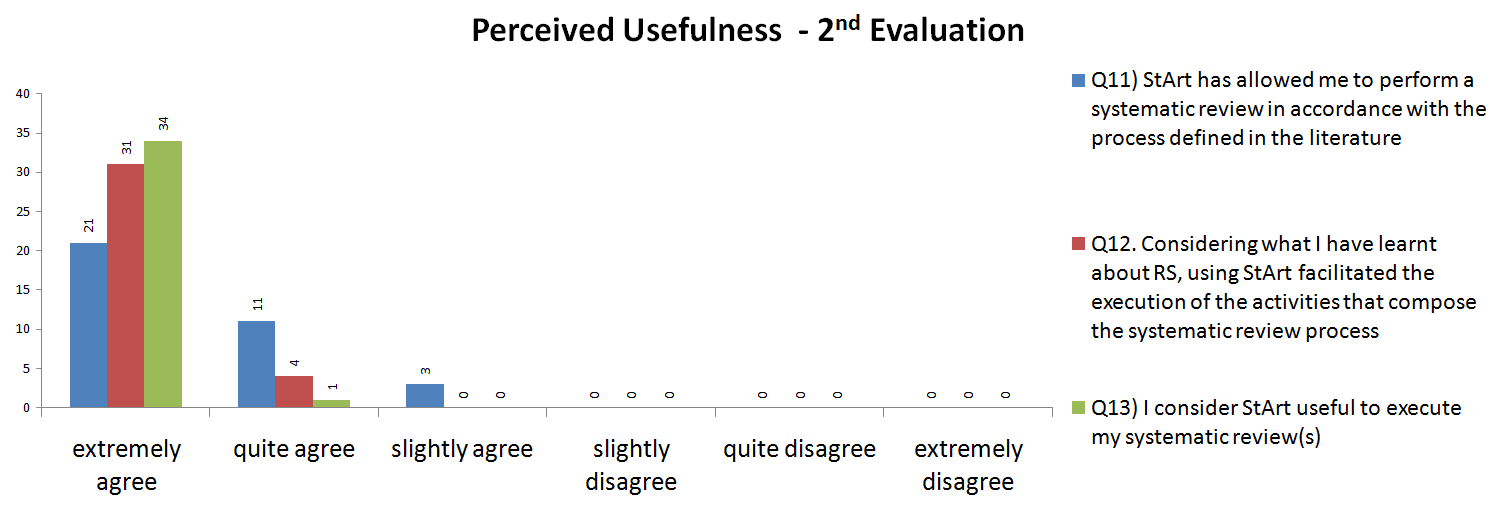
<body><![CDATA[<p></p>     	     <p style="margin-bottom: 0.21cm;" align="justify"><font size="2" face="Verdana"><span lang="en-GB">5.2. 	Data Collection </span></font> 	</p>    	     <p align="justify"><font size="2" face="Verdana"><span lang="en-GB">The 	data were collected as follows: firstly, Questionnaire1 	was sent by e-mail to the participants who, after answered it, had 	access to two training videos about StArt and had permission to 	download the tool. Hence, the students were asked to explore the 	tool as they have done manually during the course. </span></font> 	</p>    	     <p style="text-indent: 0.64cm;" align="justify" lang="en-GB"> 	<font size="2" face="Verdana">Secondly, the 	students who have finished Questionnaire1, received Questionnaire2 	that was, sent by e-mail. By using electronic questionnaires, at the 	end of the evaluation process all the answers were available on 	spreadsheets, which facilitated the data collection.</font></p>    	     <p style="text-indent: 0.64cm;" align="justify"><font size="2" face="Verdana"><span lang="en-GB">The 	summary of the data collected is showed in the next tables and 	figures. Tables <a href="#t5">5</a>, <a href="#t6">6</a>	and <a href="#t7">7</a> present the questions and answers of the first questionnaire 	and Figures <a href="#f8">8</a>,<a href="#f9">9</a>, <a href="#f10">10</a> and <a href="#f11">11</a> present charts that show the questions 	and the answers of the second one. In the charts, the order of the 	bars obeys the order of the questions.</span></font></p>        <p align="center"> <a name="t5" href="/img/revistas/cleiej/v15n1/1a03t5.jpg"> <font size="2" face="Verdana">Table 5: Data collected in questionnaire 1 (question 1) </font> </a> </p>        <p align="center"> <font face="Verdana"> <a name="t6" href="/img/revistas/cleiej/v15n1/1a03t6.jpg"> <font size="2">Table 6: Data collected in questionnaire 1 (questions 2 and 3) </font> </a> </font> </p>        <p align="center"> <font size="2" face="Verdana"><a href="/img/revistas/cleiej/v15n1/1a03t7.jpg">Table 7:  Data collected in questionnaire 1 (question 4)</a> </font>  </p>         <p align="center"> <a name="f8" href="/img/revistas/cleiej/v15n1/1a03f8.png"> <font size="2" face="Verdana">Figure 8: Questions and answers related to the ease of use - 1st evaluation </font> </a> </p>         <p align="center"> <a name="f9" href="/img/revistas/cleiej/v15n1/1a03f9.png"> <font size="2" face="Verdana">Figure 9: Questions and answers related to the ease of use - 2nd evaluation </font> </a> </p>          ]]></body>
<body><![CDATA[<p align="center"> <a name="f10" href="/img/revistas/cleiej/v15n1/1a03f10.png"> <font size="2" face="Verdana">Figure 10: Questions and answers related to the usefulness - 1st evaluation </font> </a> </p>         <p align="center"> <a name="f11" href="/img/revistas/cleiej/v15n1/1a03f11.png"> <font size="2" face="Verdana">Figure 11: Questions and answers related to the usefulness - 2nd evaluation </font> </a> </p>          <p style="margin-bottom: 0.21cm;" align="justify" lang="en-GB"> 	<font size="2" face="Verdana">5.3 Interpretation</font></p>    	     <p align="left"><font size="2" face="Verdana"><span lang="en-GB">Applying the interpretation 	model presented in <a href="#t6">Table 6</a> on the data collected and presented in 	the previous section, we can assume the following about the goals:</span></font></p>    	 <ul>    		    <li>                   <p align="justify"><font size="2" face="Verdana"><span lang="en-GB">G1: 		in relation to this goal, the results showed that in the first 		evaluation the protocol filling was selected as the most difficult 		activity of the SLR process, since six participants (42%) have 		selected this option (<a href="#t1">Table 1</a>) and this value makes the expression 		1 true (<a href="#t6">Table 6</a>). However, in the second evaluation the 		construction of search strings was selected as the most difficult 		activity of the SLR process, since fifteen participants (42%) have 		selected this option (<a href="#t1">Table 1</a>) and this value makes the expression 		2 true (<a href="#t6">Table 6</a>). From now, we are planning to address this issue 		in a deeper way, aiming to provide facilities that can help the 		researcher in doing these activities.</span></font></p>    	</li>       </ul>    	     <p style="margin-left: 0.64cm;" align="justify" lang="en-GB"> 	<font face="Verdana" size="2"> 	    <br>    	</font>    	</p>    	 <ul>    		    <li>                   ]]></body>
<body><![CDATA[<p align="justify"><font size="2" face="Verdana"><span lang="en-GB">G2: in relation to this 		goal, the results showed that the participants change their 		behaviour for conducting literature review. Although most of the 		participants have not tried to apply the SLR process after the 		course, they consider the SLR a key for the quality of academic 		research. This conclusion is supported by the following expressions 		(<a href="#t6">Table 6</a>):</span></font></p>    		               <ul>    			    <li>                               <p align="justify"><font size="2" face="Verdana"><span lang="en-GB">expression 			7: Q2: M7 &ge; M8, 			that is true for the evaluation 1 (13&ge; 1) and for the 			evaluation 2 (32 &ge; 3), according to the values of the <a href="#t2">Table 2</a>;</span></font></p>    			</li>             <li>                               <p align="justify"><font size="2" face="Verdana"><span lang="en-GB">expression 8: Q3: M7 &ge; M8, 			that is false for the evaluations 1 (6 &ge; 8) and for the 			evaluation 2 (12 &ge; 23), according to the values of the <a href="#t2">Table 2</a>;</span></font></p>    			</li>             <li>                               <p align="justify"><font size="2" face="Verdana"><span lang="en-GB">expression 9: Q4:M9 + M10 + M11 			&ge; M12 + M13 + M14, that is true for the evaluation 1 (7+3+4 &ge; 			0+0+0) and for the evaluation 2 (21+6+8 &ge; 0+0+0), according to 			the values of the <a href="#t3">Table 3</a>.</span></font></p>    		</li>                     </ul>    	</li>       </ul>    	     <p style="margin-left: 1.91cm;" align="justify" lang="en-GB"> 	<font face="Verdana" size="2"> 	    ]]></body>
<body><![CDATA[<br>    	</font>    	</p>    	 <ul>    		    <li>                   <p align="justify"><font size="2" face="Verdana"><span lang="en-GB">G3: 		in relation to this goal, 		there are four expressions in the interpretation model (<a href="#t6">Table 6</a>): 		10, 11, 12 and 16. The results showed that in both the evaluations, 		most of the participants agree with the ease of use of the StArt. </span></font> 		</p>    	</li>       </ul>    	     <p style="margin-left: 0.64cm;" align="justify"><font size="2" face="Verdana"><span lang="en-GB">In 	the evaluation 1 the answers 	of the participants were concentred in &ldquo;quite agree&rdquo; 	(<a href="#f8">Figure 8</a>). Considering the answers for questions 5 up to 10, the 	expression 11: Qi, i=5 to 10: M9 &le; M10 + M11 and M10 &ge; M11 is 	true, since 32 &le; 34 + 12 and 34 &ge; 12. Hence, the next step 	should be the analysis of the comments submitted by the participants 	in order to identify improvements needed to facilitate the use of 	the tool. Once the improvements are made, the evaluation could be 	carried out with a new group of participants.</span></font></p>    	     <p style="margin-left: 0.64cm;" align="justify" lang="en-GB"> 	<font size="2" face="Verdana">In the evaluation 2 	the answers of the participants were concentred in &ldquo;extremely 	agree&rdquo; (<a href="#f9">Figure 9</a>). Considering the answers for questions 5 up 	to 10, the expression 10: Qi, i = 5 to 10: M9 &ge; M10 + M11 is 	true, since 103 &ge; 70 + 32. Therefore, the development team should 	conduct an experimental study with a new group of participants to 	test the result of the evaluation 2.</font></p>    	     <p align="justify" lang="en-GB"><font face="Verdana" size="2">    <br>    	</font>    	</p>    	 <ul>    		    <li>                   <p align="justify"><font size="2" face="Verdana"><span lang="en-GB">G4: 		in relation to this goal, 		there are four expressions in the interpretation model (<a href="#t6">Table 6</a>): 		13, 14, 15 and 17. The results showed that in both the evaluations, 		the majority of the participants agree with the usefulness of the 		StArt (Figures <a href="#f10">10</a> and <a href="#f11">11</a>). </span></font> 		</p>    	</li>       ]]></body>
<body><![CDATA[</ul>    	     <p style="margin-left: 0.64cm;" align="justify"><font size="3" face="Verdana"><font size="2"><span lang="en-GB">Considering 	the answers for questions 11 up to 13, the 	expression 13: Q</span></font><sub><font size="2"><span lang="en-GB">i</span></font></sub><font size="2"><span lang="en-GB">, 	i=11 to 13: M9 &ge; M10 + M11 is true, since for the evaluation 1 	(50 &ge; 17 + 2) and for the evaluation 2 (86 &ge; 16 + 3). </span></font></font> 	</p>    	     <p style="margin-left: 0.64cm;" align="justify"><font size="2" face="Verdana"><span lang="en-GB">According 	to the interpretation model (<a href="#t6">Table 6</a>) the next step is to conduct an 	experimental study to confirm this result.</span></font></p>    	     <p align="justify" lang="en-US"><font face="Verdana" size="2">    <br>    	</font>    	</p>    	     <p style="margin-bottom: 0.21cm;" align="justify"><font size="2" face="Verdana"><span lang="en-GB"><b>6 	Final remarks and future work </b></span></font> 	</p>    	     <p align="justify"><font size="2" face="Verdana"><span lang="en-GB">This 	paper presented the 	StArt tool that supports the conduction of the systematic literature 	review process <a href="#c14">(14)</a><a name="c14."></a> providing facilities for minimizing this 	laborious process. It has been developed in an iterative and 	interactive way, with constant feedback from users. For directing 	the next steps, an evaluation was carried out twice, aiming to 	explore the support of the tool for conducting all the stages of the 	SLR process. This evaluation involved students who had already 	applied the SLR process manually.</span></font></p>    	     <p style="text-indent: 0.64cm;" align="justify"><font size="2" face="Verdana"><span lang="en-GB">The 	evaluation was planned 	using the GQM model and established four goals: two of them, related 	to the aspects addressed by the Technology Acceptance Model (TAM) &ndash; 	ease of use and usefulness; one related to the identification of the 	activity considered the most difficult among the SLR activities; and 	another one related to the investigation on user&rsquo;s behaviour 	change in conducting literature review. </span></font> 	</p>    	     <p style="text-indent: 0.64cm;" align="justify"><font size="2" face="Verdana"><span lang="en-GB">The 	use of the TAM has 	turned the evaluation quick and objective, and disseminated the 	model among the participants. The use of the GQM led objectivity to 	the evaluation and to the definition and elaboration of forms for 	data collection. One of the limitations of the evaluation is the 	number of participants, which does not allow generalizing the 	results.</span></font></p>    	     <p style="text-indent: 0.64cm;" align="justify"><font size="2" face="Verdana"><span lang="en-GB">As 	our main objective was to explore the TAM aspects, in 	relation to these issues, the evaluation indicated that the StArt is 	useful, since 71.42% of the participants of the evaluation 1and 	81.90% of the participants of the evaluation 2 extremely agreed with 	the usefulness of the tool. For the ease of use, in the evaluation 	1the answers were concentrated on quite agree (45.23%) and extremely 	agree (38.09%) and in the evaluation 2 the answers were concentrated 	on extremely agree (49.04%) and quite agree (33.33%).</span></font></p>    	     ]]></body>
<body><![CDATA[<p style="text-indent: 0.64cm;" align="justify"><font size="2" face="Verdana"><span lang="en-GB">According 	to the GQM interpretation 	model, the actions that should be taken are: conducting an 	experimental study to confirm the results of this evaluation and 	analyse the qualitative data sent by the participants in order to 	identify improvements needed to facilitate the use of the tool. In 	summary, the evaluation has provided evidence that the tool will be 	accepted by users to support the conduction of SLRs.</span></font></p>    	     <p style="text-indent: 0.64cm;" align="justify" lang="en-GB"> 	<font size="2" face="Verdana">In addition to the 	actions defined in the GQM interpretation model, arose directly from 	the evaluation, some functionalities are already being implemented 	such as systematic mapping process support <a href="#c15">(15)</a> <a name="c15."></a>and mechanisms of 	communication with other tools. </font> 	</p>    	     <p style="margin-right: 0.02cm; margin-top: 0.42cm; margin-bottom: 0.21cm; page-break-inside: avoid; widows: 0; orphans: 0; page-break-after: avoid;" align="left" lang="en-US"> 	<font face="Verdana" size="2"><b>Acknowledgements</b></font></p>    	     <p align="justify"><font size="2" face="Verdana"><span lang="en-GB">The 	authors thank the students who participated in the 	evaluation and CNPq, CAPES and Observat&oacute;rio da Educa&ccedil;&atilde;o 	Project for financial support.</span></font></p>    	     <p style="margin-right: 0.02cm; margin-top: 0.42cm; margin-bottom: 0.21cm; page-break-inside: avoid; widows: 0; orphans: 0; page-break-after: avoid;" align="left" lang="en-US"> 	<font face="Verdana" size="2"><b>References</b></font></p>     		     <p style="margin-bottom: 0.21cm; widows: 0; orphans: 0;" lang="en-US"> 		<font face="Verdana" size="2"> 		<a name="c1"></a>(<a href="#c1.">1</a>) B. A. Kitchenham, T. Dyba, M. 		J&oslash;rgensen, &ldquo;Evidence-based software engineering&rdquo;, 		in Proc. <i>International Conference on Software Engineering 		(ICSE&rsquo;04)</i>, Edinburgh, Scotland, May. 2004, pp. 273-281.</font></p>    		     <p style="margin-bottom: 0.21cm; widows: 0; orphans: 0;" lang="en-US"> <font face="Verdana" size="2"><a name="c2"></a>(<a href="#c2.">2</a>) T. Dyba, B. A. Kitchenham, M. 		Jorgensen, &ldquo;Evidence-based software engineering for 		practitioners&rdquo;, <i>IEEE Software, </i>vol.<i> </i>22, pp. 		58-65, Jan. Feb. 2005.</font></p>    		     <p style="margin-bottom: 0.21cm; widows: 0; orphans: 0;" lang="en-US"> <font face="Verdana" size="2"><a name="c3"></a>(<a href="#c3.">3</a>) M. Jorgensen, T. Dyba, B. 		Kitchenham, &ldquo;Teaching evidence-based software engineering to 		university students&rdquo;, in Proc: <i>IEEE International Software 		Metrics Symposium (METRICS 2005)</i>, Como, Italy, Sep. 2005, pp. 		24.</font></p>    		     <p style="margin-bottom: 0.21cm; widows: 0; orphans: 0;" lang="en-US"> <font face="Verdana" size="2"><a name="c4"></a>(<a href="#c4.">4</a>) B. Kitchenham, P. Brereton, D. 		Budgen, M. Turner, J. Bailey, S. G. Linkman, &ldquo;Systematic 		literature reviews in software engineering - a systematic 		literature review&rdquo;: <i>Information &amp; Software Technology</i>, 		vol. 51, pp. 7-15, Nov. 2009.</font></p>    		     <p style="margin-bottom: 0.21cm; widows: 0; orphans: 0;" lang="en-US"> <font face="Verdana" size="2"><a name="c5"></a>(<a href="#c5.">5</a>) B. A. Kitchenham, &ldquo;<i>Procedures 		for Performing Systematic Reviews</i>&rdquo;, Software Engineering 		Group , Keele University, Keele, UK, Tech. Rep. TR/SE 0401, Jul. 		2004.</font></p>    		     ]]></body>
<body><![CDATA[<p style="margin-bottom: 0.21cm; widows: 0; orphans: 0;" lang="en-US"> <font face="Verdana" size="2"><a name="c6"></a>(<a href="#c6.">6</a>) J. Biolchini, P. G. Mian, A. C. 		C. Natali, G. H. Travassos, &ldquo;<i>Systematic Review in Software 		Engineering</i>&rdquo;, UFRJ, Rio de Janeiro, Brazil, Tech. Rep. 		RT&ndash;ES (679/05), May. 2005.</font></p>    		     <p style="margin-bottom: 0.21cm; widows: 2; orphans: 2;" lang="en-US"> <font face="Verdana" size="2"><a name="c7"></a>(<a href="#c7.">7</a>) <span lang="es-ES">A. M. 		Fern&aacute;ndez-S&aacute;ez, M. G. Bocco, F.P. Romero, &ldquo;SLR-tool 		- a tool for performing systematic literature reviews&rdquo;, in 		Proc: <i>International Conference on 		Software and Data Technologies (ICSOFT&rsquo; 10)</i>, 		Athens, Greece, Jul. 2010, pp. 144.</span></font></p>    		     <p style="margin-bottom: 0.21cm; widows: 2; orphans: 2;" lang="en-US"> <font face="Verdana" size="2"><a name="c8"></a>(<a href="#c8.">8</a>) V. R. Basili, S. Green, O. 		Laitenberger, F. Lanubile, F. Shull, S. Sorumgard,M. Zelkowitz, 		&ldquo;Packaging researcher experience to assist replication of 		experiments&rdquo;, in Proc. <i>International Software Engineering 		Research Network Meeting (ISERN&rsquo;96)</i>, Sydney, Australia, 		Aug. 1996, pp. 3-6.</font></p>    		     <p style="margin-bottom: 0.21cm; widows: 2; orphans: 2;" lang="en-US"> <font face="Verdana" size="2"><a name="c9"></a>(<a href="#c9.">9</a>) F. D. Davis, &ldquo;User 		acceptance of information technology: system characteristics, user 		perceptions and behavioral impacts&rdquo;, <i>International Jounal 		of Man-Machine Studies</i>, vol 38, pp. 475-487. Jan. 1993.</font></p>    		     <p style="margin-bottom: 0.21cm; widows: 2; orphans: 2;" lang="en-US"> <font face="Verdana" size="2"><a name="c10"></a>(<a href="#c10.">10)</a> V. R. Basili, C. Caldiera, H.D. 		Rombach, &ldquo;Goal Question Metric Paradigm&rdquo; in 		<i>Encyclopedia of Software Engineering</i>, New York: John Wiley &amp; 		Sons, 1994, pp. 528-532.</font></p>    		     <!-- ref --><p style="margin-bottom: 0.21cm; widows: 2; orphans: 2;" lang="en-US"> <font face="Verdana" size="2"><a name="c11"></a>(<a href="#c11.">11</a>) R. Soligen, E. Berghout, <i>The 		Goal/Question/Metric Method: a practical guide for quality 		improvement of software development</i>. London, UK: McGraw W-Hill 		Companies, 1999.    &nbsp;&nbsp;&nbsp;&nbsp;&nbsp;&nbsp;&nbsp;&nbsp;[&#160;<a href="javascript:void(0);" onclick="javascript: window.open('/scielo.php?script=sci_nlinks&ref=007187&pid=S0717-5000201200010000300011&lng=','','width=640,height=500,resizable=yes,scrollbars=1,menubar=yes,');">Links</a>&#160;]<!-- end-ref --></font></p>    		     <p style="margin-bottom: 0.21cm; widows: 2; orphans: 2;" lang="en-US"> <font face="Verdana" size="2"><a name="c12"></a>(<a href="#c12.">12</a>) O. Laitenberger, H. M. Dreyer, 		&ldquo;Evaluating the Usefulness and the Ease of Use of a Web-based 		Inspection Data Collection Tool&rdquo;, in Proc.: <i>International 		Symposium on Software Metrics (METRICS&rsquo;98)</i>, Bethesda, 		USA, March, 1998, pp. 122-135. </font> 		</p>    		     <p style="margin-bottom: 0.21cm; widows: 2; orphans: 2;" lang="en-US"> <font face="Verdana" size="2"><a name="c13"></a>(<a href="#c13.">13</a>) J. P. McIver, E. G. Carmines, 		&ldquo;<i>Unidimensional Scaling</i>&rdquo;. London, UK: Sage 		Publications, 1981.</font></p>    		     <p style="margin-bottom: 0.21cm; widows: 2; orphans: 2;" lang="en-US"> <font face="Verdana" size="2"><a name="c14"></a>(<a href="#c14.">14</a>) <span lang="pt-BR">A. B. 		Zamboni, A. Di Thommazo, E. C. M. Hernandes, S. C. P. F. Fabbri, 		&ldquo;StArt Uma Ferramenta Computacional de Apoio &agrave; Revis&atilde;o 		Sistem&aacute;tica&rdquo;, in Proc.: <i>Congresso 		Brasileiro de Software (CBSoft&rsquo;10)</i>, 		Salvador, Brazil, Sep. 2010. </span></font> 		</p>    		     ]]></body>
<body><![CDATA[<p style="margin-bottom: 0.21cm; widows: 2; orphans: 2;" lang="en-US"> <font face="Verdana" size="2"><a name="c15"></a>(<a href="#c15.">15</a>) K. Petersen, R. Feldt, S. 		Mujtaba, M. Mattsson, &ldquo;Systematic Mapping Studies in Software 		Engineering&rdquo;, in Proc.: <i>Inter. Conf. on Evaluation and 		Assessment in Software Engineering (EASE&rsquo;08)</i>, Bari, 		Italy, Jun. 2008, pp.26-27</font></p>    	 	     <p style="margin-bottom: 0.21cm; widows: 2; orphans: 2;" lang="en-US"> 	<font face="Verdana" size="2"> 	    <br>       <br>    	</font>    	</p>    </div>        <div id="Secci&oacute;n4" dir="ltr"> 	     <p align="left"><font face="Verdana" size="2">    <br>    	</font>    	</p>    </div>        <p style="margin-right: 0.02cm; margin-top: 0.42cm; margin-bottom: 0.21cm; page-break-inside: avoid; widows: 0; orphans: 0; page-break-before: always; page-break-after: avoid;" align="left" lang="en-US"> <font face="Verdana" size="2">     <br>       <br>    </font>    </p>        ]]></body>
<body><![CDATA[<div type="FOOTER"> 	     <p style="margin-top: 0.31cm; margin-bottom: 0.21cm; widows: 0; orphans: 0;" align="center" lang="en-US"> 	<font face="Verdana" size="2"> 	    <br>       <br>    	</font>    	</p>    </div>         ]]></body>
<back>
<ref-list>
<ref id="B1">
<label>1</label><nlm-citation citation-type="confpro">
<person-group person-group-type="author">
<name>
<surname><![CDATA[Kitchenham]]></surname>
<given-names><![CDATA[B. A]]></given-names>
</name>
<name>
<surname><![CDATA[Dyba]]></surname>
<given-names><![CDATA[T]]></given-names>
</name>
<name>
<surname><![CDATA[Jørgensen]]></surname>
<given-names><![CDATA[M]]></given-names>
</name>
</person-group>
<article-title xml:lang="en"><![CDATA[Evidence-based software engineering]]></article-title>
<source><![CDATA[]]></source>
<year></year>
<conf-name><![CDATA[ Proc. International Conference on Software Engineering (ICSE’04)]]></conf-name>
<conf-date>May. 2004</conf-date>
<conf-loc>Edinburgh </conf-loc>
</nlm-citation>
</ref>
<ref id="B2">
<label>2</label><nlm-citation citation-type="journal">
<person-group person-group-type="author">
<name>
<surname><![CDATA[Dyba]]></surname>
<given-names><![CDATA[T]]></given-names>
</name>
<name>
<surname><![CDATA[Kitchenham]]></surname>
<given-names><![CDATA[B. A]]></given-names>
</name>
<name>
<surname><![CDATA[Jorgensen]]></surname>
<given-names><![CDATA[M]]></given-names>
</name>
</person-group>
<article-title xml:lang="en"><![CDATA[Evidence-based software engineering for practitioners]]></article-title>
<source><![CDATA[IEEE Software]]></source>
<year>Jan.</year>
<month> F</month>
<day>eb</day>
<volume>22</volume>
<page-range>58-65</page-range></nlm-citation>
</ref>
<ref id="B3">
<label>3</label><nlm-citation citation-type="confpro">
<person-group person-group-type="author">
<name>
<surname><![CDATA[Jorgensen]]></surname>
<given-names><![CDATA[M]]></given-names>
</name>
<name>
<surname><![CDATA[Dyba]]></surname>
<given-names><![CDATA[T]]></given-names>
</name>
<name>
<surname><![CDATA[Kitchenham]]></surname>
<given-names><![CDATA[B]]></given-names>
</name>
</person-group>
<article-title xml:lang="en"><![CDATA[Teaching evidence-based software engineering to university students]]></article-title>
<source><![CDATA[]]></source>
<year></year>
<conf-name><![CDATA[ IEEE International Software Metrics Symposium (METRICS 2005)]]></conf-name>
<conf-loc>Como </conf-loc>
</nlm-citation>
</ref>
<ref id="B4">
<label>4</label><nlm-citation citation-type="journal">
<person-group person-group-type="author">
<name>
<surname><![CDATA[Kitchenham]]></surname>
<given-names><![CDATA[B]]></given-names>
</name>
<name>
<surname><![CDATA[Brereton]]></surname>
<given-names><![CDATA[P]]></given-names>
</name>
<name>
<surname><![CDATA[Budgen]]></surname>
<given-names><![CDATA[D]]></given-names>
</name>
<name>
<surname><![CDATA[Turner]]></surname>
<given-names><![CDATA[M]]></given-names>
</name>
<name>
<surname><![CDATA[Bailey]]></surname>
<given-names><![CDATA[J]]></given-names>
</name>
<name>
<surname><![CDATA[Linkman]]></surname>
<given-names><![CDATA[S. G]]></given-names>
</name>
</person-group>
<article-title xml:lang="en"><![CDATA[Systematic literature reviews in software engineering: a systematic literature review]]></article-title>
<source><![CDATA[Information & Software Technology]]></source>
<year>Nov.</year>
<month> 2</month>
<day>00</day>
<volume>51</volume>
<page-range>7-15</page-range></nlm-citation>
</ref>
<ref id="B5">
<label>5</label><nlm-citation citation-type="book">
<person-group person-group-type="author">
<name>
<surname><![CDATA[Kitchenham]]></surname>
<given-names><![CDATA[B. A]]></given-names>
</name>
</person-group>
<source><![CDATA[Procedures for Performing Systematic Reviews]]></source>
<year>Jul.</year>
<month> 2</month>
<day>00</day>
<volume>0401</volume>
<publisher-loc><![CDATA[Keele ]]></publisher-loc>
<publisher-name><![CDATA[Software Engineering Group , Keele University]]></publisher-name>
</nlm-citation>
</ref>
<ref id="B6">
<label>6</label><nlm-citation citation-type="book">
<person-group person-group-type="author">
<name>
<surname><![CDATA[Biolchini]]></surname>
<given-names><![CDATA[J]]></given-names>
</name>
<name>
<surname><![CDATA[Mian]]></surname>
<given-names><![CDATA[P. G]]></given-names>
</name>
<name>
<surname><![CDATA[Natali]]></surname>
<given-names><![CDATA[A. C. C]]></given-names>
</name>
<name>
<surname><![CDATA[Travassos]]></surname>
<given-names><![CDATA[G. H]]></given-names>
</name>
</person-group>
<source><![CDATA[Systematic Review in Software Engineering]]></source>
<year>May.</year>
<month> 2</month>
<day>00</day>
<volume>679/05</volume>
<publisher-loc><![CDATA[Rio de Janeiro ]]></publisher-loc>
<publisher-name><![CDATA[UFRJ]]></publisher-name>
</nlm-citation>
</ref>
<ref id="B7">
<label>7</label><nlm-citation citation-type="confpro">
<person-group person-group-type="author">
<name>
<surname><![CDATA[Fernández-Sáez]]></surname>
<given-names><![CDATA[A. M]]></given-names>
</name>
<name>
<surname><![CDATA[Bocco]]></surname>
<given-names><![CDATA[M. G.]]></given-names>
</name>
<name>
<surname><![CDATA[Romero]]></surname>
<given-names><![CDATA[F.P.]]></given-names>
</name>
</person-group>
<article-title xml:lang="en"><![CDATA[SLR-tool: a tool for performing systematic literature reviews]]></article-title>
<source><![CDATA[]]></source>
<year></year>
<conf-name><![CDATA[ International Conference on Software and Data Technologies (ICSOFT’ 10)]]></conf-name>
<conf-date>Jul. 2010</conf-date>
<conf-loc>Athens </conf-loc>
</nlm-citation>
</ref>
<ref id="B8">
<label>8</label><nlm-citation citation-type="confpro">
<person-group person-group-type="author">
<name>
<surname><![CDATA[Basili]]></surname>
<given-names><![CDATA[V. R]]></given-names>
</name>
<name>
<surname><![CDATA[Green]]></surname>
<given-names><![CDATA[S]]></given-names>
</name>
<name>
<surname><![CDATA[Laitenberger]]></surname>
<given-names><![CDATA[O]]></given-names>
</name>
<name>
<surname><![CDATA[Lanubile]]></surname>
<given-names><![CDATA[F]]></given-names>
</name>
<name>
<surname><![CDATA[Shull]]></surname>
<given-names><![CDATA[F]]></given-names>
</name>
<name>
<surname><![CDATA[Sorumgard]]></surname>
<given-names><![CDATA[S]]></given-names>
</name>
<name>
<surname><![CDATA[Zelkowitz]]></surname>
<given-names><![CDATA[M]]></given-names>
</name>
</person-group>
<article-title xml:lang="en"><![CDATA[Packaging researcher experience to assist replication of experiments]]></article-title>
<source><![CDATA[]]></source>
<year></year>
<conf-name><![CDATA[ International Software Engineering Research Network Meeting (ISERN’96)]]></conf-name>
<conf-date>Aug. 1996</conf-date>
<conf-loc>Sydney </conf-loc>
</nlm-citation>
</ref>
<ref id="B9">
<label>9</label><nlm-citation citation-type="journal">
<person-group person-group-type="author">
<name>
<surname><![CDATA[Davis]]></surname>
<given-names><![CDATA[F. D]]></given-names>
</name>
</person-group>
<article-title xml:lang="en"><![CDATA[User acceptance of information technology: system characteristics, user perceptions and behavioral impacts]]></article-title>
<source><![CDATA[International Jounal of Man-Machine Studies]]></source>
<year>Jan.</year>
<month> 1</month>
<day>99</day>
<volume>38</volume>
<page-range>475-487</page-range></nlm-citation>
</ref>
<ref id="B10">
<label>10</label><nlm-citation citation-type="book">
<person-group person-group-type="author">
<name>
<surname><![CDATA[Basili]]></surname>
<given-names><![CDATA[V. R]]></given-names>
</name>
<name>
<surname><![CDATA[Caldiera]]></surname>
<given-names><![CDATA[C]]></given-names>
</name>
<name>
<surname><![CDATA[Rombach]]></surname>
<given-names><![CDATA[H.D]]></given-names>
</name>
</person-group>
<article-title xml:lang="en"><![CDATA[Goal Question Metric Paradigm]]></article-title>
<source><![CDATA[Encyclopedia of Software Engineering]]></source>
<year>1994</year>
<page-range>528-532</page-range><publisher-loc><![CDATA[New York ]]></publisher-loc>
<publisher-name><![CDATA[John Wiley & Sons]]></publisher-name>
</nlm-citation>
</ref>
<ref id="B11">
<label>11</label><nlm-citation citation-type="book">
<person-group person-group-type="author">
<name>
<surname><![CDATA[Soligen]]></surname>
<given-names><![CDATA[R]]></given-names>
</name>
<name>
<surname><![CDATA[Berghout]]></surname>
<given-names><![CDATA[E]]></given-names>
</name>
</person-group>
<source><![CDATA[The Goal/Question/Metric Method: a practical guide for quality improvement of software development]]></source>
<year>1999</year>
<publisher-loc><![CDATA[London^eUK UK]]></publisher-loc>
<publisher-name><![CDATA[McGraw W-Hill Companies]]></publisher-name>
</nlm-citation>
</ref>
<ref id="B12">
<label>12</label><nlm-citation citation-type="confpro">
<person-group person-group-type="author">
<name>
<surname><![CDATA[Laitenberger]]></surname>
<given-names><![CDATA[O]]></given-names>
</name>
<name>
<surname><![CDATA[Dreyer]]></surname>
<given-names><![CDATA[H. M]]></given-names>
</name>
</person-group>
<article-title xml:lang="en"><![CDATA[Evaluating the Usefulness and the Ease of Use of a Web-based Inspection Data Collection Tool]]></article-title>
<source><![CDATA[]]></source>
<year></year>
<conf-name><![CDATA[ International Symposium on Software Metrics (METRICS’98)]]></conf-name>
<conf-date>March, 1998</conf-date>
<conf-loc>Bethesda </conf-loc>
</nlm-citation>
</ref>
<ref id="B13">
<label>13</label><nlm-citation citation-type="book">
<person-group person-group-type="author">
<name>
<surname><![CDATA[McIver]]></surname>
<given-names><![CDATA[J. P]]></given-names>
</name>
<name>
<surname><![CDATA[Carmines]]></surname>
<given-names><![CDATA[E. G]]></given-names>
</name>
</person-group>
<source><![CDATA[Unidimensional Scaling]]></source>
<year>1981</year>
<publisher-loc><![CDATA[London^eUK UK]]></publisher-loc>
<publisher-name><![CDATA[Sage Publications]]></publisher-name>
</nlm-citation>
</ref>
<ref id="B14">
<label>14</label><nlm-citation citation-type="confpro">
<person-group person-group-type="author">
<name>
<surname><![CDATA[Zamboni]]></surname>
<given-names><![CDATA[A. B]]></given-names>
</name>
<name>
<surname><![CDATA[Di Thommazo]]></surname>
<given-names><![CDATA[A]]></given-names>
</name>
<name>
<surname><![CDATA[Hernandes]]></surname>
<given-names><![CDATA[E. C. M]]></given-names>
</name>
<name>
<surname><![CDATA[Fabbri]]></surname>
<given-names><![CDATA[S. C. P. F.]]></given-names>
</name>
</person-group>
<article-title xml:lang="pt"><![CDATA[StArt Uma Ferramenta Computacional de Apoio à Revisão Sistemática]]></article-title>
<source><![CDATA[]]></source>
<year></year>
<conf-name><![CDATA[ Congresso Brasileiro de Software (CBSoft’10)]]></conf-name>
<conf-loc>Salvador </conf-loc>
</nlm-citation>
</ref>
<ref id="B15">
<label>15</label><nlm-citation citation-type="confpro">
<person-group person-group-type="author">
<name>
<surname><![CDATA[Petersen]]></surname>
<given-names><![CDATA[K]]></given-names>
</name>
<name>
<surname><![CDATA[Feldt]]></surname>
<given-names><![CDATA[R]]></given-names>
</name>
<name>
<surname><![CDATA[Mujtaba]]></surname>
<given-names><![CDATA[S]]></given-names>
</name>
<name>
<surname><![CDATA[Mattsson]]></surname>
<given-names><![CDATA[M]]></given-names>
</name>
</person-group>
<article-title xml:lang="en"><![CDATA[Systematic Mapping Studies in Software Engineering]]></article-title>
<source><![CDATA[]]></source>
<year></year>
<conf-name><![CDATA[ Inter. Conf. on Evaluation and Assessment in Software Engineering (EASE’08)]]></conf-name>
<conf-date>Jun. 2008</conf-date>
<conf-loc>Bari </conf-loc>
</nlm-citation>
</ref>
</ref-list>
</back>
</article>