<?xml version="1.0" encoding="ISO-8859-1"?><article xmlns:mml="http://www.w3.org/1998/Math/MathML" xmlns:xlink="http://www.w3.org/1999/xlink" xmlns:xsi="http://www.w3.org/2001/XMLSchema-instance">
<front>
<journal-meta>
<journal-id>0717-5000</journal-id>
<journal-title><![CDATA[CLEI Electronic Journal]]></journal-title>
<abbrev-journal-title><![CDATA[CLEIej]]></abbrev-journal-title>
<issn>0717-5000</issn>
<publisher>
<publisher-name><![CDATA[Centro Latinoamericano de Estudios en Informática]]></publisher-name>
</publisher>
</journal-meta>
<article-meta>
<article-id>S0717-50002011000300007</article-id>
<title-group>
<article-title xml:lang="en"><![CDATA[Semantics for Interactive Sequential Systems and Non-Interference Properties]]></article-title>
</title-group>
<contrib-group>
<contrib contrib-type="author">
<name>
<surname><![CDATA[Lee]]></surname>
<given-names><![CDATA[Matias]]></given-names>
</name>
<xref ref-type="aff" rid="A01"/>
</contrib>
<contrib contrib-type="author">
<name>
<surname><![CDATA[D'Argenio]]></surname>
<given-names><![CDATA[Pedro R]]></given-names>
</name>
<xref ref-type="aff" rid="A01"/>
</contrib>
</contrib-group>
<aff id="A01">
<institution><![CDATA[,Universidad Nacional de Córdoba CONICET ]]></institution>
<addr-line><![CDATA[Córdoba ]]></addr-line>
<country>Argentina</country>
</aff>
<pub-date pub-type="pub">
<day>00</day>
<month>12</month>
<year>2011</year>
</pub-date>
<pub-date pub-type="epub">
<day>00</day>
<month>12</month>
<year>2011</year>
</pub-date>
<volume>14</volume>
<numero>3</numero>
<fpage>7</fpage>
<lpage>7</lpage>
<copyright-statement/>
<copyright-year/>
<self-uri xlink:href="http://www.scielo.edu.uy/scielo.php?script=sci_arttext&amp;pid=S0717-50002011000300007&amp;lng=en&amp;nrm=iso"></self-uri><self-uri xlink:href="http://www.scielo.edu.uy/scielo.php?script=sci_abstract&amp;pid=S0717-50002011000300007&amp;lng=en&amp;nrm=iso"></self-uri><self-uri xlink:href="http://www.scielo.edu.uy/scielo.php?script=sci_pdf&amp;pid=S0717-50002011000300007&amp;lng=en&amp;nrm=iso"></self-uri><abstract abstract-type="short" xml:lang="en"><p><![CDATA[Abstract An interactive system is a system that allows communication with the users. This communication is modeled through input and output actions. Input actions are controllable by a user of the system, while output actions are controllable by the system. Standard semantics for sequential system [1, 2] are not suitable in this context because they do not distinguish between the different kinds of actions. Applying a similar approach to the one used in [2] we define semantics for interactive systems. In this setting, a particular semantic is associated with a notion of observability. These notions of observability are used as parameters of a general definition of non-interference. We show that some previous versions of the non-interference property based on traces semantic, weak bisimulation and refinement, are actually instances of the observability-based non-interference property presented here. Moreover, this allows us to show some results in a general way and to provide a better understanding of the security properties.]]></p></abstract>
<abstract abstract-type="short" xml:lang="es"><p><![CDATA[Un sistema interactivo es un sistema que permite comunicación con los usuarios. Esta comunicación es modelada a través de acciones de entrada y de salida. Las acciones de entrada son controladas por un usuario del sistema, mientras las acciones de salida son controladas por el sistema. Las semánticas estándares para sistemas secuenciales [1, 2], no se adaptan bien para este contexto porque éstas no distinguen entre estos tipos de acciones. Aplicando un enfoque similar al utilizado en [2] definimos semánticas para sistemas interactivos. En este contexto, una semántica particular está asociada a una &#8221;noción de observabilidad&#8221;. Estas nociones de observabilidad son usadas como parámetro para una definición general de no interferencia. En este trabajo demostramos que versiones anteriores de la propiedad de no-interferencia, basadas en semácticas de trazas, bisimulación débil y refinamiento, son en realidad instancias de la propiedad de no-interferencia basada en nociones de observabilidad presentada en este trabajo. Más aún, este nuevo enfoque permite demostrar algunos resultados en forma general y permite un mejor entendimiento de las propiedades de seguridad.]]></p></abstract>
<kwd-group>
<kwd lng="en"><![CDATA[process theory]]></kwd>
<kwd lng="en"><![CDATA[semantic]]></kwd>
<kwd lng="en"><![CDATA[interactive systems]]></kwd>
<kwd lng="en"><![CDATA[interface automata]]></kwd>
<kwd lng="en"><![CDATA[non interference]]></kwd>
<kwd lng="en"><![CDATA[secure information flow]]></kwd>
<kwd lng="en"><![CDATA[refinement]]></kwd>
<kwd lng="en"><![CDATA[composition]]></kwd>
<kwd lng="es"><![CDATA[Teoría de procesos]]></kwd>
<kwd lng="es"><![CDATA[semántica]]></kwd>
<kwd lng="es"><![CDATA[sistemas interactivos]]></kwd>
<kwd lng="es"><![CDATA[autómata de interfaz]]></kwd>
<kwd lng="es"><![CDATA[no-interferencia]]></kwd>
<kwd lng="es"><![CDATA[flujos de información seguros]]></kwd>
<kwd lng="es"><![CDATA[refinamiento]]></kwd>
<kwd lng="es"><![CDATA[composición]]></kwd>
</kwd-group>
</article-meta>
</front><body><![CDATA[ <div class="maketitle">                                                                                                                                                                                                                                                                                                                                                                          <b><font face="Verdana" size="4">Semantics for Interactive Sequential Systems and Non-Interference Properties</font></b>    <div class="author">    <font face="Verdana" size="2"> <span class="cmbx-12">Matias Lee</span>     <br>  <span class="cmr-12">Universidad Nacional de C&oacute;rdoba, Fa.M.A.F. - CONICET,</span>     <br>                     <span class="cmr-12">C&oacute;rdoba, Argentina,</span>     <br>         <span class="cmti-12"><a href="mailto:lee@famaf.unc.edu.ar">lee@famaf.unc.edu.ar</a> </span><br class="and"> <span class="cmbx-12">Pedro R. D&rsquo;Argenio</span>     <br>  <span class="cmr-12">Universidad Nacional de C&oacute;rdoba, Fa.M.A.F. - CONICET,</span>     <br>                     <span class="cmr-12">C&oacute;rdoba, Argentina,</span>     <br>                  <span class="cmti-12"><a href="mailto:dargenio@famaf.unc.edu.ar%20">dargenio@famaf.unc.edu.ar </a></span>   </font></div> <font face="Verdana" size="2">     <br>  </font>      <div class="date"></div>     </div>          ]]></body>
<body><![CDATA[<div class="abstract">     <div class="center"> <font face="Verdana" size="2">     <br> </font>     <p> </p>     <div class="minipage">     <div class="center"> <font face="Verdana" size="2">     <br> </font>     <p> </p>     <p><font face="Verdana" size="2"><span class="cmbx-10">Abstract</span></font></p> </div>  <font face="Verdana" size="2">      <br> </font>     ]]></body>
<body><![CDATA[<p><font face="Verdana" size="2">An <span class="cmti-10">interactive system </span>is a system that allows communication with the users. This communication is modeled through input and output actions. Input actions are controllable by a user of the system, while output actions are controllable by the system. Standard semantics for sequential system <span class="cite">[<a href="#c1">1</a>,&nbsp;<a href="#c2">2</a>]</span><a name="c1."></a><a name="c2."></a> are not suitable in this context because they do not distinguish between the different kinds of actions. Applying a similar approach to the one used in <span class="cite">[<a href="#c2">2</a>]</span> we define semantics for interactive systems. In this setting, a particular semantic is associated with a <span class="cmti-10">notion of observability</span>. These notions of observability are used as parameters of a general definition of non-interference. We show that some previous versions of the non-interference property based on traces semantic, weak bisimulation and refinement, are actually instances of the observability-based non-interference property presented here. Moreover, this allows us to show some results in a general way and to provide a better understanding of the security properties.&nbsp;</font></p>     <p><font face="Verdana" size="2">Un sistema interactivo es un sistema que permite comunicaci&oacute;n con los usuarios. Esta comunicaci&oacute;n es modelada a trav&eacute;s de acciones de entrada y de salida. Las acciones de entrada son controladas por un usuario del sistema, mientras las acciones de salida son controladas por el sistema. Las sem&aacute;nticas est&aacute;ndares para sistemas secuenciales <span class="cite">[<a href="#c1">1</a>,&nbsp;<a href="#c2">2</a>]</span>, no se adaptan bien para este contexto porque &eacute;stas no distinguen entre estos tipos de acciones. Aplicando un enfoque similar al utilizado en <span class="cite">[<a href="#c2">2]</a></span> definimos sem&aacute;nticas para sistemas interactivos. En este contexto, una sem&aacute;ntica particular est&aacute; asociada a una &rdquo;noci&oacute;n de observabilidad&rdquo;. Estas nociones de observabilidad son usadas como par&aacute;metro para una definici&oacute;n general de no interferencia. En este trabajo demostramos que versiones anteriores de la propiedad de no-interferencia, basadas en sem&aacute;cticas de trazas, bisimulaci&oacute;n d&eacute;bil y refinamiento, son en realidad instancias de la propiedad de no-interferencia basada en nociones de observabilidad presentada en este trabajo. M&aacute;s a&uacute;n, este nuevo enfoque permite demostrar algunos resultados en forma general y permite un mejor entendimiento de las propiedades de seguridad. </font> </p> </div> </div>                                                                                                                                                                                      </div>  <font face="Verdana" size="2">      <br> </font>     <p><font face="Verdana" size="2"><span class="cmbx-10">Keywords: </span>process theory, semantic, interactive systems, interface automata, non interference, secure information flow, refinement, composition.&nbsp;</font></p>     <p>   <font face="Verdana" size="2">Teor&iacute;a de procesos, sem&aacute;ntica, sistemas interactivos, aut&oacute;mata de interfaz, no-interferencia, flujos de informaci&oacute;n seguros, refinamiento, composici&oacute;n&nbsp;</font></p>     <p>   <font face="Verdana" size="2">Received: 2011-03-30 Revised: 2011-10-06 Accepted: 2011-10-06 </font>    </p>     <p><font face="Verdana" size="2"><span class="titlemark">1   </span> <a id="x1-10001"></a>Introduction</font></p>  <font face="Verdana" size="2">      <br> </font>     <p><font face="Verdana" size="2">An <span class="cmti-10">interactive system </span>is a system that allows communication with the users. Usually, to carry out this communication, the system provides an interface that is used by them. Through the interface, the user sends messages to the system and receives messages from it. <span class="cmti-10">Interface Automata (IA)</span>&nbsp;<span class="cite"><a href="#c3">[3</a>,&nbsp;<a href="#c4">4</a>,&nbsp;<a href="#c5">5</a>]</span><a name="c3."></a><a name="c4."></a><a name="c5."></a> is a light-weight formalism that captures the temporal aspects of interactive system interfaces. In this formalism, the messages sent by the user are represented as <span class="cmti-10">input actions</span>, while the received messages are represented as <span class="cmti-10">output</span> <span class="cmti-10">actions</span>.&nbsp;</font></p>     <p>   <font face="Verdana" size="2">   <span class="cmti-10">Interface structure for security </span>(ISS)&nbsp;<span class="cite">[<a href="#c6">6</a>]</span><a name="c6."></a> is a variant of IA, where there are two different types of visible actions. One type carries <span class="cmti-10">public </span>or <span class="cmti-10">low confidential </span>information and the other carries <span class="cmti-10">private </span>or <span class="cmti-10">high confidential</span> information. For simplicity, we call them <span class="cmti-10">low </span>and <span class="cmti-10">high </span>actions, respectively. Low actions are intended to be accessed by any user while high actions can only be accessed by those users having the appropriate clearance. In this context the desired requirement is the so-called <span class="cmti-10">non-interference </span>property&nbsp;<span class="cite">[<a href="#c7">7</a>]</span><a name="c7."></a>. In the setting of ISS, bisimulation based notion of non-interference has been considered, more precisely, the so called BSNNI and BNNI properties&nbsp;<span class="cite">[<a href="#c8">8</a>]<a name="c8."></a></span>. Informally, these properties state that users with <span class="cmti-10">no </span>appropriate permission cannot deduce any kind of confidential information or activity by only interacting through low actions. Since it is expected that a low-level user cannot distinguish the occurrence of high actions, the system has to behave the same when high actions are not performed or when high actions are considered as hidden actions. To formalize the idea of &ldquo;behave the same&rdquo;, the concept of weak bisimulation is used.&nbsp;</font></p>     ]]></body>
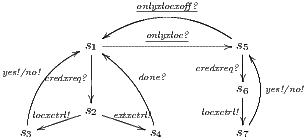
<body><![CDATA[<p>   <font face="Verdana" size="2">In <span class="cite">[<a href="#c9">9</a>]</span> it was argued that the BSNNI/BNNI properties are not quite appropriate to formalize the concept of <span class="cmti-10">secure interface</span>. To illustrate this point the following two examples are presented: in the first one (Figure&nbsp;<a href="#x1-10011">1</a>), we get that the system does not satisfy neither BNNI nor BSNNI but we show that it could be considered secure since no information is actually revealed to low users. The main problem is the way in which weak bisimulation relates output transitions. On the other hand, the second example (Figure&nbsp;<a href="#x1-10022">2</a>) shows that weak bisimulation based security properties may fail to detect an information leakage through input transitions.&nbsp;</font></p>     <p>   </p> <hr class="figure">     <div class="figure">                                                                                                                                                                                     <font face="Verdana" size="2">                                                                                                                                                                                     <a id="x1-10011"></a>                                                                                                                                                                                     </font>                                                                                                                                                                                         <div class="center"> <font face="Verdana" size="2">     <br> </font>     <p> </p>     <p><font face="Verdana" size="2"><img src="/img/revistas/cleiej/v14n3/3a070x.png" alt="                -onlyxlocxoff?-             ----- onlyxloc? -----         --s1-----------------s5- yes!/no!----  -  ---       credxreq?---     -credxreq?-    -done?        s6 -yes!/no!    --    -s2--   --      locxctrl!---    -locxctrl!-   -extxctrl!-          --   s3              s4         s7  " class="math">     <br>  </font>  </p>     <div class="caption"><font face="Verdana" size="2"><span class="id">Figure&nbsp;1: </span><span class="content">Credit approval process of an on-line banking service</span></font></div> <font face="Verdana" size="2">     <br>  </font>  </div>                                                                                                                                                                                      <font face="Verdana" size="2">                                                                                                                                                                                          ]]></body>
<body><![CDATA[<br> </font>     <p>   </p> </div> <hr class="endfigure"> <font face="Verdana" size="2">     <br> </font>     <p>   <font face="Verdana" size="2">Figure&nbsp;<a href="#x1-10011">1</a> models a credit approval process of an on-line banking service using an ISS. As usual, outputs are suffixed by <span class="cmti-10">! </span>and inputs by <span class="cmti-10">?</span>. At the initial state <img src="/img/revistas/cleiej/v14n3/3a071x.png" alt="s1  " class="math">, a client can request a credit (<span class="cmti-10">cred_req?</span>). The credit approval process can be carried on locally or by delegating it to an external component. This decision is modeled by a non deterministic choice. If it is locally processed (<span class="cmti-10">loc_ctrl!</span>), an affirmative or negative response is given to the client (<span class="cmti-10">yes!/no!</span>) and the process returns to the initial state. On the other hand, if the decision is delegated (<span class="cmti-10">ext_ctrl!</span>), the process waits until it receives a notification that the control is finished (<span class="cmti-10">done?</span>), returning then to the initial state. Besides, in the initial state, an administrator can configure the system to do only local control (<span class="underline"><span class="cmti-10">only_loc?</span></span>). This action is high and is not visible for low users. (We <span class="underline">underline</span> private/high actions.) In state <img src="/img/revistas/cleiej/v14n3/3a072x.png" alt="s5  " class="math">, the administrator can configure the system to return to the original configuration using action <span class="underline"><span class="cmti-10">only_loc_off?</span></span>.&nbsp;</font></p>     <p>   <font face="Verdana" size="2">The Credit Request does not satisfy the BSNNI property (nor the BNNI property) and hence it is considered insecure in this setting. The system behaves differently depending on whether the private action <span class="underline"><span class="cmti-10">only_loc?</span></span> is performed or not. If <span class="underline"><span class="cmti-10">only_loc?</span></span> is not executed, after action <span class="cmti-10">cred_req?</span>, it is possible to execute action <span class="cmti-10">ext_ctrl!</span>. This behavior is not possible after the action <span class="underline"><span class="cmti-10">only_loc?</span></span>. Notice nevertheless that output actions are not visible for the user until they are executed. Then, from a low user perspective, the system behavior does not seem to change: the same input is accepted at states <img src="/img/revistas/cleiej/v14n3/3a073x.png" alt="s1  " class="math"> and <img src="/img/revistas/cleiej/v14n3/3a074x.png" alt="s5  " class="math">, and then, the low user cannot distinguish whether the observation of <span class="cmti-10">loc_ctrl! </span>is a consequence of the unique option (at state <img src="/img/revistas/cleiej/v14n3/3a075x.png" alt="s6  " class="math">) or it is just an invariable decision of the Credit Request Process (at state <img src="/img/revistas/cleiej/v14n3/3a076x.png" alt="s2  " class="math">). Hence we expect the system to be classified as secure by the formalism.&nbsp;</font></p>     <p>   <font face="Verdana" size="2">We consider this example to be secure because a user does not know exactly what output action can be executed by an interface if he has no knowledge of the current state, he can observe the output actions only when they are executed.&nbsp;</font></p>     <p>   <font face="Verdana" size="2">On the other hand, a user may try to guess the behavior of the system by performing input actions: wrong inputs will be rejected/ignored; otherwise, they will be accepted. Based on this fact, the following example shows that weak bisimulation based non-interference may fail to detect an information leakage.&nbsp;</font></p>     <p>   </p> <hr class="figure">     <div class="figure">                                                                                                                                                                                     <font face="Verdana" size="2">                                                                                                                                                                                     <a id="x1-10022"></a>                                                                                                                                                                                     </font>                                                                                                                                                                                         <div class="center"> <font face="Verdana" size="2">     ]]></body>
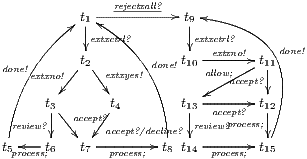
<body><![CDATA[<br> </font>     <p> </p>     <p><font face="Verdana" size="2"><img src="/img/revistas/cleiej/v14n3/3a077x.png" alt="          t1 --rejectxall?---t9 ----       -----extxctrl?       -extxctrl?-----      --   -    ---     - -extxno!- --done! done!--  --t2--extxyes!-done!t10allow;---t11--   -extxno!-   --     --    ---accept?- -  --  t3-     t4     - t13-accept?-t12--  review?---accept?-      -- -review?process;-- t----t-  -t--accept?/dectline?t- -------t--  5process;6   7  process;   8 14 process;  15  " class="math">     <br>  </font>  </p>     <div class="caption"><font face="Verdana" size="2"><span class="id">Figure&nbsp;2: </span><span class="content">External Control Process in an on-line banking service</span></font></div> <font face="Verdana" size="2">     <br>  </font>  </div>                                                                                                                                                                                      <font face="Verdana" size="2">                                                                                                                                                                                          <br> </font>     <p>   </p> </div> <hr class="endfigure"> <font face="Verdana" size="2">     <br> </font>     <p>   <font face="Verdana" size="2">Figure&nbsp;<a href="#x1-10022">2</a> depicts the component that executes the external control. In the initial state, the interface waits for input <span class="cmti-10">ext_ctrl? </span>from the Credit Request Process. After this stimulus, a response about the credit request is given. If the credit is denied (<span class="cmti-10">ext_no!</span>), the client can either ask for a decision review (<span class="cmti-10">review?</span>) or accept the decision (<span class="cmti-10">accept?</span>). In both cases, the decision is processed by the component (<span class="cmti-10">process;</span>). This action is internal and is not visible by users (hidden/internal action are suffixed by semicolon). The process finishes with action <span class="cmti-10">done! </span>returning to the initial state. If the credit is approved (<span class="cmti-10">ext_yes!</span>), the client can accept or decline the credit (<span class="cmti-10">accept?/decline?</span>). The decision is processed, the component informs that the task is done and it returns to the initial state. As in the first example, the behavior of the component can be modified by an administrator, which can configure the interface to reject all credit requests (<span class="underline"><span class="cmti-10">reject_all?</span></span>). For this reason, if <span class="underline"><span class="cmti-10">reject_all?</span></span> is received at the initial state, after an input action <span class="cmti-10">ext_ctrl?</span>, the process can only execute action <span class="cmti-10">ext_no!</span>. At this point, clients are not allowed to ask for a decision review. Then, at state <img src="/img/revistas/cleiej/v14n3/3a078x.png" alt="t11  " class="math">, the interface accepts only input action <span class="cmti-10">accept?</span>. However, based on the client records, the review may be enabled; this is represented with the internal transition <img src="/img/revistas/cleiej/v14n3/3a079x.png" alt="t  -al-lo-w-&rarr;; t  11       13  " class="math">, notice state <img src="/img/revistas/cleiej/v14n3/3a0710x.png" alt="t  13  " class="math"> accepts both inputs actions <span class="cmti-10">accept? </span>and <span class="cmti-10">review?</span>. In any case, after the client response, the result is processed, the component informs that the task is done, and the process is restarted.&nbsp;</font></p>     ]]></body>
<body><![CDATA[<p>   <font face="Verdana" size="2">Suppose that the bank requires that the client cannot detect whether the external process is denying all credit request. Since a low user cannot see the output action until they are executed, he cannot differentiate between the executions <img src="/img/revistas/cleiej/v14n3/3a0711x.png" alt="  extxctrl?    extxno! t1 -----&rarr; t2----&rarr;  t3  " class="math"> and <img src="/img/revistas/cleiej/v14n3/3a0712x.png" alt="   extxctrl?    extxno! t9-----&rarr;  t10- ---&rarr; t11  " class="math">. If we compare states <img src="/img/revistas/cleiej/v14n3/3a0713x.png" alt="t3  " class="math"> and <img src="/img/revistas/cleiej/v14n3/3a0714x.png" alt="t11  " class="math"> under weak bisimulation, both state can execute the same visible transitions and no security problem is detected. Notice that at state <img src="/img/revistas/cleiej/v14n3/3a0715x.png" alt="t11  " class="math">, the process cannot respond immediately to a <span class="cmti-10">review? </span>input, but it can execute <img src="/img/revistas/cleiej/v14n3/3a0716x.png" alt="t11-a-ll-ow-;&rarr; t13-re-v-ie-w-&rarr;? t14  " class="math"> (recall <span class="cmti-10">allow; </span>is an internal action). In fact, low users can distinguish state <img src="/img/revistas/cleiej/v14n3/3a0717x.png" alt="t3  " class="math"> from <img src="/img/revistas/cleiej/v14n3/3a0718x.png" alt="t11  " class="math">: testing the interface at state <img src="/img/revistas/cleiej/v14n3/3a0719x.png" alt="t11  " class="math">, the low user can find out that input action <span class="cmti-10">review? </span>is not enabled, while at <img src="/img/revistas/cleiej/v14n3/3a0720x.png" alt="t3  " class="math"> it is. Hence, we consider that the interface is not secure.&nbsp;</font></p>     <p>   <font face="Verdana" size="2">These observations are based on the fact that input and output actions are conceptually very different. Input actions are controllable by the user while output actions are controllable by the system. Therefore, some behavior one would expect from input actions may be inappropriate for outputs and vice-versa. For instance, the assumption that <span class="cmti-10">&ldquo;wrong inputs will be rejected/ignored; otherwise, they will be accepted&rdquo; </span>in the second example above, makes no sense if applied to outputs because the malicious user is interested in collecting all possible information rather than in rejecting it.&nbsp;</font></p>     <p>   <font face="Verdana" size="2">In <span class="cite">[<a href="#c1">1</a>]</span> and <span class="cite"><a href="#c2">[2</a>]</span>, a deep study about semantic for sequential system is done, but they do not take in account systems where both kinds of actions coexist. In their setting all actions are controlled by one entity: the user or the system. For example, in <span class="cmti-10">Fail Trace Semantic </span>a user executes (input) actions until one action is rejected by the system, in this case the user has the control of which action is executed. A different case is <span class="cmti-10">Trace Semantic </span>where the system has the control of the actions and the user can only observe the executions of the system. Also in stronger semantics, for example with <span class="cmti-10">global testing</span>, the control belongs to one entity. For instance, <span class="cmti-10">Weak</span> <span class="cmti-10">Bisimulation equivalence </span>is also called <span class="cmti-10">observational equivalence </span>and its intuitive notion is &ldquo;two system are observational equivalence if they cannot be distinguished by <span class="cmti-10">an observer</span>&rdquo;, ie the user observes and the system executes (controls) the actions. Notice the subtlety in this case: global testing allows the user to force the system to execute all possible executions but, which actions can be executed in each state is controlled/defined by the system.&nbsp;</font></p>     <p>   <font face="Verdana" size="2">In this work we define semantics for systems where both coexist, actions controlled by the user (input actions) and actions controlled by the system (output actions). We have used an approach similar to the one used in <span class="cite">[<a href="#c2">2]</a></span>. First we define <span class="cmti-10">types of observations</span>, an information record that can be performed by a user. Second, we define a <span class="cmti-10">notion of observability </span>as a set of types of observations. Each notion of observability is a particular semantic. This approach is simple, elegant and allows to be exhaustive: when the types of observation and notion of observability are defined one has all the possible semantics that could be defined.&nbsp;</font></p>     <p>   <font face="Verdana" size="2">These new semantics are suitable to study secure information flow properties over ISS. Moreover, the definition of non-interference presented in this work has as parameter a notion of observability. This generalization through types of observations provides a framework to prove generic theorems that extends to families of security properties. In addition, the approach subsumes previous definitions of non-interference for ISS, in particular the one based on traces&nbsp;<span class="cite">[<a href="#c9">9</a>]</span><a name="c9."></a>, the one based on weak bisimulation <span class="cite">[<a href="#c6">6</a>]</span> and the one based on refinement&nbsp;<span class="cite">[<a href="#c9">9</a>]</span>.&nbsp;</font></p>     <p>   <font face="Verdana" size="2">We also focus our attention in non-interference based on refinement. We give sufficient and simple conditions to ensure compositionality. We also provide two algorithms. The first one determines if an ISS satisfies the                                                                                                                                                                                     refinement-based non-interference property. The second one, determines if an ISS can be made secure by controlling some input actions, and if so, synthesizes the secure ISS. Both algorithms are polynomial in the number of states of the ISS under study. These results are relevant because they could be adapted to other instances of non interference based on notion of observability.&nbsp;</font></p>     <p>   <font face="Verdana" size="2">This paper is an extension of <span class="cite"><a href="#c9">[9</a>]</span>. In <span class="cite">[<a href="#c9">9</a>]</span> we introduce non-interference based on refinement to resolve some shortcomings in the non-interference based on weak bisimulation properties. The approach based on notions of observability shows that the shortcomings do not exist because the properties should be considered in different contexts. We explain this in the last section of the paper.&nbsp;</font></p>     <p>   <font face="Verdana" size="2">   <span class="cmti-10">Organization of the paper.&nbsp; </span>In section&nbsp;<a href="#x1-20002">2</a> we recall definitions of IA, composition and ISS. In section&nbsp;<a href="#x1-60003">3</a> we define the types of observations, notion of observability and the set of observable behaviors of an IA. In section&nbsp;<a href="#x1-70004">4</a> we present the notion of non-interference based on notion of observability. We show that the approach subsumes previous definition of non-interference for ISS and we proof some general properties of non-interference. In section&nbsp;<a href="#x1-80005">5</a> we review the definitions of non-interference based on refinement, and we show that these definitions also are subsumed by the new approach. We study compositionality in this setting and define two algorithms: one to check whether an interface satisfies the property and the another to derive a secure interface from a given (non-secure) interface by controlling inputs actions. Section&nbsp;<a href="#x1-110006">6</a> concludes the paper. </font>    </p>     <p><font face="Verdana" size="2"><span class="titlemark">2   </span> <a id="x1-20002"></a>Interfaces Automata and Interface Structure for Security</font></p>  <font face="Verdana" size="2">      <br> </font>     ]]></body>
<body><![CDATA[<p><font face="Verdana" size="2">In the following, we define <span class="cmti-10">Interface Automata </span>(IA) <span class="cite">[<a href="#c3.">3</a>,&nbsp;<a href="#c4">4]</a></span> and <span class="cmti-10">Interface Structure for Security </span>(ISS) <span class="cite">[<a href="#c6">6</a>]</span>, and introduce some notations.&nbsp;</font></p>     <p>    </p>     <p><font face="Verdana" size="2"><span class="titlemark">2.1   </span> <a id="x1-30002.1"></a>Interfaces Automata</font></p>          <div class="newtheorem"> <font face="Verdana" size="2">     <br> </font>     <p><font face="Verdana" size="2"><span class="head"> <a id="x1-3001r1"></a> <span class="cmbx-10">Definition 1.</span>  </span><span class="cmti-10">An </span>Interface Automaton <span class="cmti-10">(IA) is a tuple</span> <img src="/img/revistas/cleiej/v14n3/3a0721x.png" alt="        0 S = &#10216;Q,q ,  " class="math"> <img src="/img/revistas/cleiej/v14n3/3a0722x.png" alt="  I  O  H A  ,A  ,A  ,-&rarr; &#10217; " class="math"> <span class="cmti-10">where:</span> <a id="x1-3002r1"></a><span class="cmti-10">&nbsp;(i)&nbsp;</span><img src="/img/revistas/cleiej/v14n3/3a0723x.png" alt="Q  " class="math"> <span class="cmti-10">is a finite</span> <span class="cmti-10">set of  </span>states <span class="cmti-10">with</span> <img src="/img/revistas/cleiej/v14n3/3a0724x.png" alt=" 0 q  &isin; Q  " class="math"> <span class="cmti-10">being the </span>initial state<span class="cmti-10">;</span> <a id="x1-3003r2"></a><span class="cmti-10">&nbsp;(ii)&nbsp;</span><img src="/img/revistas/cleiej/v14n3/3a0725x.png" alt="  I A  " class="math"><span class="cmti-10">,</span> <img src="/img/revistas/cleiej/v14n3/3a0726x.png" alt="  O A  " class="math"><span class="cmti-10">, and</span> <img src="/img/revistas/cleiej/v14n3/3a0727x.png" alt="  H A  " class="math"> <span class="cmti-10">are the (pairwise disjoint) finite sets of</span> input<span class="cmti-10">, </span>output<span class="cmti-10">, and </span>hidden actions<span class="cmti-10">, respectively, with</span> <img src="/img/revistas/cleiej/v14n3/3a0728x.png" alt="     I   O    H A = A &cup; A  &cup; A  " class="math"><span class="cmti-10">; and</span> <a id="x1-3004r3"></a><span class="cmti-10">&nbsp;(iii)&nbsp;</span><img src="/img/revistas/cleiej/v14n3/3a0729x.png" alt="-&rarr;  &sube; Q &times;A &times; Q  " class="math"> <span class="cmti-10">is the</span> transition relation <span class="cmti-10">that is required to be finite and </span>input deterministic <span class="cmti-10">(i.e.</span> <img src="/img/revistas/cleiej/v14n3/3a0730x.png" alt="(q,a,q1),(q,a,q2) &isin; &delta;  " class="math"> <span class="cmti-10">implies</span> <img src="/img/revistas/cleiej/v14n3/3a0731x.png" alt="q1 = q2   " class="math"> <span class="cmti-10">for all</span> <img src="/img/revistas/cleiej/v14n3/3a0732x.png" alt="     I a &isin; A  " class="math"> <span class="cmti-10">and</span> <img src="/img/revistas/cleiej/v14n3/3a0733x.png" alt="q,q1,q2 &isin; Q  " class="math"><span class="cmti-10">).</span> <span class="cmti-10">In general, we denote</span> <img src="/img/revistas/cleiej/v14n3/3a0734x.png" alt="QS  " class="math"><span class="cmti-10">,</span> <img src="/img/revistas/cleiej/v14n3/3a0735x.png" alt=" I AS  " class="math"><span class="cmti-10">,</span> <img src="/img/revistas/cleiej/v14n3/3a0736x.png" alt="&rarr;S  " class="math"><span class="cmti-10">, etc.&nbsp;to indicate that they are the set of states, input actions, transitions,</span> <span class="cmti-10">etc.&nbsp;of the IA</span> <img src="/img/revistas/cleiej/v14n3/3a0737x.png" alt="S  " class="math"><span class="cmti-10">.</span> </font>    </p> </div>  <font face="Verdana" size="2">      <br> </font>     <p><font face="Verdana" size="2">As usual, we denote <img src="/img/revistas/cleiej/v14n3/3a0738x.png" alt="q a-&rarr; q&prime; " class="math"> whenever <img src="/img/revistas/cleiej/v14n3/3a0739x.png" alt="(q,a,q&prime;) &isin; -&rarr; " class="math">, <img src="/img/revistas/cleiej/v14n3/3a0740x.png" alt="q a-&rarr; " class="math"> if there is <img src="/img/revistas/cleiej/v14n3/3a0741x.png" alt="q&prime; " class="math"> s.t.&nbsp;<img src="/img/revistas/cleiej/v14n3/3a0742x.png" alt="q-a&rarr; q&prime; " class="math">, and <img src="/img/revistas/cleiej/v14n3/3a0743x.png" alt="q-a&rarr;&frasl; " class="math"> if this is not the case. An <span class="cmti-10">execution </span>of <img src="/img/revistas/cleiej/v14n3/3a0744x.png" alt="S  " class="math"> is a finite sequence <img src="/img/revistas/cleiej/v14n3/3a0745x.png" alt="q0a0q1a1...qn  " class="math"> s.t.&nbsp;<img src="/img/revistas/cleiej/v14n3/3a0746x.png" alt="qi &isin; Q  " class="math">, <img src="/img/revistas/cleiej/v14n3/3a0747x.png" alt="ai &isin; A  " class="math"> and <img src="/img/revistas/cleiej/v14n3/3a0748x.png" alt="  ai qi-&rarr;  qi+1  " class="math"> for <img src="/img/revistas/cleiej/v14n3/3a0749x.png" alt="0 &le; i &lt; n  " class="math">. An execution is <span class="cmti-10">autonomous </span>if all their actions are output or hidden (the execution does not need stimulus from the environment to run). If there is an autonomous execution from <img src="/img/revistas/cleiej/v14n3/3a0750x.png" alt="q  " class="math"> to <img src="/img/revistas/cleiej/v14n3/3a0751x.png" alt="&prime; q " class="math"> and all action are hidden, we write <img src="/img/revistas/cleiej/v14n3/3a0752x.png" alt="  &epsilon;  &prime; q&rArr;  q " class="math">. Notice this includes case <img src="/img/revistas/cleiej/v14n3/3a0753x.png" alt="    &prime; q = q " class="math">. We write <img src="/img/revistas/cleiej/v14n3/3a0754x.png" alt="  a  &prime; q &rArr; q " class="math"> if there are <img src="/img/revistas/cleiej/v14n3/3a0755x.png" alt="q1  " class="math"> and <img src="/img/revistas/cleiej/v14n3/3a0756x.png" alt="q2  " class="math"> s.t.&nbsp;<img src="/img/revistas/cleiej/v14n3/3a0757x.png" alt="  &epsilon;   a    &epsilon; q&rArr;  q1-&rarr;  q2 &rArr; q&prime; " class="math">. Moreover <img src="/img/revistas/cleiej/v14n3/3a0758x.png" alt="  &circ;a q&rArr; q&prime; " class="math"> denotes <img src="/img/revistas/cleiej/v14n3/3a0759x.png" alt="  a q&rArr;  q&prime; " class="math"> or <img src="/img/revistas/cleiej/v14n3/3a0760x.png" alt="a &isin; AH  " class="math"> and <img src="/img/revistas/cleiej/v14n3/3a0761x.png" alt="q = q&prime; " class="math">. We write <img src="/img/revistas/cleiej/v14n3/3a0762x.png" alt="    a q &rArr;&epsilon;-&rarr; " class="math"> if there is <img src="/img/revistas/cleiej/v14n3/3a0763x.png" alt="q&prime; " class="math"> s.t.&nbsp;<img src="/img/revistas/cleiej/v14n3/3a0764x.png" alt="q &rArr;&epsilon;q&prime; " class="math"> and <img src="/img/revistas/cleiej/v14n3/3a0765x.png" alt="  a q&prime;-&rarr; " class="math">. A <span class="cmti-10">trace </span>from <img src="/img/revistas/cleiej/v14n3/3a0766x.png" alt="q0  " class="math"> is a sequence of visible actions <img src="/img/revistas/cleiej/v14n3/3a0767x.png" alt="a0,a1 &sdot;&sdot;&sdot; " class="math"> such that there are states <img src="/img/revistas/cleiej/v14n3/3a0768x.png" alt="q1,q2,&sdot;&sdot;&sdot; " class="math"> such that <img src="/img/revistas/cleiej/v14n3/3a0769x.png" alt="q0&rArr;a0 q1 a&rArr;1 q2 &sdot;&sdot;&sdot; " class="math"> is an execution. The set of traces of an IA <img src="/img/revistas/cleiej/v14n3/3a0770x.png" alt="S  " class="math">, notation <img src="/img/revistas/cleiej/v14n3/3a0771x.png" alt="Traces(S)  " class="math">, is the set of all traces from the initial state of <img src="/img/revistas/cleiej/v14n3/3a0772x.png" alt="S  " class="math">.&nbsp;</font></p>     <p>    </p>     <p><font face="Verdana" size="2"><a id="x1-40002.1"></a>Composition</font></p>  <font face="Verdana" size="2">      ]]></body>
<body><![CDATA[<br> </font>     <p><font face="Verdana" size="2">Composition of two IA is only defined if their actions are disjoint except when input actions of one of the IA coincide with some of the output actions of the other. Such actions are intended to synchronize in a communication. </font>                                                                                                                                                                                        </p>     <div class="newtheorem"> <font face="Verdana" size="2">     <br> </font>     <p><font face="Verdana" size="2"><span class="head"> <a id="x1-4001r2"></a> <span class="cmbx-10">Definition 2.</span>  </span><span class="cmti-10">Let</span> <img src="/img/revistas/cleiej/v14n3/3a0773x.png" alt="S  " class="math"> <span class="cmti-10">and</span> <img src="/img/revistas/cleiej/v14n3/3a0774x.png" alt="T  " class="math"> <span class="cmti-10">be two IA, and let</span> <img src="/img/revistas/cleiej/v14n3/3a0775x.png" alt="shared(S,T) = (AS &cap; AT)  " class="math"> <span class="cmti-10">be the set of  </span>shared actions<span class="cmti-10">.</span> <span class="cmti-10">We say that</span> <img src="/img/revistas/cleiej/v14n3/3a0776x.png" alt="S  " class="math"> <span class="cmti-10">and</span> <img src="/img/revistas/cleiej/v14n3/3a0777x.png" alt="T  " class="math"> <span class="cmti-10">are  </span>composable  <span class="cmti-10">whenever</span> <img src="/img/revistas/cleiej/v14n3/3a0778x.png" alt="               I   O     O    I shared(S,T) = (A S &cap; AT) &cup;(AS &cap; AT )  " class="math"><span class="cmti-10">. Two ISS</span> <img src="/img/revistas/cleiej/v14n3/3a0779x.png" alt="        h   l S = &#10216;S,AS,A S&#10217; " class="math"> <span class="cmti-10">and</span> <img src="/img/revistas/cleiej/v14n3/3a0780x.png" alt="         h  l T = &#10216;T,A T,AT&#10217; " class="math"> <span class="cmti-10">are composable if</span> <img src="/img/revistas/cleiej/v14n3/3a0781x.png" alt="S  " class="math"> <span class="cmti-10">and</span> <img src="/img/revistas/cleiej/v14n3/3a0782x.png" alt="T  " class="math"> <span class="cmti-10">are composable.</span> </font>    </p> </div>  <font face="Verdana" size="2">      <br> </font>     <p>   <font face="Verdana" size="2">The product of two composable IA <img src="/img/revistas/cleiej/v14n3/3a0783x.png" alt="S  " class="math"> and <img src="/img/revistas/cleiej/v14n3/3a0784x.png" alt="T  " class="math"> is defined pretty much as CSP parallel composition: <a id="x1-4002r1"></a><span class="cmti-10">(i)</span>&nbsp;the state space of the product is the product of the set of states of the components, <a id="x1-4003r2"></a><span class="cmti-10">(ii)</span>&nbsp;only shared actions can synchronize, i.e., both component should perform a transition with the same synchronizing label (one input, and the other output), and <a id="x1-4004r3"></a><span class="cmti-10">(iii)</span>&nbsp;transitions with non-shared actions are interleaved. Besides, shared actions are hidden in the product. </font>    </p>     <div class="newtheorem"> <font face="Verdana" size="2">     <br> </font>     <p><font face="Verdana" size="2"><span class="head"> <a id="x1-4005r3"></a> <span class="cmbx-10">Definition 3.</span>  </span><span class="cmti-10">Let</span> <img src="/img/revistas/cleiej/v14n3/3a0785x.png" alt="S  " class="math"> <span class="cmti-10">and</span> <img src="/img/revistas/cleiej/v14n3/3a0786x.png" alt="T  " class="math"> <span class="cmti-10">be composable IA. The </span>product <img src="/img/revistas/cleiej/v14n3/3a0787x.png" alt="S &otimes; T  " class="math"> <span class="cmti-10">is the interface automaton defined</span> <span class="cmti-10">by:</span> </font>      </p> <ul>       <li class="compactitem"><font face="Verdana" size="2"><img src="/img/revistas/cleiej/v14n3/3a0788x.png" alt="QS &otimes;T = QS &times; QT  " class="math"> <span class="cmti-10">with</span> <img src="/img/revistas/cleiej/v14n3/3a0789x.png" alt=" 0       0  0 qS&otimes;T = (qS,qT )  " class="math"><span class="cmti-10">;</span> </font>      </li>       <li class="compactitem"><font face="Verdana" size="2"><img src="/img/revistas/cleiej/v14n3/3a0790x.png" alt=" I       I   I AS&otimes;T = A S &cup; AT - shared(S,T )  " class="math"><span class="cmti-10">,</span>                 <img src="/img/revistas/cleiej/v14n3/3a0791x.png" alt=" O      O    O AS&otimes;T = AS &cup; AT - shared(S,T)  " class="math"><span class="cmti-10">,                 and</span>      <img src="/img/revistas/cleiej/v14n3/3a0792x.png" alt=" H       H    H AS&otimes;T = A S &cup;A T &cup;shared(S,T)  " class="math"><span class="cmti-10">; and</span>      </font>      </li>       <li class="compactitem"><font face="Verdana" size="2"><img src="/img/revistas/cleiej/v14n3/3a0793x.png" alt="       a       &prime; &prime; (qS,qT )-&rarr;S &otimes;T (qS,qT)  " class="math"> <span class="cmti-10">if any of the following holds:</span>      </font>            <ul>        <li class="compactitem"><font face="Verdana" size="2"><img src="/img/revistas/cleiej/v14n3/3a0794x.png" alt="a &isin; AS - shared(S,T)  " class="math"><span class="cmti-10">,</span> <img src="/img/revistas/cleiej/v14n3/3a0795x.png" alt="   a   &prime; qS-&rarr;S  qS  " class="math"><span class="cmti-10">, and</span> <img src="/img/revistas/cleiej/v14n3/3a0796x.png" alt="      &prime; qT = qT  " class="math"><span class="cmti-10">;</span> </font>       </li>        <li class="compactitem"><font face="Verdana" size="2"><img src="/img/revistas/cleiej/v14n3/3a0797x.png" alt="a &isin; AT - shared(S,T)  " class="math"><span class="cmti-10">,</span> <img src="/img/revistas/cleiej/v14n3/3a0798x.png" alt="   a   &prime; qT-&rarr;S qT  " class="math"><span class="cmti-10">, and</span> <img src="/img/revistas/cleiej/v14n3/3a0799x.png" alt="      &prime; qS = qS  " class="math"><span class="cmti-10">;</span> </font>       </li>        <li class="compactitem"><font face="Verdana" size="2"><img src="/img/revistas/cleiej/v14n3/3a07100x.png" alt="a &isin; shared(S,T )  " class="math"><span class="cmti-10">,</span> <img src="/img/revistas/cleiej/v14n3/3a07101x.png" alt="   a   &prime; qS-&rarr;S qS  " class="math"><span class="cmti-10">, and</span> <img src="/img/revistas/cleiej/v14n3/3a07102x.png" alt="   a    &prime; qT -&rarr;T  qT  " class="math"><span class="cmti-10">.</span></font></li>         ]]></body>
<body><![CDATA[</ul>       </li>     </ul>     </div>  <font face="Verdana" size="2">      <br> </font>     <p>   <font face="Verdana" size="2">There may be reachable states on <img src="/img/revistas/cleiej/v14n3/3a07103x.png" alt="S &otimes; T  " class="math"> for which one of the components, say <img src="/img/revistas/cleiej/v14n3/3a07104x.png" alt="S  " class="math">, may produce an output shared action that the other is not ready to accept (i.e., its corresponding input is not available at the current state). Then <img src="/img/revistas/cleiej/v14n3/3a07105x.png" alt="S  " class="math"> violates the input assumption of <img src="/img/revistas/cleiej/v14n3/3a07106x.png" alt="T  " class="math"> and this is not acceptable. States like these are called <span class="cmti-10">error</span> <span class="cmti-10">states</span>. </font>    </p>     <div class="newtheorem"> <font face="Verdana" size="2">     <br> </font>     <p><font face="Verdana" size="2"><span class="head"> <a id="x1-4006r4"></a> <span class="cmbx-10">Definition 4.</span>  </span><span class="cmti-10">Let</span> <img src="/img/revistas/cleiej/v14n3/3a07107x.png" alt="S  " class="math"> <span class="cmti-10">and</span> <img src="/img/revistas/cleiej/v14n3/3a07108x.png" alt="T  " class="math"> <span class="cmti-10">be composable IA. A product state</span> <img src="/img/revistas/cleiej/v14n3/3a07109x.png" alt="(qS,qT) &isin; QS &otimes;T  " class="math"> <span class="cmti-10">is an </span>error state <span class="cmti-10">if</span> <span class="cmti-10">there is an action</span> <img src="/img/revistas/cleiej/v14n3/3a07110x.png" alt="a &isin; shared(S,T )  " class="math"> <span class="cmti-10">s.t.&nbsp;either</span> <img src="/img/revistas/cleiej/v14n3/3a07111x.png" alt="a &isin; AOS  " class="math"><span class="cmti-10">,</span> <img src="/img/revistas/cleiej/v14n3/3a07112x.png" alt="qS-&rarr;aS  " class="math"> <span class="cmti-10">and</span> <img src="/img/revistas/cleiej/v14n3/3a07113x.png" alt="qT-&rarr;a&frasl; T  " class="math"><span class="cmti-10">, or</span> <img src="/img/revistas/cleiej/v14n3/3a07114x.png" alt="a &isin; AOT  " class="math"><span class="cmti-10">,</span> <img src="/img/revistas/cleiej/v14n3/3a07115x.png" alt="qT-&rarr;aT  " class="math"> <span class="cmti-10">and</span> <img src="/img/revistas/cleiej/v14n3/3a07116x.png" alt="q -&rarr;a&frasl;  S  S  " class="math"><span class="cmti-10">.</span> </font>    </p> </div>  <font face="Verdana" size="2">      <br> </font>     <p>   <font face="Verdana" size="2">If the product <img src="/img/revistas/cleiej/v14n3/3a07117x.png" alt="S &otimes; T  " class="math"> does not contain any reachable error state, then each component satisfies the interface of the other (i.e., the input assumptions) and thus are compatible. Instead, the presence of a reachable error state is evidence that one component is violating the interface of the other. This may not be a major problem as long as the environment is able to restrain of producing an output (an input to <img src="/img/revistas/cleiej/v14n3/3a07118x.png" alt="S &otimes; T  " class="math">) that leads the product to the error state. Of course, it may be the case that <img src="/img/revistas/cleiej/v14n3/3a07119x.png" alt="S &otimes; T  " class="math"> does not provide any possible input to the environment and reaches autonomously (i.e., via output or hidden actions) an error state. In such a case we say that <img src="/img/revistas/cleiej/v14n3/3a07120x.png" alt="S &otimes; T  " class="math"> is incompatible. </font>    </p>     <div class="newtheorem"> <font face="Verdana" size="2">     ]]></body>
<body><![CDATA[<br> </font>     <p><font face="Verdana" size="2"><span class="head"> <a id="x1-4007r5"></a>                                                                                                                                                                                     <span class="cmbx-10">Definition 5.</span>  </span><span class="cmti-10">Let</span> <img src="/img/revistas/cleiej/v14n3/3a07121x.png" alt="S  " class="math"> <span class="cmti-10">and</span> <img src="/img/revistas/cleiej/v14n3/3a07122x.png" alt="T  " class="math"> <span class="cmti-10">be composable IA and let</span> <img src="/img/revistas/cleiej/v14n3/3a07123x.png" alt="S &otimes; T  " class="math"> <span class="cmti-10">be its product. A state</span> <img src="/img/revistas/cleiej/v14n3/3a07124x.png" alt="(qS,qT) &isin; QS &otimes;T  " class="math"> <span class="cmti-10">is</span> <span class="cmti-10">an </span>incompatible state <span class="cmti-10">if there is an error state reachable from</span> <img src="/img/revistas/cleiej/v14n3/3a07125x.png" alt="(qS,qT)  " class="math"> <span class="cmti-10">through an autonomous execution.</span> <span class="cmti-10">If a state is not incompatible, it is </span>compatible<span class="cmti-10">. If the initial state of</span> <img src="/img/revistas/cleiej/v14n3/3a07126x.png" alt="S &otimes; T  " class="math"> <span class="cmti-10">is compatible, then</span> <img src="/img/revistas/cleiej/v14n3/3a07127x.png" alt="S  " class="math"> <span class="cmti-10">and</span> <img src="/img/revistas/cleiej/v14n3/3a07128x.png" alt="T  " class="math"> <span class="cmti-10">are </span>compatible<span class="cmti-10">.</span> </font>    </p> </div>  <font face="Verdana" size="2">      <br> </font>     <p>   <font face="Verdana" size="2">Finally, if two IA are compatible, it is possible to define the interface for the resulting composition. Such interface is the result of pruning all input transitions of the product that lead to incompatible states i.e.&nbsp;states from which an error state can be autonomously reached. </font>    </p>     <div class="newtheorem"> <font face="Verdana" size="2">     <br> </font>     <p><font face="Verdana" size="2"><span class="head"> <a id="x1-4008r6"></a> <span class="cmbx-10">Definition 6.</span>  </span><span class="cmti-10">Let</span> <img src="/img/revistas/cleiej/v14n3/3a07129x.png" alt="S  " class="math"> <span class="cmti-10">and</span> <img src="/img/revistas/cleiej/v14n3/3a07130x.png" alt="T  " class="math"> <span class="cmti-10">be compatible IA. The </span>composition <img src="/img/revistas/cleiej/v14n3/3a07131x.png" alt="S &#8741; T  " class="math"> <span class="cmti-10">is the IA that results from</span> <img src="/img/revistas/cleiej/v14n3/3a07132x.png" alt="S &otimes; T  " class="math"> <span class="cmti-10">by</span> <span class="cmti-10">removing all transition</span> <img src="/img/revistas/cleiej/v14n3/3a07133x.png" alt="q-&rarr;a    q&prime;    S&otimes;T " class="math"> <span class="cmti-10">s.t.&nbsp;</span><a id="x1-4009r1"></a><span class="cmti-10">(i)&nbsp;</span><img src="/img/revistas/cleiej/v14n3/3a07134x.png" alt="q  " class="math"> <span class="cmti-10">is a compatible state in</span> <img src="/img/revistas/cleiej/v14n3/3a07135x.png" alt="S &otimes;T  " class="math"><span class="cmti-10">,</span> <a id="x1-4010r2"></a><span class="cmti-10">(ii)&nbsp;</span><img src="/img/revistas/cleiej/v14n3/3a07136x.png" alt="a &isin; AI      S&otimes;T  " class="math"><span class="cmti-10">, and</span> <a id="x1-4011r3"></a><span class="cmti-10">(iii)&nbsp;</span><img src="/img/revistas/cleiej/v14n3/3a07137x.png" alt="q&prime; " class="math"> <span class="cmti-10">is an</span> <span class="cmti-10">incompatible state in</span> <img src="/img/revistas/cleiej/v14n3/3a07138x.png" alt="S &otimes; T  " class="math"><span class="cmti-10">.</span> </font>    </p> </div>  <font face="Verdana" size="2">      <br> </font>     <p>    </p>     <p><font face="Verdana" size="2"><span class="titlemark">2.2   </span> <a id="x1-50002.2"></a>Interface Structure For Security</font></p>  <font face="Verdana" size="2">      ]]></body>
<body><![CDATA[<br> </font>     <p><font face="Verdana" size="2">An <span class="cmti-10">Interface Structures for Security </span>is an IA, where visible actions are divided in two disjoint sets: the <span class="cmti-10">high action</span> set and the <span class="cmti-10">low action </span>set. Low actions can be observed and used for any user, while high actions are intended only for users with the appropriate clearance. </font>    </p>     <div class="newtheorem"> <font face="Verdana" size="2">     <br> </font>     <p><font face="Verdana" size="2"><span class="head"> <a id="x1-5001r7"></a> <span class="cmbx-10">Definition 7.</span>  </span><span class="cmti-10">An  </span>Interface  Structure  for  Security  (ISS)  <span class="cmti-10">is  a  tuple</span>  <img src="/img/revistas/cleiej/v14n3/3a07139x.png" alt="&#10216;S,Ah,Al&#10217; " class="math"> <span class="cmti-10">where</span>  <img src="/img/revistas/cleiej/v14n3/3a07140x.png" alt="S = &#10216;Q,q0,  " class="math"> <img src="/img/revistas/cleiej/v14n3/3a07141x.png" alt="AI,AO, AH, -&rarr; &#10217; " class="math"> <span class="cmti-10">is an IA and</span> <img src="/img/revistas/cleiej/v14n3/3a07142x.png" alt="Ah  " class="math"> <span class="cmti-10">and</span> <img src="/img/revistas/cleiej/v14n3/3a07143x.png" alt="Al  " class="math"> <span class="cmti-10">are disjoint sets of actions s.t.&nbsp;</span><img src="/img/revistas/cleiej/v14n3/3a07144x.png" alt="Ah &cup; Al = AO &cup; AI  " class="math"><span class="cmti-10">.</span> </font>    </p> </div>  <font face="Verdana" size="2">      <br> </font>     <p>   <font face="Verdana" size="2">If necessary, we will write <img src="/img/revistas/cleiej/v14n3/3a07145x.png" alt="Ah  S  " class="math"> and <img src="/img/revistas/cleiej/v14n3/3a07146x.png" alt="Al   S  " class="math"> instead of <img src="/img/revistas/cleiej/v14n3/3a07147x.png" alt="Ah  " class="math"> and <img src="/img/revistas/cleiej/v14n3/3a07148x.png" alt="Al  " class="math">, respectively, and write <img src="/img/revistas/cleiej/v14n3/3a07149x.png" alt="AX,m  " class="math"> instead of <img src="/img/revistas/cleiej/v14n3/3a07150x.png" alt="AX  &cap;Am  " class="math"> with <img src="/img/revistas/cleiej/v14n3/3a07151x.png" alt="X  &isin; {I,O } " class="math"> and <img src="/img/revistas/cleiej/v14n3/3a07152x.png" alt="m &isin; {h,l} " class="math">.&nbsp;</font></p>     <p>   <font face="Verdana" size="2">Extending the definition of composition of IA to ISS is straightforward. </font>    </p>     <div class="newtheorem"> <font face="Verdana" size="2">     <br> </font>     ]]></body>

<body><![CDATA[<p><font face="Verdana" size="2"><span class="head"> <a id="x1-5002r8"></a> <span class="cmbx-10">Definition 8.</span>  </span><span class="cmti-10">Let</span> <img src="/img/revistas/cleiej/v14n3/3a07153x.png" alt="S = &#10216;S,AhS,AlS&#10217; " class="math"> <span class="cmti-10">and</span> <img src="/img/revistas/cleiej/v14n3/3a07154x.png" alt="T = &#10216;T,AhT,AlT&#10217; " class="math"> <span class="cmti-10">be two ISS.</span> <img src="/img/revistas/cleiej/v14n3/3a07155x.png" alt="S " class="math"> <span class="cmti-10">and</span> <img src="/img/revistas/cleiej/v14n3/3a07156x.png" alt="T " class="math"> <span class="cmti-10">are </span>composable <span class="cmti-10">if</span> <img src="/img/revistas/cleiej/v14n3/3a07157x.png" alt="S  " class="math"> <span class="cmti-10">and</span> <img src="/img/revistas/cleiej/v14n3/3a07158x.png" alt="T  " class="math"> <span class="cmti-10">are composable. Given two composable ISS,</span> <img src="/img/revistas/cleiej/v14n3/3a07159x.png" alt="S " class="math"> <span class="cmti-10">and</span> <img src="/img/revistas/cleiej/v14n3/3a07160x.png" alt="T " class="math"><span class="cmti-10">, their </span>composition<span class="cmti-10">,</span> <img src="/img/revistas/cleiej/v14n3/3a07161x.png" alt="S &#8741; T " class="math"><span class="cmti-10">, is defined by</span> <span class="cmti-10">the ISS</span> <img src="/img/revistas/cleiej/v14n3/3a07162x.png" alt="&#10216;S &#8741; T,(AhS &cup; AhT)- shared(S,T ),(AlS &cup; AlT) - shared(S,T)&#10217; " class="math"><span class="cmti-10">.</span> </font>    </p> </div>  <font face="Verdana" size="2">      <br> </font>     <p>    </p>     <p><font face="Verdana" size="2"><span class="titlemark">3   </span> <a id="x1-60003"></a>Observability</font></p>  <font face="Verdana" size="2">      <br> </font>     <p><font face="Verdana" size="2">Semantic equivalences for sequential systems with silent moves are studied in <span class="cite">[<a href="#c2">2</a>]</span>. Resulting in 155 notions of observability and a complete comparison between them. Unfortunately, these results cannot be applied straightforward to the IA context. For example, studied machines in <span class="cite">[<a href="#c2">2</a>]</span> have not notions of input and output actions over the same machine. Moreover, in <span class="cite">[<a href="#c2">2</a>]</span> there is not a notion of the internal structure of the analyzed machine. This situation have forced them to talk about <span class="cmti-10">definite </span>and <span class="cmti-10">hypothetical </span>behaviors of the machine. Despite these differences, we use<a href="#c2"> </a><span class="cite"><a href="#c2">[2</a>]</span> as a reference to define different semantics for IA. To avoid the distinction between definite and hypothetical behaviors, we use the transition relation of the IA to present the set of observable behaviors.&nbsp;</font></p>     <p>   <font face="Verdana" size="2">First we define <span class="cmti-10">type of observation</span>, an information record that can be done by the user. Second, we define a <span class="cmti-10">notion of observability </span>as a set of types of observations. Each notion of observability defines a particular semantic. Third, using the transition relation of the IA, we define the semantic of each type of observation and therefore a semantic for each possible notion of observability.&nbsp;</font></p>     <p>   <font face="Verdana" size="2">Given a system, a <span class="cmti-10">type of observation </span>is an information that can be recorded by a user with respect to the interface. To define our types of observations we consider the following assumptions: input and output actions are observable when they are executed. Inputs are executed by a user, while outputs are executed by the interface. Then, input actions are controllable by the user and output actions are controllable by the interface. Internal transitions are controllable by the interface. In some cases, internal transitions can be detectable by the user but the user cannot distinguish between different internal actions. An user can observe how the interface interact with another user or he can be the one who interacts. If the user is interacting, the interface can behave in different ways as a result of some violation of its input assumptions: (<img src="/img/revistas/cleiej/v14n3/3a07163x.png" alt="i  " class="math">) it does not show any error and continues with the execution, (<img src="/img/revistas/cleiej/v14n3/3a07164x.png" alt="ii  " class="math">) it stops the execution and shows an error to the user, (<img src="/img/revistas/cleiej/v14n3/3a07165x.png" alt="iii  " class="math">) it shows an error to the user and continues with the execution; (<img src="/img/revistas/cleiej/v14n3/3a07166x.png" alt="iv  " class="math">) finally, an interface could provide a special service to inform which inputs are enabled in its current state. In this way, the user can avoid input assumption violations. Notice that cases (<img src="/img/revistas/cleiej/v14n3/3a07167x.png" alt="i  " class="math">), (<img src="/img/revistas/cleiej/v14n3/3a07168x.png" alt="ii  " class="math">) and (<img src="/img/revistas/cleiej/v14n3/3a07169x.png" alt="iii  " class="math">) determine, at the semantic level, a sort of input-enableness. In these cases we fix the behavior of input actions that are not defined in a particular state. The last four assumptions do not increase the expressiveness power of the model, as consequence they can be implemented in any IA. For example: let <img src="/img/revistas/cleiej/v14n3/3a07170x.png" alt="S  " class="math"> be an IA, the assumption <img src="/img/revistas/cleiej/v14n3/3a07171x.png" alt="(i)  " class="math"> can be implemented with self loops with action <img src="/img/revistas/cleiej/v14n3/3a07172x.png" alt="a?  " class="math"> for all state state <img src="/img/revistas/cleiej/v14n3/3a07173x.png" alt="s &isin; Q      S  " class="math"> and <img src="/img/revistas/cleiej/v14n3/3a07174x.png" alt="a? &isin; AI - I(s)  " class="math">. Using the same reasoning, we assume an interface could provide a service to detect the end of an execution, where the end is reached when no more transitions are possible. In addition, a user can make copies of the interface with the objective of studying the interface in more detail. Finally, a user can do <span class="cmti-10">global testing</span>. Under this assumption it is possible to say that a particular observation will not happen.&nbsp;</font></p>     <p>   <font face="Verdana" size="2">Based on these assumptions, we introduce the following types of observations: </font>         </p> <ul class="itemize1">          <li class="itemize"><font face="Verdana" size="2">[<img src="/img/revistas/cleiej/v14n3/3a07175x.png" alt="a  " class="math">] The execution of external actions <img src="/img/revistas/cleiej/v14n3/3a07176x.png" alt="AI &cup;AO  " class="math"> are detectable.         </font>         </li>          <li class="itemize"><font face="Verdana" size="2">[<img src="/img/revistas/cleiej/v14n3/3a07177x.png" alt="&epsilon;,&epsilon;&frasl; " class="math">] The case of internal transitions are detectable is denoted with <img src="/img/revistas/cleiej/v14n3/3a07178x.png" alt="&epsilon;  " class="math">. Otherwise <img src="/img/revistas/cleiej/v14n3/3a07179x.png" alt="&epsilon;&frasl; " class="math">.         </font>         </li>          <li class="itemize"><font face="Verdana" size="2">[<img src="/img/revistas/cleiej/v14n3/3a07180x.png" alt="T  " class="math">] The session is terminated by the user. This is possible in any time. After this no more records         are possible </font>         </li>          <li class="itemize"><font face="Verdana" size="2">[<img src="/img/revistas/cleiej/v14n3/3a07181x.png" alt="&#8644;&frasl; ,&#8644; " class="math">] If a user only observes the actions that are executed by an interface and cannot send         stimuli to it, then there is no interaction. We denote this with <img src="/img/revistas/cleiej/v14n3/3a07182x.png" alt="&#8644;&frasl; " class="math">. The case where the interaction         is possible is denoted by <img src="/img/revistas/cleiej/v14n3/3a07183x.png" alt="&#8644; " class="math">.         </font>         </li>          <li class="itemize"><font face="Verdana" size="2">[<img src="/img/revistas/cleiej/v14n3/3a07184x.png" alt="F  " class="math">] The user interacts with system and the interface stops the execution whenever it receives an         input action that is not enabled. In this case, the stop is observable.         </font>         </li>          <li class="itemize"><font face="Verdana" size="2">[<img src="/img/revistas/cleiej/v14n3/3a07185x.png" alt="FT  " class="math">] Suppose the previous type but now whenever the interface receives an input action that is         not enabled, the error is informed to the user and the execution continues.         </font>         </li>          <li class="itemize"><font face="Verdana" size="2">[<img src="/img/revistas/cleiej/v14n3/3a07186x.png" alt="RT  " class="math">] To avoid the error of sending an input action that is not enabled, the interface can provide         a method to check what input actions are enabled in its current state. In this case, the observation         includes the set <img src="/img/revistas/cleiej/v14n3/3a07187x.png" alt="X  " class="math"> of enabled inputs.         </font>         </li>          <li class="itemize"><font face="Verdana" size="2">[<img src="/img/revistas/cleiej/v14n3/3a07188x.png" alt="0  " class="math">] This type is used if it is detectable when an interface reachs a final state, i.e. no more activity         is possible. </font>         </li>          <li class="itemize"><font face="Verdana" size="2">[<img src="/img/revistas/cleiej/v14n3/3a07189x.png" alt="&and; " class="math">]  Suppose  the  user  has  a  machine  to  make  arbitrary  number  of  copies  of  the  system.                                                                                                                                                                                             These copies reveal more information about the interface because one could observes different         execution from the same interface. If the user makes <img src="/img/revistas/cleiej/v14n3/3a07190x.png" alt="N  " class="math"> copies and in each copy executes <img src="/img/revistas/cleiej/v14n3/3a07191x.png" alt="&#981;i  " class="math"> for         <img src="/img/revistas/cleiej/v14n3/3a07192x.png" alt="i &isin; {1,...,N} " class="math">, this observations is denoted with <img src="/img/revistas/cleiej/v14n3/3a07193x.png" alt="&and;   ni=1&#981;i  " class="math">. </font>         </li>          <li class="itemize"><font face="Verdana" size="2">[<img src="/img/revistas/cleiej/v14n3/3a07194x.png" alt="&not; " class="math">] It is possible to test the interface over all possible condition. This allows to ensure that a         particular observation is not possible; then a user can do an observation <img src="/img/revistas/cleiej/v14n3/3a07195x.png" alt="&not; &#981;  " class="math"> whenever <img src="/img/revistas/cleiej/v14n3/3a07196x.png" alt="&#981;  " class="math"> is not         possible execution of the system.</font></li>     </ul>  <font face="Verdana" size="2">      ]]></body>
<body><![CDATA[<br> </font>     <p>   <font face="Verdana" size="2">The types of observations studied here are not the studies in <span class="cite">[<a href="#c2">2</a>]</span>. On one hand, we decided to skip some types for the sake of simplicity. For example we did not include <img src="/img/revistas/cleiej/v14n3/3a07197x.png" alt="&eta;  " class="math">-replication nor <span class="cmti-10">continuous copying</span>, which are different forms of make copies of the system. We did not include the notion of <span class="cmti-10">stable state</span>, this avoids the inclusion of some variant of types of visibilities presented here. On the other hand, we have added new features. First, we differentiate between a user that interacts with the interface and a non-interacting user. Second, the knowledge of the internal structure of the interface allow us to know exactly when an internal action could be executed and define if the internal transitions are observable or not. This is a relevant feature in the context of security, because it could be used to represent covert channels.&nbsp;</font></p>     <p>   <font face="Verdana" size="2">A set of types of observations defines a <span class="cmti-10">notion of observability</span>, see Definition&nbsp;<a href="#x1-6001r9">9</a>. The notion of observability determines what information can be observed by a user. This has to be consistent, for example, types of observations &ldquo;a user cannot interact with the interface&rdquo; (<img src="/img/revistas/cleiej/v14n3/3a07198x.png" alt="&#8644;&frasl; " class="math">) and &ldquo;a user can detect that the input sent was not enabled&rdquo; (<img src="/img/revistas/cleiej/v14n3/3a07199x.png" alt="F  " class="math">) cannot belong to same notion of observability. Note that the definition of notion of observability ensures consistency. </font>    </p>     <div class="newtheorem"> <font face="Verdana" size="2">     <br> </font>     <p><font face="Verdana" size="2"><span class="head"> <a id="x1-6001r9"></a> <span class="cmbx-10">Definition 9.</span>  </span> <span class="cmti-10">A set</span> <img src="/img/revistas/cleiej/v14n3/3a07200x.png" alt="V  " class="math"> <span class="cmti-10">is a </span>notion of observability (for IA) <span class="cmti-10">if</span> <img src="/img/revistas/cleiej/v14n3/3a07201x.png" alt="V &sube; {a,&epsilon;,&epsilon;&frasl; ,0,&#8644;, &#8644;&frasl; ,T, F,FT ,RT ,&and;,&not; } " class="math"> <span class="cmti-10">and</span> <img src="/img/revistas/cleiej/v14n3/3a07202x.png" alt="V  " class="math"> <span class="cmti-10">satisfies the following conditions:</span> </font>      </p> <dl class="enumerate-enumitem">   <dd><font face="Verdana" size="2">   <span class="cmti-10">1.</span> </font></dd>   <dd class="enumerate-enumitem"><font face="Verdana" size="2"><a id="x1-60021"></a> <img src="/img/revistas/cleiej/v14n3/3a07203x.png" alt="{a,T } &sube; V  " class="math"><span class="cmti-10">,</span>   </font>      </dd>   <dd><font face="Verdana" size="2">   <span class="cmti-10">2.</span> </font></dd>   <dd class="enumerate-enumitem"><font face="Verdana" size="2"><a id="x1-60032"></a> <img src="/img/revistas/cleiej/v14n3/3a07204x.png" alt="|{&epsilon;,&epsilon;&frasl; }&cap; V| = 1  " class="math"><span class="cmti-10">,</span>   </font>      </dd>   <dd><font face="Verdana" size="2">   <span class="cmti-10">3.</span> </font></dd>   <dd class="enumerate-enumitem"><font face="Verdana" size="2"><a id="x1-60043"></a> <img src="/img/revistas/cleiej/v14n3/3a07205x.png" alt="|{&#8644;, &#8644;&frasl; ,F,F T,RT }&cap; V| = 1  " class="math"><span class="cmti-10">.</span></font></dd> </dl>     </div>  <font face="Verdana" size="2">      <br> </font>     <p>   <font face="Verdana" size="2">Condition (<a href="#x1-60021">1</a>) ensures that input and output actions are always visible and that the user can terminate the session when he wants. Condition&nbsp;(<a href="#x1-60032">2</a>) ensures that internal transitions are detectable or not. Condition&nbsp;(<a href="#x1-60043">3</a>) ensures that a user can interact with the interface (<img src="/img/revistas/cleiej/v14n3/3a07206x.png" alt="&#8644;,F,F T,RT  " class="math">) or not (<img src="/img/revistas/cleiej/v14n3/3a07207x.png" alt="&#8644;&frasl; " class="math">), and if he interacts, he will do in one particular way.&nbsp;</font></p>     <p>   <font face="Verdana" size="2">In&nbsp;<span class="cite">[<a href="#c2">2]</a></span> other kind of restrictions were added to simplify the study of which semantics make more differences: for example conditions as <span class="cmti-10">&ldquo;if</span> <img src="/img/revistas/cleiej/v14n3/3a07208x.png" alt="FT &isin; V  " class="math"> <span class="cmti-10">then</span> <img src="/img/revistas/cleiej/v14n3/3a07209x.png" alt="F &isin; V  " class="math"><span class="cmti-10">&rdquo; </span>are added. This reflects the fact that if the interface stops when a disable input is received, all observations that one can do in this scenario, can be done in the same machine configured to continue when the error occurs. Since we are not interested in studying which semantics is coarser than others, we omit these conditions.&nbsp;</font></p>     <p>   <font face="Verdana" size="2">   <span class="cmti-10">Semantic.&nbsp; </span>First we define all possible observations as a set of logic formulas called <span class="cmti-10">execution formulas</span>. Then the set of <span class="cmti-10">observable behavior </span>of an IA is the set of execution formulas that are satisfied by the initial state of the interface. </font>    </p>     ]]></body>
<body><![CDATA[<div class="table">                                                                                                                                                                                     <font face="Verdana" size="2">                                                                                                                                                                                         <br> </font>     <p>   <font face="Verdana" size="2">   <a id="x1-60051"></a></font></p> <hr class="float">     <div class="float">                                                                                                                                                                                     <font face="Verdana" size="2">                                                                                                                                                                                         <br> </font>     <p></p>     <div class="gather-star"><font face="Verdana" size="2"><img src="/img/revistas/cleiej/v14n3/3a07210x.png" alt="                                              I   O T &isin; L    0 &isin; L   &frasl;a &isin; L  &forall;a &isin; AI    &#981; &isin;-L-a-&isin;-A-&cup;-A--&cup;-{&epsilon;}-                                            a&#981; &isin; L  &#981; &isin;-L-a-&isin;-AI-   &#981;-&isin;-L--X-&sube;-AI-    &#981;i &isin;-L-i &isin;-I   -&#981;-&isin; L-     &frasl;a&#981; &isin; L           X&#981; &isin; L         &and;i&isin;I &#981;i &isin; L   &not; &#981; &isin; L"></font></div>  <font face="Verdana" size="2">      <br>   </font>       <div class="caption"><font face="Verdana" size="2"><span class="id">Table&nbsp;1: </span><span class="content">Recursive rules for definition of execution formulas.</span></font></div> <font face="Verdana" size="2">     <br>                                                                                                                                                                                         </font>                                                                                                                                                                                         </div> <hr class="endfloat">    </div>          ]]></body>
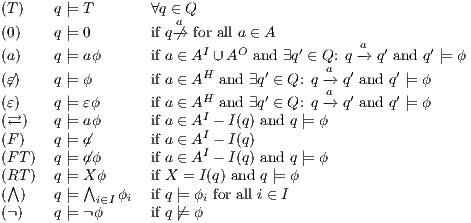
<body><![CDATA[<div class="newtheorem"> <font face="Verdana" size="2">     <br> </font>     <p><font face="Verdana" size="2"><span class="head">  <span class="cmbx-10">Definition 10.</span>  </span><span class="cmti-10">The set of  </span>execution formulas <img src="/img/revistas/cleiej/v14n3/3a07211x.png" alt="L " class="math"> <span class="cmti-10">for an IA</span> <img src="/img/revistas/cleiej/v14n3/3a07212x.png" alt="S = &#10216;Q, q0,  " class="math"> <img src="/img/revistas/cleiej/v14n3/3a07213x.png" alt="AI,AO, AH,-&rarr; &#10217; " class="math"> <span class="cmti-10">is the smallest</span> <span class="cmti-10">set satisfying rules in Table&nbsp;</span><a href="#x1-60051"><span class="cmti-10">1</span></a><span class="cmti-10">.</span> </font>    </p> </div>          <div class="table">                                                                                                                                                                                     <font face="Verdana" size="2">                                                                                                                                                                                         <br> </font>     <p>   <font face="Verdana" size="2">   <a id="x1-60072"></a></font></p> <hr class="float">     <div class="float">                                                                                                                                                                                         <div class="center"> <font face="Verdana" size="2">     <br> </font>     <p> </p>     ]]></body>
<body><![CDATA[<div class="pic-tabular"> <font face="Verdana" size="2"> <img src="/img/revistas/cleiej/v14n3/3a07214x.png" alt="(T)    q |= T       &forall;q &isin;aQ (0)    q |= 0       if q-&rarr;&frasl; for all a &isin; A (a)    q |= a&#981;      if a &isin; AI &cup; AO and &exist;q&prime; &isin; Q: q-&rarr;a q&prime; and q&prime; |= &#981;                          H       &prime;       a  &prime;    &prime; (&epsilon;&frasl; )   q |= &#981;       if a &isin; A and &exist;q &isin; Q: q-&rarr;a q and q |= &#981; (&epsilon;)    q |= &epsilon;&#981;      if a &isin; AH and &exist;q&prime; &isin; Q: q-&rarr; q&prime; and q&prime; |= &#981; (&#8644; )   q |= a&#981;      if a &isin; AI - I(q) and q |= &#981; (F)    q |= &frasl;a       if a &isin; AI - I(q) (FT )  q |= &frasl;a&#981;      if a &isin; AI - I(q) and q |= &#981; (R&and;T )  q |= X&and; &#981;     if X = I(q) and q |= &#981; ( )    q |=  i&isin;I &#981;i  if q |= &#981;i for all i &isin; I (&not;)    q |= &not;&#981;      if q &frasl;|= &#981;"></font></div> </div>  <font face="Verdana" size="2">      <br>   </font>       <div class="caption"><font face="Verdana" size="2"><span class="id">Table&nbsp;2: </span><span class="content">Semantic of the observations</span></font></div> <font face="Verdana" size="2">     <br>                                                                                                                                                                                         </font>                                                                                                                                                                                         </div> <hr class="endfloat">    </div>          <div class="newtheorem"> <font face="Verdana" size="2">     <br> </font>     <p><font face="Verdana" size="2"><span class="head">  <span class="cmbx-10">Definition 11.</span>  </span><span class="cmti-10">Given  an  IA</span>  <img src="/img/revistas/cleiej/v14n3/3a07215x.png" alt="S = &#10216;Q,q0,  " class="math">  <img src="/img/revistas/cleiej/v14n3/3a07216x.png" alt="AI,AO, AH, -&rarr;&#10217; " class="math"> <span class="cmti-10">and  a  notion  of  observability</span>  <img src="/img/revistas/cleiej/v14n3/3a07217x.png" alt="V  " class="math"><span class="cmti-10">,  the</span> satisfaction relation <img src="/img/revistas/cleiej/v14n3/3a07218x.png" alt="|=V  &sube; Q &times; L " class="math"> <span class="cmti-10">is defined for each type of observation in</span> <img src="/img/revistas/cleiej/v14n3/3a07219x.png" alt="V  " class="math"> <span class="cmti-10">by clauses in Table&nbsp;</span><a href="#x1-60072"><span class="cmti-10">2</span></a><span class="cmti-10">. The</span> observables behavior of an IA <img src="/img/revistas/cleiej/v14n3/3a07220x.png" alt="S  " class="math"> with notion of observability <img src="/img/revistas/cleiej/v14n3/3a07221x.png" alt="V  " class="math"> <span class="cmti-10">is</span> <img src="/img/revistas/cleiej/v14n3/3a07222x.png" alt="OV (S) = {&#981; &isin; L : q0 |=V &#981;} " class="math"> </font>    </p> </div>          <p><font face="Verdana" size="2"><span class="titlemark">4   </span> <a id="x1-70004"></a>Non interference based on Notion of Observability.</font></p>  <font face="Verdana" size="2">      <br> </font>     <p><font face="Verdana" size="2">First we introduce a general notion of non-interference. Informally, non-interference states that users with no appropriate permission cannot deduce any kind of confidential information or activity by only interacting through low actions. Since it is expected that a low-level user cannot distinguish the occurrence of high actions, the system has to behave the same when high actions are not performed or when high actions are considered as hidden actions. Hence, restriction and hiding are central to our definitions of security. </font>    </p>     ]]></body>
<body><![CDATA[<div class="newtheorem"> <font face="Verdana" size="2">     <br> </font>     <p><font face="Verdana" size="2"><span class="head"> <a id="x1-7001r12"></a> <span class="cmbx-10">Definition 12.</span>  </span> <span class="cmti-10">Given an IA</span> <img src="/img/revistas/cleiej/v14n3/3a07223x.png" alt="S  " class="math"> <span class="cmti-10">and a set of actions</span> <img src="/img/revistas/cleiej/v14n3/3a07224x.png" alt="X  &sube; AIS &cup;AOS  " class="math"><span class="cmti-10">, define:</span> </font>      </p> <ul class="itemize1">       <li class="itemize"><font face="Verdana" size="2"><span class="cmti-10">the </span>restriction <span class="cmti-10">of</span> <img src="/img/revistas/cleiej/v14n3/3a07225x.png" alt="X  " class="math"> <span class="cmti-10">in</span> <img src="/img/revistas/cleiej/v14n3/3a07226x.png" alt="S  " class="math"> <span class="cmti-10">by</span> <img src="/img/revistas/cleiej/v14n3/3a07227x.png" alt="           0   I      O       H S\X = &#10216;QS,qS,A S - X, AS - X,A S ,-&rarr;S \X&#10217; " class="math"> <span class="cmti-10">where</span> <img src="/img/revistas/cleiej/v14n3/3a07228x.png" alt="  a     &prime; q -&rarr;S \X q " class="math"> <span class="cmti-10">iff</span>      <img src="/img/revistas/cleiej/v14n3/3a07229x.png" alt="  a q-&rarr;S q&prime; " class="math"> <span class="cmti-10">and</span> <img src="/img/revistas/cleiej/v14n3/3a07230x.png" alt="a &#8725;&isin; X  " class="math"><span class="cmti-10">.</span>      </font>      </li>       <li class="itemize"><font face="Verdana" size="2"><span class="cmti-10">the </span>hiding <span class="cmti-10">of</span> <img src="/img/revistas/cleiej/v14n3/3a07231x.png" alt="X  " class="math"> <span class="cmti-10">in</span> <img src="/img/revistas/cleiej/v14n3/3a07232x.png" alt="S  " class="math"> <span class="cmti-10">by</span> <img src="/img/revistas/cleiej/v14n3/3a07233x.png" alt="            0  I      O       H S &#8725;X  = &#10216;QS, qS,AS - X,AS - X, AS &cup; X,-&rarr;S &#10217; " class="math"><span class="cmti-10">.</span></font></li>     </ul>  <font face="Verdana" size="2">      <br> </font>     <p><font face="Verdana" size="2"><span class="cmti-10">Given an ISS</span> <img src="/img/revistas/cleiej/v14n3/3a07234x.png" alt="S = &#10216;S,Ah,Al &#10217;         S   S " class="math"> <span class="cmti-10">define the </span>restriction <span class="cmti-10">of</span> <img src="/img/revistas/cleiej/v14n3/3a07235x.png" alt="X  " class="math"> <span class="cmti-10">in</span> <img src="/img/revistas/cleiej/v14n3/3a07236x.png" alt="S " class="math"> <span class="cmti-10">by</span> <img src="/img/revistas/cleiej/v14n3/3a07237x.png" alt="S \X = &#10216;S\X,Ah - X, Al - X &#10217;               S      S " class="math"> <span class="cmti-10">and the </span>hiding <span class="cmti-10">of</span> <img src="/img/revistas/cleiej/v14n3/3a07238x.png" alt="X  " class="math"> <span class="cmti-10">in</span> <img src="/img/revistas/cleiej/v14n3/3a07239x.png" alt="S " class="math"> <span class="cmti-10">by</span> <img src="/img/revistas/cleiej/v14n3/3a07240x.png" alt="S &#8725;X = &#10216;S&#8725;X,Ah - X, Al - X &#10217;               S      S " class="math"><span class="cmti-10">.</span> </font>    </p> </div>          <div class="newtheorem"> <font face="Verdana" size="2">     <br> </font>     <p><font face="Verdana" size="2"><span class="head"> <a id="x1-7002r13"></a> <span class="cmbx-10">Definition 13.</span>  </span><span class="cmti-10">Let</span> <img src="/img/revistas/cleiej/v14n3/3a07241x.png" alt="S = &#10216;S,Ah,Al&#10217; " class="math"> <span class="cmti-10">be an ISS and</span> <img src="/img/revistas/cleiej/v14n3/3a07242x.png" alt="V  " class="math"> <span class="cmti-10">a notion of observability, then:</span> </font>      </p> <ul class="itemize1">       <li class="itemize"><font face="Verdana" size="2"><img src="/img/revistas/cleiej/v14n3/3a07243x.png" alt="S " class="math"> <span class="cmti-10">is</span> <img src="/img/revistas/cleiej/v14n3/3a07244x.png" alt="V  " class="math"> <span class="cmti-10">strong non-deterministic non-interference (</span><img src="/img/revistas/cleiej/v14n3/3a07245x.png" alt="V  " class="math"><span class="cmti-10">-SNNI) if</span> <img src="/img/revistas/cleiej/v14n3/3a07246x.png" alt="       h          h OV(S&#8725;A  ) = OV (S \A )  " class="math"><span class="cmti-10">.</span>      </font>      </li>       <li class="itemize"><font face="Verdana" size="2"><img src="/img/revistas/cleiej/v14n3/3a07247x.png" alt="S  " class="math"> <span class="cmti-10">is</span> <img src="/img/revistas/cleiej/v14n3/3a07248x.png" alt="V  " class="math"> <span class="cmti-10">non-deterministic non-interference (</span><img src="/img/revistas/cleiej/v14n3/3a07249x.png" alt="V  " class="math"><span class="cmti-10">-NNI) if</span> <img src="/img/revistas/cleiej/v14n3/3a07250x.png" alt="O  (S&#8725;Ah ) = O ((S \Ah,I)&#8725;Ah,O)  V           V  " class="math"><span class="cmti-10">.</span></font></li>     </ul>     </div>  <font face="Verdana" size="2">      ]]></body>
<body><![CDATA[<br> </font>     <p>   <font face="Verdana" size="2">Notice the difference between the two definitions. <img src="/img/revistas/cleiej/v14n3/3a07251x.png" alt="V  " class="math">-SNNI formalizes the security property as we described so far: a system satisfies <img src="/img/revistas/cleiej/v14n3/3a07252x.png" alt="V  " class="math">-SNNI if a low-level user cannot distinguish (up to notion of observability <img src="/img/revistas/cleiej/v14n3/3a07253x.png" alt="V  " class="math">) by means of low level actions (the only visible ones) whether the system performs high actions (so they are hidden) or not (high actions are restricted). In the definition of <img src="/img/revistas/cleiej/v14n3/3a07254x.png" alt="V  " class="math">-NNI only high input actions are restricted since the low-level user cannot provide this type of actions; instead high output actions are only hidden since they still can autonomously occur. The second notion is considered as it seems appropriate for IA where only input actions are controllable.&nbsp;</font></p>     <p>   <font face="Verdana" size="2">The approach of non-interference based on notion of observability generalizes other notion of non-interference for IA. For example <span class="cmti-10">Non deterministic Non-Interference </span>(NNI), <span class="cmti-10">Strong Non deterministic Non-Interference </span>(SNNI), both based on trace equivalence; <span class="cmti-10">Bisimulation NNI </span>(BNNI) and <span class="cmti-10">Bisimulation SNNI </span>(BSNNI) both based on bisimulation equivalence. To prove our statement, we recall the definitions of <span class="cmti-10">trace equivalence, weak bisimulation</span> and non-interference properties. </font>    </p>     <div class="newtheorem"> <font face="Verdana" size="2">     <br> </font>     <p><font face="Verdana" size="2"><span class="head"> <a id="x1-7003r14"></a> <span class="cmbx-10">Definition 14.</span>  </span><span class="cmti-10">Let</span>  <img src="/img/revistas/cleiej/v14n3/3a07255x.png" alt="S  " class="math"> <span class="cmti-10">and</span>  <img src="/img/revistas/cleiej/v14n3/3a07256x.png" alt="T  " class="math"> <span class="cmti-10">be  two  IA.</span>  <img src="/img/revistas/cleiej/v14n3/3a07257x.png" alt="S  " class="math"> <span class="cmti-10">and</span>  <img src="/img/revistas/cleiej/v14n3/3a07258x.png" alt="T  " class="math"> <span class="cmti-10">are  </span>trace  equivalent<span class="cmti-10">,  notation</span>  <img src="/img/revistas/cleiej/v14n3/3a07259x.png" alt="S &asymp;T T  " class="math"><span class="cmti-10">,  if</span> <img src="/img/revistas/cleiej/v14n3/3a07260x.png" alt="Traces(S ) = Traces(T)  " class="math"><span class="cmti-10">.  We  say  that  two  ISS</span>  <img src="/img/revistas/cleiej/v14n3/3a07261x.png" alt="S " class="math"> <span class="cmti-10">and</span>  <img src="/img/revistas/cleiej/v14n3/3a07262x.png" alt="T " class="math"> <span class="cmti-10">are  trace  equivalent,  and  write</span>  <img src="/img/revistas/cleiej/v14n3/3a07263x.png" alt="S &asymp;T T " class="math"><span class="cmti-10">,</span> <span class="cmti-10">whenever the underlying IA are trace equivalent.</span> </font>    </p> </div>          <div class="newtheorem"> <font face="Verdana" size="2">     <br> </font>     <p><font face="Verdana" size="2"><span class="head"> <a id="x1-7004r15"></a> <span class="cmbx-10">Definition 15.</span>  </span><span class="cmti-10">Let</span> <img src="/img/revistas/cleiej/v14n3/3a07264x.png" alt="S  " class="math"> <span class="cmti-10">and</span> <img src="/img/revistas/cleiej/v14n3/3a07265x.png" alt="T  " class="math"> <span class="cmti-10">be two IA. A relation</span> <img src="/img/revistas/cleiej/v14n3/3a07266x.png" alt="R &sube; QS &times; QT  " class="math"> <span class="cmti-10">is a </span>(weak) bisimulation <span class="cmti-10">between</span> <img src="/img/revistas/cleiej/v14n3/3a07267x.png" alt="S  " class="math"> <span class="cmti-10">and</span> <img src="/img/revistas/cleiej/v14n3/3a07268x.png" alt="T  " class="math"> <span class="cmti-10">if</span> <img src="/img/revistas/cleiej/v14n3/3a07269x.png" alt="s0 R t0   " class="math"> <span class="cmti-10">and, for all</span> <img src="/img/revistas/cleiej/v14n3/3a07270x.png" alt="s &isin; QS  " class="math"> <span class="cmti-10">and</span> <img src="/img/revistas/cleiej/v14n3/3a07271x.png" alt="t &isin; QT  " class="math"><span class="cmti-10">,</span> <img src="/img/revistas/cleiej/v14n3/3a07272x.png" alt="s R t  " class="math"> <span class="cmti-10">implies:</span> </font>      </p> <ul class="itemize1">       <li class="itemize"><font face="Verdana" size="2"><span class="cmti-10">for all</span> <img src="/img/revistas/cleiej/v14n3/3a07273x.png" alt="a &isin; AS  " class="math"> <span class="cmti-10">and</span> <img src="/img/revistas/cleiej/v14n3/3a07274x.png" alt="s&prime; &isin; QS  " class="math"><span class="cmti-10">,</span> <img src="/img/revistas/cleiej/v14n3/3a07275x.png" alt="s-&rarr;aS  s&prime; " class="math"> <span class="cmti-10">implies that there exists</span> <img src="/img/revistas/cleiej/v14n3/3a07276x.png" alt="t&prime; &isin; QT  " class="math"> <span class="cmti-10">s.t.&nbsp;</span><img src="/img/revistas/cleiej/v14n3/3a07277x.png" alt="t&rArr;&circ;aT  t&prime; " class="math"> <span class="cmti-10">and</span> <img src="/img/revistas/cleiej/v14n3/3a07278x.png" alt="s&prime; R t&prime; " class="math"><span class="cmti-10">;</span>      <span class="cmti-10">and</span> </font>      </li>       <li class="itemize"><font face="Verdana" size="2"><span class="cmti-10">for all</span> <img src="/img/revistas/cleiej/v14n3/3a07279x.png" alt="a &isin; AT  " class="math"> <span class="cmti-10">and</span> <img src="/img/revistas/cleiej/v14n3/3a07280x.png" alt="t&prime; &isin; QT  " class="math"><span class="cmti-10">,</span> <img src="/img/revistas/cleiej/v14n3/3a07281x.png" alt="  a t-&rarr;T  t&prime; " class="math"> <span class="cmti-10">implies that there exists</span> <img src="/img/revistas/cleiej/v14n3/3a07282x.png" alt="s&prime; &isin; QS  " class="math"> <span class="cmti-10">s.t.&nbsp;</span><img src="/img/revistas/cleiej/v14n3/3a07283x.png" alt="  &circ;a s&rArr;S  s&prime; " class="math"> <span class="cmti-10">and</span> <img src="/img/revistas/cleiej/v14n3/3a07284x.png" alt="s&prime; R t&prime; " class="math"><span class="cmti-10">.</span></font></li>     </ul>  <font face="Verdana" size="2">      ]]></body>
<body><![CDATA[<br> </font>     <p>   <font face="Verdana" size="2">   <span class="cmti-10">We say that</span> <img src="/img/revistas/cleiej/v14n3/3a07285x.png" alt="S  " class="math"> <span class="cmti-10">and</span> <img src="/img/revistas/cleiej/v14n3/3a07286x.png" alt="T  " class="math"> <span class="cmti-10">are </span>bisimilar<span class="cmti-10">, notation</span> <img src="/img/revistas/cleiej/v14n3/3a07287x.png" alt="S &asymp; T  " class="math"><span class="cmti-10">, if there is a bisimulation between</span> <img src="/img/revistas/cleiej/v14n3/3a07288x.png" alt="S  " class="math"> <span class="cmti-10">and</span> <img src="/img/revistas/cleiej/v14n3/3a07289x.png" alt="T  " class="math"><span class="cmti-10">.</span> <span class="cmti-10">Moreover, we say that two ISS</span> <img src="/img/revistas/cleiej/v14n3/3a07290x.png" alt="S " class="math"> <span class="cmti-10">and</span> <img src="/img/revistas/cleiej/v14n3/3a07291x.png" alt="T " class="math"> <span class="cmti-10">are bisimilar, and write</span> <img src="/img/revistas/cleiej/v14n3/3a07292x.png" alt="S &asymp; T " class="math"><span class="cmti-10">, whenever the underlying IA are</span> <span class="cmti-10">bisimilar.</span> </font>    </p> </div>          <div class="newtheorem"> <font face="Verdana" size="2">     <br> </font>     <p><font face="Verdana" size="2"><span class="head"> <a id="x1-7005r16"></a> <span class="cmbx-10">Definition 16.</span>  </span><span class="cmti-10">Let</span> <img src="/img/revistas/cleiej/v14n3/3a07293x.png" alt="S = &#10216;S,Ah,Al&#10217; " class="math"> <span class="cmti-10">be an ISS.</span> </font>      </p> <dl class="enumerate-enumitem">   <dd><font face="Verdana" size="2">   <span class="cmti-10">1.</span> </font></dd>   <dd class="enumerate-enumitem"><font face="Verdana" size="2"><img src="/img/revistas/cleiej/v14n3/3a07294x.png" alt="S " class="math"> <span class="cmti-10">satisfies </span>strong non-deterministic non-interference (SNNI) <span class="cmti-10">if</span> <img src="/img/revistas/cleiej/v14n3/3a07295x.png" alt="S \Ah &asymp;T  S&#8725;Ah  " class="math"><span class="cmti-10">.</span>   </font>      </dd>   <dd><font face="Verdana" size="2">   <span class="cmti-10">2.</span> </font></dd>   <dd class="enumerate-enumitem"><font face="Verdana" size="2"><img src="/img/revistas/cleiej/v14n3/3a07296x.png" alt="S " class="math"> <span class="cmti-10">satisfies </span>non-deterministic non-interference (NNI) <span class="cmti-10">if</span> <img src="/img/revistas/cleiej/v14n3/3a07297x.png" alt="    h,I   h,O       h S \A  &#8725;A    &asymp;T S&#8725;A  " class="math"><span class="cmti-10">.</span>   </font>      </dd>   <dd><font face="Verdana" size="2">   <span class="cmti-10">3.</span> </font></dd>   <dd class="enumerate-enumitem"><font face="Verdana" size="2"><img src="/img/revistas/cleiej/v14n3/3a07298x.png" alt="S " class="math"> <span class="cmti-10">satisfies </span>bisimulation-based strong non-deterministic non-interference (BSNNI) <span class="cmti-10">if</span> <img src="/img/revistas/cleiej/v14n3/3a07299x.png" alt="S\Ah &asymp; S&#8725;Ah  " class="math"><span class="cmti-10">.</span>   </font>      </dd>   <dd><font face="Verdana" size="2">   <span class="cmti-10">4.</span> </font></dd>   <dd class="enumerate-enumitem"><font face="Verdana" size="2"><img src="/img/revistas/cleiej/v14n3/3a07300x.png" alt="S " class="math"> <span class="cmti-10">satisfies </span>bisimulation-based non-deterministic non-interference (BNNI) <span class="cmti-10">if</span> <img src="/img/revistas/cleiej/v14n3/3a07301x.png" alt="S\Ah,I&#8725;Ah,O &asymp; S&#8725;Ah  " class="math"><span class="cmti-10">.</span></font></dd> </dl>     </div>  <font face="Verdana" size="2">      <br> </font>     <p>   <font face="Verdana" size="2">We prove how to represent these notions of security with notions of observability. </font>    </p>     <div class="newtheorem"> <font face="Verdana" size="2">     <br> </font>     <p><font face="Verdana" size="2"><span class="head"> <a id="x1-7010r1"></a> <span class="cmbx-10">Theorem 1.</span>  </span> <span class="cmti-10">Let</span> <img src="/img/revistas/cleiej/v14n3/3a07302x.png" alt="S = &#10216;S,Ah,Al&#10217; " class="math"> <span class="cmti-10">be an ISS then</span> </font>                                                                                                                                                                                          </p> <dl class="enumerate-enumitem">   <dd><font face="Verdana" size="2">   <span class="cmti-10">1.</span> </font></dd>   <dd class="enumerate-enumitem"><font face="Verdana" size="2"><a id="x1-70111"></a><img src="/img/revistas/cleiej/v14n3/3a07303x.png" alt="S " class="math"> <span class="cmti-10">is (S)NNI iff</span> <img src="/img/revistas/cleiej/v14n3/3a07304x.png" alt="S " class="math"> <span class="cmti-10">is</span> <img src="/img/revistas/cleiej/v14n3/3a07305x.png" alt="V  " class="math"><span class="cmti-10">-(S)NNI with</span> <img src="/img/revistas/cleiej/v14n3/3a07306x.png" alt="V = {a,T,&epsilon;&frasl; ,&#8644;&frasl; } " class="math"><span class="cmti-10">.</span>   </font>      </dd>   <dd><font face="Verdana" size="2">   <span class="cmti-10">2.</span> </font></dd>   <dd class="enumerate-enumitem"><font face="Verdana" size="2"><a id="x1-70122"></a><img src="/img/revistas/cleiej/v14n3/3a07307x.png" alt="S " class="math"> <span class="cmti-10">is B(S)NNI iff</span> <img src="/img/revistas/cleiej/v14n3/3a07308x.png" alt="S " class="math"> <span class="cmti-10">is</span> <img src="/img/revistas/cleiej/v14n3/3a07309x.png" alt="V  " class="math"><span class="cmti-10">-(S)NNI with</span> <img src="/img/revistas/cleiej/v14n3/3a07310x.png" alt="              &and; V = {a,T,&epsilon;&frasl; ,&#8644;&frasl; , ,&not; } " class="math"><span class="cmti-10">.</span></font></dd> </dl>     </div>  <font face="Verdana" size="2">      ]]></body>
<body><![CDATA[<br> </font>     <p>    </p>     <div class="proof"> <font face="Verdana" size="2">     <br> </font>     <p>   <font face="Verdana" size="2">   <span class="head"> <span class="cmti-10">Proof.</span> </span>First we prove (<a href="#x1-70122">2</a>). For this, we have to show that for all states <img src="/img/revistas/cleiej/v14n3/3a07311x.png" alt="s &isin; Q      S  " class="math"> and <img src="/img/revistas/cleiej/v14n3/3a07312x.png" alt="t &isin; Q     T  " class="math"> it holds <img src="/img/revistas/cleiej/v14n3/3a07313x.png" alt="s &asymp; t  " class="math"> iff <img src="/img/revistas/cleiej/v14n3/3a07314x.png" alt="O (s) = O (t)  V       V  " class="math">. <img src="/img/revistas/cleiej/v14n3/3a07315x.png" alt="(&rArr;)  " class="math"> Suppose <img src="/img/revistas/cleiej/v14n3/3a07316x.png" alt="s &asymp; t  " class="math"> and <img src="/img/revistas/cleiej/v14n3/3a07317x.png" alt="&#981; &isin; O  (s)      V  " class="math">. Let <img src="/img/revistas/cleiej/v14n3/3a07318x.png" alt="f : L &rarr; &#8469;  " class="math"> a function defined as: </font> </p> <table class="gather">   <tbody>     <tr>       <td class="gather1"><font face="Verdana" size="2"><img src="/img/revistas/cleiej/v14n3/3a07319x.png" alt="f(T) = f(0) = f (&frasl;a) = 0 f (a&#981;) = f(&frasl;a&#981;) = f(X &#981;) = f(&not;&#981;) = f(&#981; )+ 1 f (&and;  &#981;i) = maxi(f(&#981;i))+ 1                                                                     i"><a id="x1-7014r1"></a></font></td>     </tr>   </tbody> </table>  <font face="Verdana" size="2">      <br> </font>     <p>   <font face="Verdana" size="2">We define <img src="/img/revistas/cleiej/v14n3/3a07320x.png" alt="f  " class="math"> in general for all <img src="/img/revistas/cleiej/v14n3/3a07321x.png" alt="L " class="math"> since we will make use of it again later. We proceed by complete induction. In the base case <img src="/img/revistas/cleiej/v14n3/3a07322x.png" alt="f(&#981;) = 0  " class="math"> then <img src="/img/revistas/cleiej/v14n3/3a07323x.png" alt="&#981; = T  " class="math"> because <img src="/img/revistas/cleiej/v14n3/3a07324x.png" alt="V = {a,T,&epsilon;&frasl; ,&#8644;&frasl; &and;,&not;} " class="math"> and since <img src="/img/revistas/cleiej/v14n3/3a07325x.png" alt="T  " class="math"> is an observation for every state <img src="/img/revistas/cleiej/v14n3/3a07326x.png" alt="&#981; &isin; OV (t)  " class="math">. By induction suppose that if <img src="/img/revistas/cleiej/v14n3/3a07327x.png" alt="s &asymp; t  " class="math"> then, if <img src="/img/revistas/cleiej/v14n3/3a07328x.png" alt="f (&#981;) &le; k  " class="math"> and <img src="/img/revistas/cleiej/v14n3/3a07329x.png" alt="&#981; &isin; OV (s)  " class="math"> it holds <img src="/img/revistas/cleiej/v14n3/3a07330x.png" alt="&#981; &isin; OV (t)  " class="math">. Let <img src="/img/revistas/cleiej/v14n3/3a07331x.png" alt="f(&#981; ) = k+ 1  " class="math">, we do case analysis according to the shape of the formula. Suppose <img src="/img/revistas/cleiej/v14n3/3a07332x.png" alt="&#981; = a&#981;&prime; " class="math"> with <img src="/img/revistas/cleiej/v14n3/3a07333x.png" alt="a &isin; AI &cup;AO  " class="math">. <img src="/img/revistas/cleiej/v14n3/3a07334x.png" alt="s |= a&#981;  " class="math"> implies <img src="/img/revistas/cleiej/v14n3/3a07335x.png" alt="s&rArr;a s&prime; " class="math"> and <img src="/img/revistas/cleiej/v14n3/3a07336x.png" alt="&#981; &isin; O (s&prime;)  " class="math"> (see <img src="/img/revistas/cleiej/v14n3/3a07337x.png" alt="(a)  " class="math"> and <img src="/img/revistas/cleiej/v14n3/3a07338x.png" alt="(&epsilon;&frasl; )  " class="math"> in Table&nbsp;<a href="#x1-60072">2</a>). Since <img src="/img/revistas/cleiej/v14n3/3a07339x.png" alt="s &asymp; t  " class="math"> there is state <img src="/img/revistas/cleiej/v14n3/3a07340x.png" alt="t&prime; " class="math"> such that <img src="/img/revistas/cleiej/v14n3/3a07341x.png" alt="s&prime; &asymp; t&prime; " class="math">. By induction <img src="/img/revistas/cleiej/v14n3/3a07342x.png" alt="&#981;&prime; &isin; OV(t&prime;)  " class="math">, therefore <img src="/img/revistas/cleiej/v14n3/3a07343x.png" alt="a&#981;&prime; &isin; OV(t)  " class="math">. Now let <img src="/img/revistas/cleiej/v14n3/3a07344x.png" alt="&#981; = &and; &#981;i       i  " class="math">. Since <img src="/img/revistas/cleiej/v14n3/3a07345x.png" alt="f(&#981;i) &le; k  " class="math"> for all <img src="/img/revistas/cleiej/v14n3/3a07346x.png" alt="i  " class="math">, by induction <img src="/img/revistas/cleiej/v14n3/3a07347x.png" alt="&#981;i &isin; OV (t)  " class="math">. Therefore <img src="/img/revistas/cleiej/v14n3/3a07348x.png" alt="&#981; = &and; &#981;i &isin; OV (t)      i  " class="math">. Now suppose <img src="/img/revistas/cleiej/v14n3/3a07349x.png" alt="&#981; = &not;&#981;&prime; " class="math"> then <img src="/img/revistas/cleiej/v14n3/3a07350x.png" alt="f(&#981;&prime;) = k  " class="math"> and <img src="/img/revistas/cleiej/v14n3/3a07351x.png" alt="s &frasl;|= &#981;&prime; " class="math">, by induction <img src="/img/revistas/cleiej/v14n3/3a07352x.png" alt="t &frasl;|= &#981;&prime; " class="math">. Therefore <img src="/img/revistas/cleiej/v14n3/3a07353x.png" alt="t |= &not;&#981;&prime; " class="math">, ie <img src="/img/revistas/cleiej/v14n3/3a07354x.png" alt="&#981; &isin; OV (t)  " class="math">. The other cases are outside of the observation defined by <img src="/img/revistas/cleiej/v14n3/3a07355x.png" alt="V  " class="math">. The symmetric case is analogous.&nbsp;</font></p>     <p>   <font face="Verdana" size="2">   <img src="/img/revistas/cleiej/v14n3/3a07356x.png" alt="(&lArr; )  " class="math"> Let <img src="/img/revistas/cleiej/v14n3/3a07357x.png" alt="OV (s) = OV(t)  " class="math"> and <img src="/img/revistas/cleiej/v14n3/3a07358x.png" alt="  a  &prime; s -&rarr; s " class="math">. We have to show that there is <img src="/img/revistas/cleiej/v14n3/3a07359x.png" alt=" &prime; t " class="math"> such that <img src="/img/revistas/cleiej/v14n3/3a07360x.png" alt=" a  &prime; t&rArr; t " class="math"> and <img src="/img/revistas/cleiej/v14n3/3a07361x.png" alt="     &prime;       &prime; OV (s) = OV(t)  " class="math">. Since <img src="/img/revistas/cleiej/v14n3/3a07362x.png" alt="OV (s) = OV (t)  " class="math"> we have <img src="/img/revistas/cleiej/v14n3/3a07363x.png" alt="  a t &rArr; " class="math">. Let <img src="/img/revistas/cleiej/v14n3/3a07364x.png" alt="Q  " class="math"> be <img src="/img/revistas/cleiej/v14n3/3a07365x.png" alt="  &prime;   a &prime; {t : t&rArr; t} " class="math">. If for all <img src="/img/revistas/cleiej/v14n3/3a07366x.png" alt="&prime; t&isin; Q  " class="math"> it holds <img src="/img/revistas/cleiej/v14n3/3a07367x.png" alt="     &prime;       &prime; OV (s) &frasl;= OV(t)  " class="math"> then there is <img src="/img/revistas/cleiej/v14n3/3a07368x.png" alt="         &prime;       &prime; &#981;s&prime; &isin; OV (s )- OV (t )  " class="math"> (as consequence of <img src="/img/revistas/cleiej/v14n3/3a07369x.png" alt="(&not;)  " class="math">). Then for any <img src="/img/revistas/cleiej/v14n3/3a07370x.png" alt="&prime; t&isin; Q  " class="math"> it holds <img src="/img/revistas/cleiej/v14n3/3a07371x.png" alt="&and;            &prime;       &prime;  q&isin;Q &#981;q &isin; OV (s )- OV (t )  " class="math"> (at least one <img src="/img/revistas/cleiej/v14n3/3a07372x.png" alt="&#981;q  " class="math"> fails). But then <img src="/img/revistas/cleiej/v14n3/3a07373x.png" alt=" &and; a  q&isin;Q &#981;q &isin; OV (s)- OV (t)  " class="math"> contradicting <img src="/img/revistas/cleiej/v14n3/3a07374x.png" alt="OV (s) = OV (t)  " class="math">. The symmetric case is analogous.&nbsp;</font></p>     <p>   <font face="Verdana" size="2">To prove (<a href="#x1-70111">1</a>) we show that given two IA <img src="/img/revistas/cleiej/v14n3/3a07375x.png" alt="S  " class="math"> and <img src="/img/revistas/cleiej/v14n3/3a07376x.png" alt="T  " class="math"> it holds <img src="/img/revistas/cleiej/v14n3/3a07377x.png" alt="S &asymp;T T  " class="math"> iff <img src="/img/revistas/cleiej/v14n3/3a07378x.png" alt="OV (S) = OV (T)  " class="math">. We reduce this to prove <img src="/img/revistas/cleiej/v14n3/3a07379x.png" alt="&#981; &isin; Traces(S)  " class="math"> iff <img src="/img/revistas/cleiej/v14n3/3a07380x.png" alt="&#981;T &isin; OV (S)  " class="math">. This proof is straightforward.                                               __ </font>    </p> </div>  <font face="Verdana" size="2">      <br> </font>     ]]></body>
<body><![CDATA[<p>   <font face="Verdana" size="2">The relation between <img src="/img/revistas/cleiej/v14n3/3a07381x.png" alt="V  " class="math">-SNNI and <img src="/img/revistas/cleiej/v14n3/3a07382x.png" alt="V  " class="math">-NNI depends on the notion observability <img src="/img/revistas/cleiej/v14n3/3a07383x.png" alt="V  " class="math">. In general, we only can ensure <img src="/img/revistas/cleiej/v14n3/3a07384x.png" alt="V  " class="math">-NNI is not stronger than <img src="/img/revistas/cleiej/v14n3/3a07385x.png" alt="V  " class="math">-SNNI for all <img src="/img/revistas/cleiej/v14n3/3a07386x.png" alt="V  " class="math">. </font>    </p>     <div class="newtheorem"> <font face="Verdana" size="2">     <br> </font>     <p><font face="Verdana" size="2"><span class="head"> <a id="x1-7015r2"></a> <span class="cmbx-10">Theorem 2.</span>  </span> <span class="cmti-10">For all notion of observability</span> <img src="/img/revistas/cleiej/v14n3/3a07387x.png" alt="V  " class="math"> <span class="cmti-10">there is an ISS</span> <img src="/img/revistas/cleiej/v14n3/3a07388x.png" alt="S " class="math"> <span class="cmti-10">such that</span> <img src="/img/revistas/cleiej/v14n3/3a07389x.png" alt="S " class="math"> <span class="cmti-10">is</span> <img src="/img/revistas/cleiej/v14n3/3a07390x.png" alt="V  " class="math"><span class="cmti-10">-NNI and</span> <img src="/img/revistas/cleiej/v14n3/3a07391x.png" alt="S " class="math"> <span class="cmti-10">is</span> <span class="cmti-10">not</span> <img src="/img/revistas/cleiej/v14n3/3a07392x.png" alt="V  " class="math"><span class="cmti-10">-SNNI.</span> </font>    </p> </div>  <font face="Verdana" size="2">      <br> </font>     <p>    </p>     <div class="proof"> <font face="Verdana" size="2">     <br> </font>     <p>   <font face="Verdana" size="2">   <span class="head"> <span class="cmti-10">Proof.</span> </span>Let <img src="/img/revistas/cleiej/v14n3/3a07393x.png" alt="S " class="math"> the following ISS <img src="/img/revistas/cleiej/v14n3/3a07394x.png" alt="   H!    a s0 --&rarr; s1-&rarr; s2  " class="math"> with <img src="/img/revistas/cleiej/v14n3/3a07395x.png" alt="     I   O a &isin; A &cup; A  " class="math">. Notice <img src="/img/revistas/cleiej/v14n3/3a07396x.png" alt="S " class="math"> is always <img src="/img/revistas/cleiej/v14n3/3a07397x.png" alt="V  " class="math">-NNI. On the other hand <img src="/img/revistas/cleiej/v14n3/3a07398x.png" alt="S " class="math"> is not <img src="/img/revistas/cleiej/v14n3/3a07399x.png" alt="V  " class="math">-SNNI: if <img src="/img/revistas/cleiej/v14n3/3a07400x.png" alt="&epsilon;&frasl; &isin; V  " class="math"> then <img src="/img/revistas/cleiej/v14n3/3a07401x.png" alt="            h aT &isin; OV ((S&#8725;A ))  " class="math"> and <img src="/img/revistas/cleiej/v14n3/3a07402x.png" alt="             h aT &frasl;&isin; OV ((S \A  ))  " class="math">; if <img src="/img/revistas/cleiej/v14n3/3a07403x.png" alt="&epsilon; &isin; V  " class="math"> then <img src="/img/revistas/cleiej/v14n3/3a07404x.png" alt="              h &epsilon;aT &isin; OV ((S&#8725;A  ))  " class="math"> and <img src="/img/revistas/cleiej/v14n3/3a07405x.png" alt="             h &epsilon;aT &frasl;&isin; OV ((S\A ))  " class="math">.                                                                             __ </font>                                                                                                                                                                                        </p> </div>  <font face="Verdana" size="2">      <br> </font>     ]]></body>
<body><![CDATA[<p>   <font face="Verdana" size="2">This result is not novel. In <span class="cite">[<a href="#Xfocardi_gorrieri">8</a>]</span>, it is shown that SNNI is stronger than NNI. Therefore as trace semantic is the coarsest sensible semantic on labeled transition system, it is natural that the result holds for all other semantic. The Theorem&nbsp;<a href="#x1-7015r2">2</a> only formalize this fact for IA semantics.&nbsp;</font></p>     <p>   <font face="Verdana" size="2">The other relations depend on <img src="/img/revistas/cleiej/v14n3/3a07406x.png" alt="V  " class="math"> and we state in the following two theorems. Previously an auxiliary lemma. </font>    </p>     <div class="newtheorem"> <font face="Verdana" size="2">     <br> </font>     <p><font face="Verdana" size="2"><span class="head"> <a id="x1-7016r1"></a> <span class="cmbx-10">Lemma 1.</span>  </span> <span class="cmti-10">Let</span> <img src="/img/revistas/cleiej/v14n3/3a07407x.png" alt="S  " class="math"> <span class="cmti-10">be an IA and</span> <img src="/img/revistas/cleiej/v14n3/3a07408x.png" alt="V  " class="math"> <span class="cmti-10">a notion of observability such that</span> <img src="/img/revistas/cleiej/v14n3/3a07409x.png" alt="{0,&not;} &cap;V = &empty; " class="math"><span class="cmti-10">. Let</span> <img src="/img/revistas/cleiej/v14n3/3a07410x.png" alt="S &prime; " class="math"> <span class="cmti-10">be an</span> <span class="cmti-10">IA obtained by removing a set of internal transitions from</span> <img src="/img/revistas/cleiej/v14n3/3a07411x.png" alt="S  " class="math"><span class="cmti-10">. Then</span> <img src="/img/revistas/cleiej/v14n3/3a07412x.png" alt="O (S) &supe; O (S &prime;)  " class="math"><span class="cmti-10">.</span> </font>    </p> </div>  <font face="Verdana" size="2">      <br> </font>     <p>    </p>     <div class="proof"> <font face="Verdana" size="2">     <br> </font>     <p>   <font face="Verdana" size="2">   <span class="head"> <span class="cmti-10">Proof.</span> </span>The proof is straightforward by induction in <img src="/img/revistas/cleiej/v14n3/3a07413x.png" alt="f(&#981;)  " class="math"> where <img src="/img/revistas/cleiej/v14n3/3a07414x.png" alt="&#981; &isin; OV (S&prime;)  " class="math"> and <img src="/img/revistas/cleiej/v14n3/3a07415x.png" alt="f  " class="math"> is the function defined in (<a href="#x1-7014r1">1</a>). __ </font> </p> </div>          ]]></body>
<body><![CDATA[<div class="newtheorem"> <font face="Verdana" size="2">     <br> </font>     <p><font face="Verdana" size="2"><span class="head"> <a id="x1-7017r3"></a> <span class="cmbx-10">Theorem 3.</span>  </span> <span class="cmti-10">Let</span> <img src="/img/revistas/cleiej/v14n3/3a07416x.png" alt="S " class="math"> <span class="cmti-10">be an ISS and</span> <img src="/img/revistas/cleiej/v14n3/3a07417x.png" alt="V  " class="math"> <span class="cmti-10">a notion of observability such that</span> <img src="/img/revistas/cleiej/v14n3/3a07418x.png" alt="{0,&not; }&cap; V = &empty; " class="math"><span class="cmti-10">. If</span> <img src="/img/revistas/cleiej/v14n3/3a07419x.png" alt="S " class="math"> <span class="cmti-10">is</span> <img src="/img/revistas/cleiej/v14n3/3a07420x.png" alt="V  " class="math"><span class="cmti-10">-SNNI then</span> <img src="/img/revistas/cleiej/v14n3/3a07421x.png" alt="S " class="math"> <span class="cmti-10">is</span> <img src="/img/revistas/cleiej/v14n3/3a07422x.png" alt="V  " class="math"><span class="cmti-10">-NNI.</span> </font>    </p> </div>  <font face="Verdana" size="2">      <br> </font>     <p>    </p>     <div class="proof"> <font face="Verdana" size="2">     <br> </font>     <p>   <font face="Verdana" size="2">   <span class="head"> <span class="cmti-10">Proof.</span> </span>If <img src="/img/revistas/cleiej/v14n3/3a07423x.png" alt="S " class="math"> is <img src="/img/revistas/cleiej/v14n3/3a07424x.png" alt="V  " class="math">-SNNI then <img src="/img/revistas/cleiej/v14n3/3a07425x.png" alt="OV (S&#8725;AH ) = OV (S \AH )  " class="math">. Notice <img src="/img/revistas/cleiej/v14n3/3a07426x.png" alt="S\AH  " class="math"> is obtained by removing some hidden  transitions  from  <img src="/img/revistas/cleiej/v14n3/3a07427x.png" alt="(S\Ah,I)&#8725;Ah,O  " class="math">,  then  <img src="/img/revistas/cleiej/v14n3/3a07428x.png" alt="OV ((S\Ah,I)&#8725;Ah,O) &supe; OV(S\AH )  " class="math">  by  Lemma&nbsp;<a href="#x1-7016r1">1</a>,  and therefore <img src="/img/revistas/cleiej/v14n3/3a07429x.png" alt="OV ((S\Ah,I)&#8725;Ah,O) &supe; OV (S&#8725;AH )  " class="math">. On the other hand <img src="/img/revistas/cleiej/v14n3/3a07430x.png" alt="(S\Ah,I)&#8725;Ah,O  " class="math"> is obtained by removing some hidden transitions from <img src="/img/revistas/cleiej/v14n3/3a07431x.png" alt="S&#8725;AH  " class="math"> then <img src="/img/revistas/cleiej/v14n3/3a07432x.png" alt="OV (S&#8725;AH ) &supe; OV ((S \Ah,I)&#8725;Ah,O)  " class="math"> by Lemma&nbsp;<a href="#x1-7016r1">1</a>. Both inclusions imply <img src="/img/revistas/cleiej/v14n3/3a07433x.png" alt="OV(S&#8725;AH ) = OV ((S\Ah,I)&#8725;Ah,O)  " class="math">.                                                                                   __ </font>    </p> </div>  <font face="Verdana" size="2">      <br> </font>     <p>   </p> <hr class="figure">     ]]></body>

<body><![CDATA[<div class="figure">                                                                                                                                                                                     <font face="Verdana" size="2">&nbsp; </font>     <p></p>     <div class="gather-star"><font face="Verdana" size="2"><img src="/img/revistas/cleiej/v14n3/3a07434x.png" alt="s0-b;-s1 a--s2-b;-s3-a-s4  H1! s--a-s H2?-s -a-s  5    6     7    8         S"></font></div>  <font face="Verdana" size="2">      <br>   </font>       <div class="caption"><font face="Verdana" size="2"><span class="id">Figure&nbsp;3: </span><span class="content"><img src="/img/revistas/cleiej/v14n3/3a07435x.png" alt="S " class="math"> is <img src="/img/revistas/cleiej/v14n3/3a07436x.png" alt="V  " class="math">-SNNI does not imply <img src="/img/revistas/cleiej/v14n3/3a07437x.png" alt="S " class="math"> is <img src="/img/revistas/cleiej/v14n3/3a07438x.png" alt="V  " class="math">-NNI if <img src="/img/revistas/cleiej/v14n3/3a07439x.png" alt="V &cap;{0,&not;} &frasl;= &empty; " class="math"></span></font></div> <font face="Verdana" size="2">     <br> &nbsp; </font>     <p>   </p> </div> <hr class="endfigure">         <div class="newtheorem"> <font face="Verdana" size="2">     <br> </font>     <p><font face="Verdana" size="2"><span class="head"> <a id="x1-7019r4"></a> <span class="cmbx-10">Theorem 4.</span>  </span> <span class="cmti-10">For all notion of observability</span> <img src="/img/revistas/cleiej/v14n3/3a07440x.png" alt="V  " class="math"> <span class="cmti-10">such that</span> <img src="/img/revistas/cleiej/v14n3/3a07441x.png" alt="V &cap; {0,&not; } &frasl;= &empty; " class="math"> <span class="cmti-10">there is an ISS</span> <img src="/img/revistas/cleiej/v14n3/3a07442x.png" alt="S " class="math"> <span class="cmti-10">such that</span> <img src="/img/revistas/cleiej/v14n3/3a07443x.png" alt="S " class="math"> <span class="cmti-10">is</span> <img src="/img/revistas/cleiej/v14n3/3a07444x.png" alt="V  " class="math"><span class="cmti-10">-SNNI and</span> <img src="/img/revistas/cleiej/v14n3/3a07445x.png" alt="S " class="math"> <span class="cmti-10">is not</span> <img src="/img/revistas/cleiej/v14n3/3a07446x.png" alt="V  " class="math"><span class="cmti-10">-NNI.</span> </font>    </p> </div>  <font face="Verdana" size="2">      ]]></body>
<body><![CDATA[<br> </font>     <p>    </p>     <div class="proof"> <font face="Verdana" size="2">     <br> </font>     <p>   <font face="Verdana" size="2">   <span class="head"> <span class="cmti-10">Proof.</span> </span>Define  <img src="/img/revistas/cleiej/v14n3/3a07447x.png" alt="S " class="math"> as  ISS  in  Figure&nbsp;<a href="#x1-70183">3</a>  with  <img src="/img/revistas/cleiej/v14n3/3a07448x.png" alt="a &isin; AI &cup;AO  " class="math">.  Clearly  <img src="/img/revistas/cleiej/v14n3/3a07449x.png" alt="S " class="math"> is  <img src="/img/revistas/cleiej/v14n3/3a07450x.png" alt="V  " class="math">-SNNI  for  all  <img src="/img/revistas/cleiej/v14n3/3a07451x.png" alt="V  " class="math">. Suppose <img src="/img/revistas/cleiej/v14n3/3a07452x.png" alt="&epsilon;&frasl; &isin; V  " class="math">: if <img src="/img/revistas/cleiej/v14n3/3a07453x.png" alt="&not; &isin; V  " class="math"> then <img src="/img/revistas/cleiej/v14n3/3a07454x.png" alt="a&not;a &isin; OV ((S \Ah,I)&#8725;Ah,O)  " class="math"> while <img src="/img/revistas/cleiej/v14n3/3a07455x.png" alt="a&not;a &frasl;&isin; OV (S \AH)  " class="math">; if <img src="/img/revistas/cleiej/v14n3/3a07456x.png" alt="0 &isin; V  " class="math"> then <img src="/img/revistas/cleiej/v14n3/3a07457x.png" alt="a0 &isin; OV((S\Ah,I)&#8725;Ah,O)  " class="math"> while  <img src="/img/revistas/cleiej/v14n3/3a07458x.png" alt="a0 &frasl;&isin; OV (S\AH )  " class="math">.  Then  <img src="/img/revistas/cleiej/v14n3/3a07459x.png" alt="S " class="math"> is  not  <img src="/img/revistas/cleiej/v14n3/3a07460x.png" alt="V  " class="math">-NNI  for  any  <img src="/img/revistas/cleiej/v14n3/3a07461x.png" alt="V  " class="math">  such  that <img src="/img/revistas/cleiej/v14n3/3a07462x.png" alt="V &cap; {0,&not;} &frasl;= &empty; " class="math">. The case <img src="/img/revistas/cleiej/v14n3/3a07463x.png" alt="&epsilon; &isin; V  " class="math"> is analogous.                                                                            __ </font>    </p> </div>  <font face="Verdana" size="2">      <br> </font>     <p>   <font face="Verdana" size="2">The approach based on notion of observability also allows to show that security properties are not preserved by composition.&nbsp;</font></p>     <p>   </p> <hr class="figure">     <div class="figure">                                                                                                                                                                                     <font face="Verdana" size="2">&nbsp; </font>     <p></p>     ]]></body>
<body><![CDATA[<div class="gather-star"><font face="Verdana" size="2"><img src="/img/revistas/cleiej/v14n3/3a07464x.png" alt="                           s    a;    b?    c!   a;   a;--5                             a;                    a; s0 ---s1---s2---s3 ---s4----         c?   H1!-t2    s0,t0----s1,t0    H1;--s10,t2---s11,t2  -H2?        H ?       H1? s6     t0----t1----        -H2?             -- s7 b?-s8-c!-s9--1s10a;-s11                   d; -t3    s7,t0-b?-s8,t0-c;-s9,t1-d;-s9,t3               S                        T                                S &#8741; T"></font></div>  <font face="Verdana" size="2">      <br>   </font>       <div class="caption"><font face="Verdana" size="2"><span class="id">Figure&nbsp;4: </span><span class="content"><img src="/img/revistas/cleiej/v14n3/3a07465x.png" alt="V  " class="math">-SNNI and <img src="/img/revistas/cleiej/v14n3/3a07466x.png" alt="V  " class="math">-NNI properties are not preserved by composition.</span></font></div> <font face="Verdana" size="2">&nbsp;    <br> </font>     <p>   </p> </div> <hr class="endfigure">         <div class="newtheorem"> <font face="Verdana" size="2">     <br> </font>     <p><font face="Verdana" size="2"><span class="head"> <a id="x1-7021r5"></a> <span class="cmbx-10">Theorem 5.</span>  </span> <span class="cmti-10">For all notion of observability</span> <img src="/img/revistas/cleiej/v14n3/3a07467x.png" alt="V  " class="math"> <span class="cmti-10">there are ISS</span> <img src="/img/revistas/cleiej/v14n3/3a07468x.png" alt="S " class="math"> <span class="cmti-10">and</span> <img src="/img/revistas/cleiej/v14n3/3a07469x.png" alt="T " class="math"> <span class="cmti-10">such that</span> <img src="/img/revistas/cleiej/v14n3/3a07470x.png" alt="S " class="math"> <span class="cmti-10">and</span> <img src="/img/revistas/cleiej/v14n3/3a07471x.png" alt="T " class="math"> <span class="cmti-10">are</span> <img src="/img/revistas/cleiej/v14n3/3a07472x.png" alt="V  " class="math"><span class="cmti-10">-(S)NNI and composable, and the composition</span> <img src="/img/revistas/cleiej/v14n3/3a07473x.png" alt="S &#8741; T " class="math"> <span class="cmti-10">is not</span> <img src="/img/revistas/cleiej/v14n3/3a07474x.png" alt="V  " class="math"><span class="cmti-10">-(S)NNI.</span> </font>    </p> </div>  <font face="Verdana" size="2">      <br> </font>     <p>    </p>     ]]></body>
<body><![CDATA[<div class="proof"> <font face="Verdana" size="2">     <br> </font>     <p>   <font face="Verdana" size="2">   <span class="head"> <span class="cmti-10">Proof.</span> </span>Let   <img src="/img/revistas/cleiej/v14n3/3a07475x.png" alt="S " class="math"> and   <img src="/img/revistas/cleiej/v14n3/3a07476x.png" alt="T " class="math"> be   ISS   depicted   in   Figure&nbsp;<a href="#x1-70204">4</a>.   Both   interfaces   are   <img src="/img/revistas/cleiej/v14n3/3a07477x.png" alt="V  " class="math">-(S)NNI   for   all notion  of  observability  <img src="/img/revistas/cleiej/v14n3/3a07478x.png" alt="V  " class="math">  but  <img src="/img/revistas/cleiej/v14n3/3a07479x.png" alt="S &#8741; T " class="math"> is  not.  If  <img src="/img/revistas/cleiej/v14n3/3a07480x.png" alt="&epsilon;&frasl; &isin; V  " class="math">  then  <img src="/img/revistas/cleiej/v14n3/3a07481x.png" alt="b?T &isin; OV ((S &#8741; T)&#8725;Ah)  " class="math">  while  if <img src="/img/revistas/cleiej/v14n3/3a07482x.png" alt="&epsilon; &isin; V  " class="math"> then <img src="/img/revistas/cleiej/v14n3/3a07483x.png" alt="&epsilon;b?T &isin; OV ((S &#8741; T)&#8725;Ah)  " class="math">. In any case, <img src="/img/revistas/cleiej/v14n3/3a07484x.png" alt="OV ((S &#8741; T)\Ah) = OV (((S &#8741; T )\Ah,I)&#8725;Ah,O )  " class="math"> and <img src="/img/revistas/cleiej/v14n3/3a07485x.png" alt="b?T,&epsilon;b?T &frasl;&isin; OV ((S &#8741; T )\Ah )  " class="math">. Then <img src="/img/revistas/cleiej/v14n3/3a07486x.png" alt="S &#8741; T " class="math"> is not <img src="/img/revistas/cleiej/v14n3/3a07487x.png" alt="V  " class="math">-(S)NNI.                                                      __ </font>    </p> </div>          <p><font face="Verdana" size="2"><span class="titlemark">5   </span> <a id="x1-80005"></a>Non-interference based on refinement.</font></p>  <font face="Verdana" size="2">      <br> </font>     <p><font face="Verdana" size="2">In <span class="cite">[<a href="#c9">9]</a></span>, we presented definitions of non interference based on refinement. The new versions of non-interference were introduced to solve some shortcomings detected in the definitions of non interference based on bisimulation of <span class="cite">[<a href="#c6">6</a>]</span>, ie BSNNI and BNNI. In this section we review the results obtained. </font> </p> <hr class="figure">     <div class="figure">                                                                                                                                                                                     <font face="Verdana" size="2">&nbsp; </font>     <p></p>     <div class="gather-star"><font face="Verdana" size="2"><img src="/img/revistas/cleiej/v14n3/3a07488x.png" alt="   -                 - S  -  H?          V  -  H?   s1 -----s2        v1 ------v4 -&epsilon;-v5  a!- --b!- -b!       -a?&#8725;b?   -a?   a?&#8725;b?   s3     -s4        v2       v6    v7"></font></div>  <font face="Verdana" size="2">      <br>   </font>       ]]></body>
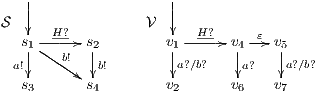
<body><![CDATA[<div class="caption"><font face="Verdana" size="2"><span class="id">Figure&nbsp;5: </span><span class="content">In these interfaces, BSNNI and BNNI are not appropriate properties to denote security.</span></font></div> <font face="Verdana" size="2">&nbsp;    <br> </font>     <p>   </p> </div> <hr class="endfigure"> <font face="Verdana" size="2">     <br> </font>     <p>   <font face="Verdana" size="2">To address the shortcomings detected in B(S)NNI properties, a variation of non-interference based on refinement was introduced. These variants are obtained from the definition of BSNNI and BNNI by replacing weak bisimulation by a new relation. Under this new relation, two states <img src="/img/revistas/cleiej/v14n3/3a07489x.png" alt="s  " class="math"> and <img src="/img/revistas/cleiej/v14n3/3a07490x.png" alt="t  " class="math"> are related if they are able to receive the same input actions; in addition, for every output transition that can execute <img src="/img/revistas/cleiej/v14n3/3a07491x.png" alt="t  " class="math">, the state <img src="/img/revistas/cleiej/v14n3/3a07492x.png" alt="s  " class="math"> can execute zero or more hidden transitions before executing the same output; finally, all hidden transitions that can execute <img src="/img/revistas/cleiej/v14n3/3a07493x.png" alt="t  " class="math"> can be &ldquo;matched&rdquo; by <img src="/img/revistas/cleiej/v14n3/3a07494x.png" alt="s  " class="math"> with zero or more hidden transitions. In all cases, the reached states have to be also related. In this way state <img src="/img/revistas/cleiej/v14n3/3a07495x.png" alt="t  " class="math"> does not reveal new visible behavior w.r.t. the state <img src="/img/revistas/cleiej/v14n3/3a07496x.png" alt="s  " class="math">. Formally: </font>    </p>     <div class="newtheorem"> <font face="Verdana" size="2">     <br> </font>     <p><font face="Verdana" size="2"><span class="head"> <a id="x1-8002r17"></a> <span class="cmbx-10">Definition 17.</span>  </span><span class="cmti-10">Given two IA</span> <img src="/img/revistas/cleiej/v14n3/3a07497x.png" alt="S  " class="math"> <span class="cmti-10">and</span> <img src="/img/revistas/cleiej/v14n3/3a07498x.png" alt="T  " class="math"><span class="cmti-10">, a relation</span> <img src="/img/revistas/cleiej/v14n3/3a07499x.png" alt="&#8829; &sube; QS  &times;QT  " class="math"> <span class="cmti-10">is a </span>Strict Input Refinement (SIR) <span class="cmti-10">of</span> <img src="/img/revistas/cleiej/v14n3/3a07500x.png" alt="S  " class="math"> <span class="cmti-10">by</span> <img src="/img/revistas/cleiej/v14n3/3a07501x.png" alt="T  " class="math"> <span class="cmti-10">if</span> <img src="/img/revistas/cleiej/v14n3/3a07502x.png" alt="q0S &#8829; q0T  " class="math"> <span class="cmti-10">and for all</span> <img src="/img/revistas/cleiej/v14n3/3a07503x.png" alt="qS &#8829; qT  " class="math"> <span class="cmti-10">it holds:</span> </font>    </p> <dl class="compactenum">   <dd><font face="Verdana" size="2">     <span class="cmti-10">(a)</span> </font></dd>   <dd class="compactenum"><font face="Verdana" size="2"><a id="x1-80031"></a><img src="/img/revistas/cleiej/v14n3/3a07504x.png" alt="&forall;a &isin; AIS,q&prime;S &isin; QS,  " class="math"> <span class="cmti-10">if</span> <img src="/img/revistas/cleiej/v14n3/3a07505x.png" alt="   a qS -&rarr;S  q&prime;S  " class="math"> <span class="cmti-10">then</span> <img src="/img/revistas/cleiej/v14n3/3a07506x.png" alt="             a &exist;q&prime;T &isin; QT : qT -&rarr;T q&prime;T  " class="math"> <span class="cmti-10">and</span> <img src="/img/revistas/cleiej/v14n3/3a07507x.png" alt="q&prime;S &#8829; q&prime;T  " class="math"><span class="cmti-10">;</span>   </font>    </dd>   <dd><font face="Verdana" size="2">     <span class="cmti-10">(b)</span> </font></dd>   <dd class="compactenum"><font face="Verdana" size="2"><a id="x1-80042"></a> <img src="/img/revistas/cleiej/v14n3/3a07508x.png" alt="&forall;a &isin; AIT,q&prime;T &isin; QT  " class="math"><span class="cmti-10">, if</span> <img src="/img/revistas/cleiej/v14n3/3a07509x.png" alt="   a qT -&rarr;T  q&prime;T  " class="math"> <span class="cmti-10">then</span> <img src="/img/revistas/cleiej/v14n3/3a07510x.png" alt="             a &exist;q&prime;S &isin; QS : qS -&rarr;S q&prime;S  " class="math"> <span class="cmti-10">and</span> <img src="/img/revistas/cleiej/v14n3/3a07511x.png" alt="q&prime;S &#8829; q&prime;T  " class="math"><span class="cmti-10">;</span>   </font>    </dd>   <dd><font face="Verdana" size="2">     <span class="cmti-10">(c)</span> </font></dd>   <dd class="compactenum"><font face="Verdana" size="2"><a id="x1-80053"></a><img src="/img/revistas/cleiej/v14n3/3a07512x.png" alt="&forall;a &isin; AOT,q&prime;T &isin; QT  " class="math"><span class="cmti-10">, if</span> <img src="/img/revistas/cleiej/v14n3/3a07513x.png" alt="   a qT-&rarr;T q&prime;T  " class="math"> <span class="cmti-10">then</span> <img src="/img/revistas/cleiej/v14n3/3a07514x.png" alt="            &epsilon;  a &exist;q&prime;S &isin; QS : qS &rArr;S -&rarr;S q&prime;S  " class="math"> <span class="cmti-10">and</span> <img src="/img/revistas/cleiej/v14n3/3a07515x.png" alt="q&prime;S &#8829; q&prime;T  " class="math"><span class="cmti-10">;</span>   </font>    </dd>   <dd><font face="Verdana" size="2">     <span class="cmti-10">(d)</span> </font></dd>   <dd class="compactenum"><font face="Verdana" size="2"><a id="x1-80064"></a><img src="/img/revistas/cleiej/v14n3/3a07516x.png" alt="&forall;a &isin; AHT ,q&prime;T &isin; QT  " class="math"><span class="cmti-10">, if</span> <img src="/img/revistas/cleiej/v14n3/3a07517x.png" alt="   a qT -&rarr;T q&prime;T  " class="math"> <span class="cmti-10">then</span> <img src="/img/revistas/cleiej/v14n3/3a07518x.png" alt="            &epsilon; &exist;q&prime;S &isin; QS : qS &rArr;S q&prime;S  " class="math"> <span class="cmti-10">and</span> <img src="/img/revistas/cleiej/v14n3/3a07519x.png" alt="q&prime;S &#8829; q&prime;T  " class="math"><span class="cmti-10">.</span></font></dd> </dl>  <font face="Verdana" size="2">      <br> </font>     <p>   <font face="Verdana" size="2">   <span class="cmti-10">We say</span> <img src="/img/revistas/cleiej/v14n3/3a07520x.png" alt="S  " class="math"> <span class="cmti-10">is </span>refined (strictly on inputs) by <img src="/img/revistas/cleiej/v14n3/3a07521x.png" alt="T  " class="math"><span class="cmti-10">, or,</span> <img src="/img/revistas/cleiej/v14n3/3a07522x.png" alt="T  " class="math"> refines (strictly on inputs) to <img src="/img/revistas/cleiej/v14n3/3a07523x.png" alt="S  " class="math"><span class="cmti-10">, notation</span> <img src="/img/revistas/cleiej/v14n3/3a07524x.png" alt="S &#8829; T  " class="math"><span class="cmti-10">, if</span> <span class="cmti-10">there is a SIR</span> <img src="/img/revistas/cleiej/v14n3/3a07525x.png" alt="&#8829; " class="math"> <span class="cmti-10">s.t.</span> <img src="/img/revistas/cleiej/v14n3/3a07526x.png" alt="S &#8829; T  " class="math"><span class="cmti-10">. Let</span> <img src="/img/revistas/cleiej/v14n3/3a07527x.png" alt="S " class="math"> <span class="cmti-10">and</span> <img src="/img/revistas/cleiej/v14n3/3a07528x.png" alt="T " class="math"> <span class="cmti-10">be two ISS, we write</span> <img src="/img/revistas/cleiej/v14n3/3a07529x.png" alt="S &#8829; T " class="math"> <span class="cmti-10">if the underlying IA satisfy</span> <img src="/img/revistas/cleiej/v14n3/3a07530x.png" alt="S &#8829; T  " class="math"><span class="cmti-10">.</span> </font>    </p> </div>  <font face="Verdana" size="2">      ]]></body>
<body><![CDATA[<br> </font>     <p>   <font face="Verdana" size="2">The definition of SIR is based on the definition of <span class="cmti-10">refinement </span>of&nbsp;<span class="cite">[<a href="#c5">5</a>]</span> only that restriction (<a href="#x1-80042">b</a>) is new with respect to the original version. Based on this relation are defined non-interference properties based on refinement. They are called SIR-NNI and SIR-SNNI. </font>    </p>     <div class="newtheorem"> <font face="Verdana" size="2">     <br> </font>     <p><font face="Verdana" size="2"><span class="head"> <a id="x1-8007r18"></a> <span class="cmbx-10">Definition 18.</span>  </span><span class="cmti-10">Let</span> <img src="/img/revistas/cleiej/v14n3/3a07531x.png" alt="S " class="math"> <span class="cmti-10">be an ISS.</span> <a id="x1-8008r1"></a><span class="cmti-10">(i)&nbsp;</span><img src="/img/revistas/cleiej/v14n3/3a07532x.png" alt="S " class="math"> <span class="cmti-10">is </span>SIR-based strong non-deterministic non-interference (SIR-SNNI) <span class="cmti-10">if</span> <img src="/img/revistas/cleiej/v14n3/3a07533x.png" alt="    h      h S \A  &#8829; S &#8725;A  " class="math"> <a id="x1-8009r2"></a><span class="cmti-10">(ii)&nbsp;</span><img src="/img/revistas/cleiej/v14n3/3a07534x.png" alt="S " class="math"> <span class="cmti-10">is </span>SIR-based non-deterministic non-interference (SIR-NNI) <span class="cmti-10">if</span> <img src="/img/revistas/cleiej/v14n3/3a07535x.png" alt="   I,h  O,h       h S\A   &#8725;A    &#8829; S&#8725;A  " class="math"><span class="cmti-10">.</span> </font>    </p> </div>  <font face="Verdana" size="2">      <br> </font>     <p>   <font face="Verdana" size="2">This new formalization of security ensures that under the presence of high level activity no new information is revealed to low users w.r.t. the system with only low activity, because the interface <img src="/img/revistas/cleiej/v14n3/3a07536x.png" alt="S\Ah  " class="math"> (resp. <img src="/img/revistas/cleiej/v14n3/3a07537x.png" alt="S\AI,h&#8725;AO,h  " class="math">) is refined by <img src="/img/revistas/cleiej/v14n3/3a07538x.png" alt="S&#8725;Ah  " class="math">.&nbsp;</font></p>     <p>   <font face="Verdana" size="2">Now we show there is a notion of observability <img src="/img/revistas/cleiej/v14n3/3a07539x.png" alt="V  " class="math"> such that <img src="/img/revistas/cleiej/v14n3/3a07540x.png" alt="V  " class="math">-(S)NNI is equivalent to SIR-(S)NNI. To prove the result we need the following theorem: </font>    </p>     <div class="newtheorem"> <font face="Verdana" size="2">     <br> </font>     ]]></body>
<body><![CDATA[<p><font face="Verdana" size="2"><span class="head"> <a id="x1-8010r6"></a> <span class="cmbx-10">Theorem 6.</span>  </span>  <span class="cmti-10">Given  two  IA</span>  <img src="/img/revistas/cleiej/v14n3/3a07541x.png" alt="S  " class="math">  <span class="cmti-10">and</span>  <img src="/img/revistas/cleiej/v14n3/3a07542x.png" alt="T  " class="math"><span class="cmti-10">,</span>  <img src="/img/revistas/cleiej/v14n3/3a07543x.png" alt="S  " class="math">  <span class="cmti-10">is  refined  strictly  on  inputs  by</span>  <img src="/img/revistas/cleiej/v14n3/3a07544x.png" alt="T  " class="math"><span class="cmti-10">,  ie</span>  <img src="/img/revistas/cleiej/v14n3/3a07545x.png" alt="S &#8829; T  " class="math">  <span class="cmti-10">iff</span> <img src="/img/revistas/cleiej/v14n3/3a07546x.png" alt="OV (S) &supe; OV (T)  " class="math"> <span class="cmti-10">with</span> <img src="/img/revistas/cleiej/v14n3/3a07547x.png" alt="V = {a,T,&epsilon;&frasl; ,RT ,&and;} " class="math"><span class="cmti-10">.</span> </font>    </p> </div>  <font face="Verdana" size="2">      <br> </font>     <p>    </p>     <div class="proof"> <font face="Verdana" size="2">     <br> </font>     <p>   <font face="Verdana" size="2">   <span class="head">                                                                                                                                                                                     <span class="cmti-10">Proof.</span> </span>For this, we have to show that for all states <img src="/img/revistas/cleiej/v14n3/3a07548x.png" alt="s &isin; QS  " class="math"> and <img src="/img/revistas/cleiej/v14n3/3a07549x.png" alt="t &isin; QT  " class="math"> it holds <img src="/img/revistas/cleiej/v14n3/3a07550x.png" alt="s &#8829; t  " class="math"> iff <img src="/img/revistas/cleiej/v14n3/3a07551x.png" alt="OV (s) &supe; OV (t)  " class="math">. <img src="/img/revistas/cleiej/v14n3/3a07552x.png" alt="(&rArr; )  " class="math"> Suppose <img src="/img/revistas/cleiej/v14n3/3a07553x.png" alt="s &#8829; t  " class="math"> and <img src="/img/revistas/cleiej/v14n3/3a07554x.png" alt="&#981; &isin; OV (t)  " class="math">. Let <img src="/img/revistas/cleiej/v14n3/3a07555x.png" alt="f : L &rarr; &#8469;  " class="math"> the function defined in (<a href="#x1-7014r1">1</a>). We proceed by complete induction.  In  the  base  case  <img src="/img/revistas/cleiej/v14n3/3a07556x.png" alt="f(&#981;) = 0  " class="math">  then  <img src="/img/revistas/cleiej/v14n3/3a07557x.png" alt="&#981; = T  " class="math"> because  <img src="/img/revistas/cleiej/v14n3/3a07558x.png" alt="              &and; V = {a,T, &epsilon;&frasl;,RT ,  } " class="math"> and  since  <img src="/img/revistas/cleiej/v14n3/3a07559x.png" alt="T  " class="math"> is  an observation for every state, then <img src="/img/revistas/cleiej/v14n3/3a07560x.png" alt="&#981; &isin; OV (s)  " class="math">. <span class="cmti-10">Inductive case</span>. By induction suppose that if <img src="/img/revistas/cleiej/v14n3/3a07561x.png" alt="s &#8829; t  " class="math"> then, if <img src="/img/revistas/cleiej/v14n3/3a07562x.png" alt="f(&#981;) &le; k  " class="math"> and <img src="/img/revistas/cleiej/v14n3/3a07563x.png" alt="&#981; &isin; OV (t)  " class="math"> it holds <img src="/img/revistas/cleiej/v14n3/3a07564x.png" alt="&#981; &isin; OV (s)  " class="math">. Let <img src="/img/revistas/cleiej/v14n3/3a07565x.png" alt="f (&#981;) = k+ 1  " class="math">, we do case analysis according to the  shape  of  the  formula.  Suppose  <img src="/img/revistas/cleiej/v14n3/3a07566x.png" alt="&#981; = X &#981;&prime; " class="math">.  Since  <img src="/img/revistas/cleiej/v14n3/3a07567x.png" alt="t |= X &#981;&prime; " class="math"> then  <img src="/img/revistas/cleiej/v14n3/3a07568x.png" alt="t |= &#981;&prime; " class="math">.  Moreover,  <img src="/img/revistas/cleiej/v14n3/3a07569x.png" alt="s &#8829; t  " class="math"> implies <img src="/img/revistas/cleiej/v14n3/3a07570x.png" alt="I(s) = I(t)  " class="math"> and therefore <img src="/img/revistas/cleiej/v14n3/3a07571x.png" alt="s |= X &#981;&prime; " class="math"> using induction. Cases <img src="/img/revistas/cleiej/v14n3/3a07572x.png" alt="a&#981;&prime; " class="math"> and <img src="/img/revistas/cleiej/v14n3/3a07573x.png" alt="&and;   i&#981;i  " class="math"> are like this respective case in proof of Theorem&nbsp;<a href="#x1-7010r1">1</a>.&nbsp;</font></p>     <p>   <font face="Verdana" size="2">   <img src="/img/revistas/cleiej/v14n3/3a07574x.png" alt="(&lArr; )  " class="math"> Let  <img src="/img/revistas/cleiej/v14n3/3a07575x.png" alt="OV(s) &supe; OV (t)  " class="math">.  Case  <img src="/img/revistas/cleiej/v14n3/3a07576x.png" alt="t-a&rarr;? t&prime; " class="math">:  we  have  to  show  there  is  <img src="/img/revistas/cleiej/v14n3/3a07577x.png" alt="s&prime; " class="math"> such  that  <img src="/img/revistas/cleiej/v14n3/3a07578x.png" alt="s a-&rarr;? s&prime; " class="math"> and <img src="/img/revistas/cleiej/v14n3/3a07579x.png" alt="     &prime;       &prime; OV (s) &supe; OV(t)  " class="math">.  If  <img src="/img/revistas/cleiej/v14n3/3a07580x.png" alt="  a? s-&rarr;&frasl; " class="math"> then  <img src="/img/revistas/cleiej/v14n3/3a07581x.png" alt="I(s) &frasl;= I(t)  " class="math">  and  therefore  <img src="/img/revistas/cleiej/v14n3/3a07582x.png" alt="OV (s) &frasl;&supe; OV(t)  " class="math">  because  <img src="/img/revistas/cleiej/v14n3/3a07583x.png" alt="t |= I(t)T  " class="math"> and <img src="/img/revistas/cleiej/v14n3/3a07584x.png" alt="s &frasl;|= I(t)T  " class="math">.  Let  <img src="/img/revistas/cleiej/v14n3/3a07585x.png" alt="s&prime; " class="math"> such  that  <img src="/img/revistas/cleiej/v14n3/3a07586x.png" alt="s a-?&rarr; s&prime; " class="math">,  notice  <img src="/img/revistas/cleiej/v14n3/3a07587x.png" alt="s&prime; " class="math"> is  unique  because  IA  are  input  deterministic.  If <img src="/img/revistas/cleiej/v14n3/3a07588x.png" alt="OV (s&prime;) &frasl;&supe; OV(t&prime;)  " class="math"> there  is  <img src="/img/revistas/cleiej/v14n3/3a07589x.png" alt="&#981;&prime; &isin; OV (t&prime;)- OV (s&prime;)  " class="math">.  This  implies  <img src="/img/revistas/cleiej/v14n3/3a07590x.png" alt="a?&#981;&prime; &isin; OV(t)- OV (s)  " class="math">  and  we  get  a contradiction. In the case <img src="/img/revistas/cleiej/v14n3/3a07591x.png" alt="  a?  &prime; s-&rarr;  s " class="math">, we have to show there is <img src="/img/revistas/cleiej/v14n3/3a07592x.png" alt=" &prime; t " class="math"> such that <img src="/img/revistas/cleiej/v14n3/3a07593x.png" alt=" a?  &prime; t-&rarr; t " class="math"> and <img src="/img/revistas/cleiej/v14n3/3a07594x.png" alt="     &prime;       &prime; OV (s) &supe; OV (t)  " class="math">, this proof is similar to the previous one. Let now <img src="/img/revistas/cleiej/v14n3/3a07595x.png" alt="  a! t-&rarr; t&prime; " class="math">, we have to show there is <img src="/img/revistas/cleiej/v14n3/3a07596x.png" alt="s&prime; " class="math"> such that <img src="/img/revistas/cleiej/v14n3/3a07597x.png" alt="   a! s &rArr; -&rarr; s&prime; " class="math"> and <img src="/img/revistas/cleiej/v14n3/3a07598x.png" alt="OV (s&prime;) &supe; OV (t&prime;)  " class="math">. Let <img src="/img/revistas/cleiej/v14n3/3a07599x.png" alt="Q  " class="math"> be <img src="/img/revistas/cleiej/v14n3/3a07600x.png" alt="{s&prime; : t &rArr; a-&rarr; s&prime;} " class="math">. If for all <img src="/img/revistas/cleiej/v14n3/3a07601x.png" alt="s&prime; &isin; Q  " class="math"> it holds <img src="/img/revistas/cleiej/v14n3/3a07602x.png" alt="OV (s&prime;) &frasl;&supe; OV (t&prime;)  " class="math"> then there is <img src="/img/revistas/cleiej/v14n3/3a07603x.png" alt="&#981;s&prime; &isin; OV (t&prime;)- OV (s&prime;)  " class="math">. Then for any <img src="/img/revistas/cleiej/v14n3/3a07604x.png" alt="s&prime; &isin; Q  " class="math"> it holds <img src="/img/revistas/cleiej/v14n3/3a07605x.png" alt="&and;    &#981;q &isin; OV (t&prime;)- OV (s&prime;)   q&isin;Q  " class="math"> (at least one <img src="/img/revistas/cleiej/v14n3/3a07606x.png" alt="&#981;q  " class="math"> fails). But then <img src="/img/revistas/cleiej/v14n3/3a07607x.png" alt="  &and; a  q&isin;Q &#981;q &isin; OV (t)- OV (s)  " class="math"> contradicting <img src="/img/revistas/cleiej/v14n3/3a07608x.png" alt="OV (s) &supe; OV (t)  " class="math">. Case <img src="/img/revistas/cleiej/v14n3/3a07609x.png" alt=" a;  &prime; t-&rarr; t " class="math"> is analogous.         __ </font>    </p> </div>  <font face="Verdana" size="2">      <br> </font>     <p>   <font face="Verdana" size="2">Now we are able show the statement. </font>    </p>     <div class="newtheorem"> <font face="Verdana" size="2">     ]]></body>

<body><![CDATA[<br> </font>     <p><font face="Verdana" size="2"><span class="head"> <a id="x1-8011r2"></a> <span class="cmbx-10">Lemma 2.</span>  </span> <span class="cmti-10">An IA</span> <img src="/img/revistas/cleiej/v14n3/3a07610x.png" alt="S " class="math"> <span class="cmti-10">is SIR-(S)NNI iff</span> <img src="/img/revistas/cleiej/v14n3/3a07611x.png" alt="S " class="math"> <span class="cmti-10">is</span> <img src="/img/revistas/cleiej/v14n3/3a07612x.png" alt="{a,T,&epsilon;&frasl; ,RT ,&and;} " class="math"><span class="cmti-10">-(S)NNI.</span> </font>    </p> </div>  <font face="Verdana" size="2">      <br> </font>     <p>    </p>     <div class="proof"> <font face="Verdana" size="2">     <br> </font>     <p>   <font face="Verdana" size="2">   <span class="head"> <span class="cmti-10">Proof.</span> </span>If <img src="/img/revistas/cleiej/v14n3/3a07613x.png" alt="S " class="math"> is SIR-SNNI then <img src="/img/revistas/cleiej/v14n3/3a07614x.png" alt="   h      h S\A  &#8829; S&#8725;A  " class="math">. By Theorem&nbsp;<a href="#x1-8010r6">6</a> we have <img src="/img/revistas/cleiej/v14n3/3a07615x.png" alt="       h           h OV (S\A ) &supe; OV(S&#8725;A  )  " class="math">. On the other hand, by Lemma&nbsp;<a href="#x1-7016r1">1</a> we have <img src="/img/revistas/cleiej/v14n3/3a07616x.png" alt="        h            h OV ((S&#8725;A  )) &supe; OV((S\A  ))  " class="math">. Finally <img src="/img/revistas/cleiej/v14n3/3a07617x.png" alt="        h            h OV ((S&#8725;A  )) = OV((S\A  ))  " class="math">. The case <img src="/img/revistas/cleiej/v14n3/3a07618x.png" alt="S " class="math"> is SIR-NNI is analogous.                                                                                               __ </font>    </p> </div>  <font face="Verdana" size="2">      <br> </font>     <p>   <font face="Verdana" size="2">Two properties about SIR-NNI and SIR-SNNI were introduced in <span class="cite">[<a href="#c9">9</a>]</span>. The first one, if an ISS is SIR-(S)NNI then it is (S)NNI. This is straightforward using their respective equivalent definition with notion of observability, ie <img src="/img/revistas/cleiej/v14n3/3a07619x.png" alt="{a,T,&epsilon;&frasl; ,RT ,&and;} " class="math">-(S)NNI and <img src="/img/revistas/cleiej/v14n3/3a07620x.png" alt="{a,T,&epsilon;&frasl; ,&#8644;&frasl; } " class="math">-(S)NNI. The second one, if an ISS is SIR-SNNI then it is SIR-NNI. This is a particular case of Theorem&nbsp;<a href="#x1-7017r3">3</a>. </font>    </p>     <p><font face="Verdana" size="2"><span class="titlemark">5.1   </span> <a id="x1-90005.1"></a>Composition</font></p>  <font face="Verdana" size="2">      ]]></body>

<body><![CDATA[<br> </font>     <p><font face="Verdana" size="2">Theorem&nbsp;<a href="#x1-7021r5">5</a> shows that non-interference properties are not preserved for all notion of observation <img src="/img/revistas/cleiej/v14n3/3a07621x.png" alt="V  " class="math">. This implies SIR-SNNI&nbsp;and SIR-NNI&nbsp;properties are not preserved by the composition.&nbsp;</font></p>     <p>   <font face="Verdana" size="2">Despite this, we give sufficient conditions to ensure that the composition of ISS results in a non-interferent ISS (always with respect to SIR-SNNI&nbsp;and SIR-NNI). Basically, these conditions require that <a id="x1-9001r1"></a>(i)&nbsp;the component ISS are <span class="cmti-10">fully compatible</span>, i.e. no error state is reached in the composition (in any way, not only autonomously), and <a id="x1-9002r2"></a>(ii)&nbsp;they do not use confidential actions to synchronize. This is stated in the following theorem. </font>    </p>     <div class="newtheorem"> <font face="Verdana" size="2">     <br> </font>     <p><font face="Verdana" size="2"><span class="head"> <a id="x1-9003r7"></a>                                                                                                                                                                                     <span class="cmbx-10">Theorem 7.</span>  </span><span class="cmti-10">Let</span>                                                                                        <img src="/img/revistas/cleiej/v14n3/3a07622x.png" alt="S = &#10216;S,AhS,AlS &#10217; " class="math"> <span class="cmti-10">and</span> <img src="/img/revistas/cleiej/v14n3/3a07623x.png" alt="T = &#10216;T,AhT ,AlT&#10217; " class="math"> <span class="cmti-10">be two composable ISS such that</span> <img src="/img/revistas/cleiej/v14n3/3a07624x.png" alt="shared(S,T)&cap; (AhS &cup;AhT) = &empty; " class="math"><span class="cmti-10">. If</span> <img src="/img/revistas/cleiej/v14n3/3a07625x.png" alt="S &otimes; T " class="math"> <span class="cmti-10">has no</span> <span class="cmti-10">reachable error states and</span> <img src="/img/revistas/cleiej/v14n3/3a07626x.png" alt="S " class="math"> <span class="cmti-10">and</span> <img src="/img/revistas/cleiej/v14n3/3a07627x.png" alt="T " class="math"> <span class="cmti-10">satisfy SIR-SNNI (resp.&nbsp;SIR-NNI) then</span> <img src="/img/revistas/cleiej/v14n3/3a07628x.png" alt="S &#8741; T " class="math"> <span class="cmti-10">satisfies SIR-SNNI</span> <span class="cmti-10">(resp.&nbsp;SIR-NNI).</span> </font>    </p> </div>  <font face="Verdana" size="2">      <br> </font>     <p>    </p>     <div class="proof"> <font face="Verdana" size="2">     <br> </font>     ]]></body>
<body><![CDATA[<p>   <font face="Verdana" size="2">   <span class="head"> <span class="cmti-10">Proof.</span> </span>Define <img src="/img/revistas/cleiej/v14n3/3a07629x.png" alt="&#8829; " class="math"> by <img src="/img/revistas/cleiej/v14n3/3a07630x.png" alt="(sr,tr) &#8829; (sa,ta)  " class="math"> iff <img src="/img/revistas/cleiej/v14n3/3a07631x.png" alt="sr &#8829;S sa  " class="math"> and <img src="/img/revistas/cleiej/v14n3/3a07632x.png" alt="tr &#8829;T ta  " class="math"> with <img src="/img/revistas/cleiej/v14n3/3a07633x.png" alt="&#8829;S " class="math"> being a SIR between <img src="/img/revistas/cleiej/v14n3/3a07634x.png" alt="S\AhS  " class="math"> and <img src="/img/revistas/cleiej/v14n3/3a07635x.png" alt="S&#8725;AhS  " class="math"> and similarly for <img src="/img/revistas/cleiej/v14n3/3a07636x.png" alt="&#8829;T " class="math">. We show that <img src="/img/revistas/cleiej/v14n3/3a07637x.png" alt="&#8829; " class="math"> is a SIR between <img src="/img/revistas/cleiej/v14n3/3a07638x.png" alt="(S &#8741; T )\Ah  " class="math"> and <img src="/img/revistas/cleiej/v14n3/3a07639x.png" alt="(S &#8741; T)&#8725;Ah  " class="math"> where <img src="/img/revistas/cleiej/v14n3/3a07640x.png" alt="Ah = (AhS &cup; AhT)- shared(S,T) = AhS &cup;AhT  " class="math">.&nbsp;</font></p>     <p>   <font face="Verdana" size="2">Suppose <img src="/img/revistas/cleiej/v14n3/3a07641x.png" alt="(sr,tr) &#8829; (sa,ta)  " class="math">. We proceed by case analysis on the different transfer properties on Def&nbsp;<a href="#x1-8002r17">17</a>. For  case  (<a href="#x1-80031">a</a>)  suppose  <img src="/img/revistas/cleiej/v14n3/3a07642x.png" alt="       a?  &prime; (sr,tr) -&rarr;  (sr,tr)  " class="math">  and  <img src="/img/revistas/cleiej/v14n3/3a07643x.png" alt="sr &#8829;S sa  " class="math">.  Then  there  is  <img src="/img/revistas/cleiej/v14n3/3a07644x.png" alt=" &prime; sa  " class="math">  such  that  <img src="/img/revistas/cleiej/v14n3/3a07645x.png" alt="   a? &prime; sa-&rarr;  sa  " class="math">  and <img src="/img/revistas/cleiej/v14n3/3a07646x.png" alt="s&prime;r &#8829; s&prime;a  " class="math">. As a consequence of the absence of error state in the product, we can ensure <img src="/img/revistas/cleiej/v14n3/3a07647x.png" alt="       a? (sa,ta)-&rarr;  (s&prime;a,ta)  " class="math"> and <img src="/img/revistas/cleiej/v14n3/3a07648x.png" alt="(s&prime;,t ) &#8829; (s&prime;,t )   r r     a a  " class="math">. The case <img src="/img/revistas/cleiej/v14n3/3a07649x.png" alt="(s,t )-a?&rarr; (s ,t&prime;)   r r      r r  " class="math"> is analogous. In the same way we prove that condition (<a href="#x1-80042">b</a>) holds. For condition (<a href="#x1-80053">c</a>), let <img src="/img/revistas/cleiej/v14n3/3a07650x.png" alt="       a! (sa,ta) -&rarr;  (s&prime;a,ta)  " class="math"> and <img src="/img/revistas/cleiej/v14n3/3a07651x.png" alt="sr &#8829;S sa  " class="math">. Then there is <img src="/img/revistas/cleiej/v14n3/3a07652x.png" alt="s&prime;r  " class="math"> such that <img src="/img/revistas/cleiej/v14n3/3a07653x.png" alt="     a! sr &rArr; -&rarr;  s&prime;r  " class="math"> and <img src="/img/revistas/cleiej/v14n3/3a07654x.png" alt="s&prime;&#8829;S s&prime;  r    a  " class="math">. Let <img src="/img/revistas/cleiej/v14n3/3a07655x.png" alt="&circ;s  " class="math"> be a state s.t. <img src="/img/revistas/cleiej/v14n3/3a07656x.png" alt="sr &rArr; &circ;s a-!&rarr; s&prime;           r  " class="math">. Notice that all internal transition used to reach <img src="/img/revistas/cleiej/v14n3/3a07657x.png" alt="&circ;s  " class="math"> in <img src="/img/revistas/cleiej/v14n3/3a07658x.png" alt="    h S \A  " class="math"> can be executed in <img src="/img/revistas/cleiej/v14n3/3a07659x.png" alt="         h (S &#8741; T )\A  " class="math">. Then <img src="/img/revistas/cleiej/v14n3/3a07660x.png" alt="              a!  &prime; (sr,tr) &rArr; (&circ;s,tr) -&rarr; (sr,tr)  " class="math"> and <img src="/img/revistas/cleiej/v14n3/3a07661x.png" alt="  &prime;       &prime; (sr,tr) &#8829; (sa,ta)  " class="math">. The case <img src="/img/revistas/cleiej/v14n3/3a07662x.png" alt="(sa,ta) a-&rarr;! (sa,t&prime;a)  " class="math"> is analogous. We finally prove that condition (<a href="#x1-80064">d</a>) holds. Cases <img src="/img/revistas/cleiej/v14n3/3a07663x.png" alt="(sa,ta)-&rarr;&epsilon; (s&prime;a,ta)  " class="math"> and <img src="/img/revistas/cleiej/v14n3/3a07664x.png" alt="(s ,t) &epsilon;-&rarr; (s ,t&prime;)   a a      a a  " class="math"> are similar to the previous one. Suppose now <img src="/img/revistas/cleiej/v14n3/3a07665x.png" alt="(s ,t) &epsilon;-&rarr;c (s&prime;,t&prime;)   a a      a  a  " class="math"> where <img src="/img/revistas/cleiej/v14n3/3a07666x.png" alt="&epsilon;  c  " class="math"> is an internal action resulting from a synchronization between <img src="/img/revistas/cleiej/v14n3/3a07667x.png" alt="S " class="math"> and <img src="/img/revistas/cleiej/v14n3/3a07668x.png" alt="T " class="math"> on common action <img src="/img/revistas/cleiej/v14n3/3a07669x.png" alt="c  " class="math">. Notice <img src="/img/revistas/cleiej/v14n3/3a07670x.png" alt="c &isin; Al &cap;Al      S    T  " class="math">. W.l.o.g suppose <img src="/img/revistas/cleiej/v14n3/3a07671x.png" alt="   c? sa -&rarr;  s&prime;a  " class="math"> and <img src="/img/revistas/cleiej/v14n3/3a07672x.png" alt="  c! ta -&rarr;  t&prime;a  " class="math">. Repeating previous reasoning, we can ensure there is state <img src="/img/revistas/cleiej/v14n3/3a07673x.png" alt="&circ;t " class="math"> such that <img src="/img/revistas/cleiej/v14n3/3a07674x.png" alt="(sr,tr) &rArr; (sr,&circ;t) c-&rarr;;(s&prime;r,t&prime;r)  " class="math"> and <img src="/img/revistas/cleiej/v14n3/3a07675x.png" alt="(s&prime;r,t&prime;r) &#8829; (s&prime;a,t&prime;a)  " class="math">.                                                         __ </font>    </p> </div>  <font face="Verdana" size="2">      <br> </font>     <p>   <font face="Verdana" size="2">This result is useful when we develop all the components of a complex system. As we have total control of each component design, it is possible to achieve full compatibility. In this way, to ensure that the composed system is secure, we only have to develop secure components s.t. every high action of the component is a high action of the final system. This result can also be used when we are not in control of all components, i.e. we want use components not developed by us. The idea is simple, given two ISS, define the high actions used in the communication process as low and check if the resulting ISS satisfies the hypothesis of Theorem&nbsp;<a href="#x1-9003r7">7</a>. </font>    </p>     <div class="newtheorem"> <font face="Verdana" size="2">     <br> </font>     <p><font face="Verdana" size="2"><span class="head"> <a id="x1-9004r1"></a> <span class="cmbx-10">Corollary 1.</span>  </span><span class="cmti-10">Let</span>     <img src="/img/revistas/cleiej/v14n3/3a07676x.png" alt="        h  l S = &#10216;S,A S,AS&#10217; " class="math">  <span class="cmti-10">and</span>     <img src="/img/revistas/cleiej/v14n3/3a07677x.png" alt="         h  l T = &#10216;T,A T,AT&#10217; " class="math">  <span class="cmti-10">be     two     composable     ISS.</span> <span class="cmti-10">Let</span> <img src="/img/revistas/cleiej/v14n3/3a07678x.png" alt=" &prime;      h               l S = &#10216;S,AS - shared(S,T),AS &cup;shared(S,T)&#10217; " class="math"> <span class="cmti-10">and</span> <img src="/img/revistas/cleiej/v14n3/3a07679x.png" alt="  &prime;      h               l T  = &#10216;T,AT - shared(S,T),AT &cup; shared(S,T)&#10217; " class="math"><span class="cmti-10">.</span> <span class="cmti-10">If</span> <img src="/img/revistas/cleiej/v14n3/3a07680x.png" alt="S &otimes; T " class="math"> <span class="cmti-10">has no reachable error states and</span> <img src="/img/revistas/cleiej/v14n3/3a07681x.png" alt=" &prime; S " class="math"> <span class="cmti-10">and</span> <img src="/img/revistas/cleiej/v14n3/3a07682x.png" alt="  &prime; T " class="math"> <span class="cmti-10">satisfy SIR-SNNI (resp.&nbsp;SIR-NNI) then</span> <img src="/img/revistas/cleiej/v14n3/3a07683x.png" alt="S &#8741; T " class="math"> <span class="cmti-10">satisfies SIR-SNNI (resp.&nbsp;SIR-NNI).</span> </font>    </p> </div>  <font face="Verdana" size="2">      <br> </font>     <p>   <font face="Verdana" size="2">This result is based on the fact that actions used in the synchronization become hidden in the composition, then it is not important the confidential level of the actions.&nbsp;</font></p>     <p>    </p>     ]]></body>
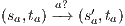

<body><![CDATA[<p><font face="Verdana" size="2"><span class="titlemark">5.2   </span> <a id="x1-100005.2"></a>Deriving Secure Interfaces</font></p>  <font face="Verdana" size="2">      <br> </font>     <p><font face="Verdana" size="2">As we have seen, the composition of secure interfaces may yield a new insecure interface. This may happen when the components are already available but they were designed independently and they were not meant to interact. The question that arises then is if there is a way to derive a secure interface out of an insecure one. To derive the secure                                                                                                                                                                                     interface, we adapt the idea used to define ISS composition (see Def.&nbsp;<a href="#x1-4008r6">6</a>); i.e. we restrict some input transitions in order to avoid insecure behavior. We then obtained a composed system that offers less services than the original one but is secure. In this section we present an algorithm to derive an ISS satisfying SIR-SNNI (or SIR-NNI) from a given ISS whenever possible. Since the method is similar in both cases, we focus on SIR-SNNI.&nbsp;</font></p>     <p>   <font face="Verdana" size="2">This algorithm is based on the algorithm presented in <span class="cite">[<a href="#c6">6</a>]</span> to derive interfaces that satisfy BSNNI/BNNI, which in turn is based on the algorithm for bisimulation checking of <span class="cite">[<a href="#c10">10</a>]</span>. The differences between both algorithm are consequence of the definition of SIR but the idea behind the procedure is the same. The new algorithm works as follows: given two interfaces <img src="/img/revistas/cleiej/v14n3/3a07684x.png" alt="V " class="math"> and <img src="/img/revistas/cleiej/v14n3/3a07685x.png" alt="V&prime; " class="math">, the second without high actions, <span class="cmti-10">(i)</span>&nbsp;<img src="/img/revistas/cleiej/v14n3/3a07686x.png" alt="V " class="math"> is <span class="cmti-10">semi-saturated </span>adding all weak transitions <img src="/img/revistas/cleiej/v14n3/3a07687x.png" alt="&rArr; -&rarr;a " class="math">; <span class="cmti-10">(ii)</span>&nbsp;a <span class="cmti-10">semi-synchronous product </span>of <img src="/img/revistas/cleiej/v14n3/3a07688x.png" alt="V " class="math"> and <img src="/img/revistas/cleiej/v14n3/3a07689x.png" alt="V&prime; " class="math"> is constructed where transitions synchronize whenever they have the same label and satisfy some particular conditions; <span class="cmti-10">(iii)</span>&nbsp;whenever there is a mismatching transition, a new transition is added on the product leading to a special <span class="cmti-10">fail </span>state; <span class="cmti-10">(iv)</span>&nbsp;if reaching a fail state is <span class="cmti-10">inevitable </span>then <img src="/img/revistas/cleiej/v14n3/3a07690x.png" alt="V &frasl;&#8829; V&prime; " class="math">; if there is always a way to avoid reaching a fail state, then <img src="/img/revistas/cleiej/v14n3/3a07691x.png" alt="V &#8829; V&prime; " class="math"> . We later define properly <span class="cmti-10">semi-saturation</span>, <span class="cmti-10">semi-synchronous product </span>and what means <span class="cmti-10">inevitably reaching a fail state</span>. In this way, given an ISS <img src="/img/revistas/cleiej/v14n3/3a07692x.png" alt="S " class="math">, we can check if <img src="/img/revistas/cleiej/v14n3/3a07693x.png" alt="S\Ah &#8829; S &#8725;Ah  " class="math">, if the check succeeds, then <img src="/img/revistas/cleiej/v14n3/3a07694x.png" alt="S " class="math"> satisfies SIR-SNNI (see Theorem&nbsp;<a href="#x1-10016r8">8</a>). If it does not succeed, then we provide an algorithm to decide whether <img src="/img/revistas/cleiej/v14n3/3a07695x.png" alt="S " class="math"> can be transformed into a secure ISS by controlling (i.e. pruning) input transitions. This decision mechanism categorizes insecure interfaces in two different classes: the class of interfaces that can surely be transformed into secure one and the class in which this is not possible.&nbsp;</font></p>     <p>   <font face="Verdana" size="2">The algorithm to synthesize the secure ISS (once it is decided that it is possible) selects an input transition to prune, prune it, and checks whether the resulting ISS is secure. If it is not, a new input transition is selected and pruned. The process is repeated until it gets a secure interface. This process is shown to terminate (see Theorem&nbsp;<a href="#x1-10027r9">9</a>).&nbsp;</font></p>     <p>   <font face="Verdana" size="2">   <span class="cmti-10">Checking Strict Inputs Refinement.&nbsp; </span>Different labels for internal actions do not play any role in a SIR relation. Then, to simplify, we replace all labels of internal action for two new ones: <img src="/img/revistas/cleiej/v14n3/3a07696x.png" alt="&epsilon;  " class="math"> and <img src="/img/revistas/cleiej/v14n3/3a07697x.png" alt="&epsilon;&prime; " class="math">. The label <img src="/img/revistas/cleiej/v14n3/3a07698x.png" alt="&epsilon;&prime; " class="math"> is used to represent an internal transition that can be removed; in our context, an internal action can be removed because it is a high input action that was hidden in order to check for security. Label <img src="/img/revistas/cleiej/v14n3/3a07699x.png" alt="&epsilon;  " class="math"> is used to identify internal action that cannot be removed. This is formalized in the following definition, which includes self-loops with <img src="/img/revistas/cleiej/v14n3/3a07700x.png" alt="&epsilon;  " class="math"> and <img src="/img/revistas/cleiej/v14n3/3a07701x.png" alt="&epsilon;&prime; " class="math"> for future simplifications. </font>    </p>     <div class="newtheorem"> <font face="Verdana" size="2">     <br> </font>     <p><font face="Verdana" size="2"><span class="head"> <a id="x1-10005r19"></a> <span class="cmbx-10">Definition 19.</span>  </span><span class="cmti-10">Let</span> <img src="/img/revistas/cleiej/v14n3/3a07702x.png" alt="S  " class="math"> <span class="cmti-10">be an IA and</span> <img src="/img/revistas/cleiej/v14n3/3a07703x.png" alt="B &sube; AHS  " class="math"><span class="cmti-10">. Define</span> <img src="/img/revistas/cleiej/v14n3/3a07704x.png" alt="S  " class="math"> marking <img src="/img/revistas/cleiej/v14n3/3a07705x.png" alt="B  " class="math"> <span class="cmti-10">or </span>marking <img src="/img/revistas/cleiej/v14n3/3a07706x.png" alt="B  " class="math"> in <img src="/img/revistas/cleiej/v14n3/3a07707x.png" alt="S  " class="math"> <span class="cmti-10">as the IA</span> <img src="/img/revistas/cleiej/v14n3/3a07708x.png" alt="SB = &#10216;QS,q0S,AIS,AOS,{&epsilon;,&epsilon;&prime;},-&rarr;SB &#10217; " class="math"> <span class="cmti-10">where</span> <img src="/img/revistas/cleiej/v14n3/3a07709x.png" alt="-&rarr;SB  " class="math"> <span class="cmti-10">is the least relation satisfying following rules: </span> </font></p>     <div class="gather-star"><font face="Verdana" size="2"><img src="/img/revistas/cleiej/v14n3/3a07710x.png" alt="                       a   &epsilon;         &epsilon;&prime;       q-&rarr;S--q&prime;-a&isin;-AIS-&cup;AOS q-&rarr;SB  q   q-&rarr;SB q         q a-&rarr;S  q&prime;                               B    q a-&rarr;S-q&prime;-a&isin;-B-   q-a&rarr;S-q&prime;-a&isin;-AHS---B-        &epsilon;&prime;   &prime;           q &epsilon;-&rarr;   q&prime;      q-&rarr;SB q               SB"></font></div>  <font face="Verdana" size="2">  <span class="cmti-10">Given an ISS</span> <img src="/img/revistas/cleiej/v14n3/3a07711x.png" alt="S " class="math"><span class="cmti-10">, the </span>marking <img src="/img/revistas/cleiej/v14n3/3a07712x.png" alt="B  " class="math"> in <img src="/img/revistas/cleiej/v14n3/3a07713x.png" alt="S " class="math"><span class="cmti-10">, notation</span> <img src="/img/revistas/cleiej/v14n3/3a07714x.png" alt="S   B  " class="math"><span class="cmti-10">, is the ISS obtained after marking</span> <img src="/img/revistas/cleiej/v14n3/3a07715x.png" alt="B  " class="math"> <span class="cmti-10">in the</span> <span class="cmti-10">underlying IA.</span> </font>    </div>  <font face="Verdana" size="2">      ]]></body>
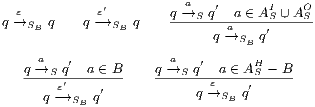
<body><![CDATA[<br> </font>     <p>   <font face="Verdana" size="2">A natural way to check weak bisimulation is to saturate the transition system i.e., to add a new transition <img src="/img/revistas/cleiej/v14n3/3a07716x.png" alt="q-a&rarr; q&prime; " class="math"> to the model for each weak transition <img src="/img/revistas/cleiej/v14n3/3a07717x.png" alt="q a&rArr; q&prime; " class="math">, and then checking strong bisimulation on the saturated transition system. Applying a similar idea we can check if there is a SIR relation. We add a transition <img src="/img/revistas/cleiej/v14n3/3a07718x.png" alt="  a  &prime; q-&rarr;  q " class="math"> whenever <img src="/img/revistas/cleiej/v14n3/3a07719x.png" alt="   a  &prime; q &rArr; -&rarr; q " class="math"> with <img src="/img/revistas/cleiej/v14n3/3a07720x.png" alt="a  " class="math"> an output action. We call this process <span class="cmti-10">semi-saturation</span>. </font>    </p>     <div class="newtheorem"> <font face="Verdana" size="2">     <br> </font>     <p><font face="Verdana" size="2"><span class="head"> <a id="x1-10006r20"></a>                                                                                                                                                                                     <span class="cmbx-10">Definition 20.</span>  </span><span class="cmti-10">Let</span> <img src="/img/revistas/cleiej/v14n3/3a07721x.png" alt="S  " class="math"> <span class="cmti-10">be an IA such that</span> <img src="/img/revistas/cleiej/v14n3/3a07722x.png" alt="AHS = {&epsilon;,&epsilon;&prime;} " class="math"><span class="cmti-10">. The </span>semi-saturation of <img src="/img/revistas/cleiej/v14n3/3a07723x.png" alt="S  " class="math"> <span class="cmti-10">is the IA</span> <img src="/img/revistas/cleiej/v14n3/3a07724x.png" alt="-- S = &#10216;QS,q0S,AIS,AOS,{&epsilon;,&epsilon;&prime;},-&rarr;S-&#10217; " class="math"> <span class="cmti-10">where</span> <img src="/img/revistas/cleiej/v14n3/3a07725x.png" alt="-&rarr;S--  " class="math"> <span class="cmti-10">is the smallest relation satisfying the following rules: </span> </font></p>     <div class="gather-star"><font face="Verdana" size="2"><img src="/img/revistas/cleiej/v14n3/3a07726x.png" alt="  a         &epsilon;        a q--&rarr;S-q&prime;   q--&rarr;S-q&prime;-q&prime;-&rarr;S--q&prime;&prime;-a-&isin;AOS q-a&rarr;- q&prime;           q a-&rarr; -q&prime;&prime;    S                  S"></font></div>  <font face="Verdana" size="2">      <br> </font>     <p>   <font face="Verdana" size="2">   <span class="cmti-10">Given an ISS</span> <img src="/img/revistas/cleiej/v14n3/3a07727x.png" alt="S " class="math"><span class="cmti-10">, its </span>semi-saturation<span class="cmti-10">,</span> <img src="/img/revistas/cleiej/v14n3/3a07728x.png" alt="-- S " class="math"><span class="cmti-10">, is the ISS obtained by saturating the underlying IA.</span> </font>    </p> </div>  <font face="Verdana" size="2">      <br> </font>     <p>   <font face="Verdana" size="2">The last definition ensure that: if <img src="/img/revistas/cleiej/v14n3/3a07729x.png" alt="a &isin; AO  " class="math"> then <img src="/img/revistas/cleiej/v14n3/3a07730x.png" alt="    a q &rArr; -&rarr;S q&prime; " class="math"> iff <img src="/img/revistas/cleiej/v14n3/3a07731x.png" alt="  a q -&rarr;S--q&prime; " class="math">.&nbsp;</font></p>     ]]></body>
<body><![CDATA[<p>   <font face="Verdana" size="2">Following <span class="cite">[<a href="#c6">6</a>]</span> and <span class="cite">[<a href="#c10">10</a>]</span><a name="c10."></a>, the definition of the synchronous products follows from the conditions of the relation being checked, in this case SIR. First, we recapitulate these conditions and then we present the formal definition. If <img src="/img/revistas/cleiej/v14n3/3a07732x.png" alt="S &#8829; T  " class="math"> then for two states <img src="/img/revistas/cleiej/v14n3/3a07733x.png" alt="s &isin; QS  " class="math"> and <img src="/img/revistas/cleiej/v14n3/3a07734x.png" alt="t &isin; QT  " class="math"> s.t. <img src="/img/revistas/cleiej/v14n3/3a07735x.png" alt="s &#8829; t  " class="math">, every output/hidden action that <img src="/img/revistas/cleiej/v14n3/3a07736x.png" alt="t  " class="math"> can execute has to be simulated by <img src="/img/revistas/cleiej/v14n3/3a07737x.png" alt="s  " class="math"> (probably using internal action); on the other hand, <img src="/img/revistas/cleiej/v14n3/3a07738x.png" alt="t  " class="math"> is not forced to simulate output/hidden actions from <img src="/img/revistas/cleiej/v14n3/3a07739x.png" alt="s  " class="math">. Finally, both states have to simulate all input action that can be executed by the other one without performing previously any internal action. All these restrictions become evident from the definition of SIR. When a condition is not satisfied, a transition to a special state <span class="cmti-10">fail </span>is created. Taking this into account we define the <span class="cmti-10">semi-synchronized</span> <span class="cmti-10">product</span>. </font>    </p>     <div class="newtheorem"> <font face="Verdana" size="2">     <br> </font>     <p><font face="Verdana" size="2"><span class="head"> <a id="x1-10007r21"></a> <span class="cmbx-10">Definition 21.</span>  </span><span class="cmti-10">Let</span> <img src="/img/revistas/cleiej/v14n3/3a07740x.png" alt="S  " class="math"> <span class="cmti-10">be a semi-saturated IA and</span> <img src="/img/revistas/cleiej/v14n3/3a07741x.png" alt="T  " class="math"> <span class="cmti-10">be an IA such that</span> <img src="/img/revistas/cleiej/v14n3/3a07742x.png" alt=" X     X    X AS = A T = A  " class="math"> <span class="cmti-10">for</span> <img src="/img/revistas/cleiej/v14n3/3a07743x.png" alt="X  &isin; {I,O } " class="math"> <span class="cmti-10">and</span> <img src="/img/revistas/cleiej/v14n3/3a07744x.png" alt=" H     H      &prime; AS = A T = {&epsilon;,&epsilon; } " class="math"><span class="cmti-10">. The </span>semi-synchronous product <span class="cmti-10">of</span> <img src="/img/revistas/cleiej/v14n3/3a07745x.png" alt="S  " class="math"> <span class="cmti-10">and</span> <img src="/img/revistas/cleiej/v14n3/3a07746x.png" alt="T  " class="math"> <span class="cmti-10">is the IA</span> <img src="/img/revistas/cleiej/v14n3/3a07747x.png" alt="                           0  0   I  O     &prime; S &times; T = &#10216;(QS &times; QT )&cup; {fail},(qS,qT),A  ,A  ,{&epsilon;,&epsilon;},-&rarr;S &times;T&#10217; " class="math"> <span class="cmti-10">where</span> <img src="/img/revistas/cleiej/v14n3/3a07748x.png" alt="-&rarr;S &times;T  " class="math"> <span class="cmti-10">is the smallest relation satisfying following rules: </span> </font></p>     <div class="gather-star"><font face="Verdana" size="2"><img src="/img/revistas/cleiej/v14n3/3a07749x.png" alt="         a   &prime;     a   &prime;        &epsilon;&prime;   &prime;     &epsilon;  &prime;       -qS--&rarr;S-qS--qT-&rarr;T--qT     qS-&rarr;S-qS--qT-&rarr;T--qT--       (qS,qT) a-&rarr;S&times;T (q&prime;S,q&prime;T)     (qS,qT) &epsilon;-&prime;&rarr;S&times;T (q&prime;S,q&prime;T)              &prime; qS &epsilon;-&rarr;S q&prime;S  qT &epsilon;-&rarr;T q&prime;T qS a-&rarr;S  qT-&rarr;a&frasl; T a &isin;AI  qS a-&rarr;&frasl; S qT a-&rarr;T -------&epsilon;&prime;------&prime;-&prime;-----------a--------- -------a------- (qS,qT)-&rarr;S &times;T (qS,qT)  (qS,qT) -&rarr;S&times;T fail   (qS,qT)-&rarr;S &times;T fail"></font></div>  <font face="Verdana" size="2">  <span class="cmti-10">Given</span> <img src="/img/revistas/cleiej/v14n3/3a07750x.png" alt="        h   l S = &#10216;S,AS,A S&#10217; " class="math"> <span class="cmti-10">and</span> <img src="/img/revistas/cleiej/v14n3/3a07751x.png" alt="        h   l T = &#10216;T,AT,A T&#10217; " class="math"> <span class="cmti-10">with</span> <img src="/img/revistas/cleiej/v14n3/3a07752x.png" alt="S  " class="math"> <span class="cmti-10">and</span> <img src="/img/revistas/cleiej/v14n3/3a07753x.png" alt="T  " class="math"> <span class="cmti-10">satisfying conditions above and</span> <img src="/img/revistas/cleiej/v14n3/3a07754x.png" alt=" m     m    m AS = A T = A  " class="math"> <span class="cmti-10">for</span> <img src="/img/revistas/cleiej/v14n3/3a07755x.png" alt="m &isin; {l,h} " class="math"><span class="cmti-10">, then the </span>semi-synchronous product <span class="cmti-10">of</span> <img src="/img/revistas/cleiej/v14n3/3a07756x.png" alt="S " class="math"> <span class="cmti-10">and</span> <img src="/img/revistas/cleiej/v14n3/3a07757x.png" alt="T " class="math"> <span class="cmti-10">is defined by the ISS</span> <img src="/img/revistas/cleiej/v14n3/3a07758x.png" alt="               h   l S &times;T  = &#10216;S &times; T,A ,A &#10217; " class="math"><span class="cmti-10">.</span> </font>    </div>  <font face="Verdana" size="2">      <br> </font>     <p>   <font face="Verdana" size="2">Let us show how we can use synchronous product to check and derive, whenever it is possible, a SIR relation. If there is a state <img src="/img/revistas/cleiej/v14n3/3a07759x.png" alt="(qS,qT)  " class="math"> such that <img src="/img/revistas/cleiej/v14n3/3a07760x.png" alt="(qS,qT) a-&rarr;S &times;T fail  " class="math"> then it is evident that <img src="/img/revistas/cleiej/v14n3/3a07761x.png" alt="qS &frasl;&#8829; qT  " class="math">. Moreover, suppose the synchronous product only has states <img src="/img/revistas/cleiej/v14n3/3a07762x.png" alt="(qS,qT )  " class="math"> and <img src="/img/revistas/cleiej/v14n3/3a07763x.png" alt="fail  " class="math"> and the transition <img src="/img/revistas/cleiej/v14n3/3a07764x.png" alt="       a (qS,qT )-&rarr;S &times;T fail  " class="math">. If <img src="/img/revistas/cleiej/v14n3/3a07765x.png" alt="     O a &isin; A  " class="math">, as the progress from <img src="/img/revistas/cleiej/v14n3/3a07766x.png" alt="(qS,qT)  " class="math"> is autonomous, there is no way to control the execution of <img src="/img/revistas/cleiej/v14n3/3a07767x.png" alt="a!  " class="math"> and hence there is no way to avoid <img src="/img/revistas/cleiej/v14n3/3a07768x.png" alt="qS &frasl;&#8829; qT  " class="math">. Then, we say that <img src="/img/revistas/cleiej/v14n3/3a07769x.png" alt="(qS,qT )  " class="math"> <span class="cmti-10">fails </span>the SIR-relation test. On the other hand, if <img src="/img/revistas/cleiej/v14n3/3a07770x.png" alt="     I a &isin; A  " class="math">, a state offers a service that the other does not. In this case, removing the input transition <img src="/img/revistas/cleiej/v14n3/3a07771x.png" alt="a  " class="math"> (the interface offers less services), we avoid transition <img src="/img/revistas/cleiej/v14n3/3a07772x.png" alt="        a (qS,qT)-&rarr;S &times;T fail  " class="math"> in the synchronous product and we get two states such that <img src="/img/revistas/cleiej/v14n3/3a07773x.png" alt="qS &#8829; qT  " class="math">, moreover, we get two interfaces related by a SIR relation. In this case, we say that <img src="/img/revistas/cleiej/v14n3/3a07774x.png" alt="(qS,qT)  " class="math"> <span class="cmti-10">may pass </span>the SIR relation test. In a more complex synchronous product, the &ldquo;failure&rdquo; in the state <img src="/img/revistas/cleiej/v14n3/3a07775x.png" alt="(qS,qT)  " class="math"> has to be propagated backwards appropriately to identify pairs of states that cannot be related. This propagation is done by the definitions of two different sets: <img src="/img/revistas/cleiej/v14n3/3a07776x.png" alt="Fail " class="math"> and <img src="/img/revistas/cleiej/v14n3/3a07777x.png" alt="May  " class="math">. The set <img src="/img/revistas/cleiej/v14n3/3a07778x.png" alt="Fail  " class="math"> contains those pairs that are not related by a refinement and there is no set of input transitions to prune so that the pair may become related by the refinement. On the other hand, <img src="/img/revistas/cleiej/v14n3/3a07779x.png" alt="May  " class="math"> contains pairs of states that are not related but will be related if some transition is pruned. States not in <img src="/img/revistas/cleiej/v14n3/3a07780x.png" alt="Fail&cup; May  " class="math">, belong to the set <img src="/img/revistas/cleiej/v14n3/3a07781x.png" alt="Pass  " class="math">. All pairs in <img src="/img/revistas/cleiej/v14n3/3a07782x.png" alt="Pass  " class="math"> are related by a SIR relation.&nbsp;</font></p>     <p>   <font face="Verdana" size="2">   <a id="x1-100083"></a></font></p> <hr class="float">     <div class="float">                                                                                                                                                                                     <font face="Verdana" size="2">                                                                                                                                                                                         <br> </font>     ]]></body>

<body><![CDATA[<p></p>     <div class="gather-star"><font face="Verdana" size="2"><img src="/img/revistas/cleiej/v14n3/3a07783x.png" alt="                   0                 a           I                 Fail = {(qS,qT):(qS,qT)-&rarr;S &times;T fail,a&frasl;&isin; A }&cup; {fail} Failk+1 = Failk &cup;{(q ,q) :a&isin; AO &cup;A,q a-&rarr; q&prime;,(&forall;q&prime; :(q ,q ) a-&rarr; (q&prime;,q&prime;):(q&prime;,q&prime;)&isin; Failk)}                 S T             T    T   S   S  T     S T    S  T"></font></div>  <font face="Verdana" size="2">      <br>   </font>       <div class="caption"><font face="Verdana" size="2"><span class="id">Table&nbsp;3: </span><span class="content">The <img src="/img/revistas/cleiej/v14n3/3a07784x.png" alt="Fail  " class="math"> set. </span>   </font></div> <font face="Verdana" size="2">     <br>                                                                                                                                                                                         </font>                                                                                                                                                                                         </div> <hr class="endfloat">                                                                                                                                                                                     <font face="Verdana" size="2">                                                                                                                                                                                         <br> </font>     <p>   <font face="Verdana" size="2">   <a id="x1-100094"></a></font></p> <hr class="float">     <div class="float">                                                                                                                                                                                     <font face="Verdana" size="2">                                                                                                                                                                                         <br> </font>     <p></p>     ]]></body>
<body><![CDATA[<div class="gather-star"><font face="Verdana" size="2"><img src="/img/revistas/cleiej/v14n3/3a07785x.png" alt="          0       &#8899;          0          k+1      k       &#8899;          k+1       May  =  a          May q- a&rarr;q&prime;  May    = May &cup;  a          May q- a&rarr;q&prime;              q-&rarr;q&prime;&isin;(-&rarr;S &cup;-&rarr;T )                         q-&rarr;q&prime;&isin;(-&rarr;S &cup;-&rarr;T )                0                                I        a             Mayq a-&rarr;q&prime; ={(qS,qT ):(q = qS &or;q = qT),a&isin; A ,(qS,qT)-&rarr;S &times;T fail}                                 a                a Mayk+1a &prime;= {(qS,qT)&frasl;&isin; Fail:a &isin; A,qS -&rarr; q&prime;S,(&forall;q&prime;T :(qS,qT)-&rarr;  (q&prime;S,q&prime;T):(qS&prime;,q&prime;T)&isin; Fail&cup; Mayk)}     qS-&rarr;q S Mayk+1a  = {(qS,qT)&frasl;&isin; Fail:a &isin; A,qT a-&rarr; q&prime;T,(&forall;q&prime;S :(qS,qT)-a&rarr; (q&prime;S,q&prime;T):(q&prime;S,q&prime;T) &isin;Fail&cup; Mayk)}    qT-&rarr;q &prime;T"></font></div>  <font face="Verdana" size="2">      <br>   </font>       <div class="caption"><font face="Verdana" size="2"><span class="id">Table&nbsp;4: </span><span class="content">The definition of <img src="/img/revistas/cleiej/v14n3/3a07786x.png" alt="May  " class="math"> set . </span>   </font></div> <font face="Verdana" size="2">     <br>                                                                                                                                                                                         </font>                                                                                                                                                                                         </div> <hr class="endfloat">         <div class="newtheorem"> <font face="Verdana" size="2">     <br> </font>     <p><font face="Verdana" size="2"><span class="head"> <a id="x1-10010r22"></a> <span class="cmbx-10">Definition 22.</span>  </span> <span class="cmti-10">Let</span> <img src="/img/revistas/cleiej/v14n3/3a07787x.png" alt="S &times; T  " class="math"> <span class="cmti-10">be a synchronous product. We define the sets</span> <img src="/img/revistas/cleiej/v14n3/3a07788x.png" alt="Fail,May, Pass &sube; QS&times;T  " class="math"> <span class="cmti-10">respectively</span> <span class="cmti-10">by:</span> </font>      </p> <ul>       <li class="compactitem"><font face="Verdana" size="2"><img src="/img/revistas/cleiej/v14n3/3a07789x.png" alt="Fail = &cup;&infin;i=0Faili  " class="math"> <span class="cmti-10">where</span> <img src="/img/revistas/cleiej/v14n3/3a07790x.png" alt="Faili  " class="math"> <span class="cmti-10">is defined in Table&nbsp;</span><a href="#x1-100083"><span class="cmti-10">3</span></a><span class="cmti-10">. If</span> <img src="/img/revistas/cleiej/v14n3/3a07791x.png" alt="q &isin; Fail  " class="math"><span class="cmti-10">, we say that the pair</span> <img src="/img/revistas/cleiej/v14n3/3a07792x.png" alt="q  " class="math"> fails the      SIR relation test<span class="cmti-10">.</span> </font>      </li>       <li class="compactitem"><font face="Verdana" size="2"><img src="/img/revistas/cleiej/v14n3/3a07793x.png" alt="May = &cup;&infin;i=0Mayi  " class="math"> <span class="cmti-10">where</span> <img src="/img/revistas/cleiej/v14n3/3a07794x.png" alt="Mayi  " class="math"> <span class="cmti-10">is defined in Table&nbsp;</span><a href="#x1-100094"><span class="cmti-10">4</span></a><span class="cmti-10">. If</span> <img src="/img/revistas/cleiej/v14n3/3a07795x.png" alt="q &isin; May  " class="math"><span class="cmti-10">, we say that the pair</span> <img src="/img/revistas/cleiej/v14n3/3a07796x.png" alt="q  " class="math"> may pass      the SIR relation test<span class="cmti-10">.</span> </font>      </li>       <li class="compactitem"><font face="Verdana" size="2"><img src="/img/revistas/cleiej/v14n3/3a07797x.png" alt="Pass = QS &times;T - (May &cup; Fail)  " class="math"><span class="cmti-10">. If</span> <img src="/img/revistas/cleiej/v14n3/3a07798x.png" alt="q &isin; Pass  " class="math"><span class="cmti-10">, we say that the pair</span> <img src="/img/revistas/cleiej/v14n3/3a07799x.png" alt="q  " class="math"> passes the SIR relation test</font></li>     </ul>  <font face="Verdana" size="2">      <br> </font>     <p><font face="Verdana" size="2"><span class="cmti-10">If the initial state of the underlying IA of an ISS</span> <img src="/img/revistas/cleiej/v14n3/3a07800x.png" alt="S &times; T " class="math"> <span class="cmti-10">passes (may pass, fails) the SIR relation test, we say that</span> <img src="/img/revistas/cleiej/v14n3/3a07801x.png" alt="S &times; T " class="math"> <span class="cmti-10">passes (may pass, fails) the SIR relation test.</span> </font>    </p> </div>  <font face="Verdana" size="2">      ]]></body>
<body><![CDATA[<br> </font>     <p>   <font face="Verdana" size="2">The proof of the following lemma is based on the proof of the algorithm to check bisimulation in <span class="cite">[<a href="#c10">10</a>]</span>, for this reason we only present a proof sketch. Our proof deviates a little from the original as a consequence of not all mismatching transitions are problematic. </font>    </p>     <div class="newtheorem"> <font face="Verdana" size="2">     <br> </font>     <p><font face="Verdana" size="2"><span class="head"> <a id="x1-10011r3"></a> <span class="cmbx-10">Lemma 3.</span>  </span> <span class="cmti-10">A semi-synchronized product</span> <img src="/img/revistas/cleiej/v14n3/3a07802x.png" alt="S &times;T  " class="math"> <span class="cmti-10">passes the SIR relation test iff</span> <img src="/img/revistas/cleiej/v14n3/3a07803x.png" alt="S &#8829; T  " class="math"><span class="cmti-10">.</span> </font>    </p> </div>  <font face="Verdana" size="2">      <br> </font>     <p>    </p>     <div class="proof"> <font face="Verdana" size="2">     <br> </font>     <p>   <font face="Verdana" size="2">   <span class="head"> <span class="cmti-10">Proof sketch.</span> </span> Since <img src="/img/revistas/cleiej/v14n3/3a07804x.png" alt="(May &cup; Fail)&cap; Pass = &empty; " class="math">, we only have to prove that <span class="cmti-10">(i)</span>&nbsp; <img src="/img/revistas/cleiej/v14n3/3a07805x.png" alt="(qS,qT) &isin; May &cup; Fail  " class="math"> implies <img src="/img/revistas/cleiej/v14n3/3a07806x.png" alt="qS &frasl;&#8829; qT  " class="math"> and <span class="cmti-10">(ii)</span>&nbsp; if <img src="/img/revistas/cleiej/v14n3/3a07807x.png" alt="(qS,qT) &isin; Pass  " class="math"> then <img src="/img/revistas/cleiej/v14n3/3a07808x.png" alt="qS &#8829; qT  " class="math"> . The proof of (<a href="#x1-10012r1">i</a>) is by induction on <img src="/img/revistas/cleiej/v14n3/3a07809x.png" alt="k  " class="math"> in <img src="/img/revistas/cleiej/v14n3/3a07810x.png" alt="Mayk  " class="math"> and <img src="/img/revistas/cleiej/v14n3/3a07811x.png" alt="Failk  " class="math">. The proof of (<a href="#x1-10013r2">ii</a>) is straightforward after showing that, given a state <img src="/img/revistas/cleiej/v14n3/3a07812x.png" alt="(s,t) &isin; QS&times;T &cap; Pass  " class="math">, then: </font>      </p> <dl class="enumerate-enumitem">   <dd><font face="Verdana" size="2">1. </font></dd>   <dd class="enumerate-enumitem"><font face="Verdana" size="2">if  <img src="/img/revistas/cleiej/v14n3/3a07813x.png" alt="  a  &prime; s -&rarr; s " class="math"> and  <img src="/img/revistas/cleiej/v14n3/3a07814x.png" alt="     I a &isin; A  " class="math">  then  there  is  a  state  <img src="/img/revistas/cleiej/v14n3/3a07815x.png" alt=" &prime; t " class="math"> s.t.  there  is  a  transition  <img src="/img/revistas/cleiej/v14n3/3a07816x.png" alt="     a   &prime; &prime; (s,t) -&rarr; (s,t )  " class="math">  and      <img src="/img/revistas/cleiej/v14n3/3a07817x.png" alt="  &prime; &prime; (s,t) &isin; Pass  " class="math">. </font>      </dd>   <dd><font face="Verdana" size="2">2. </font></dd>   <dd class="enumerate-enumitem"><font face="Verdana" size="2">if <img src="/img/revistas/cleiej/v14n3/3a07818x.png" alt="t a-&rarr; t&prime; " class="math"> then there is a state <img src="/img/revistas/cleiej/v14n3/3a07819x.png" alt="s&prime; " class="math"> s.t. there is a transition <img src="/img/revistas/cleiej/v14n3/3a07820x.png" alt="(s,t)-&rarr;a (s&prime;,t&prime;)  " class="math"> and <img src="/img/revistas/cleiej/v14n3/3a07821x.png" alt="(s&prime;,t&prime;) &isin; Pass  " class="math">.</font></dd> </dl>  <font face="Verdana" size="2">      ]]></body>

<body><![CDATA[<br> </font>     <p><font face="Verdana" size="2">The proof of both statements is by case analysis on <img src="/img/revistas/cleiej/v14n3/3a07822x.png" alt="a  " class="math"> obtaining always a contradiction.                          __ </font>    </p> </div>  <font face="Verdana" size="2">      <br> </font>     <p>   <font face="Verdana" size="2">Using this lemma, we can verify if an interface is SIR-SNNI, since <img src="/img/revistas/cleiej/v14n3/3a07823x.png" alt="S " class="math"> is SIR-SNNI&nbsp;if <img src="/img/revistas/cleiej/v14n3/3a07824x.png" alt="   h S\A  " class="math"> is refined by <img src="/img/revistas/cleiej/v14n3/3a07825x.png" alt="    h S&#8725;A  " class="math">. Notice that we cannot use <img src="/img/revistas/cleiej/v14n3/3a07826x.png" alt="    h S \A  " class="math"> and <img src="/img/revistas/cleiej/v14n3/3a07827x.png" alt="   h S&#8725;A  " class="math"> to create a semi-synchronized product; in general, <img src="/img/revistas/cleiej/v14n3/3a07828x.png" alt="    h S\A  " class="math"> does not satisfy <img src="/img/revistas/cleiej/v14n3/3a07829x.png" alt=" H       &prime; A  = {&epsilon;,&epsilon;} " class="math"> and it is not semi-saturated. This can be solved marking <img src="/img/revistas/cleiej/v14n3/3a07830x.png" alt="&empty; " class="math"> in <img src="/img/revistas/cleiej/v14n3/3a07831x.png" alt="    h S\A  " class="math"> and then semi-saturating the interface, i.e. we work with <img src="/img/revistas/cleiej/v14n3/3a07832x.png" alt="----h-- (S\A )&empty; " class="math"> instead of <img src="/img/revistas/cleiej/v14n3/3a07833x.png" alt="   h S\A  " class="math">. Similarly, <img src="/img/revistas/cleiej/v14n3/3a07834x.png" alt="    h S&#8725;A  " class="math"> does not satisfy <img src="/img/revistas/cleiej/v14n3/3a07835x.png" alt="  H      &prime; A   = {&epsilon;,&epsilon; } " class="math">. Since <img src="/img/revistas/cleiej/v14n3/3a07836x.png" alt=" &prime; &epsilon; " class="math"> is used to represent the internal action that can be removed, we solve this problem marking <img src="/img/revistas/cleiej/v14n3/3a07837x.png" alt=" h,I A  " class="math"> in <img src="/img/revistas/cleiej/v14n3/3a07838x.png" alt="   h S&#8725;A  " class="math">, i.e. we replace <img src="/img/revistas/cleiej/v14n3/3a07839x.png" alt="   h S&#8725;A  " class="math"> by <img src="/img/revistas/cleiej/v14n3/3a07840x.png" alt="    h (S&#8725;A )Ah,I  " class="math">. Therefore, verifying that <img src="/img/revistas/cleiej/v14n3/3a07841x.png" alt="S " class="math"> satisfies SIR-SNNI&nbsp;amounts to checking whether <img src="/img/revistas/cleiej/v14n3/3a07842x.png" alt="    ----h       h PS = S \A &empty; &times; (S&#8725;A )Ah,I  " class="math"> passes the refinement test. Applying a similar reasoning, if we are interested on verifying SIR-NNI, we can check if <img src="/img/revistas/cleiej/v14n3/3a07843x.png" alt="-------------- ((S\Ah,I)&#8725;Ah,O )&empty; &times; (S &#8725;Ah )Ah,I  " class="math"> passes the SIR-relation test. Then we have a decision algorithm to check whether an ISS satisfies SIR-SNNI&nbsp;or SIR-NNI. We state it in the following theorem. </font>    </p>     <div class="newtheorem">                                                                                                                                                                                     <font face="Verdana" size="2">                                                                                                                                                                                         <br> </font>     <p><font face="Verdana" size="2"><span class="head"> <a id="x1-10016r8"></a> <span class="cmbx-10">Theorem 8.</span>  </span> <span class="cmti-10">Let</span> <img src="/img/revistas/cleiej/v14n3/3a07844x.png" alt="S = &#10216;S,Ah,Al&#10217; " class="math"> <span class="cmti-10">be an ISS.</span> </font>      </p> <dl class="enumerate-enumitem">   <dd><font face="Verdana" size="2">   <span class="cmti-10">1.</span> </font></dd>   <dd class="enumerate-enumitem"><font face="Verdana" size="2"><img src="/img/revistas/cleiej/v14n3/3a07845x.png" alt="S " class="math"> <span class="cmti-10">satisfies SIR-SNNI&nbsp;iff</span> <img src="/img/revistas/cleiej/v14n3/3a07846x.png" alt="-----h-       h (S\A  )&empty; &times; (S &#8725;A )Ah,I  " class="math"> <span class="cmti-10">passes the SIR-relation test.</span>   </font>      </dd>   <dd><font face="Verdana" size="2">   <span class="cmti-10">2.</span> </font></dd>   <dd class="enumerate-enumitem"><font face="Verdana" size="2"><img src="/img/revistas/cleiej/v14n3/3a07847x.png" alt="S " class="math"> <span class="cmti-10">satisfies SIR-NNI&nbsp;iff</span> <img src="/img/revistas/cleiej/v14n3/3a07848x.png" alt="((S\Ah,I)&#8725;Ah,O) &times; (S&#8725;Ah)Ah,I               &empty;  " class="math"> <span class="cmti-10">passes the SIR-relation test.</span></font></dd> </dl>     </div>                                                                                                                                                                                      <font face="Verdana" size="2">                                                                                                                                                                                          <br> </font>     <p>   <font face="Verdana" size="2">   <a id="x1-100235"></a></font></p> <hr class="float">     <div class="float">                                                                                                                                                                                         ]]></body>

<body><![CDATA[<div class="center"> <font face="Verdana" size="2">     <br> </font>     <p> </p>     <div class="align"><font face="Verdana" size="2"><img src="/img/revistas/cleiej/v14n3/3a07849x.png" alt="pict"><a id="x1-10019r2"></a><a id="x1-10020r3"></a><a id="x1-10021r4"></a><a id="x1-10022r5"></a></font></div>  <font face="Verdana" size="2">      <br>   </font>       <div class="caption"><font face="Verdana" size="2"><span class="id">Table&nbsp;5: </span><span class="content">Set of eliminable candidates.</span></font></div> <font face="Verdana" size="2">     <br>  </font>  </div>                                                                                                                                                                                         </div> <hr class="endfloat"> <font face="Verdana" size="2">     <br> </font>     <p>   <font face="Verdana" size="2">   <span class="cmti-10">Synthesizing Secure ISS.&nbsp; </span>In the following, we show that if a synchronized product <img src="/img/revistas/cleiej/v14n3/3a07850x.png" alt="PS " class="math"> may pass the SIR relation test then there is a set of input transition that can be pruned so that the resulting interface is secure. First, we need to select which are the candidate input actions to be removed. So, if <img src="/img/revistas/cleiej/v14n3/3a07851x.png" alt="S " class="math"> is an ISS such that <img src="/img/revistas/cleiej/v14n3/3a07852x.png" alt="PS " class="math"> may pass the SIR-relation test, the set <img src="/img/revistas/cleiej/v14n3/3a07853x.png" alt="EC (S) &sube; -&rarr; &cap;Q &times; AI &times; Q  " class="math"> (see Table&nbsp;<a href="#x1-100235">5</a>) is the set of <span class="cmti-10">eliminable</span> <span class="cmti-10">candidates</span>.&nbsp;</font></p>     <p>   <font face="Verdana" size="2">All transitions in <img src="/img/revistas/cleiej/v14n3/3a07854x.png" alt="EC (S )  " class="math"> are involved in a synchronization that connects a source pair that may pass the SIR-relation test and a failing target. This can happen in four different situations. The first one is the basic case, in which one of the components of the pair can perform a low input transition that cannot be matched by the other. The following two cases are symmetric and consider the case in which both sides can perform an equally low input transition but end up in a failing state. The last case includes high input actions that are hidden in the synchronized product and always reach a pair that fails. Notice that if <img src="/img/revistas/cleiej/v14n3/3a07855x.png" alt="PS " class="math"> may pass the bisimulation test then <img src="/img/revistas/cleiej/v14n3/3a07856x.png" alt="EC (S) &frasl;= &empty; " class="math">.&nbsp;</font></p>     ]]></body>

<body><![CDATA[<p>   <font face="Verdana" size="2">An important result is that no new failing pair of states is introduced by removing eliminable candidates. Moreover, if a pair of states fails in the synchronous product of the original ISS and it is also present in the synchronous product of the reduced ISS, then it also fails in this ISS. This ensures that a synchronous product that may pass the SIR-relation test, will not fail after pruning. In a sense, Lemma&nbsp;<a href="#x1-10024r4">4</a> below states that the sets <img src="/img/revistas/cleiej/v14n3/3a07857x.png" alt="Fail  " class="math"> and <img src="/img/revistas/cleiej/v14n3/3a07858x.png" alt="Pass&cup; May  " class="math"> remain invariant. </font>    </p>     <div class="newtheorem"> <font face="Verdana" size="2">     <br> </font>     <p><font face="Verdana" size="2"><span class="head"> <a id="x1-10024r4"></a> <span class="cmbx-10">Lemma 4.</span>  </span> <span class="cmti-10">Let</span> <img src="/img/revistas/cleiej/v14n3/3a07859x.png" alt="S " class="math"> <span class="cmti-10">be an ISS s.t.&nbsp;</span><img src="/img/revistas/cleiej/v14n3/3a07860x.png" alt="PS " class="math"> <span class="cmti-10">may pass the SIR-relation test. Let</span> <img src="/img/revistas/cleiej/v14n3/3a07861x.png" alt="S &prime; " class="math"> <span class="cmti-10">be an ISS obtained by</span> <span class="cmti-10">removing one transition in</span> <img src="/img/revistas/cleiej/v14n3/3a07862x.png" alt="EC (S)  " class="math"> <span class="cmti-10">from</span> <img src="/img/revistas/cleiej/v14n3/3a07863x.png" alt="S " class="math"> <span class="cmti-10">(i.e.&nbsp;</span><img src="/img/revistas/cleiej/v14n3/3a07864x.png" alt="-&rarr;S &prime; = -&rarr;S - {q a-&rarr; q&prime;} " class="math"><span class="cmti-10">, provided</span> <img src="/img/revistas/cleiej/v14n3/3a07865x.png" alt="q-&rarr;a q&prime; &isin; EC(S)  " class="math"><span class="cmti-10">,</span> <span class="cmti-10">and unreachable states are removed form</span> <img src="/img/revistas/cleiej/v14n3/3a07866x.png" alt="S&prime; " class="math"><span class="cmti-10">). Then it holds that:</span> <a id="x1-10025r1"></a><span class="cmti-10">(i)&nbsp;</span><img src="/img/revistas/cleiej/v14n3/3a07867x.png" alt="FailPS&prime; = FailPS &cap;QPS &prime; " class="math"><span class="cmti-10">;</span> <a id="x1-10026r2"></a><span class="cmti-10">(ii)&nbsp;</span><img src="/img/revistas/cleiej/v14n3/3a07868x.png" alt="(PassPS &cup;MayPS )&cap; QPS&prime; = PassPS&prime; &cup; MayP &prime;                                      S " class="math"> <span class="cmti-10">(Subindices in</span> <img src="/img/revistas/cleiej/v14n3/3a07869x.png" alt="FailPS " class="math"><span class="cmti-10">,</span> <img src="/img/revistas/cleiej/v14n3/3a07870x.png" alt="MayPS " class="math"><span class="cmti-10">, etc.&nbsp;indicate that these sets</span> <span class="cmti-10">were obtained from the synchronous product</span> <img src="/img/revistas/cleiej/v14n3/3a07871x.png" alt="PS " class="math"> <span class="cmti-10">.)</span> </font>    </p> </div>  <font face="Verdana" size="2">      <br> </font>     <p>    </p>     <div class="proof"> <font face="Verdana" size="2">     <br> </font>     <p>   <font face="Verdana" size="2">   <span class="head"> <span class="cmti-10">Proof.</span> </span>We only show (<a href="#x1-10025r1">i</a>). (<a href="#x1-10026r2">ii</a>) is an immediate consequence of (<a href="#x1-10025r1">i</a>).&nbsp;</font></p>     <p>   <font face="Verdana" size="2">(<span class="cmti-10">Case</span>  <img src="/img/revistas/cleiej/v14n3/3a07872x.png" alt="&sube; " class="math">).  Clearly  <img src="/img/revistas/cleiej/v14n3/3a07873x.png" alt="QPS&prime; &sube; QPS  " class="math">.  Suppose  <img src="/img/revistas/cleiej/v14n3/3a07874x.png" alt="  b? q -&rarr;  q&prime; &isin; EC(S)  " class="math">  is  the  transition  that  is  removed. By  induction  on  <img src="/img/revistas/cleiej/v14n3/3a07875x.png" alt="k  " class="math">  we  show  <img src="/img/revistas/cleiej/v14n3/3a07876x.png" alt="Failka      &sube; Failka    q-&rarr;q &prime;,PS&prime;      q-&rarr;q&prime;,PS " class="math"> for  all  <img src="/img/revistas/cleiej/v14n3/3a07877x.png" alt="k  " class="math">.  This  implies  <img src="/img/revistas/cleiej/v14n3/3a07878x.png" alt="FailkPS&prime; &sube; FailkPS " class="math"> and then <img src="/img/revistas/cleiej/v14n3/3a07879x.png" alt="FailPS&prime; &sube; FailPS " class="math">. Suppose <img src="/img/revistas/cleiej/v14n3/3a07880x.png" alt="           0 (qr,qa) &isin; Failqa- a&rarr;q&prime;,PS&prime;                a " class="math">. By definition, action <img src="/img/revistas/cleiej/v14n3/3a07881x.png" alt="     I    &prime; a &frasl;&isin; A &cup; {&epsilon;} " class="math"> and <img src="/img/revistas/cleiej/v14n3/3a07882x.png" alt="       a (qr,qa) -&rarr; fail  " class="math">. Then <img src="/img/revistas/cleiej/v14n3/3a07883x.png" alt="a &frasl;= b?  " class="math"> and therefore <img src="/img/revistas/cleiej/v14n3/3a07884x.png" alt="      a (qr,qa)-&rarr; fail  " class="math"> belongs to <img src="/img/revistas/cleiej/v14n3/3a07885x.png" alt="PS " class="math">. Then <img src="/img/revistas/cleiej/v14n3/3a07886x.png" alt="            0 (qr,qa) &isin; Failq-&rarr;aq &prime;,P             a   a S " class="math">. Suppose now <img src="/img/revistas/cleiej/v14n3/3a07887x.png" alt="           k+1 (qr,qa) &isin; Failq -&rarr;aq &prime;,P &prime;             a   a S " class="math">.  Then  <img src="/img/revistas/cleiej/v14n3/3a07888x.png" alt="     I    &prime; a &frasl;&isin; A &cup; {&epsilon;} " class="math"> and  <img src="/img/revistas/cleiej/v14n3/3a07889x.png" alt="  &prime;        a   &prime;  &prime;    &prime; &prime;      k (&forall;qr : (qr,qa)-&rarr; (qr,qa) : (qr,qa) &isin; FailPS&prime;)  " class="math">.  Notice that <img src="/img/revistas/cleiej/v14n3/3a07890x.png" alt="   &prime; &prime;         a     &prime;  &prime;      &prime;  &prime;         a     &prime;  &prime; {(qr,qa) : (qr,qa)-&rarr;PS (qr,qa)} = {(qr,qa) : (qr,qa)-&rarr;PS&prime; (qr,qa)} " class="math"> as consequence of <img src="/img/revistas/cleiej/v14n3/3a07891x.png" alt="      I   &prime; b? &isin; A &cup; {&epsilon; } " class="math">. By  induction  hypothesis  <img src="/img/revistas/cleiej/v14n3/3a07892x.png" alt="FailkPS&prime; &sube; FailkPS " class="math">,  then  <img src="/img/revistas/cleiej/v14n3/3a07893x.png" alt="            a &forall;q&prime;a : (qr,qa)-&rarr; (q&prime;r,q&prime;a) : (q&prime;r,q&prime;a) &isin; FailkPS " class="math"> and  we  get <img src="/img/revistas/cleiej/v14n3/3a07894x.png" alt="(qr,qa) &isin; Failk+1a            qa-&rarr;q &prime;a,PS " class="math"> and <img src="/img/revistas/cleiej/v14n3/3a07895x.png" alt="(qr,qa) &isin; FailkP+1             S " class="math">.&nbsp;</font></p>     ]]></body>
<body><![CDATA[<p>   <font face="Verdana" size="2">(<span class="cmti-10">Case</span> <img src="/img/revistas/cleiej/v14n3/3a07896x.png" alt="(&supe;)  " class="math"><span class="cmti-10">.</span>)&nbsp;We show by induction on <img src="/img/revistas/cleiej/v14n3/3a07897x.png" alt="k  " class="math"> that <img src="/img/revistas/cleiej/v14n3/3a07898x.png" alt="   k       k FailPS&prime; &supe; FailPS &cap;QPS &prime; " class="math"> for all <img src="/img/revistas/cleiej/v14n3/3a07899x.png" alt="k  " class="math">. Let <img src="/img/revistas/cleiej/v14n3/3a07900x.png" alt="            0 (qr,qa) &isin; FailPS &cap; QPS&prime; " class="math">. Moreover,  w.l.o.g.  suppose  <img src="/img/revistas/cleiej/v14n3/3a07901x.png" alt="(qr,qa) &isin; Fail0 a            qa-&rarr;q &prime;a,PS " class="math">.  Since  <img src="/img/revistas/cleiej/v14n3/3a07902x.png" alt="a &#8725;&isin; AI  " class="math">,  the  transition  <img src="/img/revistas/cleiej/v14n3/3a07903x.png" alt="qr a-&rarr; q&prime;r  " class="math">  cannot  be removed and since <img src="/img/revistas/cleiej/v14n3/3a07904x.png" alt="  a qr-&rarr;&frasl; " class="math">, then it holds that <img src="/img/revistas/cleiej/v14n3/3a07905x.png" alt="(qr,qa) &isin; Fail0 a    &sube; Fail0PS&prime;            qr-&rarr;q&prime;r,PS&prime; " class="math">. For the induction case, suppose w.l.o.g.&nbsp;<img src="/img/revistas/cleiej/v14n3/3a07906x.png" alt="(qr,qa) &isin; Failk+1a &prime;  &cap;QPS &prime;            qa-&rarr;q a,PS " class="math">. Then <img src="/img/revistas/cleiej/v14n3/3a07907x.png" alt="            a (&forall;q&prime;r : (qr,qa) -&rarr; (q&prime;r,qa&prime;) : (q&prime;r,q&prime;a) &isin; FailkPS)  " class="math">. Since <img src="/img/revistas/cleiej/v14n3/3a07908x.png" alt="(qr,qa)  " class="math"> is reachable in <img src="/img/revistas/cleiej/v14n3/3a07909x.png" alt=" &prime; S " class="math"> and <img src="/img/revistas/cleiej/v14n3/3a07910x.png" alt="    I a &#8725;&isin; A  " class="math">, all pair <img src="/img/revistas/cleiej/v14n3/3a07911x.png" alt=" &prime;  &prime; (qr,qa)  " class="math"> is reachable in <img src="/img/revistas/cleiej/v14n3/3a07912x.png" alt="  &prime; S " class="math">. By induction hypothesis,                                                                                                                                                                                     <img src="/img/revistas/cleiej/v14n3/3a07913x.png" alt="(q&prime;r,q&prime;a) &isin; FailkPS&prime; " class="math"> and then <img src="/img/revistas/cleiej/v14n3/3a07914x.png" alt="(qr,qa) &isin; Failk+1a &prime;  &sube; FailkP+S1            qa-&rarr;qa,PS " class="math">.                                                       __ </font>    </p> </div>  <font face="Verdana" size="2">      <br> </font>     <p>   <font face="Verdana" size="2">The following theorem is the main result of this section. Notice that its proof defines the algorithm to prune input actions and obtain a secure interface. A similar result holds for SIR-NNI. </font>    </p>     <div class="newtheorem"> <font face="Verdana" size="2">     <br> </font>     <p><font face="Verdana" size="2"><span class="head"> <a id="x1-10027r9"></a> <span class="cmbx-10">Theorem 9.</span>  </span><span class="cmti-10">Let</span> <img src="/img/revistas/cleiej/v14n3/3a07915x.png" alt="S " class="math"> <span class="cmti-10">be an ISS such that</span> <img src="/img/revistas/cleiej/v14n3/3a07916x.png" alt="PS " class="math"> <span class="cmti-10">may pass the SIR relation test. Then there is an input</span> <span class="cmti-10">transition set</span> <img src="/img/revistas/cleiej/v14n3/3a07917x.png" alt="-&rarr; &chi;  " class="math"> <span class="cmti-10">such that, if</span> <img src="/img/revistas/cleiej/v14n3/3a07918x.png" alt=" &prime; S " class="math"> <span class="cmti-10">is the ISS obtained from</span> <img src="/img/revistas/cleiej/v14n3/3a07919x.png" alt="S " class="math"> <span class="cmti-10">by removing all transitions in</span> <img src="/img/revistas/cleiej/v14n3/3a07920x.png" alt="-&rarr; &chi;  " class="math"><span class="cmti-10">,</span> <img src="/img/revistas/cleiej/v14n3/3a07921x.png" alt="  &prime; S " class="math"> <span class="cmti-10">is SIR-SNNI.</span> </font>    </p> </div>  <font face="Verdana" size="2">      <br> </font>     <p>    </p>     <div class="proof"> <font face="Verdana" size="2">     <br> </font>     ]]></body>
<body><![CDATA[<p>   <font face="Verdana" size="2">   <span class="head"> <span class="cmti-10">Proof.</span> </span>We only report a proof sketch. The complete proof follows in the same way as the proof of Theorem 4.10 in <span class="cite">[<a href="#c6">6</a>]</span>. Let <img src="/img/revistas/cleiej/v14n3/3a07922x.png" alt="S &prime; " class="math"> be an ISS obtained from <img src="/img/revistas/cleiej/v14n3/3a07923x.png" alt="S " class="math"> by removing one transition from the set <img src="/img/revistas/cleiej/v14n3/3a07924x.png" alt="EC(S)  " class="math">. Lemma <a href="#x1-10024r4">4</a> ensures that <img src="/img/revistas/cleiej/v14n3/3a07925x.png" alt="S&prime; " class="math"> may pass or passes the SIR relation test. If <img src="/img/revistas/cleiej/v14n3/3a07926x.png" alt="S&prime; " class="math"> passes the SIR relation test, we stop. If <img src="/img/revistas/cleiej/v14n3/3a07927x.png" alt="S &prime; " class="math"> may pass the SIR relation test, we repeat the process until we obtain an ISS that passes the test. Since the transition set is finite, in the worst case, we will continue with the process until obtaining an ISS with an empty set of eliminable candidates. If this ISS may pass the SIR-relation test we get a contradiction with the fact that the set of eliminable candidates is empty, then this ISS has to pass the test. Finally, <img src="/img/revistas/cleiej/v14n3/3a07928x.png" alt="-&rarr; &chi;  " class="math"> is composed by the set of transitions removed along the way.                                                              __ </font>    </p> </div>          <p><font face="Verdana" size="2"><span class="titlemark">6   </span> <a id="x1-110006"></a>Concluding remarks</font></p>  <font face="Verdana" size="2">      <br> </font>     <p><font face="Verdana" size="2">In this work, we have presented semantics for interactive sequential systems. In this way we have extended the work of <span class="cite">[<a href="#c1">1</a>]</span> and <span class="cite">[<a href="#c2">2</a>]</span> to models where the control of the actions is shared by the user and the system. To reduce complexity, we did not include all types of observations presented in <span class="cite">[<a href="#c2">2</a>]</span>, thus limiting ourselves to work with a subset of them. We do not foresee major problems in extending our theory to the types of observations we left out.&nbsp;</font></p>     <p>   <font face="Verdana" size="2">The approach to define non-interference security properties through types of observations gives important insight about the security model, in particular about the characteristics of the attacker. For instance, if the attacker can make use of the covert channels, then the type of observation <img src="/img/revistas/cleiej/v14n3/3a07929x.png" alt="&epsilon;  " class="math"> should be chosen. Another example is the type of observation <img src="/img/revistas/cleiej/v14n3/3a07930x.png" alt="F  " class="math"> which can be interpreted as the system detecting an attack and aborting the execution. In this way, the types of observations define a catalogue to characterize the attackers that could be considered.&nbsp;</font></p>     <p>   <font face="Verdana" size="2">This general definition encloses previous definitions of non-interference for ISS. We found notions of observability to represent (S)NNI, B(S)NNI and SIR-(S)NNI (Theorem&nbsp;<a href="#x1-7010r1">1</a> and Lemma&nbsp;<a href="#x1-8011r2">2</a>). This approach also provides a better understanding of the security properties. In <span class="cite">[<a href="#c9">9</a>]</span>, SIR-(S)NNI is introduced to resolve some shortcomings found in B(S)NNI, but in fact, these shortcomings do not exist because the properties should be considered in a different context. B(S)NNI should be considered in a context where an attacker can only observes how the system behaves. On the other hand, SIR-(S)NNI should be considered in a context where the attacker can interact through the interface. This is obvious when we see the notions of observability used to represent each property: <img src="/img/revistas/cleiej/v14n3/3a07931x.png" alt="          &and; {a,T, &epsilon;&frasl;,&#8644;&frasl; , ,&not;} " class="math"> for B(S)NNI and <img src="/img/revistas/cleiej/v14n3/3a07932x.png" alt="          &and; {a,T,&epsilon;&frasl; ,RT, } " class="math"> for SIR-(S)NNI. Notice that B(S)NNI has the no interaction type <img src="/img/revistas/cleiej/v14n3/3a07933x.png" alt="(&#8644;&frasl; )  " class="math"> while in SIR-(S)NNI the interaction is explicit due to the type <img src="/img/revistas/cleiej/v14n3/3a07934x.png" alt="(RT )  " class="math">.&nbsp;</font></p>     <p>   <font face="Verdana" size="2">In addition, the different types of observations provide a simple way to chose the appropriate notion of security. For example notice interface <img src="/img/revistas/cleiej/v14n3/3a07935x.png" alt="S " class="math"> in Figure&nbsp;<a href="#x1-80015">5</a>. One could argue that still there is an information leakage, because the execution of action <img src="/img/revistas/cleiej/v14n3/3a07936x.png" alt="a!  " class="math"> is an evidence that the high user has not interacted with the interface. If this information is sensitive and the attacker interacts with the interface, one could use the notion of observability <img src="/img/revistas/cleiej/v14n3/3a07937x.png" alt="               &and; V = {a,T,&epsilon;&frasl; ,RT , ,&not;} " class="math"> to detect this kind of problem. Notice this notion of observability is stronger than the notion used for B(S)NNI.&nbsp;</font></p>     <p>   <font face="Verdana" size="2">   <span class="cmti-10">Future Works.&nbsp; </span>We have identified two different research lines to continue this work. At first place, the types of observations presented in <span class="cite"><a href="#c2">[2</a>]</span> that have been omitted, have to be addressed, and a deep study comparing the different semantics should be carried out to get a better understanding of them. Second, we also plan to study how the new semantics for interactive systems affect the different models with both input/controllable and output/uncontrollable actions and the results obtained for them.&nbsp;</font></p>     <p>    </p>     <p><font face="Verdana" size="2"><a id="x1-120006"></a>References</font></p>  <font face="Verdana" size="2">      ]]></body>


<body><![CDATA[<br> </font>     <p>     </p>     <div class="thebibliography">          <p><font face="Verdana" size="2"><span class="biblabel"><a name="c1"></a>   [<a href="#c1.">1</a>]<span class="bibsp">&nbsp;&nbsp;&nbsp;</span></span>R.&nbsp;J.&nbsp;V.  Glabbeek,  &ldquo;The  linear  time  -  branching  time  spectrum  i.  the  semantics  of  concrete,     sequential processes,&rdquo; in <span class="cmti-10">In Handbook of Process Algebra</span>.   Elsevier, 2001, pp. 3&ndash;99. </font>     </p>           <p><font face="Verdana" size="2"><span class="biblabel"><a name="c2"></a>   [<a href="#c2.">2</a>]<span class="bibsp">&nbsp;&nbsp;&nbsp;</span></span>R.&nbsp;van  Glabbeek,  &ldquo;The  linear  time-branching  time  spectrum  II:  The  semantics  of  sequential     processes with silent moves,&rdquo; in <span class="cmti-10">Proceedings CONCUR</span>, vol.&nbsp;93, 2003, pp. 66&ndash;81. </font>     </p>           <p><font face="Verdana" size="2"><span class="biblabel"><a name="c3"></a>   [<a href="#c3.">3</a>]<span class="bibsp">&nbsp;&nbsp;&nbsp;</span></span>L.&nbsp;de&nbsp;Alfaro and T.&nbsp;A. Henzinger, &ldquo;Interface theories for component-based design,&rdquo; in <span class="cmti-10">EMSOFT</span>,     ser. LNCS, T.&nbsp;A. Henzinger and C.&nbsp;M. Kirsch, Eds., vol. 2211.   Springer, 2001. </font>     </p>           <p><font face="Verdana" size="2"><span class="biblabel"><a name="c4"></a>   <a href="#c4.">[4</a>]<span class="bibsp">&nbsp;&nbsp;&nbsp;</span></span>L.&nbsp;de&nbsp;Alfaro and T.&nbsp;Henzinger, &ldquo;Interface automata,&rdquo; in <span class="cmti-10">ESEC / SIGSOFT FSE</span>.   ACM Press,     2001, pp. 109&ndash;120. </font>     </p>           <p><font face="Verdana" size="2"><span class="biblabel"><a name="c5"></a>   [<a href="#c5.">5</a>]<span class="bibsp">&nbsp;&nbsp;&nbsp;</span></span>L.&nbsp;de&nbsp;Alfaro   and   T.&nbsp;A.   Henzinger,   &ldquo;Interface-based   design,&rdquo;   in   <span class="cmti-10">Engineering  Theories  of</span>     <span class="cmti-10">Software-Intensive Systems</span>, ser. Nato Science Series, M.&nbsp;B. et&nbsp;al., Ed.   Springer, 2005, pp. 83&ndash;104. </font>     </p>           <p><font face="Verdana" size="2"><span class="biblabel"><a name="c6"></a>   [<a href="#c6.">6</a>]<span class="bibsp">&nbsp;&nbsp;&nbsp;</span></span>M.&nbsp;Lee and P.&nbsp;R. D&rsquo;Argenio, &ldquo;Describing secure interfaces with interface automata,&rdquo; <span class="cmti-10">Electron.</span>     <span class="cmti-10">Notes Theor. Comput. Sci.</span>, vol. 264, no.&nbsp;1, pp. 107&ndash;123, 2010. </font>     </p>           <p><font face="Verdana" size="2"><span class="biblabel"><a name="c7"></a>   [<a href="#c7.">7]</a><span class="bibsp">&nbsp;&nbsp;&nbsp;</span></span>J.&nbsp;A. Goguen and J.&nbsp;Meseguer, &ldquo;Security policies and security models,&rdquo; in <span class="cmti-10">IEEE Symposium on</span>     <span class="cmti-10">Security and Privacy</span>, 1982, pp. 11&ndash;20. </font>     </p>           ]]></body>
<body><![CDATA[<p><font face="Verdana" size="2"><span class="biblabel"><a name="c8"></a>   <a href="#c8.">[8</a>]<span class="bibsp">&nbsp;&nbsp;&nbsp;</span></span>R.&nbsp;Focardi and R.&nbsp;Gorrieri, &ldquo;Classification of security properties (part i: Information flow),&rdquo; in     <span class="cmti-10">Procs.&nbsp;of FOSAD 2000</span>, ser. LNCS, vol. 2171.   Springer, 2001, pp. 331&ndash;396. </font>     </p>           <p><font face="Verdana" size="2"><span class="biblabel"><a name="c9"></a>   [<a href="#c9.">9</a>]<span class="bibsp">&nbsp;&nbsp;&nbsp;</span></span>M.&nbsp;Lee and P.&nbsp;R. D&rsquo;Argenio, &ldquo;A refinement based notion of non-interference for interface automata:     Compositionality, decidability and synthesis,&rdquo; in <span class="cmti-10">SCCC</span>, 2010, pp. 280&ndash;289. </font>     </p>           <p><font face="Verdana" size="2"><span class="biblabel"><a name="c10"></a>  [<a href="#c10.">10</a>]<span class="bibsp">&nbsp;&nbsp;&nbsp;</span></span>J.-C.  Fernandez  and  L.&nbsp;Mounier,  &ldquo;&ldquo;On  the  fly&rdquo;  verification  of  behavioural  equivalences  and     preorders,&rdquo; in <span class="cmti-10">Procs.&nbsp;of CAV &rsquo;91</span>, ser. LNCS, vol. 575.   Springer, 1991, pp. 181&ndash;191. </font>                                                                                                                                                                                     </p>      </div>            ]]></body><back>

<ref-list>
<ref id="B1">
<label>1</label><nlm-citation citation-type="book">
<person-group person-group-type="author">
<name>
<surname><![CDATA[Glabbeek]]></surname>
<given-names><![CDATA[R. J. V.]]></given-names>
</name>
</person-group>
<article-title xml:lang="en"><![CDATA[The linear time: branching time spectrum i. the semantics of concrete, sequential processes]]></article-title>
<source><![CDATA[In Handbook of Process Algebra]]></source>
<year>2001</year>
<page-range>3-99</page-range><publisher-name><![CDATA[Elsevier]]></publisher-name>
</nlm-citation>
</ref>
<ref id="B2">
<label>2</label><nlm-citation citation-type="">
<person-group person-group-type="author">
<name>
<surname><![CDATA[Glabbeek]]></surname>
<given-names><![CDATA[R. van]]></given-names>
</name>
</person-group>
<article-title xml:lang="en"><![CDATA[The linear time-branching time spectrum II: The semantics of sequential processes with silent moves]]></article-title>
<source><![CDATA[Proceedings CONCUR]]></source>
<year>2003</year>
<volume>93</volume>
<page-range>66-81</page-range></nlm-citation>
</ref>
<ref id="B3">
<label>3</label><nlm-citation citation-type="book">
<person-group person-group-type="author">
<name>
<surname><![CDATA[de Alfaro]]></surname>
<given-names><![CDATA[L]]></given-names>
</name>
<name>
<surname><![CDATA[Henzinger]]></surname>
<given-names><![CDATA[T. A]]></given-names>
</name>
</person-group>
<article-title xml:lang="en"><![CDATA[Interface theories for component-based design]]></article-title>
<person-group person-group-type="editor">
<name>
<surname><![CDATA[Henzinger]]></surname>
<given-names><![CDATA[T. A]]></given-names>
</name>
<name>
<surname><![CDATA[Kirsch]]></surname>
<given-names><![CDATA[C. M]]></given-names>
</name>
</person-group>
<source><![CDATA[EMSOFT, ser. LNCS]]></source>
<year>2001</year>
<volume>2211</volume>
<publisher-name><![CDATA[Springer]]></publisher-name>
</nlm-citation>
</ref>
<ref id="B4">
<label>4</label><nlm-citation citation-type="book">
<person-group person-group-type="author">
<name>
<surname><![CDATA[de Alfaro]]></surname>
<given-names><![CDATA[L]]></given-names>
</name>
<name>
<surname><![CDATA[Henzinger]]></surname>
<given-names><![CDATA[T]]></given-names>
</name>
</person-group>
<article-title xml:lang="en"><![CDATA[Interface automata]]></article-title>
<source><![CDATA[ESEC / SIGSOFT FSE]]></source>
<year>2001</year>
<page-range>109-120</page-range><publisher-name><![CDATA[ACM Press]]></publisher-name>
</nlm-citation>
</ref>
<ref id="B5">
<label>5</label><nlm-citation citation-type="book">
<person-group person-group-type="author">
<name>
<surname><![CDATA[de Alfaro]]></surname>
<given-names><![CDATA[L]]></given-names>
</name>
<name>
<surname><![CDATA[Henzinger]]></surname>
<given-names><![CDATA[T. A]]></given-names>
</name>
</person-group>
<article-title xml:lang="en"><![CDATA[Interface-based design]]></article-title>
<person-group person-group-type="editor">
<name>
<surname><![CDATA[B]]></surname>
<given-names><![CDATA[M]]></given-names>
</name>
</person-group>
<source><![CDATA[Engineering Theories of Software-Intensive Systems, ser. Nato Science Series]]></source>
<year>2005</year>
<page-range>83-104</page-range><publisher-name><![CDATA[Springer]]></publisher-name>
</nlm-citation>
</ref>
<ref id="B6">
<label>6</label><nlm-citation citation-type="journal">
<person-group person-group-type="author">
<name>
<surname><![CDATA[Lee]]></surname>
<given-names><![CDATA[M]]></given-names>
</name>
<name>
<surname><![CDATA[D&#8217;Argenio]]></surname>
<given-names><![CDATA[P. R]]></given-names>
</name>
</person-group>
<article-title xml:lang="en"><![CDATA[Describing secure interfaces with interface automata]]></article-title>
<source><![CDATA[Comput. Sci]]></source>
<year>2010</year>
<volume>264</volume>
<numero>1</numero>
<issue>1</issue>
<page-range>107-123</page-range></nlm-citation>
</ref>
<ref id="B7">
<label>7</label><nlm-citation citation-type="">
<person-group person-group-type="author">
<name>
<surname><![CDATA[Goguen]]></surname>
<given-names><![CDATA[J. A]]></given-names>
</name>
<name>
<surname><![CDATA[Meseguer]]></surname>
<given-names><![CDATA[J]]></given-names>
</name>
</person-group>
<article-title xml:lang="en"><![CDATA[Security policies and security models]]></article-title>
<source><![CDATA[in IEEE Symposium on Security and Privacy]]></source>
<year>1982</year>
<page-range>11-20</page-range></nlm-citation>
</ref>
<ref id="B8">
<label>8</label><nlm-citation citation-type="book">
<person-group person-group-type="author">
<name>
<surname><![CDATA[Focardi]]></surname>
<given-names><![CDATA[R]]></given-names>
</name>
<name>
<surname><![CDATA[Gorrieri]]></surname>
<given-names><![CDATA[R]]></given-names>
</name>
</person-group>
<article-title xml:lang="en"><![CDATA[Classification of security properties: part i: Information flow]]></article-title>
<source><![CDATA[in Procs. of FOSAD 2000: ser. LNCS]]></source>
<year>2001</year>
<volume>2171</volume>
<page-range>331-396</page-range><publisher-name><![CDATA[Springer]]></publisher-name>
</nlm-citation>
</ref>
<ref id="B9">
<label>9</label><nlm-citation citation-type="">
<person-group person-group-type="author">
<name>
<surname><![CDATA[Lee]]></surname>
<given-names><![CDATA[M]]></given-names>
</name>
<name>
<surname><![CDATA[D&#8217;Argenio]]></surname>
<given-names><![CDATA[P. R]]></given-names>
</name>
</person-group>
<article-title xml:lang="en"><![CDATA[A refinement based notion of non-interference for interface automata: Compositionality, decidability and synthesis]]></article-title>
<source><![CDATA[in SCCC]]></source>
<year>2010</year>
<page-range>280-289</page-range></nlm-citation>
</ref>
<ref id="B10">
<label>10</label><nlm-citation citation-type="book">
<person-group person-group-type="author">
<name>
<surname><![CDATA[Fernandez]]></surname>
<given-names><![CDATA[J.-C]]></given-names>
</name>
<name>
<surname><![CDATA[Mounier]]></surname>
<given-names><![CDATA[L]]></given-names>
</name>
</person-group>
<article-title xml:lang="en"><![CDATA[On the fly: verification of behavioural equivalences and preorders]]></article-title>
<source><![CDATA[in Procs. of CAV &#8217;91: ser. LNCS]]></source>
<year>1991</year>
<volume>575</volume>
<page-range>181-191</page-range><publisher-name><![CDATA[Springer]]></publisher-name>
</nlm-citation>
</ref>
</ref-list>
</back>
</article>