<?xml version="1.0" encoding="ISO-8859-1"?><article xmlns:mml="http://www.w3.org/1998/Math/MathML" xmlns:xlink="http://www.w3.org/1999/xlink" xmlns:xsi="http://www.w3.org/2001/XMLSchema-instance">
<front>
<journal-meta>
<journal-id>0717-5000</journal-id>
<journal-title><![CDATA[CLEI Electronic Journal]]></journal-title>
<abbrev-journal-title><![CDATA[CLEIej]]></abbrev-journal-title>
<issn>0717-5000</issn>
<publisher>
<publisher-name><![CDATA[Centro Latinoamericano de Estudios en Informática]]></publisher-name>
</publisher>
</journal-meta>
<article-meta>
<article-id>S0717-50002011000300006</article-id>
<title-group>
<article-title xml:lang="en"><![CDATA[Application of Bio-inspired Metaheuristics in the Data Clustering Problem]]></article-title>
</title-group>
<contrib-group>
<contrib contrib-type="author">
<name>
<surname><![CDATA[Colanzi]]></surname>
<given-names><![CDATA[Thelma Elita]]></given-names>
</name>
<xref ref-type="aff" rid="A01"/>
</contrib>
<contrib contrib-type="author">
<name>
<surname><![CDATA[Guez Assunção]]></surname>
<given-names><![CDATA[Wesley Klewerton]]></given-names>
</name>
<xref ref-type="aff" rid="A01"/>
</contrib>
<contrib contrib-type="author">
<name>
<surname><![CDATA[Ramirez Pozo]]></surname>
<given-names><![CDATA[Aurora Trinidad]]></given-names>
</name>
<xref ref-type="aff" rid="A01"/>
</contrib>
<contrib contrib-type="author">
<name>
<surname><![CDATA[B]]></surname>
<given-names><![CDATA[Ana Cristina]]></given-names>
</name>
<xref ref-type="aff" rid="A01"/>
</contrib>
<contrib contrib-type="author">
<name>
<surname><![CDATA[Vendramin]]></surname>
<given-names><![CDATA[Kochem]]></given-names>
</name>
<xref ref-type="aff" rid="A01"/>
</contrib>
<contrib contrib-type="author">
<name>
<surname><![CDATA[Barros Pereira]]></surname>
<given-names><![CDATA[Diogo Augusto]]></given-names>
</name>
<xref ref-type="aff" rid="A01"/>
</contrib>
<contrib contrib-type="author">
<name>
<surname><![CDATA[Zorzo]]></surname>
<given-names><![CDATA[Carlos Alberto]]></given-names>
</name>
<xref ref-type="aff" rid="A02"/>
</contrib>
<contrib contrib-type="author">
<name>
<surname><![CDATA[de Paula Filho]]></surname>
<given-names><![CDATA[Pedro Luiz]]></given-names>
</name>
<xref ref-type="aff" rid="A03"/>
</contrib>
</contrib-group>
<aff id="A01">
<institution><![CDATA[,Federal University of Parana (UFPR) Computer Science Postgraduate Program ]]></institution>
<addr-line><![CDATA[Curitiba Paraná]]></addr-line>
<country>Brazil</country>
</aff>
<aff id="A02">
<institution><![CDATA[,Alto Vale do Rio do Peixe University (UNIARP)  ]]></institution>
<addr-line><![CDATA[Caçador Santa Catarina]]></addr-line>
<country>Brazil</country>
</aff>
<aff id="A03">
<institution><![CDATA[,Federal Technological University of Parana (UTFPR)  ]]></institution>
<addr-line><![CDATA[Medianeira Paraná]]></addr-line>
<country>Brazil</country>
</aff>
<pub-date pub-type="pub">
<day>00</day>
<month>12</month>
<year>2011</year>
</pub-date>
<pub-date pub-type="epub">
<day>00</day>
<month>12</month>
<year>2011</year>
</pub-date>
<volume>14</volume>
<numero>3</numero>
<fpage>6</fpage>
<lpage>6</lpage>
<copyright-statement/>
<copyright-year/>
<self-uri xlink:href="http://www.scielo.edu.uy/scielo.php?script=sci_arttext&amp;pid=S0717-50002011000300006&amp;lng=en&amp;nrm=iso"></self-uri><self-uri xlink:href="http://www.scielo.edu.uy/scielo.php?script=sci_abstract&amp;pid=S0717-50002011000300006&amp;lng=en&amp;nrm=iso"></self-uri><self-uri xlink:href="http://www.scielo.edu.uy/scielo.php?script=sci_pdf&amp;pid=S0717-50002011000300006&amp;lng=en&amp;nrm=iso"></self-uri><abstract abstract-type="short" xml:lang="en"><p><![CDATA[Abstract Clustering analysis includes a number of different algorithms and methods for grouping objects by their similar characteristics into categories. In recent years, considerable effort has been made to improve such algorithms performance. In this sense, this paper explores three different bio-inspired metaheuristics in the clustering problem: Genetic Algorithms (GAs), Ant Colony Optimization (ACO), and Artificial Immune Systems (AIS). This paper proposes some refinements to be applied to these metaheuristics in order to improve their performance in the data clustering problem. The performance of the proposed algorithms is compared on five different numeric UCI databases. The results show that GA, ACO and AIS based algorithms are able to efficiently and automatically forming natural groups from a pre-defined number of clusters.]]></p></abstract>
<abstract abstract-type="short" xml:lang="pt"><p><![CDATA[Resumo A Análise de Agrupamento inclui um número de diferentes algoritmos e métodos para agrupamento de objetos em categorias a partir de suas caracterí­sticas similares. Recentemente, um esforço considerável tem sido realizado visando à melhoria de desempenho de tais algoritmos. Neste sentido, este artigo explora três diferentes meta-heurí­sticas bioinspiradas no problema de agrupamento, sendo elas: Algoritmos Genéticos (AG), Otimização por Colônia de Formigas (OCF) e Sistemas Imunológicos Artificiais (SAI). Este artigo propõe alguns refinamentos a serem aplicados a estas meta-heurí­sticas visando melhorar seu desempenho no problema de agrupamento de dados. O desempenho dos algoritmos propostos é comparado usando cinco diferentes bases de dados numéricas da UCI. Os resultados mostram que os algoritmos são capazes de formar grupos automática e eficientemente a partir de um número pré-definido de clusters.]]></p></abstract>
<kwd-group>
<kwd lng="en"><![CDATA[clustering problem]]></kwd>
<kwd lng="en"><![CDATA[genetic algorithms]]></kwd>
<kwd lng="en"><![CDATA[ant colony optimization]]></kwd>
<kwd lng="en"><![CDATA[artificial immune systems]]></kwd>
<kwd lng="pt"><![CDATA[problema de agrupamento de dados]]></kwd>
<kwd lng="pt"><![CDATA[algoritmos genéticos]]></kwd>
<kwd lng="pt"><![CDATA[otimização por colônia de formigas]]></kwd>
<kwd lng="pt"><![CDATA[sistemas imunológicos artificiais]]></kwd>
</kwd-group>
</article-meta>
</front><body><![CDATA[ <p style="text-indent: 0cm; line-height: 0.64cm; widows: 2; orphans: 2;" align="center" lang="en-US">       <font size="4" face="Verdana"><b>Application               of Bio-inspired Metaheuristics in the Data Clustering Problem</b></font></p>           <p style="text-indent: 0cm; line-height: 100%; widows: 2; orphans: 2;" align="center" lang="en-US">       <font face="Verdana" size="2">           <br>        </font>      </p>           <p style="text-indent: 0cm; margin-bottom: 0.21cm; line-height: 100%; widows: 2; orphans: 2;" align="center" lang="en-US">       <font size="2" face="Verdana"><b>Thelma Elita               Colanzi, Wesley Klewerton Guez Assun&ccedil;&atilde;o, Aurora               Trinidad Ramirez Pozo</b></font></p>           <p style="text-indent: 0cm; line-height: 100%; widows: 2; orphans: 2;" align="center" lang="en-US">       <font size="2" face="Verdana">Federal             University of Parana (UFPR), Computer Science Postgraduate Program </font>     </p>           <p style="text-indent: 0cm; line-height: 100%; widows: 2; orphans: 2;" align="center" lang="en-US">       <font size="2" face="Verdana">Curitiba, Paran&aacute;,             Brazil</font></p>           <p style="text-indent: 0cm; line-height: 100%; widows: 2; orphans: 2;" align="center" lang="en-US">       <font size="2" face="Verdana"><i>{<a class="western" href="mailto:thelmae@inf.ufpr.br">thelmae</a>,               <a class="western" href="mailto:wesleyk@inf.ufpr.br">wesleyk</a>,               <a class="western" href="mailto:aurora@inf.ufpr.br">aurora</a>}@inf.ufpr.br</i></font></p>           <p style="text-indent: 0cm; line-height: 100%; widows: 2; orphans: 2;" align="center" lang="en-US">       <font face="Verdana" size="2">           <br>        </font>      </p>           <p style="text-indent: 0cm; margin-top: 0.42cm; margin-bottom: 0.07cm; line-height: 100%; widows: 2; orphans: 2;" align="center" lang="en-US">       <font size="2" face="Verdana"><span lang="pt-BR"><b>Ana                 Cristina B. Kochem Vendramin</b></span></font><font face="Verdana"><sup><font size="2"><span lang="pt-BR"><b>1,2</b></span></font></sup></font><font style="font-size: 11pt;" size="2" face="Verdana"><font size="2" face="Verdana"><span lang="pt-BR"><b>,                 Diogo Augusto Barros Pereira</b></span></font><font style="font-size: 11pt;" size="2" face="Verdana"><sup><font size="2"><span lang="pt-BR"><b>2</b></span></font></sup></font></font></p>           ]]></body>
<body><![CDATA[<p style="text-indent: 0cm; line-height: 100%; widows: 2; orphans: 2;" align="center" lang="en-US">       <font style="font-size: 10pt;" size="2" face="Verdana">Federal             Technological University of Parana (UTFPR),</font></p>           <p style="text-indent: 0cm; line-height: 100%; widows: 2; orphans: 2;" align="center" lang="en-US">       <font face="Verdana"><sup><font size="2">1</font></sup><font size="2">Informatics             Department (DAINF)</font></font></p>           <p style="text-indent: 0cm; line-height: 100%; widows: 2; orphans: 2;" align="center" lang="en-US">       <font face="Verdana"><sup><font size="2">2</font></sup><font size="2">Graduate             School of Electrical Engineering and Computer Science (CPGEI)</font></font></p>           <p style="text-indent: 0cm; line-height: 100%; widows: 2; orphans: 2;" align="center" lang="en-US">       <font size="2" face="Verdana"><span lang="pt-BR">Curitiba,               Paran&aacute;, Brazil</span></font><font face="Verdana"><sup><font size="2"><span lang="pt-BR">               </span></font></sup></font>     </p>           <p style="text-indent: 0cm; line-height: 100%; widows: 2; orphans: 2;" align="center" lang="en-US">       <font size="2" face="Verdana"><span lang="pt-BR"><i><a class="western" href="mailto:cristina@dainf.ct.utfpr.edu.br">cristina@dainf.ct.utfpr.edu.br</a>,                 <a class="western" href="mailto:diogoutfpr@gmail.com">diogoutfpr@gmail.com</a></i></span></font></p>           <p style="text-indent: 0cm; line-height: 100%; widows: 2; orphans: 2;" align="center" lang="pt-BR">       <font face="Verdana" size="2">           <br>        </font>      </p>           <p style="text-indent: 0cm; margin-top: 0.42cm; margin-bottom: 0.07cm; line-height: 100%; widows: 2; orphans: 2;" align="center" lang="en-US">       <font style="font-size: 10pt;" size="2" face="Verdana"><span lang="pt-BR"><b>Carlos                 Alberto Zorzo</b></span></font></p>           <p style="text-indent: 0cm; line-height: 100%; widows: 2; orphans: 2;" align="center" lang="en-US">       <font style="font-size: 10pt;" size="2" face="Verdana"><span lang="pt-BR">Alto               Vale do Rio do Peixe University (UNIARP), Informatics Department</span></font></p>           <p style="text-indent: 0cm; line-height: 100%; widows: 2; orphans: 2;" align="center" lang="en-US">       <font size="2" face="Verdana"><span lang="pt-BR">Ca&ccedil;ador,               Santa Catarina, Brazil</span></font><font face="Verdana"><sup><font size="2"><span lang="pt-BR">               </span></font></sup></font>     </p>           ]]></body>
<body><![CDATA[<p style="text-indent: 0cm; line-height: 100%; widows: 2; orphans: 2;" align="center" lang="en-US">       <font face="Verdana"><a class="western" href="mailto:zorzo@uniarp.edu.br">       <font size="2"><span lang="pt-BR"><i>zorzo@uniarp.edu.br</i></span></font></a></font></p>           <p style="text-indent: 0cm; line-height: 100%; widows: 2; orphans: 2;" align="center" lang="pt-BR">       <font face="Verdana" size="2">           <br>        </font>      </p>           <p style="text-indent: 0cm; line-height: 100%; widows: 2; orphans: 2;" align="center" lang="en-US">       <font size="2" face="Verdana"><span lang="pt-BR">and</span></font></p>           <p style="text-indent: 0cm; margin-top: 0.42cm; margin-bottom: 0.07cm; line-height: 100%; widows: 2; orphans: 2;" align="center" lang="en-US">       <font style="font-size: 10pt;" size="2" face="Verdana"><span lang="pt-BR"><b>Pedro                 Luiz de Paula Filho</b></span></font></p>           <p style="text-indent: 0cm; line-height: 100%; widows: 2; orphans: 2;" align="center" lang="en-US">       <font style="font-size: 10pt;" size="2" face="Verdana">Federal             Technological University of Parana (UTFPR), Informatics Department</font></p>           <p style="text-indent: 0cm; line-height: 100%; widows: 2; orphans: 2;" align="center" lang="en-US">       <font size="2" face="Verdana"><span lang="pt-BR">Medianeira,               Paran&aacute;, Brazil</span></font><font face="Verdana"><sup><font size="2"><span lang="pt-BR">               </span></font></sup></font>     </p>           <p style="text-indent: 0cm; line-height: 100%; widows: 2; orphans: 2;" align="center" lang="en-US">       <font face="Verdana"><a class="western" href="mailto:pedrol@utfpr.edu.br">       <font size="2"><span lang="pt-BR"><i>pedrol@utfpr.edu.br</i></span></font></a></font></p>           <p style="margin-left: 1.59cm; text-indent: 0cm; margin-top: 0.42cm; margin-bottom: 0.21cm; line-height: 100%; widows: 2; orphans: 2;" align="left" lang="en-US">       <font size="2" face="Verdana"><b>Abstract</b></font></p>           <p style="margin-left: 1.59cm; margin-right: 1.59cm; text-indent: 0cm; line-height: 100%;" align="justify" lang="en-US">       <font face="Verdana" size="2">Clustering analysis includes a number of different algorithms and       methods for grouping objects by their similar characteristics into       categories. In recent years, considerable effort has been made to       improve such algorithms performance. In this sense, this paper       explores three different bio-inspired metaheuristics in the       clustering problem: Genetic Algorithms (GAs), Ant Colony Optimization       (ACO), and Artificial Immune Systems (AIS). This paper proposes some       refinements to be applied to these metaheuristics in order to improve       their performance in the data clustering problem. The performance of       the proposed algorithms is compared on five different numeric UCI       databases. The results show that GA, ACO and AIS based algorithms are       able to efficiently and automatically forming natural groups from a       pre-defined number of clusters.</font></p>           ]]></body>
<body><![CDATA[<p style="margin-left: 1.59cm; margin-right: 1.59cm; text-indent: 0cm; line-height: 100%;" align="justify" lang="en-US">       <font face="Verdana" size="2">           <br>        </font>      </p>           <p style="margin-left: 1.59cm; margin-right: 1.59cm; text-indent: 0cm; line-height: 100%;" align="justify" lang="en-US">       <font face="Verdana" size="2">       <span lang="en-GB">Resumo</span></font></p>           <p style="margin-left: 1.59cm; margin-right: 1.59cm; text-indent: 0cm; line-height: 100%;" align="justify" lang="en-US">       <font face="Verdana" size="2">       <span lang="en-GB">A An&aacute;lise de Agrupamento inclui um n&uacute;mero         de diferentes algoritmos e m&eacute;todos para agrupamento de objetos         em categorias a partir de suas caracter&iacute;&shy;sticas similares.         Recentemente, um esfor&ccedil;o consider&aacute;vel tem sido         realizado visando &agrave;&nbsp; melhoria de desempenho de tais algoritmos. Neste         sentido, este artigo explora tr&ecirc;s diferentes         meta-heur&iacute;sticas bioinspiradas no problema de agrupamento,         sendo elas: Algoritmos Gen&eacute;ticos (AG), Otimiza&ccedil;&atilde;o         por Col&ocirc;nia de Formigas (OCF) e Sistemas Imunol&oacute;gicos         Artificiais (SAI). Este artigo prop&otilde;e alguns refinamentos a         serem aplicados a estas meta-heur&iacute;sticas visando melhorar seu         desempenho no problema de agrupamento de dados. O desempenho dos         algoritmos propostos &eacute; comparado usando cinco diferentes bases         de dados num&eacute;ricas da UCI. Os resultados mostram que os         algoritmos s&atilde;o capazes de formar grupos autom&aacute;tica e         eficientemente a partir de um n&uacute;mero pr&eacute;-definido de         clusters. </span>       </font>     </p>           <p style="margin-left: 1.59cm; margin-right: 1.59cm; text-indent: 0.95cm;" align="justify" lang="en-US">       <font face="Verdana" size="2">       <span style="font-style: normal;" lang="en-US"><b>Keywords:</b>           clustering problem; genetic algorithms; ant colony optimization;           artificial immune systems</span><span style="font-style: normal;" lang="en-GB"><b>    <br>            </b></span></font></p>           <p style="margin-left: 1.59cm; margin-right: 1.59cm; text-indent: 0.95cm;" align="justify" lang="en-US"> <font face="Verdana" size="2"><span style="font-style: normal;" lang="en-GB"><b>Palavras-chave:           </b><span style="font-weight: normal;">problema             de agrupamento de dados; algoritmos gen&eacute;ticos; otimiza&ccedil;&atilde;o             por col&ocirc;nia de formigas; sistemas imunol&oacute;gicos             artificiais</span></span></font></p>           <p style="margin-right: 2.54cm; text-indent: 0.32cm; margin-bottom: 0cm; font-weight: normal; line-height: 100%; margin-left: 40px;" lang="en-US"> <font size="2" face="Verdana">Received: 2011-03-30 Revised: 2011-10-06         Accepted: 2011-10-06</font></p>           <p style="margin-left: 1.59cm; margin-right: 1.59cm; text-indent: 0.95cm;" align="justify" lang="en-US"></p>           <p style="text-indent: 0cm; margin-bottom: 0.35cm; line-height: 100%; widows: 2; orphans: 2;" lang="en-US">       &nbsp;</p>           ]]></body>
<body><![CDATA[<p style="margin-top: 0cm; margin-bottom: 0.21cm; page-break-inside: auto; text-align: left;" lang="pt-BR">       <font size="2" face="Verdana"><span lang="en-GB"><b> 1 Introduction</b></span></font></p>           <p style="text-indent: 0cm; line-height: 100%;" lang="en-US">       <font face="Verdana" size="2">Many researchers from different areas face a general question of how       to organize observed data into meaningful structures, that is, to       develop taxonomies; this question is answered by clustering analysis.       Clustering analysis is an exploratory data analysis tool which aims       at sorting different objects into groups in a way that the degree of       association between two objects is maximal if they belong to the same       group and minimal otherwise. Then, clustering analysis can be used to       discover structures in data without any prior knowledge. The       resulting taxonomies must meet the following properties: homogeneity       within the clusters and heterogeneity between clusters <a href="#c1">[1]</a><a href="#c2">[2]</a>.<a name="c1."></a><a name="c2."></a> Thus,       it is desirable to obtain the greatest similarity between data points       into a cluster and the greatest dissimilarity between data points       from different clusters. One of the approaches used to solve       clustering problems is the use of cluster centers that are imaginary       points in the search space. Each point is classified using Euclidean       distance metric to the nearest center. </font> </p>           <p style="text-indent: 0.64cm;" lang="en-US"><font face="Verdana" size="2">Metaheuristics,       such as Genetic Algorithms (GA), Ant Colony Optimization (ACO),       Artificial Bee Colony (ABC) algorithm, and Artificial Immune System       have been efficiently used to achieve optimal or approximately       optimal solutions without requiring prior knowledge about the data       set to be clustered <a href="#c3">[3]</a><a href="#c4">[4]</a><a href="#c5">[5]</a><a href="#c6">[6]</a><a href="#c7">[7]</a><a href="#c8">[8]</a><a name="c3."></a><a name="c4."></a><a name="c5."></a><a name="c6."></a><a name="c7."></a><a name="c8."></a>. In a previous work <a href="#r9">[9]</a>, GA       and ACO algorithms were refined using local search in order to       improve the clustering accuracy. Experimental results on five       different databases provided evidences that GA and ACO are suitable       metaheuristics to deal with this problem.</font></p>           <p style="text-indent: 0.64cm; line-height: 100%;" lang="en-US">       <font face="Verdana" size="2">This paper extends the study in <a href="#c9">[9]</a><a name="c9."></a> by adding a third group of       algorithms: Artificial Immune Systems (AIS) <a href="#c10">[10]</a><a name="c10."></a>. AIS cover       algorithms inspired by the principles and processes of the vertebrate       immune system. These algorithms represent a new approach and its       application to clustering deserves to be studied. Here, GA and ACO       algorithms and their refinements through local search, and AIS       algorithms were developed to solve clustering problem. This paper       presents them and their results on five databases corroborate that       these metaheuristics are effective to deal with the problem. The       objective function aims at minimizing the square root of the sum of       the squares of the differences between each object and its respective       center. </font> </p>           <p style="text-indent: 0cm; margin-bottom: 0.35cm; line-height: 100%; widows: 2; orphans: 2;" lang="en-US">       <font face="Verdana" size="2">The rest of this paper is organized           as follows. Section 2 presents the data clustering problem and           related works. Section 3 addresses the bio-inspired metaheuristics:           GA, ACO and AIS. Section 4 explains empirical studies performed using           these metaheuristics on data clustering and Section 5 compares the           different approaches. Finally, concluding remarks are given in           Section 6.    <br>            <br>        </font>      </p>           <p style="margin-top: 0cm; margin-bottom: 0.21cm; page-break-inside: auto; text-align: left;" lang="pt-BR">       <font size="2" face="Verdana"><span lang="en-US"><b>2             Clustering Algorithms</b></span></font></p>           <p style="text-indent: 0cm; margin-top: 0.05cm; margin-bottom: 0.05cm; line-height: 100%;" align="justify" lang="pt-BR">       <font size="2" face="Verdana"><span lang="en-US">Clustering is concerned with grouping           together objects that are similar to each other and dissimilar to the           objects belonging to other clusters. Clustering techniques explore           similarities between patterns and group similar patterns into           categories or groups. In many fields there are obvious benefits to be           had from grouping together similar objects. For example, in a medical           application we might wish to find clusters of patients with similar           symptoms. Grouping objects into categories is a fairly common           activity and it has been intensified due to the large number of           information that is currently available <a href="#c1">[1]</a><a href="#c2">[2]</a>. There are many           important issues and research trends for cluster algorithms and a           comprehensive overview can be found in <a href="#c11">[11]</a><a name="c11."></a>. This section focuses on           related works.</span></font></p>           <p style="text-indent: 0.64cm; margin-top: 0.05cm; margin-bottom: 0.05cm; line-height: 100%;" align="justify" lang="pt-BR">       <font size="2" face="Verdana"><span lang="en-US">Although, there is no consensus, most           researchers describe a cluster by considering the internal           homogeneity and this proximity measure directly affects the formation           of the resulting clusters. Once a proximity measure is chosen, the           construction of a clustering criterion function makes the partition           of clusters an optimization problem. </span></font>     </p>           ]]></body>
<body><![CDATA[<p style="text-indent: 0.64cm; margin-top: 0.05cm; margin-bottom: 0.05cm; line-height: 100%;" align="justify" lang="pt-BR">       <font size="2" face="Verdana"><span lang="en-US">In this paper the data clustering           problem is modeled as a clustering optimization problem. Given an           instances set with <i>a           </i>attributes and a           predetermined number of clusters (<i>c</i>),           the objective function aims to find out an optimal cluster setting           such that the sum of squared Euclidean distances between each object           and the center of the belonging cluster is minimized (see Equation           <a href="#z1">(1)</a>), and the following constraints have to be satisfied: each data           object belongs to only one cluster, and no cluster is empty. </span></font>     </p>           <p style="text-indent: 0.64cm; margin-top: 0.21cm; margin-bottom: 0.21cm; line-height: 100%;" align="right" lang="en-US">  <font face="Verdana" size="2"> <a name="z1"><img src="/img/revistas/cleiej/v14n3/3a06z1.jpg">(1)</a> </font> </p>           <p style="text-indent: 0.64cm; line-height: 100%;" align="justify" lang="en-US">       <font face="Verdana" size="2">where <i>x</i><sub><i>i</i></sub><i> </i>is the vector of data       objects; <i>x</i><sub><i>ia</i></sub><i> </i>is the value of <i>a</i>th       attribute of <i>i</i>th data object, <i>c</i><sub><i>j</i></sub> is       the vector of <i>j</i>th cluster centers; <i>c</i><sub><i>ja</i></sub><i>       </i>is the value of <i>a</i>th attribute of <i>j</i>th cluster       center, <i>w</i><sub><i>ij</i></sub><i> </i>is the associated <i>x</i><sub><i>i</i></sub><i>-c</i><sub><i>i</i></sub>       pair value, such that <i>w</i><sub><i>ij</i></sub> is 1 if object <i>i</i>       is grouped into cluster <i>j</i>, and 0 otherwise.</font></p>           <p style="text-indent: 0.64cm; margin-top: 0.05cm; margin-bottom: 0.05cm; line-height: 100%;" align="justify" lang="pt-BR">       <font size="2" face="Verdana"><span lang="en-US">The k-means algorithm is one of the           most popular algorithms for clustering; it is algorithmically simple,           relatively robust and gives good results over a wide variety of data           set. However, the algorithm is known to suffer from local convergence           and depends on initial values <a href="#c12">[12]</a><a name="c12."></a>. Although, a large variety of           clustering algorithms have been developed over the last years, there           is no single algorithm that can meet and handle all the clustering           requirements <a href="#c12">[12]</a>. Metaheuristics, such as GA, ACO, ABC, and AIS have           been efficiently used to achieve optimal or approximately optimal           solutions without requiring prior knowledge about the data set to be           clustered <a href="#c3">[3]</a><a href="#c4">[4]</a><a href="#c5">[5]</a><a href="#c6">[6]</a> <a href="#c7">[7]</a><a href="#c8">[8]</a><a href="#c13">[13]</a>.<a name="c13."></a> This paper explores three           different bio-inspired metaheuristics: GAs, ACO and AIS. At           following, related works for each of these bio-inspired           metaheuristics are described and a complete review of evolutionary           algorithms for clustering can be found in <a href="#c13">[13]</a>.</span></font></p>           <p style="text-indent: 0.64cm; line-height: 100%;" align="justify" lang="en-US">       <font face="Verdana" size="2">Some studies showed that GA is a viable technique for solving the       clustering problem <a href="#c3">[3]</a><a href="#c14">[14]</a><a href="#c15">[15]</a><a href="#c16">[16]</a><a href="#c17">[17]</a>.<a name="c14."></a><a name="c15."></a><a name="c16."></a><a name="c17."></a> A genetic algorithm for       classical clustering is the Genetic K-means Algorithm (GKA) <a href="#c14">[14]</a>. It       combines the simplicity of the K-means algorithm with the robustness       of the GAs to find a globally optimal partition for a data set into a       specific number of clusters. The purpose of the GKA is to minimize       the total intracluster variance, also known as the measure of squared       error. However, its crossover operator is expensive, so some changes       were proposed for this algorithm as in the Fast Genetic K-Means       Algorithm <a href="#c15">[15]</a> and in the Incremental Genetic K-means Algorithm <a href="#c16">[16]</a>.       They reach a global optimum and are faster than GKA. Another       algorithm proposed to solve the same problem is the GA-clustering       algorithm <a href="#c17">[17]</a>. Its clustering metric is the sum of the Euclidean       distances of the points from their respective cluster centers, as       defined in Equation <a href="#c1">(1)</a>. The Genetic Algorithm for Clustering (GAC)       developed in this work is based on the GA-clustering algorithm <a href="#c17">[17]</a>       because it reaches satisfactory results to solve the clustering       problem.</font></p>           <p style="text-indent: 0.5cm; line-height: 100%;" align="justify" lang="en-US">       <font face="Verdana" size="2">The first ACO algorithm for data clustering problems was presented by       Shelokar et al. <a href="#c6">[6]</a>. It mainly relies on pheromone trails to guide       ants to group objects according to their similarity, and on a local       search that randomly tries to improve the best iteration solution       before updating pheromone trails. Their local search is performed as       follows: the cluster number of each object is altered with a       predefined probability (p<sub>ls </sub>= 0.01); A random number (<i>r</i>)       is generated for each object; If r &acirc;&permil;&curren; p<sub>ls</sub> the object is       moved to other cluster. After the local search, the quality of the       solution is obtained and it is compared to the quality of the ant, if       it is better, then the ant is replaced. The ACO algorithm proposed by       Kao and Cheng <a href="#c5">[5]</a>, called Ant Colony Optimization for Clustering       (ACOC), attempts to improve the Shelokar&acirc;&euro;&trade;s algorithm by       introducing the concept of dynamic cluster centers in the ant       clustering process, and by considering pheromone trails and heuristic       information together at each solution construction step. The ACO for       Clustering presented in this paper is based on the ACOC algorithm       proposed by Kao and Cheng <a href="#c5">[5]</a>.</font></p>           <p style="text-indent: 0.64cm; line-height: 100%;" lang="en-US">       <font face="Verdana" size="2">The interest on AIS algorithms have been growing in the last years       and many algorithms have been proposed to solve clustering problems,       as discussed in <a href="#c8">[8]</a><a href="#c10">10</a><a href="v14n3a06.html#r10">[</a><a href="#r10">]</a><a href="#c18">[18]</a><a href="#c19">[19]</a><a href="#c20">[20]</a><a href="#c21">[21]</a><a href="#c22">[22]</a>.<a name="c18."></a><a name="c19."></a><a name="c20."></a><a name="c21."></a><a name="c22."></a> Some of the founders of       these algorithms are Timmis et al. <a href="#c18">[18]</a> and Castro &amp; Von Zuben       <a href="#c19">[19]</a><a href="#c20">[20]</a>. In Timmis et al. <a href="#r18">[18]</a> the authors compare the AIS with       Kohonen Networks. Castro &amp; Von Zuben <a href="#r19">[19]</a> presented ClonalG       (CLONal selection ALGorithm), originally proposed to solve machine       learning and pattern recognition problems and later adapted to solve       optimization problems. Castro &amp; Von Zuben <a href="#r20">[20]</a> presented the       aiNet (Artificial Immune Network) algorithm that incorporates the       ClonalG as part of the training process of a network. Furthermore,       some works have been proposed to optimize the aiNet algorithm, like       in Tang et al <a href="#c8">[8]</a>, where the authors use the aiNet<sub>pca</sub> to       cluster documents; another example can be found in Liu et al <a href="#c21">[21]</a>.       Castro &amp; Timmis <a href="#c22">[22]</a> presented the opt-aiNet (Artificial Immune       Network for Optimization) algorithm, as an optimization-aimed       extension for aiNet. In this paper, the ClonalG <a href="#c19">[19]</a> and opt-aiNet       <a href="#c22">[22]</a> algorithms proposed were chosen once the first is the simplest       AIS algorithm while the second is the enhanced version that can       effectively perform global and local search.</font></p>           <p style="text-indent: 0cm; margin-bottom: 0.35cm; line-height: 100%; widows: 2; orphans: 2;" lang="en-US">       <font face="Verdana" size="2">           <br>            <br>        </font>      </p>           ]]></body>
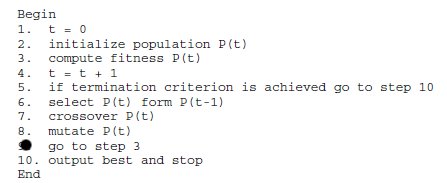
<body><![CDATA[<p style="margin-top: 0cm; margin-bottom: 0.21cm; page-break-inside: auto; text-align: left;" lang="pt-BR">       <font size="2" face="Verdana"><span lang="en-US"><b> 3. Metaheuristics:             GA, Memetic, ACO, AIS</b></span></font></p>           <p style="text-indent: 0cm; margin-top: 0.05cm; margin-bottom: 0.05cm; line-height: 100%;" align="justify" lang="pt-BR">       <font face="Verdana">       <font size="2"><span lang="en-US">This Section describes the different           algorithms and its application to the Clustering problem. All these           bio-inspired algorithms use a particular type of </span></font><a class="western" href="http://en.wikipedia.org/wiki/Objective_function">       <font size="2" color="#00000a">       <span style="text-decoration: none;" lang="en-US">objective                 function</span></font></a><font size="2"><span lang="en-US">           that prescribes the optimality of a solution so that the particular           solution may be ranked against all the other solutions. In this work,           the Equation <a href="#z1">(1)</a>, described in Section 2, is used for all the           algorithms. In GA and Memetic algorithm the term &acirc;&euro;&oelig;fitness           function&acirc;&euro;&#157; is equivalent to the objective function described           above. In the same way, &acirc;&euro;&oelig;affinity measure&acirc;&euro;&#157; in AIS refers           to the objective function.</span></font></font></p>           <p style="margin-left: 3.81cm; text-indent: 1.27cm; line-height: 100%;" align="left" lang="en-US">       <font face="Verdana" size="2">           <br>        </font>      </p>           <p style="margin-top: 0cm; margin-bottom: 0.21cm; page-break-inside: auto;" align="justify" lang="pt-BR">       <font face="Verdana" size="2">       <span style="font-style: normal;" lang="en-GB"><b>3.1 Genetic             and Memetic Algorithms</b></span></font></p>           <p style="text-indent: 0cm; line-height: 100%;" align="justify" lang="en-US">       <font face="Verdana" size="2">Genetic algorithms are inspired by the theory of natural selection       and genetic evolution and they have been successfully applied to the       optimization of complex processes. From an initial population, basic       operators are applied consisting of selection, crossover and mutation       <a href="#c23">[23]</a>.<a name="c23."></a> These operators evolve the population generation to generation.       Through the selection operator more copies of those individuals with       the best fitness (best values of the objective function) are       probabilistically allocated. The crossover operator combines parts of       two parent solutions to create a new solution. The mutation operator       modifies randomly the solution created by crossover (child). The       descendent population created from the selection, crossover and       mutation replaces the parent population. There are various techniques       of substitution, for example, elitism <a href="#c23">[23]</a>.</font></p>           <p style="text-indent: 0.64cm; line-height: 100%;" lang="en-US">       <font face="Verdana" size="2">The hybridization is an extremely effective way to increase       performance and efficiency of GAs. The most common form of       hybridization is to integrate into GAs a technique of local search as       a decisive part in the evolution, and also to incorporate the domain       specific knowledge in the search process. Such approaches of       hybridization are called Memetic Algorithms (MA) <a href="#c23">[23]</a>. The local       search can be characterized as a local refinement within a search       space. Therefore, MA is related to the cultural evolution as       individuals are adapted to meet the needs of the problem. On the       other hand, GA is based on the biological evolution of individuals,       in such a way that the offspring will inherit many skills and       characteristics present in their progenitors. </font> </p>           <p style="text-indent: 0.64cm; line-height: 100%;" lang="en-US">       <font face="Verdana" size="2">The main idea of a MA is to explore the neighborhood of the solutions       obtained through GA by searching local optima solutions before       returning to the GA and continue the process. All steps of GAs, such       as selection, crossover and mutation are present in MAs. In summary,       the difference between these two classes of algorithms is the       inclusion of an optimization step of the individuals, through the       addition of local search operators that specialize the learning for       each individual <a href="#c24">[24]</a><a name="c24."></a>. </font> </p>           <p style="text-indent: 0.64cm; line-height: 100%;" lang="en-US">       <font face="Verdana" size="2">The operators of crossover and mutation can generate individuals of       the population that are located near unexplored local optima. Thus, a       new solution should be explored for a minimization problem. However,       this improvement in the quality of the solution usually leads to a       significant increase in computational time. </font> </p>           <p style="text-indent: 0.64cm; line-height: 100%;" lang="en-US">       <font face="Verdana" size="2">GAC developed in this work is based on the GA-clustering algorithm       <a href="#c17">[17]</a> because it reaches satisfactory results to solve the clustering       problem and it also models the problem as we described at the       beginning of this section. The GAC was developed in Java from Bigus       and Bigus&acirc;&euro;&trade; code <a href="#c25">[25]</a><a name="c25."></a> and its pseudocode is shown in Figure <a href="#f1">1</a>.       The problem is represented by chromosomes consisting of a dynamic       array of <i>c </i>cluster centers. In an <i>n</i>-dimensional space,       each center is composed of <i>n</i> coordinates (<i>n</i> genes). The       data structure includes, in addition to the centers, a reference to       the data of those clusters, although they do not participate in the       evolutionary process. </font> </p>           ]]></body>
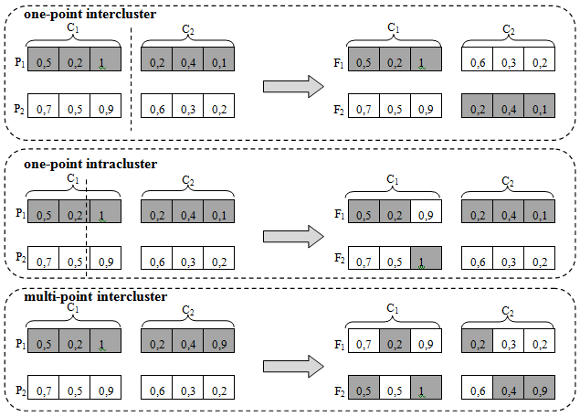
<body><![CDATA[<p style="text-indent: 0.64cm; line-height: 100%;" lang="en-US">       <font face="Verdana" size="2">           <br>        </font>      </p>           <p style="text-indent: 0cm; line-height: 95%;" align="center" lang="pt-BR">       <font face="Verdana" size="2">           <br>        </font>      </p> <font face="Verdana" size="2"> <a name="f1"><img src="/img/revistas/cleiej/v14n3/3a06f1.jpg"></a> </font>          <p style="text-indent: 0cm; margin-top: 0.21cm; line-height: 100%;" align="center" lang="en-US">       <font face="Verdana" size="2">       <span lang="en-GB"><b>Figure 1</b>: </span>Pseudocode of GA-clustering algorithm <a href="#c17">[17]</a><span lang="en-GB"> </span>       </font>     </p>           <p style="text-indent: 0.64cm; line-height: 100%;" lang="en-US">       <font face="Verdana" size="2">           <br>        </font>      </p>           <p style="text-indent: 0.64cm; line-height: 100%;" lang="en-US">       <font face="Verdana" size="2">The initial population of GAC is formed by chromosomes with <i>c</i>       centers randomly obtained from the data set. Initially, the centers       are the data set points. After the generation of new populations, the       centers become imaginary points obtained in the evolutionary process.       </font>     </p>           <p style="text-indent: 0.64cm; line-height: 100%;" lang="en-US">       <font face="Verdana" size="2">The fitness function of the GAC is given by Equation <a href="#z1">(1)</a>. The       selection operator of individuals for each new population is the       roulette method. Three types of crossover operators were implemented:       (a) one-point intercluster, (b) one-point intracluster and (c)       multi-point intracluster, as depicted in Figure <a href="#f2">2</a>. The first two       operators are based on a one-point crossover operator, in which a       position of the chromosome is randomly selected (cut point) and the       genes of one side of the chromosome are exchanged between individuals       <a href="#c23">[23]</a>. The one-point intercluster operator is an adaptation of the       intercluster operator specific to the problem of clusters implemented       in the GAC, wherein the cut point is the end of a center, and whole       centers are exchanged between individuals. The third operator       implemented is the multi-point intracluster based on uniform       crossover operator, where each gene is exchanged between a pair of       chromosomes randomly selected with a certain probability of exchange       <a href="#c23">[23]</a>. In GAC, the exchange between genes occurs whenever the value of       the gene is greater than or equal to 0.5. </font> </p>           <p style="text-indent: 0.64cm; line-height: 100%;" lang="en-US">       <font face="Verdana" size="2">Two types of mutation operators were implemented: (a) one-gene and       (b) gene to gene. The first operator performs the mutation in a       single gene of the center, randomly selected according to the       probability of mutation. The latter operator can perform the mutation       in all genes of a randomly selected center, according to the       probability of mutation. Regardless of the type of operator, the       centers are represented by a floating point, the mutation changes the       gene value within a fixed percentage <i>p</i>, called here as the       movement of the mutation. For this, a number <i>d</i> in range [0..1]       is generated with uniform distribution. Thus, if the value of a gene       is <i>v</i>, after mutation it will be <i>v * d * &Acirc;&plusmn; p%</i>.       The signs of movement ('+' or '-') occur with equal probability.       Since the algorithm works on data values normalized in the range       [0..1], it was implemented the reflect for the cases in which <i>v</i>       exceeds the limits of that range after mutation. </font> </p>           ]]></body>
<body><![CDATA[<p style="text-indent: 0.64cm; line-height: 100%;" lang="en-US">       <font face="Verdana" size="2">Each new population is generated with the same size of the parent       population. To adjust the GAC, three alternatives of elitism were       evaluated. In the first alternative of elitism, a new population is       composed only by the best individuals between the parent and       descendant populations, called in this paper as "the best".       In the second alternative, 50% of the new population consists of best       solutions from parent population and 50% for the best solutions       generated by the evolutionary process. Finally, the last alternative       of elitism preserves only the best solution of the parent population,       as occur in <a href="#c17">[17]</a>. The stopping criterion of the algorithm is the       maximum number of iterations or the maximum number of generations       without improvement (15 generations). </font> </p>           <p style="text-indent: 0cm; margin-top: 0.21cm; line-height: 100%;" align="center" lang="en-US"> </p>           <p style="text-indent: 0cm; margin-top: 0.21cm; line-height: 100%;" align="center" lang="en-GB">       <font face="Verdana" size="2">           <br>        </font>      </p>           <p style="text-indent: 0cm; margin-top: 0.21cm; line-height: 100%;" align="center" lang="en-US">       <font face="Verdana" size="2">       <a name="f2"><img src="/img/revistas/cleiej/v14n3/3a06f2.png" name="gr&aacute;ficos1" align="bottom" border="0" height="276" width="422"></a></font></p>           <p style="text-indent: 0cm; margin-top: 0.21cm; line-height: 100%;" align="center" lang="en-US">       <font face="Verdana" size="2">       <span lang="en-GB"><b>Figure 2</b>: </span>Illustration of crossover operators one-point intercluster,       one-point intracluster and multi-point intracluster in GAC</font></p>           <p style="text-indent: 0.64cm; margin-top: 0.21cm; line-height: 100%;" lang="en-US">       <font face="Verdana" size="2">           <br>        </font>      </p>           <p style="margin-top: 0cm; margin-bottom: 0.21cm; page-break-inside: auto;" align="justify" lang="pt-BR">       <font face="Verdana" size="2"><span lang="en-GB">3.1.1       </span><span lang="en-US">Local Search &acirc;&euro;&ldquo; Memetic Algorithm</span></font></p>           <p style="text-indent: 0cm; line-height: 100%;" lang="en-US">       <font face="Verdana" size="2">The Memetic Algorithm for Clustering (MAC) is a version of the GAC       with local search. The local search method implemented in the MAC is       the First Improvement. This is a refinement heuristic, a kind of Hill       Climbing, which stop the exploitation of the neighborhood when a       better neighbor is found. Thus, only in the worst case the whole       neighborhood is explored <a href="#c26">[26]</a>.<a name="c26."></a></font></p>           ]]></body>
<body><![CDATA[<p style="text-indent: 0.64cm; line-height: 100%;" lang="en-US">       <font face="Verdana" size="2">MAC is based on GAC. So, the implementation of MAC from GAC needs to       perform the local search after the creation of each new individual in       order to explore its neighborhood (after line 8 in Figure <a href="#f1">1</a>). Each       neighbor is generated by a movement of up to &Acirc;&plusmn; 5% in a gene       (dimension) of the chromosome, similarly to mutation operator. This       process is followed from the first to the last gene of a chromosome       until a better neighbor is found. First, the movement is accomplished       by adding. Then, the movement is performed by subtraction. In the       worst case it is generated a neighbor for each gene with movements of       until +5% until -5%. If there is no better neighbor, the individual       is not replaced. </font> </p>           <p style="text-indent: 0.64cm; line-height: 100%;" lang="en-US">       <font face="Verdana" size="2">           <br>        </font>      </p>           <p style="margin-top: 0cm; margin-bottom: 0.21cm; page-break-inside: auto;" align="justify" lang="pt-BR">       <font face="Verdana" size="2"><span lang="en-GB">3.1.2         Number of Objective Function Evaluations</span></font></p>           <p style="text-indent: 0cm; line-height: 100%;" align="justify" lang="en-US">       <font face="Verdana" size="2">The number of fitness function evaluations performed by GAC and MAC       was analyzed as a computational cost measure. The exact complexity of       each algorithm was not calculated but in this kind of algorithms is       accepted as computational cost the number of evaluations <a href="#c27">[27]</a><a name="c27."></a>.</font></p>           <p style="text-indent: 0cm; line-height: 100%;" align="justify" lang="en-US">       <font face="Verdana" size="2">In GAC algorithm the evaluation of the fitness function is calculated       after the creation of each new individual. So, the number of       evaluations will be equal to the number of new individuals created in       each generation multiplied by the number of generations. In MAC       algorithm the number of objective function evaluations increases       exponentially due to the inclusion of the local search where each       neighbor explored must be evaluated. This indicates that, in the       worst case, 2<i>*c*n</i> neighbors for each chromosome will be       generated and evaluated, where <i>c</i> is the number of clusters and       <i>n</i> is the number of dimensions. </font></p>           <p style="text-indent: 0.64cm; line-height: 100%;" lang="en-US">       <font face="Verdana" size="2">           <br>        </font>      </p>           <p style="margin-top: 0cm; margin-bottom: 0.21cm; page-break-inside: auto;" align="justify" lang="pt-BR">       <font face="Verdana" size="2">       <span style="font-style: normal;" lang="en-GB"><b> 3.2 Ant             Colony Optimization</b></span></font></p>           <p style="text-indent: 0cm; line-height: 100%;" lang="en-US">       <font face="Verdana" size="2">ACO metaheuristic is an example of an artificial swarm intelligence       which is inspired by the collective behavior of social insects <a href="#c28">[28]</a>       <a href="#c29">[29]</a>.<a name="c28."></a><a name="c29."></a> In the ACO algorithm, an artificial ant simulates the pheromone       trail following the behavior of real ants to find the shortest route       between a food source and their nest. Each artificial ant collects       the necessary information about the problem, stochastically make its       own decision, and constructs solutions in a stepwise way. The       behavior that emerges is a group of relatively "not intelligent"       ants that interact through simple rules and dynamically self-organize       maintaining their positions around the shortest trails: ants leave       their nest without information about the location of food sources,       move randomly at initial steps, and deposit a substance called       pheromone on the ground. The pheromone marks a trail, representing a       solution for a problem, which will be positively increased to become       more attractive in subsequent iterations. So, the pheromone       concentration indicates how useful was a solution serving as a       history of the best ants&acirc;&euro;&trade; previous movement. Besides the       pheromone concentration, ants can use heuristic function values that       generally indicate an explicit influence toward more useful local       information.</font></p>           ]]></body>
<body><![CDATA[<p style="text-indent: 0.64cm; line-height: 100%;" lang="en-US">       <font face="Verdana" size="2">The ACO for Clustering presented in this paper is based on the ACOC       algorithm proposed by Kao and Cheng <a href="#c5">[5]</a>. In the ACOC, the solution       space is represented by an object-cluster matrix containing <i>o</i>       rows (objects) and <i>c </i>columns (clusters). Ants can stay in only       one of the <i>c </i>clusters for each object. A vector (S) of size <i>o</i>       is used to represent each solution built by ants. Each element of the       vector corresponds to one of the <i>o</i> objects and its attributed       value represents the cluster number assigned to it. Each ant moves       from one node to other, deposits pheromone on nodes, and constructs a       solution in a stepwise way. At each step, an ant selects an ungrouped       object and adds it to its partial solution by considering both       pheromone intensity and heuristic information. Nodes with stronger       pheromone and heuristic values would be more likely to be selected by       ants. The heuristic information indicates the desirability of       assigning a data object to a particular cluster. It is obtained by       calculating the reciprocal of the Euclidean distance between the data       object to be grouped and each cluster center (see Equation <a href="#z1">(1)</a>). Each       ant carries a centers matrix (C<sub><i>k</i></sub>) and updates it       right after each clustering step. </font> </p>           <p style="text-indent: 0.64cm; line-height: 100%;" lang="en-US">       <font face="Verdana" size="2">The following steps are performed by ACOC <a href="#c5">[5]</a>:       </font> </p>       <ol>            <li>                  <p style="text-indent: 0cm; margin-top: 0.07cm; line-height: 100%;" lang="en-US">      <font face="Verdana" size="2">Initialize the pheromone matrix to small values ();</font></p>        </li>            <li>                  <p style="text-indent: 0cm; line-height: 100%;" lang="en-US">           <font face="Verdana" size="2">Initialize all ants: initialize cluster centers matrix (C<sub>k</sub>)           and the weight matrix (W<sub>k</sub>) that associates each object with           a center. Initially, each matrix position is set to -1 indicating           ungrouped objects. Eventually, each matrix position will be set to 0           if the object does not belong to the corresponding center or,           otherwise, it will be set to 1;</font></p>        </li>            <li>                  <p style="text-indent: 0cm; line-height: 100%;" lang="en-US">           <font face="Verdana" size="2">Select an object <i>i</i>: each ant selects an object <i>i</i>;           </font> </p>        </li>            <li>                  <p style="text-indent: 0cm; line-height: 100%;" lang="en-US">           <font face="Verdana" size="2">Select a cluster <i>j</i>: to determine <i>j</i> for a selected           object <i>i</i>, two strategies, exploitation and exploration, can be           applied depending on the result of Equation <a href="#z2">(2)</a>: (a) Exploitation:           allows ants to move in a greedy manner to a node whose product of           pheromone level and heuristic value is the highest (see Equation <a href="#z2">(2)</a>);           (b) Exploration: allows probabilities to candidate nodes, and then let           an ant chooses one of them in a stochastic manner according to           Equation <a href="#z3">(3)</a>. The more promising a node is, the higher its           probability;</font></p>        </li>            ]]></body>
<body><![CDATA[<li>                  <p style="text-indent: 0cm; line-height: 100%;" lang="en-US">           <font face="Verdana" size="2">Update ants&acirc;&euro;&trade; matrices: update weight matrix (W<sub>k</sub>) and           cluster centers matrix; </font> </p>        </li>            <li>                  <p style="text-indent: 0cm; line-height: 100%;" lang="en-US">           <font face="Verdana" size="2">Check each ant&acirc;&euro;&trade;s solution: if the ant&acirc;&euro;&trade;s solution vector (S<sub>k</sub>)           is complete, then go to step 7, otherwise, go back to step 3; </font> </p>        </li>            <li>                  <p style="text-indent: 0cm; line-height: 100%;" lang="en-US">           <font face="Verdana" size="2">Calculate the objective function value of each ant (J<sub>k</sub>) by           using Equation <a href="#z1">(1)</a>. After that, rank the solutions of ants in the           ascending order of J<sub>k</sub> values. The best solution is called           iteration-best solution (elite solution). It is compared with the           best-so-far solution, and the better one will be the new best-so-far           solution;</font></p>        </li>            <li>                  <p style="text-indent: 0cm; line-height: 100%;" lang="en-US">           <font face="Verdana" size="2">Update pheromone trails: the global updating rule is applied, and only           the elitist ants are allowed to add pheromone at the end of each           iteration. The pheromone trail is updated by Equation <a href="#z6">(6)</a>;</font></p>        </li>            <li>                  <p style="text-indent: 0cm; line-height: 100%;" lang="en-US">           <font face="Verdana" size="2">Check termination condition: if the number of iterations exceeds the           predefined maximum iteration number, then it is stopped and the           best-so-far solution is returned. Otherwise, go to step 2.</font></p>        </li>           ]]></body>
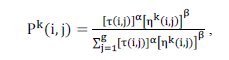
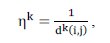
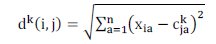
<body><![CDATA[</ol>           <p style="text-indent: 0.64cm; margin-top: 0.07cm; line-height: 100%;" lang="en-US">       <font face="Verdana" size="2">The Equations used by ACOC are presented bellow.       </font> </p>           <p style="text-indent: 0.64cm; margin-top: 0.21cm; margin-bottom: 0.21cm; line-height: 100%;" align="right" lang="en-US">       <font face="Verdana" size="2">       <a name="z2"><img src="/img/revistas/cleiej/v14n3/3a06z2.jpg">,</a> (2)       </font> </p>           <p style="text-indent: 0.64cm; line-height: 100%;" lang="en-US">       <font face="Verdana" size="2">where is a predefined probability; is a randomly generated       probability; <i>N</i><sub><i>i</i></sub><i> </i>is the <i>c</i>       clusters set; <i>S</i> is selected according to Equation <a href="#z3">(3)</a>.       </font> </p>           <p style="text-indent: 0.64cm; margin-top: 0.21cm; margin-bottom: 0.21cm; line-height: 100%;" align="right" lang="en-US">  <font face="Verdana" size="2"> <a name="z3"><img src="/img/revistas/cleiej/v14n3/3a06z3.jpg">, (3) </a> </font></p>           <p style="text-indent: 0.64cm; line-height: 100%;" lang="en-US">       <font face="Verdana" size="2">where represents the probability of assigning the object <i>i </i>to       cluster <i>j</i>; represents the pheromone trail between <i>i</i>       and <i>j</i> indicating how useful this pair was in the past;       represents the heuristic function for ant <i>k</i> defined in       Equation <a href="#z4">(4)</a>. </font> </p>           <p style="text-indent: 0.64cm; margin-top: 0.21cm; margin-bottom: 0.21cm; line-height: 100%;" align="right" lang="en-US">  <font face="Verdana" size="2"> <a name="z4"><img src="/img/revistas/cleiej/v14n3/3a06z4.jpg">, (4) </a> </font></p>           <p style="text-indent: 0.5cm; line-height: 100%;" align="justify" lang="en-US">       <font face="Verdana" size="2">where represents the Euclidian distance between object <i>i</i> and       center <i>j</i> by using Equation <a href="#z5">(5)</a>: </font> </p>           <p style="text-indent: 0.64cm; margin-top: 0.21cm; margin-bottom: 0.21cm; line-height: 100%;" align="right" lang="en-US">  <font face="Verdana" size="2"> <a name="z5"><img src="/img/revistas/cleiej/v14n3/3a06z5.jpg">(5) </a> </font></p>           <p style="text-indent: 0.64cm; line-height: 100%;" lang="en-US">       <font face="Verdana" size="2">The positive constants and are used to indicate the influence of       the pheromone concentration and the heuristic, respectively. The constant       is not used in ACOC <a href="#c5">[5]</a>, but it will be used here to show       the influence of the pheromone concentration on solutions       construction. </font> </p>           ]]></body>

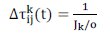
<body><![CDATA[<p style="text-indent: 0.64cm; margin-top: 0.21cm; margin-bottom: 0.21cm; line-height: 100%;" align="right" lang="en-US"> <font face="Verdana" size="2"><a name="z6"><img src="/img/revistas/cleiej/v14n3/3a06z6.jpg"> (6) </a> </font></p>           <p style="text-indent: 0.64cm; line-height: 100%;" lang="en-US">       <font face="Verdana" size="2">where &Iuml;&#129; is the pheromone evaporation rate, 0 &lt; &Iuml;&#129; &lt; 1; <i>t</i>       is the iteration number; K is the number of elite ants; is obtained       by calculating the reciprocal of the objective function J<sub>k</sub>.       Different from ACOC, in this paper is obtained by calculating the       reciprocal of the objective function J<sub>k</sub> divided by the       existent objects number (m) (see Equation <a href="#z7">(7)</a>). </font> </p>           <p style="text-indent: 0.64cm; margin-top: 0.21cm; margin-bottom: 0.21cm; line-height: 100%;" align="right" lang="en-US"> <font face="Verdana" size="2"><a name="z7"><img src="/img/revistas/cleiej/v14n3/3a06z7.jpg"> (7) </a> </font></p>           <p style="text-indent: 0.64cm; line-height: 100%;" align="center" lang="en-US">       <font face="Verdana" size="2">           <br>        </font>      </p>           <p style="margin-top: 0cm; margin-bottom: 0.21cm; page-break-inside: auto;" align="justify" lang="pt-BR">       <font face="Verdana" size="2"><span lang="en-GB">3.2.1         Local Search</span></font></p>           <p style="text-indent: 0cm; line-height: 100%;" align="justify" lang="en-US">       <font face="Verdana" size="2">The present paper aims to analyze the performance of ACOC, in terms       of objective function and computational cost, when applied a local       search at the end of each solution constructed by an ant. The       proposed local search is applied after the six step of the ACOC.       Different from the local search proposed by <a href="#c6">[6]</a> that randomly alters       the cluster of an object and only on the best solution of each       iteration, our proposed local search is applied after each ant       completes a solution and the change of cluster number is applied only       when necessary, i.e., when it exists other center more similar to the       object. </font> </p>           <p style="text-indent: 0.64cm; line-height: 100%;" lang="en-US">       <font face="Verdana" size="2">The following steps are performed by our local search after the       ACOC&acirc;&euro;&trade;s step 6: (6a) Cover all <i>o</i> objects of the S<sub>k       </sub>vector (ant&acirc;&euro;&trade;s final solution); (6b) Compare the <i>o</i>       object with each cluster centers to verify which center is more       similar to it; (6c) If the <i>o</i> object is more similar to a       center for which it was not assigned by ant k, then an exchange to       this new center is performed. After that, the <i>S</i> solution       vector and the <i>W</i> matrix is updated; (6d) If the local search       covers all the objects of the S<sub>k</sub> vector, the algorithms       goes to step (6e), otherwise it goes back to step (6b); (6e) After       completing all the necessary exchanges, the algorithm calculates the       objective function (see Equation <a href="#z1">(1)</a>); If the new found solution is       better than the ant&acirc;&euro;&trade;s solution (J<sub>k</sub>), the new       solution is accepted, the ACOC variables are replaced by the new       local search variables: C<sub>k</sub>, W<sub>k</sub>, S<sub>k</sub>,       and J<sub>k</sub>, and the algorithm goes to ACOC&acirc;&euro;&trade;s step 7.       </font> </p>           <p style="text-indent: 0.64cm; line-height: 100%;" lang="en-US">       <font face="Verdana" size="2">           <br>        </font>      </p>           ]]></body>
<body><![CDATA[<p style="margin-top: 0cm; margin-bottom: 0.21cm; page-break-inside: auto;" align="justify" lang="pt-BR">       <font face="Verdana" size="2"><span lang="en-GB">3.2.2         Number of Objective Function Evaluations</span></font></p>           <p style="text-indent: 0cm; line-height: 100%;" align="justify" lang="en-US">       <font face="Verdana" size="2">An important aspect that needs to be analyzed in relation to the       computational effort spent on runs of the two algorithms (Pure ACOC       and ACOC with local search) is the number of objective function       evaluations. In pure ACOC after each ant constructs the complete       solution vector and evaluates its value in terms of the objective       function, the evaluations counter is incremented by one. When ACOC       uses local search, it receives each ant&acirc;&euro;&trade;s solution vector, and       after switching the objects&acirc;&euro;&trade; centers, the counter is also       incremented by one.</font></p>           <p style="text-indent: 0cm; line-height: 100%;" align="justify" lang="en-US">       <font face="Verdana" size="2">           <br>        </font>      </p>           <p style="margin-top: 0cm; margin-bottom: 0.21cm; page-break-inside: auto;" align="justify" lang="pt-BR">       <font face="Verdana" size="2">       <span style="font-style: normal;" lang="en-GB"><b>3.3             Artificial Immune Systems</b></span></font></p>           <p style="text-indent: 0cm; line-height: 100%;" align="justify" lang="en-US">       <font face="Verdana" size="2">AIS have been defined as adaptive systems inspired by immunology       theoretical, with its principles and models applied in problem       solving <a href="#c10">[10]</a>. CLONALG and opt-aiNet algorithms are examples of AIS       implementations <a href="#c30">[30]</a>.<a name="c30."></a></font></p>           <p style="text-indent: 0.64cm; line-height: 100%;" lang="en-US">       <font face="Verdana" size="2">The CLONALG algorithm is inspired by clonal selection theory which       establishes the idea that only those cells (antibodies) that       recognize the antigens proliferate, generating copies (clones). Then       genetic mutations occur in the clones, generating antibodies with       higher affinity for the antigen that through the natural selection       process becomes memory cells, which implies in better adapted       individuals and more quickly and efficiently future responses to       similar antigens. The goal of the algorithm is to develop a memory       pool of antibodies that represents a solution to a problem, while an       antigen represents an element of the problem space. Initially, the       algorithm provides a local search via affinity maturation       (hypermutation) of cloned antibodies and more clones are produced for       better matched (selected) antibodies, though the scope of the local       search is inversely proportional to the selected antibodies rank.       Then, a second mechanism provides a global scope and involves the       insertion of randomly generated antibodies to be inserted into the       population to further increase the diversity and provide a means for       potentially escaping local optima <a href="#c31">[31]</a>.<a name="c31."></a>       </font> </p>           <p style="text-indent: 0.64cm; line-height: 100%;" align="justify" lang="en-US">       <font face="Verdana" size="2">The CLONALG algorithm was originally proposed by de Castro &amp; Von       Zuben <a href="#r20">[20]</a> and presented in two versions: the first to solve machine       learning and pattern recognition problems and, the second, for       optimization problems. With the evolution of CLONALG algorithm an       artificial immune network model, called aiNet has been proposed       specifically to solve machine learning, pattern recognition, data       compression and clustering problems <a href="#c31">[31]</a>. Some studies showed the       application of aiNet in clustering <a href="#c19">[19]</a> <a href="#c20">[20]</a> <a href="#c22">[22]</a>. Later, the aiNet       principles were extended to solve optimization problems, generating       the opt-aiNet algorithm <a href="#c19">[19]</a>.</font></p>           <p style="text-indent: 0.64cm; line-height: 100%;" lang="en-US">       <font face="Verdana" size="2">The implementation of CLONALG algorithm implies four key decisions:       encoding of antibodies and antigens, definition of the affinity       measure between antibodies and antigens, and configuration of       selection and mutation processes.</font></p>           <p style="text-indent: 0.64cm; line-height: 100%;" lang="en-US">       <font face="Verdana" size="2">The implementation moves through an antibodies population Ab<sub>i</sub>,       <i>i=1,...,n</i>, each one representing a candidate solution (c       centers of clusters), and a set of elements to be grouped,       represented by the antigens population Ag<sub>j</sub>, <i>j=1,...,m</i>.       The antigens population is represented by an array Ag<sub>ml</sub>,       where <i>m</i> is the amount of antigen and <i>l</i> the number of       features of each one. The antibodies population also is represented       by an array Ab<sub>nkl</sub>, where <i>n</i> is the amount of       antibodies, <i>k</i> the number of clusters and <i>l</i> the number       of features. </font> </p>           ]]></body>
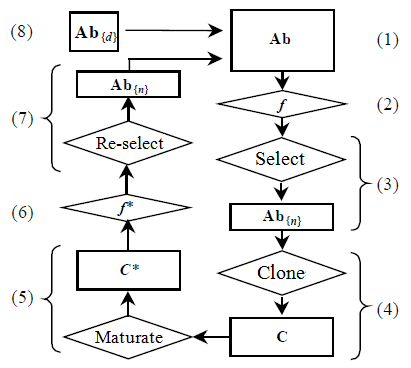
<body><![CDATA[<p style="text-indent: 0.64cm; line-height: 100%;" lang="en-US">       <font face="Verdana" size="2">The affinity measure <i>f </i> between antibodies and antigens is       given by the Euclidean distance as in Equation <a href="#z1">(1)</a>, and as shorter       the distance, the greater the measure of affinity between them. </font> </p>           <p style="text-indent: 0.64cm; line-height: 100%;" lang="en-US">       <font face="Verdana" size="2">The amount <i>n</i> of antibodies to be cloned corresponds to a       parameter of the algorithm. The amount of clones generated from each       antibody selected is proportional to its affinity to the antigen (as       higher the affinity of the antibody to the antigen, more clones will       be generated), according to Equation <a href="#z8">(8)</a>: </font> </p>           <p style="text-indent: 0.64cm; margin-top: 0.21cm; margin-bottom: 0.21cm; line-height: 100%;" align="right" lang="en-US">  <font face="Verdana" size="2"> <a name="z8"><img src="/img/revistas/cleiej/v14n3/3a06z8.jpg">(8) </a> </font></p>           <p style="text-indent: 0.64cm; line-height: 100%;" lang="en-US">       <font face="Verdana" size="2">where <i>&iuml;&#129;&cent;</i> is a clonal       multiplication factor, <i>n</i> is the total amount of antibody, i &Iuml;&micro;       [1,<i>n</i>] is the antibody current ranking based on its affinity       and <i>round (.) </i>is a rounds operator. </font> </p>           <p style="text-indent: 0.64cm; line-height: 100%;" lang="en-US">       <font face="Verdana" size="2">The generated clones suffer a mutation process at an inversely       proportional rate to its affinity to the antigen (as higher the       affinity, lower the mutation rate) which consists of a perturbation       in the value of some characteristics of the antibody. The amount of       antibody characteristics that suffer the perturbation is given by       Equation <a href="#z9">(9)</a>: </font> </p>           <p style="text-indent: 0.64cm; margin-top: 0.21cm; margin-bottom: 0.21cm; line-height: 100%;" align="right" lang="en-US">  <font face="Verdana" size="2"> <a name="z9"><img src="/img/revistas/cleiej/v14n3/3a06z9.jpg">(9)</a></font></p>           <p style="text-indent: 0.64cm; line-height: 100%;" lang="en-US">       <font face="Verdana" size="2">where &Iuml;&#129; is a parameter of the algorithm that defines the mutation       rate of an antibody and <i>f</i> is the normalized affinity function       of the antibody to the antigen. </font> </p>           <p style="text-indent: 0.64cm; line-height: 100%;" lang="en-US">       <font face="Verdana" size="2">Then, antibody characteristics are randomly selected and they will be       perturbed by adding or subtracting a percentage, defined as a       parameter of the algorithm, respecting the normalization of the       features values. </font> </p>           <p style="text-indent: 0.64cm; line-height: 100%;" lang="en-US">       <font face="Verdana" size="2">The CLONALG algorithm for clustering presented in this work is based       on the optimization version proposed by de Castro <a href="#c30">[30]</a> and its       pseudocode is shown in Figure <a href="#f3">3</a>. </font> </p>           <p style="text-indent: 0.5cm; line-height: 100%;" align="justify" lang="en-US">       <font face="Verdana" size="2">           ]]></body>
<body><![CDATA[<br>        </font>      </p>           <p style="text-indent: 0.5cm; line-height: 100%;" align="center" lang="en-US">       <font face="Verdana" size="2">       <a name="f3"><img src="/img/revistas/cleiej/v14n3/3a06f3.png" name="gr&aacute;ficos2" align="bottom" border="0" height="207" width="231"></a></font></p>           <p style="text-indent: 0cm; margin-top: 0.21cm; line-height: 100%;" align="center" lang="en-US">       <font face="Verdana" size="2">       <span lang="en-GB"><b>Figure 3</b>: </span>Flowchart of CLONALG <a href="#c30">[30]</a><span lang="en-GB"> </span>       </font>     </p>           <p style="text-indent: 0cm; margin-top: 0.14cm; line-height: 100%;" align="center" lang="en-GB">       <font face="Verdana" size="2">           <br>        </font>      </p>           <p style="text-indent: 0.64cm; line-height: 100%;" lang="en-US">       <font face="Verdana" size="2">The algorithm begins with the generation of an antibodies population.       Each antibody corresponds to a candidate solution, containing the       centers of data sets randomly generated and it performs the following       steps: </font> </p>       <ol>            <li>                  <p style="text-indent: 0cm; margin-top: 0.07cm; line-height: 100%;" align="justify" lang="pt-BR">      <font size="2" face="Verdana"><span lang="en-US">A set of antigens </span></font>     <font size="2" face="Verdana" style="font-size: 10pt"><span lang="en-US"><i>Ag</i></span></font><font size="2" face="Verdana"><span lang="en-US">                     is presented to the antibodies population </span></font>     <font style="font-size: 11pt;" size="2" face="Calibri, serif">     <font size="2" face="Verdana"><span lang="en-US"><i>Ab</i></span></font><font size="2" face="Verdana" style="font-size: 10pt"><span lang="en-US">;</span></font></font></p>        </li>            <li>                  <p style="text-indent: 0cm; line-height: 100%;" align="justify" lang="pt-BR">           <font size="2" face="Verdana"><span lang="en-US">The                     affinity </span></font>           <font size="2" face="Verdana" style="font-size: 10pt"><span lang="en-US">measure</span></font><font size="2" face="Verdana"><span lang="en-US">                   </span></font>           <font size="2" face="Verdana" style="font-size: 11pt"><span lang="en-US"><i>f</i>                     of the antibodies in relation to the antigens is calculated;</span></font></p>        </li>            ]]></body>
<body><![CDATA[<li>                  <p style="text-indent: 0cm; line-height: 100%;" align="justify" lang="pt-BR">           <font size="2" face="Verdana"><span lang="en-US">The                     </span></font>           <font size="2" face="Verdana" style="font-size: 10pt"><span lang="en-US"><i>n</i></span></font><font size="2" face="Verdana"><span lang="en-US">                     highest affinity antibodies to the antigens are selected to                     be cloned, generating the antibody </span></font>           <font style="font-size: 11pt;" size="2" face="Calibri, serif">           <font size="2" face="Verdana"><span lang="en-US">subset <i>Ab</i></span></font><font face="Calibri, serif"><sub><font size="2" face="Verdana"><span lang="en-US"><i>{n}</i></span></font></sub></font><font size="2" face="Verdana" style="font-size: 10pt"><span lang="en-US"><i>;</i></span></font></font></p>        </li>            <li>                  <p style="text-indent: 0cm; line-height: 100%;" align="justify" lang="pt-BR">           <font size="2" face="Verdana"><span lang="en-US">The                     </span></font>           <font size="2" face="Verdana" style="font-size: 10pt"><span lang="en-US">antibodies selected will be cloned                     according to their affinity to the antigens (as higher the                     affinity more clones it will generate) by using Equation <a href="#z8">(8)</a>,                     producing a <i>C</i></span></font><font size="2" face="Verdana"><span lang="en-US">                     clones population;</span></font></p>        </li>            <li>                  <p style="text-indent: 0cm; line-height: 100%;" align="justify" lang="pt-BR">           <font size="2" face="Verdana"><span lang="en-US">The                     </span></font>           <font size="2" face="Verdana" style="font-size: 10pt"><span lang="en-US"><i>C</i></span></font><font size="2" face="Verdana"><span lang="en-US">                     clones population is subjected to an affinity maturation                     process at an inversely proportional rate to the affinity of                     the clone (as higher the affinity, lower the mutation rate),                     by using Equation <a href="#z9">(9)</a>, and a new population of clones </span></font>           <font style="font-size: 11pt;" size="2" face="Calibri, serif">           <font size="2" face="Verdana"><span lang="en-US"><i>C*</i></span></font><font size="2" face="Verdana" style="font-size: 10pt"><span lang="en-US">                     is produced;</span></font></font></p>        </li>            <li>                  <p style="text-indent: 0cm; line-height: 100%;" align="justify" lang="pt-BR">           <font size="2" face="Verdana"><span lang="en-US">The                     </span></font>           <font size="2" face="Verdana" style="font-size: 10pt"><span lang="en-US"><i>C*</i></span></font><font size="2" face="Verdana"><span lang="en-US">                     clones population is evaluated and its affinity </span></font>           <font size="2" face="Verdana" style="font-size: 11pt"><span lang="en-US">measure <i>f*</i>                     in relation to the antigens is calculated;</span></font></p>        </li>            <li>                  <p style="text-indent: 0cm; line-height: 100%;" align="justify" lang="pt-BR">           <font size="2" face="Verdana"><span lang="en-US">The                     </span></font>           <font size="2" face="Verdana" style="font-size: 10pt"><span lang="en-US"><i>n</i></span></font><font size="2" face="Verdana"><span lang="en-US">                     matured antibodies of the highest affinity are selected to                     compose the next population generation, since its affinity                     is greater than its original antibodies;</span></font></p>        </li>            ]]></body>
<body><![CDATA[<li>                  <p style="text-indent: 0cm; line-height: 100%;" align="justify" lang="pt-BR">           <font size="2" face="Verdana"><span lang="en-US">The                     </span></font>           <font size="2" face="Verdana" style="font-size: 10pt"><span lang="en-US"><i>d</i></span></font><font size="2" face="Verdana"><span lang="en-US">                     worst antibodies are removed from the population and                     replaced by new randomly generated antibodies.</span></font></p>        </li>           </ol>           <p style="text-indent: 0.75cm; margin-top: 0.07cm; line-height: 100%;" align="justify" lang="en-US">       <font face="Verdana" size="2">This process repeats until a stop condition (number of generations)       is reached.</font></p>           <p style="text-indent: 0.75cm; line-height: 100%;" align="justify" lang="en-US">       <font face="Verdana" size="2">           <br>        </font>      </p>           <p style="margin-top: 0cm; margin-bottom: 0.21cm; page-break-inside: auto;" align="justify" lang="pt-BR">       <font face="Verdana" size="2"><span lang="en-GB">3.3.1         opt-aiNet algorithm</span></font></p>           <p style="text-indent: 0cm; line-height: 100%;" lang="en-US">       <font face="Verdana" size="2">The opt-aiNet algorithm is based on the clonal selection and immune       network theories. The synergy of these principles produces an       evolutionary method that can effectively perform local and global       search, and also has mechanisms to control the population size and       maintenance of diversity. It can be considered an extension of the       CLONALG algorithm, differing by the inclusion of antibody-antibody       interactions and presenting a set of characteristics that make it an       important engineering immune tool. Such characteristics includes: (i)       an elitist and deterministic mechanism for selection of clones to       decide which cell will be part of the next generation, and correspond       to a tournament between the parent cell and its clones; (ii)       automatic determination of the cardinality of the population through       the suppression and diversity introduction mechanisms; (iii) local       (searching the neighborhood through the mutation operator) and global       search combination; (iv) automatic convergence criterion and (v) the       ability to locate and maintain stable and optimal solutions <a href="#c19">[19]</a>.</font></p>           <p style="text-indent: 0.64cm; line-height: 100%;" lang="en-US">       <font face="Verdana" size="2">The opt-aiNet algorithm for the clustering problem presented in this       paper is based on the de Castro and Timmis algorithm <a href="#c22">[22]</a> and it       differs from the CLONALG algorithm by the inclusion of       antibody-antibody interactions, rather than just antibody-antigen       interactions. </font> </p>           <p style="text-indent: 0.64cm; line-height: 100%;" lang="en-US">       <font face="Verdana" size="2">The algorithm works with two cycles that are executed until a number       of population generations is reached. An internal cycle of the       algorithm, similar to the CLONALG, is responsible for the network       stabilization through a process of clonal expansion and affinity       maturation. The stabilization occurs when the population reaches a       stable state, measured through the stabilization of its affinity       measure (fitness). The selection of which clones will be part of the       next generation antibodies corresponds to a tournament between the       parent cell and its clones; and if the affinity measure (fitness) of       clones is greater than their parents, they will replace them. </font> </p>           ]]></body>
<body><![CDATA[<p style="text-indent: 0.64cm; line-height: 100%;" lang="en-US">       <font face="Verdana" size="2">At the end of the internal cycle, the antibody-antibody interaction       happens and some of the similar cells are eliminated to avoid       redundancy, more specifically those that are below a suppression       threshold. In addition, a number of randomly generated antibodies are       added to the antibodies current population and the internal cycle of       local optimizing re-starts. </font> </p>           <p style="text-indent: 0.64cm; line-height: 100%;" lang="en-US">       <font face="Verdana" size="2">As the CLONALG algorithm, this implementation represents the antigens       population as an array <i>Ag</i><sub><i>ml</i></sub>, where <i>m</i>       is the amount of antigen and <i>l</i> the number of features of each       one and the antibodies population by an array <i>Ab</i><sub><i>nkl</i></sub>,       where <i>n</i> is the amount of antibodies, <i>k</i> the number of       clusters and <i>l</i> the number of features. The affinity measure       (fitness) <i>f</i> between both antibody-antigen and       antibody-antibody is given by the Euclidean distance (see Equation       <a href="#z1">(1)</a>). </font> </p>           <p style="text-indent: 0.64cm; line-height: 100%;" lang="en-US">       <font face="Verdana" size="2">Unlike CLONALG algorithm, the number of clones generated for each       antibody and selected for clonal expansion is fixed and it is a       parameter of the algorithm. The affinity proportional mutation is       performed according to the following expression: </font> </p>           <p style="text-indent: 0.64cm; margin-top: 0.42cm; margin-bottom: 0.42cm; line-height: 100%;" align="right" lang="en-US"> <font face="Verdana" size="2"><a name="z10"><img src="/img/revistas/cleiej/v14n3/3a06z10.jpg"> , (10) </a> </font></p>           <p style="text-indent: 0.64cm; margin-top: 0.42cm; margin-bottom: 0.42cm; line-height: 100%;" align="right" lang="en-US">       <font face="Verdana" size="2">       <a name="z11"><img src="/img/revistas/cleiej/v14n3/3a06z11.jpg">, (11)</a>       </font> </p>           <p style="text-indent: 0.64cm; line-height: 100%;" lang="en-US">       <font face="Verdana" size="2">where <i>c&acirc;&euro;&trade;</i> is a mutated cell <i>c</i>, N(0,l) is a       Gaussian random variable of zero mean and unitary standard deviation,       &Icirc;&sup2; is a parameter that controls the decay of the inverse       exponential function and <i>f*</i> is the individual normalized       fitness. </font> </p>           <p style="text-indent: 0.64cm; line-height: 100%;" lang="en-US">       <font face="Verdana" size="2">           <br>        </font>      </p>           <p style="margin-top: 0cm; margin-bottom: 0.21cm; page-break-inside: auto;" align="justify" lang="pt-BR">       <font face="Verdana" size="2"><span lang="en-GB">3.3.2         Number of Objective Function Evaluations</span></font></p>           <p style="text-indent: 0cm; line-height: 100%;" align="justify" lang="en-US">       <font face="Verdana" size="2">The number of affinity measure function evaluations can be used as a       measure of the computational cost analysis of the CLONALG and       opt-aiNet algorithms. In CLONALG algorithm, when an antigen is       presented to antibodies population, an affinity measure (fitness) is       calculated for each antibody against the antigen presented (step 2 of       the algorithm). Also, an affinity measure is calculated for each       matured clone in relation to the antigen being presented (step 6 of       algorithm). Then, for each antigen there are (<i>N</i> +       <i>tClones</i>)*<i>N</i><sub><i>gen</i></sub> fitness function       evaluations where <i>N</i> is the number of antibodies, <i>tClones</i>       is the number of clones generated and <i>N</i><sub><i>gen</i></sub>       is the number of generations. In opt-aiNet algorithm, the fitness       function evaluations are performed when each antigen is presented to       the antibodies population and also when clones are generated from       antibodies, like CLONALG algorithm. However, unlike that, the number       of evaluations depends on the execution of a number of generations or       the network stabilization, measured by the stability of the affinity       measure. Also, after the network stabilization fitness function       evaluations are performed for all antibodies in order to suppress       elements of the antibodies population.</font></p>           ]]></body>
<body><![CDATA[<p style="text-indent: 0cm; margin-bottom: 0.35cm; line-height: 100%; widows: 2; orphans: 2;" lang="en-US">       <font size="2" face="Verdana">           <br>        <span lang="en-GB"><b>4 </b></span><span lang="en-US"><b>Empirical             Studies </b></span></font></p>           <p style="margin-top: 0cm; margin-bottom: 0.21cm; page-break-inside: auto;" align="justify" lang="pt-BR">     </p>           <p style="text-indent: 0cm; line-height: 100%;" lang="en-US">       <font face="Verdana" size="2">This section presents an empirical analysis to investigate the       performance of each bio-inspired metaheuristic in the clustering       problem. GAC and MAC algorithms were compared in Sub-section 4.1,       ACOC with and without local search were compared in Sub-section 4.2,       and CLONALG and opt-aiNet comparisons were presented in Sub-section       4.3. The best algorithms, in terms of the objective function       described in Section 2, was chosen from each of these comparisons and       the selected ones are compared in Section 5. The best algorithms are       evaluated using five numeric databases (previously used by the       authors <a href="#c32">[32]</a>)<a name="c32."></a>, normalized between the range [0..1]. All the databases       were obtained from <a href="#c33">[33]</a><a name="c33."></a> and they are presented in Table 1. In order       to improve the text readability, we use an alias for each database       (column 2 of Table 1).</font></p>           <p style="text-indent: 0.64cm; line-height: 100%;" lang="en-US">       <font face="Verdana"><font size="2">As our objective is to compare the performance of the metaheuristics       we chose databases composed of two clusters and with different number       of attributes. So, it is possible to analyze the behavior of each       metaheuristic with simple databases, such as Bupa that has only seven       dimensions (attributes), and with more complex databases, such as       Ionosphere that has 34 dimensions. The last attribute of each       database represents the classification of each instance in a cluster.       So, this attribute is not considered in the experiments. The last       column of Table 1 presents the number of instances,</font><font style="font-size: 10pt;" size="4"><span lang="en-US"><b>             </b></span></font><font size="2">although this number does not bring impact       on the complexity of the clustering process. </font></font> </p>           <p style="text-indent: 0cm; margin-top: 0.78cm; margin-bottom: 0.18cm; line-height: 0.39cm; page-break-after: avoid;" align="center" lang="en-US">       <font size="3" style="font-size: 10pt" face="Verdana"><b>Table               1:</b> Information about the used           databases</font></p>          <font face="Verdana" size="2">          <a name="t1"><img src="/img/revistas/cleiej/v14n3/3a06t1.jpg"></a> </font>          <p style="text-indent: 0cm; margin-top: 0.21cm; line-height: 100%;" lang="en-US">       <font face="Verdana" size="2">           <br>        </font>      </p>           <p style="margin-top: 0cm; margin-bottom: 0.21cm; page-break-inside: auto;" align="justify" lang="pt-BR">       <font face="Verdana" size="2">       <span style="font-style: normal;" lang="en-GB"><b> 4.1 </b></span>       <span style="font-style: normal;" lang="en-US"><b>GAC             and MAC empirical studies</b></span></font></p>           <p style="text-indent: 0cm; line-height: 100%;" lang="en-US">       <font face="Verdana" size="2">Before any evaluation, the parameters of the algorithm need to be       set. So, GAC was executed with varied parameters values on the Breast       database in order to choose the best setting among the existing       possibilities, such as, mutation operator, crossover operator,       mutation and crossover rates and elitism strategy. In all executions       the number of generations was 50 and one parameter was chosen to be       replaced. Also, the parameters proposed by GA-clustering algorithm       <a href="#c17">[17]</a> were evaluated. For each setting, 10 executions of the algorithm       were performed and the average of the best fitness was evaluated.       Here, we were looking for a good set of parameters but we were aware       that this process must be enhanced to obtain the best parameters for       each database. We did not focus on finding the optimum set for each       metaheuristic.</font></p>           ]]></body>
<body><![CDATA[<p style="text-indent: 0.64cm; line-height: 100%;" lang="en-US">       <font face="Verdana" size="2">The best parameters were: population size: 800; crossover       probability: 0.8; mutation probability: 0.1; generations: 50;       executions: 10. It was used the crossover operator with one-point       intercluster, i.e., whole centers are exchanged between individuals.       This operator is specific to the clustering problem. It had better       performance than the other crossover operators because it does not       fragment the center during crossover, allowing a better convergence       of the algorithm. The mutation operator used can perform the mutation       in all genes of a random selected center. The mutation changes the       gene value from -5% until +5%. GAC has an elitism strategy where only       the best individual between the parent and child populations survive.       GAC stops when the number of generations is reached or when 15       generations without improvement are executed. In this setting, GAC       converged to the best result about 15<sup>th</sup> generation. </font> </p>           <p style="text-indent: 0.64cm; line-height: 100%;" lang="en-US">       <font face="Verdana" size="2">After finding the best setting, GAC and MAC were executed on the       other four databases using that setting. The synthesis of the results       is showed in Table 2. This synthesis contains the best, the worst and       average of fitness regarding of all solutions found. It also has the       standard deviation among 10 best results and average of fitness       evaluation of GAC. The number of fitness evaluations is presented       like GAC&acirc;&euro;&trade;s computational cost measure. The standard deviation       of results was relatively small. It shows that GAC obtained results       very close in each execution. </font> </p>           <p style="text-indent: 0.64cm; line-height: 100%;" lang="en-US">       <font face="Verdana" size="2">The MAC parameters were also adjusted empirically by using Breast       database. The execution of MAC was performed using the same       parameters of GAC. However, we decided to use populations with 100       individuals for MAC due to its high number of fitness evaluations       related to the local search. Table 2 also presents the results       achieved by MAC on five databases. MAC standard deviation is greater       than GAC standard deviation, even though it is a small number. </font> </p>           <p style="text-indent: 0.64cm; line-height: 100%;" lang="en-US">       <font face="Verdana" size="2">In these experiments the following data were analyzed: (a) Best       solution; (b) Worst solution; (c) Average of the best solutions; (d)       Standard deviation; (e) Average number of objective function       evaluations.</font></p>           <p style="text-indent: 0cm; margin-top: 0.78cm; margin-bottom: 0.18cm; line-height: 0.39cm; page-break-after: avoid;" align="center" lang="en-US">       <font size="3" style="font-size: 10pt" face="Verdana"><b>Table               2:</b> Results of GAC and MAC</font></p>          <font face="Verdana" size="2">          <a name="t2"><img src="/img/revistas/cleiej/v14n3/3a06t2.jpg"></a> </font>           <p style="text-indent: 0.5cm;" lang="en-US"><font face="Verdana" size="2">    <br>      </font>      </p>           <p style="text-indent: 0.64cm; line-height: 100%;" lang="en-US">       <font face="Verdana" size="2">Ionosphere database has the highest number of attributes. So, in this       case, MAC was executed with a population size equals to 100 and 200       varying the mutation probability between 10% and 20%. Nevertheless,       the increase of both population size and mutation probability       increased the computational cost of the search and it did not improve       the resulting fitness value. For example, with a mutation probability       of 10% and a population of 100 individuals: the best fitness average       was 413.956962 and the number of fitness evaluations was 96,000. In a       population of 200 individuals, the best fitness average was 411.356       with 215,858 fitness evaluations. Therefore, we concluded that&nbsp;a       population size of 100 is more feasible than a population size of 200       considering the trade-off computational cost and benefit on       performance. </font> </p>           <p style="text-indent: 0.64cm; line-height: 100%;" lang="en-US">       <font face="Verdana" size="2">MAC was configured with the same parameters of GAC except the       population size set to 100, while in GAC it was 800. Although MAC       obtained better fitness than GAC with a significantly smaller       population, it had a greater computational cost because it needed a       significantly higher number of fitness evaluations. The only       exception is Ionosphere database, where GAC had better fitness than       MAC. </font> </p>           <p style="text-indent: 0.64cm; line-height: 100%;" lang="en-US">       <font face="Verdana" size="2">In order to compare the results obtained, we used the Wilcoxon test       <a href="#c27">[27]</a> provided by the software R <a href="#c34">[34]</a><a name="c34."></a>. The test received as input the       values obtained from the output of 10 repetitions of each algorithm       and returned the <i>p-</i>value. In this study, it was considered a       significance level (&Icirc;&plusmn; = 0.05) so, a <i>p</i>-value greater than       &Icirc;&plusmn; indicates that the algorithms compared are statistically       identical. Otherwise, there is a difference in the algorithms       performances. The Wilcoxon test indicated that there was a       significantly difference among results of both algorithms on Ecoli       database (<i>p-</i>value = 1.083 e-05). Figure <a href="#f4">4</a>(a) shows the results       of comparison between GAC and MAC on Ecoli. MAC had better fitness       values (lowest values in terms of the objective function) (lower       trace) and the lowest median value (line in box). </font> </p>           ]]></body>
<body><![CDATA[<p style="text-indent: 0.64cm; line-height: 100%;" lang="en-US">       <font face="Verdana" size="2">           <br>        </font>      </p>       <table border="0" cellpadding="7" cellspacing="0" width="638">        <colgroup><col width="302"><col width="308"></colgroup>       <tbody>          <tr valign="top">            <td height="5" width="302">                        <p style="text-indent: 0cm;" align="center" lang="en-US">               <font face="Verdana" size="2">               <img src="/img/revistas/cleiej/v14n3/3a06f4.png" name="gr&aacute;ficos3" align="bottom" border="0" height="223" width="247"></font></p>            </td>            <td width="308">                        <p style="text-indent: 0cm;" align="center" lang="en-US">               <font face="Verdana" size="2">               <img src="/img/revistas/cleiej/v14n3/3a06f5.png" name="gr&aacute;ficos4" align="bottom" border="0" height="223" width="248"></font></p>            </td>          </tr>          <tr valign="top">            <td height="5" width="302">                        <p style="text-indent: 0cm;" align="center" lang="en-US">               <font style="font-size: 10pt;" size="1" face="Verdana">(a)</font></p>            </td>            <td width="308">                        <p style="text-indent: 0cm;" align="center" lang="en-US">               <font style="font-size: 10pt;" size="1" face="Verdana">(b)</font></p>            </td>          </tr>           </tbody>      </table>           <p style="text-indent: 0cm; margin-top: 0.21cm; line-height: 100%;" align="center" lang="en-US">       <font face="Verdana" size="2">       <span lang="en-GB"><b>Figure 4</b>: </span>Comparison of GAC and MAC on (a) Ecoli and (b) Ionosphere       Databases</font></p>           <p style="text-indent: 0.64cm; line-height: 100%;" lang="en-US">       <font face="Verdana" size="2">In the case of Ionosphere database there was also difference among       algorithms results, according to the Wilcoxon test (<i>p-</i>value<i>       </i>= 0.00002165). But in this case, GAC had the better results than       MAC and smaller variance among data (Figure <a href="#f4">4</a> (b)). Despite this, we       applied Wilcoxon test to compare MAC and GAC on all databases used in       this empirical study, we do not present all boxplots due to space       limitation. Nevertheless, the analysis of boxplots showed that MAC       had better performance than GAC on Glass, Ecoli and Bupa databases       with significance level greater than &Icirc;&plusmn; (Breast: <i>p</i>-value       = 1.083e-05, Bupa: <i>p</i>-value = 1.083e-05 and Glass: <i>p</i>-value       = 2.165e-05). </font> </p>           <p style="text-indent: 0.64cm; margin-top: 0.21cm; line-height: 100%;" lang="en-US">       <font face="Verdana" size="2">           <br>        </font>      </p>           ]]></body>
<body><![CDATA[<p style="margin-top: 0cm; margin-bottom: 0.21cm; page-break-inside: auto;" align="justify" lang="pt-BR">       <font face="Verdana" size="2">       <span style="font-style: normal;" lang="en-GB"><b> 4.2 ACOC           </b></span><span style="font-style: normal;" lang="en-US"><b>empirical             studies</b></span></font></p>           <p style="text-indent: 0cm; line-height: 100%;" lang="en-US">       <font face="Verdana" size="2">ACOC without local search was executed with varied parameters values       on the Breast database in order to choose the best setting among the       following possibilities: (1) Pheromone Concentration Influence:       variable <span lang="pt-BR">&Icirc;&plusmn;</span> (A) assumes 0.5 and 2; (2)       Heuristic Influence: variable <span lang="pt-BR">&Icirc;&sup2;</span> (B)       assumes 1 and 5; (3) Pheromone Evaporation Influence: variable <span lang="pt-BR">&Iuml;&#129;</span>       (R) assumes 0.1 and 0.7; (4) Exploitation Probability: <i>q</i><sub><i>o</i> </sub>(Q0) assumes 0.4 and 0.8. The following parameters are fixed:       (a) Number of Iterations: 100; (b) Number of Ants: 10; (c) Number of       Elite Ants (K): 1; (d) Number of Repetitions: 10. Sixteen different       parameters variations were executed and the best setting found was       (refer to <a href="#c35">[35]</a><a name="c35."></a> for more details on the parameters settings): (a) B =       5, high influence of the heuristic function; (b) A = 2, high       influence of the pheromone concentration; (c) R = 0.7, high pheromone       evaporation; (d) Q0 = 0.8, high exploitation probability. It can be       noted that the heuristic function is acting positively in the       clustering process. The pheromone deposited by each elite ant, at the       end of the iteration, is also acting positively in the process,       helping future ants to find the way to the best solutions. The       greater the likelihood of exploitation, lower the probability of the       algorithm to find different solutions (diversification) for the       clustering problem. Due to the exploitation, the algorithm tends to       follow the best solutions ever found. </font> </p>           <p style="text-indent: 0.64cm; line-height: 100%;" lang="en-US">       <font face="Verdana" size="2">Table 3 presents the results of the executions of ACOC without and       with the local search proposed. All executions used the best       parameters found when running the ACOC on Breast database (B 5, A 2,       R 0.7, Q0 0.8). In these experiments the following data were       analyzed: (a) Best solution; (b) Worst solution; (c) Average of the       best solutions; (d) Standard deviation; (e) Average number of       objective function evaluations. With the latest result one can note       the aspect of diversity versus convergence and the computational cost       in terms number of objective function evaluations. </font> </p>           <p style="text-indent: 0.64cm; line-height: 100%;" lang="en-US">       <font face="Verdana" size="2">As can be seen in the last column of Table 3, ACOC with local search       provided less computational cost in terms of the average number of       objective function evaluations for the following databases: Bupa       (600), Ecoli (288), Ionosphere (472) and Glass (528). The exception       was for the Breast database, whose number of evaluations was lower       with ACOC (222.40) against the 240 evaluations on ACOC with local       search. One can also see that ACOC with local search showed better       solutions than the ACOC without local search for all databases:       Breast (331.05), Bupa (90.53), Ecoli (113.75); Ionosphere (404.82)       and Glass (84.78). Regarding the worst solutions and the average of       the best solutions, the ACOC without local search showed the worst       values for all databases. When the requirement was examining the       standard deviation from the average of the solutions, the two       algorithms showed similar values. Finally, we conclude that for all       the databases the use of ACOC with local search was advantageous. It       is possible to notice that ACOC with local search obtained better       clustering quality in terms of the objective function. </font> </p>           <p style="text-indent: 0cm; margin-top: 0.78cm; margin-bottom: 0.18cm; line-height: 0.39cm; page-break-after: avoid;" align="center" lang="en-US">       <font size="3" style="font-size: 10pt" face="Verdana"><b>Table               3:</b> Results of ACOC and ACOC with           local           search</font></p>           <p style="text-indent: 0cm; line-height: 100%;" align="center" lang="en-US">       <font face="Verdana" size="2">           <br>        </font>      </p>          <font face="Verdana" size="2">          <a name="t3"><img src="/img/revistas/cleiej/v14n3/3a06t3.jpg"></a> </font>          <p style="text-indent: 0.51cm;" lang="en-US"><font face="Verdana" size="2">    <br>      </font>      </p>           <p style="text-indent: 0.64cm; line-height: 100%;" lang="en-US">       <font face="Verdana" size="2">In order to compare the results obtained, a Wilcoxon test <a href="#c27">[27]</a> was       performed for each of the five databases. The following <i>p-</i>values       were obtained: Breast (6.386 e-05), Bupa (0.0001766), Ecoli       (0.001427), Glass (0.0001494), and Ionosphere (0.0001575). For all       the databases, the pure ACOC and ACOC with local search were       considered statistically different. Then, it is necessary to consider       the boxplot graph (see Figure <a href="#f5">5</a>) to determine which technique       provides better performance. We do not present all boxplots due to       space limitation. Nevertheless, the analysis of boxplots showed that       ACOC with local search had better performance than ACOC for all       databases as had been analyzed in Table 3. Figure <a href="#f5">5</a> shows the       comparison of both ACOC and ACOC with local search results on Ecoli       and Ionosphere. ACOC with local search obtained the best performance       (lowest values in terms of the objective function) and the lowest       median value.</font></p>           ]]></body>
<body><![CDATA[<p style="text-indent: 0.64cm; line-height: 100%;" lang="en-US">       <font face="Verdana" size="2">           <br>        </font>      </p>       <table border="0" cellpadding="7" cellspacing="0" width="638">        <colgroup><col width="295"><col width="316"></colgroup>       <tbody>          <tr valign="top">            <td height="5" width="295">                        <p style="text-indent: 0cm;" align="center" lang="en-US">               <font face="Verdana" size="2">               <img src="/img/revistas/cleiej/v14n3/3a06f6.png" name="gr&aacute;ficos5" align="bottom" border="0" height="223" width="240"></font></p>            </td>            <td width="316">                        <p style="text-indent: 0cm;" align="center" lang="en-US">               <font face="Verdana" size="2">               <img src="/img/revistas/cleiej/v14n3/3a06f7.png" name="gr&aacute;ficos6" align="bottom" border="0" height="223" width="239"></font></p>            </td>          </tr>          <tr valign="top">            <td height="5" width="295">                        <p style="text-indent: 0cm;" align="center" lang="en-US">               <font style="font-size: 10pt;" size="1" face="Verdana"><span lang="pt-BR">(a)</span></font></p>            </td>            <td width="316">                        <p style="text-indent: 0cm;" align="center" lang="en-US">               <font style="font-size: 10pt;" size="1" face="Verdana"><span lang="pt-BR">(b)</span></font></p>            </td>          </tr>           </tbody>      </table>           <p style="text-indent: 0cm; margin-top: 0.21cm; line-height: 100%;" align="center" lang="en-US">       <font face="Verdana" size="2">       <span lang="en-GB"><b>Figure 5</b>:         Comparison of ACOC and ACOC with Local Search on (a) Ecoli and (b)         Ionosphere Databases</span></font></p>           <p style="text-indent: 0.64cm; margin-top: 0.21cm; line-height: 100%;" lang="en-US">       <font face="Verdana" size="2">           <br>        </font>      </p>           <p style="margin-top: 0cm; margin-bottom: 0.21cm; page-break-inside: auto;" align="justify" lang="pt-BR">       <font face="Verdana" size="2">       <span style="font-style: normal;" lang="en-GB"><b> 4.3 CLONALG             and opt-aiNet </b></span>       <span style="font-style: normal;" lang="en-US"><b>empirical             studies</b></span></font></p>           ]]></body>
<body><![CDATA[<p style="text-indent: 0cm; line-height: 100%;" align="justify" lang="en-US">       <font face="Verdana" size="2">The parameters of CLONALG and opt-aiNet algorithms were configured       using the same methodology explained before. The algorithms were       executed with varied input parameters values on the Breast database.       The parameters proposed by de Castro and Timmis <a href="#c22">[22]</a> were the initial       set and 16 different parameters were tried, each one with 10       executions of CLONALG and opt-aiNet algorithms. The following       parameters for CLONALG algorithm were defined: number of generations       (N<sub>gen</sub>=100), antibody population size (N=200), number of       antibodies with greatest affinity selected for cloning (n=25), clonal       factor (&Icirc;&sup2;=1) and number of lowest affinity antibodies to replace       with random antibodies (d=40). For the opt-aiNet algorithm the       following values of input parameters were defined: number of       generations (N<sub>gen</sub>=100), antibody population size (N=50),       number of clones generated for each antibody (n=50), suppression       threshold (&Iuml;&fnof;=0,2), average error value (0,001), scale of the       affinity proportional selection (&Icirc;&sup2;=100) and number of lowest       affinity antibodies to replace with random antibodies (d=20). After       finding the best parameters, both CLONALG and opt-aiNet algorithms       were executed on the databases and the results are shown in Table 4.</font></p>           <p style="text-indent: 0.64cm; line-height: 100%;" lang="en-US">       <font face="Verdana" size="2">From the results shown in the Table 43, it is possible to note that       opt-aiNet algorithm was better than CLONALG algorithm for all       databases. The analysis of the <i>Best Solution</i> column showed an       improvement of the fitness function value from 128.652 to 112.526 on       Ecoli database, approximately 12.53%. In other databases this       improvement was 11.31% on Ionosphere, 11.28% on Breast, 6.68% on       Glass and 2.84% on Bupa. However, this improvement in fitness       function value was achieved through a large increase in the number of       fitness function evaluations, which can be seen in the last column of       the table. This can be explained by the increased antibody-antibody       interactions in the opt-aiNet algorithm, beyond those iterations       antibody-antigen, present in CLONALG algorithm. In addition, the       analysis showed a significant reduction in the standard deviation for       the opt-aiNet algorithm, which concluded that it gets very close       results in each execution.</font></p>           <p style="text-indent: 0.64cm; line-height: 100%;" lang="en-US">       <font face="Verdana" size="2">In order to compare the results of the experiments with CLONALG and       opt-aiNet algorithms, the Wilcoxon test <a href="#c27">[27]</a> was used. The obtained       p-values were: Breast (1.083e-05), Bupa (1.083e-05), Ecoli       (0.0001817), Ionosphere (0.0001817) and Glass (1.083e-05) indicating       that the algorithms were statistically different (for a significance       level of 0.05). Considering the boxplot graphs for each database,       shown in Figure <a href="#f6">6</a>, it can be concluded that opt-aiNet algorithm was       better than CLONALG algorithm.</font></p>           <p style="text-indent: 0cm; margin-top: 0.78cm; margin-bottom: 0.18cm; line-height: 0.39cm; page-break-after: avoid;" align="center" lang="en-US">       <font size="3" style="font-size: 10pt" face="Verdana"><b>Table               4:</b> Results of CLONALG and           opt-aiNet</font></p>       <font face="Verdana" size="2">       <a name="t4"><img src="/img/revistas/cleiej/v14n3/3a06t4.jpg"></a> </font>         <p style="text-indent: 0.64cm; line-height: 100%;" lang="en-US">       <font face="Verdana" size="2">           <br>        </font>      </p>           <p style="text-indent: 0.64cm; line-height: 100%;" lang="en-US">       <font face="Verdana" size="2">           <br>        </font>      </p>       <table border="0" cellpadding="7" cellspacing="0" width="638">        <colgroup><col width="609"><col width="1"></colgroup>       <tbody>          <tr valign="top">            <td height="241" width="609">                    <table border="0" cellpadding="7" cellspacing="0" width="609">                <colgroup><col width="283"><col width="298"></colgroup>               <tbody>                  <tr valign="top">                    <td height="5" width="283">                                      <p style="text-indent: 0cm;" align="center" lang="en-US">                       <font face="Verdana" size="2">                       <img src="/img/revistas/cleiej/v14n3/3a06f8.png" name="gr&aacute;ficos7" align="bottom" border="0" height="223" width="248"></font></p>                    </td>                    <td width="298">                                      <p style="text-indent: 0cm;" align="center" lang="en-US">                       <font face="Verdana" size="2">                       <img src="/img/revistas/cleiej/v14n3/3a06f9.png" name="gr&aacute;ficos8" align="bottom" border="0" height="223" width="249"></font></p>                    </td>                  </tr>                  <tr valign="top">                    <td height="5" width="283">                                      ]]></body>
<body><![CDATA[<p style="text-indent: 0cm;" align="center" lang="en-US">                       <font style="font-size: 10pt;" size="1" face="Verdana"><span lang="pt-BR">(a)</span></font></p>                    </td>                    <td width="298">                                      <p style="text-indent: 0cm;" align="center" lang="en-US">                       <font style="font-size: 10pt;" size="1" face="Verdana"><span lang="pt-BR">(b)</span></font></p>                    </td>                  </tr>                         </tbody>                    </table>                         <p style="text-indent: 0cm; margin-top: 0.14cm; margin-bottom: 0.35cm; line-height: 100%; widows: 2; orphans: 2;" align="justify" lang="en-US">        <font face="Verdana" size="2">     <br>                    <br>              </font>              </p>            </td>            <td width="1">                        <p style="text-indent: 0cm; margin-top: 0.14cm; margin-bottom: 0.35cm; line-height: 100%; widows: 2; orphans: 2;" align="justify" lang="en-US">        <font face="Verdana" size="2">     <br>                    <br>              </font>              </p>            </td>          </tr>           </tbody>      </table>           <p style="text-indent: 0cm; line-height: 100%;" align="center" lang="en-US">       <font face="Verdana" size="2">       <span lang="en-GB"><b>Figure 6</b>: </span>Comparison of CLONALG and opt-aiNet <span lang="en-GB">on (a)         Ecoli and (b) Ionosphere Databases</span></font></p>           <p style="text-indent: 0cm; margin-bottom: 0.35cm; line-height: 100%; widows: 2; orphans: 2;" lang="en-US">       <font face="Verdana" size="2">           ]]></body>
<body><![CDATA[<br>            <br>        </font>      </p>           <p style="margin-top: 0cm; margin-bottom: 0.21cm; page-break-inside: auto;" align="justify" lang="pt-BR">       <font size="2" face="Verdana">       <span style="font-style: normal;" lang="en-GB"><b>5.               Comparing the different approaches: MAC, ACOC with local search               and               opt-aiNet</b></span></font></p>           <p style="text-indent: 0cm; line-height: 100%;" align="justify" lang="en-US">       <font face="Verdana" size="2">This section presents the comparison among the three Bio-inspired       metaheuristics proposed for the clustering problem that achieved the       better results: MAC, ACOC with local search and opt-aiNet.</font></p>           <p style="text-indent: 0.64cm; line-height: 100%;" lang="en-US">       <font size="2" face="Verdana">Table 5 presents the best solution, the standard deviation and the       average of the number of objective function evaluations for each       algorithm in all databases. The MAC obtained the best solutions for       the three databases Breast, Bupa and Ecoli, although these values       were not so different. Other important aspect to be notice is that       the MAC presented a much higher computational cost if compared with       ACOC with local search. The computational cost of opt-aiNet is even       higher than the cost of ACOC with local search and MAC. For example,       for the Breast database, MAC performed 48747 objective function       evaluations to obtain a fitness of 329.008; opt-aiNet performed       750110 objective function evaluations to obtain a solution with       affinity of 329.454, while the ACOC with local       search performed only 240 objective function evaluations to obtain a       solution with objective function value equals to 331.053. For the       other databases the same comparisons can be made by analyzing Table       5. This high computational cost can be explained considering that       GAs, in general, are more probabilistic than ACO metaheuristics. So,       GAs&acirc;&euro;&trade; convergence is slower and, consequently, it performs a       higher number of fitness evaluations. The high number of objective       function evaluations in opt-aiNet algorithm occurred because it       needed to evaluate the antigens population in relation to the       antibodies population, as well as, the evaluation of each antibody of       the antibodies population with each other. Nevertheless, opt-aiNet       was the algorithm that achieved the lowest standard deviation.</font></p>           <p style="text-indent: 0.64cm; line-height: 100%;" lang="en-US">       <font face="Verdana" size="2">For the Glass database, opt-aiNet found the best solution despite       having both the highest average of solutions and computational cost. For       the Ionosphere database, the computational simulations revealed       that the ACOC with local search proved to be the best algorithm in       terms of the quality of solutions found and computational cost.</font></p>           <p style="text-indent: 0cm; margin-top: 0.78cm; margin-bottom: 0.18cm; line-height: 0.39cm; page-break-after: avoid;" align="center" lang="en-US">       <font size="3" style="font-size: 10pt" face="Verdana"><b>Table               5:</b> Results of MAC, ACOC with           local           search and opt-aiNet</font></p>          <font face="Verdana" size="2">          <a name="t5"><img src="/img/revistas/cleiej/v14n3/3a06t5.jpg"></a> </font>           <p style="text-indent: 0.5cm; line-height: 100%;" align="justify" lang="en-US">       <font face="Verdana" size="2">           <br>        </font>      </p>           <p style="text-indent: 0.64cm; line-height: 100%;" lang="en-US">       <font face="Verdana" size="2">In order to compare the results of these three better algorithms       (MAC, ACOC with local search and opt-aiNet), the Kruskal&acirc;&euro;&ldquo;Wallis       one-way analysis of variance by ranks (KW) <a href="#c36">[36]</a><a name="c36."></a> was performed for       each of the five databases by using the 10 better results obtained by       each algorithm. KW is a non-parametric method for testing equality of       population medians among the algorithms. The data from all the       executions was first combined and ranked from smallest to largest.       The average rank was then computed for the data at each algorithm.       Since the <i>p</i>-value is less than 0.05, there was a statistically       significant difference amongst the medians at the 95.0% confidence       level. To determine which medians were significantly different from       each others, it was necessary to analyze the boxplots graphs for the       five databases in Figure <a href="#f7">7</a>. </font> </p>           ]]></body>
<body><![CDATA[<p style="text-indent: 0.64cm;" lang="en-US"><font face="Verdana" size="2">The       following <i>p-</i>values were returned by the Kruskal-Wallis test:       Breast (0.00387), Bupa (0.001783), Ecoli (2.392e-06), Glass       (2.399e-06), and Ionosphere (2.447e-06). According to these <i>p</i>-values, for       all databases, the algorithms were considered statistically       different, so there was difference among the algorithms&acirc;&euro;&trade;       performance. It is easy to see from Figure <a href="#f7">7</a> (c) that for Ecoli       database MAC obtained better performance than the other two       algorithms in terms of the objective function and the lowest median       value. On the other hand, ACOC with local search outperformed MAC and       opt-aiNet on Ionosphere database as shown in Figure <a href="#f7">7</a> (e). Although       the MAC had presented the best solution for the Breast and Bupa       databases as shown in Table 5, the algorithms were statistically       different and considering all the best solutions obtained in the 10       repetitions opt-aiNet had the best performance for these databases       (Figure <a href="#f7">7</a> (a) and (b)) especially in terms of smaller variance among       the objective function. In addition, opt-aiNet had the lowest median       for Glass database as shown in Figure <a href="#f7">7</a> (d).</font></p>           <p style="text-indent: 0.64cm; line-height: 100%;" lang="en-US">       <font face="Verdana" size="2">Despite ACOC with local search achieved the best solution only for       one database (Ionosphere), its results for the other databases are       close to the results of MAC and opt-aiNet. In addition, ACOC with       local search had the lowest computational cost for all databases with       a satisfactory standard deviation. Opt-aiNet algorithm executed a       higher number of objective function evaluations than MAC and ACOC       with local search, but it achieved the best median for three       databases. </font> </p>           <p style="text-indent: 0cm; margin-bottom: 0.35cm; line-height: 100%; widows: 2; orphans: 2;" lang="en-US">       <font face="Verdana" size="2">           <br>        </font>      </p>           <p style="margin-top: 0cm; margin-bottom: 0.3cm; page-break-inside: auto; text-align: left;" lang="pt-BR">       <font size="2" face="Verdana"><span lang="en-US"><b> 6</b></span><span lang="en-GB"><b>             Conclusion</b></span></font></p>           <p style="text-indent: 0cm; line-height: 100%;" align="justify" lang="en-US">       <font face="Verdana" size="2">This paper analyzed the performance of the GA, ACO and AIS       metaheuristics for solving data clustering problem in an experiment       with five numeric databases. Experimental results provided evidences       that GA, ACO and AIS are suitable metaheuristics to deal with this       problem in the context of our experiment. The six algorithms       presented in this paper (GAC, MAC, pure ACOC, ACOC with local search,       CLONALG and opt-aiNet) were able to effectively discover clusters for       the five databases used. These results also showed that, in our       experiment, the algorithms with local search (MAC and ACOC with local       search) had better performance than their pure metaheuristic-based       versions (GAC and ACOC). With respect to immune algorithms, opt-aiNet       presented better results than CLONALG since it is an extension that       considers interaction of the network cells with each other.</font></p>           <p style="text-indent: 0.64cm; line-height: 100%;" lang="en-US">       <font face="Verdana" size="2">           <br>        </font>      </p>       <table border="0" cellpadding="7" cellspacing="0" width="638">        <colgroup><col width="305"><col width="305"></colgroup>       <tbody>          <tr valign="top">            <td height="241" width="305">                        <p style="text-indent: 0cm;" align="center" lang="en-US">               <font face="Verdana" size="2">               <img src="/img/revistas/cleiej/v14n3/3a06f10.png" name="gr&aacute;ficos9" align="bottom" border="0" height="223" width="246"></font></p>            </td>            <td width="305">                        <p style="text-indent: 0cm;" align="center" lang="en-US">               <font face="Verdana" size="2">               <img src="/img/revistas/cleiej/v14n3/3a06f11.png" name="gr&aacute;ficos10" align="bottom" border="0" height="223" width="249"></font></p>            </td>          </tr>          <tr valign="top">            <td height="41" width="305">                        ]]></body>
<body><![CDATA[<p style="text-indent: 0cm;" align="center" lang="en-US">               <font style="font-size: 10pt;" size="1" face="Verdana">(a)</font></p>            </td>            <td width="305">                        <p style="text-indent: 0cm;" align="center" lang="en-US">               <font style="font-size: 10pt;" size="1" face="Verdana">(b)</font></p>            </td>          </tr>          <tr valign="top">            <td height="41" width="305">                        <p style="text-indent: 0cm;" align="center" lang="en-US">               <font face="Verdana" size="2">               <img src="/img/revistas/cleiej/v14n3/3a06f12.png" name="gr&aacute;ficos11" align="bottom" border="0" height="223" width="250"></font></p>            </td>            <td width="305">                        <p style="text-indent: 0cm;" align="center" lang="en-US">               <font face="Verdana" size="2">               <img src="/img/revistas/cleiej/v14n3/3a06f13.png" name="gr&aacute;ficos12" align="bottom" border="0" height="223" width="243"></font></p>            </td>          </tr>          <tr valign="top">            <td height="41" width="305">                        <p style="text-indent: 0cm;" align="center" lang="en-US">               <font style="font-size: 10pt;" size="1" face="Verdana">(c)</font></p>            </td>            <td width="305">                        <p style="text-indent: 0cm;" align="center" lang="en-US">               <font style="font-size: 10pt;" size="1" face="Verdana">(d)</font></p>            </td>          </tr>          <tr>            <td colspan="2" height="241" valign="top" width="624">                        <p style="text-indent: 0cm;" align="center" lang="en-US">               <font face="Verdana" size="2">               <img src="/img/revistas/cleiej/v14n3/3a06f14.png" name="gr&aacute;ficos13" align="bottom" border="0" height="223" width="246"></font></p>            </td>          </tr>          <tr>            <td colspan="2" height="41" valign="top" width="624">                        <p style="text-indent: 0cm;" align="center" lang="en-US">               <font style="font-size: 10pt;" size="1" face="Verdana">(e)</font></p>            </td>          </tr>           </tbody>      </table>           <p style="text-indent: 0cm; margin-top: 0.21cm; line-height: 100%;" align="center" lang="en-US">       <font face="Verdana" size="2">       <span lang="en-GB"><b>Figure 7</b>:         Comparison of ACOC with Local Search, MAC and opt-aiNet on (a)         Breast, (b) </span>Bupa<span lang="en-GB">, </span>(c) <span lang="en-GB">Ecoli</span>,       (d) Glass and (e) Ionosphere<span lang="en-GB"> Databases</span></font></p>           <p style="text-indent: 0cm; line-height: 100%; widows: 2; orphans: 2;" align="center" lang="en-GB">       <font face="Verdana" size="2">           ]]></body>
<body><![CDATA[<br>        </font>      </p>           <p style="text-indent: 0.64cm; line-height: 100%;" lang="en-US">       <font face="Verdana" size="2">MAC, ACOC with local search and opt-aiNet were considered       statistically different. Opt-aiNet had better performance on three       databases and ACOC with local search and MAC achieved better fitness       on one database. Despite, ACOC with local search performed fewer       objective function evaluations than opt-aiNet and MAC. This is mainly       due to two important characteristics of ACOC: it uses two information       to guide the ants during solutions search: a history of the best       ants' previous movement (pheromone concentration) and an explicit       influence toward more useful local information (heuristic function);       it allows, besides an exploration transition rule, the ants to move       in a greedy/deterministic manner to a node whose product of pheromone       and heuristic value is the highest, that is, when selecting a cluster       to an object, the most similar one is generally chosen.</font></p>           <p style="text-indent: 0.64cm; line-height: 100%;" lang="en-US">       <font face="Verdana" size="2">Other observed behavior was that GAs based algorithms presented more       variability on the results than the other algorithms. This behavior       can be due to its crossover and mutation operators and need to be       better analyzed in future works. Other aspects to be noticed here is       that the substitution strategies of population in AIS algorithms are       more elitist than GA where the best individual is always selected.       ACO is also more elitist than GA once only the best ant adds       pheromone at the pheromone matrix. An interesting characteristic of       the opt-aiNet algorithm, when compared with other evolutionary       algorithms, such as GA, is the dynamic variation of population size       at run time by suppression of the similar solutions and the       generation of new random individuals (antibodies).</font></p>           <p style="text-indent: 0cm; margin-bottom: 0.35cm; line-height: 100%; widows: 2; orphans: 2;" lang="en-US">       <font face="Verdana" size="2">Some limitations of our study are: the algorithms need to know the       number of clusters and the experiment were not performed using a       fixed computational cost. Future works are going to focus on these       issues.    <br>            <br>        </font>      </p>           <p style="margin-top: 0cm; margin-bottom: 0.3cm; page-break-inside: auto; text-align: left;" lang="pt-BR">       <font size="2" face="Verdana"><span lang="en-US"><b> 7 </b></span><span lang="en-GB"><b>Acknowledgments</b></span></font></p>           <p style="text-indent: 0cm; line-height: 100%;" lang="en-US">       <font face="Verdana" size="2">This work was supported by Funda&ccedil;&atilde;o Arauc&aacute;ria,       CAPES/Reuni and CNPq.</font></p>           <p style="text-indent: 0cm; margin-bottom: 0.35cm; line-height: 100%; widows: 2; orphans: 2;" lang="en-US">       <font face="Verdana" size="2">           <br>            ]]></body>
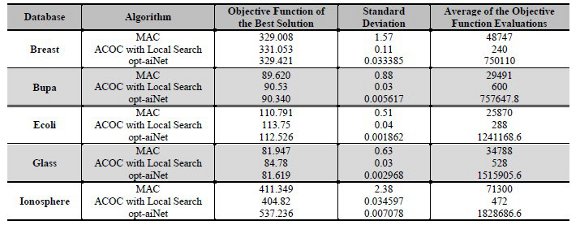
<body><![CDATA[<br>        </font>      </p>           <p style="text-align: left;" lang="pt-BR"><font face="Verdana" size="2"><span lang="en-US"><b>References</b></span></font></p>           <p style="margin-left: 0.75cm; text-indent: -0.75cm; margin-bottom: 0.21cm; line-height: 100%; widows: 2; orphans: 2;" lang="en-US">       <font size="2" style="font-size: 10pt" face="Verdana"><a name="c1"></a><a href="#c1.">1</a>.<a> M.             Bramer. &acirc;&euro;&oelig;Principles of Data Mining&acirc;&euro;&#157;. Springer, 2007.</a></font><font size="2" face="Verdana"> <a>        </a></p>  <a>    </a> </font>     <p style="margin-left: 0.75cm; text-indent: -0.75cm; margin-bottom: 0.21cm; line-height: 100%; widows: 2; orphans: 2;" lang="en-US"> <font face="Verdana"> <a>      <font size="2"></font>      </a><font size="2" style="font-size: 10pt"><a name="c2"></a><a href="#c2.">2</a>. J.             Han and M. Kamber. &acirc;&euro;&oelig;Data mining: Concepts and Techniques&acirc;&euro;&#157;.             Morgan Kaufmann Publisher, San Francisco, 2001.</font><font size="2"> </font> </font>     </p>           <p style="margin-left: 0.75cm; text-indent: -0.75cm; margin-bottom: 0.21cm; line-height: 100%; widows: 2; orphans: 2;" lang="en-US">       <font size="2" style="font-size: 10pt" face="Verdana"><a name="c3"></a><a href="#c3.">3</a>. R.             H. Sheikh, M. M. Raghuwanshi, and A. N. Jaiswal. &acirc;&euro;&oelig;Genetic             Algorithm Based Clustering: A Survey&acirc;&euro;&#157;. Proceedings of the 2008             First International Conference on Emerging Trends in Engineering and             Technology (ICETET), pp. 314-319, 2008.</font><font size="2" face="Verdana"> </font>     </p>           <p style="margin-left: 0.75cm; text-indent: -0.75cm; margin-bottom: 0.21cm; line-height: 100%; widows: 2; orphans: 2;" lang="en-US">       <font size="2" style="font-size: 10pt" face="Verdana"><a name="c4"></a><a href="#c4.">4</a>. G.             Garai and B. B. Chaudhuri. &acirc;&euro;&oelig;A Novel Genetic Algorithm for             Automatic Clustering&acirc;&euro;&#157;. Pattern             Recognition Letters, vol. 25, n.2, pp.173-187, 2004. </font>     </p>           <p style="margin-left: 0.75cm; text-indent: -0.75cm; margin-bottom: 0.21cm; line-height: 100%; widows: 2; orphans: 2;" lang="en-US">       <font size="2" style="font-size: 10pt" face="Verdana"><a name="c5"></a><a href="#c5.">5</a>. Y.             Kao and K. Cheng. &acirc;&euro;&oelig;An ACO-Based Clustering Algorithm&acirc;&euro;&#157;.             Lecture Notes in Computer Science, vol. 4150, pp. 340-347, Springer,             2006.</font><font size="2" face="Verdana"> </font>     </p>           <p style="margin-left: 0.75cm; text-indent: -0.75cm; margin-bottom: 0.21cm; line-height: 100%; widows: 2; orphans: 2;" lang="en-US">       <font size="2" style="font-size: 10pt" face="Verdana"><a name="c6"></a><a href="#c6.">6</a>. P.             S. Shelokar, V. K. Jayaraman and B. D. Kulkarni. &acirc;&euro;&oelig;An Ant Colony             Approach for Clustering&acirc;&euro;&#157;.Analytica Chimica             Acta 509, pp. 187&acirc;&euro;&ldquo;195, 2004.</font></p>           <p style="margin-left: 0.75cm; text-indent: -0.75cm; margin-bottom: 0.21cm; line-height: 100%; widows: 2; orphans: 2;" lang="en-US">       <font size="2" style="font-size: 10pt" face="Verdana"><a name="c7"></a><a href="#c7.">7</a>. D.             Karaboga and C. Ozturk. &acirc;&euro;&oelig;A Novel Clustering             Approach: Artificial Bee Colony (ABC) Algorithm&acirc;&euro;&#157;. Applied Soft             Computing, vol. 11, n. 1, pp. 652&acirc;&euro;&ldquo;657, 2011.</font></p>           <p style="margin-left: 0.75cm; text-indent: -0.75cm; margin-bottom: 0.21cm; line-height: 100%; widows: 2; orphans: 2;" lang="en-US">       <font size="2" style="font-size: 10pt" face="Verdana"><a name="c8"></a><a href="#c8.">8</a>. N.             Tang and R. Vemuri. &acirc;&euro;&oelig;An Artificial Immune System Approach to             Document Clustering&acirc;&euro;&#157;. Proceedings of the             2005 ACM symposium on Applied computing, pp.             918-922, 2005.</font></p>           ]]></body>
<body><![CDATA[<p style="margin-left: 0.75cm; text-indent: -0.75cm; margin-bottom: 0.21cm; line-height: 100%; widows: 2; orphans: 2;" lang="en-US">       <font size="2" style="font-size: 10pt" face="Verdana"><span lang="pt-BR"><a name="c9"></a><a href="#c9.">9</a>. T.               E. Colanzi, W. K. G. Assun&ccedil;&atilde;o, A. C. B. K. </span>Vendramin, D.             A. B. Pereira, and A. T. R. Pozo. &acirc;&euro;&oelig;Empirical Studies on             Application of Genetic Algorithms and Ant Colony Optimization for             Data Clustering&acirc;&euro;&#157;. Proceedings of XXIX International Conference             of the Chilean Computer Science Society (SCCC), Antofagasta/Chile,             pp. 1-10, 2010. </font>     </p>           <p style="margin-left: 0.75cm; text-indent: -0.75cm; margin-bottom: 0.21cm; line-height: 100%; widows: 2; orphans: 2;" lang="en-US">       <font size="2" style="font-size: 10pt" face="Verdana"><a name="c10"></a><a href="#c10.">10</a>. L.             N. de Castro and J. Timmis. &acirc;&euro;&oelig;Artificial Immune Systems: A New             Computational Intelligence Approach&acirc;&euro;&#157;. Springer-Verlag, 2002.</font></p>           <p style="margin-left: 0.75cm; text-indent: -0.75cm; margin-bottom: 0.21cm; line-height: 100%; widows: 2; orphans: 2;" lang="en-US">       <font size="2" style="font-size: 10pt" face="Verdana"><a name="c11"></a><a href="#c11.">11</a>. R.             Xu and D. Wunsch II . &acirc;&euro;&oelig;Survey of Clustering Algorithms&acirc;&euro;&#157;.             IEEE Transactions on neural networks, vol. 16, n. 3, pp. 645- 678,             2005.</font></p>           <p style="margin-left: 0.75cm; text-indent: -0.75cm; margin-bottom: 0.21cm; line-height: 100%; widows: 2; orphans: 2;" lang="en-US">       <font size="2" style="font-size: 10pt" face="Verdana"><a name="c12"></a><a href="#c12.">12</a>. W.             A. Barbakh, Y. Wu, and C. Fyfe. &acirc;&euro;&oelig;Non-Standard Parameter             Adaptation for Exploratory Data Analysis&acirc;&euro;&#157;. vol. 349, Springer,             2009.</font></p>           <p style="margin-left: 0.75cm; text-indent: -0.75cm; margin-bottom: 0.21cm; line-height: 100%; widows: 2; orphans: 2;" lang="en-US">       <font size="2" style="font-size: 10pt" face="Verdana"><span lang="pt-BR"><a name="c13"></a><a href="#c13.">13</a>.. E.               R. Hruschka, R. J. G. B. Campello, A. A. Freitas, and A. C. P. L.               F.               de Carvalho. </span>&acirc;&euro;&oelig;A Survey of             Evolutionary Algorithms for Clustering&acirc;&euro;&#157;. IEEE Transactions on             Systems, Man, and Cybernetics, Part C: Applications and Reviews,             vol.             39, n. 2, pp. 133-155, 2009.</font></p>           <p style="margin-left: 0.75cm; text-indent: -0.75cm; margin-bottom: 0.21cm; line-height: 100%; widows: 2; orphans: 2;" lang="en-US">       <font size="2" style="font-size: 10pt" face="Verdana"><a name="c14"></a><a href="#c14.">14.</a>. K.             Krishna and M. N. Murty. &acirc;&euro;&oelig;Genetic K-Means Algorithm&acirc;&euro;&#157;.             IEEE Transactions on Systems, Man, and Cybernetics, vol. 29, n. 3,             pp.433-439, 1999.</font></p>           <p style="margin-left: 0.75cm; text-indent: -0.75cm; margin-bottom: 0.21cm; line-height: 100%; widows: 2; orphans: 2;" lang="en-US">       <font size="2" style="font-size: 10pt" face="Verdana"><a name="c15"></a><a href="#c15.">15</a>. Y.             Lu, S. Lu, and F. Fotouhi. &acirc;&euro;&oelig;FGKA: A Fast Genetic K-means             Clustering Algorithm&acirc;&euro;&#157;. Proceedings of ACM SIG Symposium on             Applied Computing (SAC&acirc;&euro;&trade;04), Nicosia, Cyprus, pp. 622-623, 2004.</font></p>           <p style="margin-left: 0.75cm; text-indent: -0.75cm; margin-bottom: 0.21cm; line-height: 100%; widows: 2; orphans: 2;" lang="en-US">       <font size="2" style="font-size: 10pt" face="Verdana"><a name="c16"></a><a href="#c16.">16</a>. Y.             Lu, S. Lu, F. Fotouhi, Y. Deng, and S. J. Brown. &acirc;&euro;&oelig;Incremental             Genetic K-means Algorithm and its Application in Gene Expression             Data             Analysis&acirc;&euro;&#157;, BMC Bioinformatics, vol. 5, n. 172, 2004.</font></p>           <p style="margin-left: 0.75cm; text-indent: -0.75cm; margin-bottom: 0.21cm; line-height: 100%; widows: 2; orphans: 2;" lang="en-US">       <font size="2" style="font-size: 10pt" face="Verdana"><a name="c17"></a><a href="#c17.">17</a>. U.             Maulik and S. Bandyopadhyay. &acirc;&euro;&oelig;Genetic Algorithm Based             Clustering Technique&acirc;&euro;&#157;. Pattern Recognition, vol. 33, n. 9, pp.             1455-1465, 2000. </font>     </p>           <p style="margin-left: 0.75cm; text-indent: -0.75cm; margin-bottom: 0.21cm; line-height: 100%; widows: 2; orphans: 2;" lang="en-US">       <font size="2" style="font-size: 10pt" face="Verdana"><a name="c18"></a><a href="#c18.">18.</a> J.             Timmis; M. Neal; J. Hunt. &acirc;&euro;&oelig;Data analysis with artificial immune             systems, cluster analysis and Kohonen networks: some comparisons&acirc;&euro;&#157;.             Proceedings of the International Conference on Systems, Man and             Cybernetics, p. 922-927, 1999.</font></p>           ]]></body>
<body><![CDATA[<p style="margin-left: 0.75cm; text-indent: -0.75cm; margin-bottom: 0.21cm; line-height: 100%; widows: 2; orphans: 2;" lang="en-US">       <font size="2" style="font-size: 10pt" face="Verdana"><a name="c19"></a><a href="#c19.">19</a>. L.             N. de Castro and F. J. Von Zuben. &acirc;&euro;&oelig;The Clonal Selection             Algorithm with Engineering Applications,&acirc;&euro;&#157; GECCO 2000,             Workshop on Artificial Immune Systems and Their Applications,           Las Vegas, USA, pp. 36-37, 2000.</font></p>           <p style="margin-left: 0.75cm; text-indent: -0.75cm; margin-bottom: 0.21cm; line-height: 100%; widows: 2; orphans: 2;" lang="en-US">       <font size="2" style="font-size: 10pt" face="Verdana"><a name="c20"></a><a href="#c20">20</a>. L.             N. de Castro and F. J. Von Zuben. &acirc;&euro;&oelig;An Evolutionary Immune             Network for Data Clustering&acirc;&euro;&#157;. Proceedings of the Sixth             Brazilian Symposium on Neural Networks, Rio de Janeiro, Brazil, pp.             84-89, 2000. </font>     </p>           <p style="margin-left: 0.75cm; text-indent: -0.75cm; margin-bottom: 0.21cm; line-height: 100%; widows: 2; orphans: 2;" lang="en-US">       <font size="2" style="font-size: 10pt" face="Verdana"><a name="c21"></a><a href="#c21.">21</a>. L.             Tao; Z. Yan and H. Zhifeng. &acirc;&euro;&oelig;A New Clustering Algorithm Based             On Artificial Immune System&acirc;&euro;&#157;, Fuzzy Systems and Knowledge             Discovery, vol. 2, pp. 347-351, 2008.</font><font face="Verdana" size="2">       </font>     </p>           <p style="margin-left: 0.75cm; text-indent: -0.75cm; margin-bottom: 0.21cm; line-height: 100%; widows: 2; orphans: 2;" lang="en-US">       <font size="2" style="font-size: 10pt" face="Verdana"><a name="c22"></a><a href="#c22">22</a>. L.             N. de Castro and J. Timmis. &acirc;&euro;&oelig;An Artificial Immune Network for             Multimodal Function Optimization&acirc;&euro;&#157;. Congress on Evolutionary             Computation. IEEE World Congress on Computational Intelligence,             Honolulu, Hawaii, USA, 2002. </font>     </p>           <p style="margin-left: 0.75cm; text-indent: -0.75cm; margin-bottom: 0.21cm; line-height: 100%; widows: 2; orphans: 2;" lang="en-US">       <font size="2" style="font-size: 10pt" face="Verdana"><a name="c23"></a><a href="#c23.">23</a>. K.             Sastry, D. Goldberg, and G. Kendall. &acirc;&euro;&oelig;Genetic Algorithms&acirc;&euro;&#157;.             In: E. K. Burke and G. Kendall. Search Methodologies: Introductory             Tutorials in Optimization and Decision Support Techniques, Springer,             pp. 97-125, 2005. </font>     </p>           <p style="margin-left: 0.75cm; text-indent: -0.75cm; margin-bottom: 0.21cm; line-height: 100%; widows: 2; orphans: 2;" lang="en-US">       <font size="2" style="font-size: 10pt" face="Verdana"><a name="c24"></a><a href="#c24.">24</a>. A.             M. Coelho. &acirc;&euro;&oelig;A Memetic Approach to School Timetable Problem&acirc;&euro;&#157;.           <span lang="pt-BR">2006. Disserta&ccedil;&atilde;o               (Mestrado). Centro Federal de Educa&ccedil;&atilde;o Tecnol&oacute;gica               de Minas Gerais, Belo Horizonte: CEFET-MG. </span>115p (In             Portuguese). </font>     </p>           <p style="margin-left: 0.75cm; text-indent: -0.75cm; margin-bottom: 0.21cm; line-height: 100%; widows: 2; orphans: 2;" lang="en-US">       <font size="2" style="font-size: 10pt" face="Verdana"><a name="c25"></a><a href="#c25.">25</a>. J.             Bigus and J. Bigus. &acirc;&euro;&oelig;Constructing Intelligent Agents using             Java&acirc;&euro;&#157;. New York: Wiley, 2001. </font>     </p>           <p style="margin-left: 0.75cm; text-indent: -0.75cm; margin-bottom: 0.21cm; line-height: 100%; widows: 2; orphans: 2;" lang="en-US">       <font size="2" style="font-size: 10pt" face="Verdana"><a name="c26"></a><a href="#c26.">26.</a> S.             J. Russell and P. Norvig. &acirc;&euro;&oelig;Artificial Intelligence: A Modern             Approach&acirc;&euro;&#157;. 2nd ed., Upper Saddle River, New Jersey: Prentice             Hall, 2003.</font></p>           <p style="margin-left: 0.75cm; text-indent: -0.75cm; margin-bottom: 0.21cm; line-height: 100%; widows: 2; orphans: 2;" lang="en-US">       <font size="2" style="font-size: 10pt" face="Verdana"><a name="c27"></a><a href="#c27.">27</a>. S.             G&aacute;rcia, D. Molina, M. Lozano, and F. Herrera. &acirc;&euro;&oelig;A Study             on the Use of Non-parametric Tests for Analyzing the Evolutionary             Algorithms&acirc;&euro;&trade; Behaviour: a case study on the CEC&acirc;&euro;&trade;2005             Special Session on Real Parameter Optimization&acirc;&euro;&#157;. Journal of             Heuristics, vol. 15, n. 6, 2009, pp. 617&acirc;&euro;&ldquo;644.</font></p>           <p style="margin-left: 0.75cm; text-indent: -0.75cm; margin-bottom: 0.21cm; line-height: 100%; widows: 2; orphans: 2;" lang="en-US">       <font size="2" style="font-size: 10pt" face="Verdana"><a name="c28"></a><a href="#c28.">28</a>. M.             Dorigo. &acirc;&euro;&oelig;Optimization, Learning and Natural Algorithms&acirc;&euro;&#157;.           <span lang="pt-BR">PhD thesis, Politecnico di               Milano, 1992.</span></font></p>           ]]></body>
<body><![CDATA[<p style="margin-left: 0.75cm; text-indent: -0.75cm; margin-bottom: 0.21cm; line-height: 100%; widows: 2; orphans: 2;" lang="en-US">       <font size="2" style="font-size: 10pt" face="Verdana"><a name="c29"></a><a href="#c29.">29</a>. M.             Dorigo. &acirc;&euro;&oelig;Learning by Probabilistic Boolean Networks&acirc;&euro;&#157;.             Proceedings of the IEEE International Conference on Neural Networks,             pp. 887-891, 1994.</font></p>           <p style="margin-left: 0.75cm; text-indent: -0.75cm; margin-bottom: 0.21cm; line-height: 100%; widows: 2; orphans: 2;" lang="en-US">       <font size="2" style="font-size: 10pt" face="Verdana"><a name="c30"></a><a href="#c30.">30.</a> L.             N. de Castro. &acirc;&euro;&oelig;Immune Engineering: Development and Application             of Computational Tools Inspired Artificial Immune Systems&acirc;&euro;&#157;.             Thesis (Doctoral). Federal University of Campinas, School of             Computer             and Electrical Engineering, 2001 (in Portuguese). </font>     </p>           <p style="margin-left: 0.75cm; text-indent: -0.75cm; margin-bottom: 0.21cm; line-height: 100%; widows: 2; orphans: 2;" lang="en-US">       <font size="2" style="font-size: 10pt" face="Verdana"><a name="c31"></a><a href="#c31.">31</a>. J.             Brownlee. &acirc;&euro;&oelig;Clonal Selection Theory and Clonalg: the Clonal             Selection Classification Algorithm (CSCA)&acirc;&euro;&#157;. Swinburne             University of Technology, 2005.</font></p>           <p style="margin-left: 0.75cm; text-indent: -0.75cm; margin-bottom: 0.21cm; line-height: 100%; widows: 2; orphans: 2;" lang="en-US">       <font size="2" style="font-size: 10pt" face="Verdana"><span lang="pt-BR"><a name="c32"></a><a href="#c32.">32</a>. A.               B. de Carvalho and A. T. R. Pozo . </span>&acirc;&euro;&oelig;Mining Rules:             A Parallel Multiobjective Particle Swarm Optimization             Approach&acirc;&euro;&#157;. In: Coello Coello, Carlos A.; Dehuri, Satchidananda;             Ghosh, Susmita. (Org.). Swarm Intelligence for Multi-objective             Problems in Data Mining. Springer Berlin / Heidelberg, v. 242/09,             pp.             179-198, 2009.</font><font face="Verdana" size="2"> </font>     </p>           <!-- ref --><p style="margin-left: 0.75cm; text-indent: -0.75cm; margin-bottom: 0.21cm; line-height: 100%; widows: 2; orphans: 2;" lang="en-US">       <font size="2" style="font-size: 10pt" face="Verdana"><a name="c33"></a><a href="#c33.">33</a>. A.             Frank and A. Asuncion. UCI Machine Learning Repository [<a href="http://archive.ics.uci.edu/ml">http://archive.ics.uci.edu/ml</a>].             Irvine, CA: University of             California, School of Information and Computer Science, 2010.    </font></p>           <!-- ref --><p style="margin-left: 0.75cm; text-indent: -0.75cm; margin-bottom: 0.21cm; line-height: 100%; widows: 2; orphans: 2;" lang="en-US">       <font size="2" style="font-size: 10pt" face="Verdana"><a name="c34"></a><a href="#c34.">34</a>. R-Project.             The R Project for Statistical Computing. <a href="http://www.r-project.org/">&lt;http://www.r-project.org/&gt;</a>.             Access: June 11th, 2010.    </font></p>           <p style="margin-left: 0.75cm; text-indent: -0.75cm; margin-bottom: 0.21cm; line-height: 100%; widows: 2; orphans: 2;" lang="en-US">       <font size="2" style="font-size: 10pt" face="Verdana"><a name="c35"></a><a href="#c35.">35</a>. A.             C. B. K. Vendramin, D. A. Pereira, and A. Pozo. &acirc;&euro;&oelig;A Local Search             Technique to Improve the Ant Colony Optimization Metaheuristic in             Database Instances Clustering&acirc;&euro;&#157;. <span lang="pt-BR">V               SULCOMP - Congresso Sul Brasileiro de Computa&ccedil;&atilde;o, 2010,               Crici&uacute;ma. Anais do V Sulcomp, 2010 (in Portuguese).</span></font></p>           <p style="margin-left: 0.75cm; text-indent: -0.75cm; margin-bottom: 0.21cm; line-height: 100%; widows: 2; orphans: 2;" lang="en-US">       <font size="2" style="font-size: 10pt" face="Verdana"><a name="c36"></a><a href="#c36.">36</a>.K.             D. Maxwell. &acirc;&euro;&oelig;Applied Statistics for Software Managers&acirc;&euro;&#157;.             Prentice Hall PTR, 2002.</font></p>              ]]></body>
<body><![CDATA[<div type="FOOTER">            <p style="text-indent: 0cm; margin-top: 1.54cm; line-height: 100%;" align="center" lang="en-US">  <font face="Verdana" size="2">     <br>        </font>        </p>      </div>          ]]></body><back>
<ref-list>
<ref id="B1">
<label>1</label><nlm-citation citation-type="book">
<person-group person-group-type="author">
<name>
<surname><![CDATA[Bramer]]></surname>
<given-names><![CDATA[M]]></given-names>
</name>
</person-group>
<source><![CDATA[Principles of Data Mining]]></source>
<year>2007</year>
<publisher-name><![CDATA[Springer]]></publisher-name>
</nlm-citation>
</ref>
<ref id="B2">
<label>2</label><nlm-citation citation-type="book">
<person-group person-group-type="author">
<name>
<surname><![CDATA[Han]]></surname>
<given-names><![CDATA[J]]></given-names>
</name>
<name>
<surname><![CDATA[Kamber]]></surname>
<given-names><![CDATA[M]]></given-names>
</name>
</person-group>
<source><![CDATA[Data mining: Concepts and Techniques]]></source>
<year>2001</year>
<publisher-loc><![CDATA[San Francisco ]]></publisher-loc>
<publisher-name><![CDATA[Morgan Kaufmann Publisher]]></publisher-name>
</nlm-citation>
</ref>
<ref id="B3">
<label>3</label><nlm-citation citation-type="">
<person-group person-group-type="author">
<name>
<surname><![CDATA[Sheikh]]></surname>
<given-names><![CDATA[R. H]]></given-names>
</name>
<name>
<surname><![CDATA[Raghuwanshi]]></surname>
<given-names><![CDATA[M. M]]></given-names>
</name>
<name>
<surname><![CDATA[Jaiswal]]></surname>
<given-names><![CDATA[A. N]]></given-names>
</name>
</person-group>
<article-title xml:lang="en"><![CDATA[Genetic Algorithm Based Clustering: A Survey]]></article-title>
<source><![CDATA[Proceedings of the 2008 First International Conference on Emerging Trends in Engineering and Technology (ICETET)]]></source>
<year>2008</year>
<page-range>314-319</page-range></nlm-citation>
</ref>
<ref id="B4">
<label>4</label><nlm-citation citation-type="journal">
<person-group person-group-type="author">
<name>
<surname><![CDATA[Garai]]></surname>
<given-names><![CDATA[G]]></given-names>
</name>
<name>
<surname><![CDATA[Chaudhuri]]></surname>
<given-names><![CDATA[B. B]]></given-names>
</name>
</person-group>
<article-title xml:lang="en"><![CDATA[A Novel Genetic Algorithm for Automatic Clustering]]></article-title>
<source><![CDATA[Pattern Recognition Letters]]></source>
<year>2004</year>
<volume>25</volume>
<numero>2</numero>
<issue>2</issue>
<page-range>173-187</page-range></nlm-citation>
</ref>
<ref id="B5">
<label>5</label><nlm-citation citation-type="journal">
<person-group person-group-type="author">
<name>
<surname><![CDATA[Kao]]></surname>
<given-names><![CDATA[Y]]></given-names>
</name>
<name>
<surname><![CDATA[Cheng]]></surname>
<given-names><![CDATA[K]]></given-names>
</name>
</person-group>
<article-title xml:lang="en"><![CDATA[An ACO-Based Clustering Algorithm]]></article-title>
<source><![CDATA[Lecture Notes in Computer Science]]></source>
<year>2006</year>
<volume>4150</volume>
<page-range>340-347</page-range><publisher-name><![CDATA[Springer]]></publisher-name>
</nlm-citation>
</ref>
<ref id="B6">
<label>6</label><nlm-citation citation-type="">
<person-group person-group-type="author">
<name>
<surname><![CDATA[Shelokar]]></surname>
<given-names><![CDATA[P. S]]></given-names>
</name>
<name>
<surname><![CDATA[Jayaraman]]></surname>
<given-names><![CDATA[V. K]]></given-names>
</name>
<name>
<surname><![CDATA[Kulkarni]]></surname>
<given-names><![CDATA[B. D]]></given-names>
</name>
</person-group>
<article-title xml:lang="en"><![CDATA[An Ant Colony Approach for Clustering]]></article-title>
<source><![CDATA[]]></source>
<year></year>
</nlm-citation>
</ref>
<ref id="B7">
<label>7</label><nlm-citation citation-type="journal">
<person-group person-group-type="author">
<name>
<surname><![CDATA[Karaboga]]></surname>
<given-names><![CDATA[D]]></given-names>
</name>
<name>
<surname><![CDATA[Ozturk]]></surname>
<given-names><![CDATA[C]]></given-names>
</name>
</person-group>
<article-title xml:lang="en"><![CDATA[A Novel Clustering Approach: Artificial Bee Colony (ABC) Algorithm]]></article-title>
<source><![CDATA[Applied Soft Computing]]></source>
<year>2011</year>
<volume>11</volume>
<numero>1</numero>
<issue>1</issue>
<page-range>652-657</page-range></nlm-citation>
</ref>
<ref id="B8">
<label>8</label><nlm-citation citation-type="">
<person-group person-group-type="author">
<name>
<surname><![CDATA[Tang]]></surname>
<given-names><![CDATA[N]]></given-names>
</name>
<name>
<surname><![CDATA[Vemuri]]></surname>
<given-names><![CDATA[R]]></given-names>
</name>
</person-group>
<article-title xml:lang="en"><![CDATA[An Artificial Immune System Approach to Document Clustering]]></article-title>
<source><![CDATA[Proceedings of the 2005 ACM symposium on Applied computing]]></source>
<year>2005</year>
<page-range>918-922</page-range></nlm-citation>
</ref>
<ref id="B9">
<label>9</label><nlm-citation citation-type="">
<person-group person-group-type="author">
<name>
<surname><![CDATA[Colanzi]]></surname>
<given-names><![CDATA[T. E]]></given-names>
</name>
<name>
<surname><![CDATA[Assunção]]></surname>
<given-names><![CDATA[W. K. G]]></given-names>
</name>
<name>
<surname><![CDATA[Vendramin]]></surname>
<given-names><![CDATA[A. C. B. K]]></given-names>
</name>
<name>
<surname><![CDATA[Pereira]]></surname>
<given-names><![CDATA[D. A. B.]]></given-names>
</name>
<name>
<surname><![CDATA[Pozo]]></surname>
<given-names><![CDATA[A. T. R.]]></given-names>
</name>
</person-group>
<article-title xml:lang="en"><![CDATA[â&#8364;&#339;Empirical Studies on Application of Genetic Algorithms and Ant Colony Optimization for Data Clusteringâ&#8364;]]></article-title>
<source><![CDATA[Proceedings of XXIX International Conference of the Chilean Computer Science Society (SCCC)]]></source>
<year>2010</year>
<page-range>1-10</page-range><publisher-loc><![CDATA[Antofagasta ]]></publisher-loc>
</nlm-citation>
</ref>
<ref id="B10">
<label>10</label><nlm-citation citation-type="book">
<person-group person-group-type="author">
<name>
<surname><![CDATA[de Castro]]></surname>
<given-names><![CDATA[L. N.]]></given-names>
</name>
<name>
<surname><![CDATA[Timmis]]></surname>
<given-names><![CDATA[J]]></given-names>
</name>
</person-group>
<source><![CDATA[Artificial Immune Systems: A New Computational Intelligence Approach]]></source>
<year>2002</year>
<publisher-name><![CDATA[Springer-Verlag]]></publisher-name>
</nlm-citation>
</ref>
<ref id="B11">
<label>11</label><nlm-citation citation-type="journal">
<person-group person-group-type="author">
<name>
<surname><![CDATA[Xu]]></surname>
<given-names><![CDATA[R]]></given-names>
</name>
<name>
<surname><![CDATA[Wunsch II]]></surname>
<given-names><![CDATA[D]]></given-names>
</name>
</person-group>
<article-title xml:lang="en"><![CDATA[Survey of Clustering Algorithms]]></article-title>
<source><![CDATA[IEEE Transactions on neural networks]]></source>
<year>2005</year>
<volume>16</volume>
<numero>3</numero>
<issue>3</issue>
<page-range>645- 678</page-range></nlm-citation>
</ref>
<ref id="B12">
<label>12</label><nlm-citation citation-type="book">
<person-group person-group-type="author">
<name>
<surname><![CDATA[Barbakh]]></surname>
<given-names><![CDATA[W. A]]></given-names>
</name>
<name>
<surname><![CDATA[Wu]]></surname>
<given-names><![CDATA[Y]]></given-names>
</name>
<name>
<surname><![CDATA[Fyfe]]></surname>
<given-names><![CDATA[C]]></given-names>
</name>
</person-group>
<source><![CDATA[Non-Standard Parameter Adaptation for Exploratory Data Analysis]]></source>
<year>2009</year>
<volume>349</volume>
<publisher-name><![CDATA[Springer]]></publisher-name>
</nlm-citation>
</ref>
<ref id="B13">
<label>13</label><nlm-citation citation-type="journal">
<person-group person-group-type="author">
<name>
<surname><![CDATA[Hruschka]]></surname>
<given-names><![CDATA[E. R]]></given-names>
</name>
<name>
<surname><![CDATA[Campello]]></surname>
<given-names><![CDATA[R. J. G. B]]></given-names>
</name>
<name>
<surname><![CDATA[Freitas]]></surname>
<given-names><![CDATA[A. A]]></given-names>
</name>
<name>
<surname><![CDATA[de Carvalho]]></surname>
<given-names><![CDATA[A. C. P. L. F]]></given-names>
</name>
</person-group>
<article-title xml:lang="en"><![CDATA[A Survey of Evolutionary Algorithms for Clustering]]></article-title>
<source><![CDATA[IEEE Transactions on Systems, Man, and Cybernetics, Part C: Applications and Reviews]]></source>
<year>2009</year>
<volume>39</volume>
<numero>2</numero>
<issue>2</issue>
<page-range>133-155</page-range></nlm-citation>
</ref>
<ref id="B14">
<label>14</label><nlm-citation citation-type="journal">
<person-group person-group-type="author">
<name>
<surname><![CDATA[Krishna]]></surname>
<given-names><![CDATA[K]]></given-names>
</name>
<name>
<surname><![CDATA[Murty]]></surname>
<given-names><![CDATA[M. N]]></given-names>
</name>
</person-group>
<article-title xml:lang="en"><![CDATA[Genetic K-Means Algorithm]]></article-title>
<source><![CDATA[IEEE Transactions on Systems, Man, and Cybernetics]]></source>
<year>1999</year>
<volume>29</volume>
<numero>3</numero>
<issue>3</issue>
<page-range>433-439</page-range></nlm-citation>
</ref>
<ref id="B15">
<label>15</label><nlm-citation citation-type="">
<person-group person-group-type="author">
<name>
<surname><![CDATA[Lu]]></surname>
<given-names><![CDATA[Y]]></given-names>
</name>
<name>
<surname><![CDATA[Lu]]></surname>
<given-names><![CDATA[S]]></given-names>
</name>
<name>
<surname><![CDATA[Fotouhi]]></surname>
<given-names><![CDATA[F]]></given-names>
</name>
</person-group>
<article-title xml:lang="en"><![CDATA[FGKA: A Fast Genetic K-means Clustering Algorithm]]></article-title>
<source><![CDATA[Proceedings of ACM SIG Symposium on Applied Computing (SACâ&#8364;&#8482;04)]]></source>
<year>2004</year>
<page-range>622-623</page-range><publisher-loc><![CDATA[Nicosia ]]></publisher-loc>
</nlm-citation>
</ref>
<ref id="B16">
<label>16</label><nlm-citation citation-type="journal">
<person-group person-group-type="author">
<name>
<surname><![CDATA[Lu]]></surname>
<given-names><![CDATA[Y]]></given-names>
</name>
<name>
<surname><![CDATA[Lu]]></surname>
<given-names><![CDATA[S]]></given-names>
</name>
<name>
<surname><![CDATA[Fotouhi]]></surname>
<given-names><![CDATA[F]]></given-names>
</name>
<name>
<surname><![CDATA[Deng]]></surname>
<given-names><![CDATA[Y]]></given-names>
</name>
<name>
<surname><![CDATA[Brown]]></surname>
<given-names><![CDATA[S. J]]></given-names>
</name>
</person-group>
<article-title xml:lang="en"><![CDATA[Incremental Genetic K-means Algorithm and its Application in Gene Expression Data Analysis]]></article-title>
<source><![CDATA[BMC Bioinformatics]]></source>
<year>2004</year>
<volume>5</volume><volume>172</volume>
</nlm-citation>
</ref>
<ref id="B17">
<label>17</label><nlm-citation citation-type="journal">
<person-group person-group-type="author">
<name>
<surname><![CDATA[Maulik]]></surname>
<given-names><![CDATA[U]]></given-names>
</name>
<name>
<surname><![CDATA[Bandyopadhyay]]></surname>
<given-names><![CDATA[S]]></given-names>
</name>
</person-group>
<article-title xml:lang="en"><![CDATA[Genetic Algorithm Based Clustering Technique]]></article-title>
<source><![CDATA[Pattern Recognition]]></source>
<year>2000</year>
<volume>33</volume>
<numero>9</numero>
<issue>9</issue>
<page-range>1455-1465</page-range></nlm-citation>
</ref>
<ref id="B18">
<label>18</label><nlm-citation citation-type="journal">
<person-group person-group-type="author">
<name>
<surname><![CDATA[Timmis]]></surname>
<given-names><![CDATA[J]]></given-names>
</name>
<name>
<surname><![CDATA[Neal]]></surname>
<given-names><![CDATA[M]]></given-names>
</name>
<name>
<surname><![CDATA[Hunt]]></surname>
<given-names><![CDATA[J]]></given-names>
</name>
</person-group>
<article-title xml:lang="en"><![CDATA[Data analysis with artificial immune systems, cluster analysis and Kohonen networks: some comparisons]]></article-title>
<source><![CDATA[Proceedings of the International Conference on Systems, Man and Cybernetics]]></source>
<year>1999</year>
<page-range>922-927</page-range></nlm-citation>
</ref>
<ref id="B19">
<label>19</label><nlm-citation citation-type="">
<person-group person-group-type="author">
<name>
<surname><![CDATA[de Castro]]></surname>
<given-names><![CDATA[L. N]]></given-names>
</name>
<name>
<surname><![CDATA[Von Zuben]]></surname>
<given-names><![CDATA[F. J.]]></given-names>
</name>
</person-group>
<article-title xml:lang="en"><![CDATA[The Clonal Selection Algorithm with Engineering Applications]]></article-title>
<source><![CDATA[GECCO 2000, Workshop on Artificial Immune Systems and Their Applications]]></source>
<year>2000</year>
<page-range>36-37</page-range><publisher-loc><![CDATA[Las Vegas ]]></publisher-loc>
</nlm-citation>
</ref>
<ref id="B20">
<label>20</label><nlm-citation citation-type="">
<person-group person-group-type="author">
<name>
<surname><![CDATA[de Castro]]></surname>
<given-names><![CDATA[L. N.]]></given-names>
</name>
<name>
<surname><![CDATA[Von Zuben]]></surname>
<given-names><![CDATA[F. J.]]></given-names>
</name>
</person-group>
<article-title xml:lang="en"><![CDATA[An Evolutionary Immune Network for Data Clustering]]></article-title>
<source><![CDATA[Proceedings of the Sixth Brazilian Symposium on Neural Networks]]></source>
<year>2000</year>
<page-range>84-89</page-range><publisher-loc><![CDATA[Rio de Janeiro ]]></publisher-loc>
</nlm-citation>
</ref>
<ref id="B21">
<label>21</label><nlm-citation citation-type="journal">
<person-group person-group-type="author">
<name>
<surname><![CDATA[Tao]]></surname>
<given-names><![CDATA[L]]></given-names>
</name>
<name>
<surname><![CDATA[Yan]]></surname>
<given-names><![CDATA[Z]]></given-names>
</name>
<name>
<surname><![CDATA[Zhifeng]]></surname>
<given-names><![CDATA[H]]></given-names>
</name>
</person-group>
<article-title xml:lang="en"><![CDATA[A New Clustering Algorithm Based On Artificial Immune System]]></article-title>
<source><![CDATA[Fuzzy Systems and Knowledge Discovery]]></source>
<year>2008</year>
<volume>2</volume>
<page-range>347-351</page-range></nlm-citation>
</ref>
<ref id="B22">
<label>22</label><nlm-citation citation-type="confpro">
<person-group person-group-type="author">
<name>
<surname><![CDATA[de Castro]]></surname>
<given-names><![CDATA[L. N]]></given-names>
</name>
<name>
<surname><![CDATA[Timmis]]></surname>
<given-names><![CDATA[J]]></given-names>
</name>
</person-group>
<article-title xml:lang="en"><![CDATA[An Artificial Immune Network for Multimodal Function Optimization]]></article-title>
<source><![CDATA[]]></source>
<year></year>
<conf-name><![CDATA[ Congress on Evolutionary Computation. IEEE World Congress on Computational Intelligence]]></conf-name>
<conf-date>2002</conf-date>
<conf-loc>Honolulu Hawaii</conf-loc>
</nlm-citation>
</ref>
<ref id="B23">
<label>23</label><nlm-citation citation-type="book">
<person-group person-group-type="author">
<name>
<surname><![CDATA[Sastry]]></surname>
<given-names><![CDATA[K]]></given-names>
</name>
<name>
<surname><![CDATA[Goldberg]]></surname>
<given-names><![CDATA[D]]></given-names>
</name>
<name>
<surname><![CDATA[Kendall]]></surname>
<given-names><![CDATA[G]]></given-names>
</name>
</person-group>
<article-title xml:lang="en"><![CDATA[Genetic Algorithms]]></article-title>
<person-group person-group-type="editor">
<name>
<surname><![CDATA[Burke]]></surname>
<given-names><![CDATA[E. K]]></given-names>
</name>
<name>
<surname><![CDATA[Kendall]]></surname>
<given-names><![CDATA[G]]></given-names>
</name>
</person-group>
<source><![CDATA[Search Methodologies: Introductory Tutorials in Optimization and Decision Support Techniques]]></source>
<year>2005</year>
<page-range>97-125</page-range><publisher-name><![CDATA[Springer]]></publisher-name>
</nlm-citation>
</ref>
<ref id="B24">
<label>24</label><nlm-citation citation-type="book">
<person-group person-group-type="author">
<name>
<surname><![CDATA[Coelho]]></surname>
<given-names><![CDATA[A. M]]></given-names>
</name>
</person-group>
<article-title xml:lang="en"><![CDATA[A Memetic Approach to School Timetable Problem]]></article-title>
<source><![CDATA[Dissertação (Mestrado): Centro Federal de Educação Tecnológica de Minas Gerais]]></source>
<year>2006</year>
<page-range>115</page-range><publisher-loc><![CDATA[Belo Horizonte ]]></publisher-loc>
<publisher-name><![CDATA[CEFET-MG]]></publisher-name>
</nlm-citation>
</ref>
<ref id="B25">
<label>25</label><nlm-citation citation-type="book">
<person-group person-group-type="author">
<name>
<surname><![CDATA[Bigus]]></surname>
<given-names><![CDATA[J]]></given-names>
</name>
<name>
<surname><![CDATA[Bigus]]></surname>
<given-names><![CDATA[J]]></given-names>
</name>
</person-group>
<source><![CDATA[Constructing Intelligent Agents using Java]]></source>
<year>2001</year>
<publisher-loc><![CDATA[New York ]]></publisher-loc>
<publisher-name><![CDATA[Wiley]]></publisher-name>
</nlm-citation>
</ref>
<ref id="B26">
<label>26</label><nlm-citation citation-type="book">
<person-group person-group-type="author">
<name>
<surname><![CDATA[Russell]]></surname>
<given-names><![CDATA[S. J]]></given-names>
</name>
<name>
<surname><![CDATA[Norvig]]></surname>
<given-names><![CDATA[P]]></given-names>
</name>
</person-group>
<source><![CDATA[Artificial Intelligence: A Modern Approach]]></source>
<year></year>
<edition>2</edition>
<page-range>2003</page-range><publisher-loc><![CDATA[Upper Saddle River^eNew Jersey New Jersey]]></publisher-loc>
<publisher-name><![CDATA[Prentice Hall]]></publisher-name>
</nlm-citation>
</ref>
<ref id="B27">
<label>27</label><nlm-citation citation-type="journal">
<person-group person-group-type="author">
<name>
<surname><![CDATA[Gárcia]]></surname>
<given-names><![CDATA[S]]></given-names>
</name>
<name>
<surname><![CDATA[Molina]]></surname>
<given-names><![CDATA[D]]></given-names>
</name>
<name>
<surname><![CDATA[Lozano]]></surname>
<given-names><![CDATA[M]]></given-names>
</name>
<name>
<surname><![CDATA[Herrera]]></surname>
<given-names><![CDATA[F]]></given-names>
</name>
</person-group>
<article-title xml:lang="en"><![CDATA[A Study on the Use of Non-parametric Tests for Analyzing the Evolutionary Algorithmsâ&#8364;&#8482; Behaviour: a case study on the CECâ&#8364;&#8482;2005 Special Session on Real Parameter Optimization]]></article-title>
<source><![CDATA[Journal of Heuristics]]></source>
<year>2009</year>
<volume>15</volume>
<numero>6</numero>
<issue>6</issue>
<page-range>617-644</page-range></nlm-citation>
</ref>
<ref id="B28">
<label>28</label><nlm-citation citation-type="">
<person-group person-group-type="author">
<name>
<surname><![CDATA[Dorigo]]></surname>
<given-names><![CDATA[M]]></given-names>
</name>
</person-group>
<collab>Politecnico di Milano</collab>
<source><![CDATA[Optimization, Learning and Natural Algorithms: PhD thesis]]></source>
<year>1992</year>
</nlm-citation>
</ref>
<ref id="B29">
<label>29</label><nlm-citation citation-type="">
<person-group person-group-type="author">
<name>
<surname><![CDATA[Dorigo]]></surname>
<given-names><![CDATA[M]]></given-names>
</name>
</person-group>
<article-title xml:lang="en"><![CDATA[Learning by Probabilistic Boolean Networks]]></article-title>
<source><![CDATA[Proceedings of the IEEE International Conference on Neural Networks]]></source>
<year>1994</year>
<page-range>887-891</page-range></nlm-citation>
</ref>
<ref id="B30">
<label>30</label><nlm-citation citation-type="">
<person-group person-group-type="author">
<name>
<surname><![CDATA[de Castro]]></surname>
<given-names><![CDATA[L. N]]></given-names>
</name>
</person-group>
<article-title xml:lang="en"><![CDATA[Immune Engineering: Development and Application of Computational Tools Inspired Artificial Immune Systems]]></article-title>
<source><![CDATA[Thesis (Doctoral): Federal University of Campinas, School of Computer and Electrical Engineering]]></source>
<year>2001</year>
</nlm-citation>
</ref>
<ref id="B31">
<label>31</label><nlm-citation citation-type="book">
<person-group person-group-type="author">
<name>
<surname><![CDATA[Brownlee]]></surname>
<given-names><![CDATA[J]]></given-names>
</name>
</person-group>
<source><![CDATA[Clonal Selection Theory and Clonalg: the Clonal Selection Classification Algorithm (CSCA)]]></source>
<year>2005</year>
<publisher-name><![CDATA[Swinburne University of Technology]]></publisher-name>
</nlm-citation>
</ref>
<ref id="B32">
<label>32</label><nlm-citation citation-type="book">
<person-group person-group-type="author">
<name>
<surname><![CDATA[de Carvalho]]></surname>
<given-names><![CDATA[A. B]]></given-names>
</name>
<name>
<surname><![CDATA[Pozo]]></surname>
<given-names><![CDATA[A. T. R]]></given-names>
</name>
</person-group>
<article-title xml:lang="en"><![CDATA[Mining Rules: A Parallel Multiobjective Particle Swarm Optimization Approach]]></article-title>
<person-group person-group-type="editor">
<name>
<surname><![CDATA[Coello Coello]]></surname>
<given-names><![CDATA[Carlos A]]></given-names>
</name>
<name>
<surname><![CDATA[Satchidananda]]></surname>
<given-names><![CDATA[Dehuri]]></given-names>
</name>
<name>
<surname><![CDATA[Susmita]]></surname>
<given-names><![CDATA[Ghosh]]></given-names>
</name>
</person-group>
<source><![CDATA[Swarm Intelligence for Multi-objective Problems in Data Mining]]></source>
<year>2009</year>
<volume>242</volume>
<page-range>179-198</page-range><publisher-loc><![CDATA[Berlin / Heidelberg ]]></publisher-loc>
<publisher-name><![CDATA[Springer]]></publisher-name>
</nlm-citation>
</ref>
<ref id="B33">
<label>33</label><nlm-citation citation-type="book">
<person-group person-group-type="author">
<name>
<surname><![CDATA[Frank]]></surname>
<given-names><![CDATA[A]]></given-names>
</name>
<name>
<surname><![CDATA[Asuncion]]></surname>
<given-names><![CDATA[A]]></given-names>
</name>
</person-group>
<collab>University of California</collab>
<source><![CDATA[UCI Machine Learning Repository]]></source>
<year>2010</year>
<publisher-loc><![CDATA[^eCA CA]]></publisher-loc>
<publisher-name><![CDATA[Irvine]]></publisher-name>
</nlm-citation>
</ref>
<ref id="B34">
<label>34</label><nlm-citation citation-type="">
<person-group person-group-type="author">
<name>
<surname><![CDATA[Project]]></surname>
<given-names><![CDATA[R]]></given-names>
</name>
</person-group>
<source><![CDATA[The R Project for Statistical Computing]]></source>
<year></year>
</nlm-citation>
</ref>
<ref id="B35">
<label>35</label><nlm-citation citation-type="">
<person-group person-group-type="author">
<name>
<surname><![CDATA[Vendramin]]></surname>
<given-names><![CDATA[A. C. B. K]]></given-names>
</name>
<name>
<surname><![CDATA[Pereira]]></surname>
<given-names><![CDATA[D. A]]></given-names>
</name>
<name>
<surname><![CDATA[Pozo]]></surname>
<given-names><![CDATA[A]]></given-names>
</name>
</person-group>
<article-title xml:lang="en"><![CDATA[A Local Search Technique to Improve the Ant Colony Optimization Metaheuristic in Database Instances Clustering]]></article-title>
<collab>V SULCOMP</collab>
<source><![CDATA[Congresso Sul Brasileiro de Computação]]></source>
<year>2010</year>
<publisher-loc><![CDATA[Criciúma ]]></publisher-loc>
</nlm-citation>
</ref>
<ref id="B36">
<label>36</label><nlm-citation citation-type="book">
<person-group person-group-type="author">
<name>
<surname><![CDATA[Maxwell]]></surname>
<given-names><![CDATA[K. D.]]></given-names>
</name>
</person-group>
<source><![CDATA[Applied Statistics for Software Managers]]></source>
<year>2002</year>
<publisher-name><![CDATA[rentice Hall PTR]]></publisher-name>
</nlm-citation>
</ref>
</ref-list>
</back>
</article>