<?xml version="1.0" encoding="ISO-8859-1"?><article xmlns:mml="http://www.w3.org/1998/Math/MathML" xmlns:xlink="http://www.w3.org/1999/xlink" xmlns:xsi="http://www.w3.org/2001/XMLSchema-instance">
<front>
<journal-meta>
<journal-id>0717-5000</journal-id>
<journal-title><![CDATA[CLEI Electronic Journal]]></journal-title>
<abbrev-journal-title><![CDATA[CLEIej]]></abbrev-journal-title>
<issn>0717-5000</issn>
<publisher>
<publisher-name><![CDATA[Centro Latinoamericano de Estudios en Informática]]></publisher-name>
</publisher>
</journal-meta>
<article-meta>
<article-id>S0717-50002011000100008</article-id>
<title-group>
<article-title xml:lang="en"><![CDATA[Modular Visualization of Distributed Systems]]></article-title>
</title-group>
<contrib-group>
<contrib contrib-type="author">
<name>
<surname><![CDATA[Guevara S.]]></surname>
<given-names><![CDATA[Gustavo A.]]></given-names>
</name>
<xref ref-type="aff" rid="A01"/>
</contrib>
<contrib contrib-type="author">
<name>
<surname><![CDATA[Desell]]></surname>
<given-names><![CDATA[Travis]]></given-names>
</name>
<xref ref-type="aff" rid="A02"/>
</contrib>
<contrib contrib-type="author">
<name>
<surname><![CDATA[LaPorte]]></surname>
<given-names><![CDATA[Jason]]></given-names>
</name>
<xref ref-type="aff" rid="A02"/>
</contrib>
<contrib contrib-type="author">
<name>
<surname><![CDATA[Varela]]></surname>
<given-names><![CDATA[Carlos A.]]></given-names>
</name>
<xref ref-type="aff" rid="A01"/>
</contrib>
</contrib-group>
<aff id="A01">
<institution><![CDATA[,Universidad Nacional de Colombia  ]]></institution>
<addr-line><![CDATA[Cundinamarca ]]></addr-line>
<country>COLOMBIA</country>
</aff>
<aff id="A02">
<institution><![CDATA[,RPI  ]]></institution>
<addr-line><![CDATA[Troy NY]]></addr-line>
<country>USA</country>
</aff>
<pub-date pub-type="pub">
<day>00</day>
<month>04</month>
<year>2011</year>
</pub-date>
<pub-date pub-type="epub">
<day>00</day>
<month>04</month>
<year>2011</year>
</pub-date>
<volume>14</volume>
<numero>1</numero>
<fpage>7</fpage>
<lpage>7</lpage>
<copyright-statement/>
<copyright-year/>
<self-uri xlink:href="http://www.scielo.edu.uy/scielo.php?script=sci_arttext&amp;pid=S0717-50002011000100008&amp;lng=en&amp;nrm=iso"></self-uri><self-uri xlink:href="http://www.scielo.edu.uy/scielo.php?script=sci_abstract&amp;pid=S0717-50002011000100008&amp;lng=en&amp;nrm=iso"></self-uri><self-uri xlink:href="http://www.scielo.edu.uy/scielo.php?script=sci_pdf&amp;pid=S0717-50002011000100008&amp;lng=en&amp;nrm=iso"></self-uri><abstract abstract-type="short" xml:lang="en"><p><![CDATA[Abstract. Effective visualization is critical to developing, analyzing, and optimizing distributed systems. We have developed OverView, a tool for online/offline distributed systems visualization, that enables modular layout mechanisms, so that different distributed system high-level programming abstractions such as actors or processes can be visualized in intuitive ways. OverView uses by default a hierarchical concentric layout that distinguishes entities from containers allowing migration patterns triggered by adaptive middleware to be visualized. In this paper, we develop a force-directed layout strategy that connects entities according to their communication patterns in order to directly exhibit the application communication topologies. In force-directed visualization, entities&#8217; locations are encoded with different colors to illustrate load balancing. We compare these layouts using quantitative metrics including communication to entity ratio, applied on common distributed application topologies. We conclude that modular visualization is necessary to effectively visualize distributed systems since no one layout is best for all applications.]]></p></abstract>
<abstract abstract-type="short" xml:lang="es"><p><![CDATA[La visualización efectiva es crítica para desarrollar, analizar y optimizar sistemas distribuidos. Hemos desarrollado OverView, una herramienta para visualización en línea y fuera de línea de sistemas distribuidos, que permite el uso de mecanismos modulares de presentación, para que diferentes abstracciones de alto nivel para sistemas distribuidos como actores o procesos puedan ser visualizadas de forma intuitiva. OverView usa por defecto una presentación concéntrica y jerárquica que distingue entidades de contenedores, permitiendo que los patrones de migración activados por middleware adaptativo sean visualizados. En este artículo, establecemos una estrategia de presentación dirigida por fuerza, que conecta entidades de acuerdo a sus patrones de comunicación para exhibir directamente las topologías de comunicación de la aplicación. En la visualización dirigida por fuerza, la localización de las entidades están codificadas por diferentes colores para ilustrar el balanceo de cargas. Comparamos estas presentaciones usando métricas cuantitativas incluyendo la razón de comunicaciones a entidades, aplicada a topologías comunes en sistemas distribuidos. Concluimos que la visualización modular es necesaria para visualizar efectivamente sistemas distribuidos dado que ninguna presentación es la mejor para todas las aplicaciones.]]></p></abstract>
<kwd-group>
<kwd lng="en"><![CDATA[distributed systems visualization]]></kwd>
<kwd lng="en"><![CDATA[network topologies]]></kwd>
<kwd lng="es"><![CDATA[visualización de sistemas distribuidos]]></kwd>
<kwd lng="es"><![CDATA[topologías de red]]></kwd>
</kwd-group>
</article-meta>
</front><body><![CDATA[    <font face="Verdana" size="2">       <br> </font>     <p>     </p>     <div class="maketitle">  <font face="Verdana" size="2">  <a id="x1-2r1"></a>    </font><b><font face="Verdana" size="4">Modular Visualization of Distributed Systems</font></b>    <div class="author">   <font face="Verdana" size="2">Gustavo A. Guevara S., Travis Desell, Jason LaPorte, and&nbsp;Carlos A. Varela</font></div>      <div class="institute"><font face="Verdana" size="2"><span class="cmr-9">Universidad Nacional de Colombia, Bogot&aacute;, Cundinamarca, COLOMBIA</span>    <br>  <span class="cmr-9">Rensselaer Polytechnic Institute, Troy, NY 12180, USA</span>    <br>  <span class="cmtt-9"><a href="http://wcl.cs.rpi.edu">http://wcl.cs.rpi.edu</a></span></div>  <a id="Q1-1-1"></a> <a id="Q1-1-2"></a>    </font>    </div>  <font face="Verdana" size="2">      <br>      </font>          <div class="abstract">      <font face="Verdana" size="2">      <span class="cmbx-9">Abstract.</span>     ]]></body>
<body><![CDATA[<br>  <span class="cmr-9">Effective  visualization  is  critical  to  developing,  analyzing,  and  optimizing  distributed</span>      <span class="cmr-9">systems.  We  have  developed  OverView,  a  tool  for  online/offline  distributed  systems  visualization,</span>      <span class="cmr-9">that enables modular layout mechanisms, so that different distributed system high-level programming</span>      <span class="cmr-9">abstractions such as actors or processes can be visualized in intuitive ways. OverView uses by default</span>      <span class="cmr-9">a </span><span class="cmti-9">hierarchical concentric </span><span class="cmr-9">layout that distinguishes </span><span class="cmti-9">entities </span><span class="cmr-9">from </span><span class="cmti-9">containers </span><span class="cmr-9">allowing migration patterns</span>      <span class="cmr-9">triggered by adaptive middleware to be visualized. In this paper, we develop a </span><span class="cmti-9">force-directed </span><span class="cmr-9">layout</span>      <span class="cmr-9">strategy that connects entities according to their communication patterns in order to directly exhibit</span>      <span class="cmr-9">the application communication topologies. In force-directed visualization, entities&rsquo; locations are encoded</span>      <span class="cmr-9">with different colors to illustrate load balancing. We compare these layouts using quantitative metrics</span>      <span class="cmr-9">including communication to entity ratio, applied on common distributed application topologies. We</span>      <span class="cmr-9">conclude that </span><span class="cmti-9">modular </span><span class="cmr-9">visualization is necessary to effectively visualize distributed systems since no</span>      <span class="cmr-9">one layout is best for all applications. </span><br class="newline">            <br>   <span class="cmbx-9">Spanish abstract.</span>     <br>  <span class="cmr-9">La visualizaci&oacute;n efectiva es cr&iacute;tica para desarrollar, analizar y optimizar sistemas distribuidos. Hemos</span>      <span class="cmr-9">desarrollado OverView, una herramienta para visualizaci&oacute;n en l&iacute;nea y fuera de l&iacute;nea de sistemas</span>      <span class="cmr-9">distribuidos,  que  permite  el  uso  de  mecanismos  modulares  de  presentaci&oacute;n,  para  que  diferentes</span>      <span class="cmr-9">abstracciones de alto nivel para sistemas distribuidos como actores o procesos puedan ser visualizadas</span>      <span class="cmr-9">de forma intuitiva. OverView usa por defecto una presentaci&oacute;n conc&eacute;ntrica y jer&aacute;rquica que distingue</span>      <span class="cmr-9">entidades  de  contenedores,  permitiendo  que  los  patrones  de  migraci&oacute;n  activados  por  middleware</span>      <span class="cmr-9">adaptativo sean visualizados. En este art&iacute;culo, establecemos una estrategia de presentaci&oacute;n dirigida por</span>      <span class="cmr-9">fuerza, que conecta entidades de acuerdo a sus patrones de comunicaci&oacute;n para exhibir directamente las</span>      <span class="cmr-9">topolog&iacute;as de comunicaci&oacute;n de la aplicaci&oacute;n. En la visualizaci&oacute;n dirigida por fuerza, la localizaci&oacute;n de las</span>      <span class="cmr-9">entidades est&aacute;n codificadas por diferentes colores para ilustrar el balanceo de cargas. Comparamos estas</span>      <span class="cmr-9">presentaciones usando m&eacute;tricas cuantitativas incluyendo la raz&oacute;n de comunicaciones a entidades, aplicada</span>      <span class="cmr-9">a topolog&iacute;as comunes en sistemas distribuidos. Concluimos que la visualizaci&oacute;n modular es necesaria para</span>      <span class="cmr-9">visualizar efectivamente sistemas distribuidos dado que ninguna presentaci&oacute;n es la mejor para todas las</span>      <span class="cmr-9">aplicaciones.</span> </font> </div>  <font face="Verdana" size="2">      <br> </font>     <p>   <font face="Verdana" size="2">Keywords: distributed systems visualization, network topologies.&nbsp;</font></p>     <p>   <font face="Verdana" size="2">Spanish Keywords: visualizaci&oacute;n de sistemas distribuidos, topolog&iacute;as de red.&nbsp;</font></p>     <p>   <font face="Verdana" size="2">Received 2011-Jan-24, Revised 2011-Mar-31, Accepted 2011-Mar-31 </font>    </p>     <p><font face="Verdana" size="2"><span class="titlemark">1   </span> <a id="x1-10001"></a>Introduction</font></p>  <font face="Verdana" size="2">      <br> </font>     <p><font face="Verdana" size="2">Distributed systems promise increased computation power and capabilities for organizations at relatively low prices, although at a cost of increased complexity. This increased complexity rests on the shoulders of distributed application developers to be solved. Consider a scientist who would like to observe the interactions between computers while they run a high performance parallel simulation. Consider a middleware developer who would like to assess the locations of various parts of a distributed program, to ensure that the program&rsquo;s structure on the network is conducive to efficient inter-process communication. Consider visualizing computational activity of BOINC infrastructures<span class="cite">[<a href="#c1">1</a>]<a name="c1."></a></span>, such as SETI@Home<span class="cite">[<a href="#c2">2</a>]<a name="c2."></a></span> or MilkyWay@Home&nbsp;<span class="cite">[<a href="#c5">5</a>]</span><a name="c5."></a>. Finally, consider visualizing the structure of a BitTorrent<span class="cite"><a href="#c4">[4</a>]</span><a name="c4."></a> swarm as its activity spikes and dwindles over time. Visualizing distributed systems,  whose reconfiguration is not intuitive or easy to keep track of, is critical to assess the efficiency and performance of distributed applications.&nbsp;</font></p>     ]]></body>
<body><![CDATA[<p>   <font face="Verdana" size="2">The usual approach to distributed system understanding, involves attaching a debugger to each of the locations in which the system is executing, forcing the individual analysis of each of the locations of execution in the system. Progress has been made in terms of the visualization of distributed systems, with the creation of tools like Pip, WiDS, Jinsight<span class="cite">[<a name="c20."></a><a href="#c20">20</a>]</span>, Jive<span class="cite">[<a href="#c25">25</a>]</span><a name="c25."></a>, Hy+<span class="cite">[<a href="#c6">6</a>]</span><a name="c6."></a> and OverView<span class="cite">[<a href="#c7">7</a>]</span><a name="c7."></a>. OverView provides a more complete insight to a distributed program&rsquo;s execution, given it&rsquo;s capabilities for online/offline visualization and high level abstraction representations, as noted by Desell et al.<span class="cite">[<a href="#c7">7</a>]</span>. Accurate visualization of distributed systems provides scientists and developers with tools for proper assessment of the distributed system&rsquo;s performance in a large scale, taking all the execution locations into account. More particularly a visualization should provide information as to the proper co-location of actors on different locations.&nbsp;</font></p>     <p>   <font face="Verdana" size="2">Given the different network topologies that constitute different distributed systems, it is the purpose of this paper to determine the suitability of a modular approach proposed for OverView<span class="cite">[<a href="#c7">7</a>]</span> to achieve this broad perspective. Two visualization modules are proposed, <span class="cmti-10">hierarchical concentric </span>and <span class="cmti-10">force-directed</span>, which are evaluated to find their limitations and to stress the convenience of OverView&rsquo;s modular architecture to develop suitable visualizations for different types of applications. OverView&rsquo;s architecture is described, as well as it&rsquo;s bytecode instrumenting features and visualization module development examples.&nbsp;</font></p>     <p>   <font face="Verdana" size="2">The hierarchical concentric module proves effective in representing topologies resulting from structured overlay networks, such as Chord&nbsp;<span class="cite">[<a href="#c24">24</a>]</span><a name="c24."></a> because of it&rsquo;s ring-like appearance and effective conveyance of the logarithmic number of references. This is further discussed in Section&nbsp;<a href="#x1-90004">4</a>. When the network is deployed in a manner that requires actors to send large amounts of messages to each other, visualization becomes more difficult when using the hierarchical concentric module, because the representation becomes cluttered and messages can not be distinguished from each other. The force-directed module increases the amount of actors that can be effectively visualized in some of these topologies with a large communication to entity ratio since space is more efficiently distributed by inferring attraction/repulsion laws from communication between entities as discussed in Section&nbsp;<a href="#x1-30003">3</a>. Analytical and experimental analysis of both modules results in the determination of each model&rsquo;s effectivity at conveying distributed systems in theoretical and real scenarios, as discussed in Section&nbsp;<a href="#x1-140005">5</a>.&nbsp;</font></p>     <p>   <font face="Verdana" size="2">OverView has been used to visualize various distributed environments, most notably by instrumenting the SALSA programming language&nbsp;<span class="cite">[<a name="c26."></a><a href="#c26">26</a>]</span> (http://wcl.cs.rpi.edu/salsa/). The examination of the existing modules as they are plugged in to OverView, demonstrates the simple nature of using OverView&rsquo;s event processing approach to develop visualization modules, in order to convey the nature of a distributed application as developers or scientists require.&nbsp;</font></p>     <p>    </p>     <p><font face="Verdana" size="2"><span class="titlemark">2   </span> <a id="x1-20002"></a>Related work</font></p>  <font face="Verdana" size="2">      <br> </font>     <p><font face="Verdana" size="2">The majority of distributed systems visualization systems involve the use of timeline views derived from Gantt-charts&nbsp;<span class="cite">[<a href="#c28">28</a>]</span><a name="c28."></a>, with notable examples including Jumpshot&nbsp;<span class="cite">[<a href="#c29">29</a>]</span><a name="c29."></a>, Paj&nbsp;<span class="cite">[<a href="#c14">14</a>]</span><a name="c14."></a>, ParaProf&nbsp;<span class="cite">[<a href="#c3">3</a>]</span><a name="c3."></a>, Paraver&nbsp;<span class="cite">[<a href="#c21">21</a>]</span><a name="c21."></a>, Projections&nbsp;<span class="cite">[<a href="#c15">15</a>]</span><a name="c15."></a> and Vampir&nbsp;<span class="cite">[<a href="#c19">19</a>]</span><a name="c19."></a>. While these timeline views are quite useful for smaller sized distributed applications, providing an effective visualization using this approach for large scale systems is problematic as it is very difficult to display the timelines for a large number of distributed entities concisely, as they are limited by the number of entites that can fit vertically within a display.&nbsp;</font></p>     <p>   <font face="Verdana" size="2">However, there has also been some recent work in scalably visualizing distributed systems that does not follow this approach. The Trivia tool&nbsp;<span class="cite">[<a href="#c22">22</a>]</span><a name="c22."></a> has been successfully used to visualize large scale simulations of BOINC volunteer comptuing grids&nbsp;<span class="cite">[<a href="#c18">18</a>]</span><a name="c18."></a>. This approach does have some similarities with OverView, such as a topological aware visualization, which represents the usage of different resources such as bandwidth with differently sized colored links between different computing hosts. However, this topological aware visualization only provides static locations for the visualized computing hosts, which can lead to confusing visualizations of dynamic systems. In addition to this topological aware visualization, there is also a treemap visualization which is uses a hierarchical space filling approach to display resource utilization. However, this visualization approach only deals with previously gathered traces of the distributed application execution, as opposed to OverView which offers both online and offline visualzation. This tracing approach may not be viable for long running large scale applications, as the traces could become extremely large. It also is a more coarse grained approach to visualization, as different nodes in the topological aware and treemap visualizations are different computing hosts, while OverView can visualize the communication between different computational entities on a single host.&nbsp;</font></p>     <p>   <font face="Verdana" size="2">The Ibis Project&nbsp;<span class="cite">[<a href="#c23">23</a>]</span><a name="c23."></a> also provides some large scale distributed systems visualization using SmartSockets&nbsp;<span class="cite">[<a href="#c17">17]</a></span><a name="c17."></a> and JEL&nbsp;<span class="cite">[<a href="#c9">9</a>]</span><a name="c9."></a>, the Join-Elect-Leave model for resource tracking. This provides a tree like visualization, which is similar to OverView in that JEL allows dynmaic joining and leaving of resources. However, it is tailored specifically for grid computing and only provides a coarse grained visualization, only displaying the links between the clusters in a grid and the individual computing hosts within those closters, in the form of a balloon view&nbsp;<span class="cite">[<a href="#c12">12</a>]</span><a name="c12."></a>.&nbsp;</font></p>     ]]></body>
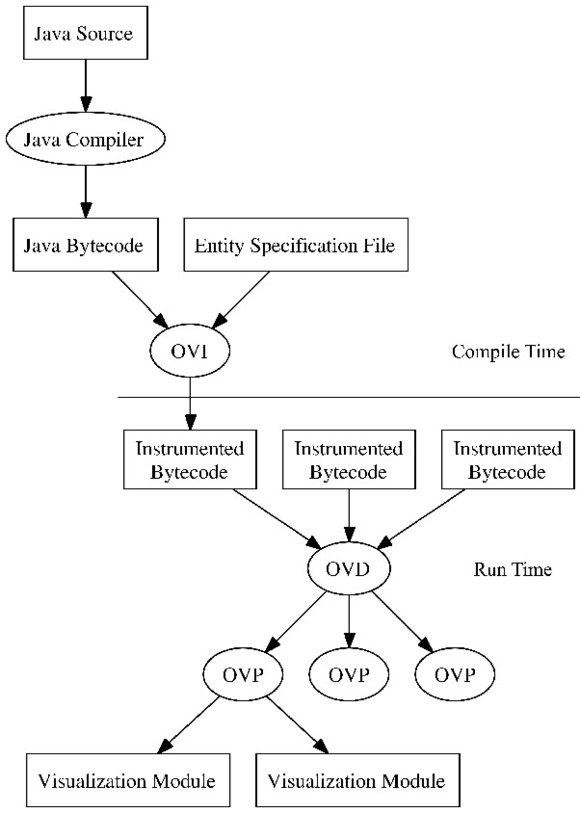
<body><![CDATA[<p>   <font face="Verdana" size="2">Liggesmeyer et al&nbsp;<span class="cite">[<a href="#c16">16</a>]</span><a name="c16."></a> also provide a tree like visualization for faults in a distributed system, using a gossip based approach for the dianostic of these faults&nbsp;<span class="cite">[<a href="#c13">13</a>]</span><a name="c13."></a>. This approach is interesting in that it provides a three dimensional layout of the computing hosts, and uses transparent containers to display different clusters, however it is limited to only displaying fault information.&nbsp;</font></p>     <p>   <font face="Verdana" size="2">Frishman and Tal<span class="cite">[<a href="#c10">10</a>]</span><a name="c10."></a> have also developed a visualization tool which bears a number of similarities to our own. While it is limited to using mobile objects (a single model of distributed systems, and thus is less generic), it takes an interesting approach to scalability. It suggests providing the user a means to select one or more points of focus; that is, parts of the visualization that are of interest. Then, the software visualization will use an algorithm to determine which mobile objects it can filter out as being uninteresting to the user. This stands in contrast to its negative: the approach of selecting the objects one wishes to filter out. Such a means might provide a better-scaling visualization; ultimately, there will always be fewer entities one is interested in than entities one is not.&nbsp;</font></p>     <p>   <font face="Verdana" size="2">Another software visualization framework which is similar to OverView is EVolve<span class="cite">[<a href="#c27">27</a>]</span><a name="c27."></a>, having the notion of events which describe the runtime behavior of an application being translated into a graphical visualization. It focuses upon object-oriented computations, supporting visualization of method invocations; while it&rsquo;s visualizations are less intuitive and generic, they are scalable and provide a large amount of information content, and may even be layered naturally on top of each other to show the user different types of information at once.&nbsp;</font></p>     <p>    </p>     <p><font face="Verdana" size="2"><span class="titlemark">3   </span> <a id="x1-30003"></a>OverView</font></p>  <font face="Verdana" size="2">      <br> </font>     <p><font face="Verdana" size="2">OverView<span class="cite">[<a href="#c7">7</a>]</span> is a toolkit which permits visualization of Java-based systems; in particular, distributed systems such as those previously described (OverView versions 0.1 and 0.2 were developed as a plugin for the Eclipse IDE. OverView&rsquo;s current version (0.5) is stand-alone to better support future features such as running the visualization from within a web browser as a Java applet.) The toolkit includes three programs, each of which performs a different task (see Figure <a href="#x1-30011">1</a>): </font>    </p> <ul class="itemize1">     <li class="itemize"><font face="Verdana" size="2">The <span class="cmti-10">OverView Instrumenter</span>, or OVI, which allows the abstraction of a Java program&rsquo;s execution into a    set of visualizable events by inserting unobtrusive event-sending behavior into existing Java bytecode.    </font>    </li>     <li class="itemize"><font face="Verdana" size="2">The <span class="cmti-10">OverView Presenter</span>, or OVP, which receives and interprets events into a meaningful, interactive,    graphical representation of the state of the distributed system. OVP has several <span class="cmti-10">visualization modules</span>,    each of which can display the distributed system in a different layout.    </font>    </li>     <li class="itemize"><font face="Verdana" size="2">The <span class="cmti-10">OverView Daemon</span>, or OVD, which acts as an event relay, collecting events sent by <span class="cmti-10">event sources</span>    (that is, any active instrumented program), and forwarding those events to <span class="cmti-10">event sinks </span>(that is, any    listening visualization program).</font></li>     </ul>  <font face="Verdana" size="2">      <br> </font>     <p>   </p> <hr class="figure">     ]]></body>
<body><![CDATA[<div class="figure">  <font face="Verdana" size="2">&nbsp; </font>     <p><font face="Verdana" size="2"><img src="/img/revistas/cleiej/v14n1/1a08f1.jpg">     <br>  </font>  </p>     <div class="caption"><font face="Verdana" size="2"><span class="id">Fig. 1: </span><span class="content"> The OverView framework, showing both compile-time operations and the layout of the run-time architecture.</span></font></div> <font face="Verdana" size="2">     <br> &nbsp; </font>     <p>   </p> </div> <hr class="endfigure"> <font face="Verdana" size="2">     <br> </font>     <p>   <font face="Verdana" size="2">Users add event-sending behavior to any existing Java program by writing an <span class="cmti-10">Entity Specification Language</span> (ESL) file, which uses a simple, declarative syntax to map Java method invocations to OverView events. These events are sent, at run-time, over a network to a listening OVD. ESL&rsquo;s simple grammar definition (see&nbsp;<span class="cite">[<a href="#c7">7</a>]</span> for details) allows the instrumentation of existing Java bytecode.&nbsp;</font></p>     <p>   <font face="Verdana" size="2">OVP can listen for incoming events from multiple sources, both online network connections and offline log files. It will multiplex these events and forward them to a visualization module, in addition to time stamping and logging them, so that they may be played back at a later date if desired. OverView visualization modules are written using the Processing Development Environment (<a href="http://www.processing.org/">http://www.processing.org/</a>). </font>    </p>     <p><font face="Verdana" size="2"><span class="titlemark">3.1   </span> <a id="x1-40003.1"></a>Events</font></p>  <font face="Verdana" size="2">      ]]></body>
<body><![CDATA[<br> </font>     <p><font face="Verdana" size="2">OverView&rsquo;s visualization model is based on two fundamental units, called <span class="cmti-10">entities </span>and <span class="cmti-10">containers</span>. An entity embodies the concept of a discrete unit of computation, which could refer to an object, an actor, an ambient, a process, or even a virtual machine. A container refers to the environment in which an entity exists. Every OverView visualization is composed of some aggregation of these two basic elements. </font>    </p> <ul class="itemize1">     <li class="itemize"><font face="Verdana" size="2"><span class="cmbx-10">Position/1</span>: Tells OverView to create a particular entity, or to move one if it already exists, outside of    any container. </font>    </li>     <li class="itemize"><font face="Verdana" size="2"><span class="cmbx-10">Position/2</span>: Tells OverView to create a particular entity inside a particular container. Again, if the    entity already exists, it is moved instead of being created. If the container does not yet exist, it is created    and placed outside any other container. </font>    </li>     <li class="itemize"><font face="Verdana" size="2"><span class="cmbx-10">Deletion/1</span>: Tells OverView to delete a particular entity. If such an entity does not exist, nothing    happens. </font>    </li>     <li class="itemize"><font face="Verdana" size="2"><span class="cmbx-10">Communication/2</span>: Tells OverView that two entities have communicated (for example, via method    invocation or message passing).</font></li>     </ul>  <font face="Verdana" size="2">      <br> </font>     <p>    </p>     <p><font face="Verdana" size="2"><span class="titlemark">3.2   </span> <a id="x1-50003.2"></a>Visualization Modules</font></p>  <font face="Verdana" size="2">      <br> </font>     <p></p> <hr class="figure">     <div class="figure">    <font face="Verdana" size="2">&nbsp; </font>     <p><font face="Verdana" size="2"><img src="/img/revistas/cleiej/v14n1/1a08f2.jpg"> <span class="cmr-9">(a)</span> <span class="cmr-9">Force-directed</span> <span class="cmr-9">layout</span><a id="x1-5002r2"></a><img src="/img/revistas/cleiej/v14n1/1a08f3.jpg">    <span class="cmr-9">(b)</span>    <span class="cmr-9">Hierarchical</span>    <span class="cmr-9">concentric</span>    <span class="cmr-9">layout</span>     ]]></body>
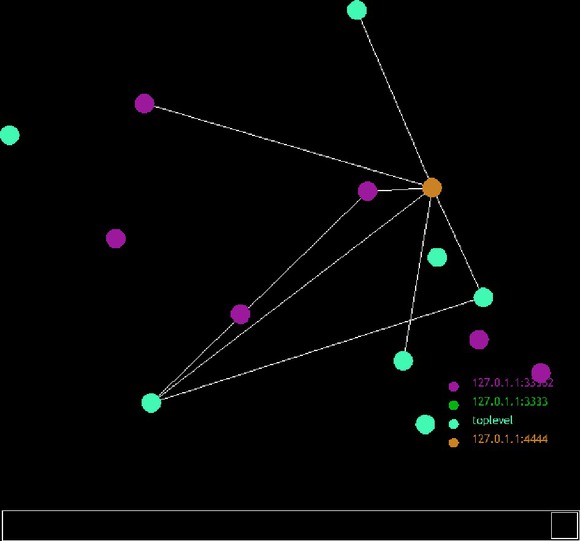
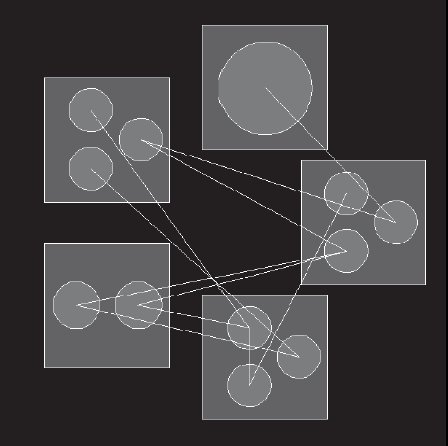
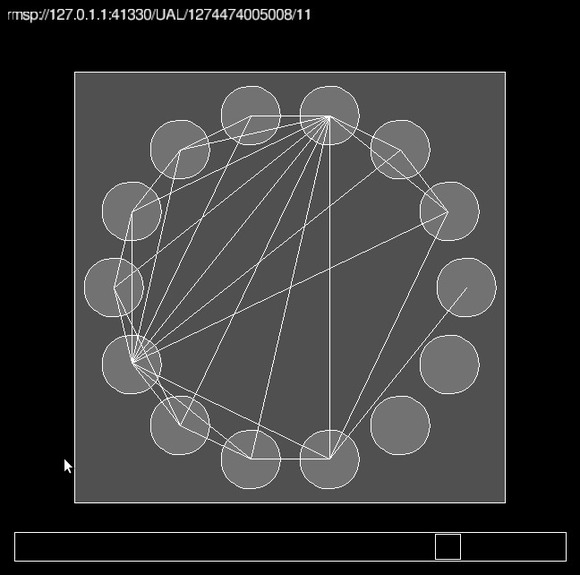
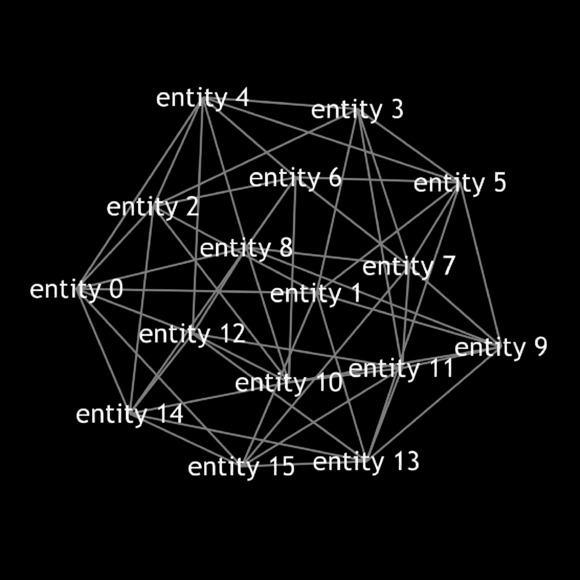
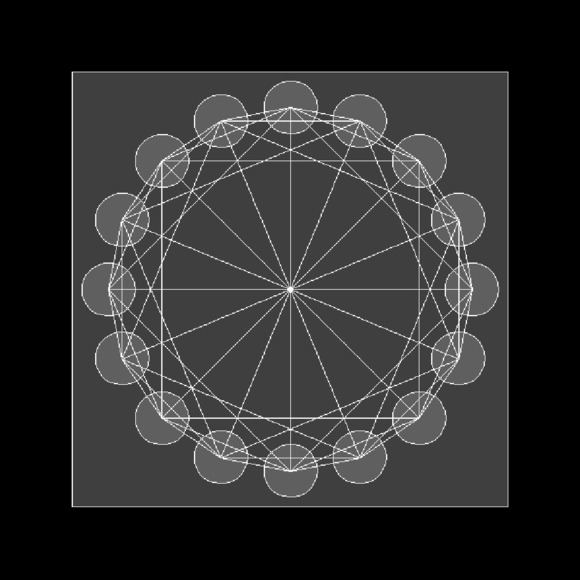
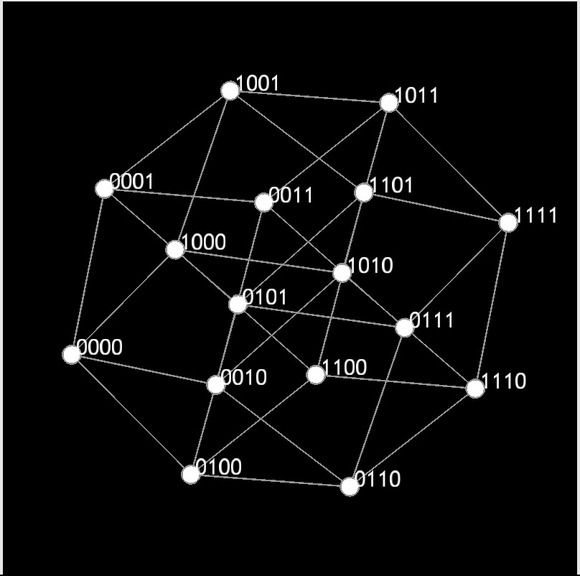
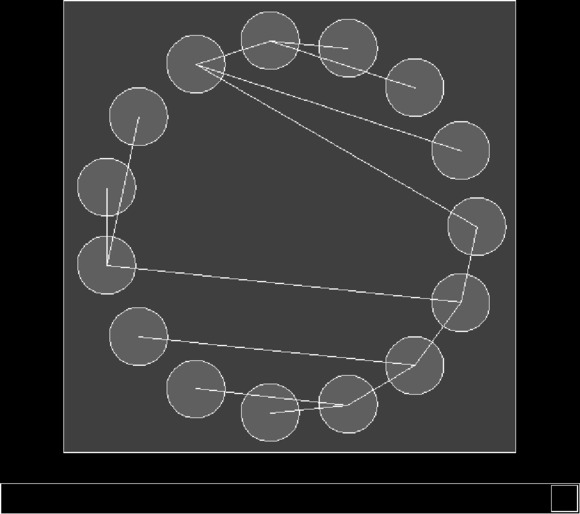
<body><![CDATA[<br>  </font>  </p>     <div class="caption"><font face="Verdana" size="2"><span class="id">Fig. 2: </span><span class="content">The two OverView visualization layouts.</span></font></div> <font face="Verdana" size="2">&nbsp;    <br> </font>     <p></p> </div> <hr class="endfigure"> <font face="Verdana" size="2">     <br> </font>     <p>   <font face="Verdana" size="2">A visualization module for OverView can be developed to suit the application to be visualized, since every OVP allows the connection of new modules that render information to the scientist or developer&rsquo;s particular preferences. The approach involves to implement the <span class="cmtt-10">Renderer </span>interface provided by OverView which will allow to implement <span class="cmtt-10">handle </span>and <span class="cmtt-10">unhandle </span>methods, as well as processing&rsquo;s <span class="cmtt-10">draw </span>method. <span class="obeylines-h"><span class="verb"><span class="cmtt-10">RingVisualization.java</span></span></span> which can be found in OverView&rsquo;s website (http://wcl.cs.rpi.edu/overview) is a good example for the creation of visualization modules. There are currently two visuailzation models implemented in OverView: </font>    </p>     <p><font face="Verdana" size="2"><a id="x1-60003.2"></a>Hierarchical Concentric</font></p>  <font face="Verdana" size="2">      <br> </font>     <p><font face="Verdana" size="2">The first module, called <span class="cmti-10">hierarchical concentric</span>, is a visualization in which all top level entities and containers are arranged in a ring around the center of the screen, each scaling to fit if necessary (see Figure&nbsp;<a href="#x1-5002r2">2b</a>). Those which are containers are differentiated from entities by being drawn as a square, rather than a circle; furthermore, any entities or containers it contains will be arranged in a circle within it. Upon communication a line is drawn between two communicating entities, disappearing momentarily. Following is a description of the actions triggered by each of the received events: </font>    </p> <ul class="itemize1">     <li class="itemize"><font face="Verdana" size="2"><span class="cmbx-10">Entity Creation</span>: After a check for its existence an entity will be created only if it does not exist inside    or outside a container. </font>    </li>     <li class="itemize"><font face="Verdana" size="2"><span class="cmbx-10">Entity Communication</span>: A line is drawn between two entities that exist, the origin located on the    message emitter and the destination on the message receiver. </font>    </li>     <li class="itemize"><font face="Verdana" size="2"><span class="cmbx-10">Entity Migration</span>: Upon removal from its current location the entity will be created in another location.    To represent this transition, the interface displays the entity as it moves along the interface from one    location to its destination, this is represented through the use of animation easing.    </font>    </li>     <li class="itemize"><font face="Verdana" size="2"><span class="cmbx-10">Entity Deletion</span>: The entity is removed from the interface.</font></li>     </ul>          ]]></body>
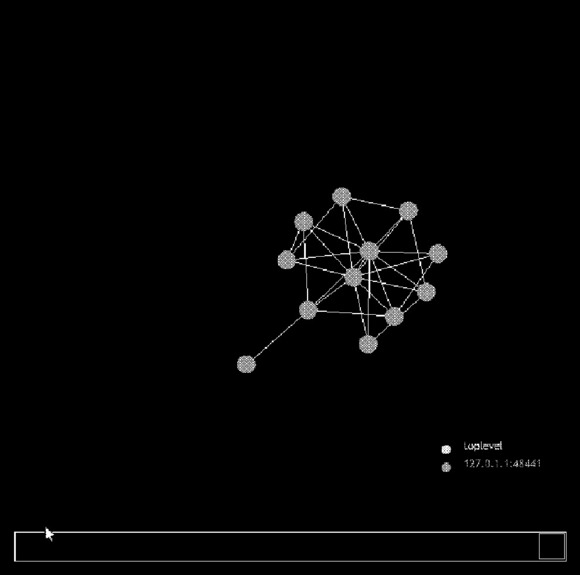
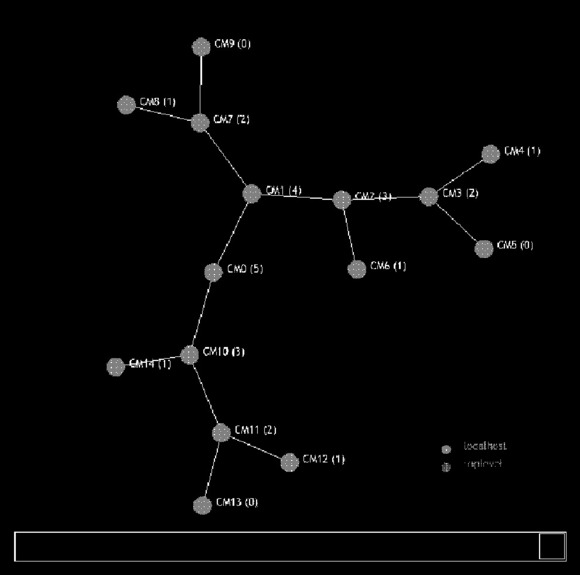
<body><![CDATA[<p><font face="Verdana" size="2"><a id="x1-70003.2"></a>Force-directed</font></p>  <font face="Verdana" size="2">      <br> </font>     <p><font face="Verdana" size="2">In <span class="cmti-10">force-directed </span>visualization, entities and containers are distinguished through color-coding. While only entities are drawn, containers are distinguished by the entity&rsquo;s color (see Figure&nbsp;<a href="#x1-5001r1">2a</a>). A color convention is provided on the screen. Entities are not positionally constrained, they move depending on two external forces. </font>    </p> <ul class="itemize1">     <li class="itemize"><font face="Verdana" size="2"><span class="cmbx-10">Entity Creation</span>: After a check for its existence an entity will be drawn in a color that depends on its    container. </font>    </li>     <li class="itemize"><font face="Verdana" size="2"><span class="cmbx-10">Entity Communication</span>: A line is drawn between two entities that exist, the origin located on the    message  emitter  and  the  destination  on  the  message  receiver.  This  line  represents  the  exertion  of    attraction force described in detail later. </font>    </li>     <li class="itemize"><font face="Verdana" size="2"><span class="cmbx-10">Entity Migration</span>: Upon removal from its current location the entity will be created in another location.    To represent this transition, the interface displays the entity as it changes it&rsquo;s color to that assigned    randomly at visualization initialization to its new container. </font>    </li>     <li class="itemize"><font face="Verdana" size="2"><span class="cmbx-10">Entity Deletion</span>: The entity is removed from the interface along with it&rsquo;s connections to other entities.</font></li>     </ul>  <font face="Verdana" size="2">      <br> </font>     <p><font face="Verdana" size="2"><span class="paragraphHead"><a id="x1-80003.2"></a><span class="cmbx-10">Entity Dynamics:</span></span>    There is a force of repulsion between entities. They repel each other following an inverse square rule, like Coulomb&rsquo;s law for electrostatics, as follows: </font>    </p> <table class="equation">   <tbody>     <tr>       <td>            <center class="math-display">       <font face="Verdana" size="2">       <img src="/img/revistas/cleiej/v14n1/1a080x.png" alt="Fr = Kr-1        r2" class="math-display"><a id="x1-8001r1"></a></font></center>       </td>       <td class="equation-label"><font face="Verdana" size="2">(1)</font></td>     </tr>   </tbody> </table>  <font face="Verdana" size="2">      <br> </font>     <p> <font face="Verdana" size="2">where <span class="cmti-10">r </span>represents the distance between two given entities and <span class="cmti-10">K</span><img src="/img/revistas/cleiej/v14n1/1a081x.png" alt="r  " class="math"> represents a repulsion coefficient. There is attraction between entities modeling communication as a force, rendering communicating entities as connected by a spring, which follows Hooke&rsquo;s Law: </font>    </p> <table class="equation">   <tbody>     <tr>       <td>           <center class="math-display">       <font face="Verdana" size="2">       <img src="/img/revistas/cleiej/v14n1/1a082x.png" alt="Fa = - Kar" class="math-display"><a id="x1-8002r2"></a></font></center>       </td>       <td class="equation-label"><font face="Verdana" size="2">(2)</font></td>     </tr>   </tbody> </table>  <font face="Verdana" size="2">      <br> </font>     <p> <font face="Verdana" size="2">where similarly, <span class="cmti-10">r </span>represents the distance between two entities and <img src="/img/revistas/cleiej/v14n1/1a083x.png" alt="Ka  " class="math"> represents the attraction coefficient. The space through which they move provides a constant friction which acts as a damper. This results in a particle system that displays the entities in a co-location scheme influenced directly by communication between entities or lack thereof. For more information about force-directed graph drawing, we refer the reader to Herman <span class="cmti-10">et. al.</span>&nbsp;<span class="cite">[<a href="#c12">12</a>]</span> or Frutcherman and Reingold&nbsp;<span class="cite">[<a href="#c11">11</a>]</span><a name="c11."></a>.&nbsp;</font></p>     ]]></body>
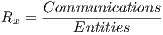
<body><![CDATA[<p>    </p>     <p><font face="Verdana" size="2"><span class="titlemark">4   </span> <a id="x1-90004"></a>Visualizing Common Communication Patterns</font></p>  <font face="Verdana" size="2">      <br> </font>     <p><font face="Verdana" size="2">In order to provide a general basis of comparison, a user can define his/her own <span class="cmti-10">clarity thresholds</span>: </font>    </p> <ul class="itemize1">     <li class="itemize"><font face="Verdana" size="2"><img src="/img/revistas/cleiej/v14n1/1a084x.png" alt="R   x  " class="math"> provides a measure of efficient use of space can be proposed by setting a fixed <span class="cmti-10">communication/entity</span>    ratio  and  measure  how  many  entities  can  be  displayed  without  communications  giving  out  false    information.  (<span class="cmti-10">e.g.</span>,  communications  between  A  and  B  passing  through  uninvolved  entity  C  or  a    communication being crossed at more than 2 points): </font>         <table class="equation">       <tbody>         <tr>           <td>               <center class="math-display">    <font face="Verdana" size="2">    <img src="/img/revistas/cleiej/v14n1/1a085x.png" alt="     Communications Rx = ----Entities----    " class="math-display"><a id="x1-9001r3"></a></font></center>           </td>           <td class="equation-label"><font face="Verdana" size="2">(3)</font></td>         </tr>       </tbody>     </table>     <font face="Verdana" size="2">         <br>     </font>         <p>         </p>   </li>   <li class="itemize"><font face="Verdana" size="2"><img src="/img/revistas/cleiej/v14n1/1a086x.png" alt="Cx  " class="math"> represents the amount of points along a communication&rsquo;s trajectory through which it is crossed by    another: </font>         <table class="equation">       <tbody>         <tr>           <td>               <center class="math-display">    <font face="Verdana" size="2">    <img src="/img/revistas/cleiej/v14n1/1a087x.png" alt="Cx &lt; 3    " class="math-display"><a id="x1-9002r4"></a></font></center>           </td>           <td class="equation-label"><font face="Verdana" size="2">(4)</font></td>         </tr>       </tbody>     </table>     <font face="Verdana" size="2">         <br>     </font>         <p>        </p>   </li>   <li class="itemize"><font face="Verdana" size="2"><img src="/img/revistas/cleiej/v14n1/1a088x.png" alt="Ex  " class="math"> represents the amount of entities that are crossed over by a communication:   </font>         <table class="equation">       <tbody>         <tr>           <td>               <center class="math-display">    <font face="Verdana" size="2">    <img src="/img/revistas/cleiej/v14n1/1a089x.png" alt="Ex = 0    " class="math-display"><a id="x1-9003r5"></a></font></center>           </td>           <td class="equation-label"><font face="Verdana" size="2">(5)</font></td>         </tr>       </tbody>     </table>     <font face="Verdana" size="2">         <br>     </font>         <p>    </p>   </li>     ]]></body>
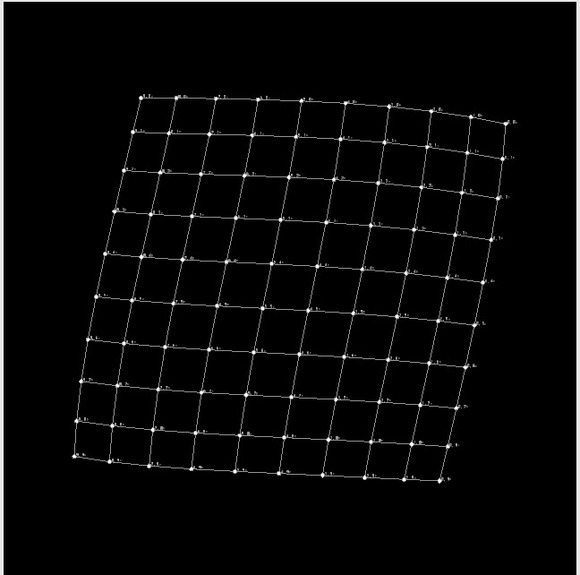
<body><![CDATA[</ul>  <font face="Verdana" size="2">      <br> </font>     <p>   <font face="Verdana" size="2">Force-directed visualization is also evaluated by measuring the amount of time it will take to reach a stable point, that is, when the velocity of the system is below an arbitrary value that tends to zero referred to as <span class="cmti-10">stability</span> <span class="cmti-10">threshold </span>which is determined in terms of <span class="cmti-10">(pixels/cycle)</span>. A cycle is measured to be <img src="/img/revistas/cleiej/v14n1/1a0810x.png" alt="        -2 1,781 &sdot;10  s  " class="math"> (using a 2000 cycle average measurement), the stability threshold was defined at <img src="/img/revistas/cleiej/v14n1/1a0811x.png" alt="    - 5 1 &sdot;10  " class="math">pixels/cycle which is considered a system velocity low enough to allow for comprehensive reading of the visualization. This is done to measure the cost of increased clarity in those representations where force-directed visualization performs significantly better in terms of the clarity threshold.&nbsp;</font></p>     <p>   <font face="Verdana" size="2">Herein, we examine the performance of the hierarchic concentric and force-directed visualizations based on their meeting of the clarity thresholds in different communication/entity ratio settings, the latter provided by different topologies.&nbsp;</font></p>     <p>    </p>     <p><font face="Verdana" size="2"><span class="titlemark">4.1   </span> <a id="x1-100004.1"></a>Linear and Grid-based Topologies:</font></p>  <font face="Verdana" size="2">      <br> </font>     <p><font face="Verdana" size="2">Linear and grid-based topologies are characterized by having a number of nodes set up in some <img src="/img/revistas/cleiej/v14n1/1a0812x.png" alt="n  " class="math">-dimensional lattice, with each node connected to and communicating with its neighbors. The most common class of programs that use such a structure are physical simulation programs, such as heat distribution or fluid dynamics applications, where each node represents an area in space (see Figure&nbsp;<a href="#x1-100033">3</a>.)&nbsp;</font></p>     <p>   </p> <hr class="figure">     <div class="figure">    <font face="Verdana" size="2">&nbsp; </font>     ]]></body>
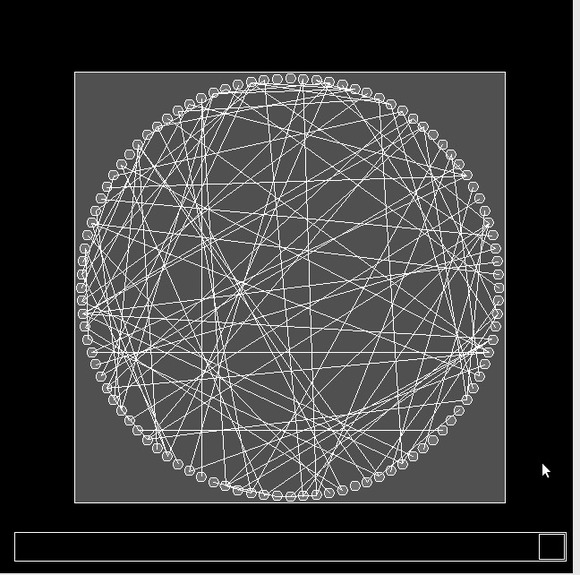
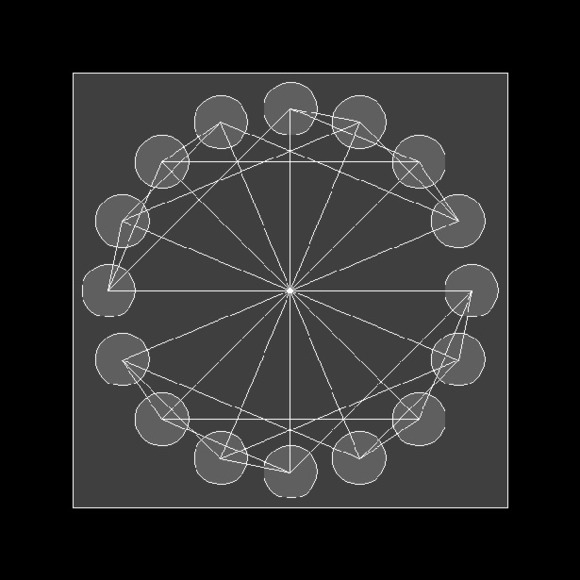
<body><![CDATA[<p><font face="Verdana" size="2"><img src="/img/revistas/cleiej/v14n1/1a08f4.jpg"> <span class="cmr-9">(a)</span> <span class="cmr-9">Force-directed</span> <span class="cmr-9">layout</span><a id="x1-10002r2"></a><img src="/img/revistas/cleiej/v14n1/1a08f5.jpg">    <span class="cmr-9">(b)</span>    <span class="cmr-9">Hierarchical</span>    <span class="cmr-9">concentric</span>    <span class="cmr-9">layout</span>     <br>  </font>  </p>     <div class="caption"><font face="Verdana" size="2"><span class="id">Fig. 3: </span><span class="content">Snapshot of a grid simulation containing 100 entities using OverView.</span></font></div> <font face="Verdana" size="2">     <br> &nbsp; </font>     <p>   </p> </div> <hr class="endfigure"> <font face="Verdana" size="2">     <br> </font>     <p>   <font face="Verdana" size="2">   <span class="cmti-10">Performance: </span>Grids are better represented by force-directed visualizations because they do not display cluttered entities and the communication links are clear, the <span class="cmti-10">clarity threshold </span>is met since there are no crossing lines or crossed entities. Hierarchic visualizations, highly dependent on the order of entity creation do not meet the clarity threshold. The stability threshold was reached by the force-directed approach in an average <img src="/img/revistas/cleiej/v14n1/1a0813x.png" alt="80.523  " class="math"> seconds. </font>    </p>     <p><font face="Verdana" size="2"><span class="titlemark">4.2   </span> <a id="x1-110004.2"></a>Ring-based Topologies</font></p>  <font face="Verdana" size="2">      <br> </font>     <p><font face="Verdana" size="2">Ring-based topologies find a common application in peer-to-peer networks (see <span class="cmti-10">e</span>.g., Figure&nbsp;<a href="#x1-110034">4</a>.) Chord<span class="cite">[<a href="#c24">24</a>]</span> increases the number of neighbor links from a constant number to a logarithmic number (based on the size of the network), which decreases the search time from linear to logarithmic as well; this makes it possible to construct robust and high-performance peer-to-peer networks (see Figure&nbsp;<a href="#x1-110065">5</a>.).&nbsp;</font></p>     ]]></body>
<body><![CDATA[<p>   </p> <hr class="figure">     <div class="figure">    <font face="Verdana" size="2">&nbsp; </font>     <p><font face="Verdana" size="2"><img src="/img/revistas/cleiej/v14n1/1a08f6.jpg"> <span class="cmr-9">(a)</span> <span class="cmr-9">Force-directed</span> <span class="cmr-9">layout</span><a id="x1-11002r2"></a><img src="/img/revistas/cleiej/v14n1/1a08f7.jpg">    <span class="cmr-9">(b)</span>    <span class="cmr-9">Hierarchical</span>    <span class="cmr-9">concentric</span>    <span class="cmr-9">layout</span>     <br>  </font>  </p>     <div class="caption"><font face="Verdana" size="2"><span class="id">Fig. 4: </span><span class="content">Flavius Josephus problem where each third man in the circle commits suicide, the solution for the &rdquo;safe&rdquo; position is visualized using OverView.</span></font></div> <font face="Verdana" size="2">     <br> &nbsp; </font>     <p>   </p> </div> <hr class="endfigure"> <font face="Verdana" size="2">     <br> </font>     <p>   <font face="Verdana" size="2">   <span class="cmti-10">Performance: </span>Both models fail to meet the clarity threshold, however once the threshold is lowered, the first model to reach compliance of it, is the hierarchical concentric. The dense communication pattern for Chord is not efficiently viewed using force-directed approaches. The stability threshold is reached at an average <img src="/img/revistas/cleiej/v14n1/1a0814x.png" alt="4.202  " class="math"> seconds.&nbsp;</font></p>     <p>   </p> <hr class="figure">     ]]></body>
<body><![CDATA[<div class="figure">    <font face="Verdana" size="2">&nbsp; </font>     <p><font face="Verdana" size="2"><img src="/img/revistas/cleiej/v14n1/1a08f8.jpg"> <span class="cmr-9">(a)</span> <span class="cmr-9">A</span> <span class="cmr-9">force-directed</span> <span class="cmr-9">representation.</span><a id="x1-11005r2"></a><img src="/img/revistas/cleiej/v14n1/1a08f9.jpg">    <span class="cmr-9">(b)</span>    <span class="cmr-9">A</span>    <span class="cmr-9">hierarchical</span>    <span class="cmr-9">concentric</span>    <span class="cmr-9">representation.</span>     <br>  </font>  </p>     <div class="caption"><font face="Verdana" size="2"><span class="id">Fig. 5: </span><span class="content">Chord networks visualized using OverView show that the clarity threshold in the force-directed approach  is  violated  by  far,  while  the  hierarchical  concentric  approach  provides  an  effective  means  of visualization.</span></font></div> <font face="Verdana" size="2">     <br> &nbsp; </font>     <p>   </p> </div> <hr class="endfigure">         <p><font face="Verdana" size="2"><span class="titlemark">4.3   </span> <a id="x1-120004.3"></a>Cube and Hypercube-based Topologies</font></p>  <font face="Verdana" size="2">      <br> </font>     <p><font face="Verdana" size="2">Cubes, hypercubes, and other <img src="/img/revistas/cleiej/v14n1/1a0815x.png" alt="n  " class="math">-dimensional cubes have a number of notable properties useful to distributed computation; among them is the upper bound on hops between any two nodes on the network, while maintaining only a small number of edges between nodes. Hypercubes are also notable for having a very structured high-dimensional organization, which is difficult to map to 2 or 3 dimensions well (see Figure&nbsp;<a href="#x1-120036">6</a>.)&nbsp;</font></p>     <p>   <font face="Verdana" size="2">   <span class="cmti-10">Performance: </span>This topology does not meet the clarity threshold on either visualization, a less objective evaluation would imply that if the scale is small enough, a Force Directed approach could be intelligible. This topology lies beyond the scope of both visualizations.&nbsp;</font></p>     ]]></body>
<body><![CDATA[<p>   </p> <hr class="figure">     <div class="figure">    <font face="Verdana" size="2">&nbsp; </font>     <p><font face="Verdana" size="2"><img src="/img/revistas/cleiej/v14n1/1a08f10.jpg"> <span class="cmr-9">(a)</span> <span class="cmr-9">A</span> <span class="cmr-9">force-directed</span> <span class="cmr-9">layout.</span><a id="x1-12002r2"></a><img src="/img/revistas/cleiej/v14n1/1a08f11.jpg">    <span class="cmr-9">(b)</span>    <span class="cmr-9">A</span>    <span class="cmr-9">hierarchical</span>    <span class="cmr-9">concentric</span>    <span class="cmr-9">layout.</span>     <br>  </font>  </p>     <div class="caption"><font face="Verdana" size="2"><span class="id">Fig. 6: </span><span class="content">A Hypercube network is visualized with OverView.</span></font></div> <font face="Verdana" size="2">     <br> &nbsp; </font>     <p>   </p> </div> <hr class="endfigure">         <p><font face="Verdana" size="2"><span class="titlemark">4.4   </span> <a id="x1-130004.4"></a>Recursive Topologies</font></p>  <font face="Verdana" size="2">      <br> </font>     <p><font face="Verdana" size="2">Recursive computation is as important in distributed computing as it is in sequential computing; many divide-and-conquer recursive algorithms can be made to run efficiently in a distributed setting (see Figure&nbsp;<a href="#x1-130037">7</a>.)&nbsp;</font></p>     ]]></body>
<body><![CDATA[<p>   <font face="Verdana" size="2">   <span class="cmti-10">Performance: </span>When nodes are created with a particular ordering, the hierarchical concentric visualization meets the clarity threshold on binary trees which are common in recursive algorithms. A force directed approach does not rely on the order of creation to meet the clarity threshold, and allows to recognize the fractal nature of the calculation. No entity crossing or communication crossing occurs once the system is at a stable position. The stability threshold is reached at average in <img src="/img/revistas/cleiej/v14n1/1a0816x.png" alt="27.962  " class="math"> seconds.&nbsp;</font></p>     <p>   </p> <hr class="figure">     <div class="figure">    <font face="Verdana" size="2">&nbsp; </font>     <p><font face="Verdana" size="2"><img src="/img/revistas/cleiej/v14n1/1a08f12.jpg"> <span class="cmr-9">(a)</span> <span class="cmr-9">A</span> <span class="cmr-9">force-directed</span> <span class="cmr-9">layout.</span><a id="x1-13002r2"></a><img src="/img/revistas/cleiej/v14n1/1a08f13.jpg">    <span class="cmr-9">(b)</span>    <span class="cmr-9">A</span>    <span class="cmr-9">hierarchical</span>    <span class="cmr-9">concentric</span>    <span class="cmr-9">layout</span>     <br>  </font>  </p>     <div class="caption"><font face="Verdana" size="2"><span class="id">Fig. 7: </span><span class="content">The fractal nature of the recursive calculation is observed using OverView.</span></font></div> <font face="Verdana" size="2">     <br> &nbsp; </font>     <p>   </p> </div> <hr class="endfigure">         <p><font face="Verdana" size="2"><span class="titlemark">5   </span> <a id="x1-140005"></a>Discussion on Visualization Models</font></p>  <font face="Verdana" size="2">      <br> </font>     ]]></body>
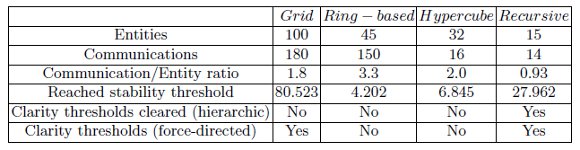
<body><![CDATA[<p><font face="Verdana" size="2">Figure&nbsp;<a href="#x1-140018">8</a> shows a table containing the data obtained for each of the topologies evaluated in Section&nbsp;<a href="#x1-90004">4</a>.&nbsp;</font></p>     <p>   </p> <hr class="figure">     <div class="figure">  <font face="Verdana" size="2">&nbsp; </font>     <p><font face="Verdana" size="2"><img src="/img/revistas/cleiej/v14n1/1a08t1.jpg">     <br>  </font>  </p>     <div class="caption"><font face="Verdana" size="2"><span class="id">Fig. 8: </span><span class="content"> Performance of visualization modules on different application classes.</span></font></div> <font face="Verdana" size="2">&nbsp;    <br> </font>     <p>   </p> </div> <hr class="endfigure">         <p><font face="Verdana" size="2"><span class="titlemark">5.1   </span> <a id="x1-150005.1"></a>Hierarchical Concentric Visualization</font></p>  <font face="Verdana" size="2">      <br> </font>     ]]></body>
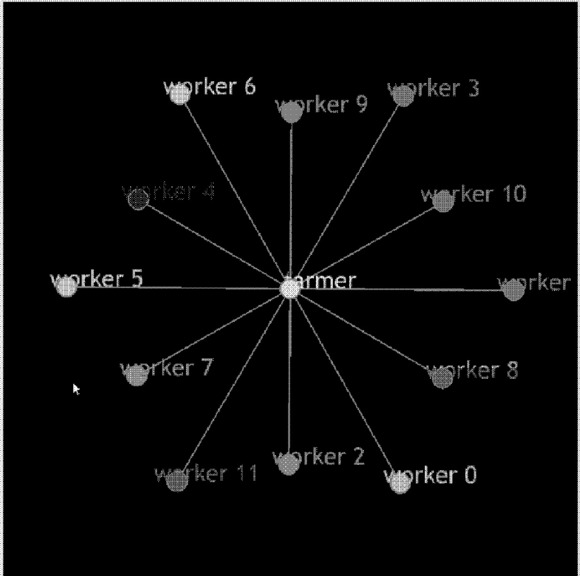
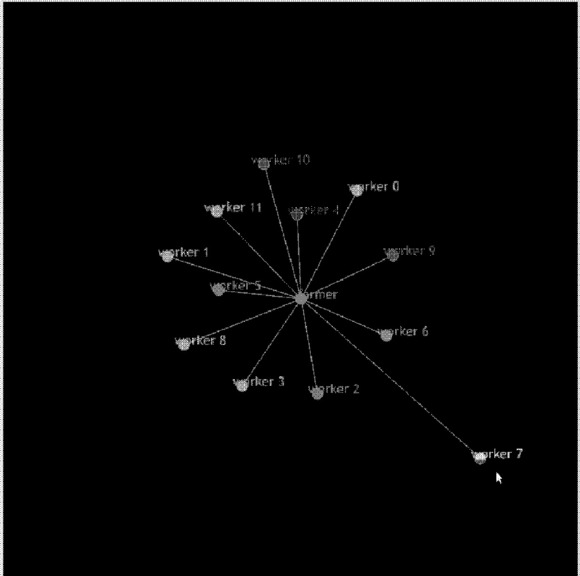
<body><![CDATA[<p><font face="Verdana" size="2">Hierarchical concentric places entities around a hierarchical series of rings. This placement mechanism was selected for several reasons: firstly, it minimizes ambiguous communications&mdash;that is, communication lines overlapping multiple entities, so one cannot determine at a glance which entities are referred to; this is a commonly-arising problem in grid-based visualizations, since many communications will either be purely horizontal or purely vertical and reach across entire rows or columns. Secondly, it can display a hierarchy of elements intuitively, even with na&iuml;ve placement of new elements at the end of the list, allowing it to support recursive computations with reasonable effectiveness. This hierarchical, concentric structure is both intuitive and generic, mapping naturally both to flat systems (such as actors within theaters) and nested systems (such as mobile ambients).&nbsp;</font></p>     <p>   <font face="Verdana" size="2">Hierarchical concentric&rsquo;s main drawback is in scalability. While it is effective for small numbers of entities, it rapidly breaks down and becomes confusing with as few as one hundred entities, with many communications filling the rings. Furthermore, logically grouped entities may be placed far from each other by the visualization, and since one cannot zoom in upon both sides of the ring at once, it can become difficult or impossible to understand what is occurring in parts of a system. However, despite these weaknesses, the visualization can be very effective for some application topologies, such as linear and circular topologies, as illustrated in Section&nbsp;<a href="#x1-90004">4</a>.&nbsp;</font></p>     <p>    </p>     <p><font face="Verdana" size="2"><span class="titlemark">5.2   </span> <a id="x1-160005.2"></a>Force-directed Visualization</font></p>  <font face="Verdana" size="2">      <br> </font>     <p><font face="Verdana" size="2">Force-directed visualization was primarily developed to remedy some of the shortcomings of hierarchical concentric. Unlike it, there is no hierarchical placement; entities are only placed upon the primary visualization surface. The only reference as to an entity&rsquo;s belonging to a particular container is the color used to draw it. Furthermore, if like colors are well clustered, it provides good information on whether entities that communicate frequently are near each other physically, which is a very natural notion for the visualization to convey. An outlier to this affirmation is the case of farmer-worker topologies, where such information is not accurately conveyed since there is no communication between workers (see Figure <a href="#x1-16001r1">9a</a>.) Given this scenario, a user can interact with the visualization by click-n-drag actions, allowing for manual configuration of entities. We note, however, that the force-directed layout provides a very intuitive visualization in most cases, especially in reference to the application communication topology.&nbsp;</font></p>     <p>   </p> <hr class="figure">     <div class="figure">    <font face="Verdana" size="2">&nbsp; </font>     <p><font face="Verdana" size="2"><img src="/img/revistas/cleiej/v14n1/1a08f14.jpg"> <span class="cmr-9">(a)</span> <span class="cmr-9">Farmer-worker</span><a id="x1-16002r2"></a><img src="/img/revistas/cleiej/v14n1/1a08f15.jpg">    <span class="cmr-9">(b)</span>    <span class="cmr-9">User</span>    <span class="cmr-9">Modification</span>    <span class="cmr-9">of</span>    <span class="cmr-9">farmer-worker</span>     <br>  </font>  </p>     ]]></body>
<body><![CDATA[<div class="caption"><font face="Verdana" size="2"><span class="id">Fig. 9:  </span><span class="content">A  farmer-worker  topology  does  not  involve  workers  communicating  with  each  other,  on  these conditions force-directed approaches are not advisable for visualization, on <a href="#x1-16002r2">9b</a> the user interacts with the visualization by dragging one of the workers.</span></font></div> <font face="Verdana" size="2">     <br> &nbsp; </font>     <p>   </p> </div> <hr class="endfigure"> <font face="Verdana" size="2">     <br> </font>     <p>   <font face="Verdana" size="2">The force-directed layout lacks support for nesting which is one of its most significant weaknesses, however it allows to visualize the appearance of clustering between entities that are tightly coupled in terms of communication which is a good indicator of proper application of load-balancing policies. </font>    </p>     <p><font face="Verdana" size="2"><span class="titlemark">6   </span> <a id="x1-170006"></a>Conclusions</font></p>  <font face="Verdana" size="2">      <br> </font>     <p><font face="Verdana" size="2">Our experiences with these visualizations indicate clearly and beyond a doubt that a modular approach to OverView is the correct choice, since different applications have different visualization needs. Furthermore, our experience developing these modules for OverView leads us to believe that a developer or scientist can better use a customized visualization module. This possibility of visualization renders the subjective nature of visualization clarity and effectiveness to a simple matter of instrumenting bytecode according to the events that are intended to be visualized and if the existing modules do not convey information in a satisfactory manner, the task of creating a visualization module is relatively simple.&nbsp;</font></p>     <p>   <font face="Verdana" size="2">OverView&rsquo;s hierarchical concentric module provides a way to convey the nesting of entities in a clear fashion, finding its boundaries when communication patterns are dense. It approaches the issue by having the representation of a communication event fade over time, which could lead to misrepresented persistent links. The force-directed module focuses it&rsquo;s attention on the communication topology of an application at a given point, which allows to evaluate the load balancing policies of adaptive middleware or the load balancing algorithms implemented within the application. An approach to migration representation is proposed within this module with the color coding of containers, however this technique is not as effective since there are topologies which do not present communication between co-located entities.&nbsp;</font></p>     <p>   <font face="Verdana" size="2">The powerful nature of OverView&rsquo;s architecture is put to the test with the development of the force-directed approach that looked to the problem that rises from the hierarchical concentric module not conveying coupling. The combined usage of these two visualization modules provides the means for comprehensive evaluation of an application&rsquo;s performance. Furthermore, it paves the way for more visualization modules to be developed in order to gain perspective on other particular characteristics of a distributed system.&nbsp;</font></p>     ]]></body>
<body><![CDATA[<p>    </p>     <p><font face="Verdana" size="2"><span class="titlemark">6.1   </span> <a id="x1-180006.1"></a>Future Work</font></p>  <font face="Verdana" size="2">      <br> </font>     <p><font face="Verdana" size="2">The most obvious next step to take in the direction of distributed systems visualization using OverView is to produce modules that focus on other characteristics of distributed systems whose visualization could prove useful. For instance, a module that focuses on visualizing the different policies available in adaptive middleware to distribute autonomous actors. Such visualizations would permit users to fully comprehend the behavior induced by the policies selected for the system at hand (<span class="cmti-10">e.g. </span>energy management, high performance, task management, etc.).&nbsp;</font></p>     <p>   <font face="Verdana" size="2">Extensive work on the matter has spawned a generation of middleware applications that specialize on load balancing<span class="cite">[<a href="#c8">8</a>]</span><a name="c8."></a> and the evaluation of such software is critical. Upon deployment of middleware, the task of load balancing the system becomes transparent to the developer, which in turn raises the question of whether the middleware selected as well as its policies are optimal given the application-level objectives.&nbsp;</font></p>     <p>   <font face="Verdana" size="2">Additional OverView visualization modules that can clearly separate physical-layer network aspects such as inter-processor latencies and bandwidths for particular clusters, from application-layer aspects would enable a better assessment of middleware resource management policies.&nbsp;</font></p>     <p>    </p>     <p><font face="Verdana" size="2"><a id="x1-190006.1"></a>Acknowledgements</font></p>  <font face="Verdana" size="2">      <br> </font>     <p><font face="Verdana" size="2">This work has been partially supported by the following grants: NSF CAREER CNS Award No. 0448407, IBM Innovation Awards.&nbsp;</font></p>     ]]></body>
<body><![CDATA[<p>    </p>     <p><font face="Verdana" size="2"><a id="x1-200006.1"></a>References</font></p>  <font face="Verdana" size="2">      <br> </font>     <p>     </p>     <div class="thebibliography">         <p><font face="Verdana" size="2"><span class="biblabel">  <span class="cmr-9"><a name="c1"></a><a href="#c1.">1</a>.</span> <span class="bibsp"><span class="cmr-9">&nbsp;&nbsp;&nbsp;</span></span></span><span class="cmr-9">D.&nbsp;P.  Anderson, </span><span class="cmti-9">Boinc:  a  system  for  public-resource  computing  and  storage</span><span class="cmr-9">,  Proceedings  of  the  Fifth</span>    <span class="cmr-9">IEEE/ACM International Workshop on Grid Computing., IEEE Computer Society, 2004, pp.&nbsp;4&ndash;10.</span> </font>    </p>          <p><font face="Verdana" size="2"><span class="biblabel">  <span class="cmr-9"><a name="c2"></a><a href="#c2.">2</a>.</span> <span class="bibsp"><span class="cmr-9">&nbsp;&nbsp;&nbsp;</span></span></span><span class="cmr-9">David&nbsp;P. Anderson, Jeff Cobb, Eric Korpela, Matt Lebofsky, and Dan Werthimer, </span><span class="cmti-9">Seti@home: an experiment</span>    <span class="cmti-9">in public-resource computing</span><span class="cmr-9">, Commun. ACM </span><span class="cmbx-9">45 </span><span class="cmr-9">(2002), no.&nbsp;11, 56&ndash;61.</span> </font>    </p>          <p><font face="Verdana" size="2"><span class="biblabel">  <span class="cmr-9"><a name="c3"></a><a href="#c3.">3</a>.</span> <span class="bibsp"><span class="cmr-9">&nbsp;&nbsp;&nbsp;</span></span></span><span class="cmr-9">Robert Bell, Allen&nbsp;D. Malony, and Sameer Shende, </span><span class="cmti-9">Paraprof: A portable, extensible, and scalable tool for</span>    <span class="cmti-9">parallel performance profile analysis.</span><span class="cmr-9">, Proceedings of Euro-Par&rsquo;03 Conference, 2003, pp.&nbsp;17&ndash;26.</span> </font>    </p>          <!-- ref --><p><font face="Verdana" size="2"><span class="biblabel">  <span class="cmr-9"><a name="c4"></a><a href="#c4.">4</a>.</span> <span class="bibsp"><span class="cmr-9">&nbsp;&nbsp;&nbsp;</span></span></span><span class="cmr-9">Bram Cohen, </span><span class="cmti-9">Incentives build robustness in BitTorrent</span><span class="cmr-9">, Tech. report, May 2003.    </span> </font>    </p>          ]]></body>
<body><![CDATA[<p><font face="Verdana" size="2"><span class="biblabel">  <span class="cmr-9"><a name="c5"></a><a href="#c5.">5</a>.</span> <span class="bibsp"><span class="cmr-9">&nbsp;&nbsp;&nbsp;</span></span></span><span class="cmr-9">Nathan   Cole,   Travis   Desell,   Daniel&nbsp;Lombranaa   Gonzalez,   Francisco&nbsp;Fernandez   de&nbsp;Vega,   Malik</span>    <span class="cmr-9">Magdon-Ismail, Heidi Newberg, , Boleslaw&nbsp;K. Szymanski, and Carlos&nbsp;A. Varela, </span><span class="cmti-9">Parallel and computational</span>    <span class="cmti-9">intelligence</span><span class="cmr-9">, ch.&nbsp;Evolutionary Algorithms on Volunteer Computing Platforms: The MilkyWay@Home Project,</span>    <span class="cmr-9">pp.&nbsp;64&ndash;90, Springer-Verlag Berlin Heidelberg, 2010.</span> </font>    </p>          <p><font face="Verdana" size="2"><span class="biblabel">  <span class="cmr-9"><a name="c6"></a><a href="#c6.">6</a>.</span> <span class="bibsp"><span class="cmr-9">&nbsp;&nbsp;&nbsp;</span></span></span><span class="cmr-9">Mariano&nbsp;P. Consens, Masum&nbsp;Z. Hasan, and Alberto&nbsp;O. Mendelzon, </span><span class="cmti-9">Using hy+ for network management and</span>    <span class="cmti-9">distributed debugging</span><span class="cmr-9">, CASCON &rsquo;93: Proceedings of the 1993 conference of the Centre for Advanced Studies on</span>    <span class="cmr-9">Collaborative research, IBM Press, 1993, pp.&nbsp;450&ndash;471.</span> </font>    </p>          <!-- ref --><p><font face="Verdana" size="2"><span class="biblabel">  <span class="cmr-9"><a name="c7"></a><a href="#c7.">7</a>.</span> <span class="bibsp"><span class="cmr-9">&nbsp;&nbsp;&nbsp;</span></span></span><span class="cmr-9">Travis Desell, H.&nbsp;Iyer, Abe Stephens, and Carlos&nbsp;A. Varela, </span><span class="cmti-9">OverView: A framework for generic online</span>    <span class="cmti-9">visualization of distributed systems</span><span class="cmr-9">, Proceedings of the European Joint Conferences on Theory and Practice of</span>    <span class="cmr-9">Software (ETAPS 2004), eclipse Technology eXchange (eTX) Workshop (Barcelona, Spain), March 2004.    </span> </font>    </p>          <p><font face="Verdana" size="2"><span class="biblabel">  <span class="cmr-9"><a name="c8"></a><a href="#c8.">8</a>.</span> <span class="bibsp"><span class="cmr-9">&nbsp;&nbsp;&nbsp;</span></span></span><span class="cmr-9">Travis  Desell,  Kaoutar&nbsp;El  Maghraoui,  and  Carlos&nbsp;A.  Varela, </span><span class="cmti-9">Load balancing of autonomous actors over</span>    <span class="cmti-9">dynamic networks</span><span class="cmr-9">, Proceedings of the Hawaii International Conference on System Sciences, HICSS-37 Software</span>    <span class="cmr-9">Technology Track, January 2004, pp.&nbsp;1&ndash;10.</span> </font>    </p>          <!-- ref --><p><font face="Verdana" size="2"><span class="biblabel">  <span class="cmr-9"><a name="c9"></a><a href="#c9.">9</a>.</span> <span class="bibsp"><span class="cmr-9">&nbsp;&nbsp;&nbsp;</span></span></span><span class="cmr-9">Niels Drost, Rob&nbsp;V. van Nieuwpoort, Jason Maassen, Frank Seinstra, and Henri&nbsp;E. Bal, </span><span class="cmti-9">Jel: unified resource</span>    <span class="cmti-9">tracking for parallel and distributed applications</span><span class="cmr-9">, Concurrency and Computation: Practice and Experience (2010).    </span> </font>    </p>          <p><font face="Verdana" size="2"><span class="biblabel"> <span class="cmr-9"><a name="c10"></a><a href="#c10.">10</a>.</span> <span class="bibsp"><span class="cmr-9">&nbsp;&nbsp;&nbsp;</span></span></span><span class="cmr-9">Yaniv Frishman and Ayellet Tal, </span><span class="cmti-9">Visualization of mobile object environments</span><span class="cmr-9">, SoftVis &rsquo;05: Proceedings of the</span>    <span class="cmr-9">2005 ACM symposium on Software visualization (New York, NY, USA), ACM Press, 2005, pp.&nbsp;145&ndash;154.</span> </font>    </p>          <!-- ref --><p><font face="Verdana" size="2"><span class="biblabel"> <span class="cmr-9"><a name="c11"></a><a href="#c11.">11</a>.</span> <span class="bibsp"><span class="cmr-9">&nbsp;&nbsp;&nbsp;</span></span></span><span class="cmr-9">Thomas M.&nbsp;J. Fruchterman and Edward&nbsp;M. Reingold, </span><span class="cmti-9">Graph drawing by force-directed placement</span><span class="cmr-9">, 1991.    </span> </font>    </p>          ]]></body>
<body><![CDATA[<p><font face="Verdana" size="2"><span class="biblabel"> <span class="cmr-9"><a name="c12"></a><a href="#c12.">12</a>.</span> <span class="bibsp"><span class="cmr-9">&nbsp;&nbsp;&nbsp;</span></span></span><span class="cmr-9">Ivan Herman, Guy Melan&ccedil;on, and M.&nbsp;Scott Marshall, </span><span class="cmti-9">Graph visualization and navigation in information</span>    <span class="cmti-9">visualization: A survey</span><span class="cmr-9">, IEEE Transactions on Visualization and Computer Graphics </span><span class="cmbx-9">6 </span><span class="cmr-9">(2000), 24&ndash;43.</span> </font>    </p>          <!-- ref --><p><font face="Verdana" size="2"><span class="biblabel"> <span class="cmr-9"><a name="c13"></a><a href="#c13.">13</a>.</span> <span class="bibsp"><span class="cmr-9">&nbsp;&nbsp;&nbsp;</span></span></span><span class="cmr-9">R.&nbsp;Kalcklsch, </span><span class="cmti-9">Gossip-based  diagnosis  of  arbitrary  component-oriented  systems</span><span class="cmr-9">,  Ph.D.  thesis,  Technische</span>    <span class="cmr-9">Universitt Kaiserslautern, 2008.    </span> </font>    </p>          <p><font face="Verdana" size="2"><span class="biblabel"> <span class="cmr-9"><a name="c14"></a><a href="#c14.">14</a>.</span> <span class="bibsp"><span class="cmr-9">&nbsp;&nbsp;&nbsp;</span></span></span><span class="cmr-9">Jacques Chassin&nbsp;de Kergommeaux and Benhur de&nbsp;Oliveira Stein, </span><span class="cmti-9">Paj&amp;#233;: An extensible environment for</span>    <span class="cmti-9">visualizing multi-threaded programs executions</span><span class="cmr-9">, Proceedings from the 6th International Euro-Par Conference on</span>    <span class="cmr-9">Parallel Processing (London, UK), Euro-Par &rsquo;00, Springer-Verlag, 2000, pp.&nbsp;133&ndash;140.</span> </font>    </p>          <p><font face="Verdana" size="2"><span class="biblabel"> <span class="cmr-9"><a name="c15"></a><a href="#c15.">15</a>.</span> <span class="bibsp"><span class="cmr-9">&nbsp;&nbsp;&nbsp;</span></span></span><span class="cmr-9">Chee&nbsp;Wai Lee, C.&nbsp;Mendes, and L.V. Kale, </span><span class="cmti-9">Towards scalable performance analysis and visualization through</span>    <span class="cmti-9">data reduction</span><span class="cmr-9">, Parallel and Distributed Processing, 2008. IPDPS 2008. IEEE International Symposium on, april</span>    <span class="cmr-9">2008, pp.&nbsp;1 &ndash;8.</span> </font>     </p>          <p><font face="Verdana" size="2"><span class="biblabel"> <span class="cmr-9"><a name="c16"></a><a href="#c16.">16</a>.</span> <span class="bibsp"><span class="cmr-9">&nbsp;&nbsp;&nbsp;</span></span></span><span class="cmr-9">Peter  Liggesmeyer,  Jens  Heidrich,  Jrgen  Mnch,  Robert  Kalcklsch,  Henning  Barthel,  and  Dirk  Zeckzer,</span>    <span class="cmti-9">Visualization  of  software  and  systems  as  support  mechanism  for  integrated  software  project  control</span><span class="cmr-9">,</span>    <span class="cmr-9">Human-Computer Interaction. New Trends (Julie Jacko, ed.), Lecture Notes in Computer Science, vol. 5610,</span>    <span class="cmr-9">Springer Berlin / Heidelberg, 2009, pp.&nbsp;846&ndash;855.</span> </font>    </p>          <p><font face="Verdana" size="2"><span class="biblabel"> <span class="cmr-9"><a name="c17"></a><a href="#c17.">17</a>.</span> <span class="bibsp"><span class="cmr-9">&nbsp;&nbsp;&nbsp;</span></span></span><span class="cmr-9">Jason  Maassen  and  Henri&nbsp;E.  Bal, </span><span class="cmti-9">Smartsockets:  solving  the  connectivity  problems  in  grid  computing</span><span class="cmr-9">,</span>    <span class="cmr-9">Proceedings of the 16th international symposium on High performance distributed computing (New York, NY,</span>    <span class="cmr-9">USA), HPDC &rsquo;07, ACM, 2007, pp.&nbsp;1&ndash;10.</span> </font>    </p>          <!-- ref --><p><font face="Verdana" size="2"><span class="biblabel"> <span class="cmr-9"><a name="c18"></a><a href="#c18.">18</a>.</span> <span class="bibsp"><span class="cmr-9">&nbsp;&nbsp;&nbsp;</span></span></span><span class="cmr-9">Lucas Mello Schnorr, Arnaud Legrand, and Jean-Marc Vincent, </span><span class="cmti-9">Visualization and Detection of Resource</span>    <span class="cmti-9">Usage Anomalies in Large Scale Distributed Systems</span><span class="cmr-9">, Research Report RR-7438, INRIA, 10 2010.    </span> </font>    </p>          <p><font face="Verdana" size="2"><span class="biblabel"> <span class="cmr-9"><a name="c19"></a><a href="#c19.">19</a>.</span> <span class="bibsp"><span class="cmr-9">&nbsp;&nbsp;&nbsp;</span></span></span><span class="cmr-9">W.&nbsp;E. Nagel, A.&nbsp;Arnold, M.&nbsp;Weber, H.-C. Hoppe, and K.&nbsp;Solchenbach, </span><span class="cmti-9">VAMPIR: Visualization and analysis</span>    <span class="cmti-9">of MPI resources</span><span class="cmr-9">, Supercomputer </span><span class="cmbx-9">12 </span><span class="cmr-9">(1996), no.&nbsp;1, 69&ndash;80.</span> </font>    </p>          ]]></body>
<body><![CDATA[<p><font face="Verdana" size="2"><span class="biblabel"> <span class="cmr-9"><a name="c20"></a><a href="#c20.">20</a>.</span> <span class="bibsp"><span class="cmr-9">&nbsp;&nbsp;&nbsp;</span></span></span><span class="cmr-9">Wim&nbsp;De  Pauw  and  John&nbsp;M.  Vlissides, </span><span class="cmti-9">Visualizing  object-oriented  programs  with  jinsight</span><span class="cmr-9">,  ECOOP  &rsquo;98:</span>    <span class="cmr-9">Workshop ion on Object-Oriented Technology (London, UK), Springer-Verlag, 1998, pp.&nbsp;541&ndash;542.</span> </font>    </p>          <p><font face="Verdana" size="2"><span class="biblabel"> <span class="cmr-9"><a name="c21"></a><a href="#c21.">21</a>.</span> <span class="bibsp"><span class="cmr-9">&nbsp;&nbsp;&nbsp;</span></span></span><span class="cmr-9">V.&nbsp;Pillet, J.&nbsp;Labarta, T.&nbsp;Cortes, and S.&nbsp;Girona, </span><span class="cmti-9">PARAVER: A Tool to Visualize and Analyze Parallel Code</span><span class="cmr-9">,</span>    <span class="cmr-9">Proceedings of WoTUG-18: Transputer and occam Developments (Patrick Nixon, ed.), mar 1995, pp.&nbsp;17&ndash;31.</span> </font>    </p>          <p><font face="Verdana" size="2"><span class="biblabel"> <span class="cmr-9"><a name="c22"></a><a href="#c22.">22</a>.</span> <span class="bibsp"><span class="cmr-9">&nbsp;&nbsp;&nbsp;</span></span></span><span class="cmr-9">Lucas&nbsp;Mello Schnorr, Guillaume Huard, and Philippe&nbsp;O.A. Navaux, </span><span class="cmti-9">Triva: Interactive 3d visualization for</span>    <span class="cmti-9">performance analysis of parallel applications</span><span class="cmr-9">, Future Generation Computer Systems </span><span class="cmbx-9">26 </span><span class="cmr-9">(2010), no.&nbsp;3, 348 &ndash; 358.</span> </font>    </p>          <!-- ref --><p><font face="Verdana" size="2"><span class="biblabel"> <span class="cmr-9"><a name="c23"></a><a href="#c23.">23</a>.</span> <span class="bibsp"><span class="cmr-9">&nbsp;&nbsp;&nbsp;</span></span></span><span class="cmr-9">Frank&nbsp;J.  Seinstra,  Jason  Maassen,  Rob&nbsp;V.  van  Nieuwpoort,  Niels  Drost,  Timo  van  Kessel,  Ben  van</span>    <span class="cmr-9">Werkhoven, Jacopo Urbani, Ceriel Jacobs, Thilo Kielmann, and Henri&nbsp;E. Bal, </span><span class="cmti-9">Jungle computing: Distributed</span>    <span class="cmti-9">supercomputing beyond clusters, grids, and clouds</span><span class="cmr-9">, Grids, Clouds and Virtualization (2010), to appear.    </span> </font>    </p>          <p><font face="Verdana" size="2"><span class="biblabel"> <span class="cmr-9"><a name="c24"></a><a href="#c24.">24</a>.</span> <span class="bibsp"><span class="cmr-9">&nbsp;&nbsp;&nbsp;</span></span></span><span class="cmr-9">Ion Stoica, Robert Morris, David Karger, M.&nbsp;Frans Kaashoek, and Hari Balakrishnan, </span><span class="cmti-9">Chord: A scalable</span>    <span class="cmti-9">peer-to-peer lookup service for internet applications</span><span class="cmr-9">, Proceedings of the 2001 ACM SIGCOMM Conference, 2001,</span>    <span class="cmr-9">pp.&nbsp;149&ndash;160.</span> </font>    </p>          <p><font face="Verdana" size="2"><span class="biblabel"> <span class="cmr-9"><a name="c25"></a><a href="#c25.">25</a>.</span> <span class="bibsp"><span class="cmr-9">&nbsp;&nbsp;&nbsp;</span></span></span><span class="cmr-9">James&nbsp;T. Streib and Takako Soma, </span><span class="cmti-9">Using contour diagrams and jive to illustrate object-oriented semantics in</span>    <span class="cmti-9">the java programming language</span><span class="cmr-9">, SIGCSE &rsquo;10: Proceedings of the 41st ACM technical symposium on Computer</span>    <span class="cmr-9">science education (New York, NY, USA), ACM, 2010, pp.&nbsp;510&ndash;514.</span> </font>    </p>          <p><font face="Verdana" size="2"><span class="biblabel"> <span class="cmr-9"><a name="c26"></a><a href="#c26.">26</a>.</span> <span class="bibsp"><span class="cmr-9">&nbsp;&nbsp;&nbsp;</span></span></span><span class="cmr-9">Carlos&nbsp;A. Varela and Gul Agha, </span><span class="cmti-9">Programming dynamically reconfigurable open systems with SALSA</span><span class="cmr-9">, ACM</span>    <span class="cmr-9">SIGPLAN Notices. OOPSLA&rsquo;2001 Intriguing Technology Track Proceedings </span><span class="cmbx-9">36 </span><span class="cmr-9">(2001), no.&nbsp;12, 20&ndash;34.</span> </font>    </p>          <p><font face="Verdana" size="2"><span class="biblabel"> <span class="cmr-9"><a name="c27"></a><a href="#c27.">27</a>.</span> <span class="bibsp"><span class="cmr-9">&nbsp;&nbsp;&nbsp;</span></span></span><span class="cmr-9">Qin Wang, Wei Wang, Rhodes Brown, Karel Driesen, Bruno Dufour, Laurie Hendren, and Clark Verbrugge,</span>    <span class="cmti-9">Evolve: an open extensible software visualization framework</span><span class="cmr-9">, SoftVis &rsquo;03: Proceedings of the 2003 ACM symposium</span>    <span class="cmr-9">on Software visualization (New York, NY, USA), ACM Press, 2003, pp.&nbsp;37&ndash;ff.</span> </font>    </p>          <p><font face="Verdana" size="2"><span class="biblabel"> <span class="cmr-9"><a name="c28"></a><a href="#c28.">28</a>.</span> <span class="bibsp"><span class="cmr-9">&nbsp;&nbsp;&nbsp;</span></span></span><span class="cmr-9">James&nbsp;M. Wilson, </span><span class="cmti-9">Gantt charts: A centenary appreciation</span><span class="cmr-9">, European Journal of Operational Research </span><span class="cmbx-9">149</span>    <span class="cmr-9">(2003), no.&nbsp;2, 430&ndash;437.</span> </font>    </p>          ]]></body>
<body><![CDATA[<p><font face="Verdana" size="2"><span class="biblabel"> <span class="cmr-9"><a name="c29"></a><a href="#c29.">29</a>.</span> <span class="bibsp"><span class="cmr-9">&nbsp;&nbsp;&nbsp;</span></span></span><span class="cmr-9">Omer Zaki, Ewing Lusk, William Gropp, and Deborah Swider, </span><span class="cmti-9">Toward scalable performance visualization</span>    <span class="cmti-9">with jumpshot</span><span class="cmr-9">, Int. J. High Perform. Comput. Appl. </span><span class="cmbx-9">13 </span><span class="cmr-9">(1999), 277&ndash;288.</span> </font> </p>     </div>            ]]></body><back>
<ref-list>
<ref id="B1">
<label>1</label><nlm-citation citation-type="confpro">
<person-group person-group-type="author">
<name>
<surname><![CDATA[Anderson]]></surname>
<given-names><![CDATA[D. P.]]></given-names>
</name>
</person-group>
<article-title xml:lang="en"><![CDATA[Boinc: a system for public-resource computing and storage]]></article-title>
<source><![CDATA[]]></source>
<year></year>
<conf-name><![CDATA[ Proceedings of the Fifth IEEE/ACM International Workshop on Grid Computing]]></conf-name>
<conf-date>2004</conf-date>
<conf-loc> </conf-loc>
</nlm-citation>
</ref>
<ref id="B2">
<label>2</label><nlm-citation citation-type="journal">
<person-group person-group-type="author">
<name>
<surname><![CDATA[Anderson]]></surname>
<given-names><![CDATA[David P.]]></given-names>
</name>
<name>
<surname><![CDATA[Cobb]]></surname>
<given-names><![CDATA[Jeff]]></given-names>
</name>
<name>
<surname><![CDATA[Korpela]]></surname>
<given-names><![CDATA[Eric]]></given-names>
</name>
<name>
<surname><![CDATA[Lebofsky]]></surname>
<given-names><![CDATA[Matt]]></given-names>
</name>
<name>
<surname><![CDATA[Werthimer]]></surname>
<given-names><![CDATA[Dan]]></given-names>
</name>
</person-group>
<article-title xml:lang="en"><![CDATA[Seti@home: an experiment in public-resource computing]]></article-title>
<source><![CDATA[Commun. ACM]]></source>
<year>2002</year>
<volume>45</volume>
<numero>11</numero>
<issue>11</issue>
<page-range>56-61</page-range></nlm-citation>
</ref>
<ref id="B3">
<label>3</label><nlm-citation citation-type="confpro">
<person-group person-group-type="author">
<name>
<surname><![CDATA[Bell]]></surname>
<given-names><![CDATA[Robert]]></given-names>
</name>
<name>
<surname><![CDATA[Malony]]></surname>
<given-names><![CDATA[Allen D.]]></given-names>
</name>
<name>
<surname><![CDATA[Shende]]></surname>
<given-names><![CDATA[Sameer]]></given-names>
</name>
</person-group>
<article-title xml:lang="en"><![CDATA[Paraprof: A portable, extensible, and scalable tool for parallel performance profile analysis]]></article-title>
<source><![CDATA[]]></source>
<year></year>
<conf-name><![CDATA[ Proceedings of Euro-Par&#8217;03 Conference]]></conf-name>
<conf-date>2003</conf-date>
<conf-loc> </conf-loc>
</nlm-citation>
</ref>
<ref id="B4">
<label>4</label><nlm-citation citation-type="">
<person-group person-group-type="author">
<name>
<surname><![CDATA[Cohen]]></surname>
<given-names><![CDATA[Bram]]></given-names>
</name>
</person-group>
<source><![CDATA[Incentives build robustness in BitTorrent]]></source>
<year>May </year>
<month>20</month>
<day>03</day>
</nlm-citation>
</ref>
<ref id="B5">
<label>5.</label><nlm-citation citation-type="book">
<person-group person-group-type="author">
<name>
<surname><![CDATA[Cole]]></surname>
<given-names><![CDATA[Nathan]]></given-names>
</name>
<name>
<surname><![CDATA[Desell]]></surname>
<given-names><![CDATA[Travis]]></given-names>
</name>
<name>
<surname><![CDATA[Lombranaa Gonzalez]]></surname>
<given-names><![CDATA[Daniel]]></given-names>
</name>
<name>
<surname><![CDATA[Fernandez de Vega]]></surname>
<given-names><![CDATA[Francisco]]></given-names>
</name>
<name>
<surname><![CDATA[Magdon-Ismail]]></surname>
<given-names><![CDATA[Malik]]></given-names>
</name>
<name>
<surname><![CDATA[Newberg]]></surname>
<given-names><![CDATA[Heidi]]></given-names>
</name>
<name>
<surname><![CDATA[Szymanski]]></surname>
<given-names><![CDATA[Boleslaw K.]]></given-names>
</name>
<name>
<surname><![CDATA[Varela]]></surname>
<given-names><![CDATA[Carlos A.]]></given-names>
</name>
</person-group>
<source><![CDATA[Evolutionary Algorithms on Volunteer Computing Platforms: The MilkyWay@Home Project]]></source>
<year>2010</year>
<page-range>64-90</page-range><publisher-loc><![CDATA[Berlin Heidelberg ]]></publisher-loc>
<publisher-name><![CDATA[Springer-Verlag]]></publisher-name>
</nlm-citation>
</ref>
<ref id="B6">
<label>6.</label><nlm-citation citation-type="confpro">
<person-group person-group-type="author">
<name>
<surname><![CDATA[Consens]]></surname>
<given-names><![CDATA[Mariano P.]]></given-names>
</name>
<name>
<surname><![CDATA[Hasan]]></surname>
<given-names><![CDATA[Masum Z.]]></given-names>
</name>
<name>
<surname><![CDATA[Mendelzon]]></surname>
<given-names><![CDATA[Alberto O.]]></given-names>
</name>
</person-group>
<article-title xml:lang="en"><![CDATA[Using hy+ for network management and distributed debugging]]></article-title>
<source><![CDATA[]]></source>
<year></year>
<conf-name><![CDATA[ CASCON &#8217;93: Proceedings of the 1993 conference of the Centre for Advanced Studies on Collaborative research]]></conf-name>
<conf-date>1993</conf-date>
<conf-loc> </conf-loc>
</nlm-citation>
</ref>
<ref id="B7">
<label>7.</label><nlm-citation citation-type="confpro">
<person-group person-group-type="author">
<name>
<surname><![CDATA[Desell]]></surname>
<given-names><![CDATA[Travis]]></given-names>
</name>
<name>
<surname><![CDATA[Iyer]]></surname>
<given-names><![CDATA[H.]]></given-names>
</name>
<name>
<surname><![CDATA[Stephens]]></surname>
<given-names><![CDATA[Abe]]></given-names>
</name>
<name>
<surname><![CDATA[Varela]]></surname>
<given-names><![CDATA[Carlos A.]]></given-names>
</name>
</person-group>
<article-title xml:lang="en"><![CDATA[OverView: A framework for generic online visualization of distributed systems]]></article-title>
<source><![CDATA[]]></source>
<year></year>
<conf-name><![CDATA[ Proceedings of the European Joint Conferences on Theory and Practice of Software (ETAPS 2004), eclipse Technology eXchange (eTX) Workshop]]></conf-name>
<conf-date>March 2004</conf-date>
<conf-loc>Barcelona </conf-loc>
</nlm-citation>
</ref>
<ref id="B8">
<label>8.</label><nlm-citation citation-type="confpro">
<person-group person-group-type="author">
<name>
<surname><![CDATA[Desell]]></surname>
<given-names><![CDATA[Travis]]></given-names>
</name>
<name>
<surname><![CDATA[El Maghraoui]]></surname>
<given-names><![CDATA[Kaoutar]]></given-names>
</name>
<name>
<surname><![CDATA[Varela]]></surname>
<given-names><![CDATA[Carlos A.]]></given-names>
</name>
</person-group>
<article-title xml:lang="en"><![CDATA[Load balancing of autonomous actors over dynamic networks]]></article-title>
<source><![CDATA[]]></source>
<year></year>
<conf-name><![CDATA[ Proceedings of the Hawaii International Conference on System Sciences]]></conf-name>
<conf-date>January 2004</conf-date>
<conf-loc> </conf-loc>
</nlm-citation>
</ref>
<ref id="B9">
<label>9.</label><nlm-citation citation-type="confpro">
<person-group person-group-type="author">
<name>
<surname><![CDATA[Drost]]></surname>
<given-names><![CDATA[Niels]]></given-names>
</name>
<name>
<surname><![CDATA[van Nieuwpoort]]></surname>
<given-names><![CDATA[Rob V.]]></given-names>
</name>
<name>
<surname><![CDATA[Maassen]]></surname>
<given-names><![CDATA[Jason]]></given-names>
</name>
<name>
<surname><![CDATA[Seinstra]]></surname>
<given-names><![CDATA[Frank]]></given-names>
</name>
<name>
<surname><![CDATA[Bal]]></surname>
<given-names><![CDATA[Henri E.]]></given-names>
</name>
</person-group>
<article-title xml:lang="en"><![CDATA[Jel: unified resource tracking for parallel and distributed applications]]></article-title>
<source><![CDATA[]]></source>
<year></year>
<conf-name><![CDATA[ Concurrency and Computation: Practice and Experience]]></conf-name>
<conf-date>2010</conf-date>
<conf-loc> </conf-loc>
</nlm-citation>
</ref>
<ref id="B10">
<label>10</label><nlm-citation citation-type="confpro">
<person-group person-group-type="author">
<name>
<surname><![CDATA[Frishman]]></surname>
<given-names><![CDATA[Yaniv]]></given-names>
</name>
<name>
<surname><![CDATA[Tal]]></surname>
<given-names><![CDATA[Ayellet]]></given-names>
</name>
</person-group>
<source><![CDATA[]]></source>
<year></year>
<conf-name><![CDATA[ SoftVis &#8217;05: Proceedings of the 2005 ACM symposium on Software visualization]]></conf-name>
<conf-date>2005</conf-date>
<conf-loc>New York </conf-loc>
</nlm-citation>
</ref>
<ref id="B11">
<label>11</label><nlm-citation citation-type="">
<person-group person-group-type="author">
<name>
<surname><![CDATA[Fruchterman]]></surname>
<given-names><![CDATA[Thomas M. J.]]></given-names>
</name>
<name>
<surname><![CDATA[Reingold]]></surname>
<given-names><![CDATA[Edward M.]]></given-names>
</name>
</person-group>
<source><![CDATA[Graph drawing by force-directed placement]]></source>
<year>1991</year>
</nlm-citation>
</ref>
<ref id="B12">
<label>12</label><nlm-citation citation-type="journal">
<person-group person-group-type="author">
<name>
<surname><![CDATA[Herman]]></surname>
<given-names><![CDATA[Ivan]]></given-names>
</name>
<name>
<surname><![CDATA[Melançon]]></surname>
<given-names><![CDATA[Guy]]></given-names>
</name>
<name>
<surname><![CDATA[Marshall]]></surname>
<given-names><![CDATA[M. Scott]]></given-names>
</name>
</person-group>
<article-title xml:lang="en"><![CDATA[Graph visualization and navigation in information visualization: A survey]]></article-title>
<source><![CDATA[IEEE Transactions on Visualization and Computer Graphics]]></source>
<year>2000</year>
<volume>6</volume>
<page-range>24-43</page-range></nlm-citation>
</ref>
<ref id="B13">
<label>13</label><nlm-citation citation-type="">
<person-group person-group-type="author">
<name>
<surname><![CDATA[Kalcklsch]]></surname>
<given-names><![CDATA[R.]]></given-names>
</name>
</person-group>
<source><![CDATA[Gossip-based diagnosis of arbitrary component-oriented systems]]></source>
<year></year>
</nlm-citation>
</ref>
<ref id="B14">
<label>14</label><nlm-citation citation-type="confpro">
<person-group person-group-type="author">
<name>
<surname><![CDATA[Chassin de Kergommeaux]]></surname>
<given-names><![CDATA[Jacques]]></given-names>
</name>
<name>
<surname><![CDATA[de Oliveira Stein]]></surname>
<given-names><![CDATA[Benhur]]></given-names>
</name>
</person-group>
<article-title xml:lang="en"><![CDATA[Paj&#233;: An extensible environment for visualizing multi-threaded programs executions]]></article-title>
<source><![CDATA[]]></source>
<year></year>
<conf-name><![CDATA[ Proceedings from the 6th International Euro-Par Conference on Parallel Processing]]></conf-name>
<conf-date>2000</conf-date>
<conf-loc>London </conf-loc>
</nlm-citation>
</ref>
<ref id="B15">
<label>15</label><nlm-citation citation-type="confpro">
<person-group person-group-type="author">
<name>
<surname><![CDATA[Lee]]></surname>
<given-names><![CDATA[Chee Wai]]></given-names>
</name>
<name>
<surname><![CDATA[Mendes]]></surname>
<given-names><![CDATA[C.]]></given-names>
</name>
<name>
<surname><![CDATA[Kale]]></surname>
<given-names><![CDATA[L.V.]]></given-names>
</name>
</person-group>
<article-title xml:lang="en"><![CDATA[Towards scalable performance analysis and visualization through data reduction]]></article-title>
<source><![CDATA[]]></source>
<year></year>
<conf-name><![CDATA[ Parallel and Distributed Processing]]></conf-name>
<conf-date>april 2008</conf-date>
<conf-loc> </conf-loc>
</nlm-citation>
</ref>
<ref id="B16">
<label>16</label><nlm-citation citation-type="book">
<person-group person-group-type="author">
<name>
<surname><![CDATA[Liggesmeyer]]></surname>
<given-names><![CDATA[Peter]]></given-names>
</name>
<name>
<surname><![CDATA[Heidrich]]></surname>
<given-names><![CDATA[Jens]]></given-names>
</name>
<name>
<surname><![CDATA[Mnch]]></surname>
<given-names><![CDATA[Jrgen]]></given-names>
</name>
<name>
<surname><![CDATA[Kalcklsch]]></surname>
<given-names><![CDATA[Robert]]></given-names>
</name>
<name>
<surname><![CDATA[Barthel]]></surname>
<given-names><![CDATA[Henning]]></given-names>
</name>
<name>
<surname><![CDATA[Zeckzer]]></surname>
<given-names><![CDATA[Dirk]]></given-names>
</name>
</person-group>
<article-title xml:lang="en"><![CDATA[Visualization of software and systems as support mechanism for integrated software project control]]></article-title>
<person-group person-group-type="editor">
<name>
<surname><![CDATA[Jacko]]></surname>
<given-names><![CDATA[Julie]]></given-names>
</name>
</person-group>
<source><![CDATA[Human-Computer Interaction.: New Trends]]></source>
<year>2009</year>
<volume>5610</volume>
<page-range>846-855</page-range><publisher-loc><![CDATA[Berlin / Heidelberg ]]></publisher-loc>
<publisher-name><![CDATA[Springer]]></publisher-name>
</nlm-citation>
</ref>
<ref id="B17">
<label>17</label><nlm-citation citation-type="confpro">
<person-group person-group-type="author">
<name>
<surname><![CDATA[Maassen]]></surname>
<given-names><![CDATA[Jason]]></given-names>
</name>
<name>
<surname><![CDATA[Bal]]></surname>
<given-names><![CDATA[Henri E.]]></given-names>
</name>
</person-group>
<article-title xml:lang="en"><![CDATA[Smartsockets: solving the connectivity problems in grid computing]]></article-title>
<source><![CDATA[]]></source>
<year></year>
<conf-name><![CDATA[ Proceedings of the 16th international symposium on High performance distributed computing]]></conf-name>
<conf-date>2007</conf-date>
<conf-loc>New York NY</conf-loc>
</nlm-citation>
</ref>
<ref id="B18">
<label>18</label><nlm-citation citation-type="book">
<person-group person-group-type="author">
<name>
<surname><![CDATA[Schnorr]]></surname>
<given-names><![CDATA[Lucas Mello]]></given-names>
</name>
<name>
<surname><![CDATA[Legrand]]></surname>
<given-names><![CDATA[Arnaud]]></given-names>
</name>
<name>
<surname><![CDATA[Vincent]]></surname>
<given-names><![CDATA[Jean-Marc]]></given-names>
</name>
</person-group>
<source><![CDATA[Visualization and Detection of Resource Usage Anomalies in Large Scale Distributed Systems]]></source>
<year>2010</year>
<publisher-name><![CDATA[INRIA]]></publisher-name>
</nlm-citation>
</ref>
<ref id="B19">
<label>19</label><nlm-citation citation-type="journal">
<person-group person-group-type="author">
<name>
<surname><![CDATA[Nagel]]></surname>
<given-names><![CDATA[W. E.]]></given-names>
</name>
<name>
<surname><![CDATA[Arnold]]></surname>
<given-names><![CDATA[A.]]></given-names>
</name>
<name>
<surname><![CDATA[Weber]]></surname>
<given-names><![CDATA[M.]]></given-names>
</name>
<name>
<surname><![CDATA[Hoppe]]></surname>
<given-names><![CDATA[H.-C.]]></given-names>
</name>
<name>
<surname><![CDATA[Solchenbach]]></surname>
<given-names><![CDATA[K.]]></given-names>
</name>
</person-group>
<article-title xml:lang="en"><![CDATA[VAMPIR: Visualization and analysis of MPI resources]]></article-title>
<source><![CDATA[Supercomputer]]></source>
<year>1996</year>
<volume>12</volume>
<numero>1</numero>
<issue>1</issue>
<page-range>69-80</page-range></nlm-citation>
</ref>
<ref id="B20">
<label>20</label><nlm-citation citation-type="confpro">
<person-group person-group-type="author">
<name>
<surname><![CDATA[De Pauw]]></surname>
<given-names><![CDATA[Wim]]></given-names>
</name>
<name>
<surname><![CDATA[Vlissides]]></surname>
<given-names><![CDATA[John M.]]></given-names>
</name>
</person-group>
<article-title xml:lang="en"><![CDATA[Visualizing object-oriented programs with jinsight]]></article-title>
<source><![CDATA[]]></source>
<year></year>
<conf-name><![CDATA[ ECOOP &#8217;98: Workshop ion on Object-Oriented Technology]]></conf-name>
<conf-date>1998</conf-date>
<conf-loc>London UK</conf-loc>
</nlm-citation>
</ref>
<ref id="B21">
<label>21</label><nlm-citation citation-type="confpro">
<person-group person-group-type="author">
<name>
<surname><![CDATA[Pillet]]></surname>
<given-names><![CDATA[V.]]></given-names>
</name>
<name>
<surname><![CDATA[Labarta]]></surname>
<given-names><![CDATA[J.]]></given-names>
</name>
<name>
<surname><![CDATA[Cortes]]></surname>
<given-names><![CDATA[T.]]></given-names>
</name>
<name>
<surname><![CDATA[Girona]]></surname>
<given-names><![CDATA[S.]]></given-names>
</name>
</person-group>
<article-title xml:lang="en"><![CDATA[PARAVER: A Tool to Visualize and Analyze Parallel Code]]></article-title>
<source><![CDATA[]]></source>
<year></year>
<conf-name><![CDATA[ Proceedings of WoTUG-18: Transputer and occam Developments]]></conf-name>
<conf-date>mar 1995</conf-date>
<conf-loc> </conf-loc>
</nlm-citation>
</ref>
<ref id="B22">
<label>22</label><nlm-citation citation-type="journal">
<person-group person-group-type="author">
<name>
<surname><![CDATA[Schnorr]]></surname>
<given-names><![CDATA[Lucas Mello]]></given-names>
</name>
<name>
<surname><![CDATA[Huard]]></surname>
<given-names><![CDATA[Guillaume]]></given-names>
</name>
<name>
<surname><![CDATA[Navaux]]></surname>
<given-names><![CDATA[Philippe O.A.]]></given-names>
</name>
</person-group>
<article-title xml:lang="en"><![CDATA[Triva: Interactive 3d visualization for performance analysis of parallel applications]]></article-title>
<source><![CDATA[Future Generation Computer Systems]]></source>
<year>2010</year>
<volume>26</volume>
<numero>3</numero>
<issue>3</issue>
<page-range>348 - 358</page-range></nlm-citation>
</ref>
<ref id="B23">
<label>23</label><nlm-citation citation-type="journal">
<person-group person-group-type="author">
<name>
<surname><![CDATA[Seinstra]]></surname>
<given-names><![CDATA[Frank J.]]></given-names>
</name>
<name>
<surname><![CDATA[Maassen]]></surname>
<given-names><![CDATA[Jason]]></given-names>
</name>
<name>
<surname><![CDATA[van Nieuwpoort]]></surname>
<given-names><![CDATA[Rob V.]]></given-names>
</name>
<name>
<surname><![CDATA[Drost]]></surname>
<given-names><![CDATA[Niels]]></given-names>
</name>
<name>
<surname><![CDATA[van Kessel]]></surname>
<given-names><![CDATA[Timo]]></given-names>
</name>
<name>
<surname><![CDATA[van Werkhoven]]></surname>
<given-names><![CDATA[Ben]]></given-names>
</name>
<name>
<surname><![CDATA[Urbani]]></surname>
<given-names><![CDATA[Jacopo]]></given-names>
</name>
<name>
<surname><![CDATA[Jacobs]]></surname>
<given-names><![CDATA[Ceriel]]></given-names>
</name>
<name>
<surname><![CDATA[Kielmann]]></surname>
<given-names><![CDATA[Thilo]]></given-names>
</name>
<name>
<surname><![CDATA[Bal]]></surname>
<given-names><![CDATA[Henri E.]]></given-names>
</name>
</person-group>
<article-title xml:lang="en"><![CDATA[Jungle computing: Distributed supercomputing beyond clusters, grids, and clouds]]></article-title>
<source><![CDATA[Grids, Clouds and Virtualization]]></source>
<year>2010</year>
</nlm-citation>
</ref>
<ref id="B24">
<label>24</label><nlm-citation citation-type="confpro">
<person-group person-group-type="author">
<name>
<surname><![CDATA[Stoica]]></surname>
<given-names><![CDATA[Ion]]></given-names>
</name>
<name>
<surname><![CDATA[Morris]]></surname>
<given-names><![CDATA[Robert]]></given-names>
</name>
<name>
<surname><![CDATA[Karger]]></surname>
<given-names><![CDATA[David]]></given-names>
</name>
<name>
<surname><![CDATA[Kaashoek]]></surname>
<given-names><![CDATA[M. Frans]]></given-names>
</name>
<name>
<surname><![CDATA[Balakrishnan]]></surname>
<given-names><![CDATA[Hari]]></given-names>
</name>
</person-group>
<article-title xml:lang="en"><![CDATA[Chord: A scalable peer-to-peer lookup service for internet applications]]></article-title>
<source><![CDATA[]]></source>
<year></year>
<conf-name><![CDATA[ Proceedings of the 2001 ACM SIGCOMM Conference]]></conf-name>
<conf-date>2001</conf-date>
<conf-loc> </conf-loc>
</nlm-citation>
</ref>
<ref id="B25">
<label>25</label><nlm-citation citation-type="confpro">
<person-group person-group-type="author">
<name>
<surname><![CDATA[Streib]]></surname>
<given-names><![CDATA[James T.]]></given-names>
</name>
<name>
<surname><![CDATA[Soma]]></surname>
<given-names><![CDATA[Takako]]></given-names>
</name>
</person-group>
<article-title xml:lang="en"><![CDATA[Using contour diagrams and jive to illustrate object-oriented semantics in the java programming language]]></article-title>
<source><![CDATA[]]></source>
<year></year>
<conf-name><![CDATA[ SIGCSE &#8217;10: Proceedings of the 41st ACM technical symposium on Computer science education]]></conf-name>
<conf-date>2010</conf-date>
<conf-loc>New York NY</conf-loc>
</nlm-citation>
</ref>
<ref id="B26">
<label>26</label><nlm-citation citation-type="confpro">
<person-group person-group-type="author">
<name>
<surname><![CDATA[Varela]]></surname>
<given-names><![CDATA[Carlos A.]]></given-names>
</name>
<name>
<surname><![CDATA[Agha]]></surname>
<given-names><![CDATA[Gul]]></given-names>
</name>
</person-group>
<article-title xml:lang="en"><![CDATA[Programming dynamically reconfigurable open systems with SALSA]]></article-title>
<source><![CDATA[]]></source>
<year></year>
<conf-name><![CDATA[ OOPSLA&#8217;2001 Intriguing Technology Track Proceedings]]></conf-name>
<conf-date>2001</conf-date>
<conf-loc> </conf-loc>
</nlm-citation>
</ref>
<ref id="B27">
<label>27</label><nlm-citation citation-type="confpro">
<person-group person-group-type="author">
<name>
<surname><![CDATA[Wang]]></surname>
<given-names><![CDATA[Qin]]></given-names>
</name>
<name>
<surname><![CDATA[Wang]]></surname>
<given-names><![CDATA[Wei]]></given-names>
</name>
<name>
<surname><![CDATA[Brown]]></surname>
<given-names><![CDATA[Rhodes]]></given-names>
</name>
<name>
<surname><![CDATA[Driesen]]></surname>
<given-names><![CDATA[Karel]]></given-names>
</name>
<name>
<surname><![CDATA[Dufour]]></surname>
<given-names><![CDATA[Bruno]]></given-names>
</name>
<name>
<surname><![CDATA[Hendren]]></surname>
<given-names><![CDATA[Laurie]]></given-names>
</name>
<name>
<surname><![CDATA[Verbrugge]]></surname>
<given-names><![CDATA[Clark]]></given-names>
</name>
</person-group>
<article-title xml:lang="en"><![CDATA[Evolve: an open extensible software visualization framework]]></article-title>
<source><![CDATA[]]></source>
<year></year>
<conf-name><![CDATA[ SoftVis &#8217;03: Proceedings of the 2003 ACM symposium on Software visualization]]></conf-name>
<conf-date>2003</conf-date>
<conf-loc>New York NY</conf-loc>
</nlm-citation>
</ref>
<ref id="B28">
<label>28</label><nlm-citation citation-type="journal">
<person-group person-group-type="author">
<name>
<surname><![CDATA[Wilson]]></surname>
<given-names><![CDATA[James M.]]></given-names>
</name>
</person-group>
<article-title xml:lang="en"><![CDATA[Gantt charts: A centenary appreciation]]></article-title>
<source><![CDATA[European Journal of Operational Research]]></source>
<year>2003</year>
<volume>149</volume>
<numero>2</numero>
<issue>2</issue>
<page-range>430-437</page-range></nlm-citation>
</ref>
<ref id="B29">
<label>29</label><nlm-citation citation-type="journal">
<person-group person-group-type="author">
<name>
<surname><![CDATA[Zaki]]></surname>
<given-names><![CDATA[Omer]]></given-names>
</name>
<name>
<surname><![CDATA[Lusk]]></surname>
<given-names><![CDATA[Ewing]]></given-names>
</name>
<name>
<surname><![CDATA[Gropp]]></surname>
<given-names><![CDATA[William]]></given-names>
</name>
<name>
<surname><![CDATA[Swider]]></surname>
<given-names><![CDATA[Deborah]]></given-names>
</name>
</person-group>
<article-title xml:lang="en"><![CDATA[Toward scalable performance visualization with jumpshot]]></article-title>
<source><![CDATA[Int. J. High Perform. Comput. Appl.]]></source>
<year>1999</year>
<volume>13</volume>
<page-range>277-288</page-range></nlm-citation>
</ref>
</ref-list>
</back>
</article>