<?xml version="1.0" encoding="ISO-8859-1"?><article xmlns:mml="http://www.w3.org/1998/Math/MathML" xmlns:xlink="http://www.w3.org/1999/xlink" xmlns:xsi="http://www.w3.org/2001/XMLSchema-instance">
<front>
<journal-meta>
<journal-id>0717-5000</journal-id>
<journal-title><![CDATA[CLEI Electronic Journal]]></journal-title>
<abbrev-journal-title><![CDATA[CLEIej]]></abbrev-journal-title>
<issn>0717-5000</issn>
<publisher>
<publisher-name><![CDATA[Centro Latinoamericano de Estudios en Informática]]></publisher-name>
</publisher>
</journal-meta>
<article-meta>
<article-id>S0717-50002011000100006</article-id>
<title-group>
<article-title xml:lang="en"><![CDATA[Coordinated Tuning of a Group of Static Var Compensators Using Multi-Objective Genetic Algorithm]]></article-title>
</title-group>
<contrib-group>
<contrib contrib-type="author">
<name>
<surname><![CDATA[Chaparro Viveros]]></surname>
<given-names><![CDATA[Enrique Ramón]]></given-names>
</name>
<xref ref-type="aff" rid="A01"/>
</contrib>
<contrib contrib-type="author">
<name>
<surname><![CDATA[Sosa Ríos]]></surname>
<given-names><![CDATA[Manuel Leonardo]]></given-names>
</name>
<xref ref-type="aff" rid="A02"/>
</contrib>
</contrib-group>
<aff id="A01">
<institution><![CDATA[,Itaipu Binacional Centro de Investigación ]]></institution>
<addr-line><![CDATA[Ciudad del Este ]]></addr-line>
<country>Paraguay</country>
</aff>
<aff id="A02">
<institution><![CDATA[,Universidad Nacional del Este Facultad Politécnica ]]></institution>
<addr-line><![CDATA[Ciudad del Este ]]></addr-line>
<country>Paraguay</country>
</aff>
<pub-date pub-type="pub">
<day>00</day>
<month>04</month>
<year>2011</year>
</pub-date>
<pub-date pub-type="epub">
<day>00</day>
<month>04</month>
<year>2011</year>
</pub-date>
<volume>14</volume>
<numero>1</numero>
<fpage>5</fpage>
<lpage>5</lpage>
<copyright-statement/>
<copyright-year/>
<self-uri xlink:href="http://www.scielo.edu.uy/scielo.php?script=sci_arttext&amp;pid=S0717-50002011000100006&amp;lng=en&amp;nrm=iso"></self-uri><self-uri xlink:href="http://www.scielo.edu.uy/scielo.php?script=sci_abstract&amp;pid=S0717-50002011000100006&amp;lng=en&amp;nrm=iso"></self-uri><self-uri xlink:href="http://www.scielo.edu.uy/scielo.php?script=sci_pdf&amp;pid=S0717-50002011000100006&amp;lng=en&amp;nrm=iso"></self-uri><abstract abstract-type="short" xml:lang="en"><p><![CDATA[The optimal coordinated tuning of a group of Static Var Compensators (SVC), in steady state, allows the Power Electric Systems (PES) to operate close to their overload limits, maintaining the voltage stability in several operating conditions. The mentioned tuning problem was considered as a Multi-objective Optimization Problem (MOP) with three objectives to optimize: the financial investment for acquiring the set of compensators, the maximum voltage deviation and total active power loss. The Genetic Algorithm (GA), which belongs to the group of Evolutionary Algorithms, was utilized and adapted for MOP, obtaining a Multi-Objective GA (MOGA). The parameters to be adjusted in each compensator are: the reference voltage and the minimum and maximum reactive power injected to the system. In this work, the number of compensators and their locations were calculated using the Q-V sensitivity curve, from the Load Flow algorithm, based on Newton-Raphson method. The proposed coordinated tuning method will be validated considering an example of PES, where was located and tuned a specific set of compensators. Time simulations were made for dynamic performing the steady state coordinated tuning.]]></p></abstract>
<abstract abstract-type="short" xml:lang="pt"><p><![CDATA[El óptimo ajuste coordinado de un grupo de Compensadores Estáticos de Reactivos, en régimen permanente, permite a los Sistemas Eléctricos de Potencia (SEP) operar bien cercanos de sus límites operativos, manteniendo estable el nivel de voltaje en diversas condiciones de operación. El referido problema de ajuste coordinado fue considerado como un Problema de optimización Multi-Objetivo (PMO) con tres funciones objetivo a ser optimizados: la inversión financiera, para la adquisición del grupo de compensadores, el máximo desvío de tensión y la pérdida total de potencia activa. El Algoritmo Genético (AG), el cual pertenece a la familia de los Algoritmos Evolucionarios, fue utilizado y adaptado para PMO, obteniendo un AG Multi-Objetivo (AGMO). Los parámetros que serán ajustados en cada uno de los compensadores son: el voltaje de referencia, y el valor mínimo y máximo de la potencia reactiva inyectada al sistema. En el presente trabajo, el número de compensadores y sus localizaciones fueron determinadas usando la curva de sensibilidad Q-V, proveniente del algoritmo de Flujo de Potencia basado en el método de Newton-Raphson. El método de ajuste coordinado propuesto será validado considerando un ejemplo de SEP, en donde fueron localizados y ajustados específicos compensadores. Simulación en el tiempo fue realizada para evaluar el desempeño dinámico del ajuste coordinado en régimen permanente.]]></p></abstract>
<kwd-group>
<kwd lng="en"><![CDATA[Static Var Compensator]]></kwd>
<kwd lng="en"><![CDATA[Coordinated Tuning]]></kwd>
<kwd lng="en"><![CDATA[Multi-Objective Optimization Problem]]></kwd>
<kwd lng="en"><![CDATA[Multi-Objective Genetic Algorithm]]></kwd>
<kwd lng="pt"><![CDATA[Compensador Estático de Reactivos]]></kwd>
<kwd lng="pt"><![CDATA[Ajuste Coordinado]]></kwd>
<kwd lng="pt"><![CDATA[Problema de Optimización Multi-Objetivo]]></kwd>
<kwd lng="pt"><![CDATA[Algoritmo Genético Multi-Objetivo]]></kwd>
</kwd-group>
</article-meta>
</front><body><![CDATA[ <div type="HEADER">     <p style="margin-bottom: 0cm;" align="center" lang="en-US"> <font face="Verdana" size="2">    <br>   </font>   </p>   </div>       <p style="margin: 0.85cm 1cm; text-indent: 0cm;" align="center" lang="en-US"> <font size="4" face="Verdana"><b>Coordinated Tuning of a Group of Static Var Compensators Using Multi-Objective Genetic Algorithm</b></font></p>       <p style="margin: 0.64cm 1cm 0.07cm; text-indent: 0cm;" align="center" lang="es-ES"> <font size="2" face="Verdana"><b>Enrique Ram&oacute;n Chaparro Viveros</b></font></p>       <p style="margin-left: 1cm; margin-right: 1cm; text-indent: 0cm; margin-bottom: 0cm;" align="center" lang="es-ES"> <font size="2" face="Verdana">Facultad Polit&eacute;cnica de la Universidad Nacional del Este, Centro de Investigaci&oacute;n</font></p>       <p style="margin-left: 1cm; margin-right: 1cm; text-indent: 0cm; margin-bottom: 0cm;" align="center" lang="en-US"> <font size="2" face="Verdana"><span lang="es-ES">Itaipu Binacional, Divisi&oacute;n de Estudios El&eacute;ctricos y Normas</span></font></p>       <p style="margin-left: 1cm; margin-right: 1cm; text-indent: 0cm; margin-bottom: 0cm;" align="center" lang="es-ES"> <font size="2" face="Verdana">Ciudad del Este, Paraguay</font></p>       <p style="margin-left: 1cm; margin-right: 1cm; text-indent: 0cm; margin-bottom: 0cm;" align="center" lang="en-US"> <a href="mailto:enriquerchv@fpune.edu.py"><font size="2" face="Verdana"><span lang="es-ES"><i>enriquerchv@fpune.edu.py</i></span></font></a><font size="2" face="Verdana"><span lang="es-ES">,</span></font><font style="font-size: 9pt;" size="2"><font size="2" face="Verdana"><span lang="es-ES"><i> <a href="mailto:cver@itaipu.gov.py">cver@itaipu.gov.py</a></i></span></font></font></p>       <p style="margin: 0.64cm 1cm 0.07cm; text-indent: 0cm;" align="center" lang="es-ES"> <font size="2" face="Verdana">and</font></p>       ]]></body>
<body><![CDATA[<p style="margin: 0.64cm 1cm 0.07cm; text-indent: 0cm;" align="center" lang="en-US"> <font size="2" face="Verdana"><span lang="es-ES"><b>Manuel Leonardo Sosa R&iacute;os</b></span></font></p>       <p style="margin-left: 1cm; margin-right: 1cm; text-indent: 0cm; margin-bottom: 0cm;" align="center" lang="es-ES"> <font size="2" face="Verdana">Facultad Polit&eacute;cnica de la Universidad Nacional del Este, Centro de Investigaci&oacute;n</font></p>       <p style="margin-left: 1cm; margin-right: 1cm; text-indent: 0cm; margin-bottom: 0cm;" align="center" lang="es-ES"> <font size="2" face="Verdana">Ciudad del Este, Paraguay</font></p>       <p style="margin-left: 1cm; margin-right: 1cm; text-indent: 0cm; margin-bottom: 0cm;" align="center" lang="en-US"> <a href="mailto:mansos@fpune.edu.py"><font size="2" face="Verdana"><span lang="es-ES"><i>mansos@fpune.edu.py</i></span></font></a></p>       <p style="margin: 0.64cm 1cm 0.11cm; text-indent: 0cm;" lang="en-US"> <font size="2" face="Verdana"><b>Abstract</b></font></p>       <p style="margin-left: 1cm; margin-right: 1cm; text-indent: 0cm; margin-top: 0.21cm;" lang="en-US"> <font size="2" face="Verdana" style="font-size: 9pt">The optimal coordinated tuning of a group of <i>Static Var Compensators</i> (<i>SVC</i>), in steady state, allows the <i>Power Electric Systems</i> (<i>PES</i>) to operate close to their overload limits, maintaining the voltage stability in several operating conditions. The mentioned tuning problem was considered as a <i>Multi-objective Optimization Problem</i> (<i>MOP</i>) with three objectives to optimize: the financial investment for acquiring the set of compensators, the maximum voltage deviation and total active power loss. The <i>Genetic Algorithm</i> (<i>GA</i>), which belongs to the group of Evolutionary Algorithms, was utilized and adapted for <i>MOP</i>, obtaining a <i>Multi-Objective GA</i> (<i>MOGA</i>). The parameters to be adjusted in each compensator are: the reference voltage and the minimum and maximum reactive power injected to the system. In this work, the number of compensators and their locations were calculated using the <i>Q-V</i> sensitivity curve, from the <i>Load Flow</i> algorithm, based on <i>Newton&ndash;Raphson</i> method. The proposed coordinated tuning method will be validated considering an example of <i>PES</i>, where was located and tuned a specific set of compensators. Time simulations were made for dynamic performing the steady state coordinated tuning. </font> </p>       <p style="margin: 0.64cm 1cm 0.11cm; text-indent: 0cm;" lang="en-US"> <font size="2" face="Verdana"><b>Spanish abstract</b></font></p>      <p style="margin-left: 1cm; margin-right: 1cm; text-indent: 0cm; margin-top: 0.21cm;" lang="en-US"> <font size="2" face="Verdana" style="font-size: 9pt">El &oacute;ptimo ajuste coordinado de un grupo de Compensadores Est&aacute;ticos de Reactivos, en r&eacute;gimen permanente, permite a los Sistemas El&eacute;ctricos de Potencia (SEP) operar bien cercanos de sus l&iacute;mites operativos, manteniendo estable el nivel de voltaje en diversas condiciones de operaci&oacute;n. El referido problema de ajuste coordinado fue considerado como un Problema de optimizaci&oacute;n Multi-Objetivo (PMO) con tres funciones objetivo a ser optimizados: la inversi&oacute;n financiera, para la adquisici&oacute;n del grupo de compensadores, el m&aacute;ximo desv&iacute;o de tensi&oacute;n y la p&eacute;rdida total de potencia activa. El Algoritmo Gen&eacute;tico (AG), el cual pertenece a la familia de los Algoritmos Evolucionarios, fue utilizado y adaptado para PMO, obteniendo un AG Multi-Objetivo (AGMO). Los par&aacute;metros que ser&aacute;n ajustados en cada uno de los compensadores son: el voltaje de referencia, y el valor m&iacute;nimo y m&aacute;ximo de la potencia reactiva inyectada al sistema. En el presente trabajo, el n&uacute;mero de compensadores y sus localizaciones fueron determinadas usando la curva de sensibilidad Q&ndash;V, proveniente del algoritmo de Flujo de Potencia basado en el m&eacute;todo de Newton&ndash;Raphson. El m&eacute;todo de ajuste coordinado propuesto ser&aacute; validado considerando un ejemplo de SEP, en donde fueron localizados y ajustados espec&iacute;ficos compensadores. Simulaci&oacute;n en el tiempo fue realizada para evaluar el desempe&ntilde;o din&aacute;mico del ajuste coordinado en r&eacute;gimen permanente. </font> </p>       <p style="margin: 0.18cm 1cm; text-indent: 0cm;" lang="en-US"> <font size="2" face="Verdana"><b>Keywords:</b></font><font face="Verdana"><font size="2"><b> </b></font> <font style="font-size: 9pt;" size="2"><font size="2">Static Var Compensator, Coordinated Tuning, Multi-Objective Optimization Problem, Multi-Objective Genetic Algorithm.     <br>  <b>Palabras&ndash;clave:</b> Compensador Est&aacute;tico de Reactivos, Ajuste Coordinado, Problema de Optimizaci&oacute;n Multi-Objetivo, Algoritmo Gen&eacute;tico Multi-Objetivo. </font></font></font></p>   <font face="Verdana" size="2">Received 2011-Jan-24, Revised 2011-Mar-31 , Accepted 2011-Mar-31 </font>       ]]></body>
<body><![CDATA[<div id="Secci&oacute;n1" dir="ltr">     <p style="text-indent: 0cm; margin-top: 0.85cm; margin-bottom: 0.35cm; page-break-inside: avoid; page-break-after: avoid;" lang="en-US">  <font size="2" face="Verdana"><b>1 Introduction</b></font></p>       <p style="text-indent: 0cm; margin-top: 0.04cm; margin-bottom: 0.11cm;" lang="en-US">  <font face="Verdana" size="2">This paper is an extension of work presented in <a href="#c1">[1]</a><a name="c1."></a>, where it was described the optimal robust tuning of the <i>SVC</i> parameters, considering a few operating conditions, in steady state. So, in this work, it was implemented an optimal coordinated tuning procedure for adjusting several compensators, simultaneously, considering different critical operating scenarios, in order to overcome the voltage stability, in steady and dynamic state. Then, the compensators adjusted optimally allow to any <i>PES</i> studied operates close to their overload limits, maintaining a good level voltage for any disturbance.</font></p>       <p style="text-indent: 0cm; margin-top: 0.04cm; margin-bottom: 0.11cm; page-break-before: always;" lang="en-US">  <font face="Verdana" size="2">The <i>SVC</i> devices belong to the <i>FACTS</i> group (<i>Flexible AC Transmission System</i>), which combine the digital electronic and the <i>AC</i> (<i>Alternative Current</i>) electric circuits and power electronic, and offer high speed response and large operational reliability <a href="#c2">[2]</a><a name="c2."></a>; because of those attractive characteristics, the compensators are largely utilized in protection and voltage stability of <i>PES</i> and require minimum financial investment to evaluate and locate <a href="#c3">[3]</a><a name="c3."></a>.</font></p>       <p style="text-indent: 0cm; margin-top: 0.04cm; margin-bottom: 0.11cm;" lang="en-US">  <font face="Verdana" size="2">This reactive compensation problem is solved, commonly, in two steps: a) Financial procedure, where the compensator parameters are adjusted and, b) operational procedure, where the feasibility of the tuned parameters is verified applying the <i>Optimal Power Flow</i> (<i>OPF</i>) method. If the parameter values, calculated in the financial step, do not satisfy the design requirements, in operational procedure step, the necessary reactive power is determined for injecting in the system, in order to satisfy the requirements. This reactive power value calculated, in the operational step in order to satisfy the voltage stability, is called as <i>virtual reactive power</i>. Then, considering the <i>Bender Decomposition</i>, new parameters are calculated in the financial step, taking into account the parameter values of the previous iteration, and the new parameters obtained are validated again. This iterative procedure is repeated until the <i>virtual reactive power</i> approaches to zero [<a href="#c4">4</a>&ndash;<a href="#c5">5</a>]<a name="c4."></a><a name="c5."></a>.</font></p>       <p style="text-indent: 0cm; margin-top: 0.04cm; margin-bottom: 0.11cm;" lang="en-US">  <font face="Verdana" size="2">Nowadays, the <i>GA</i> is going to be used in reactive compensation problems. In reference <a href="#c6">[6]</a><a name="c6."></a>, is detailed a reactive location method based on <i>GA</i>, and in reference <a href="#c7">[7]</a><a name="c7."></a> was utilized the <i>MOGA</i> in order to locate and calculate capacitor banks in a determined <i>PES</i>, used as a test.</font></p>       <p style="text-indent: 0cm; margin-top: 0.04cm; margin-bottom: 0.11cm;" lang="en-US">  <font face="Verdana" size="2">In this work is proposed a coordinated tuning procedure for calculating the optimal parameter values of a group of compensators, based on the search technique of the <i>GA</i>, considering several operating conditions in steady state. It was used the <i>GA</i> because its recognized efficacy in global optimization of complex and large industrial problems <a href="#c8">[8]</a><a name="c8."></a>. The parameters to be adjusted for each <i>SVC</i> are: a) the reference voltage of the <i>Automatic Voltage Regulator</i> (<i>AVR</i>) of each <i>SVC</i>, b) minimum reactive power, and c) maximum reactive power, to be injected to the system by each <i>SVC</i> devices.</font></p>       <p style="text-indent: 0cm; margin-top: 0.04cm; margin-bottom: 0.11cm;" lang="en-US">  <font face="Verdana" size="2">The coordinated tuning problem was considered as a <i>MOP</i> with three objectives to minimize: a) <i>Financial Investment</i> for acquiring the set of compensators, b) <i>Maximum Voltage Deviation</i>, and c) <i>Maximum Power Loss</i>. Then, the <i>GA</i> described in <a href="#c8">[8]</a> was adapted in order to optimize several objective functions, simultaneously, obtaining a <i>Multi-Objective GA</i> (<i>MOGA</i>). The main methodology for adapting the <i>GA</i> for <i>MOP</i>, described in details in this paper, is the <i>Pareto Dominance </i>rules; where, several optimal solutions are classified and saved on a group of optimal solutions. The group of optimal solutions is classified in each iteration of the <i>GA</i>. This algorithm gets a family of optimal solutions <a href="#c9">[9]</a><a name="c9."></a>, at the end of its execution.</font></p>       <p style="text-indent: 0cm; margin-top: 0.04cm; margin-bottom: 0.11cm;" lang="en-US">  <font face="Verdana" size="2">In order to compare the performance of the <i>MOGA</i>, based on <i>Pareto Dominance </i>rules, it was also implemented the <i>Weighted Sum Method</i> for adapting the <i>GA</i> for <i>MOP</i>, where the global evaluation function, or <i>Fitness</i>, is calculated by the weighted sum of several objective functions to optimize. This algorithm gets a unique optimal solution, at the end of its search procedure. In addition, this paper presents numerical results, which validate the proposed coordinated tuning procedure. The <i>PES</i>, used as a test, corresponds to an academic <i>IEEE PES</i> with fourteen buses (substations) <a href="#c10">[10]</a><a name="c10."></a>. Time response simulations were made in order to evaluate the dynamic performance of the group of tuned compensators, using standard values for dynamic parameters of the <i>AVR</i>, of each <i>SVC</i> device.</font></p>       <p style="text-indent: 0cm; margin-top: 0.42cm; margin-bottom: 0.35cm; page-break-inside: avoid; page-break-after: avoid;" lang="en-US">  <font size="2" face="Verdana"><b>2 Mathematical Model</b></font></p>       ]]></body>
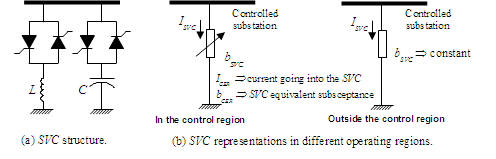
<body><![CDATA[<p style="text-indent: 0cm; margin-top: 0.04cm;" lang="en-US"> <font face="Verdana" size="2">In this section, it is described the steady state mathematical model of the <i>SVC</i> device, such as described in <a href="#f1">Fig. 1</a>.</font></p>       <p style="margin-bottom: 0.11cm;" lang="es-ES"><font face="Verdana" size="2"><img style="width: 496px; height: 159px; float: left;" src="/img/revistas/cleiej/v14n1/1a06f1.gif" hspace="12">    <br>       <br>   </font>   </p>       <p style="margin-bottom: 0.11cm;" lang="en-US"><font face="Verdana" size="2">    <br>       <br>   </font>   </p>       <p style="margin-bottom: 0.11cm;" lang="en-US"><font face="Verdana" size="2">    <br>       <br>   </font>   </p>       ]]></body>
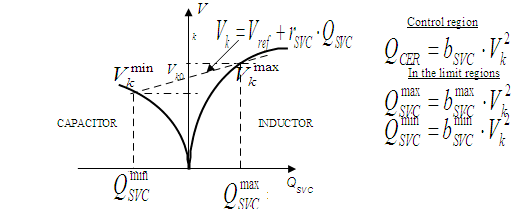
<body><![CDATA[<p style="margin-bottom: 0.11cm;" lang="en-US"><font face="Verdana" size="2">    <br>       <br>   </font>   </p>   <font face="Verdana">   <font size="2"><b><a name="f1"></a>Figure 1.</b> <i>Steady State</i> model of the </font>  <font size="2" style="font-size: 9pt"><i>Static Var Compensator</i></font><font size="2">. </font> </font>     <p style="text-indent: 0cm; margin-top: 0.04cm; margin-bottom: 0.11cm; page-break-before: always;" lang="en-US">  <font face="Verdana" size="2">According <a href="#f1">Fig. 1</a> (a), the compensator is composed by switching reactor <i>L</i> and capacitor <i>C</i> banks, controlled by thyristors <a href="#c2">[2]</a>, and they are connected in series. In <a href="#f1">Fig. 1</a> (b), a linearly susceptance represents, mathematically, the performance of the <i>SVC</i> device operating in the control region. However, the susceptance is a fixed value outside that region.</font></p>       <p style="text-indent: 0cm; margin-top: 0.04cm; margin-bottom: 0.11cm;" lang="en-US">  <font face="Verdana"><font size="2">The susceptance is associated to the reactive power injected to the system in order to maintain the voltage level between suitable limits, in the </font> <i><font size="2">controlled substation</font></i><font style="font-size: 6pt;" size="1"><i><a class="sdfootnoteanc" name="sdfootnote1anc" href="#sdfootnote1sym"><sup><font size="2">1</font></sup></a></i></font><font size="2">. <a href="#f2">Fig. 2</a> describes the mathematical expression regarding to the voltage level of the controlled substation with the reactive power injected to the system.</font></font></p>       <p style="margin-top: 0.04cm; margin-bottom: 0.11cm;" lang="es-ES"> <font face="Verdana" size="2"> <img style="width: 526px; height: 220px;" src="/img/revistas/cleiej/v14n1/1a06f2.gif" align="middle" hspace="12">    <br>       <br>   </font>   </p>       <p style="text-indent: 0cm; margin-top: 0.21cm; page-break-inside: avoid; page-break-after: avoid;" align="center" lang="en-US"> </p>  <font size="2" face="Verdana"><b>Figure 2.</b>  </font> <font size="2" style="font-size: 9pt" face="Verdana">Voltage Characteristics versus Reactive Power to be injected</font><font size="2" face="Verdana">.    <br>  </font>     ]]></body>
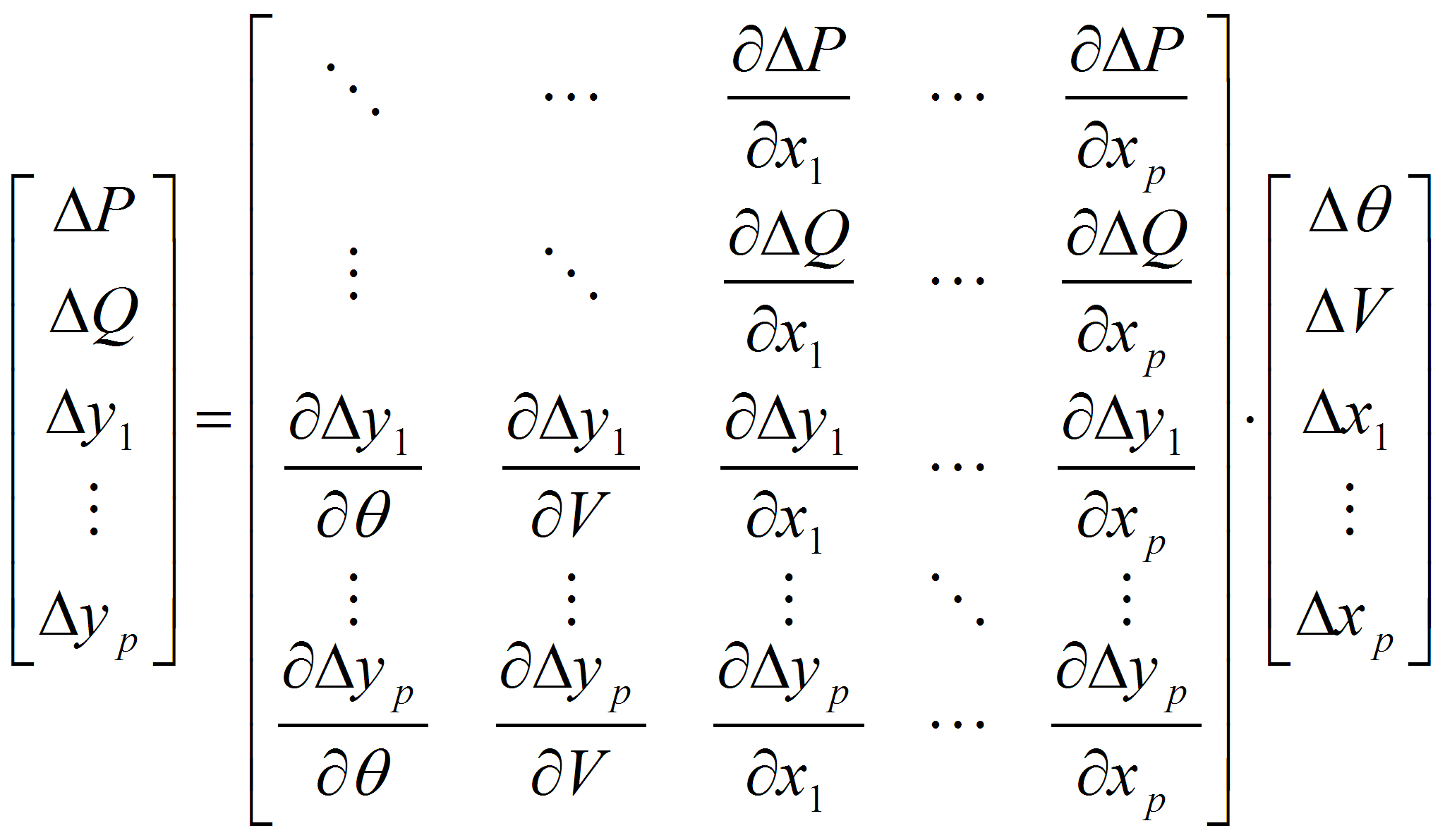
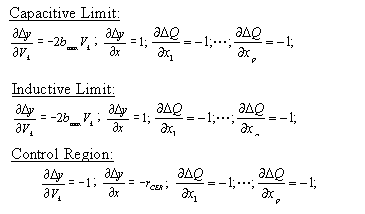
<body><![CDATA[<p style="text-indent: 0cm; margin-top: 0.04cm; margin-bottom: 0.11cm;" lang="en-US"> <font face="Verdana" size="2"><a href="#f2"> Fig. 2</a> describes the relationship between the voltage value, in the controlled substation <i>k</i>, and the reactive power, <i>Q</i><sub><i>SVC</i></sub>, injected to the system; where, <i>r</i><sub><i>SVC</i></sub> is the slope of the characteristic curve. The <i>b</i><sub><i>SVC</i></sub> varies linearly in the control region, but is a fixed value in the limit regions, because it has achieved the capacitive or inductive reactive power limit. These limits are associated to the capacity of the capacitor and reactor banks.</font></p>       <p style="text-indent: 0cm; margin-bottom: 0cm; line-height: 105%; widows: 0; orphans: 0;" lang="en-US">  <font color="#000000" face="Verdana"><span lang="en-GB"><font size="2">In order to represent each <i>SVC</i> device, operating in different regions, in the <i>Load flow</i> algorithm, based on the <i>Newton-Raphson</i> method, the corresponding <i>Jacobian</i> matrix is modified. Then, in the <i>Jacobian</i> matrix, the <i>SVC</i></font></span><font size="2"><span lang="en-GB"> entries as a control function where the variable parameter is&nbsp;&Delta;</span></font></font><font face="Times New Roman, serif"><font size="2"><font face="Verdana"><i>x</i></font><sub><font face="Verdana"><i>i</i></font></sub><font face="Verdana"> = <i>Q</i></font><sub><font face="Verdana"><i>i,SVC</i></font></sub></font><font size="2" face="Verdana"> <a href="#c11">[11]</a><a name="c11."></a>, and <i>i</i> in {1, 2, &hellip;, <i>p</i>} | <i>p</i> is the number of compensators considered in the group, as indicated in equation (1).</font></font></p>       <p style="text-indent: 0.42cm; margin-bottom: 0cm; line-height: 105%; widows: 0; orphans: 0;" lang="en-GB">  <font face="Verdana" size="2">     <br>   </font>   </p>       <p style="text-indent: 0cm; margin-bottom: 0cm; line-height: 105%; widows: 0; orphans: 0;" align="right" lang="en-US">  <font size="2" color="#000000" face="Verdana"><img style="width: 270px; height: 156px;" src="/img/revistas/cleiej/v14n1/1a06f3.gif" name="Objeto3" align="middle"></font><font color="#000000" face="Verdana" size="2"><span lang="en-GB"> </span><img style="width: 270px; height: 156px;" src="/img/revistas/cleiej/v14n1/1a06f4.gif" name="Objeto3" align="middle"></font><font color="#000000" face="Verdana"><span lang="en-GB"><font size="2">(1)</font></span></font></p>   <font face="Verdana" size="2">       <br>   </font>       <p style="text-indent: 0cm; line-height: 105%; widows: 0; orphans: 0;" lang="en-US"> <font color="#000000" face="Verdana"><span lang="en-GB"><font size="2">The components of the <i>Jacobian</i> matrix, associated to the <i>SVC</i> group, set to different numerical values according to the operating condition, such as indicated in equation (1). All components, regarding to the <i>SVC</i></font></span><font size="2"><span lang="en-GB"> control function with the angle and the active power with&nbsp;</span></font></font><font color="#000000" face="Verdana" size="2"><span lang="en-GB">&Delta;</span></font><font face="Times New Roman, serif"><font size="2"><font face="Verdana"><i>x</i></font><sub><font face="Verdana"><i>i</i></font></sub></font><font size="2" face="Verdana">, are equal to zero.</font></font></p>       <p style="text-indent: 0cm; margin-top: 0.64cm; margin-bottom: 0.35cm; page-break-inside: avoid; page-break-before: always; page-break-after: avoid;" lang="en-US">  <font size="2" face="Verdana"><b>3 Proposed Tuning Procedure</b></font></p>       <p style="text-indent: 0cm; line-height: 105%; widows: 0; orphans: 0;" lang="en-US">  <font color="#000000" face="Verdana"><span lang="en-GB"><font size="2">The coordinated tuning of parameters of a <i>SVC</i> group was considered as a <i>MOP</i></font></span><font size="2"><span lang="en-GB"> with three objective functions to be minimized</span></font></font><font size="2" face="Verdana">, such as indicated in equation (2):</font></p>       <p style="margin-left: 2.5cm; text-indent: 0cm; line-height: 105%; widows: 0; orphans: 0;" lang="en-US">  <font face="Verdana" size="2"><font color="#000000">Minimize </font><img style="width: 179px; height: 25px;" src="/img/revistas/cleiej/v14n1/1a06f6.gif" name="Objeto4" align="middle"></font></p>       ]]></body>
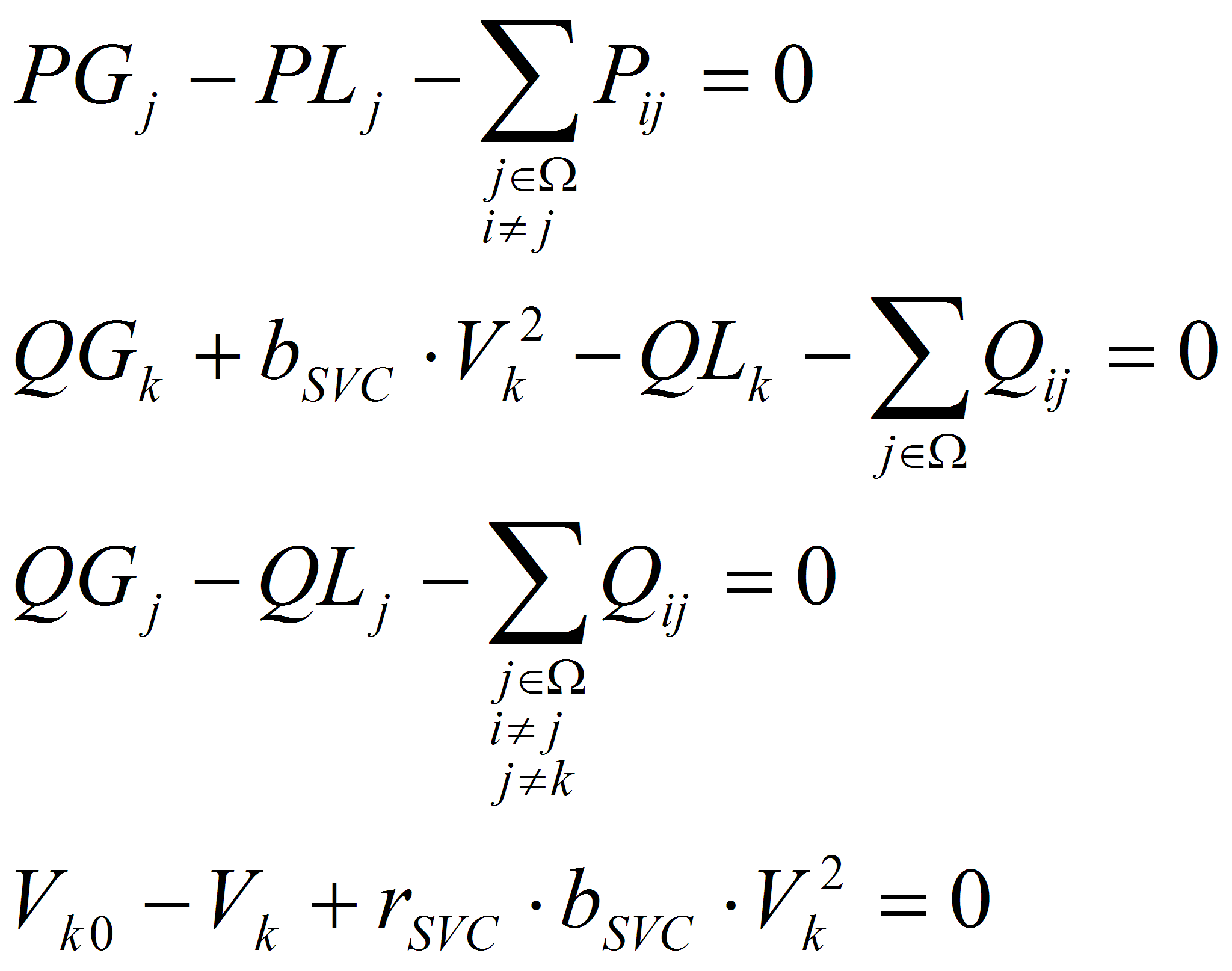
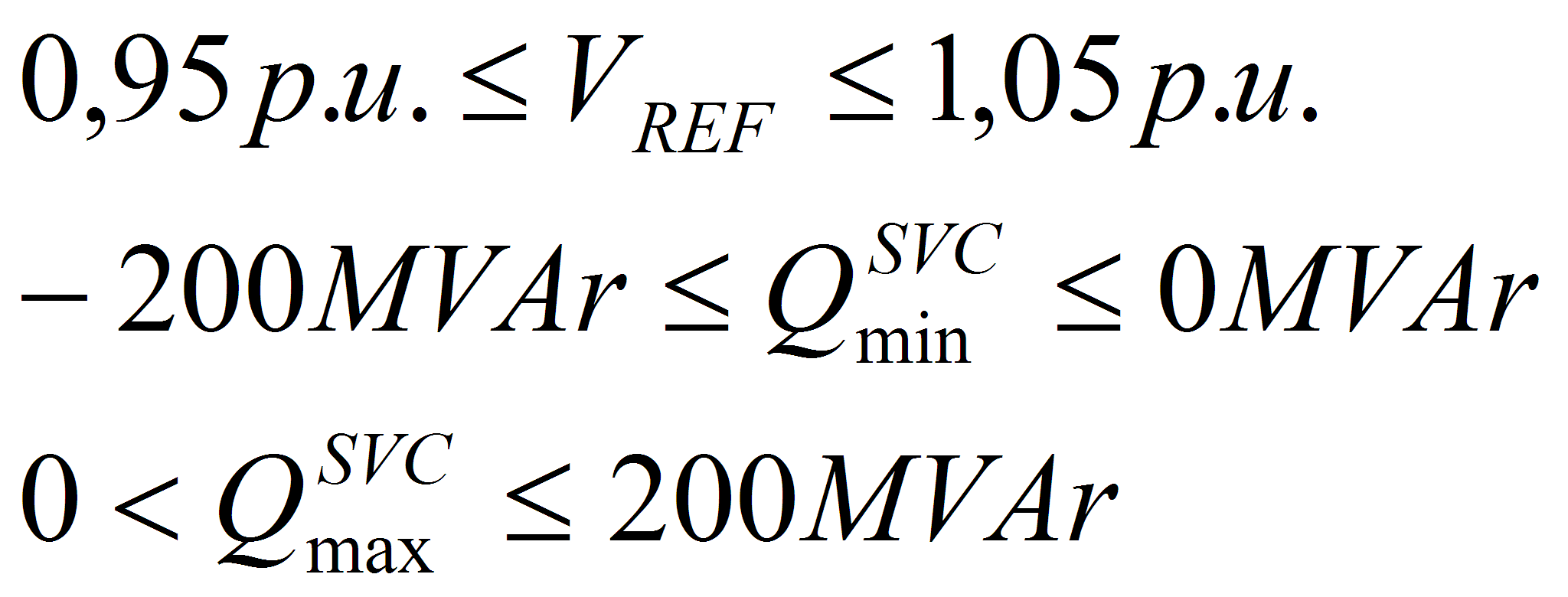
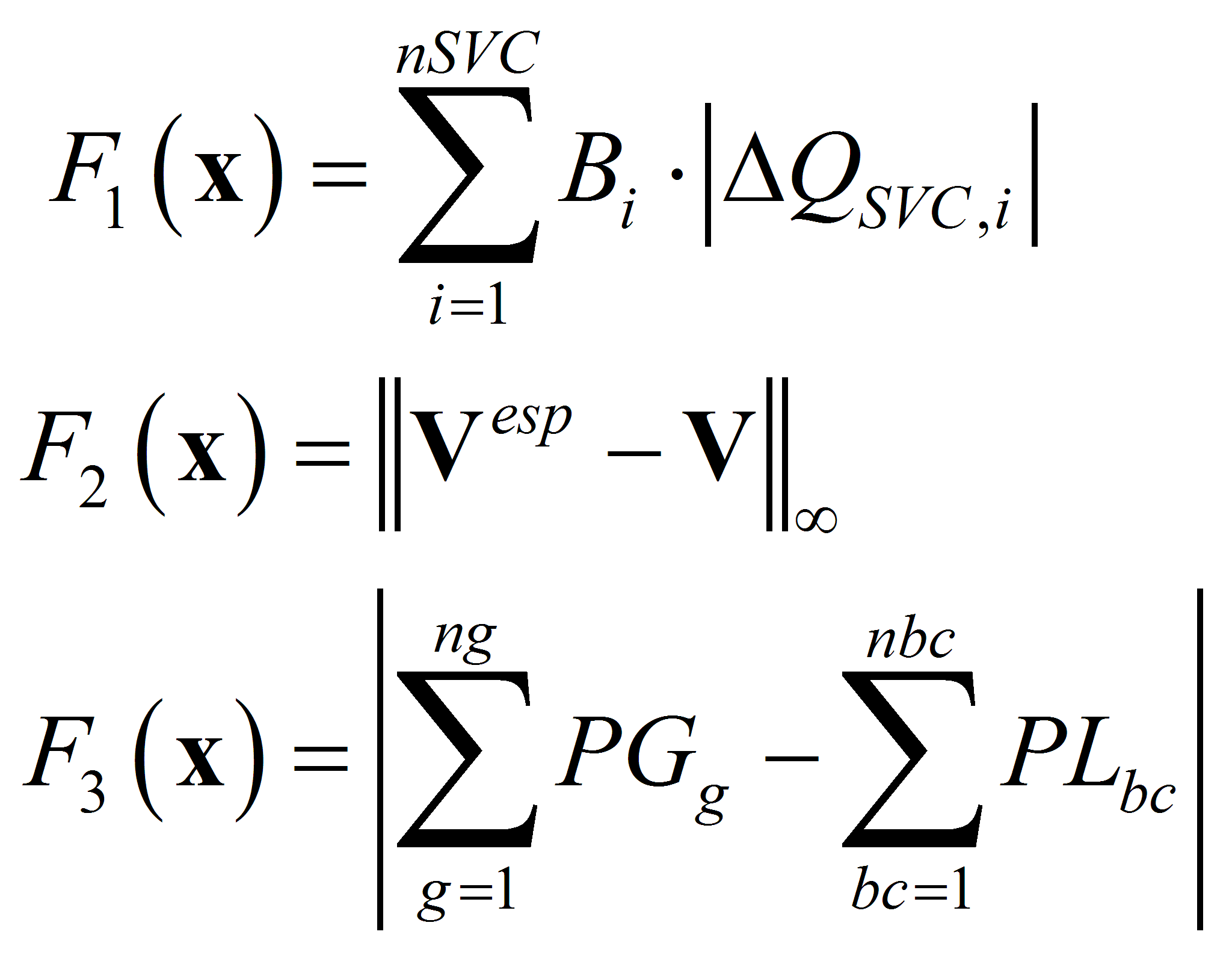
<body><![CDATA[<p style="margin-left: 2.5cm; text-indent: 0cm; line-height: 105%; widows: 0; orphans: 0;" lang="en-US">  <font face="Verdana" size="2">subject to the following restrictions:</font></p>       <p style="margin-left: 2.5cm; text-indent: 0cm; line-height: 105%; widows: 0; orphans: 0;" align="right" lang="en-US">  <font face="Verdana" size="2"> <img style="width: 227px; height: 179px;" src="/img/revistas/cleiej/v14n1/1a06f7.gif" name="Objeto5" align="middle"> (2)</font></p>       <p style="text-indent: 0cm; line-height: 105%; widows: 0; orphans: 0;" lang="en-US">  <font face="Verdana" size="2">where <i>P</i><sub><i>Gi</i></sub>, <i>Q</i><sub><i>Gi</i></sub>, <i>P</i><sub><i>Li</i></sub>, <i>Q</i><sub><i>Li</i></sub> correspond to the active and reactive power generated and demanded in the substation <i>i</i>, such <i>i</i> &isin; {1, 2, &hellip;, <i>nsubs</i>} | <i>nsubs</i> is the number of substations of the <i>PES</i>. The index <i>k</i> identifies the <i>controlled substation</i>; so, <i>V</i><sub><i>k</i>0</sub> corresponds to the reference voltage of the <i>AVR</i> associated to the compensators installed in substation <i>k</i>. In addition, there are restrictions which limit the active and reactive power generation, in those substations where are installed a group of generator machines: <i>PG</i><sub>min,<i>i</i></sub> &le; <i>PG</i><sub><i>i</i></sub> &le; <i>PG</i><sub>max,<i>i</i></sub> , <i>QG</i><sub>min,<i>i</i></sub> &le; <i>QG</i><sub><i>i</i></sub> &le; <i>QG</i><sub>max,<i>I</i></sub>; and restrictions which limit the voltage level in substations regarding to load zones: <i>V</i><sub>min,<i>j</i></sub> &le; <i>V</i><sub><i>j</i></sub> &le; <i>V</i><sub>max,<i>j</i></sub>| <i>j</i> &le; {1, 2, &hellip;, <i>nbL</i>} | <i>nbL</i> is the number of load centers in the <i>PES</i>.</font></p>       <p style="text-indent: 0cm; margin-top: 0.42cm; margin-bottom: 0.35cm; page-break-inside: avoid; page-break-after: avoid;" lang="en-US">  <font face="Verdana" size="2"> <b>3.1 Decision Variables</b></font></p>       <p style="text-indent: 0cm; margin-top: 0.04cm; margin-bottom: 0.11cm;" lang="en-US">  <font face="Verdana" size="2">The <i>GA</i> handles the vector of parameters (decision variables) such as shown in equation (3), and it was used the float point codification for representing each of them <a href="#c12">[12]</a><a name="c12."></a>:</font></p>       <p style="margin-top: 0.04cm; margin-bottom: 0.11cm;" align="right" lang="en-US">  <font color="#000000" face="Verdana" size="2"><img style="width: 258px; height: 24px;" src="/img/revistas/cleiej/v14n1/1a06f8.gif" name="Objeto6" align="middle"> (3)</font></p>       <p style="text-indent: 0cm; margin-top: 0.04cm; margin-bottom: 0.11cm;" lang="en-US">  <font color="#000000" face="Verdana" size="2">Such as described before, the parameters to be optimized for each <i>SVC</i> device are: a) the reference voltage, <i>V</i><sub><i>REF</i></sub> (where, <i>V</i><sub><i>REF</i></sub> = <i>V</i><sub><i>k</i>0</sub>), of the <i>AVR</i> associated, b) the minimum reactive power to be injected, <i>Q</i><sub>min</sub>, and, c) the maximum reactive power to be injected by each <i>SVC</i> device, <i>Q</i><sub>max</sub>. Each parameter value belongs to the following search space:</font></p>       <p style="text-indent: 0cm; margin-top: 0.04cm; margin-bottom: 0.11cm;" align="right" lang="en-US">  <font color="#000000" face="Verdana" size="2"><img style="width: 196px; height: 75px;" src="/img/revistas/cleiej/v14n1/1a06f9.gif" name="Objeto7" align="middle"> (4)</font></p>       <p style="text-indent: 0cm; margin-top: 0.42cm; margin-bottom: 0.35cm; page-break-inside: avoid; page-break-after: avoid;" lang="en-US">  <font face="Verdana" size="2"> <b>3.2 Objective Functions</b></font></p>       <p style="text-indent: 0cm; margin-top: 0.04cm; margin-bottom: 0.11cm;" lang="en-US">  <font face="Verdana" size="2">In the <i>MOP</i>, for coordinated tuning of a group of <i>SVC</i>, there are three objective functions to be minimized: a) the <i>Financial Investment</i>, <i>F</i><sub>1</sub>(<b>x</b>), for acquiring the set of compensators, b) the <i>Maximum Voltage Deviation</i>, <i>F</i><sub>2</sub>(<b>x</b>), and, c) the <i>Maximum Total Active Power Loss</i>, <i>F</i><sub>3</sub>(<b>x</b>), calculated by considering all selected critical operating scenarios.</font></p>       ]]></body>
<body><![CDATA[<p style="text-indent: 0cm; margin-top: 0.04cm; margin-bottom: 0.11cm; page-break-before: always;" align="right" lang="en-US">  <font face="Verdana" size="2"> <img style="width: 157px; height: 123px;" src="/img/revistas/cleiej/v14n1/1a06f10.gif" name="Objeto8" align="middle"> (4)</font></p>       <p style="text-indent: 0cm; margin-top: 0.04cm; margin-bottom: 0.11cm;" lang="en-US">  <font face="Verdana" size="2">In equation (4), <i>F</i><sub>1</sub>(<b>x</b>) is directly proportional to the compensation capacity of each <i>SVC</i>, where <i>B</i><sub><i>i</i></sub> is the monetary value for each <i>MVAr</i> of the <i>i</i>-<i>th</i> compensator; and, <i>n</i><sub><i>SVC</i></sub> indicates the number of compensators to be adjusted in the <i>PES</i>. In this work, each <i>B</i><sub><i>i</i></sub> = 1.0 monetary/<i>MVAr</i>. In addition, <i>ng</i> and <i>nbL</i> correspond to the number of substations with a group of installed generators and substations associated to the load zones, respectively.</font></p>       <p style="text-indent: 0cm; margin-top: 0.42cm; margin-bottom: 0.35cm; page-break-inside: avoid; page-break-after: avoid;" lang="en-US">  <font face="Verdana" size="2"> <b>3.3 <i>GA</i> Adapted for <i>MOP</i></b></font></p>       <p style="text-indent: 0cm; margin-top: 0.04cm; margin-bottom: 0.11cm;" lang="en-US">  <font face="Verdana" size="2">In this subsection will be described the two proposed algorithms, based on <i>GA</i>, adapted for <i>MOP</i> and applied for optimal coordinated tuning of parameters belonging to the group of compensators.</font></p>       <p style="text-indent: 0cm; margin-top: 0.42cm; margin-bottom: 0.35cm; page-break-inside: avoid; page-break-after: avoid;" lang="en-US">  <font face="Verdana" size="2"> <i><span style="font-weight: normal;">3.3.1 MOGA based on Pareto Rules</span></i></font></p>       <p style="text-indent: 0cm; margin-top: 0.04cm; margin-bottom: 0.11cm;" lang="en-US">  <font face="Verdana" size="2">Considering the coordinated tuning problem of compensator parameters of a group, the <i>Dominance Pareto Rules</i> are described through the following mathematical expressions <a href="#c9">[9]</a>:</font></p>   <ol type="i">         <li>              <p style="text-indent: 0cm; margin-bottom: 0cm; line-height: 105%; widows: 0; orphans: 0;" lang="en-US">      <font face="Verdana" size="2"><font color="#000000"><span lang="en-GB"><i>F</i></span><sub><span lang="en-GB"><i>k</i></span></sub><span lang="en-GB">(<b>x</b></span><sub><span lang="en-GB"><i>r</i></span></sub><span lang="en-GB">) </span></font>&le;<font color="#000000"><span lang="en-GB"> <i>F</i></span><sub><span lang="en-GB"><i>k</i></span></sub><span lang="en-GB">(<b>x</b></span><sub><span lang="en-GB"><i>s</i></span></sub><span lang="en-GB">), where <i>r</i> and <i>s</i> </span>&isin;<span lang="en-GB"> (1, 2, &hellip;, <i>N</i>) | <i>r</i> </span></font>&ne;     <i>s</i> and <font color="#000000"><span lang="en-GB"><i>N</i> indicates the population size in the <i>GA</i>, and </span></font><i>k</i> &isin; {1, 2, &hellip;, <i>f</i>}, such <i>f</i> corresponds to the number of objective functions considered in the optimization procedure<font color="#000000"><span lang="en-GB">;</span></font></font></p>     </li>         <li>              <p style="text-indent: 0cm; margin-bottom: 0cm; line-height: 105%; widows: 0; orphans: 0;" lang="en-US">      <font face="Verdana" size="2"> <font color="#000000">&#61476; </font>&exist;<font color="#000000"><span lang="en-GB"><i>i</i>, such that, at least one of the entries satisfies <i>F</i></span><sub><span lang="en-GB"><i>i</i></span></sub><span lang="en-GB">(<b>x</b></span><sub><span lang="en-GB"><i>j</i></span></sub><span lang="en-GB">) &lt; <i>F</i></span><sub><span lang="en-GB"><i>i</i></span></sub><span lang="en-GB">(<b>x</b></span><sub><span lang="en-GB"><i>k</i></span></sub><span lang="en-GB">).</span></font></font></p>     </li>       ]]></body>
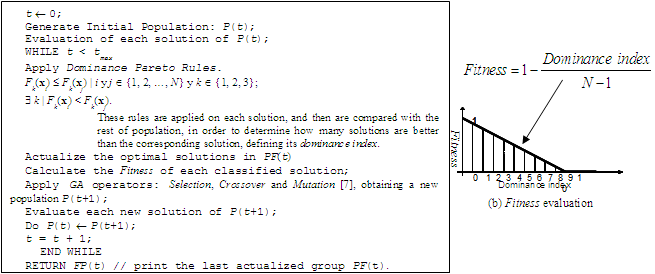
<body><![CDATA[</ol>       <p style="text-indent: 0cm; margin-top: 0.11cm; margin-bottom: 0.11cm;" lang="en-US">  <font face="Verdana" size="2"> <span lang="en-GB">The <i>Pareto Rules</i> are applied on each solution of the <i>GA</i> population, in order to determine how many numbers of solutions are better than other one. This number defines the <i>Dominance index</i> for each feasible solution. The individual (solution), which <i>Dominance index</i> is null, is considered as an optimal solution. This classification method is made in each generation of the <i>GA</i>. Then, in each generation all optimal solutions obtained by the <i>Pareto Rules</i> are saved in a group, called the <i>Pareto Front</i> (<i>PF</i>); and, it is also actualized in each generation.</span></font></p>       <p style="text-indent: 0cm; margin-top: 0.11cm; margin-bottom: 0.11cm;" lang="en-US">  <font face="Verdana" size="2"> <span lang="en-GB">In Fig. 3 is shown a pseudocode of the <i>GA</i> adapted for <i>MOP</i> by using the <i>Dominance Pareto Rules</i>.</span></font></p>       <p style="text-indent: 0cm; margin-bottom: 0cm;" lang="es-ES"> <font face="Verdana" size="2"><img style="width: 655px; height: 274px;" src="/img/revistas/cleiej/v14n1/1a06f11.gif" align="middle" hspace="12">    <br>   </font>   </p>  <font size="2" face="Verdana"><b>Figure 3.</b>  </font> <font size="2" style="font-size: 9pt" face="Verdana"><i>Pseudocode of the MOGA based on Dominance Pareto Rules</i></font><font size="2" face="Verdana">.    <br>  </font>     <p style="text-indent: 0cm; margin-top: 0.11cm; margin-bottom: 0.11cm; page-break-before: always;" lang="en-US">  <font face="Verdana" size="2">All optimal solutions, which are obtained by applying the <i>Dominance Pareto </i>rules, are reproduced, in each generation, inside the <i>PF</i>(<i>t</i>) | <i>t</i> is an iteration counter. The <i>PF</i>(<i>t</i>) is actualized in each generation. In the mathematical expression, the <i>Fitness</i> calculation is directly associated to the <i>Dominance index</i> of the individual, such as indicated in Fig. 3 (b). The <i>GA</i> adapted for <i>MOP</i> using the <i>Dominance Pareto Rules</i> is called as <i>GADP</i>.</font></p>       <p style="text-indent: 0cm; margin-top: 0.42cm; page-break-inside: avoid; page-break-after: avoid;" lang="en-US">  <font face="Verdana" size="2"> <i><span style="font-weight: normal;">3.3.2 MOGA based on Weighted Sum Method</span></i></font></p>       <p style="text-indent: 0cm; margin-bottom: 0cm;" lang="en-US"> <font face="Verdana" size="2">In this case, the <i>GA</i> such as described in <a href="#c8">[8]</a> was adapted for <i>MOP</i> according to equation (5):</font></p>       <p style="margin-top: 0.07cm; margin-bottom: 0cm;" align="right" lang="en-US">  <font face="Verdana" size="2"> <img style="width: 270px; height: 22px;" src="/img/revistas/cleiej/v14n1/1a06f12.gif" name="Objeto9" align="middle"> (5)</font></p>       ]]></body>
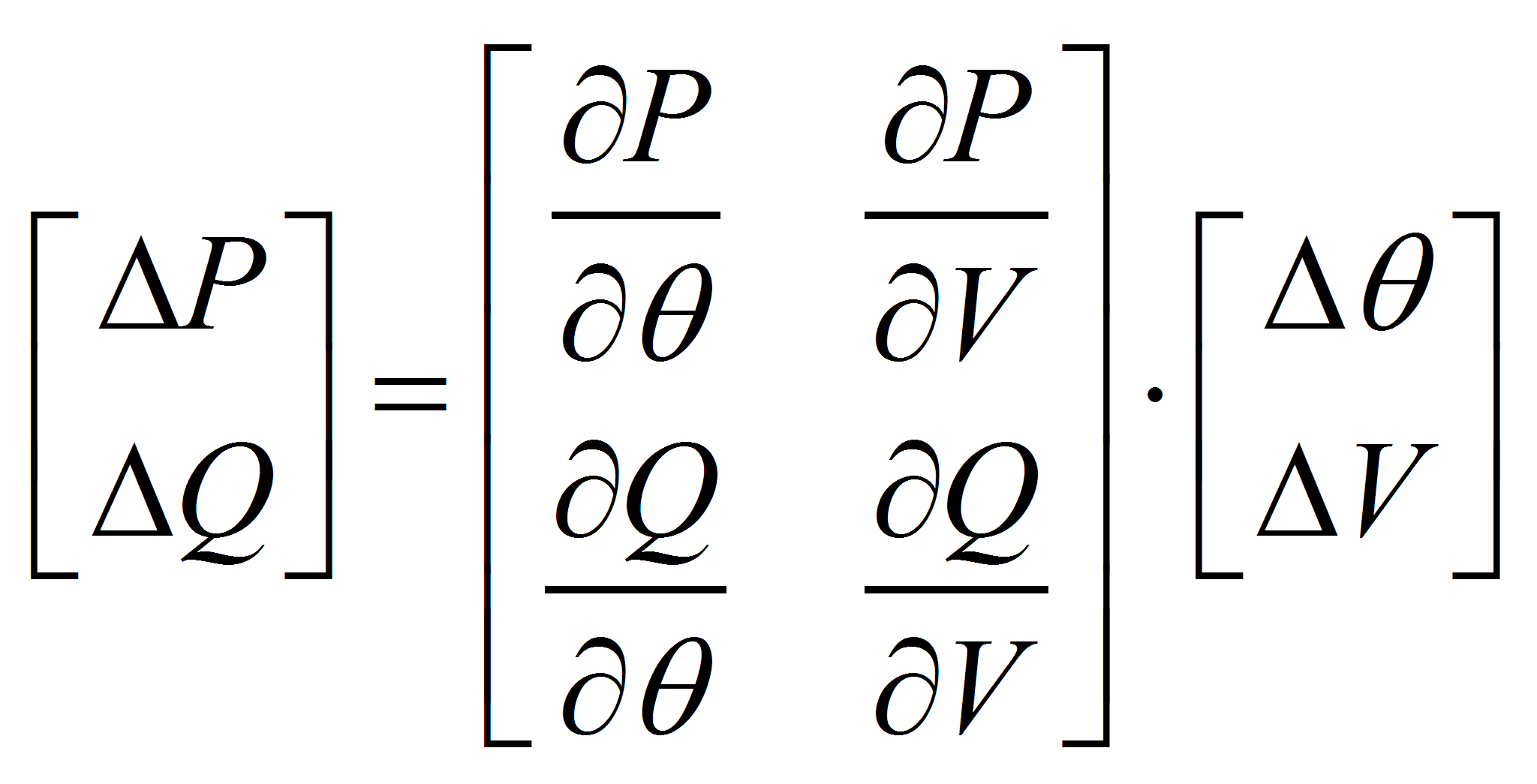
<body><![CDATA[<p style="text-indent: 0cm; margin-top: 0.11cm; margin-bottom: 0.11cm;" lang="en-US">  <font face="Verdana" size="2">The coefficients of equation (5) correspond to the normalization factors, where <i>a</i><sub><i>q</i></sub> = <i>c</i><sub><i>q</i></sub> / <i>F</i><sup><i>max</i></sup><sub><i>q</i></sub> and <i>q</i> &isin; {1, 2, 3}. <i>F</i><sup><i>max</i></sup><sub><i>q</i></sub> is the maximum value of the <i>q-th</i> objective function, and the coefficient <i>c</i><sub><i>q</i></sub> is any value such that <i>c</i><sub><i>q</i></sub> &ge; 1, this methodology avoids certain objective functions dominate over the rests <a href="#c9">[9]</a>, carrying to a local optimum <a href="#c9">[9]</a>.</font></p>       <p style="text-indent: 0cm; margin-top: 0.42cm; margin-bottom: 0.35cm; page-break-inside: avoid; page-break-after: avoid;" lang="en-US">  <font face="Verdana" size="2"> <b>3.4 Initial Population</b></font></p>       <p style="text-indent: 0cm; margin-top: 0.11cm; margin-bottom: 0.11cm;" lang="en-US">  <font face="Verdana" size="2">In this work, <i>N</i> &ndash; <i>D</i> feasible individuals are generated randomly, where <i>N</i> = 50 individuals. The remaining <i>D</i> individuals are estimated through equation (6), varying the reference voltage, <i>V</i><sub><i>REF,i</i></sub>, and then is calculated the necessary reactive power to be injected into the system, in the corresponding <i>i-th</i> <i>controlled substation</i>, which also defines the initial reactive compensation capacity of the <i>i-th</i> <i>SVC</i> device.</font></p>       <p style="text-indent: 0cm; margin-bottom: 0cm;" align="right" lang="en-US">  <font face="Verdana" size="2"> <img style="width: 134px; height: 68px;" src="/img/revistas/cleiej/v14n1/1a06f13.gif" name="Objeto10" align="middle">, &rArr;<img style="width: 230px; height: 45px;" src="/img/revistas/cleiej/v14n1/1a06f14.gif" name="Objeto11" align="middle"> (6)</font></p>       <p style="text-indent: 0cm; margin-top: 0.11cm; margin-bottom: 0.11cm;" lang="en-US">  <font face="Verdana" size="2">The equation (6) describes the <i>Q&ndash;V</i> sensitivity curve, obtained by the matrix equation of the active and reactive power deviation of the <i>Load Flow</i> algorithm <a href="#c2">[2]</a>. Each compensator is located in a substation, associated to the load zone, where is required a high reactive power value in order to maintain the associated voltage module in 1 p.u. So, this methodology also defines the <i>i-th</i> <i>controlled substation</i>.</font></p>       <p style="text-indent: 0cm; margin-top: 0.42cm; margin-bottom: 0.35cm; page-break-inside: avoid; page-break-after: avoid;" lang="en-US">  <font face="Verdana" size="2"> <b>3.5 <i>GA</i> Operators</b></font></p>       <p style="text-indent: 0cm; margin-bottom: 0cm; line-height: 105%; widows: 0; orphans: 0; text-align: left;" lang="en-US">  <font color="#000000" face="Verdana" size="2">A Stochastic Tournament <i>Selection</i>, with five individuals, was used in order to choose the probabilistic better solution for next generation. Then, it was utilized an <i>Arithmetic Crossover</i> <a href="#c12">[12]</a>, with probability <i>p</i><sub><i>c</i></sub> = </font> <font style="font-size: 10pt;" size="2" face="Verdana" color="#000000">0,7</font><font color="#000000" face="Verdana" size="2">, and <i>Mutation</i> operator, with a constant probability <i>p</i><sub><i>m</i></sub> = </font> <font face="Verdana" color="#000000"><font style="font-size: 10pt;" size="2">0,01</font><font size="2">, for getting new individuals.</font></font></p>       <p style="text-indent: 0cm; margin-top: 0.42cm; margin-bottom: 0.32cm; page-break-inside: avoid; page-break-after: avoid;" lang="en-US">  <font size="2" face="Verdana"><b>4 Experimental Results</b></font></p>       <p style="text-indent: 0cm; margin-top: 0.42cm; margin-bottom: 0.35cm; page-break-inside: avoid; page-break-after: avoid;" lang="en-US">  <font face="Verdana" size="2"> <b>4.1 Characteristics of Power System Test</b></font></p>       <p style="text-indent: 0cm; margin-bottom: 0cm; line-height: 105%; widows: 0; orphans: 0;" lang="en-US">  <font color="#000000" face="Verdana" size="2">The implemented coordinated tuning algorithms are applied on IEEE14 system <a href="#c10">[10]</a>, show in <a href="#f4">Fig. 4</a>.</font></p>       ]]></body>
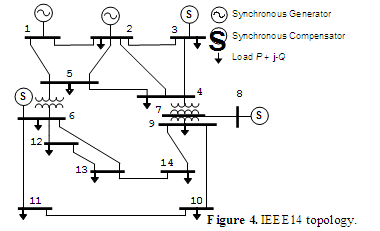
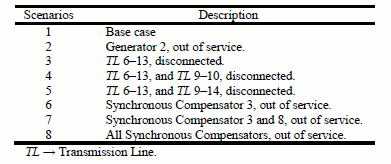
<body><![CDATA[<p style="text-indent: 0cm; margin-bottom: 0cm; line-height: 105%; widows: 0; orphans: 0;" lang="es-ES">  <font face="Verdana" size="2"> <img style="width: 380px; height: 231px;" src="/img/revistas/cleiej/v14n1/1a06f15.gif" align="middle" hspace="12">    <br>   </font>   </p>       <p style="text-indent: 0cm; margin-bottom: 0cm; line-height: 105%; widows: 0; orphans: 0;" lang="en-US"> <font style="font-size: 10pt;" size="2" face="Verdana"><b><a name="f4"></a>Figure 4.</b> IEEE 14 topology</font></p>       <p style="text-indent: 0cm; margin-bottom: 0cm; line-height: 105%; widows: 0; orphans: 0;" lang="en-US"></p>       <p style="text-indent: 0cm; margin-bottom: 0cm; line-height: 105%; widows: 0; orphans: 0;" lang="">  <font face="Verdana" size="2"> <a name="t1"></a></font><span id="Marco3" style="border: medium none ; padding: 0cm; background: rgb(255, 255, 255) none repeat scroll 0% 50%; -moz-background-clip: initial; -moz-background-origin: initial; -moz-background-inline-policy: initial; float: left; width: 8.84cm;" dir="ltr">     <p style="text-indent: 0cm; margin-top: 0.21cm; page-break-inside: avoid; page-break-after: avoid;" align="center" lang="de-DE">  <font style="font-size: 10pt;" size="2" face="Verdana"><span lang="en-US"><b>Table 1.</b> Operating Conditions considered on IEEE14 system.</span></font></p>       <p style="text-indent: 0cm; margin-top: 0.21cm; page-break-inside: avoid; page-break-after: avoid;" align="center" lang="de-DE">  <font face="Verdana" style="font-size: 10pt" size="2"><span lang="en-US"><b>    <br>   </b></span></font></p>   </span></p>   <font face="Verdana" size="2">       <br>  <img style="width: 391px; height: 164px;" src="/img/revistas/cleiej/v14n1/1a06t1.gif" align="middle"> </font>     <p style="text-indent: 0cm; margin-bottom: 0cm; line-height: 105%; widows: 0; orphans: 0; page-break-before: always;" lang="en-US"> <font color="#000000" face="Verdana" size="2">In this paper, the coordinated tuning methodology adjusts two compensators. The <i>Q&ndash;V</i> sensitivity curve, which procedure was described in subsection 3.4, determined the load buses 13 and 14 for installing each <i>SVC</i>.</font></p>       ]]></body>
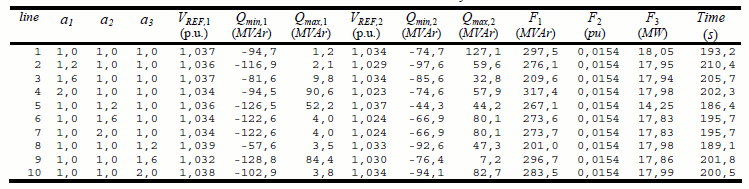
<body><![CDATA[<p style="text-indent: 0cm; margin-top: 0.42cm; page-break-inside: avoid; page-break-after: avoid;" lang="en-US">  <font face="Verdana" size="2"> <b>4.2 Computational Environment</b></font></p>       <p style="text-indent: 0cm; margin-bottom: 0cm; line-height: 105%; widows: 0; orphans: 0;" lang="en-US">  <font size="2" color="#000000" face="Verdana">The <i>MatLab</i></font><font color="#000000" face="Times New Roman, serif" size="2"><sup><font face="Verdana">&#61650;</font></sup></font><font size="2" color="#000000" face="Verdana"> <a href="#c13">[13]</a><a name="c13."></a> was used for <i>Load Flow</i> implementation and <i>GA</i> adaptation for <i>MOP.</i> The <i>Power System Analysis Toolbox</i> (<i>PSAT</i>) <a href="#c14">[14]</a><a name="c14."></a> was used to evaluate the dynamic perform of each <i>SVC</i>.</font></p>       <p style="text-indent: 0cm; margin-top: 0.42cm; page-break-inside: avoid; page-break-after: avoid;" lang="en-US">  <font face="Verdana" size="2"> <b>4.3 Analysis of Numerical Results</b></font></p>       <p style="text-indent: 0cm; margin-bottom: 0cm; line-height: 105%; widows: 0; orphans: 0;" lang="en-US">  <font face="Verdana" size="2"><font color="#000000">The <i>GA</i>, based on </font><i>Weighted Sum</i> methodology (<i>GAWS</i>), was executed 5 times for each different <i>Fitness</i>. The different mathematical expressions for <i>Fitness</i> were obtained by modification of each coefficient, such as described in equation (5). In <a href="#t2">Table 2</a> are shown the different values considered for each coefficient, the best numerical result obtained by each <i>GAWS</i> execution, and the average computational time spent in each running.</font></p>       <p style="text-indent: 0cm; margin-top: 0.21cm; margin-bottom: 0.11cm; page-break-inside: avoid; page-break-after: avoid; text-align: left;" lang="de-DE">  <font style="font-size: 10pt;" size="2" face="Verdana"><span lang="en-US"><b><a name="t2"></a>Table 2.</b> Numerical results obtained by <i>GAWS</i>.</span></font></p>       <p style="text-indent: 0cm; margin-top: 0.21cm; margin-bottom: 0.11cm; page-break-inside: avoid; page-break-after: avoid;" align="center" lang="de-DE"> <font face="Verdana" size="2"><img src="/img/revistas/cleiej/v14n1/1a06t2.gif"></font></p>       <center><font face="Verdana" size="2">    <br>   </font>   </center>       <p style="text-indent: 0cm; margin-top: 0.21cm; margin-bottom: 0cm; line-height: 105%; widows: 0; orphans: 0;" lang="en-US">  <font color="#000000" face="Verdana" size="2">In <a href="#t3">Table 3</a> are shown the numerical results of <i>GA</i>, based on <i>Pareto Dominance</i> rules (<i>GAPD</i>).</font></p>       <p style="text-indent: 0cm; margin-top: 0.21cm; margin-bottom: 0.11cm; page-break-inside: avoid; page-break-after: avoid;" align="center" lang="de-DE">  <font style="font-size: 10pt;" size="2" face="Verdana"><span lang="en-US"><b><a name="t3"></a>Table 3.</b> <i>Pareto Front</i> of the <i>GAPD</i> algorithm, obtained in one execution.</span></font></p>       ]]></body>
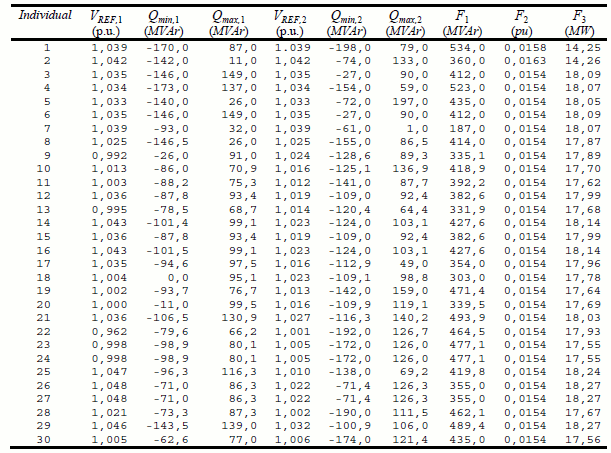
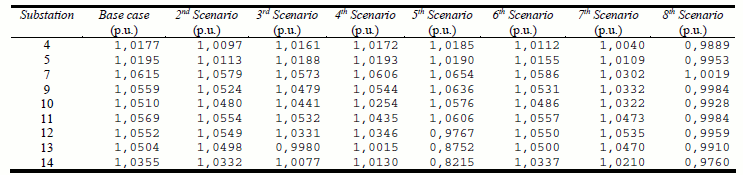
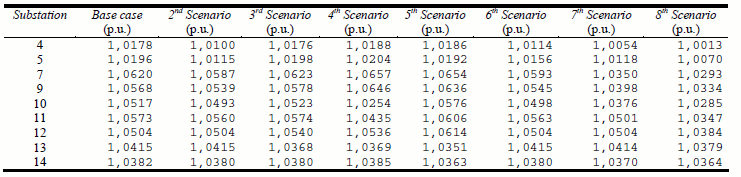
<body><![CDATA[<p style="text-indent: 0cm; margin-top: 0.21cm; margin-bottom: 0.11cm; page-break-inside: avoid; page-break-after: avoid;" align="center" lang="de-DE"> <font style="font-size: 10pt;" size="2" face="Verdana"><span lang="en-US"><img src="/img/revistas/cleiej/v14n1/1a06t3.gif"></span></font></p>       <center><font face="Verdana" size="2">    <br>   </font>   </center>       <p style="text-indent: 0cm; margin-top: 0.11cm; margin-bottom: 0.11cm; line-height: 105%; widows: 0; orphans: 0; page-break-before: always;" lang="en-US">  <font color="#000000" face="Verdana" size="2">In <a href="#t2">Table 2</a> and <a href="#t3">Table 3</a>, the first <i>SVC</i> parameters correspond to the compensator installed in the 13<sup>th</sup> substation, and the second parameters belong to the compensator located in the 14<sup>th</sup> substation. Such as shown in <a href="#t2">Table 2</a>, the set of <i>SVC</i> parameters, located on the 8<sup>th</sup> <i>line</i>, corresponds to the best solution obtained by the <i>GAWS</i> algorithm. The main computational time, spent by each <i>GAWS</i> running, is approximately equals to 198 s, but, it produces a unique solution at the end of its execution.</font></p>       <p style="text-indent: 0cm; margin-top: 0.11cm; margin-bottom: 0.11cm; line-height: 105%; widows: 0; orphans: 0;" lang="en-US">  <font color="#000000" face="Verdana" size="2">In contrast, the <i>GAPD</i> got a family of optimal solutions in a single run of the algorithm, according to the results shown in <a href="#t3">Table 3</a>, and spent approximately 241 s for obtaining the solution set. The referred computational time, spent by the <i>GAPD</i> algorithm, is greater than the execution time of the <i>GAWS,</i> mainly due to the classification process of the optimal solution set, applying the <i>Pareto</i> rules, made in each generation and saved on the <i>Pareto Front</i> group. The 7<sup>th</sup> individual regards to the best solution in the <i>Pareto Front</i> of the <i>GAPD</i>. This solution is associated to the less financial investment, the identical voltage deviation and the same order of the active power loss value, comparing with the best numerical solution obtained by the <i>GAWS</i> algorithm.</font></p>       <p style="text-indent: 0cm; margin-top: 0.11cm; margin-bottom: 0.11cm; line-height: 105%; widows: 0; orphans: 0;" lang="en-US">  <font color="#000000" face="Verdana" size="2">The voltage values in the substations of the IEEE14, without any <i>SVC</i> installed and obtained by the <i>Newton&ndash;Raphson</i> <i>Load Flow</i> algorithm for each operating conditions described in subsection 4.1, are shown in Table 4.</font></p>       <p style="text-indent: 0cm; margin-top: 0.21cm; margin-bottom: 0.11cm; page-break-inside: avoid; page-break-after: avoid;" align="center" lang="de-DE">  <font style="font-size: 10pt;" size="2" face="Verdana"><span lang="en-US"><b><a name="t4"></a>Table 4.</b> Voltage values in the IEEE14 system, without any <i>SVC</i> installed.</span></font></p>       <p style="text-indent: 0cm; margin-top: 0.21cm; margin-bottom: 0.11cm; page-break-inside: avoid; page-break-after: avoid;" align="center" lang="de-DE"> <font style="font-size: 10pt;" size="2" face="Verdana"><span lang="en-US"><img src="/img/revistas/cleiej/v14n1/1a06t4.gif"></span></font></p>       <center><font face="Verdana" size="2">    <br>   </font>   </center>       ]]></body>
<body><![CDATA[<p style="text-indent: 0cm; margin-top: 0.11cm; margin-bottom: 0.11cm; line-height: 105%; widows: 0; orphans: 0;" lang="en-US">  <font color="#000000" face="Verdana" size="2">The voltage module of the substations 13<sup>th</sup> and 14<sup>th</sup> are the most sensitive to any disturbance in the system, such as indicated on <a href="#t4">Table 4</a>. Therefore, the voltage drop, in the referred substations, is higher. However, the voltage values in the whole system are corrected by installing<i> SVC</i> in the substation 13<sup>th</sup> and 14<sup>th</sup>, which numerical results are illustrated in <a href="#t5">Table 5</a>. The <i>SVC</i> parameters selected are those belong to the best coordinated tuning solution obtained by the <i>GADP</i> algorithm.</font></p>       <p style="text-indent: 0cm; margin-top: 0.21cm; margin-bottom: 0.11cm; page-break-inside: avoid; page-break-after: avoid;" align="center" lang="de-DE">  <font style="font-size: 10pt;" size="2" face="Verdana"><span lang="en-US"><b><a name="t5"></a>Table 5.</b> Voltage values in the IEEE14 system, with <i>SVC</i> installed in substations 13</span><sup><span lang="en-US">th</span></sup><span lang="en-US"> and 14</span><sup><span lang="en-US">th</span></sup><span lang="en-US">.</span></font></p>       <p style="text-indent: 0cm; margin-top: 0.21cm; margin-bottom: 0.11cm; page-break-inside: avoid; page-break-after: avoid;" align="center" lang="de-DE"> <font style="font-size: 10pt;" size="2" face="Verdana"><span lang="en-US"><img src="/img/revistas/cleiej/v14n1/1a06t5.gif"></span></font></p>       <center><font face="Verdana" size="2">    <br>   </font>   </center>       <p style="text-indent: 0cm; margin-top: 0.11cm; margin-bottom: 0.11cm; line-height: 105%; widows: 0; orphans: 0;" lang="en-US">  <font color="#000000" face="Verdana" size="2">Such as illustrated on <a href="#t5">Table 5</a>, the most critical operating condition is the 5<sup>th</sup> Scenario, where the voltage modules of the whole system are successfully corrected by installing the group of compensators, which parameters were adjusted by the <i>GADP</i> algorithm.</font></p>       <p style="text-indent: 0cm; margin-top: 0.11cm; margin-bottom: 0.11cm; line-height: 105%; widows: 0; orphans: 0;" lang="en-US">  <font color="#000000" face="Verdana" size="2">An optimal coordinated tuning of the compensators, at steady state, also determines a good dynamic performance on single contingencies. The most critical operating conditions, such as the 5<sup>th</sup> and 8<sup>th</sup> scenarios, were dynamically simulated in order to validate the referred hypothesis. For that reason, a standard dynamic model of the <i>AVR</i>, associated to each <i>SVC</i> <a href="#r2">[2]</a>, was used and it is described in <a href="#f5">Fig. 5</a>.</font></p>       <p style="margin-top: 0.04cm; margin-bottom: 0.11cm; page-break-before: always;" lang="en-US">  <font face="Verdana" size="2">     <br>       <br>   </font>   </p>       ]]></body>
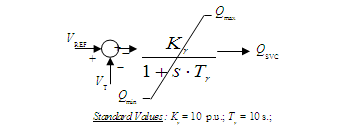
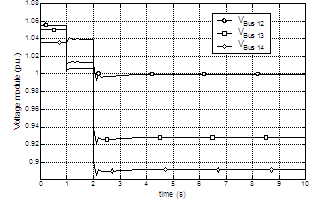
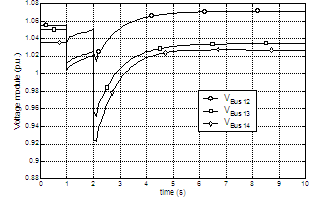
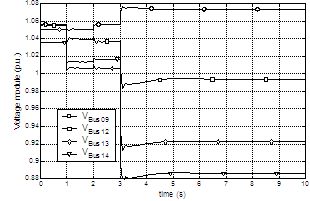
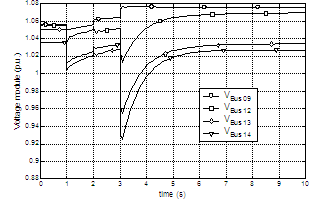
<body><![CDATA[<p style="margin-top: 0.04cm; margin-bottom: 0.11cm;" lang="es-ES"> <font face="Verdana" size="2"> <img style="width: 354px; height: 139px;" src="/img/revistas/cleiej/v14n1/1a06f16.gif" align="middle" hspace="12">    <br>   </font>   </p>  <font face="Verdana" size="2">  <b><a name="f5"></a>Figure 5.</b> Dynamic model of the <i>SVC</i> voltage regulator. </font>     <p style="margin-top: 0.21cm;" align="center" lang="en-US"></p>       <p style="text-indent: 0cm; margin-top: 0.11cm; margin-bottom: 0.11cm; line-height: 105%; widows: 0; orphans: 0;" lang="en-US">  <font color="#000000" face="Verdana" size="2">In <a href="#f5">Fig. 5</a>, the variables: <i>V</i><sub>REF</sub>, <i>Q</i><sub>min</sub> and <i>Q</i><sub>max</sub> correspond to the adjusted parameters, at steady state. The dynamic model, associated to each <i>SVC</i>, generates the necessary reactive power to be injected to the <i>PES</i> for correcting and regulating the voltage level of the whole system for any disturbance. The 5<sup>th</sup> scenario is the most critical operating condition and is simulated dynamically using the software <i>PSAT</i>, and numerical results are shown in Fig. 6; where, <i>TL</i> 6 &ndash; 13 and <i>TL</i> 9 &ndash; 14 are disconnected at 1 and 2 s, respectively, after starting the time simulation. In <a href="#f6">Fig. 6</a> (a) the simulation was made without any <i>SVC</i> installed in the system test; but the dynamic results considering the compensators adjusted and installed in substations 13<sup>th</sup> and 14<sup>th</sup> are shown in <a href="#f6">Fig. 6</a> (b).</font></p>       <p style="margin-top: 0.04cm; margin-bottom: 0.11cm;" lang="en-US"> <font face="Verdana" size="2"> <img style="border: 0px solid ; width: 310px; height: 201px; float: left;" src="/img/revistas/cleiej/v14n1/1a06f18.gif" name="gr&aacute;ficos1" hspace="12"><img style="border: 0px solid ; width: 310px; height: 201px; float: left;" name="gr&aacute;ficos2" src="/img/revistas/cleiej/v14n1/1a06f17.gif" hspace="12"> </font> </p>       <p style="margin-top: 0.04cm; margin-bottom: 0.11cm;" lang="en-US"> <font face="Verdana" size="2">     <br>       <br>   </font>   </p>       <p style="margin-top: 0.04cm; margin-bottom: 0.11cm;" lang="en-US"> <font face="Verdana" size="2">     <br>       ]]></body>
<body><![CDATA[<br>   </font>   </p>       <p style="margin-top: 0.04cm; margin-bottom: 0.11cm;" lang="en-US"> <font face="Verdana" size="2">     <br>       <br>   </font>   </p>       <p style="margin-top: 0.04cm; margin-bottom: 0.11cm;" lang="en-US"> <font face="Verdana" size="2">     <br>       <br>   </font>   </p>       <p style="margin-top: 0.04cm; margin-bottom: 0.11cm;" lang="en-US"> <font face="Verdana" size="2">     <br>       <br>   </font>   </p>     <table border="0" cellpadding="7" cellspacing="0" width="633">     <col width="302"> <col width="303"> <tbody>       <tr valign="top">         <td width="302">              <ol>               ]]></body>
<body><![CDATA[<li>                          <p style="margin-top: 0.04cm;" align="center" lang="en-US">           <font face="Verdana" size="2">(a) Simulation without any <i>SVC</i>.</font></p>           </li>                    </ol>         </td>         <td width="303">              <ol start="2">               <li>                          <p style="margin-top: 0.04cm;" align="center" lang="en-US">           <font face="Verdana" size="2">(b) Simulation with the <i>SVC</i> group adjusted.</font></p>           </li>                    </ol>         </td>       </tr>        </tbody> </table>       <p style="text-indent: 0cm; margin-top: 0.21cm; margin-bottom: 0.42cm; page-break-inside: avoid; page-break-after: avoid;" align="center" lang="en-US">  <font style="font-size: 10pt;" size="2" face="Verdana"><b><a name="f6"></a>Figure 6.</b> Time simulation of the 5<sup>th</sup> Operating Condition.</font></p>       <p style="text-indent: 0cm; margin-top: 0.21cm; margin-bottom: 0.42cm; page-break-inside: avoid; page-break-after: avoid;" align="center" lang="en-US"></p>       <p style="text-indent: 0cm; margin-bottom: 0.11cm; line-height: 105%; widows: 0; orphans: 0;" lang="">  <font face="Verdana"> <font style="font-size: 10pt;" size="2"><b><img style="border: 0px solid ; width: 310px; height: 201px; float: left;" src="/img/revistas/cleiej/v14n1/1a06f19.gif" name="gr&aacute;ficos3" hspace="12"></b></font><font size="2"><img style="border: 0px solid ; width: 310px; height: 201px; float: left;" src="/img/revistas/cleiej/v14n1/1a06f20.gif" name="gr&aacute;ficos4" hspace="12">    <br>       ]]></body>
<body><![CDATA[<br>   </font></font>   </p>       <p style="text-indent: 0cm; margin-top: 0.11cm; margin-bottom: 0.11cm; line-height: 105%; widows: 0; orphans: 0;" lang="en-US">  <font face="Verdana" size="2">     <br>       <br>   </font>   </p>       <p style="text-indent: 0cm; margin-top: 0.11cm; margin-bottom: 0.11cm; line-height: 105%; widows: 0; orphans: 0;" lang="en-US">  <font face="Verdana" size="2">     <br>       <br>   </font>   </p>       <p style="text-indent: 0cm; margin-top: 0.11cm; margin-bottom: 0.11cm; line-height: 105%; widows: 0; orphans: 0;" lang="en-US">  <font face="Verdana" size="2">     <br>       <br>   </font>   </p>       ]]></body>
<body><![CDATA[<p style="text-indent: 0cm; margin-top: 0.11cm; margin-bottom: 0.11cm; line-height: 105%; widows: 0; orphans: 0;" lang="en-US">  <font face="Verdana" size="2">     <br>       <br>   </font>   </p>       <p style="margin-top: 0.04cm; margin-bottom: 0.11cm;" lang="en-US"> <font face="Verdana" size="2">     <br>       <br>   </font>   </p>   <table border="0" cellpadding="7" cellspacing="0" width="633">     <col width="302"> <col width="303"> <tbody>       <tr valign="top">         <td width="302">              <ol>               <li>                          <p style="margin-top: 0.04cm;" align="center" lang="en-US">           <font face="Verdana" size="2">(a) Simulation without any <i>SVC</i>.</font></p>           </li>                    </ol>         </td>         <td width="303">              <ol start="2">               <li>                          ]]></body>
<body><![CDATA[<p style="margin-top: 0.04cm;" align="center" lang="en-US">           <font face="Verdana" size="2">(b) Simulation with the <i>SVC</i> group adjusted.</font></p>           </li>                    </ol>         </td>       </tr>        </tbody> </table>       <p style="text-indent: 0cm; margin-top: 0.21cm; margin-bottom: 0.42cm; page-break-inside: avoid; page-break-after: avoid;" align="center" lang="en-US">  <font style="font-size: 10pt;" size="2" face="Verdana"><b><a name="f7"></a>Figure 7.</b> Time simulation of Three Transmission Lines disconnection.</font></p>       <p style="text-indent: 0cm; margin-top: 0.11cm; margin-bottom: 0.11cm; line-height: 105%; widows: 0; orphans: 0; page-break-before: always;" lang="en-US">  <font face="Verdana" size="2">The disconnection of three transmission lines was simulated in order to validate the dynamic performance of the group of compensators, adjusted by applying the proposed multi-objective coordinated tuning algorithm. Then, the <font color="#000000"><i>TL</i> 6 &ndash; 13, <i>TL</i> 9 &ndash; 10 and <i>TL</i> 9 &ndash; 14 are disconnected at 1, 2 and 3 s, respectively, after starting the time simulation,</font> and the numerical results are shown in Fig. 7.</font></p>       <p style="text-indent: 0cm; margin-top: 0.11cm; margin-bottom: 0.11cm; line-height: 105%; widows: 0; orphans: 0;" lang="en-US">  <font face="Verdana" size="2"><font color="#000000">The simulation was made, firstly, without any compensator installed in the system, illustrating in <a href="#f7">Fig. 7</a> (a) the voltage drops, because insufficient reactive compensation. Then, in <a href="#f7">Fig. 7</a> (b), the response curve of each voltage module was simulated considering the compensator group adjusted by the proposed methodology.</font> The numerical results, such as shown in Table 5 and dynamic simulations illustrated in <a href="#f6">Fig. 6</a> and <a href="#f7">Fig. 7</a>, indicate the optimal performance of the <i>SVC</i> devices. The group of adjusted compensators maintains a good voltage level in the whole <i>PES</i>, in steady state, and, shows a good dynamic performance on single contingencies.</font></p>       <p style="text-indent: 0cm; margin-top: 0.42cm; margin-bottom: 0.35cm; page-break-inside: avoid; page-break-after: avoid;" lang="en-US">  <font size="2" face="Verdana"><b><span lang="es-ES">5 </span>Conclusions</b></font></p>       <p style="text-indent: 0cm; margin-top: 0.11cm; margin-bottom: 0.11cm; line-height: 105%; widows: 0; orphans: 0;" lang="en-US">  <font face="Verdana" size="2">The two proposed coordinated tuning procedures are able to adjust several static compensator devices, considering several operating conditions, simultaneously. Both methodologies are based on the <i>MOGA</i>, the <i>GAWS</i> and the <i>GAPD</i>, and modify the <i>Fitness</i> calculation. In the <i>GAWS</i> algorithm, the <i>Fitness</i> is calculated with the weighted sum of the considered objective functions, and is obtained a unique optimal solution at the end of the execution. However, in the <i>GAPD</i> algorithm, the <i>Pareto Dominance</i> rules are applied in order to obtain a group of optimal solutions. The <i>GAPD</i> algorithm owns greater search capacity than the <i>GAWS</i> search procedure, according to the numerical results, despite of spending more computational time. The set of compensators, adjusted at steady state, also presents a good dynamic performance in single contingences, like transmission line disconnection.</font></p>       <p style="text-indent: 0cm; margin-top: 0.42cm; margin-bottom: 0.35cm; page-break-inside: avoid; page-break-after: avoid;" lang="en-US">  <font size="2" face="Verdana"><b>References</b></font></p>   <ul>         <li>              <p style="text-indent: 0cm; margin-bottom: 0cm;" lang="en-US"><font style="font-size: 9pt;" size="2">     <font size="2" face="Verdana" color="#000000"><span lang="es-ES"><a name="c1"></a>(<a href="#c1.">1</a>)Maldonado, D. M., Chaparro, E. </span></font><font size="2" face="Verdana" color="#000000"><span lang="es-ES">R., &ldquo;Ajuste Robusto del Compensador Est&aacute;tico de Reactivos Usando Metaheur&iacute;stica Multi-Objetivo&rdquo;. </span></font>     <font size="2" face="Verdana" color="#000000"><span lang="es-ES"><i>XXXVI Conferencia Latinoamericana de Inform&aacute;tica</i></span></font><font size="2" face="Verdana" color="#000000"><span lang="es-ES">, </span></font>     <font size="2" face="Verdana" color="#000000"><span lang="es-ES"><i>CLEI&rsquo;</i></span></font><font size="2" face="Verdana" color="#000000"><span lang="es-ES">2010, Octubre 2010, San Lorenzo &ndash; Paraguay;</span></font></font></p>     </li>         ]]></body>
<body><![CDATA[<li>              <!-- ref --><p style="text-indent: 0cm; margin-bottom: 0cm;" lang="en-US"><font style="font-size: 9pt;" size="2">     <font size="2" face="Verdana" color="#000000"><a name="c2"></a>[<a href="#c2.">2</a>]Kundur, P., </font>     <font size="2" face="Verdana" color="#000000"><i>Power System Stability and Control.</i></font><font size="2" face="Verdana" color="#000000"> Mc Graw Hill, Inc. (1993);    </font></font></p>     </li>         <li>              <!-- ref --><p style="text-indent: 0cm; margin-bottom: 0cm;" lang="en-US"><font style="font-size: 9pt;" size="2">     <font size="2" face="Verdana" color="#000000"><a name="c3"></a>[<a href="#c3.">3</a>]Gyugi, L.: Power Electronics in Electric Utilities: Static Var Compensators. </font><font size="2" face="Verdana" color="#000000"><i>Proceedings of the IEEE</i></font><font size="2" face="Verdana" color="#000000">, Vol. 76, No. 4, April (1988);    </font></font></p>     </li>         <li>              <p style="text-indent: 0cm; margin-bottom: 0cm;" lang="en-US"><font style="font-size: 9pt;" size="2">     <font size="2" face="Verdana" color="#000000"><span lang="es-ES"><a name="c4"></a>[<a href="#c4.">4</a>]Willer, O., L., </span></font><font size="2" face="Verdana" color="#000000"><span lang="es-ES"><i>Ajuste &Oacute;timo e Coordenado dos Par&acirc;metros do Compensador Est&aacute;tico de Reativos.</i></span></font><font size="2" face="Verdana" color="#000000"><span lang="es-ES"> </span></font>     <font size="2" face="Verdana" color="#000000">M. Sc. Thesis Dissertation, Federal University of Juiz de Fora, Minas Gerais &ndash; Brasil, August 2005;</font></font></p>     </li>         <li>              <p style="text-indent: 0cm; margin-bottom: 0cm;" lang="en-US"><font style="font-size: 9pt;" size="2">     <font size="2" face="Verdana" color="#000000"><a name="c5"></a>[<a href="#c5.">5</a>]Moghavvemi, M., Faruque, M., &ldquo;Effects of FACTS Devices on Static Voltage Stability. </font>     <font size="2" face="Verdana" color="#000000"><i>TENCON 2000</i></font><font size="2" face="Verdana" color="#000000">, </font>     <font size="2" face="Verdana" color="#000000"><i>Proceedings</i></font><font size="2" face="Verdana" color="#000000">, Vol. 2, pp. 357 &ndash; 362, September 2000;</font></font></p>     </li>         ]]></body>
<body><![CDATA[<li>              <p style="text-indent: 0cm; margin-bottom: 0cm;" lang="en-US"><font style="font-size: 9pt;" size="2">     <font size="2" face="Verdana" color="#000000"><a name="c6"></a><a href="#c6.">[6</a>]Gerbex, S., Cherkaoui, R., Germond, A. J., &ldquo;Optimal Location of Multi&ndash;Type FACTS Devices in a Power System by Means of Genetic Algorithm&rdquo;. </font>     <font size="2" face="Verdana" color="#000000"><i>IEEE Transactions on Power Systems</i></font><font size="2" face="Verdana" color="#000000">, Vol. 16, No. 3, pp. 537 &ndash; 544, August 2001;</font></font></p>     </li>         <li>              <p style="text-indent: 0cm; margin-bottom: 0cm;" lang="en-US"><font style="font-size: 9pt;" size="2">     <font size="2" face="Verdana" color="#000000"><a name="c7"></a>[<a href="#c7.">7</a>]Bar&aacute;n, B., Vallejos, J., Ramos, R., Fernandez, U., &ldquo;Multi-Objective Reactive Power Compensation&rdquo;. </font><font size="2" face="Verdana" color="#000000"><i>IEEE Transmission and Distribution Conference and Exposition</i></font><font size="2" face="Verdana" color="#000000">. Atlanta, USA. 2001;</font></font></p>     </li>         <li>              <p style="text-indent: 0cm; margin-bottom: 0cm;" lang="en-US"><font style="font-size: 9pt;" size="2">     <font size="2" face="Verdana" color="#000000"><a name="c8"></a>[<a href="#c8.">8]</a>Goldberg, D. E., </font><font size="2" face="Verdana" color="#000000"><i>Genetic Algorithms in Search Optimization and Machine Learning</i></font><font size="2" face="Verdana" color="#000000">, Addison &ndash; Wesley Publishing Company, Inc., 1989;</font></font></p>     </li>         <li>              <!-- ref --><p style="text-indent: 0cm; margin-bottom: 0cm;" lang="en-US"><font style="font-size: 9pt;" size="2">     <font size="2" face="Verdana" color="#000000"><a name="c9"></a>[<a href="#c9.">9</a>]Coello C., C. A., Lamont, G. B., Van Veldhuizen, D. A.: Evolutionary Algorithms for Solving Multi-Objective Problems, 2</font><font color="#000000"><sup><font size="2" face="Verdana">nd</font></sup><font size="2" face="Verdana"> Edition, Springer Science + Business Media, 2007;    </font></font></font></p>     </li>         <li>              ]]></body>
<body><![CDATA[<!-- ref --><p style="text-indent: 0cm; margin-bottom: 0cm;" lang="en-US"><font style="font-size: 9pt;" size="2">     <font size="2" face="Verdana" color="#000000"><a name="c10"></a>[<a href="#c10.">10</a>]<a href="http://www.ee.washington.edu/research/pstca/">http://www.ee.washington.edu/research/pstca/</a></font><font size="2" face="Verdana" color="#000000">. Power Electric System Data Base of Washington University;    </font></font></p>     </li>         <li>              <!-- ref --><p style="text-indent: 0cm; margin-bottom: 0cm;" lang="en-US"><font style="font-size: 9pt;" size="2">     <font size="2" face="Verdana" color="#000000"><a name="c11"></a>[<a href="#c11.">11</a>]Arrilaga, J., Watson, N. R., </font><font size="2" face="Verdana" color="#000000"><i>Computer Modelling of Electrical Power System</i></font><font size="2" face="Verdana" color="#000000">. 2</font><font color="#000000"><sup><font size="2" face="Verdana">nd</font></sup><font size="2" face="Verdana"> Edition, John Wiley &amp; Sons, Ltd., 2001;    </font></font></font></p>     </li>         <li>              <p style="text-indent: 0cm; margin-bottom: 0cm;" lang="en-US">     <font face="Verdana" color="#000000" style="font-size: 10pt" size="2"><a name="c12"></a>[<a href="#c12.">12</a>]Michalewicz, Z., <i>Genetic Algorithms + Data Structures = Evolution Programs</i>. Springer&ndash;Verlag, Heidelberg, Berlin 1996;</font></p>     </li>         <li>              <!-- ref --><p style="text-indent: 0cm; margin-bottom: 0cm;" lang="en-US">     <font style="font-size: 10pt;" size="2">     <font face="Verdana" color="#000000"><a name="c13"></a>[<a href="#c13.">13</a>]<a href="http://www.mathworks.com/products/matlab/description1.html">http://www.mathworks.com/products/matlab/description1.html</a>. The MathWorks</font><font color="#000000"><sup><font face="Verdana">TM</font></sup><font face="Verdana"> homepage</font></font><font color="#000000" face="Verdana"><span lang="pt-BR">;    </span></font></font></p>     </li>         ]]></body>
<body><![CDATA[<li>              <p style="text-indent: 0cm; margin-bottom: 0cm;" lang="en-US">     <font face="Verdana" color="#000000" style="font-size: 10pt" size="2"><a name="c14"></a>[<a href="#c14.">14]</a><a href="http://www.power.uwaterloo.ca/%7Efmilano/news.htm">http://www.power.uwaterloo.ca/~fmilano/news.htm</a>. <i>PSAT</i> Webpage (<i>Power System Analysis Toolbox</i>) &ndash; Waterloo University<span lang="pt-BR">;</span></font></p>     </li>       </ul>   </div>       <div id="sdfootnote1">     <p lang="en-US"><font face="Verdana"><a class="sdfootnotesym-western" name="sdfootnote1sym" href="#sdfootnote1anc"> <font size="2">1</font></a><font size="2"> <i>Controlled substation</i> is the substation where the <i>SVC</i> device is installed. Then, the compensator injects the necessary reactive power, throughout the referred substation, in order to maintain the voltage level in the whole system between suitable limits.</font></font></p>   </div>       <div type="FOOTER">     <p style="margin-bottom: 0cm;" lang="en-US"><font face="Verdana" size="2">    <br>   </font>   </p>   </div>        ]]></body><back>
<ref-list>
<ref id="B1">
<label>1</label><nlm-citation citation-type="confpro">
<person-group person-group-type="author">
<name>
<surname><![CDATA[Maldonado]]></surname>
<given-names><![CDATA[D. M]]></given-names>
</name>
<name>
<surname><![CDATA[Chaparro]]></surname>
<given-names><![CDATA[E. R]]></given-names>
</name>
</person-group>
<article-title xml:lang="es"><![CDATA[Ajuste Robusto del Compensador Estático de Reactivos Usando Metaheurística Multi-Objetivo]]></article-title>
<source><![CDATA[]]></source>
<year></year>
<conf-name><![CDATA[ XXXVI Conferencia Latinoamericana de Informática, CLEI’2010]]></conf-name>
<conf-date>Octubre 2010</conf-date>
<conf-loc>San Lorenzo </conf-loc>
</nlm-citation>
</ref>
<ref id="B2">
<label>2</label><nlm-citation citation-type="book">
<person-group person-group-type="author">
<name>
<surname><![CDATA[Kundur]]></surname>
<given-names><![CDATA[P.]]></given-names>
</name>
</person-group>
<source><![CDATA[Power System Stability and Control]]></source>
<year>1993</year>
<publisher-name><![CDATA[Mc Graw Hill, Inc.]]></publisher-name>
</nlm-citation>
</ref>
<ref id="B3">
<label>3</label><nlm-citation citation-type="journal">
<person-group person-group-type="author">
<name>
<surname><![CDATA[Gyugi]]></surname>
<given-names><![CDATA[L.]]></given-names>
</name>
</person-group>
<article-title xml:lang="en"><![CDATA[Power Electronics in Electric Utilities: Static Var Compensators]]></article-title>
<source><![CDATA[Proceedings of the IEEE]]></source>
<year>Apri</year>
<month>l </month>
<day>(1</day>
<volume>76</volume>
<numero>4</numero>
<issue>4</issue>
</nlm-citation>
</ref>
<ref id="B4">
<label>4</label><nlm-citation citation-type="">
<person-group person-group-type="author">
<name>
<surname><![CDATA[O., L.]]></surname>
<given-names><![CDATA[Willer]]></given-names>
</name>
</person-group>
<source><![CDATA[Ajuste Ótimo e Coordenado dos Parâmetros do Compensador Estático de Reativos]]></source>
<year></year>
</nlm-citation>
</ref>
<ref id="B5">
<label>5</label><nlm-citation citation-type="confpro">
<person-group person-group-type="author">
<name>
<surname><![CDATA[Moghavvemi]]></surname>
<given-names><![CDATA[M.]]></given-names>
</name>
<name>
<surname><![CDATA[Faruque]]></surname>
<given-names><![CDATA[M.]]></given-names>
</name>
</person-group>
<article-title xml:lang="pt"><![CDATA[Effects of FACTS Devices on Static Voltage Stability]]></article-title>
<source><![CDATA[]]></source>
<year></year>
<conf-name><![CDATA[ TENCON 2000]]></conf-name>
<conf-date>September 2000</conf-date>
<conf-loc> </conf-loc>
</nlm-citation>
</ref>
<ref id="B6">
<label>6</label><nlm-citation citation-type="journal">
<person-group person-group-type="author">
<name>
<surname><![CDATA[Gerbex]]></surname>
<given-names><![CDATA[S.]]></given-names>
</name>
<name>
<surname><![CDATA[Cherkaoui]]></surname>
<given-names><![CDATA[R.]]></given-names>
</name>
<name>
<surname><![CDATA[Germond]]></surname>
<given-names><![CDATA[A. J.]]></given-names>
</name>
</person-group>
<article-title xml:lang="en"><![CDATA[Optimal Location of Multi-Type FACTS Devices in a Power System by Means of Genetic Algorithm]]></article-title>
<source><![CDATA[IEEE Transactions on Power Systems]]></source>
<year>Augu</year>
<month>st</month>
<day> 2</day>
<volume>16</volume>
<numero>3</numero>
<issue>3</issue>
<page-range>537 - 544</page-range></nlm-citation>
</ref>
<ref id="B7">
<label>7</label><nlm-citation citation-type="confpro">
<person-group person-group-type="author">
<name>
<surname><![CDATA[Barán]]></surname>
<given-names><![CDATA[B.]]></given-names>
</name>
<name>
<surname><![CDATA[Vallejos]]></surname>
<given-names><![CDATA[J.]]></given-names>
</name>
<name>
<surname><![CDATA[Ramos]]></surname>
<given-names><![CDATA[R.]]></given-names>
</name>
<name>
<surname><![CDATA[Fernandez]]></surname>
<given-names><![CDATA[U.]]></given-names>
</name>
</person-group>
<article-title xml:lang="en"><![CDATA[Multi-Objective Reactive Power Compensation]]></article-title>
<source><![CDATA[]]></source>
<year></year>
<conf-name><![CDATA[ IEEE Transmission and Distribution Conference and Exposition]]></conf-name>
<conf-date>2001</conf-date>
<conf-loc>Atlanta </conf-loc>
</nlm-citation>
</ref>
<ref id="B8">
<label>8</label><nlm-citation citation-type="book">
<person-group person-group-type="author">
<name>
<surname><![CDATA[Goldberg]]></surname>
<given-names><![CDATA[D. E.]]></given-names>
</name>
</person-group>
<source><![CDATA[Genetic Algorithms in Search Optimization and Machine Learning]]></source>
<year>1989</year>
<publisher-name><![CDATA[Addison - Wesley Publishing Company, Inc.]]></publisher-name>
</nlm-citation>
</ref>
<ref id="B9">
<label>9</label><nlm-citation citation-type="book">
<person-group person-group-type="author">
<name>
<surname><![CDATA[Coello C.]]></surname>
<given-names><![CDATA[C. A.]]></given-names>
</name>
<name>
<surname><![CDATA[Lamont]]></surname>
<given-names><![CDATA[G. B.]]></given-names>
</name>
<name>
<surname><![CDATA[Van Veldhuizen]]></surname>
<given-names><![CDATA[D. A.]]></given-names>
</name>
</person-group>
<source><![CDATA[Evolutionary Algorithms for Solving Multi-Objective Problems]]></source>
<year>2007</year>
<edition>2nd Edition</edition>
<publisher-name><![CDATA[Springer Science + Business Media]]></publisher-name>
</nlm-citation>
</ref>
<ref id="B10">
<label>10</label><nlm-citation citation-type="">
<source><![CDATA[Power Electric System Data Base of Washington University]]></source>
<year></year>
</nlm-citation>
</ref>
<ref id="B11">
<label>11</label><nlm-citation citation-type="book">
<person-group person-group-type="author">
<name>
<surname><![CDATA[Arrilaga]]></surname>
<given-names><![CDATA[J.]]></given-names>
</name>
<name>
<surname><![CDATA[Watson]]></surname>
<given-names><![CDATA[N. R.]]></given-names>
</name>
</person-group>
<source><![CDATA[Computer Modelling of Electrical Power System]]></source>
<year>2001</year>
<edition>2nd Edition</edition>
<publisher-name><![CDATA[John Wiley & Sons, Ltd.]]></publisher-name>
</nlm-citation>
</ref>
<ref id="B12">
<label>12</label><nlm-citation citation-type="book">
<person-group person-group-type="author">
<name>
<surname><![CDATA[Michalewicz]]></surname>
<given-names><![CDATA[Z.]]></given-names>
</name>
</person-group>
<source><![CDATA[Genetic Algorithms + Data Structures = Evolution Programs]]></source>
<year>1996</year>
<publisher-loc><![CDATA[Heidelberg, Berlin ]]></publisher-loc>
<publisher-name><![CDATA[Springer-Verlag]]></publisher-name>
</nlm-citation>
</ref>
<ref id="B13">
<label>13</label><nlm-citation citation-type="">
<source><![CDATA[The MathWorksTM homepage]]></source>
<year></year>
</nlm-citation>
</ref>
<ref id="B14">
<label>14</label><nlm-citation citation-type="">
<collab>Waterloo University</collab>
<source><![CDATA[PSAT Webpage (Power System Analysis Toolbox)]]></source>
<year></year>
</nlm-citation>
</ref>
</ref-list>
</back>
</article>