<?xml version="1.0" encoding="ISO-8859-1"?><article xmlns:mml="http://www.w3.org/1998/Math/MathML" xmlns:xlink="http://www.w3.org/1999/xlink" xmlns:xsi="http://www.w3.org/2001/XMLSchema-instance">
<front>
<journal-meta>
<journal-id>1688-9339</journal-id>
<journal-title><![CDATA[Odontoestomatología]]></journal-title>
<abbrev-journal-title><![CDATA[Odontoestomatología]]></abbrev-journal-title>
<issn>1688-9339</issn>
<publisher>
<publisher-name><![CDATA[Facultad de Odontología - Universidad de la República]]></publisher-name>
</publisher>
</journal-meta>
<article-meta>
<article-id>S1688-93392010000200005</article-id>
<title-group>
<article-title xml:lang="es"><![CDATA[Uso del aparato bucal PMpositioner" en el tratamiento del ronquido y la apnea obstructiva del sueño]]></article-title>
<article-title xml:lang="en"><![CDATA[Use of PM-Positioner oral appliance in the treatment of snoring and mild obstructive sleep apnea]]></article-title>
</title-group>
<contrib-group>
<contrib contrib-type="author">
<name>
<surname><![CDATA[Giannasi]]></surname>
<given-names><![CDATA[Lílian C]]></given-names>
</name>
</contrib>
<contrib contrib-type="author">
<name>
<surname><![CDATA[Sampaio]]></surname>
<given-names><![CDATA[LMM]]></given-names>
</name>
</contrib>
<contrib contrib-type="author">
<name>
<surname><![CDATA[Hirata]]></surname>
<given-names><![CDATA[R P]]></given-names>
</name>
</contrib>
<contrib contrib-type="author">
<name>
<surname><![CDATA[Faria Júnior]]></surname>
<given-names><![CDATA[NS]]></given-names>
</name>
</contrib>
<contrib contrib-type="author">
<name>
<surname><![CDATA[Santos]]></surname>
<given-names><![CDATA[IR]]></given-names>
</name>
</contrib>
<contrib contrib-type="author">
<name>
<surname><![CDATA[Nacif]]></surname>
<given-names><![CDATA[S]]></given-names>
</name>
</contrib>
<contrib contrib-type="author">
<name>
<surname><![CDATA[Leitão Filho]]></surname>
<given-names><![CDATA[S S]]></given-names>
</name>
</contrib>
<contrib contrib-type="author">
<name>
<surname><![CDATA[Oliveira]]></surname>
<given-names><![CDATA[LVF]]></given-names>
</name>
</contrib>
</contrib-group>
<aff id="A">
<institution><![CDATA[,  ]]></institution>
<addr-line><![CDATA[ ]]></addr-line>
</aff>
<pub-date pub-type="pub">
<day>00</day>
<month>09</month>
<year>2010</year>
</pub-date>
<pub-date pub-type="epub">
<day>00</day>
<month>09</month>
<year>2010</year>
</pub-date>
<volume>12</volume>
<numero>15</numero>
<fpage>39</fpage>
<lpage>45</lpage>
<copyright-statement/>
<copyright-year/>
<self-uri xlink:href="http://www.scielo.edu.uy/scielo.php?script=sci_arttext&amp;pid=S1688-93392010000200005&amp;lng=en&amp;nrm=iso"></self-uri><self-uri xlink:href="http://www.scielo.edu.uy/scielo.php?script=sci_abstract&amp;pid=S1688-93392010000200005&amp;lng=en&amp;nrm=iso"></self-uri><self-uri xlink:href="http://www.scielo.edu.uy/scielo.php?script=sci_pdf&amp;pid=S1688-93392010000200005&amp;lng=en&amp;nrm=iso"></self-uri><abstract abstract-type="short" xml:lang="es"><p><![CDATA[La elección de un aparato bucal apropiado para lograr los mejores resultados en el tratamiento de la apnea obstructiva del sueño es importante. El objetivo de este estudio fue evaluar el efecto de un aparato bucal específico, el PMPositioner, para el tratamiento del ronquido y la apnea obstructiva del sueño leve, a través de polisomnografía y la Escala de Epworth del sueño, después de seis meses de uso del mencionado aparato. Se incluyeron en el estudio 17 pacientes divididos en dos grupos: un grupo de roncadores integrado por 7 pacientes y otro grupo de 10 pacientes con apnea obstructiva leve. Los resultados fueron significativos para el segundo grupo, revelando una disminución en el índice de apnea-hipoapnea de 7,4 .plusmn; 5,0 a 3,0 .plusmn; 2,5 (p <0,05), un aumento de la saturación de oxígeno en un rango de 88,0 .plusmn; 6,0 a 90,0 .plusmn; 2,8 (p <0,05), aumento del sueño REM de 16,0.plusmn;4,0 a 19.plusmn;6,0 y una mejora de la somnolencia en la Escala Epworth de 12,5.plusmn;5,4 a 7,4.plusmn;2,4. Asimismo, se constató una disminución en los ronquidos y los síntomas subjetivos de acuerdo a lo informado por los pacientes y sus parejas. Se concluyó que el aparato bucal evaluado, PMPositioner, fue efectivo en el tratamiento de los ronquidos y la apnea obstructiva leve, así como en la reducción de la somnolencia y de otros síntomas]]></p></abstract>
<abstract abstract-type="short" xml:lang="en"><p><![CDATA[The choice of an adequate oral appliance is very important in the treatment of obstructive sleep apnea. The present study evaluated the effect of PMPositioner for the treatment of snoring and mild obstructive sleep apnea through polysomnography and Epworth Sleep Scale prior to treatment and after six months. Seventeen patients, divided into 2 groups, snoring (n=7) and 10 with mild obstructive sleep apnea were enrolled. The results were significant for obstructive sleep apnea group reveling a decrease in the apnea/hypopnea index from 7.4.plusmn;5.0 to 3.0.plusmn;2.5 (p<0.05), an increase in oxigen saturation from 88.0.plusmn;6.0 to 90.0.plusmn;2.8 (p<0.05), an increase in REM sleep from 16.0.plusmn;6.0 to 19.plusmn;4.0 and a sleepiness improved in from 12.5.plusmn;5.4 to 7.4.plusmn;2.4. Furthermore, it was noticed an improvement in snoring and subjective symptoms according to reports from the patients and their partners. We conclude that the PM Positioner is efficient in the treatment of snoring and mild obstructive sleep apnea and in reduction of sleepiness and others symptoms]]></p></abstract>
<kwd-group>
<kwd lng="es"><![CDATA[apnea del sueño]]></kwd>
<kwd lng="es"><![CDATA[trastornos del sueño]]></kwd>
</kwd-group>
</article-meta>
</front><body><![CDATA[ <p style="text-align: justify; line-height: 150%;"><b> <span style="font-family: Verdana;"><font style="font-size: 13pt">Uso del aparato bucal<span style="">&nbsp; </span>&ldquo;PMpositioner&rdquo; en el tratamiento del ronquido y la apnea obstructiva del sue&ntilde;o.</font></span></b><span style="font-family: Arial;"><o:p></o:p></span></p>       <p style="text-align: justify; line-height: 150%;"><i> <font face="Verdana" size="3"><span lang="EN-US">Use of PMPositioner oral appliance in the treatment of snoring and mild obstructive sleep apnea</span></font><o:p></o:p></i></p>       <p style="text-align: justify; line-height: 150%;"><span style="font-family: Arial;"><o:p></o:p></span></p>       <p style="text-align: justify; line-height: 150%;"> <font face="Verdana" size="2"><sup><a name="1.."></a><a href="#indi1">1</a></sup></font><span style="font-size: 10pt; line-height: 150%; font-family: Verdana;" lang="PT-BR">Giannasi L&iacute;lian C,<a name="2.."></a> <a href="#indi2"><sup>2</sup></a>Sampaio, L M M,<a name="3.."></a> <a href="#indi3"><sup>3</sup></a>Hirata R P, <a href="#indi3"><sup>3</sup></a>Faria J&uacute;nior NS, <sup><a name="4.."></a>4</sup>Santos I R, <a name="5.."></a><a href="#indi5"><sup>5</sup></a>Nacif S,<a name="6.."></a> <a href="#indi6"><sup>6</sup></a>Leit&atilde;o Filho S S,<a name="7.."></a> <a href="#indi7"><sup>7</sup></a>Oliveira LVF.&nbsp;</span></p>       <p style="text-align: justify; line-height: 150%;"> <font face="Verdana" size="2"><a href="mailto:odontogiannasi@uol.com.br">odontogiannasi@uol.com.br</a></font></p>       <p style="text-align: justify; line-height: 150%;"><span style="font-size: 10pt; line-height: 150%; font-family: Arial;" lang="PT-BR"><o:p></o:p></span></p>       <p style="text-align: justify; line-height: 150%;"><sup> <span style="font-size: 10pt; line-height: 150%; font-family: Verdana;" lang="PT-BR"><a name="indi1"></a><a href="#1..">1</a></span></sup><span style="font-size: 10pt; line-height: 150%; font-family: Verdana;" lang="PT-BR">Dentista, PhD. Laboratorio de Trastornos del Sue&ntilde;o. UNINOVE, S&atilde;o Paulo, Brazil.</span><span style="font-size: 10pt; line-height: 150%; font-family: Arial;" lang="PT-BR"><o:p></o:p></span></p>       <p style="text-align: justify; line-height: 150%;"><sup> <span style="font-size: 10pt; line-height: 150%; font-family: Verdana;"><a name="indi2"></a><a href="#2..">2</a></span></sup><span style="font-size: 10pt; line-height: 150%; font-family: Verdana;">Fisioterapeuta, PhD. Laboratorio de Trastornos del Sue&ntilde;o. </span> <span style="font-size: 10pt; line-height: 150%; font-family: Verdana;" lang="PT-BR">UNINOVE, S&atilde;o Paulo, Brazil.</span><span style="font-size: 10pt; line-height: 150%; font-family: Arial;" lang="PT-BR"><o:p></o:p></span></p>       <p style="text-align: justify; line-height: 150%;"><sup> <span style="font-size: 10pt; line-height: 150%; font-family: Verdana;" lang="PT-BR"><a name="indi3"></a><a href="#3..">3</a></span></sup><span style="font-size: 10pt; line-height: 150%; font-family: Verdana;" lang="PT-BR">Fisioterapeuta. </span> <span style="font-size: 10pt; line-height: 150%; font-family: Verdana;">Cursante del Master en Ciencias de Rehabilitaci&oacute;n, UNINOVE, S&atilde;o Paulo, Brazil.</span><span style="font-size: 10pt; line-height: 150%; font-family: Arial;"><o:p></o:p></span></p>       <p style="text-align: justify; line-height: 150%;"><sup> <span style="font-size: 10pt; line-height: 150%; font-family: Verdana;" lang="PT-BR"><a name="indi4"></a><a href="#4..">4</a></span></sup><span style="font-size: 10pt; line-height: 150%; font-family: Verdana;" lang="PT-BR">Estudiante de Fisioterapeuta, UNINOVE, S&atilde;o Paulo, Brazil.</span><span style="font-size: 10pt; line-height: 150%; font-family: Arial;" lang="PT-BR"><o:p></o:p></span></p>       ]]></body>
<body><![CDATA[<p style="text-align: justify; line-height: 150%;"><sup> <span style="font-size: 10pt; line-height: 150%; font-family: Verdana;"><a name="indi5"></a><a href="#5..">5</a></span></sup><span style="font-size: 10pt; line-height: 150%; font-family: Verdana;">M&eacute;dico, MSc, Laboratorio de Trastornos del Sue&ntilde;o. </span> <span style="font-size: 10pt; line-height: 150%; font-family: Verdana;" lang="PT-BR">UNINOVE, S&atilde;o Paulo, Brazil.</span><span style="font-size: 10pt; line-height: 150%; font-family: Arial;" lang="PT-BR"><o:p></o:p></span></p>       <p style="text-align: justify; line-height: 150%;"><sup> <span style="font-size: 10pt; line-height: 150%; font-family: Verdana;"><a name="indi6"></a><a href="#6..">6</a></span></sup><span style="font-size: 10pt; line-height: 150%; font-family: Verdana;">M&eacute;dico, PhD, Laboratorio de Trastornos del Sue&ntilde;o. </span><font face="Verdana"> <span style="font-size: 10pt; line-height: 150%; " lang="PT-BR">UNINOVE, S&atilde;o Paulo, Brazil.</span></font><o:p></o:p></p>       <p style="text-align: justify; line-height: 150%;"><sup> <span style="font-size: 10pt; line-height: 150%; font-family: Verdana;"><a name="indi7"></a><a href="#7..">7</a></span></sup><span style="font-size: 10pt; line-height: 150%; font-family: Verdana;"><a href="#7.."> </a>Fisioterapeuta, Ph D. Laboratorio de Trastornos del Sue&ntilde;o. </span> <font face="Verdana"> <span style="font-size: 10pt; line-height: 150%; " lang="PT-BR">UNINOVE, S&atilde;o Paulo, Brazil.</span></font><o:p></o:p></p>       <p style="text-align: justify; line-height: 150%;"> <span style="font-size: 10pt; line-height: 150%; font-family: Verdana;" lang="PT-BR"><o:p>&nbsp;</o:p></span></p>       <p style="text-align: justify; line-height: 150%;"><b> <span style="font-family: Verdana;"><o:p><font size="2">&nbsp;</font></o:p></span></b></p>       <p style="text-align: justify; line-height: 150%;"><b> <span style="font-family: Verdana;"><font size="2">RESUMEN </font> </span></b> <span style="font-family: Verdana"><font size="2">&nbsp;</font></span><span style="font-family: Arial;"><o:p></o:p></span></p>       <p style="text-align: justify; line-height: 150%;"> <font face="Verdana" size="2">La elecci&oacute;n de un aparato bucal apropiado para lograr los mejores resultados en el tratamiento de la apnea obstructiva del sue&ntilde;o es importante. El objetivo de este estudio fue evaluar el efecto de un aparato bucal espec&iacute;fico, el PMPositioner, para el tratamiento del ronquido y la apnea obstructiva del sue&ntilde;o leve, a trav&eacute;s de polisomnograf&iacute;a y la Escala de Epworth del sue&ntilde;o, despu&eacute;s de seis meses de uso del mencionado aparato. Se incluyeron en el estudio 17 pacientes divididos en dos grupos: un grupo de roncadores integrado por 7 pacientes y otro grupo de 10 pacientes con apnea obstructiva leve. Los resultados fueron significativos para el segundo grupo, revelando una disminuci&oacute;n en el &iacute;ndice de apnea-hipoapnea de 7,4 &plusmn; 5,0 a 3,0 &plusmn; 2,5 (p &lt;0,05), un aumento de la saturaci&oacute;n de ox&iacute;geno en un rango de 88,0 &plusmn; 6,0 a 90,0 &plusmn; 2,8 (p &lt;0,05), aumento del sue&ntilde;o REM de 16,0&plusmn;4,0 a 19&plusmn;6,0 y una mejora de la somnolencia en la Escala Epworth<span style="">&nbsp; </span>de 12,5&plusmn;5,4 a 7,4&plusmn;2,4. Asimismo, se constat&oacute; una disminuci&oacute;n en los ronquidos y los s&iacute;ntomas subjetivos de acuerdo a lo informado por los pacientes y sus parejas. Se concluy&oacute; que el aparato bucal evaluado, PMPositioner, fue efectivo en el tratamiento de los ronquidos y la apnea obstructiva leve, as&iacute; como en <span style="">&nbsp;</span>la reducci&oacute;n de la somnolencia y de otros s&iacute;ntomas. </font> <o:p></o:p></p>       <p style="text-align: justify; line-height: 150%;"> <font face="Verdana" size="2">Palabras claves: PMPositioner, aparato bucal, apnea del sue&ntilde;o, trastornos del sue&ntilde;o.&nbsp;</font><o:p></o:p></p>       <p style="text-align: justify; line-height: 150%;"><b> <span style="font-family: Verdana;" lang="EN-US"><font size="2">ABSTRACT</font></span></b><span style="font-family: Arial;" lang="EN-US"><o:p></o:p></span></p>       <p style="text-align: justify; line-height: 150%;"> <font face="Verdana" size="2"><span lang="EN-US">The choice of an adequate oral appliance is very important in the treatment of obstructive sleep apnea. The present study evaluated the effect of PMPositioner for the treatment of snoring and mild obstructive sleep apnea through polysomnography and Epworth Sleep Scale prior to treatment and after six months. Seventeen patients, divided into 2 groups, snoring (n=7) and 10 with mild obstructive sleep apnea were enrolled. The results were significant for obstructive sleep apnea group reveling a decrease in the apnea/hypopnea index from 7.4&plusmn;5.0 to 3.0&plusmn;2.5 (p&lt;0.05), an increase in oxigen saturation from 88.0&plusmn;6.0 to 90.0&plusmn;2.8 (p&lt;0.05), an increase in REM sleep from 16.0&plusmn;6.0 to 19&plusmn;4.0 and a sleepiness improved in from 12.5&plusmn;5.4 to 7.4&plusmn;2.4. Furthermore, it was noticed an improvement in snoring and subjective symptoms according to reports from the patients and their partners. We conclude that the PM Positioner is efficient in the treatment of snoring and mild obstructive sleep apnea and in reduction of sleepiness and others symptoms. </span></font> <o:p></o:p></p>       ]]></body>
<body><![CDATA[<p style="text-align: justify; line-height: 150%;"><b> <span style="font-family: Verdana;" lang="EN-US"><font size="2">Keywords:</font></span></b><font face="Verdana"><span lang="EN-US"><font size="2"> PMPositioner, oral appliance, sleep apnea, sleep disorders.</font></span></font><o:p></o:p></p>       <p style="text-align: justify; line-height: 150%;"> <font face="Verdana" size="2"><span lang="EN-US">This research was conducted at the Sleep Laboratory, Rehabilitation Sciences Master&rsquo;s Program; Nove de Julho University &ndash; UNINOVE, Sao Paulo &ndash; SP, Brazil.</span></font><o:p></o:p></p>       <p style="text-align: justify; line-height: 150%;"><b> <span style="font-family: Verdana;"><font size="2">INTRODUCCI&Oacute;N</font></span></b><span style="font-family: Arial;"><o:p></o:p></span></p>       <p style="text-align: justify; line-height: 150%;"> <font face="Verdana" size="2">La apnea obstructiva del sue&ntilde;o (AOS) se caracteriza por una obstrucci&oacute;n total o parcial de la v&iacute;a a&eacute;rea superior, por lo menos de 10 segundos con desaturaci&oacute;n de la oxihemoglobina y despertares durante el sue&ntilde;o (<a name="1.-"></a><a href="#1">1</a>). La AOS es una condici&oacute;n compleja y algunos autores afirman que su fisiopatolog&iacute;a puede estar relacionada a alteraciones neuromusculares (<a name="2.-"></a><a href="#2">2</a>). La obstrucci&oacute;n de la faringe tambi&eacute;n puede ser inducida por: consumo de<span style="">&nbsp; </span>alcohol y/o<span style="">&nbsp; </span>drogas, hipertrofia de am&iacute;gdalas, macroglosia, anormalidades cr&aacute;neofaciales y aumento en el tejido adiposo o l&iacute;quido en la regi&oacute;n del cuello (<a name="3-6.-"></a><a href="#3.">3</a>-<a href="#6.">6</a>). </font> <o:p></o:p></p>       <p style="text-align: justify; line-height: 150%;"> <font face="Verdana" size="2">Los s&iacute;ntomas m&aacute;s frecuentes de la AOS son: ronquidos, somnolencia diurna excesiva, fatiga, depresi&oacute;n, d&eacute;ficit de atenci&oacute;n, dolor de cabeza matutino y disfunci&oacute;n sexual (<a name="7-9.-"></a><a href="#7.">7</a>-<a href="#9.">9</a>). Si esta condici&oacute;n <span style="">&nbsp;</span>(AOS) no recibe tratamiento, puede dar lugar a cambios significativos en el sistema cardiovascular, tales como la aparici&oacute;n de arritmias card&iacute;acas, hipertensi&oacute;n e isquemia mioc&aacute;rdica, as&iacute; como cambios en el sistema end&oacute;crino y trastornos cognitivos (<a name="10.-"></a><a href="#10">10</a>). </font> <o:p></o:p></p>       <p style="text-align: justify; line-height: 150%;"> <font face="Verdana" size="2">La terapia con la utilizaci&oacute;n de un aparato bucal (AB) es el tratamiento m&aacute;s frecuente para la apnea obstructiva del sue&ntilde;o (AOS). En la &uacute;ltima d&eacute;cada, los estudios han demostrado que los aparatos bucales son eficaces y seguros para los pacientes con apnea obstructiva del sue&ntilde;o (<a name="11.-"></a><a href="#11">11</a>). Investigaciones sobre los trastornos del sue&ntilde;o y la fisiopatolog&iacute;a de la AOS destacan el importante papel que puede desempe&ntilde;ar el odont&oacute;logo para mejorar la calidad de vida de las personas con AOS. La etiolog&iacute;a de esta condici&oacute;n parece ser una combinaci&oacute;n de alteraciones orofaciales y <span style="">&nbsp;</span>factores neuromusculares que conducen a la obstrucci&oacute;n de las v&iacute;as respiratorias superiores.</font><o:p></o:p></p>       <p style="text-align: justify; line-height: 150%;"><sup> <span style="font-family: Verdana"><font size="2">&nbsp;</font></span></sup><font size="2" face="Verdana">Actualmente, en el mercado existen varios tipos de aparatos bucales, para el tratamiento de este s&iacute;ndrome. En cada caso es muy importante valorar el tipo de dispositivo que ofrezca la mayor eficacia con los menores efectos secundarios. Los aparatos bucales se dividen habitualmente en dos grandes grupos: A) retenedores de la lengua y B) dispositivos de avance mandibular. Este &uacute;ltimo se subdivide en tipo monoblock y tipo ajustable, que es el m&aacute;s utilizado y estudiado en la literatura actual (<a name="12.-"></a><a href="#12.">12</a>). Los dispositivos bucales tambi&eacute;n se diferencian en el material de fabricaci&oacute;n y en la posibilidad de ajuste para el est&iacute;mulo del avance mandibular en forma incremental, proceso denominado como &ldquo;titration&rdquo;. Estudios controlados, aleatorios y cruzados han demostrado que los dispositivos confeccionados con resina acr&iacute;lica son m&aacute;s eficaces que los realizados con materiales termopl&aacute;sticos tipo &ldquo;hervir y morder&rdquo;. Del mismo modo, un aparato ajustable es m&aacute;s efectivo que uno tipo monoblock porque &eacute;ste no permite el adelantamiento mandibular progresivo (<a name="13.-"></a><a href="#13">13</a>,<a name="14.-"></a><a href="#14">14</a>). Estas diferencias son esenciales para la eficacia de un AB en el tratamiento de la AOS. Estudios espec&iacute;ficos han demostrado la eficacia del uso de aparatolog&iacute;a ajustable en la disminuci&oacute;n del &iacute;ndice apnea / hipoapnea (IAH), en el aumento de la saturaci&oacute;n de ox&iacute;geno durante el sue&ntilde;o, en la disminuci&oacute;n de la presi&oacute;n arterial y en la mejora del ritmo card&iacute;aco (<a name="15-22.-"></a><a href="#15">15</a>-<a href="#22">22</a>).<sup> </sup>El &Iacute;ndice de apnea/hipoapnea obstructiva indica la cantidad de eventos respiratorios por hora que ocurren durante el sue&ntilde;o. Seg&uacute;n la Academia Americana de Medicina del Sue&ntilde;o, el uso de AB representa <span style="">&nbsp;</span>la primera opci&oacute;n de tratamiento para los ronquidos, el <span style="">&nbsp;</span>s&iacute;ndrome de resistencia de la v&iacute;a a&eacute;rea superior (SRVAS) y la AOS leve y constituye la segunda opci&oacute;n de tratamiento para los pacientes con AOS moderada o severa que se niegan a la terapia con presi&oacute;n positiva continua de la v&iacute;a a&eacute;rea (<a name="23.-"></a><a href="#23">23</a>). </font> <o:p></o:p></p>       <p style="text-align: justify; line-height: 150%;"> <font face="Verdana" size="2">El objetivo de este estudio fue evaluar el uso de un aparato bucal ajustable, el PMPositioner, para el tratamiento de ronquidos y la AOS leve. Se compararon los datos obtenidos por polisomnograf&iacute;a, antes y despu&eacute;s de seis meses de uso del mencionado dispositivo y se evalu&oacute; la somnolencia utilizando la Escala de Epworth del Sue&ntilde;o (EES) (<a name="24.-"></a><a href="#24">24</a>).</font><o:p></o:p></p>       <p style="text-align: justify; line-height: 150%;"> <font face="Verdana" size="2">La polisonmograf&iacute;a o poligraf&iacute;a respiratoria (PSG) es un m&eacute;todo de referencia (gold standard) que se recomienda para el diagn&oacute;stico de pacientes con presunci&oacute;n de AOS. Consiste en el registro simult&aacute;neo de variables neurofisiol&oacute;gicas y respiratorias que permiten evaluar la cantidad y calidad del sue&ntilde;o as&iacute; como identificar los diferentes eventos respiratorios y su repercusi&oacute;n cardiorespiratoria y neurofisiol&oacute;gica (<a name="25.-"></a><a href="#25">25)</a>.</font><o:p></o:p></p>       <p style="text-align: justify; line-height: 150%;"> <span style="font-family: Verdana;"><o:p><font size="2">&nbsp;</font></o:p></span></p>       ]]></body>
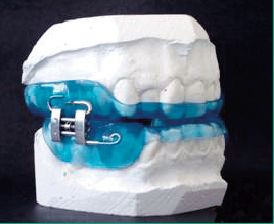
<body><![CDATA[<p style="text-align: justify; line-height: 150%;"><b> <span style="font-family: Verdana;"><font size="2">MATERIAL Y M&Eacute;TODOS</font></span></b><span style="font-family: Arial;"><o:p></o:p></span></p>       <p style="text-align: justify; line-height: 150%;"> <font face="Verdana" size="2">Se incluyeron en el estudio 17 pacientes con los siguientes signos y s&iacute;ntomas: ronquidos, respiraci&oacute;n jadeante, somnolencia, fatiga, alteraciones del sue&ntilde;o y lapsos de p&eacute;rdida de memoria. Todos los pacientes fueron examinados por un m&eacute;dico especialista en trastornos del sue&ntilde;o realiz&aacute;ndoles&nbsp;una polisomnograf&iacute;a del sue&ntilde;o inicial (PSG) en el Laboratorio de Trastornos del Sue&ntilde;o en la Universidad de Nove de Julho (UNINOVE), San Pablo, Brasil. Previo al tratamiento, se realiz&oacute; una historia cl&iacute;nica detallada del paciente y el examen bucal fue efectuado por un odont&oacute;logo especialista en trastornos del sue&ntilde;o. Al mismo tiempo, se aplic&oacute; el cuestionario-EES para evaluar la somnolencia diurna excesiva. </font> <o:p></o:p></p>       <p style="text-align: justify; line-height: 150%;"> <font face="Verdana" size="2">Se excluyeron pacientes con: &iacute;ndice de masa corporal (IMC) superior a 33 Kg/m<sup>2</sup>, dolor en la articulaci&oacute;n t&eacute;mporomandibular, enfermedad periodontal activa, obstrucci&oacute;n de v&iacute;as a&eacute;reas y apnea central del sue&ntilde;o. Los criterios de inclusi&oacute;n fueron: salud periodontal, protrusi&oacute;n mandibular mayor de 7 mm., apertura bucal superior a 35 mm., presencia de 8 a 10 dientes en cada arcada. </font> <o:p></o:p></p>       <p style="text-align: justify; line-height: 150%;"> <font face="Verdana" size="2">Todos los pacientes<span style="">&nbsp; </span>firmaron el consentimiento informado y el estudio fue aprobado por el Comit&eacute; de &Eacute;tica de UNINOVE.</font><o:p></o:p></p>       <p style="text-align: justify; line-height: 150%;"> <span style="font-family: Verdana;"> <font size="2"><img style="width: 274px; height: 224px;" alt="" src="/img/revistas/ode/v12n15/15a05f01.jpg"></font></span></p>       <p style="text-align: justify; line-height: 150%;"> <font face="Verdana" size="2"><b>Figura 1:</b> Aparato Bucal</font></p>       <p style="text-align: justify; line-height: 150%;">&nbsp;</p>       <p style="text-align: justify; line-height: 150%;"> <font face="Verdana" size="2">Los dispositivos fueron realizados en un laboratorio dental, sobre modelos de yeso de ambas arcadas y mordidas en cera efectuadas con un m&aacute;ximo de 65% de protrusi&oacute;n mandibular. El mismo dise&ntilde;o, PMPositioner ajustable, se utiliz&oacute; para todos los pacientes (Figura <a href="#Figura_1">1</a>). El aparato consta de dos placas<span style="">&nbsp; </span>(superior e inferior) que cubren completamente las superficies oclusales de los dientes y se mantienen<span style="">&nbsp; </span>unidas por<span style="">&nbsp; </span>tornillos expansores ubicados lateralmente, que facilitan el adelantamiento mandibular, de acuerdo a las necesidades del paciente<span style="">&nbsp;&nbsp;&nbsp;&nbsp;&nbsp;&nbsp;&nbsp;&nbsp;&nbsp;&nbsp;&nbsp;&nbsp;&nbsp;&nbsp;&nbsp;&nbsp;&nbsp;&nbsp;&nbsp;&nbsp;&nbsp;&nbsp;&nbsp;&nbsp; </span></font><span style="font-family: Arial;"><o:p></o:p></span> <font size="2" face="Verdana">    <br>   </font><span style="font-family: Arial;"><font size="2" face="Verdana">El ajuste para promover el adelantamiento mandibular se realiz&oacute; en forma semanal hasta lograr la reducci&oacute;n o eliminaci&oacute;n de la sintomatolog&iacute;a. El avance mandibular promedio alcanzado fue de 9,5 mm. Los pacientes usaron el dispositivo durante seis meses, seis a siete noches por semana, se realiz&oacute; una segunda PSG con el aparato en boca y respondieron a un nuevo test-ESE. Las variables polisomnogr&aacute;ficas fueron analizadas con el test de Student obteni&eacute;ndose un nivel de significaci&oacute;n de p &lt;0,05.</font><o:p></o:p></span></p>       <p style="text-align: justify; line-height: 150%;"><b> <span style="font-family: Verdana;"><font size="2">RESULTADOS</font></span></b><span style="font-family: Arial;"><o:p></o:p></span></p>       ]]></body>
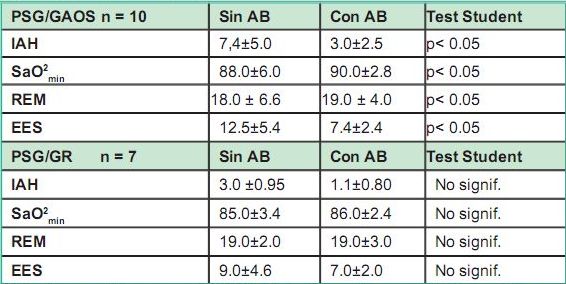
<body><![CDATA[<p style="text-align: justify; line-height: 150%;"> <font face="Verdana" size="2">La edad promedio de los pacientes fue de 48,4 &plusmn;&nbsp;11,3 a&ntilde;os, con una circunferencia media del cuello de 39,6 &plusmn;&nbsp;3,0 cm y el &iacute;ndice de masa corporal (IMC) promedio fue de 24,4 &plusmn;&nbsp;3,0.</font><o:p></o:p></p>       <p style="text-align: justify; line-height: 150%;"> <font face="Verdana" size="2">La muestra se dividi&oacute;&nbsp;en dos grupos: un grupo de roncadores<span style="">&nbsp; </span>(GR) integrado con 7 pacientes de sexo masculino, y el grupo apnea obstructiva del sue&ntilde;o leve <span style="">&nbsp;</span>(GAOS) constitu&iacute;do por 10 pacientes: 6<span style="">&nbsp; </span>hombres y 4 <span style="">&nbsp;</span>mujeres. La comparaci&oacute;n de la polisonmograf&iacute;a inicial y la realizada con el dispositivo en boca, luego de seis meses de su uso, revel&oacute; un resultado estad&iacute;sticamente significativo en la reducci&oacute;n del &iacute;ndice apnea-hipoapnea, s&oacute;lo en los pacientes GAOS. En particular el estudio demostr&oacute;: a) una reducci&oacute;n en el &Iacute;ndice de apnea/hipoapnea (IAH) de 7,4 &plusmn; 5,0 a 3,0 &plusmn; 2,5 (p &lt;0, 05), b) un aumento de <span style="">&nbsp;</span>la saturaci&oacute;n m&iacute;nima<span style="">&nbsp; </span>de ox&iacute;geno de 88,0 &plusmn; 6,0 a 90,0 &plusmn; 2,8<span style="">&nbsp; </span>(p &lt;0,05) y c) un aumento del &iacute;ndice REM (movimiento r&aacute;pido<span style="">&nbsp; </span>de ojos) de 18,0 &plusmn; 6,0 a 19 &plusmn; 4,0. <span style="">&nbsp;</span>La escala-ES se redujo de 12,5 &plusmn; 5,4 a 7,4 &plusmn; 2,4 (Tabla 1). El avance mandibular promedio fue de 9,5 &plusmn; 0,70 mm (variaci&oacute;n: 8-10 mm). . Todos los pacientes y sus parejas reportaron una mejor&iacute;a significativa de la eficiencia del sue&ntilde;o, de los ronquidos y dem&aacute;s s&iacute;ntomas. No se constataron cambios significativos en las fases del sue&ntilde;o: S1, S2 y S3. </font> <o:p></o:p></p>       <p style="text-align: justify; line-height: 150%;"> <font face="Verdana" size="2">El grupo ronquido (GR) no present&oacute; cambios significativos en las variables estudiadas aunque seg&uacute;n informe de las parejas de los pacientes, el ronquido desapareci&oacute; (Tabla <a href="#Tabla_1">1</a>).</font><o:p></o:p></p>       <p style="text-align: center; line-height: 150%;" align="center"><b> <span style="font-family: Verdana;"> <font size="2">Tabla 1:</font></span></b><font size="2" face="Verdana"> Variables fisiol&oacute;gica del sue&ntilde;o GR (n=7) y GAOS (n=10) con y sin AB despu&eacute;s de 6 meses. Valores promedio y desv&iacute;o est&aacute;ndar</font><o:p></o:p></p>   <font face="Verdana">   <span style="font-size: 10pt; line-height: 150%; ">    <br>   <img style="width: 566px; height: 284px;" alt="" src="/img/revistas/ode/v12n15/15a05t01.jpg">    <br>   PSG=polisomnograf&iacute;a; AB=aparato bucal; IAH=indice de apnea/hipoapnea; SAO<sup>2 </sup>min= m&iacute;nima saturaci&oacute;n de ox&iacute;geno; EES=Escala de Epworth del sue&ntilde;o;&nbsp;REM=movimiento r&aacute;pido<span style="">&nbsp; </span>de ojos </span> </font> <o:p></o:p>     <p style="text-align: justify; line-height: 150%;"><b> <span style="font-family: Verdana;"><o:p><font size="2">&nbsp;</font></o:p></span></b></p>       <p style="text-align: justify; line-height: 150%;"><b> <span style="font-family: Verdana;"><font size="2">DISCUSI&Oacute;N&nbsp;</font></span></b><font face="Verdana"><font size="2"> &nbsp;    <br>   La aparatolog&iacute;a bucal se ha convertido en una modalidad de tratamiento de rutina para pacientes de AOS en todo el mundo. Este estudio demuestra que el tipo de aparato bucal utilizado durante 6 meses redujo el &Iacute;ndice de apnea/hipoapnea (p &lt;0,05), lo que corrobora estudios previos que utilizaron dispositivos similares<sup> </sup>(<a href="#16">16</a>-<a href="#19">19</a>). Actualmente, el aparato MPPositioner est&aacute; siendo ampliamente utilizado en las investigaciones del tratamiento de este s&iacute;ndrome ya que permite el incremento de las dimensiones de las v&iacute;as a&eacute;reas superiores, generando una disminuci&oacute;n o eliminaci&oacute;n de los ronquidos y otros eventos adversos.</font><span style=""><font size="2">&nbsp;&nbsp;&nbsp;&nbsp;&nbsp;&nbsp;&nbsp;&nbsp; </font> </span> </font> <o:p></o:p></p>       <p style="text-align: justify; line-height: 150%;"> <font face="Verdana" size="2">Con esta nueva demanda, los dentistas han asumido una responsabilidad considerable en el tratamiento de los trastornos del sue&ntilde;o. Es importante tener un conocimiento profundo en el campo de la medicina del sue&ntilde;o para evaluar cada caso de acuerdo a las necesidades del paciente y ser conscientes del estado del arte, basado en evidencias. Esto permitir&aacute; al odont&oacute;logo poder realizar la<span style="">&nbsp; </span>indicaci&oacute;n del dispositivo adecuado a fin de lograr los mejores resultados. <span style="">&nbsp;</span>Por lo tanto, se debe tener en cuenta el material con que se realiza <span style="">&nbsp;</span>el AB y si el tipo elegido permite ser ajustable.</font><o:p></o:p></p>       ]]></body>
<body><![CDATA[<p style="text-align: justify; line-height: 150%;"> <font face="Verdana" size="2">Vanderveken y col. (2008) en un ensayo cl&iacute;nico aleatorio compararon la eficacia de dos tipos de aparatos realizados con diferentes materiales. Uno de ellos confeccionado en el laboratorio y el otro pre-fabricado, de material termopl&aacute;stico, conocido como &ldquo;de hervir y morder&rdquo;, que requiere la inmersi&oacute;n en agua hirviendo para ablandar el material y adaptarse a los dientes con presi&oacute;n digital. Los autores concluyeron que el dispositivo realizado en el laboratorio logr&oacute; mejores resultados en comparaci&oacute;n con el de tipo <span style="">&nbsp;</span>termopl&aacute;stico, en la reducci&oacute;n de la apnea de sue&ntilde;o. Los aparatos bucales termopl&aacute;sticos con el uso frecuente pierden retenci&oacute;n y son desalojados de su ubicaci&oacute;n durante el sue&ntilde;o, perdiendo eficacia. <span style="">&nbsp;</span>Tsuiki y col. (2004) evaluaron 18 pacientes con AB ajustable y constataron <span style="">&nbsp;</span>una disminuci&oacute;n en el IAH y un aumento de SaO<sup>2</sup>min (<a name="26.-"></a><a href="#26.">26</a>). <span style="">&nbsp;</span>En otro estudio, los mismos autores evaluaron 20 pacientes con AOS y tambi&eacute;n observaron una disminuci&oacute;n en el IAH y un aumento de SaO<sub>2</sub> m&iacute;nima (<a name="27.-"></a><a href="#27">27</a>). </font> <o:p></o:p></p>       <p style="text-align: justify; line-height: 150%;"> <font face="Verdana" size="2">Al igual que en el presente estudio, Marklund y Rose (2000) no encontraron resultados estad&iacute;sticamente significativos en las fases de sue&ntilde;o (S) aplicando este dispositivo<sup> </sup><span style="">&nbsp;</span>(<a name="28.-"></a><a href="#28">28</a>, <a name="29.-"></a><a href="#29.">29</a>). Este dato se explicar&iacute;a dado que los valores de las variables estudiadas antes del tratamiento, estaban pr&oacute;ximos a los normales, lo cual podr&iacute;a aplicarse tambi&eacute;n a los resultados no significativos obtenidos del grupo ronquido(GR). La somnolencia diurna es un s&iacute;ntoma importante de la AOS, sin embargo, los resultados de la escala-ES, no mostraron diferencias signifitivas en el GR. En el grupo apnea del sue&ntilde;o leve (GAOS), sin embargo, los valores de la escala-ES con AB <span style="">en boca </span>fueron estad&iacute;sticamente significativos, con una reducci&oacute;n media de 12,5 &plusmn; 5,4 a 7,4 &plusmn; 2,7. Cabe se&ntilde;alar que el GAOS present&oacute; una disminuci&oacute;n del &iacute;ndice de masa corporal (IMC), que puede haber contribuido a la mejora significativa de la apnea. El aumento de peso est&aacute; relacionado con el dep&oacute;sito de grasa en las v&iacute;as respiratorias lo que incrementa la posibilidad de colapso de las v&iacute;as a&eacute;reas<sup> </sup>superiores (<a name="30-32.-"></a><a href="#30">30</a>- <a href="#32.">32</a>). Algunos autores sostienen que una mejor&iacute;a de las variables respiratorias depende del grado de avance mandibular logrado<sup> </sup>(<a href="#26.">26</a>, <a name="33.-"></a><a href="#33.">33</a>, <a name="34.-"></a><a href="#34.">34</a>). Sin embargo, en el presente trabajo no se constat&oacute; dicha correlaci&oacute;n (r = -0.1038), probablemente debido al tama&ntilde;o peque&ntilde;o de la <span style="">&nbsp;</span>muestra (n=17). </font> <o:p></o:p></p>       <p style="text-align: justify; line-height: 150%;"> <font face="Verdana" size="2">Otros estudios han demostrado que el tratamiento con AB exitoso no depende s&oacute;lo del avance mandibular logrado sino que tambi&eacute;n depende de los cambios alcanzados en las v&iacute;as a&eacute;reas superiores en respuesta a ese adelantamiento de la mand&iacute;bula<sup> </sup>(<a name="35.-"></a><a href="#35">35</a>). </font> <o:p></o:p></p>       <p style="text-align: justify; line-height: 150%;"> <font face="Verdana" size="2">El tratamiento con el aparato bucal es el m&aacute;s aceptado entre los pacientes con AOS, de ah&iacute; la importancia de una estrecha colaboraci&oacute;n entre el dentista y los profesionales de la medicina del sue&ntilde;o con el fin de mejorar la calidad de vida de los pacientes, reconociendo que este s&iacute;ndrome necesita de una atenci&oacute;n permanente.</font><o:p></o:p></p>       <p style="text-align: justify; line-height: 150%;"> <span style="font-family: Verdana;"><o:p><font size="2">&nbsp;</font></o:p></span></p>       <p style="text-align: justify; line-height: 150%;"><b> <span style="font-family: Verdana;"><font size="2">CONCLUSIONES</font></span></b><font size="2" face="Verdana">&nbsp;</font><o:p></o:p></p>       <p style="text-align: justify; line-height: 150%;"> <font face="Verdana" size="2">El <span style="">&nbsp;</span>aparato bucal MPPositioner, utilizado en este estudio, fue eficaz en el tratamiento de la apnea obstructiva del sue&ntilde;o, eliminando los ronquidos y los s&iacute;ntomas. Su utilizaci&oacute;n durante 6 meses redujo el &Iacute;ndice de apnea/hipoapnea (p &lt;0,05), permitiendo el incremento de las dimensiones de las v&iacute;as a&eacute;reas superiores. Son necesarios estudios que faciliten la comparaci&oacute;n con otros dise&ntilde;os de AB. Para el &eacute;xito en el tratamiento de la AOS, un adecuado dispositivo bucal debe ser elegido basado en las necesidades del paciente en particular y con conocimientos de las evidencias cient&iacute;ficas disponibles en la literatura. &nbsp;</font><o:p></o:p></p>       <p style="text-align: justify; line-height: 150%;"><b> <span style="font-family: Verdana;"><o:p><font size="2">&nbsp;</font></o:p></span></b></p>       <p style="text-align: justify; line-height: 150%;"><b> <span style="font-family: Verdana;" lang="EN-US"><font size="2">REFERENCIAS</font></span></b><span style="font-family: Arial;" lang="EN-US"><o:p></o:p></span></p>       <!-- ref --><p style="text-align: justify; line-height: 150%;"><b> <span style="font-family: Verdana;" lang="EN-US"><font size="2"><a href="#1.-">1</a></font></span></b><font face="Verdana"><span lang="EN-US"><font size="2">. <st1:place w:st="on"><st1:placename w:st="on">American</st1:placename> <st1:placetype w:st="on">Academy</st1:placetype></st1:place> of Sleep Medicine. D<i>iagnostic and coding manual.</i> 2nd ed. <st1:city w:st="on">Westchester</st1:city>, <st1:state w:st="on">Illinois</st1:state>: <st1:place w:st="on"><st1:placename w:st="on">American</st1:placename> <st1:placetype w:st="on">Academy</st1:placetype></st1:place> of Sleep Medicine; 2005. International classification of sleep disorders.    </font></span></font><o:p></o:p></p>       <!-- ref --><p style="text-align: justify; line-height: 150%;"><b> <span style="font-family: Verdana;" lang="EN-US"><font size="2"><a href="#3-6.-">2</a></font></span></b><font face="Verdana"><span lang="EN-US"><font size="2">. Ayappa I, Rapoport DM. The upper airway in sleep: physiology of the Pharynx. Sleep Medicine Reviews. 2003;7(1):9-33.    </font></span></font><o:p></o:p></p>       <!-- ref --><p style="text-align: justify; line-height: 150%;"><b> <span style="font-family: Verdana;" lang="EN-US"><font size="2"><a href="#3-6.-">3</a></font></span></b><font size="2"><span style="font-family: Verdana;" lang="EN-US">. </span> <span style="font-family: Verdana;"><a href="http://www.ncbi.nlm.nih.gov/pubmed?term=%22Mahfoud%20Y%22%5BAuthor%5D" target="_blank"><span style="color: windowtext; text-decoration: none;" lang="EN-US">Mahfoud Y</span></a></span><span style="font-family: Verdana;" lang="EN-US">, </span> <span style="font-family: Verdana;"><a href="http://www.ncbi.nlm.nih.gov/pubmed?term=%22Talih%20F%22%5BAuthor%5D" target="_blank"><span style="color: windowtext; text-decoration: none;" lang="EN-US">Talih F</span></a></span><span style="font-family: Verdana;" lang="EN-US">, </span> <span style="font-family: Verdana;"><a href="http://www.ncbi.nlm.nih.gov/pubmed?term=%22Streem%20D%22%5BAuthor%5D" target="_blank"><span style="color: windowtext; text-decoration: none;" lang="EN-US">Streem D</span></a></span><span style="font-family: Verdana;" lang="EN-US">, </span> <span style="font-family: Verdana;"><a href="http://www.ncbi.nlm.nih.gov/pubmed?term=%22Budur%20K%22%5BAuthor%5D" target="_blank"><span style="color: windowtext; text-decoration: none;" lang="EN-US">Budur K</span></a></span></font><font face="Verdana"><span lang="EN-US"><font size="2">. Sleep disorders in substance abusers: how common are they? Psychiatry (Edgmont). 2009; 6(9):38-42.    </font></span></font><o:p></o:p></p>       <!-- ref --><p style="text-align: justify; line-height: 150%;"><b> <span style="font-family: Verdana;" lang="EN-US"><font size="2"><a href="#3-6.-">4</a></font></span></b><font face="Verdana"><span lang="EN-US"><font size="2">. Shepard JW Jr, Gefter WB, Guilleminault C, Hoffman EA, Hoffstein V, Hudgel DW, Suratt PM, White DP. Evaluation of the upper airway in patients with obstructive sleep apnea. Sleep. 1991; 14(4):361-71. Review .    </font></span></font><o:p></o:p></p>       <!-- ref --><p style="text-align: justify; line-height: 150%;"><b> <span style="font-family: Verdana;" lang="EN-US"><font size="2"><a href="#3-6.-">5</a></font></span></b><font face="Verdana"><span lang="EN-US"><font size="2">. Chiu KL, Ryan CM, Shiota S, Ruttanaumpawan P, Arzt M, Haight JS, Chan CT, Floras JS, Bradley TD. Fluid shift by lower body positive pressure increases pharyngeal resistance in healthy subjects. Am J Respir Crit Care Med. 2006; 174(12):1378-1383.    </font></span></font><o:p></o:p></p>       <!-- ref --><p style="text-align: justify; line-height: 150%;"><b> <span style="font-family: Verdana;" lang="EN-US"><font size="2"><a href="#3-6.-">6</a></font></span></b><font face="Verdana"><span lang="EN-US"><font size="2">. Tsuda H, Fastlicht S, Almeida FR, Lowe AA. The correlation between craniofacial morphology and sleep-disordered breathing in children in an undergraduate orthodontic clinic. Sleep Breath. 2010; DOI 10.1007/s11325-010-0345-4.    </font></span></font><o:p></o:p></p>       <p style="text-align: justify; line-height: 150%;"><b> <span style="font-family: Verdana;" lang="EN-US"><font size="2"><a href="#7-9.-">7</a></font></span></b><font face="Verdana"><span lang="EN-US"><font size="2">. Sleep&ndash;Related Breathing Disorders in Adults: Recommendations for Syndrome Definition and Measurement Techniques in Clinical Research-<i> </i>The Report of an <st1:place w:st="on"><st1:placename w:st="on">American</st1:placename> <st1:placetype w:st="on">Academy</st1:placetype></st1:place> of Sleep Medicine Task Force. Sleep. 1999; 22(5): 667-89.</font></span></font><o:p></o:p></p>       <p style="text-align: justify; line-height: 150%;"><b> <span style="font-family: Verdana;" lang="EN-US"><font size="2"><a href="#7-9.-">8</a>.</font></span></b><font size="2"><span style="font-family: Verdana;" lang="EN-US"> Zias N, <st1:place w:st="on">Bezwada</st1:place>&nbsp; V, Gilman S, Chroneou A Obstructive sleep apnea and erectile dysfunction: still a neglected risk factor? </span></font> <font face="Verdana"><span lang="PT-BR"><font size="2">Sleep Breath. 2009; 13: 3-10.</font></span></font><o:p></o:p></p>       <p style="text-align: justify; line-height: 150%;"><b> <span style="font-family: Verdana;" lang="PT-BR"><font size="2"><a href="#7-9.-">9</a></font></span></b><font size="2"><span style="font-family: Verdana;" lang="PT-BR">. </span> <span style="font-family: Verdana;"><a href="http://www.ncbi.nlm.nih.gov/pubmed?term=%22Provini%20F%22%5BAuthor%5D" target="_blank"><span style="color: windowtext; text-decoration: none;" lang="PT-BR">Provini F</span></a></span><span style="font-family: Verdana;" lang="PT-BR">, </span> <span style="font-family: Verdana;"><a href="http://www.ncbi.nlm.nih.gov/pubmed?term=%22Vetrugno%20R%22%5BAuthor%5D" target="_blank"><span style="color: windowtext; text-decoration: none;" lang="PT-BR">Vetrugno R</span></a></span><span style="font-family: Verdana;" lang="PT-BR">, </span> <span style="font-family: Verdana;"><a href="http://www.ncbi.nlm.nih.gov/pubmed?term=%22Lugaresi%20E%22%5BAuthor%5D" target="_blank"><span style="color: windowtext; text-decoration: none;" lang="PT-BR">Lugaresi E</span></a></span><span style="font-family: Verdana;" lang="PT-BR">, </span> <span style="font-family: Verdana;"><a href="http://www.ncbi.nlm.nih.gov/pubmed?term=%22Montagna%20P%22%5BAuthor%5D" target="_blank"><span style="color: windowtext; text-decoration: none;" lang="PT-BR">Montagna P</span></a></span><span style="font-family: Verdana;" lang="PT-BR">. </span> </font><font face="Verdana"><span lang="EN-US"><font size="2">Sleep-related breathing disorders and headache. Neurol Sci. 2006; 27 Suppl 2:S149-52.</font></span></font><o:p></o:p></p>       <!-- ref --><p style="text-align: justify; line-height: 150%;"><b> <span style="font-family: Verdana;" lang="EN-US"><font size="2"><a href="#10.-">10</a>.</font></span></b><font size="2"><span style="font-family: Verdana;" lang="EN-US"> </span> <span style="font-family: Verdana;"><a href="http://www.ncbi.nlm.nih.gov/pubmed?term=%22Zamarron%20C%22%5BAuthor%5D" target="_blank"><span style="color: windowtext; text-decoration: none;" lang="EN-US">Zamarron C</span></a></span><span style="font-family: Verdana;" lang="EN-US">, </span> <span style="font-family: Verdana;"><a href="http://www.ncbi.nlm.nih.gov/pubmed?term=%22Garc%C3%ADa%20Paz%20V%22%5BAuthor%5D" target="_blank"><span style="color: windowtext; text-decoration: none;" lang="EN-US">Garc&iacute;a Paz V</span></a></span><span style="font-family: Verdana;" lang="EN-US">, </span> <span style="font-family: Verdana;"><a href="http://www.ncbi.nlm.nih.gov/pubmed?term=%22Riveiro%20A%22%5BAuthor%5D" target="_blank"><span style="color: windowtext; text-decoration: none;" lang="EN-US">Riveiro A</span></a></span></font><font face="Verdana"><span lang="EN-US"><font size="2">. Obstructive sleep apnea syndrome is a systemic disease. Current evidence. Eur J Intern Med. 2008;19(6):390-8.     </font></span></font> <o:p></o:p></p>       <!-- ref --><p style="text-align: justify; line-height: 150%;"><b> <span style="font-family: Verdana;" lang="EN-US"><font size="2"><a href="#11.-">11</a>. </font> </span></b> <font face="Verdana"><span lang="EN-US"><font size="2">Hoffstein V. Review of oral appliances for treatment of sleep-disordered breathing. Sleep Breath. 2007; 11:1-22.    </font></span></font><o:p></o:p></p>       <!-- ref --><p style="text-align: justify; line-height: 150%;"><b> <span style="font-family: Verdana;" lang="EN-US"><font size="2"><a href="#12.-">12</a></font></span></b><font face="Verdana"><span lang="EN-US"><font size="2">. Lowe AA. Titratable Oral Appliances for the Treatment of Snoring and Obstructive Sleep Apnea. J Can Dent Assoc. 1999; 65:571-4.     </font></span></font> <o:p></o:p></p>       ]]></body>
<body><![CDATA[<p style="text-align: justify; line-height: 150%;"><b> <span style="font-family: Verdana;" lang="EN-US"><font size="2"><a href="#13.-">13</a>.</font></span></b><font face="Verdana"><span lang="EN-US"><font size="2"> Vanderveken OM, Devolder A, MArklund M et al. Comparison of a Custom-made and a Thermoplastic Oral Appliance for the Treatment of Mild Sleep Apnea. Am J Respir Crit Care Med. 2008; 178:197&ndash;202.</font></span></font><o:p></o:p></p>       <!-- ref --><p style="text-align: justify; line-height: 150%;"><b> <span style="font-family: Verdana;" lang="EN-US"><font size="2"><a href="#14.-">14</a>.</font></span></b><font face="Verdana"><span lang="EN-US"><font size="2"> Rose E, Staats R, Virchow C et al. A comparative study of two mandibular advancement appliances for the treatment of obstructive sleep apnoea. Eur J Orthod. 2002; 24:191-98</font></span></font><o:p></o:p><!-- ref --><p style="text-align: justify; line-height: 150%;"><b> <span style="font-family: Verdana;" lang="EN-US"><font size="2"><a href="#15-22.-">15</a>.</font></span></b><font face="Verdana"><span lang="EN-US"><font size="2">&nbsp; Coruzzi P, Gualerzi M,&nbsp; Bernkopf E, Brambilla V, Broia V, Lombardi C, Parati G.&nbsp; Autonomic Cardiac Modulation in Obstructive Sleep Apnea: Effect of an Oral Jaw-Positioning Appliance. Chest. 2006;130:1362-68.     </font></span></font> <o:p></o:p></p>       <!-- ref --><p style="text-align: justify; line-height: 150%;"><b> <span style="font-family: Verdana;" lang="EN-US"><font size="2"><a href="#15-22.-">16</a>.</font></span></b><font face="Verdana"><span lang="EN-US"><font size="2"> Otsuka R, Almeida F R, Lowe A A, <st1:city w:st="on"><st1:place w:st="on">Linden</st1:place></st1:city> W, Ryan F.&nbsp; A comparison of responders and nonresponders to oral appliance therapy for the treatment of obstructive sleep apnea. Am J Orthod Dentofacial Orthop. 2006;129:222-9.     </font></span></font> <o:p></o:p></p>       <p style="text-align: justify; line-height: 150%;"><b> <span style="font-family: Verdana;" lang="EN-US"><font size="2"><a href="#15-22.-">17</a>.</font></span></b><font face="Verdana"><span lang="EN-US"><font size="2"> Tan Y K, L&rsquo;estrange P R, Luo Y M, Smith C, Grant H R, Simonds A K. Mandibular Advancement Splints and Continuous Positive Airway Pression in Pacients with Obstructive Sleep Apnea: a mandibular randomized cross-over trial. Eur J Orthod. 2002; 24: 239-49.</font></span></font><o:p></o:p></p>       <p style="text-align: justify; line-height: 150%;"><b> <span style="font-family: Verdana;" lang="EN-US"><font size="2"><a href="#15-22.-">18</a>.</font></span></b><font size="2"><span style="font-family: Verdana;" lang="EN-US"> Johnston C D, Gleadhill I C, Cinnamond M J, Gabbey J, Burden D J. Mandibular advancement appliance and OSA a randomized clinical trial. </span></font> <font face="Verdana"><span lang="PT-BR"><font size="2">Eur J Orthod. 2002; 24:251-62. </font></span></font> <o:p></o:p></p>       <p style="text-align: justify; line-height: 150%;"><b> <span style="font-family: Verdana;" lang="PT-BR"><font size="2"><a href="#15-22.-">19</a>.</font></span></b><font size="2"><span style="font-family: Verdana;" lang="PT-BR"> Giannasi LC, Magini M, Oliveira CS, Oliveira LVF. </span></font><font face="Verdana"> <span lang="EN-US"><font size="2">Treatment of obstructive sleep apnea using an adjustable mandibular repositioning appliance fitted to a total prosthesis in a maxillary edentulous patient. Sleep Breath. 2008; 12(1):91-95.</font></span></font><o:p></o:p></p>       <!-- ref --><p style="text-align: justify; line-height: 150%;"><b> <span style="font-family: Verdana;" lang="EN-US"><font size="2"><a href="#15-22.-">20</a>.</font></span></b><font face="Verdana"><span lang="EN-US"><font size="2"> Schimidt-Nowara W, Lowe A A, Wiegand L, Cartwright R, Perez-Guerra F, Menn S. Oral appliances for treatment of snoring and sleep apnea a review. Sleep. 1995;18(6):501-510.     </font></span></font> <o:p></o:p></p>       <p style="text-align: justify; line-height: 150%;"><b> <span style="font-family: Verdana;" lang="EN-US"><font size="2"><a href="#15-22.-">21</a>.</font></span></b><font size="2"><span style="font-family: Verdana;" lang="EN-US"> Lowe AA, Sjoholm T, Ryan CF, Fleetham JA, <st1:city w:st="on"><st1:place w:st="on">Ferguson</st1:place></st1:city> KA, Remmers JE. Treatment, airway, and compliance effects of titrattable oral appliance. Sleep. </span></font><font face="Verdana"><span lang="PT-BR"> <font size="2">2000; 23:172-78.</font></span></font><o:p></o:p></p>       <p style="text-align: justify; line-height: 150%;"><b> <span style="font-family: Verdana;" lang="PT-BR"><font size="2"><a href="#15-22.-">22</a>. </font> </span></b> <font size="2"><span style="font-family: Verdana;" lang="PT-BR">Giannasi LC, Magini M, Costa MS, Oliveira CS, Oliveira LVF. </span></font> <font face="Verdana"><span lang="EN-US"><font size="2">Oral appliance treatment for obstructive sleep apnea in partly edentulous patient. Am J Orthod Dentofacial Orthop. 2010; 137:548-51.</font></span></font><o:p></o:p></p>       <!-- ref --><p style="text-align: justify; line-height: 150%;"><b> <span style="font-family: Verdana;" lang="EN-US"><font size="2"><a href="#23.-">23</a>. </font> </span></b> <font face="Verdana"><span lang="EN-US"><font size="2">Kushida CA, Morgenthaler TI, Littner MR et al. Practice parameters for the treatment of snoring and obstructive sleep apnea with oral appliances: An update for 2005. Sleep. 2006; 29:240-43.     </font></span></font> <o:p></o:p></p>       <!-- ref --><p style="text-align: justify; line-height: 150%;"><b> <span style="font-family: Verdana;" lang="EN-US"><font size="2"><a href="#24.-">24</a>.</font></span></b><font face="Verdana"><span lang="EN-US"><font size="2"> Johns, MW. Daytime sleepiness, snoring, and obstructive sleep apnea. Chest. 1993; 103:30-36.    </font></span></font><o:p></o:p></p>       <!-- ref --><p style="text-align: justify; line-height: 150%;"><b> <span style="font-family: Verdana;" lang="EN-US"><font size="2"><a href="#25.-">25</a>.</font></span></b><font face="Verdana"><span lang="EN-US"><font size="2"> Rechtschaffen A, Kales A. A Manual of Standardized Terminology, Techniques and Scoring System for Sleep Stages of Human Subjects. <st1:city w:st="on"><st1:place w:st="on">Los Angeles</st1:place></st1:city>: UCLA. Brain Information Service/Brain Research Institute, 1968.    </font></span></font><o:p></o:p></p>       <!-- ref --><p style="text-align: justify; line-height: 150%;"><b> <span style="font-family: Verdana;" lang="EN-US"><font size="2"><a href="#26.-">26</a></font></span></b><font face="Verdana"><span lang="EN-US"><font size="2">. Tsuiki S, Lowe AA, Almeida FR, Kawahata N, Fleetham JA.&nbsp; Effects of mandibular advancement on airway curvature and obstructive sleep apnoea severity. Eur Respir.&nbsp; 2004; 23:263-68.    </font></span></font><o:p></o:p></p>       <!-- ref --><p style="text-align: justify; line-height: 150%;"><b> <span style="font-family: Verdana;" lang="EN-US"><font size="2"><a href="#27.-">27</a>.</font></span></b><font face="Verdana"><span lang="EN-US"><font size="2">&nbsp; Tsuik S, Lowe AA, Almeida FR, Fleethan JA.&nbsp; Effects of an anteriorly titrated mandibular position on awake airway and obstructive sleep apnea severity. Am J Orthod&nbsp; Dentofacial Orthop. 2004;125:548-55.    </font></span></font><o:p></o:p></p>       <!-- ref --><p style="text-align: justify; line-height: 150%;"><b> <span style="font-family: Verdana;" lang="EN-US"><font size="2"><a href="#28.-">28</a>.</font></span></b><font face="Verdana"><span lang="EN-US"><font size="2"> Marklund M, Sahlin C, Stenlund H, Person M, Franklin KA. Mandibular advancement device in patient with obstructive sleep apnea: long-term effects on apnea and sleep. Chest. 2000;120:162-69.    &nbsp; </font></span></font> <o:p></o:p></p>       <!-- ref --><p style="text-align: justify; line-height: 150%;"><b> <span style="font-family: Verdana;" lang="EN-US"><font size="2"><a href="#29.-">29</a></font></span></b><font face="Verdana"><span lang="EN-US"><font size="2">. Rose E, Mering L, Frucht S, Virchow C, Jonas IE. Oral Appliances in Patients with Obstructive Sleep Apnoea-Polysomnographic outcome. Eur J Orthod. 2000;22:456-57.    </font></span></font><o:p></o:p></p>       <!-- ref --><p style="text-align: justify; line-height: 150%;"><b> <span style="font-family: Verdana;" lang="EN-US"><font size="2"><a href="#30-32.-">30</a>.</font></span></b><font face="Verdana"><span lang="EN-US"><font size="2"> Wolk R, Ahamsuzzaman A, Somers VK. Obesity, sleep apnea, and hypertension. Hypertension. 2003; 42:1067-74.    </font></span></font><o:p></o:p></p>       <!-- ref --><p style="text-align: justify; line-height: 150%;"><b> <span style="font-family: Verdana;" lang="EN-US"><font size="2"><a href="#30-32.-">31</a></font></span></b><font face="Verdana"><span lang="EN-US"><font size="2">. Isono S. Contribution of obesity and craniofacial abnormalities to pharyngeal collapsibility in patients with obstructive sleep apnea. Sleep and Biological Rythms. 2003;2:17-21.     </font></span></font> <o:p></o:p></p>       <!-- ref --><p style="text-align: justify; line-height: 150%;"><b> <span style="font-family: Verdana;" lang="EN-US"><font size="2"><a href="#30-32.-">32</a></font></span></b><font face="Verdana"><span lang="EN-US"><font size="2">. Ward FW, McNicholas WT. Clinical prediction of the sleep apnea syndrome. Sleep Med Rev. 1997; 1: 19-32.    </font></span></font><o:p></o:p></p>       <!-- ref --><p style="text-align: justify; line-height: 150%;"><b> <span style="font-family: Verdana;" lang="EN-US"><font size="2"><a href="#33.-">33</a></font></span></b><font face="Verdana"><span lang="EN-US"><font size="2">. Walker-Engstr&ouml;m ML, Ringqvist I, Vestling O, Wilhelmsson B, Tegelberg AA. Prospective Randomized Study Comparing Two Different Degrees of Mandibular Advancement with a Dental Appliance in treatment of Severe Obstructive Sleep Apnea. Sleep and Breath. 2003; 10:119-30.    </font></span></font><o:p></o:p></p>       <!-- ref --><p style="text-align: justify; line-height: 150%;"><b> <span style="font-family: Verdana;" lang="EN-US"><font size="2"><a href="#34.-">34</a></font></span></b><font face="Verdana"><span lang="EN-US"><font size="2">.&nbsp; Almeida FR, Bittencourt LR, de Almeida CIR, Tsuik S, Lowe AA, Tufik S. Effects on Mandibular Posture on Obstructive Sleep Apnea Severity and the Temporomandibular Joint in Patients Fitted with an Oral Appliance. Sleep. 2002; 25(5):505-11.    </font></span></font><o:p></o:p></p>       <p style="text-align: justify; line-height: 150%;"><b> <span style="font-family: Verdana;" lang="EN-US"><font size="2"><a href="#35.-">35</a>.</font></span></b><font size="2"><span style="font-family: Verdana;" lang="EN-US"> Johal A, Gill G, Ferman A, McLaughlin K. The effect of mandibular advancement appliances on awake upper airway and masticatory muscle activity in patients with obstructive sleep apnoea. </span></font><font size="2" face="Verdana">Clin Physiol Funct Imaging. 2007; 27:47&ndash;53.&nbsp;</font><o:p></o:p></p>       <p style="text-align: justify; line-height: 150%;"><b style=""> <font face="Verdana" size="2">Agradecimiento</font><o:p></o:p></b></p>       <p style="text-align: justify; line-height: 150%;"> <font face="Verdana" size="2"><span lang="PT-BR">Este trabajo fue financiado por: Funda&ccedil;&atilde;o de Amparo &agrave; Pesquisa do Estado de S&atilde;o Paulo (FAPESP) y Conselho Nacional de Desenvolvimento Cient&iacute;fico e Tecnol&oacute;gico (CNPq).</span></font><o:p></o:p></p>       ]]></body>
<body><![CDATA[ ]]></body><back>
<ref-list>
<ref id="B1">
<label>1</label><nlm-citation citation-type="book">
<collab>American Academy of Sleep Medicine</collab>
<source><![CDATA[Diagnostic and coding manual]]></source>
<year>2005</year>
<edition>2nd ed</edition>
<publisher-loc><![CDATA[Westchester^eIllinois Illinois]]></publisher-loc>
<publisher-name><![CDATA[American Academy of Sleep Medicine]]></publisher-name>
</nlm-citation>
</ref>
<ref id="B2">
<label>2</label><nlm-citation citation-type="journal">
<person-group person-group-type="author">
<name>
<surname><![CDATA[Ayappa]]></surname>
<given-names><![CDATA[I]]></given-names>
</name>
<name>
<surname><![CDATA[Rapoport]]></surname>
<given-names><![CDATA[DM]]></given-names>
</name>
</person-group>
<article-title xml:lang="en"><![CDATA[The upper airway in sleep: physiology of the Pharynx]]></article-title>
<source><![CDATA[Sleep Medicine Reviews]]></source>
<year>2003</year>
<volume>7</volume>
<numero>1</numero>
<issue>1</issue>
<page-range>9-33</page-range></nlm-citation>
</ref>
<ref id="B3">
<label>3</label><nlm-citation citation-type="journal">
<person-group person-group-type="author">
<name>
<surname><![CDATA[Mahfoud]]></surname>
<given-names><![CDATA[Y]]></given-names>
</name>
<name>
<surname><![CDATA[Talih]]></surname>
<given-names><![CDATA[F]]></given-names>
</name>
<name>
<surname><![CDATA[Streem]]></surname>
<given-names><![CDATA[D]]></given-names>
</name>
<name>
<surname><![CDATA[Budur]]></surname>
<given-names><![CDATA[K]]></given-names>
</name>
</person-group>
<article-title xml:lang="en"><![CDATA[Sleep disorders in substance abusers: how common are they?]]></article-title>
<source><![CDATA[Psychiatry]]></source>
<year>2009</year>
<volume>6</volume>
<numero>9</numero>
<issue>9</issue>
<page-range>38-42</page-range></nlm-citation>
</ref>
<ref id="B4">
<label>4</label><nlm-citation citation-type="journal">
<person-group person-group-type="author">
<name>
<surname><![CDATA[Shepard]]></surname>
<given-names><![CDATA[JW Jr]]></given-names>
</name>
<name>
<surname><![CDATA[Gefter]]></surname>
<given-names><![CDATA[WB]]></given-names>
</name>
<name>
<surname><![CDATA[Guilleminault]]></surname>
<given-names><![CDATA[C]]></given-names>
</name>
<name>
<surname><![CDATA[Hoffman]]></surname>
<given-names><![CDATA[EA]]></given-names>
</name>
<name>
<surname><![CDATA[Hoffstein]]></surname>
<given-names><![CDATA[V]]></given-names>
</name>
<name>
<surname><![CDATA[Hudgel]]></surname>
<given-names><![CDATA[DW]]></given-names>
</name>
<name>
<surname><![CDATA[Suratt]]></surname>
<given-names><![CDATA[PM]]></given-names>
</name>
<name>
<surname><![CDATA[White]]></surname>
<given-names><![CDATA[DP]]></given-names>
</name>
</person-group>
<article-title xml:lang="en"><![CDATA[Evaluation of the upper airway in patients with obstructive sleep apnea]]></article-title>
<source><![CDATA[Sleep]]></source>
<year>1991</year>
<volume>14</volume>
<numero>4</numero>
<issue>4</issue>
<page-range>361-71</page-range></nlm-citation>
</ref>
<ref id="B5">
<label>5</label><nlm-citation citation-type="journal">
<person-group person-group-type="author">
<name>
<surname><![CDATA[Chiu]]></surname>
<given-names><![CDATA[KL]]></given-names>
</name>
<name>
<surname><![CDATA[Ryan]]></surname>
<given-names><![CDATA[CM]]></given-names>
</name>
<name>
<surname><![CDATA[Shiota]]></surname>
<given-names><![CDATA[S]]></given-names>
</name>
<name>
<surname><![CDATA[Ruttanaumpawan]]></surname>
<given-names><![CDATA[P]]></given-names>
</name>
<name>
<surname><![CDATA[Arzt]]></surname>
<given-names><![CDATA[M]]></given-names>
</name>
<name>
<surname><![CDATA[Haight]]></surname>
<given-names><![CDATA[JS]]></given-names>
</name>
<name>
<surname><![CDATA[Chan]]></surname>
<given-names><![CDATA[CT]]></given-names>
</name>
<name>
<surname><![CDATA[Floras]]></surname>
<given-names><![CDATA[JS]]></given-names>
</name>
<name>
<surname><![CDATA[Bradley]]></surname>
<given-names><![CDATA[TD]]></given-names>
</name>
</person-group>
<article-title xml:lang="en"><![CDATA[Fluid shift by lower body positive pressure increases pharyngeal resistance in healthy subjects]]></article-title>
<source><![CDATA[Am J Respir Crit Care Med]]></source>
<year>2006</year>
<volume>174</volume>
<numero>12</numero>
<issue>12</issue>
<page-range>1378-1383</page-range></nlm-citation>
</ref>
<ref id="B6">
<label>6</label><nlm-citation citation-type="journal">
<person-group person-group-type="author">
<name>
<surname><![CDATA[Tsuda]]></surname>
<given-names><![CDATA[H]]></given-names>
</name>
<name>
<surname><![CDATA[Fastlicht]]></surname>
<given-names><![CDATA[S]]></given-names>
</name>
<name>
<surname><![CDATA[Almeida]]></surname>
<given-names><![CDATA[FR]]></given-names>
</name>
<name>
<surname><![CDATA[Lowe]]></surname>
<given-names><![CDATA[AA]]></given-names>
</name>
</person-group>
<article-title xml:lang="en"><![CDATA[The correlation between craniofacial morphology and sleep-disordered breathing in children in an undergraduate orthodontic clinic]]></article-title>
<source><![CDATA[Sleep Breath]]></source>
<year>2010</year>
</nlm-citation>
</ref>
<ref id="B7">
<label>7</label><nlm-citation citation-type="journal">
<article-title xml:lang="en"><![CDATA[The Report of an American Academy of Sleep Medicine Task Force]]></article-title>
<source><![CDATA[Sleep]]></source>
<year>1999</year>
<volume>22</volume>
<numero>5</numero>
<issue>5</issue>
<page-range>667-89</page-range></nlm-citation>
</ref>
<ref id="B8">
<label>8</label><nlm-citation citation-type="journal">
<person-group person-group-type="author">
<name>
<surname><![CDATA[Zias]]></surname>
<given-names><![CDATA[N]]></given-names>
</name>
<name>
<surname><![CDATA[Bezwada]]></surname>
<given-names><![CDATA[V]]></given-names>
</name>
<name>
<surname><![CDATA[Gilman]]></surname>
<given-names><![CDATA[S]]></given-names>
</name>
<name>
<surname><![CDATA[Chroneou]]></surname>
<given-names><![CDATA[A]]></given-names>
</name>
</person-group>
<article-title xml:lang="en"><![CDATA[Obstructive sleep apnea and erectile dysfunction: still a neglected risk factor?]]></article-title>
<source><![CDATA[lang="PT-BR"Sleep Breath]]></source>
<year>2009</year>
<volume>13</volume>
<page-range>3-10</page-range></nlm-citation>
</ref>
<ref id="B9">
<label>lang="PT-BR"9</label><nlm-citation citation-type="journal">
<person-group person-group-type="author">
<name>
<surname><![CDATA[Provini]]></surname>
<given-names><![CDATA[F]]></given-names>
</name>
<name>
<surname><![CDATA[Vetrugno]]></surname>
<given-names><![CDATA[R]]></given-names>
</name>
<name>
<surname><![CDATA[Lugaresi]]></surname>
<given-names><![CDATA[E]]></given-names>
</name>
<name>
<surname><![CDATA[Montagna]]></surname>
<given-names><![CDATA[P]]></given-names>
</name>
</person-group>
<article-title xml:lang="en"><![CDATA[Sleep-related breathing disorders and headache]]></article-title>
<source><![CDATA[Neurol Sci]]></source>
<year>2006</year>
<volume>27</volume>
<numero>^sSuppl 2</numero>
<issue>^sSuppl 2</issue>
<supplement>Suppl 2</supplement>
<page-range>S149-52</page-range></nlm-citation>
</ref>
<ref id="B10">
<label>10</label><nlm-citation citation-type="journal">
<person-group person-group-type="author">
<name>
<surname><![CDATA[Zamarron]]></surname>
<given-names><![CDATA[C]]></given-names>
</name>
<name>
<surname><![CDATA[García Paz]]></surname>
<given-names><![CDATA[V]]></given-names>
</name>
<name>
<surname><![CDATA[Riveiro]]></surname>
<given-names><![CDATA[A]]></given-names>
</name>
</person-group>
<article-title xml:lang="en"><![CDATA[Obstructive sleep apnea syndrome is a systemic disease: Current evidence]]></article-title>
<source><![CDATA[Eur J Intern Med]]></source>
<year>2008</year>
<volume>19</volume>
<numero>6</numero>
<issue>6</issue>
<page-range>390-8</page-range></nlm-citation>
</ref>
<ref id="B11">
<label>11</label><nlm-citation citation-type="journal">
<person-group person-group-type="author">
<name>
<surname><![CDATA[Hoffstein]]></surname>
<given-names><![CDATA[V]]></given-names>
</name>
</person-group>
<article-title xml:lang="en"><![CDATA[Review of oral appliances for treatment of sleep-disordered breathing]]></article-title>
<source><![CDATA[Sleep Breath]]></source>
<year>2007</year>
<volume>11</volume>
<page-range>1-22</page-range></nlm-citation>
</ref>
<ref id="B12">
<label>12</label><nlm-citation citation-type="journal">
<person-group person-group-type="author">
<name>
<surname><![CDATA[Lowe]]></surname>
<given-names><![CDATA[AA]]></given-names>
</name>
</person-group>
<article-title xml:lang="en"><![CDATA[Titratable Oral Appliances for the Treatment of Snoring and Obstructive Sleep Apnea]]></article-title>
<source><![CDATA[J Can Dent Assoc]]></source>
<year>1999</year>
<volume>65</volume>
<page-range>571-4</page-range></nlm-citation>
</ref>
<ref id="B13">
<label>13</label><nlm-citation citation-type="journal">
<person-group person-group-type="author">
<name>
<surname><![CDATA[Vanderveken]]></surname>
<given-names><![CDATA[OM]]></given-names>
</name>
<name>
<surname><![CDATA[Devolder]]></surname>
<given-names><![CDATA[A]]></given-names>
</name>
<name>
<surname><![CDATA[MArklund]]></surname>
<given-names><![CDATA[M]]></given-names>
</name>
</person-group>
<article-title xml:lang="en"><![CDATA[Comparison of a Custom-made and a Thermoplastic Oral Appliance for the Treatment of Mild Sleep Apnea]]></article-title>
<source><![CDATA[Am J Respir Crit Care Med]]></source>
<year>2008</year>
<volume>178</volume>
<page-range>197-202</page-range></nlm-citation>
</ref>
<ref id="B14">
<label>14</label><nlm-citation citation-type="journal">
<person-group person-group-type="author">
<name>
<surname><![CDATA[Rose]]></surname>
<given-names><![CDATA[E]]></given-names>
</name>
<name>
<surname><![CDATA[Staats]]></surname>
<given-names><![CDATA[R]]></given-names>
</name>
<name>
<surname><![CDATA[Virchow]]></surname>
<given-names><![CDATA[C]]></given-names>
</name>
</person-group>
<article-title xml:lang="en"><![CDATA[A comparative study of two mandibular advancement appliances for the treatment of obstructive sleep apnoea]]></article-title>
<source><![CDATA[Eur J Orthod]]></source>
<year>2002</year>
<volume>24</volume>
<page-range>191-98</page-range></nlm-citation>
</ref>
<ref id="B15">
<label>15</label><nlm-citation citation-type="journal">
<person-group person-group-type="author">
<name>
<surname><![CDATA[Coruzzi]]></surname>
<given-names><![CDATA[P]]></given-names>
</name>
<name>
<surname><![CDATA[Gualerzi]]></surname>
<given-names><![CDATA[M]]></given-names>
</name>
<name>
<surname><![CDATA[Bernkopf]]></surname>
<given-names><![CDATA[E]]></given-names>
</name>
<name>
<surname><![CDATA[Brambilla]]></surname>
<given-names><![CDATA[V]]></given-names>
</name>
<name>
<surname><![CDATA[Broia]]></surname>
<given-names><![CDATA[V]]></given-names>
</name>
<name>
<surname><![CDATA[Lombardi]]></surname>
<given-names><![CDATA[C]]></given-names>
</name>
<name>
<surname><![CDATA[Parati]]></surname>
<given-names><![CDATA[G]]></given-names>
</name>
</person-group>
<article-title xml:lang="en"><![CDATA[Autonomic Cardiac Modulation in Obstructive Sleep Apnea: Effect of an Oral Jaw-Positioning Appliance]]></article-title>
<source><![CDATA[Chest]]></source>
<year>2006</year>
<volume>130</volume>
<page-range>1362-68</page-range></nlm-citation>
</ref>
<ref id="B16">
<label>16</label><nlm-citation citation-type="journal">
<person-group person-group-type="author">
<name>
<surname><![CDATA[Otsuka]]></surname>
<given-names><![CDATA[R]]></given-names>
</name>
<name>
<surname><![CDATA[Almeida]]></surname>
<given-names><![CDATA[F R]]></given-names>
</name>
<name>
<surname><![CDATA[Lowe]]></surname>
<given-names><![CDATA[A A]]></given-names>
</name>
<name>
<surname><![CDATA[Linden]]></surname>
<given-names><![CDATA[W]]></given-names>
</name>
<name>
<surname><![CDATA[Ryan]]></surname>
<given-names><![CDATA[F]]></given-names>
</name>
</person-group>
<article-title xml:lang="en"><![CDATA[A comparison of responders and nonresponders to oral appliance therapy for the treatment of obstructive sleep apnea]]></article-title>
<source><![CDATA[Am J Orthod Dentofacial Orthop]]></source>
<year></year>
<volume>2006</volume>
<numero>129</numero>
<issue>129</issue>
<page-range>222-9</page-range></nlm-citation>
</ref>
<ref id="B17">
<label>17</label><nlm-citation citation-type="journal">
<person-group person-group-type="author">
<name>
<surname><![CDATA[Tan]]></surname>
<given-names><![CDATA[Y K]]></given-names>
</name>
<name>
<surname><![CDATA[L&rsquo;estrange]]></surname>
<given-names><![CDATA[P R]]></given-names>
</name>
<name>
<surname><![CDATA[Luo]]></surname>
<given-names><![CDATA[Y M]]></given-names>
</name>
<name>
<surname><![CDATA[Smith]]></surname>
<given-names><![CDATA[C]]></given-names>
</name>
<name>
<surname><![CDATA[Grant]]></surname>
<given-names><![CDATA[H R]]></given-names>
</name>
<name>
<surname><![CDATA[Simonds]]></surname>
<given-names><![CDATA[A K]]></given-names>
</name>
</person-group>
<article-title xml:lang="en"><![CDATA[Mandibular Advancement Splints and Continuous Positive Airway Pression in Pacients with Obstructive Sleep Apnea: a mandibular randomized cross-over trial]]></article-title>
<source><![CDATA[Eur J Orthod]]></source>
<year>2002</year>
<volume>24</volume>
<page-range>239-49</page-range></nlm-citation>
</ref>
<ref id="B18">
<label>18</label><nlm-citation citation-type="journal">
<person-group person-group-type="author">
<name>
<surname><![CDATA[Johnston]]></surname>
<given-names><![CDATA[C D]]></given-names>
</name>
<name>
<surname><![CDATA[Gleadhill]]></surname>
<given-names><![CDATA[I C]]></given-names>
</name>
<name>
<surname><![CDATA[Cinnamond]]></surname>
<given-names><![CDATA[M J]]></given-names>
</name>
<name>
<surname><![CDATA[Gabbey]]></surname>
<given-names><![CDATA[J]]></given-names>
</name>
<name>
<surname><![CDATA[Burden]]></surname>
<given-names><![CDATA[D J]]></given-names>
</name>
</person-group>
<article-title xml:lang="en"><![CDATA[Mandibular advancement appliance and OSA a randomized clinical trial]]></article-title>
<source><![CDATA[lang="PT-BR"Eur J Orthod]]></source>
<year>2002</year>
<volume>24</volume>
<page-range>251-62</page-range></nlm-citation>
</ref>
<ref id="B19">
<label>lang="PT-BR"19</label><nlm-citation citation-type="journal">
<person-group person-group-type="author">
<name>
<surname><![CDATA[Giannasi]]></surname>
<given-names><![CDATA[LC]]></given-names>
</name>
<name>
<surname><![CDATA[Magini]]></surname>
<given-names><![CDATA[M]]></given-names>
</name>
<name>
<surname><![CDATA[Oliveira]]></surname>
<given-names><![CDATA[CS]]></given-names>
</name>
<name>
<surname><![CDATA[Oliveira]]></surname>
<given-names><![CDATA[LVF]]></given-names>
</name>
</person-group>
<article-title xml:lang="en"><![CDATA[Treatment of obstructive sleep apnea using an adjustable mandibular repositioning appliance fitted to a total prosthesis in a maxillary edentulous patient]]></article-title>
<source><![CDATA[Sleep Breath]]></source>
<year>2008</year>
<volume>12</volume>
<numero>1</numero>
<issue>1</issue>
<page-range>91-95</page-range></nlm-citation>
</ref>
<ref id="B20">
<label>20</label><nlm-citation citation-type="journal">
<person-group person-group-type="author">
<name>
<surname><![CDATA[Schimidt-Nowara]]></surname>
<given-names><![CDATA[W]]></given-names>
</name>
<name>
<surname><![CDATA[Lowe]]></surname>
<given-names><![CDATA[A A]]></given-names>
</name>
<name>
<surname><![CDATA[Wiegand]]></surname>
<given-names><![CDATA[L]]></given-names>
</name>
<name>
<surname><![CDATA[Cartwright]]></surname>
<given-names><![CDATA[R]]></given-names>
</name>
<name>
<surname><![CDATA[Perez-Guerra]]></surname>
<given-names><![CDATA[F]]></given-names>
</name>
<name>
<surname><![CDATA[Menn]]></surname>
<given-names><![CDATA[S]]></given-names>
</name>
</person-group>
<article-title xml:lang="en"><![CDATA[Oral appliances for treatment of snoring and sleep apnea a review]]></article-title>
<source><![CDATA[Sleep]]></source>
<year>1995</year>
<volume>18</volume>
<numero>6</numero>
<issue>6</issue>
<page-range>501-510</page-range></nlm-citation>
</ref>
<ref id="B21">
<label>21</label><nlm-citation citation-type="journal">
<person-group person-group-type="author">
<name>
<surname><![CDATA[Lowe]]></surname>
<given-names><![CDATA[AA]]></given-names>
</name>
<name>
<surname><![CDATA[Sjoholm]]></surname>
<given-names><![CDATA[T]]></given-names>
</name>
<name>
<surname><![CDATA[Ryan]]></surname>
<given-names><![CDATA[CF]]></given-names>
</name>
<name>
<surname><![CDATA[Fleetham]]></surname>
<given-names><![CDATA[JA]]></given-names>
</name>
<name>
<surname><![CDATA[Ferguson]]></surname>
<given-names><![CDATA[KA]]></given-names>
</name>
<name>
<surname><![CDATA[Remmers]]></surname>
<given-names><![CDATA[JE]]></given-names>
</name>
</person-group>
<article-title xml:lang="en"><![CDATA[Treatment, airway, and compliance effects of titrattable oral appliance]]></article-title>
<source><![CDATA[Sleep]]></source>
<year>lang</year>
<month>="</month>
<day>PT</day>
<volume>23</volume>
<page-range>172-78</page-range></nlm-citation>
</ref>
<ref id="B22">
<label>lang="PT-BR"22</label><nlm-citation citation-type="journal">
<person-group person-group-type="author">
<name>
<surname><![CDATA[lang="PT-BR"Giannasi]]></surname>
<given-names><![CDATA[LC]]></given-names>
</name>
<name>
<surname><![CDATA[Magini]]></surname>
<given-names><![CDATA[M]]></given-names>
</name>
<name>
<surname><![CDATA[Costa]]></surname>
<given-names><![CDATA[MS]]></given-names>
</name>
<name>
<surname><![CDATA[Oliveira]]></surname>
<given-names><![CDATA[CS]]></given-names>
</name>
<name>
<surname><![CDATA[Oliveira]]></surname>
<given-names><![CDATA[LVF]]></given-names>
</name>
</person-group>
<article-title xml:lang="en"><![CDATA[Oral appliance treatment for obstructive sleep apnea in partly edentulous patient]]></article-title>
<source><![CDATA[Am J Orthod Dentofacial Orthop]]></source>
<year>2010</year>
<volume>137</volume>
<page-range>548-51</page-range></nlm-citation>
</ref>
<ref id="B23">
<label>23</label><nlm-citation citation-type="journal">
<person-group person-group-type="author">
<name>
<surname><![CDATA[Kushida]]></surname>
<given-names><![CDATA[CA]]></given-names>
</name>
<name>
<surname><![CDATA[Morgenthaler]]></surname>
<given-names><![CDATA[TI]]></given-names>
</name>
<name>
<surname><![CDATA[Littner]]></surname>
<given-names><![CDATA[MR]]></given-names>
</name>
</person-group>
<article-title xml:lang="en"><![CDATA[Practice parameters for the treatment of snoring and obstructive sleep apnea with oral appliances: An update for 2005]]></article-title>
<source><![CDATA[Sleep]]></source>
<year>2006</year>
<volume>29</volume>
<page-range>240-43</page-range></nlm-citation>
</ref>
<ref id="B24">
<label>24</label><nlm-citation citation-type="journal">
<person-group person-group-type="author">
<name>
<surname><![CDATA[Johns]]></surname>
<given-names><![CDATA[MW]]></given-names>
</name>
</person-group>
<article-title xml:lang="en"><![CDATA[Daytime sleepiness, snoring, and obstructive sleep apnea]]></article-title>
<source><![CDATA[Chest]]></source>
<year>1993</year>
<volume>103</volume>
<page-range>30-36</page-range></nlm-citation>
</ref>
<ref id="B25">
<label>25</label><nlm-citation citation-type="book">
<person-group person-group-type="author">
<name>
<surname><![CDATA[Rechtschaffen]]></surname>
<given-names><![CDATA[A]]></given-names>
</name>
<name>
<surname><![CDATA[Kales]]></surname>
<given-names><![CDATA[A]]></given-names>
</name>
</person-group>
<source><![CDATA[A Manual of Standardized Terminology, Techniques and Scoring System for Sleep Stages of Human Subjects]]></source>
<year>1968</year>
<publisher-loc><![CDATA[Los Angeles ]]></publisher-loc>
<publisher-name><![CDATA[UCLA. Brain Information Service/Brain Research Institute]]></publisher-name>
</nlm-citation>
</ref>
<ref id="B26">
<label>26</label><nlm-citation citation-type="journal">
<person-group person-group-type="author">
<name>
<surname><![CDATA[Tsuiki]]></surname>
<given-names><![CDATA[S]]></given-names>
</name>
<name>
<surname><![CDATA[Lowe]]></surname>
<given-names><![CDATA[AA]]></given-names>
</name>
<name>
<surname><![CDATA[Almeida]]></surname>
<given-names><![CDATA[FR]]></given-names>
</name>
<name>
<surname><![CDATA[Kawahata]]></surname>
<given-names><![CDATA[N]]></given-names>
</name>
<name>
<surname><![CDATA[Fleetham]]></surname>
<given-names><![CDATA[JA]]></given-names>
</name>
</person-group>
<article-title xml:lang="en"><![CDATA[Effects of mandibular advancement on airway curvature and obstructive sleep apnoea severity]]></article-title>
<source><![CDATA[Eur Respir]]></source>
<year>2004</year>
<volume>23</volume>
<page-range>263-68</page-range></nlm-citation>
</ref>
<ref id="B27">
<label>27</label><nlm-citation citation-type="journal">
<person-group person-group-type="author">
<name>
<surname><![CDATA[Tsuik]]></surname>
<given-names><![CDATA[S]]></given-names>
</name>
<name>
<surname><![CDATA[Lowe]]></surname>
<given-names><![CDATA[AA]]></given-names>
</name>
<name>
<surname><![CDATA[Almeida]]></surname>
<given-names><![CDATA[FR]]></given-names>
</name>
<name>
<surname><![CDATA[Fleethan]]></surname>
<given-names><![CDATA[JA]]></given-names>
</name>
</person-group>
<article-title xml:lang="en"><![CDATA[Effects of an anteriorly titrated mandibular position on awake airway and obstructive sleep apnea severity]]></article-title>
<source><![CDATA[Am J Orthod Dentofacial Orthop]]></source>
<year>2004</year>
<volume>125</volume>
<page-range>548-55</page-range></nlm-citation>
</ref>
<ref id="B28">
<label>28</label><nlm-citation citation-type="journal">
<person-group person-group-type="author">
<name>
<surname><![CDATA[Marklund]]></surname>
<given-names><![CDATA[M]]></given-names>
</name>
<name>
<surname><![CDATA[Sahlin]]></surname>
<given-names><![CDATA[C]]></given-names>
</name>
<name>
<surname><![CDATA[Stenlund]]></surname>
<given-names><![CDATA[H]]></given-names>
</name>
<name>
<surname><![CDATA[Person]]></surname>
<given-names><![CDATA[M]]></given-names>
</name>
<name>
<surname><![CDATA[Franklin]]></surname>
<given-names><![CDATA[KA]]></given-names>
</name>
</person-group>
<article-title xml:lang="en"><![CDATA[Mandibular advancement device in patient with obstructive sleep apnea: long-term effects on apnea and sleep]]></article-title>
<source><![CDATA[Chest]]></source>
<year>2000</year>
<volume>120</volume>
<page-range>162-69</page-range></nlm-citation>
</ref>
<ref id="B29">
<label>29</label><nlm-citation citation-type="journal">
<person-group person-group-type="author">
<name>
<surname><![CDATA[Rose]]></surname>
<given-names><![CDATA[E]]></given-names>
</name>
<name>
<surname><![CDATA[Mering]]></surname>
<given-names><![CDATA[L]]></given-names>
</name>
<name>
<surname><![CDATA[Frucht]]></surname>
<given-names><![CDATA[S]]></given-names>
</name>
<name>
<surname><![CDATA[Virchow]]></surname>
<given-names><![CDATA[C]]></given-names>
</name>
<name>
<surname><![CDATA[Jonas]]></surname>
<given-names><![CDATA[IE]]></given-names>
</name>
</person-group>
<article-title xml:lang="en"><![CDATA[Oral Appliances in Patients with Obstructive Sleep Apnoea-Polysomnographic outcome]]></article-title>
<source><![CDATA[Eur J Orthod]]></source>
<year></year>
<volume>2000</volume>
<numero>22</numero>
<issue>22</issue>
<page-range>456-57</page-range></nlm-citation>
</ref>
<ref id="B30">
<label>30</label><nlm-citation citation-type="journal">
<person-group person-group-type="author">
<name>
<surname><![CDATA[Wolk]]></surname>
<given-names><![CDATA[R]]></given-names>
</name>
<name>
<surname><![CDATA[Ahamsuzzaman]]></surname>
<given-names><![CDATA[A]]></given-names>
</name>
<name>
<surname><![CDATA[Somers]]></surname>
<given-names><![CDATA[VK]]></given-names>
</name>
</person-group>
<article-title xml:lang="en"><![CDATA[Obesity, sleep apnea, and hypertension]]></article-title>
<source><![CDATA[Hypertension]]></source>
<year>2003</year>
<volume>42</volume>
<page-range>1067-74</page-range></nlm-citation>
</ref>
<ref id="B31">
<label>31</label><nlm-citation citation-type="journal">
<person-group person-group-type="author">
<name>
<surname><![CDATA[Isono]]></surname>
<given-names><![CDATA[S]]></given-names>
</name>
</person-group>
<article-title xml:lang="en"><![CDATA[Contribution of obesity and craniofacial abnormalities to pharyngeal collapsibility in patients with obstructive sleep apnea]]></article-title>
<source><![CDATA[Sleep and Biological Rythms]]></source>
<year>2003</year>
<volume>2</volume>
<page-range>17-21</page-range></nlm-citation>
</ref>
<ref id="B32">
<label>32</label><nlm-citation citation-type="journal">
<person-group person-group-type="author">
<name>
<surname><![CDATA[Ward]]></surname>
<given-names><![CDATA[FW]]></given-names>
</name>
<name>
<surname><![CDATA[McNicholas]]></surname>
<given-names><![CDATA[WT]]></given-names>
</name>
</person-group>
<article-title xml:lang="en"><![CDATA[Clinical prediction of the sleep apnea syndrome]]></article-title>
<source><![CDATA[Sleep Med Rev]]></source>
<year>1997</year>
<volume>1</volume>
<page-range>19-32</page-range></nlm-citation>
</ref>
<ref id="B33">
<label>33</label><nlm-citation citation-type="journal">
<person-group person-group-type="author">
<name>
<surname><![CDATA[Walker-Engström]]></surname>
<given-names><![CDATA[ML]]></given-names>
</name>
<name>
<surname><![CDATA[Ringqvist]]></surname>
<given-names><![CDATA[I]]></given-names>
</name>
<name>
<surname><![CDATA[Vestling]]></surname>
<given-names><![CDATA[O]]></given-names>
</name>
<name>
<surname><![CDATA[Wilhelmsson]]></surname>
<given-names><![CDATA[B]]></given-names>
</name>
<name>
<surname><![CDATA[Tegelberg]]></surname>
<given-names><![CDATA[AA]]></given-names>
</name>
</person-group>
<article-title xml:lang="en"><![CDATA[Prospective Randomized Study Comparing Two Different Degrees of Mandibular Advancement with a Dental Appliance in treatment of Severe Obstructive Sleep Apnea]]></article-title>
<source><![CDATA[Sleep and Breath]]></source>
<year>2003</year>
</nlm-citation>
</ref>
<ref id="B34">
<label>34</label><nlm-citation citation-type="journal">
<person-group person-group-type="author">
<name>
<surname><![CDATA[Almeida]]></surname>
<given-names><![CDATA[FR]]></given-names>
</name>
<name>
<surname><![CDATA[Bittencourt]]></surname>
<given-names><![CDATA[LR]]></given-names>
</name>
<name>
<surname><![CDATA[de Almeida]]></surname>
<given-names><![CDATA[CIR]]></given-names>
</name>
<name>
<surname><![CDATA[Tsuik]]></surname>
<given-names><![CDATA[S]]></given-names>
</name>
<name>
<surname><![CDATA[Lowe]]></surname>
<given-names><![CDATA[AA]]></given-names>
</name>
<name>
<surname><![CDATA[Tufik]]></surname>
<given-names><![CDATA[S]]></given-names>
</name>
</person-group>
<article-title xml:lang="en"><![CDATA[Effects on Mandibular Posture on Obstructive Sleep Apnea Severity and the Temporomandibular Joint in Patients Fitted with an Oral Appliance]]></article-title>
<source><![CDATA[Sleep]]></source>
<year>2002</year>
<volume>25</volume>
<numero>5</numero>
<issue>5</issue>
<page-range>505-11</page-range></nlm-citation>
</ref>
<ref id="B35">
<label>35</label><nlm-citation citation-type="journal">
<person-group person-group-type="author">
<name>
<surname><![CDATA[Johal]]></surname>
<given-names><![CDATA[A]]></given-names>
</name>
<name>
<surname><![CDATA[Gill]]></surname>
<given-names><![CDATA[G]]></given-names>
</name>
<name>
<surname><![CDATA[Ferman]]></surname>
<given-names><![CDATA[A]]></given-names>
</name>
<name>
<surname><![CDATA[McLaughlin]]></surname>
<given-names><![CDATA[K]]></given-names>
</name>
</person-group>
<article-title xml:lang="en"><![CDATA[The effect of mandibular advancement appliances on awake upper airway and masticatory muscle activity in patients with obstructive sleep apnoea]]></article-title>
<source><![CDATA[Clin Physiol Funct Imaging]]></source>
<year>2007</year>
<volume>27</volume>
<page-range>47-53</page-range></nlm-citation>
</ref>
</ref-list>
</back>
</article>