<?xml version="1.0" encoding="ISO-8859-1"?><article xmlns:mml="http://www.w3.org/1998/Math/MathML" xmlns:xlink="http://www.w3.org/1999/xlink" xmlns:xsi="http://www.w3.org/2001/XMLSchema-instance">
<front>
<journal-meta>
<journal-id>1688-423X</journal-id>
<journal-title><![CDATA[Archivos de Medicina Interna]]></journal-title>
<abbrev-journal-title><![CDATA[Arch Med Int]]></abbrev-journal-title>
<issn>1688-423X</issn>
<publisher>
<publisher-name><![CDATA[Sociedad de Medicina Interna del Uruguay]]></publisher-name>
</publisher>
</journal-meta>
<article-meta>
<article-id>S1688-423X2015000300014</article-id>
<title-group>
<article-title xml:lang="es"><![CDATA[Síndrome de Lambert - Eaton: Características clínicas y neurofisiológicas]]></article-title>
<article-title xml:lang="en"><![CDATA[Lambert Syndrome - Eaton: Clinical and neurophysiological characteristics]]></article-title>
</title-group>
<contrib-group>
<contrib contrib-type="author">
<name>
<surname><![CDATA[Hackembruch]]></surname>
<given-names><![CDATA[H. Jochen]]></given-names>
</name>
<xref ref-type="aff" rid="A01"/>
</contrib>
<contrib contrib-type="author">
<name>
<surname><![CDATA[Perna]]></surname>
<given-names><![CDATA[Abayubá]]></given-names>
</name>
<xref ref-type="aff" rid="A01"/>
</contrib>
<contrib contrib-type="author">
<name>
<surname><![CDATA[Gaye]]></surname>
<given-names><![CDATA[Andrés]]></given-names>
</name>
<xref ref-type="aff" rid="A01"/>
</contrib>
<contrib contrib-type="author">
<name>
<surname><![CDATA[Caamaño]]></surname>
<given-names><![CDATA[José]]></given-names>
</name>
<xref ref-type="aff" rid="A01"/>
</contrib>
</contrib-group>
<aff id="A01">
<institution><![CDATA[,Universidad de la República (UdelaR) Hospital de Clínicas Instituto de Neurología]]></institution>
<addr-line><![CDATA[ ]]></addr-line>
</aff>
<pub-date pub-type="pub">
<day>00</day>
<month>11</month>
<year>2015</year>
</pub-date>
<pub-date pub-type="epub">
<day>00</day>
<month>11</month>
<year>2015</year>
</pub-date>
<volume>37</volume>
<numero>3</numero>
<fpage>163</fpage>
<lpage>166</lpage>
<copyright-statement/>
<copyright-year/>
<self-uri xlink:href="http://www.scielo.edu.uy/scielo.php?script=sci_arttext&amp;pid=S1688-423X2015000300014&amp;lng=en&amp;nrm=iso"></self-uri><self-uri xlink:href="http://www.scielo.edu.uy/scielo.php?script=sci_abstract&amp;pid=S1688-423X2015000300014&amp;lng=en&amp;nrm=iso"></self-uri><self-uri xlink:href="http://www.scielo.edu.uy/scielo.php?script=sci_pdf&amp;pid=S1688-423X2015000300014&amp;lng=en&amp;nrm=iso"></self-uri><abstract abstract-type="short" xml:lang="es"><p><![CDATA[Resumen: El síndrome miasténico de Lambert Eaton (LEMS) es una enfermedad de la transmisión neuromuscular pre sináptica poco frecuente e infra diagnosticada, con síntomas clínicos característicos aunque poco específicos pero hallazgos neurofisiológicos muy típicos. En la mayor parte de los casos se presenta como un síndrome paraneoplásico aunque existen formas idiopáticas. Describimos el caso de un paciente que se presentó con un cuadro clínico compatible y hallazgos neurofisiológicos contundentes que permitieron realizar el diagnóstico. Si bien no se encontró una neoplasia oculta en el tamizaje inicial es fundamental el seguimiento clínico-paraclínico por su elevada asociación con la misma. La evolución fue satisfactoria con tratamiento sintomático. Discutimos la fisiopatología del trastorno, estableciendo, como hecho fundamental la presencia de anticuerpos contra los canales de calcio voltaje dependientes pre sinápticos, siendo este hecho fundamental para la comprensión del tratamiento sintomático planteado. Repasamos las características que se asocian a mayor riesgo de neoplasia oculta y planteamos la estrategia de seguimiento para despistarla precozmente]]></p></abstract>
<abstract abstract-type="short" xml:lang="en"><p><![CDATA[Abstract: Lambert Eaton myasthenic syndrome (LEMS) is an uncommon neuromuscular joint disease, usually infra diagnosed, with characteristic but nonspecific clinical symptoms but very typical neurophysiological findings. In most cases it is a paraneoplastic syndrome although idiopathic forms also exist. We describe the case of a patient with typical clinical presentation and neurophysiological findings that allowed the diagnosis. The initial screening for hidden malignancy was negative, but the follow up is essential to rule it out given its strong association. The evolution was satisfactory with symptomatic treatment. We discuss the pathophysiology of the disorder, establishing as fundamental fact, the presence of antibodies against presynaptic voltage-dependent calcium channels, which is essential to understand the symptomatic treatment. We review the features that are associated with increased risk of hidden malignancy and propose a follow-up strategy to throw it off early]]></p></abstract>
<kwd-group>
<kwd lng="es"><![CDATA[Eaton Lambert]]></kwd>
<kwd lng="es"><![CDATA[Síndrome miasténico]]></kwd>
<kwd lng="es"><![CDATA[Síndrome paraneoplásico]]></kwd>
<kwd lng="en"><![CDATA[Eaton Lambert]]></kwd>
<kwd lng="en"><![CDATA[Myasthenic síndrome]]></kwd>
<kwd lng="en"><![CDATA[Paraneoplastic syndrome]]></kwd>
</kwd-group>
</article-meta>
</front><body><![CDATA[ <div class="Section1">      <p class="Seccin"><i><span style="font-size: 10pt; font-family: Verdana;" lang="ES-TRAD">ARCHIVOS DEL INSTITUTO DE NEUROLOG&Iacute;A</span></i><span style="font-size: 10pt; font-family: Verdana;" lang="ES-TRAD"><o:p></o:p></span></p>        <p class="CuerpoA" style="text-align: justify; line-height: 120%;"><b><span style="font-family: Arial;" lang="ES-TRAD"><o:p>&nbsp;</o:p></span></b></p>        <p class="Seccin"><span style="font-size: 10pt; font-family: Verdana;" lang="ES-TRAD">Caso Cl&iacute;nico de Inter&eacute;s<o:p></o:p></span></p>        <p class="CuerpoA" style="line-height: 120%;"><b><span style="font-size: 10pt; line-height: 120%; font-family: Verdana;"><br style="">   <br style="">   <o:p></o:p></span></b></p>        <p class="CuerpoA" style="text-align: center; line-height: 120%;" align="center"><b><span style="font-size: 14pt; line-height: 120%; font-family: Verdana;">S&iacute;ndrome de Lambert - Eaton. <o:p></o:p></span></b></p>        <p class="CuerpoA" style="text-align: center; line-height: 120%;" align="center"><b><span style="font-size: 14pt; line-height: 120%; font-family: Verdana;">Caracter&iacute;sticas cl&iacute;nicas y neurofisiol&oacute;gicas<br style="">   <br style="">   <o:p></o:p></span></b></p>        <p class="CuerpoA" style="text-align: center; line-height: 120%;" align="center"><span class="hps"><b style=""><span style="font-size: 12pt; line-height: 120%; font-family: Verdana; color: rgb(34, 34, 34);" lang="EN">Lambert</span></b></span><b style=""><span style="font-size: 12pt; line-height: 120%; font-family: Verdana; color: rgb(34, 34, 34);" lang="EN"> <span class="hps">Syndrome</span> <span class="hps">-</span> <span class="hps">Eaton.</span> <o:p></o:p></span></b></p>        <p class="CuerpoA" style="text-align: center; line-height: 120%;" align="center"><span class="hps"><b style=""><span style="font-size: 12pt; line-height: 120%; font-family: Verdana; color: rgb(34, 34, 34);" lang="EN">Clinical and neurophysiological</span></b></span><b style=""><span style="font-size: 12pt; line-height: 120%; font-family: Verdana; color: rgb(34, 34, 34);" lang="EN"> <span class="hps">characteristics</span></span></b><b><span style="font-size: 12pt; line-height: 120%; font-family: Verdana;" lang="EN-US"><o:p></o:p></span></b></p>        <p class="CuerpoA" style="text-align: center; line-height: 120%;" align="center"><b><span style="font-size: 10pt; line-height: 120%; font-family: Verdana;" lang="EN-US"><br style="">   <br style="">   </span></b><span style="font-size: 10pt; line-height: 120%; font-family: Verdana;"><o:p></o:p></span></p>        ]]></body>
<body><![CDATA[<p class="CuerpoA" style="text-align: center; line-height: 120%;" align="center"><b><span style="font-size: 10pt; line-height: 120%; font-family: Verdana;" lang="EN-US">Dr. H. Jochen Hackembruch</span></b><span style="font-size: 10pt; line-height: 120%; font-family: Verdana;" lang="EN-US">    <br>   Neur&oacute;logo. </span><span style="font-size: 10pt; line-height: 120%; font-family: Verdana;">Ex Asistente de Neurolog&iacute;a. Asistente de Neurofisiolog&iacute;a Cl&iacute;nica. Secci&oacute;n de Enfermedades Neuromusculares. Departamento de Neurofisiolog&iacute;a. Instituto de Neurolog&iacute;a.    <br>       <br>   <b>Dr. Abayub&aacute; Perna</b>    <br>   Neur&oacute;logo. Profesor Adjunto de Neurolog&iacute;a. Secci&oacute;n de Enfermedades Neuromusculares. Instituto de Neurolog&iacute;a.    <br>       <br>   <b>Dr. Andr&eacute;s Gaye</b>    <br>   Neur&oacute;logo. Profesor Adjunto de Neurolog&iacute;a. Instituto de Neurolog&iacute;a.    <br>       <br>   <b>Dr. Jos&eacute; Caama&ntilde;o</b>    ]]></body>
<body><![CDATA[<br>   Neur&oacute;logo. Ex Profesor Adjunto de Neurolog&iacute;a. Instituto de Neurolog&iacute;a.<br style="">   <br style="">   </span><span style="font-size: 10pt; line-height: 120%; font-family: Verdana;" lang="ES-TRAD"><o:p></o:p></span></p>        <p class="CuerpoA" style="text-align: center; line-height: 120%;" align="center"><span style="font-size: 10pt; line-height: 120%; font-family: Verdana;" lang="ES-TRAD"><o:p>&nbsp;</o:p></span></p>        <p class="CuerpoA" style="text-align: center; line-height: 120%;" align="center"><span style="font-size: 10pt; line-height: 120%; font-family: Verdana;" lang="ES-TRAD"><o:p>&nbsp;</o:p></span></p>        <p class="CuerpoA" style="line-height: 120%;"><b><span style="font-size: 10pt; line-height: 120%; font-family: Verdana;" lang="ES-TRAD">Recibido: </span></b><span style="font-size: 10pt; line-height: 120%; font-family: Verdana;" lang="ES-TRAD">19/08/15<span style="">&nbsp;&nbsp;&nbsp;&nbsp; </span><b>Aceptado:</b> 24/09/15<o:p></o:p></span></p>        <p class="CuerpoA" style="line-height: 120%;"><b><span style="font-size: 10pt; line-height: 120%; font-family: Verdana;" lang="ES-TRAD">Instituci&oacute;n responsable: </span></b><span style="font-size: 10pt; line-height: 120%; font-family: Verdana;" lang="ES-TRAD">Instituto de Neurolog&iacute;a. Hospital de Cl&iacute;nicas. Facultad de Medicina. UdelaR. Montevideo, Uruguay.<o:p></o:p></span></p>        <p class="CuerpoA" style="line-height: 120%;"><b><span style="font-size: 10pt; line-height: 120%; font-family: Verdana;" lang="ES-TRAD">Correspondencia:</span></b><span style="font-size: 10pt; line-height: 120%; font-family: Verdana;" lang="ES-TRAD"> </span><span class="apple-converted-space"><span style="background: white none repeat scroll 0% 50%; -moz-background-clip: initial; -moz-background-origin: initial; -moz-background-inline-policy: initial; font-size: 10pt; line-height: 120%; font-family: Verdana; color: rgb(34, 34, 34);" lang="ES-TRAD">&nbsp;Dr. H.Jochen Hackembruch. E-mail: </span></span><span style="background: white none repeat scroll 0% 50%; -moz-background-clip: initial; -moz-background-origin: initial; -moz-background-inline-policy: initial; font-size: 10pt; line-height: 120%; font-family: Verdana;" lang="ES-TRAD"><a href="mailto:hackembruch@gmail.com">hackembruch@gmail.com</a><o:p></o:p></span></p>        <p class="CuerpoA" style="line-height: 120%;"><span style="font-size: 10pt; line-height: 120%; font-family: Verdana;" lang="ES-TRAD"><o:p>&nbsp;</o:p></span></p>        <p class="CuerpoA" style="text-align: justify; line-height: 120%;"><b><span style="font-size: 10pt; line-height: 120%; font-family: Verdana;" lang="ES-TRAD"><o:p>&nbsp;</o:p></span></b></p>        <p class="MsoNormal"><b style=""><span style="font-size: 10pt; font-family: Verdana;">Resumen</span></b><span style="font-size: 10pt; font-family: Verdana;">: Arch Med Interna 37(3):<o:p></o:p></span></p>        <p class="CuerpoA" style="text-align: justify; line-height: 120%;"><span style="font-size: 10pt; line-height: 120%; font-family: Verdana;" lang="ES-TRAD">El s&iacute;ndrome miast&eacute;nico de Lambert Eaton (LEMS) es una enfermedad de la transmisi&oacute;n neuromuscular pre sin&aacute;ptica poco frecuente e infra diagnosticada, con s&iacute;ntomas cl&iacute;nicos caracter&iacute;sticos aunque poco espec&iacute;ficos pero hallazgos neurofisiol&oacute;gicos muy t&iacute;picos. En la mayor parte de los casos se presenta como un s&iacute;ndrome paraneopl&aacute;sico aunque existen formas idiop&aacute;ticas.</span><span style="font-size: 10pt; line-height: 120%; font-family: Verdana;" lang="ES-TRAD"><o:p></o:p></span></p>        ]]></body>
<body><![CDATA[<p class="CuerpoA" style="text-align: justify; line-height: 120%;"><span style="font-size: 10pt; line-height: 120%; font-family: Verdana;" lang="ES-TRAD">Describimos<span style="">&nbsp; </span>el caso de un paciente que se present&oacute; con un cuadro cl&iacute;nico compatible y hallazgos neurofisiol&oacute;gicos contundentes que permitieron realizar el diagn&oacute;stico. Si bien no se encontr&oacute; una neoplasia oculta en el tamizaje inicial es fundamental el seguimiento cl&iacute;nico-paracl&iacute;nico por su elevada asociaci&oacute;n con la misma. La evoluci&oacute;n fue satisfactoria con tratamiento sintom&aacute;tico. </span><span style="font-size: 10pt; line-height: 120%; font-family: Verdana;" lang="ES-TRAD"><o:p></o:p></span></p>        <p class="CuerpoA" style="text-align: justify; line-height: 120%;"><span style="font-size: 10pt; line-height: 120%; font-family: Verdana;" lang="ES-TRAD">Discutimos la fisiopatolog&iacute;a del trastorno, estableciendo, como hecho fundamental la presencia de anticuerpos contra los canales de calcio voltaje dependientes pre sin&aacute;pticos, siendo este hecho fundamental para la comprensi&oacute;n del tratamiento sintom&aacute;tico planteado.</span><span style="font-size: 10pt; line-height: 120%; font-family: Verdana;" lang="ES-TRAD"><o:p></o:p></span></p>        <p class="CuerpoA" style="border: medium none ; text-align: justify; line-height: 120%;"><span style="font-size: 10pt; line-height: 120%; font-family: Verdana;" lang="ES-TRAD">Repasamos las caracter&iacute;sticas que se asocian a mayor riesgo de neoplasia oculta y planteamos la estrategia de seguimiento para despistarla precozmente.</span><span style="font-size: 10pt; line-height: 120%; font-family: Verdana;" lang="ES-TRAD"><o:p></o:p></span></p>        <p class="CuerpoA" style="border: medium none ; text-align: justify; line-height: 120%;"><span style="font-size: 10pt; line-height: 120%; font-family: Verdana;" lang="ES-TRAD"><o:p>&nbsp;</o:p></span></p>        <p class="MsoNormal" style="border: medium none ;"><i style=""><span style="font-size: 10pt; font-family: Verdana;">Palabras claves:</span></i><span style="font-size: 10pt; font-family: Verdana;"> Eaton Lambert. S&iacute;ndrome miast&eacute;nico. S&iacute;ndrome paraneopl&aacute;sico.<o:p></o:p></span></p>        <p class="MsoNormal" style="border: medium none ;"><b><span style="font-size: 10pt; font-family: Verdana;"><o:p>&nbsp;</o:p></span></b></p>        <p class="MsoNormal" style="border: medium none ;"><b><span style="font-size: 10pt; font-family: Verdana;"><o:p>&nbsp;</o:p></span></b></p>        <p class="MsoNormal" style="border: medium none ;"><b><span style="font-size: 10pt; font-family: Verdana;" lang="EN-US">Abstract</span></b><span style="font-size: 10pt; font-family: Verdana;" lang="EN-US">: Arch Med Interna 37(3):<o:p></o:p></span></p>        <p class="CuerpoA" style="border: medium none ; text-align: justify; line-height: 120%;"><span style="font-size: 10pt; line-height: 120%; font-family: Verdana;" lang="EN-US">Lambert Eaton myasthenic syndrome (LEMS) is an uncommon neuromuscular joint disease, usually infra diagnosed, with characteristic but nonspecific clinical symptoms but very typical neurophysiological findings. In most cases it is a paraneoplastic syndrome although idiopathic<span style="">&nbsp; </span>forms also exist.</span><span style="font-size: 10pt; line-height: 120%; font-family: Verdana;" lang="EN-US"><o:p></o:p></span></p>        <p class="CuerpoA" style="border: medium none ; text-align: justify; line-height: 120%;"><span style="font-size: 10pt; line-height: 120%; font-family: Verdana;" lang="EN-US">We describe the case of a patient with typical clinical presentation and neurophysiological findings that allowed the diagnosis. The initial screening for hidden malignancy was negative, but the follow up is essential to rule it out given its strong association. The evolution was satisfactory with symptomatic treatment.</span><span style="font-size: 10pt; line-height: 120%; font-family: Verdana;" lang="EN-US"><o:p></o:p></span></p>        ]]></body>
<body><![CDATA[<p class="CuerpoA" style="border: medium none ; text-align: justify; line-height: 120%;"><span style="font-size: 10pt; line-height: 120%; font-family: Verdana;" lang="EN-US">We discuss the pathophysiology of the disorder, establishing as fundamental fact, the presence of antibodies against presynaptic voltage-dependent calcium channels, which is essential to understand the symptomatic treatment.</span><span style="font-size: 10pt; line-height: 120%; font-family: Verdana;" lang="EN-US"><o:p></o:p></span></p>        <p class="CuerpoA" style="border: medium none ; text-align: justify; line-height: 120%;"><span style="font-size: 10pt; line-height: 120%; font-family: Verdana;" lang="EN-US">We review the features that are associated with increased risk of hidden malignancy and propose a follow-up strategy to throw it off early.</span><span style="font-size: 10pt; line-height: 120%; font-family: Verdana;" lang="EN-US"><o:p></o:p></span></p>        <p class="CuerpoA" style="border: medium none ; text-align: justify; line-height: 120%;"><b><span style="font-size: 10pt; line-height: 120%; font-family: Verdana;" lang="EN-US"><o:p>&nbsp;</o:p></span></b></p>        <p class="CuerpoA" style="border: medium none ; text-align: justify; line-height: 120%;"><i style=""><span style="font-size: 10pt; line-height: 120%; font-family: Verdana;" lang="ES-TRAD">Key words: </span></i><span style="font-size: 10pt; line-height: 120%; font-family: Verdana;" lang="ES-TRAD">Eaton Lambert. Myasthenic s&iacute;ndrome. Paraneoplastic syndrome.<o:p></o:p></span></p>        <p class="CuerpoA" style="border: medium none ; text-align: justify; line-height: 120%;"><b><span style="font-size: 10pt; line-height: 120%; font-family: Verdana;" lang="ES-TRAD"><o:p>&nbsp;</o:p></span></b></p>        <p class="CuerpoA" style="border: medium none ; text-align: justify; line-height: 120%;"><b><span style="font-size: 10pt; line-height: 120%; font-family: Verdana;" lang="ES-TRAD"><o:p>&nbsp;</o:p></span></b></p>        <p class="CuerpoA" style="border: medium none ; text-align: justify; line-height: 120%;"><b><span style="font-size: 14pt; line-height: 120%; font-family: Verdana;" lang="ES-TRAD">INTRODUCCI&Oacute;N</span></b><b><span style="font-size: 14pt; line-height: 120%; font-family: Verdana;" lang="ES-TRAD"><o:p></o:p></span></b></p>        <p class="CuerpoA" style="border: medium none ; text-align: justify; line-height: 120%;"><span style="font-size: 10pt; line-height: 120%; font-family: Verdana;" lang="ES-TRAD"><o:p>&nbsp;</o:p></span></p>        <p class="CuerpoA" style="border: medium none ; text-align: justify; line-height: 120%;"><span style="font-size: 10pt; line-height: 120%; font-family: Verdana;" lang="ES-TRAD">El s&iacute;ndrome miast&eacute;nico de Lambert - Eaton (LEMS) es un defecto de la transmisi&oacute;n neuromuscular sin&aacute;ptica, de tipo presin&aacute;ptico, autoinmune y adquirido. Se caracteriza por la presencia cl&iacute;nica de debilidad muscular espinal y con evoluci&oacute;n fluctuante. Como hecho cl&iacute;nico caracter&iacute;stico no compromete la musculatura craneal en su inicio. Se acompa&ntilde;a de s&iacute;ntomas auton&oacute;micos, s&iacute;ntomas sensitivos no sistematizables y arreflexia. Es considerado un s&iacute;ndrome neurol&oacute;gico paraneopl&aacute;sico cl&aacute;sico, pero puede ser idiop&aacute;tico <sup>(<a href="#1">1</a><a name="1."></a><a name="2."></a><a name="3."></a>-<a href="#4">4</a><a name="4."></a>).</sup></span><span style="font-size: 10pt; line-height: 120%; font-family: Verdana;" lang="ES-TRAD"><o:p></o:p></span></p>        <p class="CuerpoA" style="border: medium none ; text-align: justify; line-height: 120%;"><span style="font-size: 10pt; line-height: 120%; font-family: Verdana;" lang="ES-TRAD"><o:p>&nbsp;</o:p></span></p>        ]]></body>
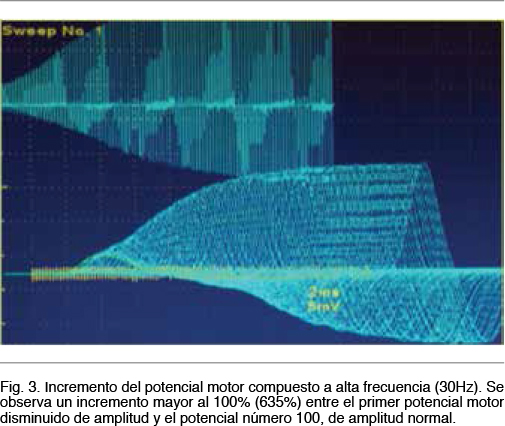
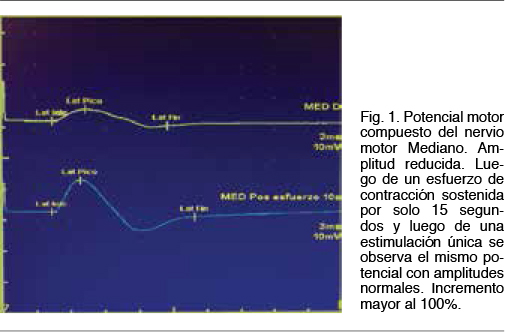
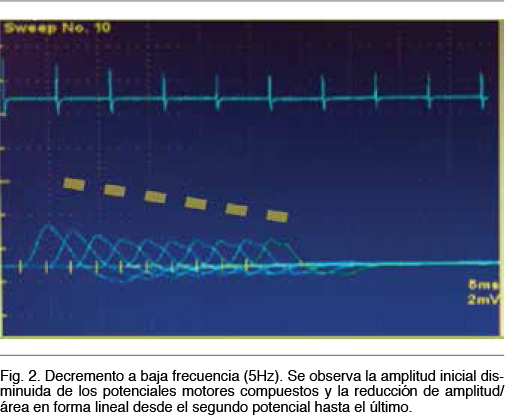
<body><![CDATA[<p class="CuerpoA" style="border: medium none ; text-align: justify; line-height: 120%;"><span style="font-size: 10pt; line-height: 120%; font-family: Verdana;" lang="ES-TRAD">Presentamos a continuaci&oacute;n un caso cl&iacute;nico, sus hallazgos neurofisiol&oacute;gicos, su discusi&oacute;n fisiopatol&oacute;gica y su tratamiento.</span><span style="font-size: 10pt; line-height: 120%; font-family: Verdana;" lang="ES-TRAD"><o:p></o:p></span></p>        <p class="CuerpoA" style="border: medium none ; text-align: justify; line-height: 120%;"><span style="font-size: 10pt; line-height: 120%; font-family: Verdana;" lang="ES-TRAD"><o:p>&nbsp;</o:p></span></p>        <p class="CuerpoA" style="border: medium none ; text-align: justify; line-height: 120%;"><b><span style="font-size: 14pt; line-height: 120%; font-family: Verdana;" lang="ES-TRAD">CASO CL&Iacute;NICO</span></b><b><span style="font-size: 14pt; line-height: 120%; font-family: Verdana;" lang="ES-TRAD"><o:p></o:p></span></b></p>        <p class="CuerpoA" style="border: medium none ; text-align: justify; line-height: 120%;"><span style="font-size: 10pt; line-height: 120%; font-family: Verdana;" lang="ES-TRAD"><o:p>&nbsp;</o:p></span></p>        <p class="CuerpoA" style="border: medium none ; text-align: justify; line-height: 120%;"><span style="font-size: 10pt; line-height: 120%; font-family: Verdana;" lang="ES-TRAD">Paciente de 41 a&ntilde;os de sexo masculino sano que presenta una historia de 1 a&ntilde;o de evoluci&oacute;n de s&iacute;ntomas sensitivos no sistematizables que se relatan como parestesias en 4 miembros. Adem&aacute;s debilidad muscular fluctuante que se acent&uacute;a con el ejercicio fisco y mejora con el reposo. Refiere disfunci&oacute;n er&eacute;ctil y eyaculaci&oacute;n precoz. En la evoluci&oacute;n el cuadro permanece estable y sin agregar s&iacute;ntomas o signos de participaci&oacute;n craneal. Niega s&iacute;ntomas extraneurol&oacute;gicos, antecedentes de tabaquismo o enfermedad neopl&aacute;sica. Niega repercusi&oacute;n general. </span><span style="font-size: 10pt; line-height: 120%; font-family: Verdana;" lang="ES-TRAD"><o:p></o:p></span></p>        <p class="CuerpoA" style="border: medium none ; text-align: justify; line-height: 120%;"><span style="font-size: 10pt; line-height: 120%; font-family: Verdana;" lang="ES-TRAD">Al examen f&iacute;sico presenta pares craneales normales. No cefaloparesia. A nivel espinal no se observa amiotrofia o actividad muscular espont&aacute;nea visible. Tono normal. Paresia generalizada, leve, a predominio proximal y de miembros inferiores sin fen&oacute;meno de apokamnosis. Arreflexia de los cuatro miembros. Cut&aacute;neo plantar en flexi&oacute;n. Coordinaci&oacute;n normal y sensibilidad normal. Examen de piel, mucosas y faneras normal. Linfoganglionar normal. Pleuropulmonar normal. Abdomen y fosas lumbares normales.</span><span style="font-size: 10pt; line-height: 120%; font-family: Verdana;" lang="ES-TRAD"><o:p></o:p></span></p>        <p class="CuerpoA" style="border: medium none ; text-align: justify; line-height: 120%;"><span style="font-size: 10pt; line-height: 120%; font-family: Verdana;" lang="ES-TRAD"><o:p>&nbsp;</o:p></span></p>        <p class="CuerpoA" style="text-align: justify; line-height: 120%;"><span style="font-size: 10pt; line-height: 120%; font-family: Verdana;" lang="ES-TRAD">Se realiza estudio de neuroconducci&oacute;n sensitivo - motora, electromiograma y estudio de transmisi&oacute;n neuromuscular repetitiva a baja y alta frecuencia.</span><span style="font-size: 10pt; line-height: 120%; font-family: Verdana;" lang="ES-TRAD"><o:p></o:p></span></p>        <p class="CuerpoA" style="text-align: justify; line-height: 120%;"><span style="font-size: 10pt; line-height: 120%; font-family: Verdana;" lang="ES-TRAD"><o:p>&nbsp;</o:p></span></p>        <p class="CuerpoA" style="text-align: justify; line-height: 120%;"><span style="font-size: 10pt; line-height: 120%; font-family: Verdana;" lang="ES-TRAD">Se observa una neuroconducci&oacute;n sensitiva con latencias distales, amplitudes y velocidades de conducci&oacute;n normales. El electromiograma fue normal. Del estudio de neuroconducci&oacute;n motora destacamos la presencia de potenciales motores bien configurados, de latencias normales, con velocidades de conducci&oacute;n motora normales y sin bloqueos de la conducci&oacute;n, pero con amplitudes reducidas en 4 miembros. Se realiza una breve contracci&oacute;n isom&eacute;trica de 15 segundos y se procede a la estimulaci&oacute;n motora nuevamente, observandose un incremento de la amplitud a rangos normales. El incremento de amplitud obtenido fue &gt; 100%<span style="">&nbsp; </span>para nervio motor Mediano (<a href="#figura_1">Figura 1</a>). En el estudio de transmisi&oacute;n neuromuscular repetitiva realizado en el nervio motor Cubital se observa un decremento en el tren de potenciales obtenidos a baja frecuencia (5Hz) en un 33% entre el primer potencial y el cuarto potencial y con una morfolog&iacute;a del tren en descenso lineal (<a href="#figura_2">Figura 2</a>). El cociente de decremento tard&iacute;o / decremento temprano fue de 102%. A alta frecuencia (30Hz) se observo un incremento de la amplitud de un 635% entre el primer potencial y el potencial n&uacute;mero 100 (<a href="#figura_3">Figura 3</a>).<span style=""></span></span></p>      ]]></body>
<body><![CDATA[<p class="CuerpoA" style="text-align: justify; line-height: 120%;"></p>      <p class="CuerpoA" style="text-align: justify; line-height: 120%;"><a name="figura_1"></a><img style="width: 505px; height: 332px;" alt="" src="/img/revistas/ami/v37n3/3a14f1.jpg"><span style="font-size: 10pt; line-height: 120%; font-family: Verdana;" lang="ES-TRAD"><span style=""> </span></span><span style="font-size: 10pt; line-height: 120%; font-family: Verdana;" lang="ES-TRAD"><o:p></o:p></span></p>        <p class="CuerpoA" style="text-align: justify; line-height: 120%;"><span style="font-size: 10pt; line-height: 120%; font-family: Verdana;" lang="ES-TRAD"><o:p>&nbsp;</o:p></span></p>      <p class="CuerpoA" style="text-align: justify; line-height: 120%;"><span style="font-size: 10pt; line-height: 120%; font-family: Verdana;" lang="ES-TRAD"><o:p></o:p></span></p>      <p class="CuerpoA" style="text-align: justify; line-height: 120%;"><span style="font-size: 10pt; line-height: 120%; font-family: Verdana;" lang="ES-TRAD"><o:p></o:p></span></p>      <p class="CuerpoA" style="text-align: justify; line-height: 120%;"><span style="font-size: 10pt; line-height: 120%; font-family: Verdana;" lang="ES-TRAD"><o:p></o:p></span></p>      <p class="CuerpoA" style="text-align: justify; line-height: 120%;"><a name="figura_2"></a><img style="width: 505px; height: 415px;" alt="" src="/img/revistas/ami/v37n3/3a14f2.jpg"><span style="font-size: 10pt; line-height: 120%; font-family: Verdana;" lang="ES-TRAD"><o:p></o:p></span></p>      <p class="CuerpoA" style="text-align: justify; line-height: 120%;"><span style="font-size: 10pt; line-height: 120%; font-family: Verdana;" lang="ES-TRAD"><o:p></o:p></span></p>      <p class="CuerpoA" style="text-align: justify; line-height: 120%;"><a name="figura_3"></a><img style="width: 505px; height: 426px;" alt="" src="/img/revistas/ami/v37n3/3a14f3.jpg"><span style="font-size: 10pt; line-height: 120%; font-family: Verdana;" lang="ES-TRAD"><o:p></o:p></span></p>      <p class="CuerpoA" style="text-align: justify; line-height: 120%;"><span style="font-size: 10pt; line-height: 120%; font-family: Verdana;" lang="ES-TRAD"><o:p></o:p></span></p>      ]]></body>
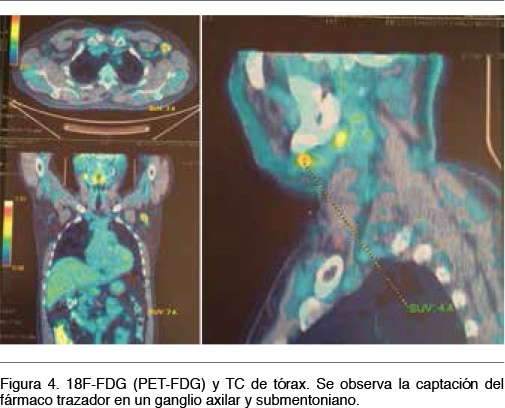
<body><![CDATA[<p class="CuerpoA" style="text-align: justify; line-height: 120%;"><span style="font-size: 10pt; line-height: 120%; font-family: Verdana;" lang="ES-TRAD"><o:p></o:p></span></p>        <p class="CuerpoA" style="text-align: justify; line-height: 120%;"><span style="font-size: 10pt; line-height: 120%; font-family: Verdana;" lang="ES-TRAD">Se realiza as&iacute; el diagn&oacute;stico cl&iacute;nico - electrofisiol&oacute;gico de S&iacute;ndrome Miast&eacute;nico de tipo presin&aacute;ptico y dentro de este subgrupo por sus caracter&iacute;sticas cl&iacute;nicas el de un LEMS. Se calcul&oacute; un Delta p- Score de 1. Hemograma, VES y enzimograma hep&aacute;tico normal. PEF normal. Se solicit&oacute; Rx de t&oacute;rax y tomograf&iacute;a de cuerpo entero. No se observan im&aacute;genes sugestivas de una neoplasia. Se realiza a continuaci&oacute;n tomografia por emisi&oacute;n de positrones con 18F-FDG (PET-FDG) observando adenopat&iacute;as m&uacute;ltiples (regiones cervicales, axilares, de mediastino y retroperineales), algunas de ellas hipermetabolicas (axilar izquierda, submaxilar derecha e inguinales bilaterales a predomionio izquierdo), donde se destaca por su tama&ntilde;o y nivel de captaci&oacute;n la axilar izquierda (<a href="#figura_4">Figura 4</a>). Se env&iacute;a al paciente para realizaci&oacute;n de biopsia diagn&oacute;stica del ganglio m&aacute;s accesible.</span><span style="font-size: 10pt; line-height: 120%; font-family: Verdana; color: rgb(255, 44, 33);" lang="ES-TRAD"> </span><span style="font-size: 10pt; line-height: 120%; font-family: Verdana;" lang="ES-TRAD">No se realizo dosificaci&oacute;n de los anticuerpos anti canales voltaje dependientes de calcio (VGCC tipo P/Q o tipo N) por no disponer de dicha t&eacute;cnica en nuestro pa&iacute;s.</span></p>      <p class="CuerpoA" style="text-align: justify; line-height: 120%;"></p>  <a name="figura_4"></a><img style="width: 505px; height: 408px;" alt="" src="/img/revistas/ami/v37n3/3a14f4.jpg">     <p class="CuerpoA" style="text-align: justify; line-height: 120%;"></p>      <p class="CuerpoA" style="text-align: justify; line-height: 120%;"><span style="font-size: 10pt; line-height: 120%; font-family: Verdana;" lang="ES-TRAD"></span><span style="font-size: 10pt; line-height: 120%; font-family: Verdana;" lang="ES-TRAD"><o:p></o:p></span></p>        <p class="CuerpoA" style="text-align: justify; line-height: 120%;"><span style="font-size: 10pt; line-height: 120%; font-family: Verdana;" lang="ES-TRAD"><o:p>&nbsp;</o:p></span></p>        <p class="CuerpoA" style="text-align: justify; line-height: 120%;"><span style="font-size: 10pt; line-height: 120%; font-family: Verdana;" lang="ES-TRAD">El paciente recibe como tratamiento sintom&aacute;tico Piridostigmina 60 mg v.o. en tres tomas diarias, con mejor&iacute;a sintom&aacute;tica del cuadro de debilidad. No es posible obtener en nuestro pa&iacute;s la 3-4 Diaminopiridina como tratamiento de elecci&oacute;n. Se mantiene en control para la b&uacute;squeda de neoplasia oculta. </span><span style="font-size: 10pt; line-height: 120%; font-family: Verdana;" lang="ES-TRAD"><o:p></o:p></span></p>        <p class="CuerpoA" style="text-align: justify; line-height: 120%;"><span style="font-size: 10pt; line-height: 120%; font-family: Verdana;" lang="ES-TRAD"><o:p>&nbsp;</o:p></span></p>        <p class="CuerpoA" style="text-align: justify; line-height: 120%;"><span style="font-size: 10pt; line-height: 120%; font-family: Verdana;" lang="ES-TRAD"><o:p>&nbsp;</o:p></span></p>        <p class="CuerpoA" style="text-align: justify; line-height: 120%;"><b><span style="font-size: 14pt; line-height: 120%; font-family: Verdana;" lang="ES-TRAD">DISCUSI&Oacute;N</span></b><b><span style="font-size: 14pt; line-height: 120%; font-family: Verdana;" lang="ES-TRAD"><o:p></o:p></span></b></p>        ]]></body>
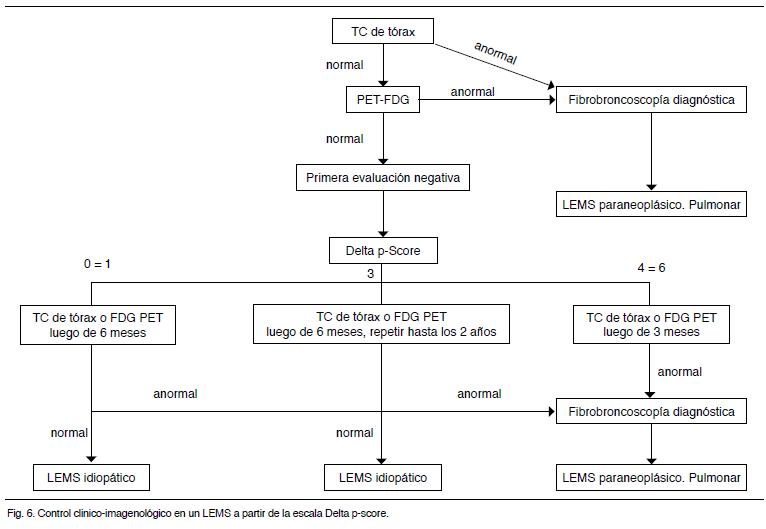
<body><![CDATA[<p class="CuerpoA" style="text-align: justify; line-height: 120%;"><span style="font-size: 10pt; line-height: 120%; font-family: Verdana;" lang="ES-TRAD"><o:p>&nbsp;</o:p></span></p>        <p class="CuerpoA" style="text-align: justify; line-height: 120%;"><span style="font-size: 10pt; line-height: 120%; font-family: Verdana;" lang="ES-TRAD">El LEMS es una de las enfermedades de la uni&oacute;n neuromuscular probablemente m&aacute;s<span style="">&nbsp; </span>subdiagn&oacute;sticada, es poco frecuente, con una incidencia estimada en 0,5 casos por mill&oacute;n/a&ntilde;o y una prevalencia de 3,4 casos por mill&oacute;n <sup>(<a href="#1">1</a>)</sup>. Fue descripta por Eaton y Lambert en el a&ntilde;o 1957. Es un defecto de la transmisi&oacute;n neuromuscular de tipo presin&aacute;ptico, de origen autoinmune, donde la existencia de anticuerpos anti canales voltaje dependientes de calcio impiden la entrada de este i&oacute;n a la terminal presinaptica axonal <sup>(<a href="#1">1</a>-<a href="#4">4</a>).</sup> El influjo normal de calcio ocurre cuando el potencial de acci&oacute;n de membrana arriba a la terminal ax&oacute;nica y genera la apertura de estos canales voltaje dependientes. El calcio ingresa al ax&oacute;n distal y promueve, con su uni&oacute;n a una serie de prote&iacute;nas citoplasm&aacute;ticas, la liberaci&oacute;n de Acetilcolina. La Acetilcolina asegura as&iacute; la depolarizaci&oacute;n de la membrana postsin&aacute;ptica muscular (neurotransmision quimica). Debemos destacar que el egreso de Acetilcolina se realiza de dos formas: 1) desde un compartimiento de movilizaci&oacute;n inmediata, pronto para su liberaci&oacute;n y 2) desde una reserva no disponible en forma inmediata pero de mayor cantidad de Acetilcolina <sup>(<a href="#5">5</a><a name="5."></a>, <a href="#6">6</a><a name="6."></a>).</sup> Es esta &uacute;ltima movilizaci&oacute;n de Acetilcolina la cual no se produce en el LEMS generando una falla en la neurotransmisi&oacute;n que explican los hallazgos cl&iacute;nicos y electrofisiol&oacute;gicos. La estimulaci&oacute;n a alta frecuencia o la contracci&oacute;n voluntaria y sostenida de breve duraci&oacute;n permiten una mayor entrada de calcio en la terminal presin&aacute;ptica resolviendo transitoriamente el defecto mencionado <sup>(<a href="#5">5</a>,<a href="#6">6</a>).</sup> La debilidad muscular afecta t&iacute;picamente el sector espinal, al inicio a predominio de miembros inferiores, en su sector proximal y de forma sim&eacute;trica. No comienza con una afectaci&oacute;n craneal, pero este sector puede verse afectado en la evoluci&oacute;n y en casos severos <sup>(<a href="#1">1</a>,<a href="#4">4</a>).</sup> Pacientes con LEMS pueden presentar hipo o arreflexia. Una manifestaci&oacute;n t&iacute;pica pero presente en solo un 40% de los pacientes (nuestro paciente no lo presentaba) es la aparici&oacute;n de los reflejos ostetendinosos y mejor&iacute;a de la fuerza muscular pos-ejercicio <sup>(<a href="#1">1</a>).</sup></span><span style="font-size: 10pt; line-height: 120%; font-family: Verdana;" lang="ES-TRAD"><o:p></o:p></span></p>        <p class="CuerpoA" style="text-align: justify; line-height: 120%;"><span style="font-size: 10pt; line-height: 120%; font-family: Verdana;" lang="ES-TRAD"><o:p>&nbsp;</o:p></span></p>        <p class="CuerpoA" style="text-align: justify; line-height: 120%;"><span style="font-size: 10pt; line-height: 120%; font-family: Verdana;" lang="ES-TRAD">El s&iacute;ndrome no es solo motor y</span><span style="font-size: 10pt; line-height: 120%; font-family: Verdana; color: rgb(241, 41, 34);" lang="ES-TRAD"> </span><span style="font-size: 10pt; line-height: 120%; font-family: Verdana;" lang="ES-TRAD">tambi&eacute;n ocurren s&iacute;ntomas a nivel auton&oacute;mico. Los s&iacute;ntomas m&aacute;s frecuentes son la boca seca y la disfunci&oacute;n er&eacute;ctil en el hombre. Otros s&iacute;ntomas menos comunes descriptos son: constipaci&oacute;n, hipotensi&oacute;n ortost&aacute;tica, ojos secos, alteraciones en la sudaci&oacute;n y disfunci&oacute;n en la micci&oacute;n <sub>(<a href="#1">1</a>).</sub> La exploraci&oacute;n cl&iacute;nica y electrofisiol&oacute;gica sensitiva som&aacute;tica es normal.</span><span style="font-size: 10pt; line-height: 120%; font-family: Verdana;" lang="ES-TRAD"><o:p></o:p></span></p>        <p class="CuerpoA" style="text-align: justify; line-height: 120%;"><span style="font-size: 10pt; line-height: 120%; font-family: Verdana;" lang="ES-TRAD"><o:p>&nbsp;</o:p></span></p>        <p class="CuerpoA" style="text-align: justify; line-height: 120%;"><span style="font-size: 10pt; line-height: 120%; font-family: Verdana;" lang="ES-TRAD">El diagn&oacute;stico de LEMS es dif&iacute;cil, debido a su forma de presentaci&oacute;n y evoluci&oacute;n lentamente progresiva. Los diagn&oacute;sticos err&oacute;neos incluyen desde miopat&iacute;as hasta patolog&iacute;a degenerativa de columna como la estenosis del canal lumbosacro. Cuando la afectaci&oacute;n ya compromete el sector craneal el diagnostico de Miastenia Gravis suele ser otro de los errores m&aacute;s comunes. Cabe destacar adem&aacute;s en este &uacute;ltimo caso, que la estimulaci&oacute;n repetitiva a baja frecuencia en ambas patolog&iacute;as demuestran un decremento del tren de potenciales motores, por lo cual su mala interpretaci&oacute;n puede colaborar al diagn&oacute;stico err&oacute;neo si solo se analiza este hecho <sup>(<a href="#2">2</a>).</sup> En la Miastenia Gravis los potenciales motores no son de baja amplitud y el perfil de descenso en la transmisi&oacute;n repetitiva a baja frecuencia es diferente y no hay anormalidades en la transmisi&oacute;n repetitiva a altas frecuencias como en el LEMS <sup>(<a href="#2">2</a>).</sup> </span><span style="font-size: 10pt; line-height: 120%; font-family: Verdana;" lang="ES-TRAD"><o:p></o:p></span></p>        <p class="CuerpoA" style="text-align: justify; line-height: 120%;"><span style="font-size: 10pt; line-height: 120%; font-family: Verdana;" lang="ES-TRAD"><o:p>&nbsp;</o:p></span></p>        <p class="CuerpoA" style="text-align: justify; line-height: 120%;"><span style="font-size: 10pt; line-height: 120%; font-family: Verdana;" lang="ES-TRAD">Para el diagnostico de LEMS es &uacute;til pero no imprescindible la dosificaci&oacute;n de anticuerpos VGCC tipo P/Q si bien estos pueden encontrarse en otras patolog&iacute;as paraneopl&aacute;sicas, aunque parad&oacute;jicamente su presencia no siempre indica un riesgo de neoplasia asociada <sup>(<a href="#1">1</a>, <a href="#4">4</a>, <a href="#7">7</a><a name="7."></a>).</sup> </span><span style="font-size: 10pt; line-height: 120%; font-family: Verdana;" lang="ES-TRAD"><o:p></o:p></span></p>        <p class="CuerpoA" style="text-align: justify; line-height: 120%;"><span style="font-size: 10pt; line-height: 120%; font-family: Verdana;" lang="ES-TRAD"><o:p>&nbsp;</o:p></span></p>        <p class="CuerpoA" style="text-align: justify; line-height: 120%;"><span style="font-size: 10pt; line-height: 120%; font-family: Verdana;" lang="ES-TRAD">El LEMS es cl&aacute;sicamente un s&iacute;ndrome paraneopl&aacute;sico, pero puede ser idiop&aacute;tico en el 40% de los casos. El tumor m&aacute;s frecuente es el pulmonar a c&eacute;lulas peque&ntilde;as. Se reportan casos secundarios a s&iacute;ndromes linfoproliferativos <sup>(<a href="#1">1</a>,<a href="#8">8</a><a name="8."></a>).</sup> El riesgo de un LEMS paraneopl&aacute;sico de origen pulmonar aumenta en mayores de 50 a&ntilde;os y tabaquistas. En estos casos pueden encontrarse como asociaci&oacute;n otros anticuerpos como el Hu. El &uml;Delta p-score&uml; es un puntaje que se calcula en un paciente con LEMS para determinar la probabilidad de presentar una neoplasia pulmonar asociado al momento del diagn&oacute;stico (<a href="/img/revistas/ami/v37n3/v3a14f5.jpg">Figura 5</a>) <sup>(<a href="#1">1</a>).</sup> La evaluaci&oacute;n imagenol&oacute;gica consiste en una tomograf&iacute;a de cuerpo entero y si esta es normal la realizaci&oacute;n de un PET - FDG <sup>(<a href="#1">1</a>,<a href="#9">9</a><a name="9."></a>).</sup> Si en la primera evaluaci&oacute;n de b&uacute;squeda de neoplasia es negativa, deber&aacute; realizarse un seguimiento durante los siguientes 5 a&ntilde;os, siendo los dos primeros a&ntilde;os donde se registra la mayor incidencia de estudios positivos. La frecuencia con que se repetir&aacute;n dichos estudios podr&aacute; sistematizarse mediante el Delta p-score (<a href="/img/revistas/ami/v37n3/3a14f6.jpg">Figura 6</a>).</span><span style="font-size: 10pt; line-height: 120%; font-family: Verdana;" lang="ES-TRAD"><o:p></o:p></span></p>        ]]></body>
<body><![CDATA[<p class="CuerpoA" style="text-align: justify; line-height: 120%;"><span style="font-size: 10pt; line-height: 120%; font-family: Verdana;" lang="ES-TRAD"><o:p>&nbsp;</o:p></span></p>        <p class="CuerpoA" style="text-align: justify; line-height: 120%;"><span style="font-size: 10pt; line-height: 120%; font-family: Verdana;" lang="ES-TRAD"><o:p>&nbsp;</o:p></span></p>        <p class="CuerpoA" style="text-align: justify; line-height: 120%;"><span style="font-size: 10pt; line-height: 120%; font-family: Verdana;" lang="ES-TRAD">El tratamiento es sintom&aacute;tico y etiopatog&eacute;nico. En los sintom&aacute;ticos se utiliza la piridostigmina via oral que promueve la inhibici&oacute;n de la enzima acetilcolinesterasa, o la 3,4 diaminopiridina via oral que promueve la inhibici&oacute;n de canales de potasio presin&aacute;pticos que provocan mayor liberaci&oacute;n de ves&iacute;culas de acetilcolina. Ambos tratamientos aumentan la disponibilidad de acetilcolina en la terminal postsin&aacute;ptica. En cuanto al tratamiento etiopatog&eacute;nico este subyace en la remoci&oacute;n de los anticuerpos a trav&eacute;s de inmunoglobulinas o plasmaferesis. Tambi&eacute;n pueden utilizarse inmunosupresores para inhibir la producci&oacute;n de los mismos. El tratamiento oncoespec&iacute;fico se realizar&aacute; una vez detectado la neoplasia en las formas de LEMS paraneopl&aacute;sicas.</span><span style="font-size: 10pt; line-height: 120%; font-family: Verdana;" lang="ES-TRAD"><o:p></o:p></span></p>        <p class="CuerpoA" style="text-align: justify; line-height: 120%;"><span style="font-size: 10pt; line-height: 120%; font-family: Verdana;" lang="ES-TRAD"><o:p>&nbsp;</o:p></span></p>        <p class="CuerpoA" style="text-align: justify; line-height: 120%;"><span style="font-size: 10pt; line-height: 120%; font-family: Verdana;" lang="ES-TRAD">La evoluci&oacute;n y pronostico depender&aacute;n de si se trate de un LEMS idiop&aacute;tico o paraneopl&aacute;sico.</span><span style="font-size: 10pt; line-height: 120%; font-family: Verdana;" lang="ES-TRAD"><o:p></o:p></span></p>        <p class="CuerpoA" style="text-align: justify; line-height: 120%;"><span style="font-size: 10pt; line-height: 120%; font-family: Verdana;" lang="ES-TRAD">Las formas severas requieren un tratamiento con inmunosupresores e IG o plasmaf&eacute;resis y en general se relacionan a formas paraneopl&aacute;sicas siendo habitualmente suficiente con el tratamiento<span style="">&nbsp; </span>sintom&aacute;tico en los casos idiop&aacute;ticos como en el paciente descrito.</span><span style="font-size: 10pt; line-height: 120%; font-family: Verdana;" lang="ES-TRAD"><o:p></o:p></span></p>        <p class="CuerpoA" style="text-align: justify; line-height: 120%;"><span style="font-size: 10pt; line-height: 120%; font-family: Verdana;" lang="ES-TRAD"><o:p>&nbsp;</o:p></span></p>        <p class="CuerpoA" style="text-align: justify; line-height: 120%;"><b><span style="font-size: 14pt; line-height: 120%; font-family: Verdana;" lang="ES-TRAD">CONCLUSIONES</span></b><b><span style="font-size: 14pt; line-height: 120%; font-family: Verdana;" lang="ES-TRAD"><o:p></o:p></span></b></p>        <p class="CuerpoA" style="text-align: justify; line-height: 120%;"><span style="font-size: 10pt; line-height: 120%; font-family: Verdana;" lang="ES-TRAD"><o:p>&nbsp;</o:p></span></p>        <p class="CuerpoA" style="text-align: justify; line-height: 120%;"><span style="font-size: 10pt; line-height: 120%; font-family: Verdana;" lang="ES-TRAD">El LEMS es una enfermedad poco frecuente y subdiagn&oacute;sticada. Se presenta bajo la asociaci&oacute;n de s&iacute;ntomas y signos motores y auton&oacute;micos.<span style="">&nbsp; </span>La neurofisiolog&iacute;a es una de las herramientas m&aacute;s &uacute;tiles en su diagn&oacute;stico por los hallazgos caracter&iacute;sticos m&aacute;s a&uacute;n cuando las t&eacute;cnicas de detecci&oacute;n de anticuerpos contra los canales voltaje dependiente de calcio no est&aacute;n disponibles. Es una enfermedad neurol&oacute;gica paraneopl&aacute;sica t&iacute;pica, existiendo casos idiop&aacute;ticos y su seguimiento debe ser no menor a 5 a&ntilde;os para la exclusi&oacute;n de una neoplasia, dentro de las cuales se impone el carcinoma pulmonar a c&eacute;lulas peque&ntilde;as. </span><span style="font-size: 10pt; line-height: 120%; font-family: Verdana;" lang="ES-TRAD"><o:p></o:p></span></p>        ]]></body>
<body><![CDATA[<p class="Cuerpo" style="text-align: justify; line-height: 120%;"><span style="font-size: 10pt; line-height: 120%; font-family: Verdana;"><o:p>&nbsp;</o:p></span></p>        <p class="Cuerpo" style="text-align: justify; line-height: 120%;"><span style="font-size: 10pt; line-height: 120%; font-family: Verdana;"><o:p>&nbsp;</o:p></span></p>        <p class="Cuerpo" style="text-align: justify; line-height: 120%;"><b><span style="font-size: 14pt; line-height: 120%; font-family: Verdana;">BIBLIOGRAFIA</span></b><span style="font-size: 14pt; line-height: 120%; font-family: Verdana;"><o:p></o:p></span></p>        <p class="Cuerpo" style="text-align: justify; line-height: 120%;"><span style="font-size: 10pt; line-height: 120%; font-family: Verdana;"><o:p>&nbsp;</o:p></span></p>        <!-- ref --><p class="Cuerpo" style="border: medium none ; margin-left: 18pt; text-align: justify; text-indent: -18pt; line-height: 120%;"><span style="font-size: 12pt; line-height: 120%; font-family: Arial;"><span style=""><a name="1"></a><a href="#1.">1</a>.<span style="font-family: &quot;Times New Roman&quot;; font-style: normal; font-variant: normal; font-weight: normal; font-size: 7pt; line-height: normal; font-size-adjust: none; font-stretch: normal;">&nbsp;&nbsp;&nbsp;&nbsp;&nbsp;&nbsp;</span></span></span><span style="font-size: 10pt; line-height: 120%; font-family: Verdana;">Titulaer MJ, Kang B, Verschuuren JJ. </span><span style="font-size: 10pt; line-height: 120%; font-family: Verdana;" lang="EN-US">Lambert - Eaton myasthenic syndrome: from clinical characteristics to therapeutic strategies. Lancet Neurol<span style="">&nbsp; </span>2011; 10: 1098-1107.    </span><span style="font-size: 10pt; line-height: 120%; font-family: Verdana;"><o:p></o:p></span></p>        <p class="Cuerpo" style="text-align: justify; line-height: 120%;"><span style="font-size: 10pt; line-height: 120%; font-family: Verdana;"><o:p>&nbsp;</o:p></span></p>        <!-- ref --><p class="Cuerpo" style="border: medium none ; margin-left: 18pt; text-align: justify; text-indent: -18pt; line-height: 120%;"><span style="font-size: 12pt; line-height: 120%; font-family: Arial;"><span style=""><a name="2"></a><a href="#2.">2</a>.<span style="font-family: &quot;Times New Roman&quot;; font-style: normal; font-variant: normal; font-weight: normal; font-size: 7pt; line-height: normal; font-size-adjust: none; font-stretch: normal;">&nbsp;&nbsp;&nbsp;&nbsp;&nbsp;&nbsp;</span></span></span><span style="font-size: 10pt; line-height: 120%; font-family: Verdana;" lang="EN-US">Sanders D, Cao L, Massey J, Juel V, Hobson-Webb L, Guptill J. Is the decremental pattern in Lambert - Eaton syndrome different from that in myasthenia gravis. </span><span style="font-size: 10pt; line-height: 120%; font-family: Verdana;" lang="EN-US">Clin Neurophysiol. 2014;125:1274-7</span><span style="font-size: 10pt;     line-height: 120%; font-family: Verdana;"><o:p></o:p></span></p>        <p class="Cuerpo" style="text-align: justify; line-height: 120%;"><span style="font-size: 10pt; line-height: 120%; font-family: Verdana;"><o:p>&nbsp;</o:p></span></p>        ]]></body>
<body><![CDATA[<!-- ref --><p class="Cuerpo" style="border: medium none ; margin-left: 18pt; text-align: justify; text-indent: -18pt; line-height: 120%;"><span style="font-size: 12pt; line-height: 120%; font-family: Arial;"><span style=""><a name="3"></a><a href="#3.">3</a>.<span style="font-family: &quot;Times New Roman&quot;; font-style: normal; font-variant: normal; font-weight: normal; font-size: 7pt; line-height: normal; font-size-adjust: none; font-stretch: normal;">&nbsp;&nbsp;&nbsp;&nbsp;&nbsp;&nbsp;</span></span></span><st1:place w:st="on"><span style="font-size: 10pt; line-height: 120%; font-family: Verdana;" lang="EN-US">Preston</span></st1:place><span style="font-size: 10pt; line-height: 120%; font-family: Verdana;" lang="EN-US"> D, Shapiro B. Neuromuscular Junction Disorders. Clinical - Electrophysiologic Correlations. In: <st1:place w:st="on">Preston</st1:place> D, editor. Electromiography and Neuromuscular Disorders. <st1:city w:st="on"><st1:place w:st="on">London</st1:place></st1:city>:<span style="">&nbsp; </span>Elsevier; 2013.pp. 529-548.    </span><span style="font-size: 10pt; line-height: 120%; font-family: Verdana;"><o:p></o:p></span></p>        <p class="Cuerpo" style="text-align: justify; line-height: 120%;"><span style="font-size: 10pt; line-height: 120%; font-family: Verdana;"><o:p>&nbsp;</o:p></span></p>        <!-- ref --><p class="Cuerpo" style="border: medium none ; margin-left: 18pt; text-align: justify; text-indent: -18pt; line-height: 120%;"><span style="font-size: 12pt; line-height: 120%; font-family: Arial;"><span style=""><a name="4"></a><a href="#4.">4</a>.<span style="font-family: &quot;Times New Roman&quot;; font-style: normal; font-variant: normal; font-weight: normal; font-size: 7pt; line-height: normal; font-size-adjust: none; font-stretch: normal;">&nbsp;&nbsp;&nbsp;&nbsp;&nbsp;&nbsp;</span></span></span><span style="font-size: 10pt; line-height: 120%; font-family: Verdana;" lang="EN-US">Zhang K, Liu W, Li Y, Zhang K, Gao X, Wang J. Mediastinal small cell cancer associated with Lambert-Eaton myasthenic syndrome: A case report. Exp Ther Med. 2015; 10: 117-120.    </span><span style="font-size: 10pt; line-height: 120%; font-family: Verdana;"><o:p></o:p></span></p>        <p class="Cuerpo" style="text-align: justify; line-height: 120%;"><span style="font-size: 10pt; line-height: 120%; font-family: Verdana;"><o:p>&nbsp;</o:p></span></p>        <!-- ref --><p class="Cuerpo" style="border: medium none ; margin-left: 18pt; text-align: justify; text-indent: -18pt; line-height: 120%;"><span style="font-size: 12pt; line-height: 120%; font-family: Arial;"><span style=""><a name="5"></a><a href="#5.">5</a>.<span style="font-family: &quot;Times New Roman&quot;; font-style: normal; font-variant: normal; font-weight: normal; font-size: 7pt; line-height: normal; font-size-adjust: none; font-stretch: normal;">&nbsp;&nbsp;&nbsp;&nbsp;&nbsp;&nbsp;</span></span></span><st1:place w:st="on"><span style="font-size: 10pt; line-height: 120%; font-family: Verdana;" lang="EN-US">Preston</span></st1:place><span style="font-size: 10pt; line-height: 120%; font-family: Verdana;" lang="EN-US"> D, Shapiro B. Fundamentals of Nerve Conduction Studies. Repetitive Nerve Stimulation. Preston D, editor. Electromiography and Neuromuscular Disorders. <st1:city w:st="on"><st1:place w:st="on">London</st1:place></st1:city>:<span style="">&nbsp; </span>Elsevier; 2013.pp. 52-61.    </span><span style="font-size: 10pt; line-height: 120%; font-family: Verdana;"><o:p></o:p></span></p>        <p class="Cuerpo" style="text-align: justify; line-height: 120%;"><span style="font-size: 10pt; line-height: 120%; font-family: Verdana;"><o:p>&nbsp;</o:p></span></p>        <p class="Cuerpo" style="border: medium none ; margin-left: 18pt; text-align: justify; text-indent: -18pt; line-height: 120%;"><span style="font-size: 12pt; line-height: 120%; font-family: Arial;"><span style=""><a name="6"></a><a href="#6.">6</a>.<span style="font-family: &quot;Times New Roman&quot;; font-style: normal; font-variant: normal; font-weight: normal; font-size: 7pt; line-height: normal; font-size-adjust: none; font-stretch: normal;">&nbsp;&nbsp;&nbsp;&nbsp;&nbsp;&nbsp;</span></span></span><span style="font-size: 10pt; line-height: 120%; font-family: Verdana;" lang="EN-US">Cherian A, Baheti N, Lype T. Electrophysiological study in neuromuscular junction disorders. Ann Indian Acad Neurol. 2013; 16: 34</span><span style="font-size: 10pt; line-height: 120%; font-family: Verdana;">&ndash;</span><span style="font-size: 10pt; line-height: 120%; font-family: Verdana;">41.</span><span style="font-size: 10pt; line-height: 120%; font-family: Verdana;"><o:p></o:p></span></p>        ]]></body>
<body><![CDATA[<p class="Cuerpo" style="text-align: justify; line-height: 120%;"><span style="font-size: 10pt; line-height: 120%; font-family: Verdana;"><o:p>&nbsp;</o:p></span></p>        <!-- ref --><p class="Cuerpo" style="border: medium none ; margin-left: 18pt; text-align: justify; text-indent: -18pt; line-height: 120%;"><span style="font-size: 12pt; line-height: 120%; font-family: Arial;"><span style=""><a name="7"></a><a href="#7.">7</a>.<span style="font-family: &quot;Times New Roman&quot;; font-style: normal; font-variant: normal; font-weight: normal; font-size: 7pt; line-height: normal; font-size-adjust: none; font-stretch: normal;">&nbsp;&nbsp;&nbsp;&nbsp;&nbsp;&nbsp;</span></span></span><span style="font-size: 10pt; line-height: 120%; font-family: Verdana;" lang="DE">Bekircan-Kurt C, </span><span style="font-size: 10pt; line-height: 120%; font-family: Verdana;" lang="EN-US">&Ccedil;</span><span style="font-size: 10pt; line-height: 120%; font-family: Verdana;" lang="EN-US">ift</span><span style="font-size: 10pt; line-height: 120%; font-family: Verdana;" lang="EN-US">&ccedil;</span><span style="font-size: 10pt; line-height: 120%; font-family: Verdana;" lang="EN-US">i E, Kurne A, Anlar B. Voltage gated calcium channel antibody-related neurological diseases. World J Clin Cases 2015; 3: 293-300.    </span><span style="font-size: 10pt; line-height: 120%; font-family: Verdana;"><o:p></o:p></span></p>        <p class="Cuerpo" style="text-align: justify; line-height: 120%;"><span style="font-size: 10pt; line-height: 120%; font-family: Verdana;"><o:p>&nbsp;</o:p></span></p>        <p class="Cuerpo" style="border: medium none ; margin-left: 18pt; text-align: justify; text-indent: -18pt; line-height: 120%;"><span style="font-size: 12pt; line-height: 120%; font-family: Arial;" lang="EN-US"><span style=""><a name="8"></a><a href="#8.">8</a>.<span style="font-family: &quot;Times New Roman&quot;; font-style: normal; font-variant: normal; font-weight: normal; font-size: 7pt; line-height: normal; font-size-adjust: none; font-stretch: normal;">&nbsp;&nbsp;&nbsp;&nbsp;&nbsp;&nbsp;</span></span></span><span style="font-size: 10pt; line-height: 120%; font-family: Verdana;" lang="DE">Graus F, Ari</span><span style="font-size: 10pt; line-height: 120%; font-family: Verdana;" lang="EN-US">&ntilde;</span><span style="font-size: 10pt; line-height: 120%; font-family: Verdana;" lang="EN-US">o H,<span style="">&nbsp; </span>Dalmau J. Paraneoplastic neurological syndromes in Hodgkin and non-Hodgkin lymphomas. Blood 2014; 123: 3230</span><span style="font-size: 10pt; line-height: 120%; font-family: Verdana;" lang="EN-US">&ndash;</span><span style="font-size: 10pt; line-height: 120%; font-family: Verdana;" lang="EN-US">38.<o:p></o:p></span></p>        <p class="Prrafodelista"><span style="font-size: 10pt; font-family: Verdana;" lang="EN-US"><o:p>&nbsp;</o:p></span></p>        <!-- ref --><p class="Cuerpo" style="border: medium none ; margin-left: 18pt; text-align: justify; text-indent: -18pt; line-height: 120%;"><span style="font-size: 12pt; line-height: 120%; font-family: Arial;"><span style=""><a name="9"></a><a href="#9.">9</a>.<span style="font-family: &quot;Times New Roman&quot;; font-style: normal; font-variant: normal; font-weight: normal; font-size: 7pt; line-height: normal; font-size-adjust: none; font-stretch: normal;">&nbsp;&nbsp;&nbsp;&nbsp;&nbsp;&nbsp;</span></span></span><span style="font-size: 10pt; line-height: 120%; font-family: Verdana;" lang="EN-US">Braatz V, Kay C, Lorenzoni P, Ludwig B, Junior MM, Ioshii S, et al. Fluoro-2-deoxy-D-glucose positron emission tomography/computed tomography imaging in the investigation of Lambert Eaton myasthenic syndrome. Arq Neuropsiquiatr. 2013; 71: 643-644.    </span><span style="font-size: 10pt; line-height: 120%; font-family: Verdana;"><o:p></o:p></span></p>        <p class="Cuerpo" style="text-align: justify; line-height: 120%;"><b><span style="font-family: Arial;" lang="EN-US"><o:p>&nbsp;</o:p></span></b></p>    </div>         ]]></body><back>
<ref-list>
<ref id="B1">
<label>1</label><nlm-citation citation-type="journal">
<person-group person-group-type="author">
<name>
<surname><![CDATA[Titulaer]]></surname>
<given-names><![CDATA[MJ]]></given-names>
</name>
<name>
<surname><![CDATA[Kang]]></surname>
<given-names><![CDATA[B]]></given-names>
</name>
<name>
<surname><![CDATA[Verschuuren]]></surname>
<given-names><![CDATA[JJ]]></given-names>
</name>
</person-group>
<article-title xml:lang="en"><![CDATA[Lambert - Eaton myasthenic syndrome: from clinical characteristics to therapeutic strategies]]></article-title>
<source><![CDATA[Lancet Neurol]]></source>
<year>2011</year>
<volume>10</volume>
<page-range>1098-1107</page-range></nlm-citation>
</ref>
<ref id="B2">
<label>2</label><nlm-citation citation-type="journal">
<person-group person-group-type="author">
<name>
<surname><![CDATA[Sanders]]></surname>
<given-names><![CDATA[D]]></given-names>
</name>
<name>
<surname><![CDATA[Cao]]></surname>
<given-names><![CDATA[L]]></given-names>
</name>
<name>
<surname><![CDATA[Massey]]></surname>
<given-names><![CDATA[J]]></given-names>
</name>
<name>
<surname><![CDATA[Juel]]></surname>
<given-names><![CDATA[V]]></given-names>
</name>
<name>
<surname><![CDATA[Hobson-Webb]]></surname>
<given-names><![CDATA[L]]></given-names>
</name>
<name>
<surname><![CDATA[Guptill]]></surname>
<given-names><![CDATA[J]]></given-names>
</name>
</person-group>
<article-title xml:lang="en"><![CDATA[Is the decremental pattern in Lambert - Eaton syndrome different from that in myasthenia gravis]]></article-title>
<source><![CDATA[Clin Neurophysiol]]></source>
<year>2014</year>
<volume>125</volume>
<page-range>1274-7</page-range></nlm-citation>
</ref>
<ref id="B3">
<label>3</label><nlm-citation citation-type="book">
<person-group person-group-type="author">
<name>
<surname><![CDATA[Preston]]></surname>
<given-names><![CDATA[D]]></given-names>
</name>
<name>
<surname><![CDATA[Shapiro]]></surname>
<given-names><![CDATA[B]]></given-names>
</name>
</person-group>
<article-title xml:lang="en"><![CDATA[Neuromuscular Junction Disorders: Clinical - Electrophysiologic Correlations]]></article-title>
<person-group person-group-type="editor">
<name>
<surname><![CDATA[Preston]]></surname>
<given-names><![CDATA[D]]></given-names>
</name>
</person-group>
<source><![CDATA[Electromiography and Neuromuscular Disorders]]></source>
<year>2013</year>
<page-range>529-548</page-range><publisher-loc><![CDATA[London ]]></publisher-loc>
<publisher-name><![CDATA[Elsevier]]></publisher-name>
</nlm-citation>
</ref>
<ref id="B4">
<label>4</label><nlm-citation citation-type="journal">
<person-group person-group-type="author">
<name>
<surname><![CDATA[Zhang]]></surname>
<given-names><![CDATA[K]]></given-names>
</name>
<name>
<surname><![CDATA[Liu]]></surname>
<given-names><![CDATA[W]]></given-names>
</name>
<name>
<surname><![CDATA[Li]]></surname>
<given-names><![CDATA[Y]]></given-names>
</name>
<name>
<surname><![CDATA[Zhang]]></surname>
<given-names><![CDATA[K]]></given-names>
</name>
<name>
<surname><![CDATA[Gao]]></surname>
<given-names><![CDATA[X]]></given-names>
</name>
<name>
<surname><![CDATA[Wang]]></surname>
<given-names><![CDATA[J]]></given-names>
</name>
</person-group>
<article-title xml:lang="en"><![CDATA[Mediastinal small cell cancer associated with Lambert-Eaton myasthenic syndrome: A case report]]></article-title>
<source><![CDATA[Exp Ther Med.]]></source>
<year>2015</year>
<volume>10</volume>
<page-range>117-120</page-range></nlm-citation>
</ref>
<ref id="B5">
<label>5</label><nlm-citation citation-type="book">
<person-group person-group-type="author">
<name>
<surname><![CDATA[Preston]]></surname>
<given-names><![CDATA[D]]></given-names>
</name>
<name>
<surname><![CDATA[Shapiro]]></surname>
<given-names><![CDATA[B]]></given-names>
</name>
</person-group>
<source><![CDATA[Fundamentals of Nerve Conduction Studies: Repetitive Nerve StimulationElectromiography and Neuromuscular Disorders]]></source>
<year>2013</year>
<page-range>52-61</page-range><publisher-loc><![CDATA[London ]]></publisher-loc>
<publisher-name><![CDATA[Elsevier]]></publisher-name>
</nlm-citation>
</ref>
<ref id="B6">
<label>6</label><nlm-citation citation-type="journal">
<person-group person-group-type="author">
<name>
<surname><![CDATA[Cherian]]></surname>
<given-names><![CDATA[A]]></given-names>
</name>
<name>
<surname><![CDATA[Baheti]]></surname>
<given-names><![CDATA[N]]></given-names>
</name>
<name>
<surname><![CDATA[Lype]]></surname>
<given-names><![CDATA[T]]></given-names>
</name>
</person-group>
<article-title xml:lang="en"><![CDATA[Electrophysiological study in neuromuscular junction disorders]]></article-title>
<source><![CDATA[Ann Indian Acad Neurol.]]></source>
<year>2013</year>
<volume>16</volume>
<page-range>34-41</page-range></nlm-citation>
</ref>
<ref id="B7">
<label>7</label><nlm-citation citation-type="journal">
<person-group person-group-type="author">
<name>
<surname><![CDATA[Bekircan-Kurt]]></surname>
<given-names><![CDATA[C]]></given-names>
</name>
<name>
<surname><![CDATA[Çiftçi]]></surname>
<given-names><![CDATA[E]]></given-names>
</name>
<name>
<surname><![CDATA[Kurne]]></surname>
<given-names><![CDATA[A]]></given-names>
</name>
<name>
<surname><![CDATA[Anlar]]></surname>
<given-names><![CDATA[B]]></given-names>
</name>
</person-group>
<article-title xml:lang="en"><![CDATA[Voltage gated calcium channel antibody-related neurological diseases]]></article-title>
<source><![CDATA[World J Clin Cases]]></source>
<year>2015</year>
<volume>3</volume>
<page-range>293-300</page-range></nlm-citation>
</ref>
<ref id="B8">
<label>8</label><nlm-citation citation-type="journal">
<person-group person-group-type="author">
<name>
<surname><![CDATA[Graus]]></surname>
<given-names><![CDATA[F]]></given-names>
</name>
<name>
<surname><![CDATA[Ariño]]></surname>
<given-names><![CDATA[H]]></given-names>
</name>
<name>
<surname><![CDATA[Dalmau]]></surname>
<given-names><![CDATA[J]]></given-names>
</name>
</person-group>
<article-title xml:lang="en"><![CDATA[Paraneoplastic neurological syndromes in Hodgkin and non-Hodgkin lymphomas]]></article-title>
<source><![CDATA[Blood]]></source>
<year>2014</year>
<volume>123</volume>
<page-range>3230-38</page-range></nlm-citation>
</ref>
<ref id="B9">
<label>9</label><nlm-citation citation-type="journal">
<person-group person-group-type="author">
<name>
<surname><![CDATA[Braatz]]></surname>
<given-names><![CDATA[V]]></given-names>
</name>
<name>
<surname><![CDATA[Kay]]></surname>
<given-names><![CDATA[C]]></given-names>
</name>
<name>
<surname><![CDATA[Lorenzoni]]></surname>
<given-names><![CDATA[P]]></given-names>
</name>
<name>
<surname><![CDATA[Ludwig]]></surname>
<given-names><![CDATA[B]]></given-names>
</name>
<name>
<surname><![CDATA[Junior]]></surname>
<given-names><![CDATA[MM]]></given-names>
</name>
<name>
<surname><![CDATA[Ioshii]]></surname>
<given-names><![CDATA[S]]></given-names>
</name>
</person-group>
<article-title xml:lang="en"><![CDATA[Fluoro-2-deoxy-D-glucose positron emission tomography/computed tomography imaging in the investigation of Lambert Eaton myasthenic syndrome]]></article-title>
<source><![CDATA[Arq Neuropsiquiatr]]></source>
<year>2013</year>
<volume>71</volume>
<page-range>643-644</page-range></nlm-citation>
</ref>
</ref-list>
</back>
</article>