<?xml version="1.0" encoding="ISO-8859-1"?><article xmlns:mml="http://www.w3.org/1998/Math/MathML" xmlns:xlink="http://www.w3.org/1999/xlink" xmlns:xsi="http://www.w3.org/2001/XMLSchema-instance">
<front>
<journal-meta>
<journal-id>1688-423X</journal-id>
<journal-title><![CDATA[Archivos de Medicina Interna]]></journal-title>
<abbrev-journal-title><![CDATA[Arch Med Int]]></abbrev-journal-title>
<issn>1688-423X</issn>
<publisher>
<publisher-name><![CDATA[Sociedad de Medicina Interna del Uruguay]]></publisher-name>
</publisher>
</journal-meta>
<article-meta>
<article-id>S1688-423X2015000300004</article-id>
<title-group>
<article-title xml:lang="es"><![CDATA[Abscesos de hipófisis: presentación de dos casos clínicos y revisión de la literatura]]></article-title>
<article-title xml:lang="en"><![CDATA[Pituitary abscess: two cases assisted and review of the literature is presented]]></article-title>
</title-group>
<contrib-group>
<contrib contrib-type="author">
<name>
<surname><![CDATA[Graña]]></surname>
<given-names><![CDATA[Diego]]></given-names>
</name>
<xref ref-type="aff" rid="A01"/>
</contrib>
<contrib contrib-type="author">
<name>
<surname><![CDATA[Ponce de León]]></surname>
<given-names><![CDATA[Carolina]]></given-names>
</name>
</contrib>
<contrib contrib-type="author">
<name>
<surname><![CDATA[Perendones]]></surname>
<given-names><![CDATA[Mercedes]]></given-names>
</name>
<xref ref-type="aff" rid="A01"/>
</contrib>
<contrib contrib-type="author">
<name>
<surname><![CDATA[Dufrechou]]></surname>
<given-names><![CDATA[Carlos]]></given-names>
</name>
<xref ref-type="aff" rid="A01"/>
</contrib>
</contrib-group>
<aff id="A01">
<institution><![CDATA[,Universidad de la República (UdelaR) Hospital Pasteur Clínica Médica 2]]></institution>
<addr-line><![CDATA[ ]]></addr-line>
</aff>
<pub-date pub-type="pub">
<day>00</day>
<month>11</month>
<year>2015</year>
</pub-date>
<pub-date pub-type="epub">
<day>00</day>
<month>11</month>
<year>2015</year>
</pub-date>
<volume>37</volume>
<numero>3</numero>
<fpage>122</fpage>
<lpage>126</lpage>
<copyright-statement/>
<copyright-year/>
<self-uri xlink:href="http://www.scielo.edu.uy/scielo.php?script=sci_arttext&amp;pid=S1688-423X2015000300004&amp;lng=en&amp;nrm=iso"></self-uri><self-uri xlink:href="http://www.scielo.edu.uy/scielo.php?script=sci_abstract&amp;pid=S1688-423X2015000300004&amp;lng=en&amp;nrm=iso"></self-uri><self-uri xlink:href="http://www.scielo.edu.uy/scielo.php?script=sci_pdf&amp;pid=S1688-423X2015000300004&amp;lng=en&amp;nrm=iso"></self-uri><abstract abstract-type="short" xml:lang="es"><p><![CDATA[Resumen: El absceso de hipófisis es una enfermedad poco frecuente, constituye menos del 1% de la patología selar, con alta dificultad diagnóstica, clínica poco orientadora, imagenología inespecífica y necesidad de cirugía diagnóstico-terapéutica en gran número de casos. Se denominan primarios cuando asientan en una glándula sana, y secundarios cuando la misma tiene una enfermedad preexistente. La infección se desarrolla por vía hematógena, por contigüidad o por mecanismos no evidentes. La resolución debe ser urgente ya que el curso es impredecible. Se presentan dos casos clínicos asistidos en el transcurso de un año y se realiza revisión de la literatura.]]></p></abstract>
<abstract abstract-type="short" xml:lang="en"><p><![CDATA[ABSTRACT: Pituitary abscess is a rare disease, is less than 1% of the sellar pathology, with high diagnostic difficulty, little clinical counselor, nonspecific imaging and diagnostic- therapeutic need surgery in many cases. Are called primary when seated in a healthy, and secondary when the same side gland has a preexisting condition. The infection develops through the blood, contiguous or non-obvious mechanisms. The resolution must be urgently because the course is rarely. Two cases assisted in the course of a year and review of the literature is presented.]]></p></abstract>
<kwd-group>
<kwd lng="es"><![CDATA[: Absceso de hipófisis]]></kwd>
<kwd lng="es"><![CDATA[infección intracraneana]]></kwd>
<kwd lng="en"><![CDATA[Pituitary abscess]]></kwd>
<kwd lng="en"><![CDATA[intracraneal infection]]></kwd>
</kwd-group>
</article-meta>
</front><body><![CDATA[ <div class="Section1">      <p class="Seccin"><span style="font-size: 10pt; font-family: Verdana;" lang="ES-TRAD">Caso Cl&iacute;nico de Inter&eacute;s<o:p></o:p></span></p>       <p class="MsoNormal" style="text-align: center;" align="center"><b style=""><span style="font-size: 14pt; line-height: 115%; font-family: Verdana;" lang="ES-UY"><o:p>&nbsp;</o:p></span></b></p>       <p class="MsoNormal" style="text-align: center;" align="center"><b style=""><span style="font-size: 14pt; line-height: 115%; font-family: Verdana;" lang="ES-UY">Abscesos de hip&oacute;fisis: presentaci&oacute;n de dos casos cl&iacute;nicos y revisi&oacute;n de la literatura</span></b></p>       <p class="MsoNormal" style="margin-bottom: 0.0001pt; text-align: center;" align="center"><span lang="ES-UY"><o:p>&nbsp;</o:p></span></p>       <p class="MsoNormal" style="margin-bottom: 0.0001pt; text-align: center;" align="center"><span class="hps"><b style=""><span style="font-size: 12pt; line-height: 115%; font-family: Verdana; color: rgb(34, 34, 34);" lang="EN-US">Pituitary abscess: two cases assisted and review of the literature is presented</span></b></span><span style="font-size: 10pt; line-height: 115%; font-family: Verdana;" lang="EN-US"><o:p></o:p></span></p>       <p class="MsoNormal" style="text-align: justify;"><span style="font-size: 10pt; line-height: 115%; font-family: Verdana;" lang="EN-US"><o:p>&nbsp;</o:p></span></p>       <p class="autor"><span style="font-size: 10pt; line-height: 120%; font-family: Verdana;" lang="ES-TRAD">Dr. Diego Gra&ntilde;a<o:p></o:p></span></p>       <p class="autor"><span style="font-size: 10pt; line-height: 120%; font-family: Verdana; font-weight: normal;" lang="ES-TRAD">Asistente Cl&iacute;nica M&eacute;dica. <o:p></o:p></span></p>       <p class="autor"><span style="font-size: 10pt; line-height: 120%; font-family: Verdana;" lang="ES-TRAD"><o:p>&nbsp;</o:p></span></p>       ]]></body>
<body><![CDATA[<p class="autor"><span style="font-size: 10pt; line-height: 120%; font-family: Verdana;" lang="ES-TRAD">Dra. Carolina Ponce de Le&oacute;n<o:p></o:p></span></p>       <p class="autor"><span style="font-size: 10pt; line-height: 120%; font-family: Verdana; font-weight: normal;" lang="ES-TRAD">Residente Medicina Interna.</span><span style="font-size: 10pt; line-height: 120%; font-family: Verdana;" lang="ES-TRAD"><o:p></o:p></span></p>       <p class="autor"><span style="font-size: 10pt; line-height: 120%; font-family: Verdana;" lang="ES-TRAD"><o:p>&nbsp;</o:p></span></p>       <p class="autor"><span style="font-size: 10pt; line-height: 120%; font-family: Verdana;" lang="ES-TRAD">Dra. Mercedes <span class="SpellE">Perendones</span><o:p></o:p></span></p>       <p class="autor"><span style="font-size: 10pt; line-height: 120%; font-family: Verdana; font-weight: normal;" lang="ES-TRAD">Profesor Adjunto Cl&iacute;nica M&eacute;dica. </span><span style="font-size: 10pt; line-height: 120%; font-family: Verdana;" lang="ES-TRAD"><o:p></o:p></span></p>       <p class="autor"><span style="font-size: 10pt; line-height: 120%; font-family: Verdana;" lang="ES-TRAD"><o:p>&nbsp;</o:p></span></p>       <p class="autor"><span style="font-size: 10pt; line-height: 120%; font-family: Verdana;" lang="ES-TRAD">Dr. Carlos <span class="SpellE">Dufrechou</span><o:p></o:p></span></p>       <p class="autor"><span style="font-size: 10pt; line-height: 120%; font-family: Verdana; font-weight: normal;" lang="ES-TRAD">Profesor Cl&iacute;nica M&eacute;dica</span><span style="font-size: 10pt; line-height: 120%; font-family: Verdana;" lang="ES-TRAD"><o:p></o:p></span></p>       <p class="autor"><span style="font-size: 10pt; line-height: 120%; font-family: Verdana;" lang="ES-TRAD"><o:p>&nbsp;</o:p></span></p>       <p class="autor"><span style="font-size: 10pt; line-height: 120%; font-family: Verdana;" lang="ES-TRAD"><o:p>&nbsp;</o:p></span></p>       ]]></body>
<body><![CDATA[<p class="Helve7"><b style=""><span style="font-size: 10pt; font-family: Verdana;" lang="ES-TRAD">Recibido:</span></b><span style="font-size: 10pt; font-family: Verdana;" lang="ES-TRAD"> 29/04/15 - <b style="">Aceptado:</b> 28/08/15<o:p></o:p></span></p>       <p class="Helve7"><b style=""><span style="font-size: 10pt; font-family: Verdana;" lang="ES-TRAD">Instituci&oacute;n responsable:</span></b><span style="font-size: 10pt; font-family: Verdana;" lang="ES-TRAD"> Cl&iacute;nica M&eacute;dica 2 (Facultad de Medicina - <span class="SpellE">UdelaR</span>). Hospital Pasteur. <o:p></o:p></span></p>       <p style="margin-bottom: 0.0001pt; text-align: justify;"><b style=""><span style="font-size: 10pt; font-family: Verdana;" lang="ES-UY">Correspondencia:</span></b><span style="font-size: 10pt; font-family: Verdana;" lang="ES-UY"> Dr. Diego Gra&ntilde;a. Hervidero 2932. Montevideo, Uruguay. CP 11700.</span><span style="font-size: 10pt; font-family: Verdana;" lang="ES-UY"> Correo electr&oacute;nico: diegograna@adinet.com.uy<o:p></o:p></span></p>       <p class="Helve7"><span style="font-size: 10pt; font-family: Verdana;" lang="ES-UY"><o:p>&nbsp;</o:p></span></p>       <p class="MsoNormal"><span style="font-size: 10pt; line-height: 115%; font-family: Verdana;" lang="ES-UY"><o:p>&nbsp;</o:p></span></p>       <p class="MsoNormal"><span style="font-size: 10pt; line-height: 115%; font-family: Verdana;" lang="ES-UY">Resumen: <span class="SpellE">Arch</span> <span class="SpellE">Med</span> Interna 37(3):<o:p></o:p></span></p>       <p style="margin: 0cm 0cm 0.0001pt; text-align: justify;"><span style="font-size: 10pt; font-family: Verdana;" lang="ES-UY">El absceso de hip&oacute;fisis es una enfermedad poco frecuente, constituye menos del 1% de la patolog&iacute;a <span class="SpellE">selar</span>, con alta dificultad diagn&oacute;stica, cl&iacute;nica poco orientadora, <o:p></o:p></span></p>       <p style="margin: 0cm 0cm 0.0001pt; text-align: justify;"><span class="SpellE"><span style="font-size: 10pt; font-family: Verdana;" lang="ES-UY">imagenolog&iacute;a</span></span><span style="font-size: 10pt; font-family: Verdana;" lang="ES-UY"> inespec&iacute;fica y necesidad de cirug&iacute;a diagn&oacute;stico-terap&eacute;utica en gran <o:p></o:p></span></p>       <p style="margin: 0cm 0cm 0.0001pt; text-align: justify;"><span style="font-size: 10pt; font-family: Verdana;" lang="ES-UY">n&uacute;mero de casos. Se denominan primarios cuando asientan en una gl&aacute;ndula sana, y secundarios cuando la misma tiene una enfermedad preexistente. La infecci&oacute;n se <o:p></o:p></span></p>       <p style="margin: 0cm 0cm 0.0001pt; text-align: justify;"><span style="font-size: 10pt; font-family: Verdana;" lang="ES-UY">desarrolla por v&iacute;a <span class="SpellE">hemat&oacute;gena</span>, por contig&uuml;idad o por mecanismos no evidentes. La <o:p></o:p></span></p>       ]]></body>
<body><![CDATA[<p style="margin: 0cm 0cm 0.0001pt; text-align: justify;"><span style="font-size: 10pt; font-family: Verdana;" lang="ES-UY">resoluci&oacute;n debe ser urgente ya que el curso es impredecible. Se presentan dos casos cl&iacute;nicos asistidos en el transcurso de un a&ntilde;o y se realiza revisi&oacute;n de la literatura.<o:p></o:p></span></p>       <p style="margin: 0cm 0cm 0.0001pt; text-align: justify;"><span style="font-size: 10pt; font-family: Verdana;" lang="ES-UY"><o:p>&nbsp;</o:p></span></p>       <p class="MsoNormal" style="margin-bottom: 0.0001pt; text-align: justify;"><i><span style="font-size: 10pt; line-height: 115%; font-family: Verdana;" lang="ES-UY">Palabras clave: Absceso de hip&oacute;fisis, infecci&oacute;n <span class="SpellE">intracraneana</span>.<o:p></o:p></span></i></p>       <p class="MsoNormal" style="margin-bottom: 0.0001pt; text-align: justify;"><i><span style="font-size: 10pt; line-height: 115%; font-family: Verdana;" lang="ES-UY"><o:p>&nbsp;</o:p></span></i></p>       <p class="MsoNormal" style="margin-bottom: 0.0001pt; text-align: justify;"><span style="font-size: 10pt; line-height: 115%; font-family: Verdana;" lang="EN-US">ABSTRACT: Arch Med <span class="SpellE">Interna</span> 37(3):</span><span style="" lang="EN-US"><o:p></o:p></span></p>       <p class="MsoNormal" style="margin-bottom: 0.0001pt; text-align: justify;"><span style="" lang="EN-US"><o:p>&nbsp;</o:p></span></p>       <p class="MsoNormal" style="margin-bottom: 0.0001pt; text-align: justify;"><span class="hps"><span style="font-size: 10pt; line-height: 115%; font-family: Verdana; color: rgb(34, 34, 34);" lang="EN-US">Pituitary</span></span><span style="font-size: 10pt; line-height: 115%; font-family: Verdana; color: rgb(34, 34, 34);" lang="EN-US"> <span class="hps">abscess</span> <span class="hps">is</span> <span class="hps">a rare disease</span>, is <span class="hps">less than 1%</span> <span class="hps">of the <span class="SpellE">sellar</span></span> <span class="hps">pathology,</span> <span class="hps">with</span> <span class="hps">high</span> <span class="hps"><o:p></o:p></span></span></p>       <p class="MsoNormal" style="margin-bottom: 0.0001pt; text-align: justify;"><span class="hps"><span style="font-size: 10pt; line-height: 115%; font-family: Verdana; color: rgb(34, 34, 34);" lang="EN-US">diagnostic difficulty</span></span><span style="font-size: 10pt; line-height: 115%; font-family: Verdana; color: rgb(34, 34, 34);" lang="EN-US">, <span class="hps">little</span> <span class="hps">clinical</span> <span class="hps">counselor</span>, nonspecific <span class="hps">imaging and</span> <span class="hps">diagnostic</span><span class="atn">-</span><o:p></o:p></span></p>       <p class="MsoNormal" style="margin-bottom: 0.0001pt; text-align: justify;"><span style="font-size: 10pt; line-height: 115%; font-family: Verdana; color: rgb(34, 34, 34);" lang="EN-US">therapeutic <span class="hps">need</span> <span class="hps">surgery in</span> <span class="hps">many cases</span>. <span class="hps">Are called primary</span> <span class="hps">when</span> <span class="hps">seated</span> <span class="hps">in</span> <span class="hps">a healthy</span>, <span class="hps">and</span> secondary <span class="hps">when the same</span> <span class="hps">side</span> <span class="hps">gland</span> <span class="hps">has</span> <span class="hps">a preexisting condition.</span> <span class="hps">The</span> <span class="hps">infection develops</span> <span class="hps">through the blood</span>, <span class="hps">contiguous</span> <span class="hps">or</span> <span class="hps">non-obvious</span> <span class="hps">mechanisms.</span> <span class="hps">The</span> <span class="hps">resolution must be</span> <span class="hps">urgently</span> <span class="hps">because the</span> <span class="hps">course is</span> <span class="hps">rarely</span>. <span class="hps">Two cases</span> <span class="hps">assisted</span> <span class="hps">in the</span> <span class="hps">course of a year</span> <span class="hps">and review of the</span> <span class="hps">literature is</span> <span class="hps">presented</span>.</span><i><span style="font-size: 10pt; line-height: 115%; font-family: Verdana;" lang="EN-US"><o:p></o:p></span></i></p>       <p class="MsoNormal" style="margin-bottom: 0.0001pt; text-align: justify;"><i><span style="font-size: 10pt; line-height: 115%; font-family: Verdana;" lang="EN-US"><o:p>&nbsp;</o:p></span></i></p>       ]]></body>
<body><![CDATA[<p class="MsoNormal" style="margin-bottom: 0.0001pt; text-align: justify;"><i><span style="font-size: 10pt; line-height: 115%; font-family: Verdana;" lang="EN-US">Key words: Pituitary abscess, <span class="SpellE">intracraneal</span> infection</span></i><span style="font-size: 10pt; line-height: 115%; font-family: Verdana;" lang="EN-US"><o:p></o:p></span></p>       <p class="MsoNormal" style="margin-bottom: 0.0001pt; text-align: justify;"><span style="font-size: 10pt; line-height: 115%; font-family: Verdana;" lang="EN-US"><o:p>&nbsp;</o:p></span></p>       <p class="MsoNormal" style="margin-bottom: 0.0001pt; text-align: justify;"><b><span style="font-size: 10pt; font-family: Verdana;" lang="EN-US"><o:p>&nbsp;</o:p></span></b></p>       <p style="margin: 0cm 0cm 0.0001pt; text-align: justify;"><b><span style="font-size: 14pt; font-family: Verdana;">Introducci&oacute;n</span></b><span style="font-size: 14pt; font-family: Verdana;" lang="ES-UY"><o:p></o:p></span></p>       <p style="margin: 0cm 0cm 0.0001pt; text-align: justify;"><span style="font-size: 10pt; font-family: Verdana;" lang="ES-UY"><o:p>&nbsp;</o:p></span></p>       <p style="margin: 0cm 0cm 0.0001pt; text-align: justify;"><span style="font-size: 10pt; font-family: Verdana;" lang="ES-UY">El absceso de hip&oacute;fisis o absceso <span class="SpellE">selar</span> se define como un proceso infeccioso dentro <o:p></o:p></span></p>       <p style="margin: 0cm 0cm 0.0001pt; text-align: justify;"><span style="font-size: 10pt; font-family: Verdana;" lang="ES-UY">de la silla turca con reacci&oacute;n inflamatoria aguda o cr&oacute;nica. Es infrecuente y representa el 1% de las patolog&iacute;as <span class="SpellE">selares</span>. Pocos cientos de casos han sido reportados en la literatura internacional. <o:p></o:p></span></p>       <p style="margin: 0cm 0cm 0.0001pt; text-align: justify;"><span style="font-size: 10pt; font-family: Verdana;" lang="ES-UY"><o:p>&nbsp;</o:p></span></p>       <p style="margin: 0cm 0cm 0.0001pt; text-align: justify;"><span style="font-size: 10pt; font-family: Verdana;" lang="ES-UY">Se plantean tres or&iacute;genes posibles para su desarrollo: 1) complicaci&oacute;n de lesiones preexistentes 2) por extensi&oacute;n directa o por v&iacute;a <span class="SpellE">hemat&oacute;gena</span> 3) sin fuente de infecci&oacute;n clara. Los abscesos <span class="SpellE">selares</span> se clasifican en primarios cuando se desarrollan sobre una gl&aacute;ndula sana, y secundarios cuando lo hacen sobre una gl&aacute;ndula con patolog&iacute;a subyacente. <o:p></o:p></span></p>       <p style="margin: 0cm 0cm 0.0001pt; text-align: justify;"><span style="font-size: 10pt; font-family: Verdana;" lang="ES-UY"><o:p>&nbsp;</o:p></span></p>       ]]></body>
<body><![CDATA[<p style="margin: 0cm 0cm 0.0001pt; text-align: justify;"><span style="font-size: 10pt; font-family: Verdana;" lang="ES-UY">Los agentes etiol&oacute;gicos pueden ser bacterianos (espec&iacute;ficos o inespec&iacute;ficos), <span class="SpellE">mic&oacute;ticos</span>, virales o parasitarios; aunque en el 50% de los casos se desconoce el mismo. <o:p></o:p></span></p>       <p style="margin: 0cm 0cm 0.0001pt; text-align: justify;"><span style="font-size: 10pt; font-family: Verdana;" lang="ES-UY"><o:p>&nbsp;</o:p></span></p>       <p style="margin: 0cm 0cm 0.0001pt; text-align: justify;"><span style="font-size: 10pt; font-family: Verdana;" lang="ES-UY">Las manifestaciones cl&iacute;nicas remedan otras afecciones hipofisarias, con signos y <o:p></o:p></span></p>       <p style="margin: 0cm 0cm 0.0001pt; text-align: justify;"><span style="font-size: 10pt; font-family: Verdana;" lang="ES-UY">s&iacute;ntomas de compresi&oacute;n <span class="SpellE">quiasm&aacute;tica</span> y disfunci&oacute;n glandular. <o:p></o:p></span></p>       <p style="margin: 0cm 0cm 0.0001pt; text-align: justify;"><span style="font-size: 10pt; font-family: Verdana;" lang="ES-UY"><o:p>&nbsp;</o:p></span></p>       <p style="margin: 0cm 0cm 0.0001pt; text-align: justify;"><span style="font-size: 10pt; font-family: Verdana;" lang="ES-UY">La Tomograf&iacute;a<span style="">&nbsp; </span>Axial Computarizada (TAC) de cr&aacute;neo es poco espec&iacute;fica y sensible, aunque la calidad de las im&aacute;genes ha mejorado con los nuevos tom&oacute;grafos disponibles.<o:p></o:p></span></p>       <p style="margin: 0cm 0cm 0.0001pt; text-align: justify;"><span style="font-size: 10pt; font-family: Verdana;" lang="ES-UY">La Resonancia Nuclear Magn&eacute;tica (RNM) es el estudio de elecci&oacute;n frente a la sospecha de una lesi&oacute;n <span class="SpellE">selar</span>, ya que puede identificar una anomal&iacute;a <span class="SpellE">intraselar</span> <span class="SpellE">hiperintensa</span> en T2 que sugieren la presencia de una lesi&oacute;n qu&iacute;stica contaminada, realzando en anillo en la periferia al administrar gadolinio. La interpretaci&oacute;n de las im&aacute;genes se dificulta a&uacute;n m&aacute;s si existe un tumor subyacente o cirug&iacute;as <span class="SpellE">selares</span> previas. De todos modos no existen caracter&iacute;sticas definidas dada la poca experiencia en esta patolog&iacute;a. <o:p></o:p></span></p>       <p style="margin: 0cm 0cm 0.0001pt; text-align: justify;"><span style="font-size: 10pt; font-family: Verdana;" lang="ES-UY"><o:p>&nbsp;</o:p></span></p>       <p style="margin: 0cm 0cm 0.0001pt; text-align: justify;"><span style="font-size: 10pt; font-family: Verdana;" lang="ES-UY">El tratamiento debe ser urgente dado que la evoluci&oacute;n es impredecible pudiendo <o:p></o:p></span></p>       <p style="margin: 0cm 0cm 0.0001pt; text-align: justify;"><span style="font-size: 10pt; font-family: Verdana;" lang="ES-UY">ocasionar un r&aacute;pido deterioro del estado de conciencia, falla endocrina, ruptura del absceso al espacio <span class="SpellE">subaracnoideo</span> y espasmo de la car&oacute;tida interna en el seno <o:p></o:p></span></p>       ]]></body>
<body><![CDATA[<p style="margin: 0cm 0cm 0.0001pt; text-align: justify;"><span style="font-size: 10pt; font-family: Verdana;" lang="ES-UY">cavernoso. Visto la dificultad diagn&oacute;stica, la gran mayor&iacute;a de los casos se operan con planteo de adenoma hipofisario, consistiendo en una cirug&iacute;a receptiva, en caso de compromiso de la v&iacute;a visual se realiza tambi&eacute;n descompresi&oacute;n de la misma. <o:p></o:p></span></p>       <p style="margin: 0cm 0cm 0.0001pt; text-align: justify;"><span style="font-size: 10pt; font-family: Verdana;" lang="ES-UY">Frente al hallazgo del absceso o si existe sospecha previa, deben asociarse antibi&oacute;ticos de amplio espectro y soporte endocrinol&oacute;gico. <o:p></o:p></span></p>       <p style="margin: 0cm 0cm 0.0001pt; text-align: justify;"><span style="font-size: 10pt; font-family: Verdana;" lang="ES-UY"><o:p>&nbsp;</o:p></span></p>       <p style="margin: 0cm 0cm 0.0001pt; text-align: justify;"><span style="font-size: 10pt; font-family: Verdana;" lang="ES-UY">La tasa de mortalidad es alta, cercana al 28% cuando no asocia meningitis y se eleva a 45% cuando si la asocia.<o:p></o:p></span></p>       <p style="margin: 0cm 0cm 0.0001pt; text-align: justify;"><span style="font-size: 10pt; font-family: Verdana;" lang="ES-UY"><o:p>&nbsp;</o:p></span></p>       <p style="margin: 0cm 0cm 0.0001pt; text-align: justify;"><span style="font-size: 10pt; font-family: Verdana;" lang="ES-UY">Se describen dos casos cl&iacute;nicos de abscesos hipofisarios asistidos en un per&iacute;odo de <o:p></o:p></span></p>       <p style="margin: 0cm 0cm 0.0001pt; text-align: justify;"><span style="font-size: 10pt; font-family: Verdana;" lang="ES-UY">un a&ntilde;o. El caso cl&iacute;nico 1 fue asistido en una instituci&oacute;n privada (CASMU) y el caso cl&iacute;nico 2 en un hospital p&uacute;blico (Hospital Pasteur). A partir de los mismos se realiza una revisi&oacute;n de la literatura. <b style=""><o:p></o:p></b></span></p>       <p style="margin: 0cm 0cm 0.0001pt; text-align: justify;"><b style=""><span style="font-size: 14pt; font-family: Verdana;" lang="ES-UY">Caso 1</span></b><span style="font-size: 14pt; font-family: Verdana;" lang="ES-UY"><o:p></o:p></span></p>       <p style="margin: 0cm 0cm 0.0001pt; text-align: justify;"><span style="font-size: 10pt; font-family: Verdana;" lang="ES-UY"><o:p>&nbsp;</o:p></span></p>       <p style="margin: 0cm 0cm 0.0001pt; text-align: justify;"><span style="font-size: 10pt; font-family: Verdana;" lang="ES-UY">Paciente de sexo femenino, 66 a&ntilde;os, sin antecedentes personales a destacar. <o:p></o:p></span></p>       ]]></body>
<body><![CDATA[<p style="margin: 0cm 0cm 0.0001pt; text-align: justify;"><span style="font-size: 10pt; font-family: Verdana;" lang="ES-UY">Consult&oacute; por cuadro de un mes de evoluci&oacute;n dado por repercusi&oacute;n general, <o:p></o:p></span></p>       <p style="margin: 0cm 0cm 0.0001pt; text-align: justify;"><span style="font-size: 10pt; font-family: Verdana;" lang="ES-UY">decaimiento y un episodio de p&eacute;rdida de conocimiento catalogado como sincopal. <o:p></o:p></span></p>       <p style="margin: 0cm 0cm 0.0001pt; text-align: justify;"><span style="font-size: 10pt; font-family: Verdana;" lang="ES-UY">Sin cuadro febril previo. No presenta cefalea, trastornos visuales ni s&iacute;ntomas <o:p></o:p></span></p>       <p style="margin: 0cm 0cm 0.0001pt; text-align: justify;"><span style="font-size: 10pt; font-family: Verdana;" lang="ES-UY">neurol&oacute;gicos deficitarios. El examen f&iacute;sico al momento del ingreso es normal. <o:p></o:p></span></p>       <p style="margin: 0cm 0cm 0.0001pt; text-align: justify;"><span style="font-size: 10pt; font-family: Verdana;" lang="ES-UY">De la valoraci&oacute;n <span class="SpellE">paracl&iacute;nica</span> se objetiva una <span class="SpellE">hiponatremia</span> mantenida de 119 <o:p></o:p></span></p>       <p style="margin: 0cm 0cm 0.0001pt; text-align: justify;"><span class="SpellE"><span style="font-size: 10pt; font-family: Verdana;" lang="ES-UY">mEq</span></span><span style="font-size: 10pt; font-family: Verdana;" lang="ES-UY">/l con <span class="SpellE">natriuresis</span> de 203 <span class="SpellE">mEq</span>/24hs y <span class="SpellE">osmolaridad</span> plasm&aacute;tica de 280 <span class="SpellE">mOsm</span>/kg. <o:p></o:p></span></p>       <p style="margin: 0cm 0cm 0.0001pt; text-align: justify;"><span style="font-size: 10pt; font-family: Verdana;" lang="ES-UY"><o:p>&nbsp;</o:p></span></p>       <p style="margin: 0cm 0cm 0.0001pt; text-align: justify;"><span style="font-size: 10pt; font-family: Verdana;" lang="ES-UY">Con planteo de s&iacute;ndrome de secreci&oacute;n inadecuado de hormona <span class="SpellE">antidiur&eacute;tica</span> (SIADH) se realiza TAC de cr&aacute;neo que evidencia en la silla turca un proceso s&oacute;lido, <o:p></o:p></span></p>       <p style="margin: 0cm 0cm 0.0001pt; text-align: justify;"><span style="font-size: 10pt; font-family: Verdana;" lang="ES-UY">redondeado, de contornos netos de aproximadamente 15 mm de di&aacute;metro, <o:p></o:p></span></p>       <p style="margin: 0cm 0cm 0.0001pt; text-align: justify;"><span style="font-size: 10pt; font-family: Verdana;" lang="ES-UY">heterog&eacute;neo de mayor densidad que el par&eacute;nquima encef&aacute;lico. La RNM de cr&aacute;neo <o:p></o:p></span></p>       ]]></body>
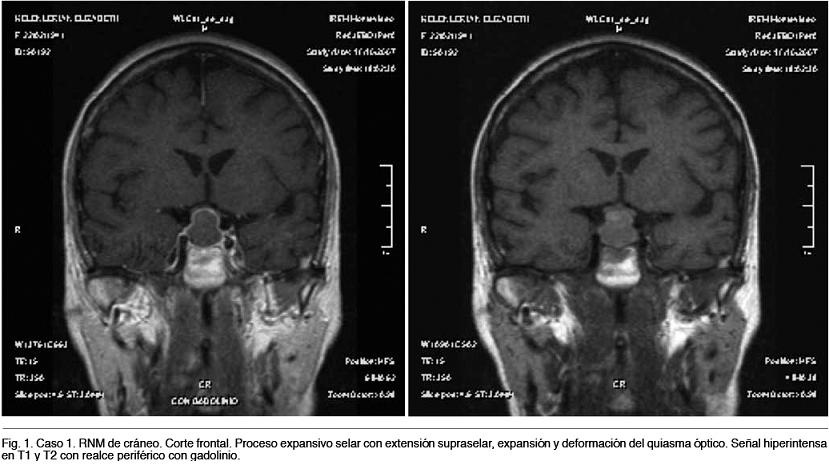
<body><![CDATA[<p style="margin: 0cm 0cm 0.0001pt; text-align: justify;"><span style="font-size: 10pt; font-family: Verdana;" lang="ES-UY">evidenci&oacute; proceso expansivo <span class="SpellE">selar</span> y <span class="SpellE">supraselar</span> de 20 mm de di&aacute;metro c&eacute;falo caudal y 15 mm de di&aacute;metro trasverso, con crecimiento <span class="SpellE">supraselar</span> con compresi&oacute;n y <o:p></o:p></span></p>       <p style="margin: 0cm 0cm 0.0001pt; text-align: justify;"><span style="font-size: 10pt; font-family: Verdana;" lang="ES-UY">deformaci&oacute;n del quiasma &oacute;ptico que deforma el piso de la silla turca. Presenta se&ntilde;al <o:p></o:p></span></p>       <p style="margin: 0cm 0cm 0.0001pt; text-align: justify;"><span class="SpellE"><span style="font-size: 10pt; font-family: Verdana;" lang="ES-UY">hiperintensa</span></span><span style="font-size: 10pt; font-family: Verdana;" lang="ES-UY"> en T1 y T2, que luego de la administraci&oacute;n del medio de contraste <o:p></o:p></span></p>       <p style="margin: 0cm 0cm 0.0001pt; text-align: justify;"><span style="font-size: 10pt; font-family: Verdana;" lang="ES-UY">evidencia realce a nivel de la c&aacute;psula (<a href="/img/revistas/ami/v37n3/3a04f1.jpg">Figura 1</a>). <o:p></o:p></span></p>       <p style="margin: 0cm 0cm 0.0001pt; text-align: justify;"><span style="font-size: 10pt; font-family: Verdana;" lang="ES-UY"><o:p>&nbsp;</o:p></span></p>       <p style="margin: 0cm 0cm 0.0001pt; text-align: justify;"><span style="font-size: 10pt; font-family: Verdana;" lang="ES-UY">La campimetr&iacute;a evidenci&oacute; un <span class="SpellE">denudamiento</span> de la mancha ciega en ambos ojos. <o:p></o:p></span></p>       <p style="margin: 0cm 0cm 0.0001pt; text-align: justify;"><span style="font-size: 10pt; font-family: Verdana;" lang="ES-UY"><o:p>&nbsp;</o:p></span></p>       <p style="margin: 0cm 0cm 0.0001pt; text-align: justify;"><span style="font-size: 10pt; font-family: Verdana;" lang="ES-UY">El estudio hormonal para la valoraci&oacute;n endocrinol&oacute;gica de la gl&aacute;ndula mostr&oacute; que las hormonas fol&iacute;culo estimulante (FSH), <span class="SpellE">adrenocorticotrofa</span> (ACTH) y estimulante de la tiroides (TSH) estaban dentro de rangos normales, mientras que la prolactina era de 31,3 <span class="SpellE">ng</span>/<span class="SpellE">mL</span> (levemente aumentada). <o:p></o:p></span></p>       <p style="margin: 0cm 0cm 0.0001pt; text-align: justify;"><span style="font-size: 10pt; font-family: Verdana;" lang="ES-UY"><o:p>&nbsp;</o:p></span></p>       <p style="margin: 0cm 0cm 0.0001pt; text-align: justify;"><span style="font-size: 10pt; font-family: Verdana;" lang="ES-UY">Del resto de la <span class="SpellE">paraclinica</span> se destaca una velocidad de <span class="SpellE">eritrosedimentaci&oacute;n</span> (VES) 73 mm/1er hora, prote&iacute;na C reactiva (PCR) 41,1 mg/l, plaquetas 660.000/mm3, <o:p></o:p></span></p>       ]]></body>
<body><![CDATA[<p style="margin: 0cm 0cm 0.0001pt; text-align: justify;"><span style="font-size: 10pt; font-family: Verdana;" lang="ES-UY">fibrin&oacute;geno 602 mg/dl. S&iacute;filis y serolog&iacute;a para VIH no reactivos.<o:p></o:p></span></p>       <p style="margin: 0cm 0cm 0.0001pt; text-align: justify;"><span style="font-size: 10pt; font-family: Verdana;" lang="ES-UY"><o:p>&nbsp;</o:p></span></p>       <p style="margin: 0cm 0cm 0.0001pt; text-align: justify;"><span style="font-size: 10pt; font-family: Verdana;" lang="ES-UY">En funci&oacute;n de los hallazgos se plante&oacute; adenoma hipofisario no <span class="SpellE">secretante</span>.<o:p></o:p></span></p>       <p style="margin: 0cm 0cm 0.0001pt; text-align: justify;"><span style="font-size: 10pt; font-family: Verdana;" lang="ES-UY"><o:p>&nbsp;</o:p></span></p>       <p style="margin: 0cm 0cm 0.0001pt; text-align: justify;"><span style="font-size: 10pt; font-family: Verdana;" lang="ES-UY">En cuanto al tratamiento se corrigi&oacute; la <span class="SpellE">natremia</span> mediante aporte de sodio intravenoso y restricci&oacute;n h&iacute;drica, normaliz&aacute;ndose la misma a los pocos d&iacute;as. <o:p></o:p></span></p>       <p style="margin: 0cm 0cm 0.0001pt; text-align: justify;"><span style="font-size: 10pt; font-family: Verdana;" lang="ES-UY">Se realiza resecci&oacute;n quir&uacute;rgica por abordaje <span class="SpellE">transesfenoidal</span> cl&aacute;sico, obteni&eacute;ndose a trav&eacute;s de la incisi&oacute;n de la duramadre del piso <span class="SpellE">selar</span> en forma espont&aacute;nea material purulento, se toman muestra para cultivo y se procede a lavar la zona quir&uacute;rgica. <o:p></o:p></span></p>       <p style="margin: 0cm 0cm 0.0001pt; text-align: justify;"><span style="font-size: 10pt; font-family: Verdana;" lang="ES-UY">El diagn&oacute;stico definitivo <span class="SpellE">intraoperatorio</span> fue de absceso hipofisario, dando inici&oacute; a tratamiento antibi&oacute;tico emp&iacute;rico con <span class="SpellE">Ceftriaxona</span> 2gr i/v cada 24 hs y <span class="SpellE">Metronidazol</span> 500mg i/v cada 8 hs que se mantienen por 6 semanas. <o:p></o:p></span></p>       <p style="margin: 0cm 0cm 0.0001pt; text-align: justify;"><span style="font-size: 10pt; font-family: Verdana;" lang="ES-UY"><o:p>&nbsp;</o:p></span></p>       <p style="margin: 0cm 0cm 0.0001pt; text-align: justify;"><span style="font-size: 10pt; font-family: Verdana;" lang="ES-UY">Los cultivos del absceso y los <span class="SpellE">hemocultivos</span> no desarrollaron bacterias. <o:p></o:p></span></p>       <p style="margin: 0cm 0cm 0.0001pt; text-align: justify;"><span style="font-size: 10pt; font-family: Verdana;" lang="ES-UY">El <span class="SpellE">ecocardiograma</span> <span class="SpellE">transesof&aacute;gico</span> no mostro vegetaciones ni im&aacute;genes compatibles con endocarditis. <o:p></o:p></span></p>       ]]></body>
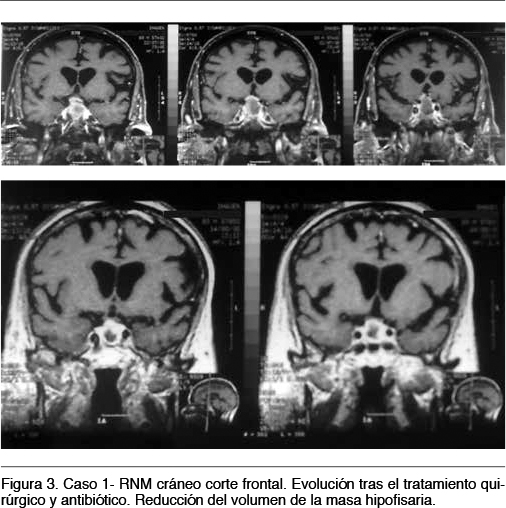
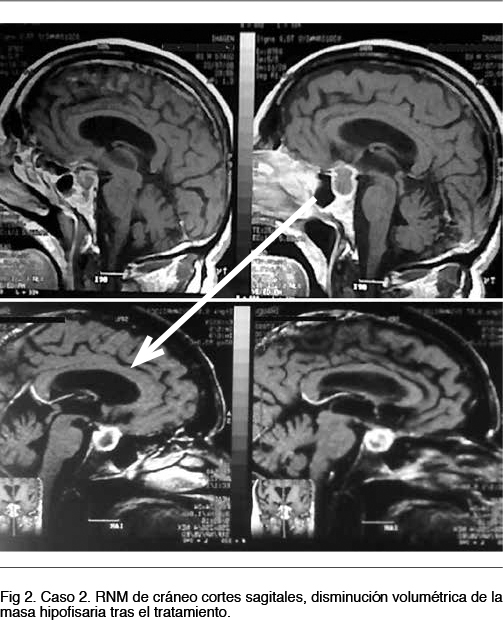
<body><![CDATA[<p style="margin: 0cm 0cm 0.0001pt; text-align: justify;"><span style="font-size: 10pt; font-family: Verdana;" lang="ES-UY"><o:p>&nbsp;</o:p></span></p>       <p style="margin: 0cm 0cm 0.0001pt; text-align: justify;"><span style="font-size: 10pt; font-family: Verdana;" lang="ES-UY">Al finalizar el tratamiento, se asisti&oacute; a un descenso de los par&aacute;metros reactivos al proceso infeccioso con VES de 54mm/1era hora, plaquetas de 166.000/mm3. Asimismo se normaliz&oacute; el valor de prolactina (8,6 <span class="SpellE">ng</span>/<span class="SpellE">mL</span>) y la RNM de cr&aacute;neo evidenci&oacute; drenaje de la colecci&oacute;n <span class="SpellE">intraselar</span> con realce perif&eacute;rico de la gl&aacute;ndula de tama&ntilde;o habitual, sin evidencia de colecciones <span class="SpellE">intraselares</span> (<a href="#figura_2">Figura 2</a> y <a href="#figura_3">3</a>). <b style=""><o:p></o:p></b></span></p>       <p style="margin: 0cm 0cm 0.0001pt; text-align: justify;"><b style=""><span style="font-size: 10pt; font-family: Verdana;" lang="ES-UY"><o:p>&nbsp;</o:p></span></b></p>     <p style="margin: 0cm 0cm 0.0001pt; text-align: justify;"><a name="figura_2"></a><img style="width: 503px; height: 620px;" alt="" src="/img/revistas/ami/v37n3/3a04f2.jpg"><b style=""><span style="font-size: 10pt; font-family: Verdana;" lang="ES-UY"><o:p></o:p></span></b></p>     <p style="margin: 0cm 0cm 0.0001pt; text-align: justify;"></p> <a name="figura_3"></a><img style="width: 506px; height: 508px;" alt="" src="/img/revistas/ami/v37n3/3a04f3.jpg">    <br>       <p style="margin: 0cm 0cm 0.0001pt; text-align: justify;"><b style=""><span style="font-size: 10pt; font-family: Verdana;" lang="ES-UY"><o:p>&nbsp;</o:p></span></b></p>       <p style="margin: 0cm 0cm 0.0001pt; text-align: justify;"><b style=""><span style="font-size: 14pt; font-family: Verdana;" lang="ES-UY">Caso 2</span></b><span style="font-size: 14pt; font-family: Verdana;" lang="ES-UY"><o:p></o:p></span></p>       <p style="margin: 0cm 0cm 0.0001pt; text-align: justify;"><span style="font-size: 10pt; font-family: Verdana;" lang="ES-UY"><o:p>&nbsp;</o:p></span></p>       <p style="margin: 0cm 0cm 0.0001pt; text-align: justify;"><span style="font-size: 10pt; font-family: Verdana;" lang="ES-UY">Paciente de 83 a&ntilde;os, sexo masculino, antecedentes personales: diabetes <span class="SpellE">mellitus</span> tipo 2 en tratamiento con <span class="SpellE">Metformina</span> 850 mg/d&iacute;a, con buena adherencia y buen control metab&oacute;lico. Consulta por cuadro de una semana de evoluci&oacute;n dado por tos, <o:p></o:p></span></p>       ]]></body>
<body><![CDATA[<p style="margin: 0cm 0cm 0.0001pt; text-align: justify;"><span style="font-size: 10pt; font-family: Verdana;" lang="ES-UY">expectoraci&oacute;n y fiebre de hasta 38&deg;C axilar. El examen f&iacute;sico revela la presencia de <o:p></o:p></span></p>       <p style="margin: 0cm 0cm 0.0001pt; text-align: justify;"><span style="font-size: 10pt; font-family: Verdana;" lang="ES-UY">estertores crepitantes en cara posterior de <span class="SpellE">hemit&oacute;rax</span> derecho, confirm&aacute;ndose con la radiograf&iacute;a de t&oacute;rax un foco de condensaci&oacute;n en l&oacute;bulo inferior derecho. <o:p></o:p></span></p>       <p style="margin: 0cm 0cm 0.0001pt; text-align: justify;"><span style="font-size: 10pt; font-family: Verdana;" lang="ES-UY"><o:p>&nbsp;</o:p></span></p>       <p style="margin: 0cm 0cm 0.0001pt; text-align: justify;"><span style="font-size: 10pt; font-family: Verdana;" lang="ES-UY">Con planteo de neumon&iacute;a comunitaria se realizan <span class="SpellE">hemocultivos</span> que resultan negativos y se inicia tratamiento antibi&oacute;tico con Ampicilina &ndash;<span class="SpellE">sulbactam</span> 1,5 gr i/v cada 6hs y <span class="SpellE">Claritromicina</span> 500mg v/o cada 12hs. <o:p></o:p></span></p>       <p style="margin: 0cm 0cm 0.0001pt; text-align: justify;"><span style="font-size: 10pt; font-family: Verdana;" lang="ES-UY">A las 48 horas del ingreso instala cefalea <span class="SpellE">holocraneana</span>, n&aacute;useas y v&oacute;mitos reiterados. El examen neurol&oacute;gico muestra un paciente l&uacute;cido, bien orientado en tiempo y espacio, sin alteraciones de las funciones simb&oacute;licas, sin alteraciones de los pares craneanos, sin rigidez de nuca y sin alteraciones del sector espinal. <o:p></o:p></span></p>       <p style="margin: 0cm 0cm 0.0001pt; text-align: justify;"><span style="font-size: 10pt; font-family: Verdana;" lang="ES-UY"><o:p>&nbsp;</o:p></span></p>       <p style="margin: 0cm 0cm 0.0001pt; text-align: justify;"><span style="font-size: 10pt; font-family: Verdana;" lang="ES-UY">Tras la b&uacute;squeda de esta situaci&oacute;n cl&iacute;nica se realiza glucemia, <span class="SpellE">ionograma</span> azoemia, <o:p></o:p></span></p>       <p style="margin: 0cm 0cm 0.0001pt; text-align: justify;"><span class="SpellE"><span style="font-size: 10pt; font-family: Verdana;" lang="ES-UY">creatininemia</span></span><span style="font-size: 10pt; font-family: Verdana;" lang="ES-UY"> y hemograma que son normales.<span style="">&nbsp; </span><o:p></o:p></span></p>       <p style="margin: 0cm 0cm 0.0001pt; text-align: justify;"><span style="font-size: 10pt; font-family: Verdana;" lang="ES-UY">El an&aacute;lisis del l&iacute;quido cefalorraqu&iacute;deo (LCR) muestra: aspecto turbio, <span class="SpellE">pandy</span>+++, <o:p></o:p></span></p>       <p style="margin: 0cm 0cm 0.0001pt; text-align: justify;"><span style="font-size: 10pt; font-family: Verdana;" lang="ES-UY">glucosa: 0,53 mg/dl, prote&iacute;nas: 3,5g/dl, gl&oacute;bulos rojos: 20/mm3 conservados, gl&oacute;bulos blancos: 7/mm3. Cultivo bacteriol&oacute;gico del l&iacute;quido sin desarrollo. PCR para grupo herpes virus negativo. VDRL negativo <o:p></o:p></span></p>       ]]></body>
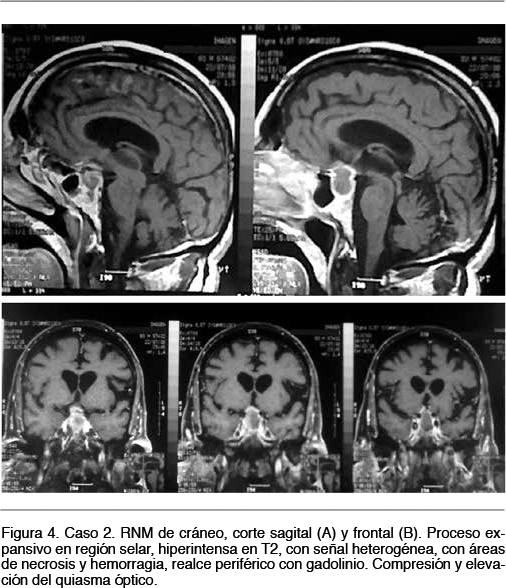
<body><![CDATA[<p style="margin: 0cm 0cm 0.0001pt; text-align: justify;"><span style="font-size: 10pt; font-family: Verdana;" lang="ES-UY"><o:p>&nbsp;</o:p></span></p>         <p style="margin: 0cm 0cm 0.0001pt; text-align: justify;"><span style="font-size: 10pt; font-family: Verdana;" lang="ES-UY">Frente a este hallazgo de proceso inflamatorio <span class="SpellE">intracraneano</span> se procede a realizar TAC de cr&aacute;neo que mostro silla turca ocupada por proceso redondeado de 4mm. Se completo valoraci&oacute;n con RNM de cr&aacute;neo que evidencia voluminoso proceso expansivo que ocupa la silla turca que determina elevaci&oacute;n y compresi&oacute;n del quiasma &oacute;ptico. La intensidad de la se&ntilde;al del proceso es heterog&eacute;nea con &aacute;reas de necrosis hemorr&aacute;gica y realce m&aacute;s intenso en su periferia (<a href="#figura_4">Figura<span style="">&nbsp; </span>4</a>).</span></p>     <p style="margin: 0cm 0cm 0.0001pt; text-align: justify;"><span style="font-size: 10pt; font-family: Verdana;" lang="ES-UY"></span></p>     <p style="margin: 0cm 0cm 0.0001pt; text-align: justify;"><a name="figura_4"></a><img style="width: 506px; height: 588px;" alt="" src="/img/revistas/ami/v37n3/3a04f4.jpg"><span style="font-size: 10pt; font-family: Verdana;" lang="ES-UY"></span></p>     <p style="margin: 0cm 0cm 0.0001pt; text-align: justify;"><span style="font-size: 10pt; font-family: Verdana;" lang="ES-UY"></span></p>     <p style="margin: 0cm 0cm 0.0001pt; text-align: justify;"><span style="font-size: 10pt; font-family: Verdana;" lang="ES-UY"><o:p>&nbsp;</o:p></span></p>       <p style="margin: 0cm 0cm 0.0001pt; text-align: justify;"><span style="font-size: 10pt; font-family: Verdana;" lang="ES-UY">Por las caracter&iacute;sticas <span class="SpellE">imagenol&oacute;gicas</span> y el contexto inflamatorio-infeccioso se plante&oacute; como diagnostico primario un absceso hipofisario. <o:p></o:p></span></p>       <p style="margin: 0cm 0cm 0.0001pt; text-align: justify;"><span style="font-size: 10pt; font-family: Verdana;" lang="ES-UY"><o:p>&nbsp;</o:p></span></p>       <p style="margin: 0cm 0cm 0.0001pt; text-align: justify;"><span style="font-size: 10pt; font-family: Verdana;" lang="ES-UY">La valoraci&oacute;n endocrinol&oacute;gica mostr&oacute; TSH 0,17 <span class="SpellE">mUI</span>/<span class="SpellE">mL</span> (normal 0,23 - 4,20), T4 1,55 <span class="SpellE">ng</span>/dl (normal 0,85 -1,70), ACTH,<span style="">&nbsp; </span>FSH,<span style="">&nbsp; </span>LH, y prolactina en rango normales. <o:p></o:p></span></p>       <p style="margin: 0cm 0cm 0.0001pt; text-align: justify;"><span style="font-size: 10pt; font-family: Verdana;" lang="ES-UY"><o:p>&nbsp;</o:p></span></p>       ]]></body>
<body><![CDATA[<p style="margin: 0cm 0cm 0.0001pt; text-align: justify;"><span style="font-size: 10pt; font-family: Verdana;" lang="ES-UY">En funci&oacute;n del planteo diagnostico realizado se continu&oacute; tratamiento antibi&oacute;tico con <o:p></o:p></span></p>       <p style="margin: 0cm 0cm 0.0001pt; text-align: justify;"><span style="font-size: 10pt; font-family: Verdana;" lang="ES-UY">Ampicilina 3gr i/v cada 6hs por 6 semanas. <o:p></o:p></span></p>       <p style="margin: 0cm 0cm 0.0001pt; text-align: justify;"><span style="font-size: 10pt; font-family: Verdana;" lang="ES-UY">El paciente presenta mejor&iacute;a de los s&iacute;ntomas a partir del quinto d&iacute;a de tratamiento, sin nuevas manifestaciones neurol&oacute;gicas. <o:p></o:p></span></p>       <p style="margin: 0cm 0cm 0.0001pt; text-align: justify;"><span style="font-size: 10pt; font-family: Verdana;" lang="ES-UY"><o:p>&nbsp;</o:p></span></p>       <p style="margin: 0cm 0cm 0.0001pt; text-align: justify;"><span style="font-size: 10pt; font-family: Verdana;" lang="ES-UY">Al finalizar el tratamiento antibi&oacute;tico se realiza control de las hormonas tiroideas que son normales y RNM de cr&aacute;neo que muestra franca reducci&oacute;n del proceso <span class="SpellE">selar</span>. <o:p></o:p></span></p>       <p class="MsoNormal" style="margin-bottom: 0.0001pt; text-align: justify;"><span style="font-size: 10pt; line-height: 115%; font-family: Verdana;" lang="ES-UY"><o:p>&nbsp;</o:p></span></p>       <p class="MsoNormal" style="margin-bottom: 0.0001pt; text-align: justify;"><b style=""><span style="font-size: 14pt; line-height: 115%; font-family: Verdana;" lang="ES-UY">Discusi&oacute;n</span></b><span style="font-size: 14pt; line-height: 115%; font-family: Verdana;" lang="ES-UY"><o:p></o:p></span></p>       <p class="MsoNormal" style="margin-bottom: 0.0001pt; text-align: justify;"><span style="font-size: 10pt; line-height: 115%; font-family: Verdana;" lang="ES-UY"><o:p>&nbsp;</o:p></span></p>       <p class="MsoNormal" style="margin-bottom: 0.0001pt; text-align: justify;"><span style="font-size: 10pt; line-height: 115%; font-family: Verdana;" lang="ES-UY">Los abscesos de hip&oacute;fisis son una entidad poco frecuente que comprende menos del <o:p></o:p></span></p>       <p class="MsoNormal" style="margin-bottom: 0.0001pt; text-align: justify;"><span style="font-size: 10pt; line-height: 115%; font-family: Verdana;" lang="ES-UY">1% de la patolog&iacute;a hipofisaria y menos del<span style="">&nbsp; </span>0,27% de los tumores hipofisarios <sup>(<a href="#1">1</a><a name="1."></a> - <a href="#2">2</a><a name="2."></a>), </sup>descrito por primera vez por <span class="SpellE">Simmonds</span> en 1914 y definido como la localizaci&oacute;n <span class="SpellE">intraselar</span> de un proceso supurativo <sup>(<a href="#3">3</a><a name="3."></a>).</sup><o:p></o:p></span></p>       ]]></body>
<body><![CDATA[<p class="MsoNormal" style="margin-bottom: 0.0001pt; text-align: justify;"><span style="font-size: 10pt; line-height: 115%; font-family: Verdana;" lang="ES-UY"><o:p>&nbsp;</o:p></span></p>       <p class="MsoNormal" style="margin-bottom: 0.0001pt; text-align: justify;"><span style="font-size: 10pt; line-height: 115%; font-family: Verdana;" lang="ES-UY">Entidad de alta dificultad diagn&oacute;stica, por presentarse con una cl&iacute;nica ambigua donde s&oacute;lo un tercio de los pacientes evidencian signos y s&iacute;ntomas sugestivos de infecci&oacute;n, donde las im&aacute;genes no son patognom&oacute;nicas del proceso y los cultivos tienen tan s&oacute;lo un rendimiento del 50% <sup>(<a href="#1">1</a>).</sup> Es sin embargo una patolog&iacute;a con una mortalidad no despreciable lo que implica una tenaz consideraci&oacute;n y sospecha diagn&oacute;stica junto con la valoraci&oacute;n oportuna mediante RNM como t&eacute;cnica &ldquo;<span class="SpellE">gold</span> <span class="SpellE">standard</span>&rdquo; sabiendo que de todas formas la amplia mayor&iacute;a de las veces la confirmaci&oacute;n &uacute;nicamente se da tras el procedimiento quir&uacute;rgico que obtiene la muestra purulenta <sup>(<a href="#4">4</a><a name="4."></a>)</sup> tal como ocurri&oacute; en el primer caso cl&iacute;nico. <o:p></o:p></span></p>       <p class="MsoNormal" style="margin-bottom: 0.0001pt; text-align: justify;"><span style="font-size: 10pt; line-height: 115%; font-family: Verdana;" lang="ES-UY"><o:p>&nbsp;</o:p></span></p>       <p class="MsoNormal" style="margin-bottom: 0.0001pt; text-align: justify;"><span style="font-size: 10pt; line-height: 115%; font-family: Verdana;" lang="ES-UY">Si bien la cl&aacute;sica tr&iacute;ada sintom&aacute;tica de cefalea, alteraciones visuales y fiebre <sup>(<a href="#5">5</a><a name="5."></a>) </sup>no fue objetivada en ninguno de los pacientes, el s&iacute;ntoma aislado m&aacute;s frecuente es la <o:p></o:p></span></p>       <p class="MsoNormal" style="margin-bottom: 0.0001pt; text-align: justify;"><span style="font-size: 10pt; line-height: 115%; font-family: Verdana;" lang="ES-UY">cefalea, presente en el 60% de los casos <sup>(<a href="#1">1</a>)</sup>, t&iacute;picamente de evoluci&oacute;n prolongada, de escaso alivio con analg&eacute;sicos comunes y topograf&iacute;a <span class="SpellE">bitemporal</span>. Los s&iacute;ntomas de <o:p></o:p></span></p>       <p class="MsoNormal" style="margin-bottom: 0.0001pt; text-align: justify;"><span style="font-size: 10pt; line-height: 115%; font-family: Verdana;" lang="ES-UY">hipertensi&oacute;n <span class="SpellE">endocraneana</span> como v&oacute;mitos y n&aacute;useas junto con los de irritaci&oacute;n <o:p></o:p></span></p>       <p class="MsoNormal" style="margin-bottom: 0.0001pt; text-align: justify;"><span style="font-size: 10pt; line-height: 115%; font-family: Verdana;" lang="ES-UY">men&iacute;ngea (fotofobia, <span class="SpellE">acusofobia</span> y limitaci&oacute;n en la flexi&oacute;n de nuca) est&aacute;n presentes en el 25% de los pacientes <sup>(<a href="#2">2</a>,<a href="#4">4</a>).<span style="">&nbsp; </span></sup>Estos &uacute;ltimos junto a la presencia de cefalea, <o:p></o:p></span></p>       <p class="MsoNormal" style="margin-bottom: 0.0001pt; text-align: justify;"><span style="font-size: 10pt; line-height: 115%; font-family: Verdana;" lang="ES-UY">estuvieron presentes en el segundo caso cl&iacute;nico, siendo el hilo conductor para llegar al<span style="">&nbsp; </span>diagn&oacute;stico del proceso <span class="SpellE">intracraneano</span>. <o:p></o:p></span></p>       <p class="MsoNormal" style="margin-bottom: 0.0001pt; text-align: justify;"><span style="font-size: 10pt; line-height: 115%; font-family: Verdana;" lang="ES-UY"><o:p>&nbsp;</o:p></span></p>       <p class="MsoNormal" style="margin-bottom: 0.0001pt; text-align: justify;"><span style="font-size: 10pt; line-height: 115%; font-family: Verdana;" lang="ES-UY">La meningitis recurrente es una forma de presentaci&oacute;n rara de esta enfermedad con pocos casos reportados hasta la fecha <sup>(<a href="#6">6</a><a name="6."></a>)</sup> y de muy dif&iacute;cil diagn&oacute;stico ya que habitualmente el l&iacute;quido cefalorraqu&iacute;deo resulta as&eacute;ptico por la implementaci&oacute;n precoz de tratamiento antibi&oacute;tico <sub>(<a href="#6">6</a>).</sub><o:p></o:p></span></p>       ]]></body>
<body><![CDATA[<p class="MsoNormal" style="margin-bottom: 0.0001pt; text-align: justify;"><span style="font-size: 10pt; line-height: 115%; font-family: Verdana;" lang="ES-UY"><o:p>&nbsp;</o:p></span></p>       <p class="MsoNormal" style="margin-bottom: 0.0001pt; text-align: justify;"><span style="font-size: 10pt; line-height: 115%; font-family: Verdana;" lang="ES-UY">Las alteraciones visuales presentes en hasta el 50% de los casos se deben al <o:p></o:p></span></p>       <p class="MsoNormal" style="margin-bottom: 0.0001pt; text-align: justify;"><span style="font-size: 10pt; line-height: 115%; font-family: Verdana;" lang="ES-UY">compromiso del quiasma &oacute;ptico y porciones proximales de los nervios &oacute;pticos <sup>(<a href="#2">2</a>,<a href="#4">4</a>).</sup><o:p></o:p></span></p>       <p class="MsoNormal" style="margin-bottom: 0.0001pt; text-align: justify;"><span style="font-size: 10pt; line-height: 115%; font-family: Verdana;" lang="ES-UY">Nuestros pacientes coincid&iacute;an en la compresi&oacute;n objetivada por im&aacute;genes del quiasma &oacute;ptico sin otra expresi&oacute;n cl&iacute;nica<span style="">&nbsp; </span>que el <span class="SpellE">denudamiento</span> de la mancha ciega bilateral observada en la campimetr&iacute;a en el primer caso cl&iacute;nico. <o:p></o:p></span></p>       <p class="MsoNormal" style="margin-bottom: 0.0001pt; text-align: justify;"><span style="font-size: 10pt; line-height: 115%; font-family: Verdana;" lang="ES-UY"><o:p>&nbsp;</o:p></span></p>       <p class="MsoNormal" style="margin-bottom: 0.0001pt; text-align: justify;"><span style="font-size: 10pt; line-height: 115%; font-family: Verdana;" lang="ES-UY">En las primeras descripciones, los abscesos <span class="SpellE">selares</span> eran secundarios a cuadros s&eacute;pticos graves, pero en la actualidad esta situaci&oacute;n es muy poco frecuente; siendo consecuencia de procesos primarios a partir de tres circunstancias <sup>(<a href="#3">3</a>):</sup> <o:p></o:p></span></p>       <p class="ListParagraph" style="margin-bottom: 0.0001pt; text-align: justify; text-indent: -18pt;"><span style="font-size: 10pt; line-height: 115%; font-family: Verdana;" lang="ES-UY"><span style="">a)<span style="font-family: &quot;Times New Roman&quot;; font-style: normal; font-variant: normal; font-weight: normal; font-size: 7pt; line-height: normal; font-size-adjust: none; font-stretch: normal;">&nbsp;&nbsp;&nbsp;&nbsp;&nbsp;</span></span></span><span style="font-size: 10pt; line-height: 115%; font-family: Verdana;" lang="ES-UY">Como extensi&oacute;n secundaria a la silla turca de infecciones de vecindad (sinusitis, meningitis e infecciones postoperatorias de abordajes <span class="SpellE">transesfenoidales</span>).<o:p></o:p></span></p>       <p class="ListParagraph" style="margin-bottom: 0.0001pt; text-align: justify; text-indent: -18pt;"><span style="font-size: 10pt; line-height: 115%; font-family: Verdana;" lang="ES-UY"><span style="">b)<span style="font-family: &quot;Times New Roman&quot;; font-style: normal; font-variant: normal; font-weight: normal; font-size: 7pt; line-height: normal; font-size-adjust: none; font-stretch: normal;">&nbsp;&nbsp;&nbsp;&nbsp;&nbsp;</span></span></span><span style="font-size: 10pt; line-height: 115%; font-family: Verdana;" lang="ES-UY">Como infecciones aparecidas en una silla turca comprometida por una lesi&oacute;n preexistente como adenoma de hip&oacute;fisis, <span class="SpellE">craneofaringiomas</span> o quistes de la bolsa de <span class="SpellE">Rathka</span>.<o:p></o:p></span></p>       <p class="ListParagraph" style="margin-bottom: 0.0001pt; text-align: justify; text-indent: -18pt;"><span style="font-size: 10pt; line-height: 115%; font-family: Verdana;" lang="ES-UY"><span style="">c)<span style="font-family: &quot;Times New Roman&quot;; font-style: normal; font-variant: normal; font-weight: normal; font-size: 7pt; line-height: normal; font-size-adjust: none; font-stretch: normal;">&nbsp;&nbsp;&nbsp;&nbsp;&nbsp;</span></span></span><span style="font-size: 10pt; line-height: 115%; font-family: Verdana;" lang="ES-UY">Sin lesiones previas ni infecciones vecinas o sist&eacute;micas en actividad, constituyendo el grupo de abscesos primarios, algunos de los cuales cursan en <span class="SpellE">inmunodeprimidos</span>.<o:p></o:p></span></p>       <p class="MsoNormal" style="margin-bottom: 0.0001pt; text-align: justify;"><span style="font-size: 10pt; line-height: 115%; font-family: Verdana;" lang="ES-UY"><span style="">&nbsp; </span><o:p></o:p></span></p>       ]]></body>
<body><![CDATA[<p class="MsoNormal" style="margin-bottom: 0.0001pt; text-align: justify;"><span style="font-size: 10pt; line-height: 115%; font-family: Verdana;" lang="ES-UY">Los abscesos primarios constituyen el 60% de los casos <sup>(<a href="#4">4</a>)</sup>. En nuestros dos casos no contamos con ning&uacute;n factor favorecedor para el desarrollo de esta patolog&iacute;a, si bien sabemos que la diabetes <span class="SpellE">mellitus</span> presente en el segundo caso cl&iacute;nico puede considerarse un factor de <span class="SpellE">comorbilidad</span> que puede entorpecedor la evoluci&oacute;n y resoluci&oacute;n del proceso infeccioso.<o:p></o:p></span></p>       <p class="MsoNormal" style="margin-bottom: 0.0001pt; text-align: justify;"><span style="font-size: 10pt; line-height: 115%; font-family: Verdana;" lang="ES-UY"><o:p>&nbsp;</o:p></span></p>       <p class="MsoNormal" style="margin-bottom: 0.0001pt; text-align: justify;"><span style="font-size: 10pt; line-height: 115%; font-family: Verdana;" lang="ES-UY">Proponemos por tanto que el primer caso se trata de un absceso primario ya que no se detect&oacute; un origen claro, y el segundo caso sea un absceso secundario con diseminaci&oacute;n <span class="SpellE">hemat&oacute;gena</span> ya que estaba cursando una infecci&oacute;n pulmonar aguda.<o:p></o:p></span></p>       <p class="MsoNormal" style="margin-bottom: 0.0001pt; text-align: justify;"><span style="font-size: 10pt; line-height: 115%; font-family: Verdana;" lang="ES-UY"><o:p>&nbsp;</o:p></span></p>       <p class="MsoNormal" style="margin-bottom: 0.0001pt; text-align: justify;"><span style="font-size: 10pt; line-height: 115%; font-family: Verdana;" lang="ES-UY">Los des&oacute;rdenes endocrinol&oacute;gicos m&aacute;s frecuentes son: la amenorrea<span style="">&nbsp; </span>y el<span style="">&nbsp; </span><o:p></o:p></span></p>       <p class="MsoNormal" style="margin-bottom: 0.0001pt; text-align: justify;"><span class="SpellE"><span style="font-size: 10pt; line-height: 115%; font-family: Verdana;" lang="ES-UY">panhipopituitarismo</span></span><span style="font-size: 10pt; line-height: 115%; font-family: Verdana;" lang="ES-UY">, presentes en hasta el 30-50% de los casos <sup>(<a href="#2">2</a>,<a href="#4">4</a>)</sup>. Tal como se <o:p></o:p></span></p>       <p class="MsoNormal" style="margin-bottom: 0.0001pt; text-align: justify;"><span style="font-size: 10pt; line-height: 115%; font-family: Verdana;" lang="ES-UY">describe en los dos casos cl&iacute;nicos, el primero present&oacute; un aumento de la prolactina consecuente con la interrupci&oacute;n del eje de retroalimentaci&oacute;n por compresi&oacute;n del tallo y el segundo paciente present&oacute; &uacute;nicamente descenso de la TSH, ambos casos mejoraron con el tratamiento del absceso hipofisario.<span style="">&nbsp; </span>En t&eacute;rminos de frecuencia se afecta en primer lugar la secreci&oacute;n de hormona del crecimiento seguida por la de las hormonas sexuales, la TSH y la ACTH <sup>(<a href="#2">2</a>).</sup> <o:p></o:p></span></p>       <p class="MsoNormal" style="margin-bottom: 0.0001pt; text-align: justify;"><span style="font-size: 10pt; line-height: 115%; font-family: Verdana;" lang="ES-UY"><o:p>&nbsp;</o:p></span></p>       <p class="MsoNormal" style="margin-bottom: 0.0001pt; text-align: justify;"><span style="font-size: 10pt; font-family: Verdana;" lang="ES-UY">La presencia de manifestaciones sist&eacute;micas o marcadores de actividad infecciosa est&aacute;n presentes &uacute;nicamente en el 24-33% de los pacientes <sup>(<a href="#2">2</a>,<a href="#4">4</a>),</sup> tal como observamos en los casos descritos donde &uacute;nicamente el segundo paciente estuvo febril y fue en contexto del proceso infeccioso respiratorio.<o:p></o:p></span></p>       <p class="MsoNormal" style="margin-bottom: 0.0001pt; text-align: justify;"><span style="font-size: 10pt; font-family: Verdana;" lang="ES-UY"><span style="">&nbsp; </span><o:p></o:p></span></p>       ]]></body>
<body><![CDATA[<p class="MsoNormal" style="margin-bottom: 0.0001pt; text-align: justify;"><span style="font-size: 10pt; line-height: 115%; font-family: Verdana;" lang="ES-UY">La TAC de cr&aacute;neo puede ser orientadora con im&aacute;genes redondeadas <span class="SpellE">hipodensas</span> con <o:p></o:p></span></p>       <p class="MsoNormal" style="margin-bottom: 0.0001pt; text-align: justify;"><span style="font-size: 10pt; line-height: 115%; font-family: Verdana;" lang="ES-UY">realce en anillo o una masa <span class="SpellE">isodensa</span> con realce homog&eacute;neo en la silla turca <sup>(<a href="#1">1</a>),</sup> siendo sin embargo su principal aporte la valoraci&oacute;n del compromiso de las estructuras &oacute;seas adyacentes. La RNM de cr&aacute;neo es la t&eacute;cnica de elecci&oacute;n para la valoraci&oacute;n tanto de la morfolog&iacute;a glandular como de los procesos infecciosos abscedados, podr&aacute; mostrar im&aacute;genes qu&iacute;sticas, con eventual extensi&oacute;n <span class="SpellE">supraselar</span> hipo o <span class="SpellE">isointensas</span> en T1, <span class="SpellE">iso</span> o <span class="SpellE">hiperintensas</span> en T2 con realce perif&eacute;rico tras la administraci&oacute;n de gadolinio. <o:p></o:p></span></p>       <p class="MsoNormal" style="margin-bottom: 0.0001pt; text-align: justify;"><span style="font-size: 10pt; line-height: 115%; font-family: Verdana;" lang="ES-UY">Cl&aacute;sicamente son im&aacute;genes que presentan restricci&oacute;n de la<span style="">&nbsp; </span>difusi&oacute;n, siendo &eacute;ste un dato de importancia para el diagn&oacute;stico diferencial <sup>(<a href="#4">4</a>)</sup> principalmente y por frecuencia con el adenoma hipofisario. &Eacute;ste fue el planteo diagn&oacute;stico inicial en el primer caso cl&iacute;nico siendo el diagn&oacute;stico definitivo de absceso hipofisario en el <span class="SpellE">intra</span>- operatorio al obtener material purulento, apoyando entonces lo descrito en las series internacionales en cuanto a la poca especificidad y certeza de la <span class="SpellE">imagenolog&iacute;a</span>, ya que las im&aacute;genes descritas no son exclusivas del absceso hipofisario, adem&aacute;s de ser variables en cuanto a su densidad e intensidad de realce en funci&oacute;n de la cantidad de prote&iacute;nas que contenga y la presencia de hemorragia. <o:p></o:p></span></p>       <p class="MsoNormal" style="margin-bottom: 0.0001pt; text-align: justify;"><span style="font-size: 10pt; line-height: 115%; font-family: Verdana;" lang="ES-UY"><o:p>&nbsp;</o:p></span></p>       <p class="MsoNormal" style="margin-bottom: 0.0001pt; text-align: justify;"><span style="font-size: 10pt; line-height: 115%; font-family: Verdana;" lang="ES-UY">En los pr&oacute;ximos a&ntilde;os la TAC con gallium-67 puede ser de ayuda para aproximar el diagn&oacute;stico <sup>(<a href="#1">1</a>),</sup> siendo actualmente de baja disponibilidad en nuestro medio.<o:p></o:p></span></p>       <p class="MsoNormal" style="margin-bottom: 0.0001pt; text-align: justify;"><span style="font-size: 10pt; line-height: 115%; font-family: Verdana;" lang="ES-UY"><o:p>&nbsp;</o:p></span></p>       <p class="MsoNormal" style="margin-bottom: 0.0001pt; text-align: justify;"><span style="font-size: 10pt; line-height: 115%; font-family: Verdana;" lang="ES-UY">Los cultivos desarrollan principalmente cocos <span class="SpellE">gram</span> positivos como <span class="SpellE"><i style="">Staphlococcus</i></span><i style=""> <o:p></o:p></i></span></p>       <p class="MsoNormal" style="margin-bottom: 0.0001pt; text-align: justify;"><span class="SpellE"><i style=""><span style="font-size: 10pt; line-height: 115%; font-family: Verdana;" lang="ES-UY">aureus</span></i></span><span style="font-size: 10pt; line-height: 115%; font-family: Verdana;" lang="ES-UY"> y <span class="SpellE"><i style="">Streptococcus</i></span><i style=""> <span class="SpellE">pyogenes</span></i>. <span class="SpellE"><i style="">Pseudomonas</i></span>, <span class="SpellE"><i style="">Klebsiella</i></span>, <span class="SpellE"><i style="">Bacteroides</i></span>, <i style=""><o:p></o:p></i></span></p>       <p class="MsoNormal" style="margin-bottom: 0.0001pt; text-align: justify;"><span class="SpellE"><i style=""><span style="font-size: 10pt; line-height: 115%; font-family: Verdana;" lang="ES-UY">Acinetobacter</span></i></span><span style="font-size: 10pt; line-height: 115%; font-family: Verdana;" lang="ES-UY">, <span class="SpellE"><i style="">Candida</i></span><i style=""> <span class="SpellE">albicans</span></i>, g&eacute;rmenes anaerobios, <span class="SpellE"><i style="">Entamoeba</i></span><i style=""> <span class="SpellE">hystolitica</span></i>, y <i style=""><o:p></o:p></i></span></p>       <p class="MsoNormal" style="margin-bottom: 0.0001pt; text-align: justify;"><span class="SpellE"><i style=""><span style="font-size: 10pt; line-height: 115%; font-family: Verdana;" lang="ES-UY">Brucella</span></i></span><span style="font-size: 10pt; line-height: 115%; font-family: Verdana;" lang="ES-UY"> completan la amplia gama de g&eacute;rmenes identificados <sup>(<a href="#7">7</a><a name="7."></a>)</sup>; sin embargo el 50% de los cultivos resulta sin desarrollo lo que puede ser atribuido a la mala t&eacute;cnica de cultivo de agentes <span class="SpellE">mic&oacute;ticos</span> y anaerobios as&iacute; como el inicio de antibi&oacute;tico previo a la realizaci&oacute;n de la muestra <sup>(<a href="#1">1</a>,<a href="#4">4</a>).</sup> Algunos autores proponen, sin embargo, que esta entidad no ser&iacute;a infecciosa sino parte de una reacci&oacute;n tisular frente a un infarto de adenoma explicando con ello la escasa detecci&oacute;n de g&eacute;rmenes, la similitud cl&iacute;nica y la microbiolog&iacute;a m&aacute;s prevalente siendo los cultivos positivos en mayor n&uacute;mero de cirug&iacute;as <span class="SpellE">trans</span>-esfenoidales frente a <span class="SpellE">trans</span>-craneales, sospech&aacute;ndose contaminaci&oacute;n de la muestra <sup>(<a href="#8">8</a><a name="8."></a>).</sup> <o:p></o:p></span></p>       ]]></body>
<body><![CDATA[<p class="MsoNormal" style="margin-bottom: 0.0001pt; text-align: justify;"><span style="font-size: 10pt; line-height: 115%; font-family: Verdana;" lang="ES-UY"><o:p>&nbsp;</o:p></span></p>       <p class="MsoNormal" style="margin-bottom: 0.0001pt; text-align: justify;"><span style="font-size: 10pt; line-height: 115%; font-family: Verdana;" lang="ES-UY">Frente a la sospecha cl&iacute;nico- <span class="SpellE">imagenol&oacute;gica</span> de esta patolog&iacute;a, la conducta quir&uacute;rgica frente a una conducta expectante ofrece beneficios en t&eacute;rminos de prevenci&oacute;n de progreso y deficiencia hormonal a largo plazo <sup>(<a href="#2">2</a>).</sup><o:p></o:p></span></p>       <p class="MsoNormal" style="margin-bottom: 0.0001pt; text-align: justify;"><span style="font-size: 10pt; line-height: 115%; font-family: Verdana;" lang="ES-UY">El tratamiento del absceso hipofisario incluye t&eacute;cnicas quir&uacute;rgicas, idealmente con <o:p></o:p></span></p>       <p class="MsoNormal" style="margin-bottom: 0.0001pt; text-align: justify;"><span style="font-size: 10pt; line-height: 115%; font-family: Verdana;" lang="ES-UY">abordaje <span class="SpellE">trans</span>-esfenoidal tal como se practic&oacute; en el primero de los casos comentados, con evacuaci&oacute;n, irrigaci&oacute;n del lecho con soluciones con antibi&oacute;tico y mantenimiento de drenaje de ser requerido con beneficio en cuanto a <span class="SpellE">decompresi&oacute;n</span> de quiasma &oacute;ptico. La consideraci&oacute;n integral de la situaci&oacute;n biol&oacute;gica del segundo paciente condujo al equipo tratante a optar por una conducta menos invasiva que deriv&oacute; afortunadamente en excelentes resultados.<o:p></o:p></span></p>       <p class="MsoNormal" style="margin-bottom: 0.0001pt; text-align: justify;"><span style="font-size: 10pt; line-height: 115%; font-family: Verdana;" lang="ES-UY"><o:p>&nbsp;</o:p></span></p>       <p class="MsoNormal" style="margin-bottom: 0.0001pt; text-align: justify;"><span style="font-size: 10pt; line-height: 115%; font-family: Verdana;" lang="ES-UY">El tratamiento quir&uacute;rgico en combinaci&oacute;n con la <span class="SpellE">antibioticoterapia</span> sist&eacute;mica dirigida <o:p></o:p></span></p>       <p class="MsoNormal" style="margin-bottom: 0.0001pt; text-align: justify;"><span style="font-size: 10pt; line-height: 115%; font-family: Verdana;" lang="ES-UY">emp&iacute;ricamente contra los g&eacute;rmenes planteados m&aacute;s frecuentes y ajustada seg&uacute;n <o:p></o:p></span></p>       <p class="MsoNormal" style="margin-bottom: 0.0001pt; text-align: justify;"><span style="font-size: 10pt; line-height: 115%; font-family: Verdana;" lang="ES-UY">resultado de cultivo y t&eacute;cnicas de resoluci&oacute;n de procesos locales (en caso de <o:p></o:p></span></p>       <p class="MsoNormal" style="margin-bottom: 0.0001pt; text-align: justify;"><span style="font-size: 10pt; line-height: 115%; font-family: Verdana;" lang="ES-UY">colecciones) son los pilares que sustentan una terapia combinada para esta patolog&iacute;a compleja. Los antimicrobianos tienen indicaci&oacute;n inicialmente de 2 a 6 semanas <sup>(<a href="#1">1</a>,<a href="#9">9</a><a name="9."></a>). </sup>En ambos<sup> </sup>reportes se realiz&oacute; <span class="SpellE">antibioticoterapia</span> por seis semanas, con un excelente evoluci&oacute;n tanto en lo sintom&aacute;tico como en lo <span class="SpellE">imagenol&oacute;gico</span> con resoluci&oacute;n objetivada de ambos hechos.<span style="">&nbsp; </span><o:p></o:p></span></p>       <p class="MsoNormal" style="margin-bottom: 0.0001pt; text-align: justify;"><span style="font-size: 10pt; line-height: 115%; font-family: Verdana;" lang="ES-UY"><o:p>&nbsp;</o:p></span></p>       ]]></body>
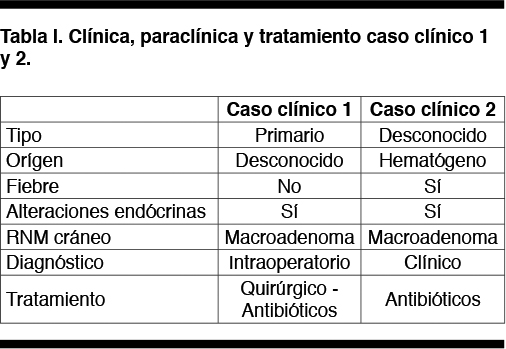
<body><![CDATA[<p class="MsoNormal" style="margin-bottom: 0.0001pt; text-align: justify;"><span style="font-size: 10pt; line-height: 115%; font-family: Verdana;" lang="ES-UY">Si bien la insuficiencia pituitaria posterior a la afectaci&oacute;n y procedimiento quir&uacute;rgico es altamente frecuente con manifestaciones como diabetes ins&iacute;pida (al menos en el 50% de los casos) que implican tratamiento hormonal de sustituci&oacute;n por tiempo indefinido, no fue la evoluci&oacute;n de los enfermos comentados que cursaron sin necesidad de sustituci&oacute;n ni d&eacute;ficits endocrinol&oacute;gicos a posteriori. <o:p></o:p></span></p>       <p class="MsoNormal" style="margin-bottom: 0.0001pt; text-align: justify;"><span style="font-size: 10pt; line-height: 115%; font-family: Verdana;" lang="ES-UY"><o:p>&nbsp;</o:p></span></p>       <p class="MsoNormal" style="margin-bottom: 0.0001pt; text-align: justify;"><span style="font-size: 10pt; line-height: 115%; font-family: Verdana;" lang="ES-UY">Actualmente la mortalidad se ha reducido a menos del 10% <sup>(<a href="#8">8</a>).</sup> EL seguimiento debe ser estrecho y a largo plazo por el riesgo de recurrencia <sup>(<a href="#2">2</a>).</sup> <b><o:p></o:p></b></span></p>       <p class="MsoNormal" style="margin-bottom: 0.0001pt; text-align: justify;"><b><span style="font-size: 10pt; line-height: 115%; font-family: Verdana;" lang="ES-UY"><o:p>&nbsp;</o:p></span></b></p>       <p class="MsoNormal" style="margin-bottom: 0.0001pt; text-align: justify;"><b><span style="font-size: 14pt; line-height: 115%; font-family: Verdana;" lang="ES-UY">Conclusiones</span></b><span style="font-size: 14pt; line-height: 115%; font-family: Verdana;" lang="ES-UY"><o:p></o:p></span></p>       <p class="MsoNormal" style="margin-bottom: 0.0001pt; text-align: justify;"><span style="font-size: 10pt; line-height: 115%; font-family: Verdana;" lang="ES-UY"><o:p>&nbsp;</o:p></span></p>       <p class="MsoNormal" style="margin-bottom: 0.0001pt; text-align: justify;"><span style="font-size: 10pt; line-height: 115%; font-family: Verdana;" lang="ES-UY">Los abscesos de hip&oacute;fisis son una patolog&iacute;a de muy baja incidencia y dif&iacute;cil diagn&oacute;stico tal como podemos entender a partir de los dos casos cl&iacute;nicos descritos. <o:p></o:p></span></p>       <p class="MsoNormal" style="margin-bottom: 0.0001pt; text-align: justify;"><span style="font-size: 10pt; line-height: 115%; font-family: Verdana;" lang="ES-UY">La<span style="">&nbsp; </span><span class="SpellE">imagenolog&iacute;a</span> es poco espec&iacute;fica, lo que determino la decisi&oacute;n de intervenci&oacute;n <o:p></o:p></span></p>       <p class="MsoNormal" style="margin-bottom: 0.0001pt; text-align: justify;"><span style="font-size: 10pt; line-height: 115%; font-family: Verdana;" lang="ES-UY">quir&uacute;rgica con el planteo<span style="">&nbsp; </span>de adenoma hipofisario en el caso 1, surgiendo el diagn&oacute;stico en el <span class="SpellE">intra</span>-operatorio. En el caso 2 la situaci&oacute;n cl&iacute;nica y los hallazgos<span style="">&nbsp; </span><o:p></o:p></span></p>       <p class="MsoNormal" style="margin-bottom: 0.0001pt; text-align: justify;"><span class="SpellE"><span style="font-size: 10pt; line-height: 115%; font-family: Verdana;" lang="ES-UY">imagenol&oacute;gicos</span></span><span style="font-size: 10pt; line-height: 115%; font-family: Verdana;" lang="ES-UY"> realizaron la sospecha diagn&oacute;stica. En la <a href="#tabla_1">tabla 1</a> se presentan las <o:p></o:p></span></p>       ]]></body>
<body><![CDATA[<p class="MsoNormal" style="margin-bottom: 0.0001pt; text-align: justify;"><span style="font-size: 10pt; line-height: 115%; font-family: Verdana;" lang="ES-UY">comparaciones de ambos casos cl&iacute;nicos. La detecci&oacute;n del germen no fue posible tal <o:p></o:p></span></p>       <p class="MsoNormal" style="margin-bottom: 0.0001pt; text-align: justify;"><span style="font-size: 10pt; line-height: 115%; font-family: Verdana;" lang="ES-UY">como ocurre en m&aacute;s de la mitad de los casos. El tratamiento antibi&oacute;tico prolongado <o:p></o:p></span></p>       <p class="MsoNormal" style="margin-bottom: 0.0001pt; text-align: justify;"><span style="font-size: 10pt; line-height: 115%; font-family: Verdana;" lang="ES-UY">permiti&oacute; la resoluci&oacute;n del proceso. La evoluci&oacute;n fue favorable con recuperaci&oacute;n total de s&iacute;ntomas y de las alteraciones hormonales presentes, a&uacute;n para el paciente que recibi&oacute; un tratamiento conservador.<span style="">&nbsp;</span></span></p>     <p class="MsoNormal" style="margin-bottom: 0.0001pt; text-align: justify;"></p> <a name="tabla_1"></a><img style="width: 506px; height: 349px;" alt="" src="/img/revistas/ami/v37n3/3a04t1.jpg">     <p class="MsoNormal" style="margin-bottom: 0.0001pt; text-align: justify;"></p>       <p class="MsoNormal" style="margin-bottom: 0.0001pt; text-align: justify;"><span style="font-size: 10pt; line-height: 115%; font-family: Verdana;" lang="ES-UY"><o:p>&nbsp;</o:p></span></p>       <p class="MsoNormal" style="margin-bottom: 0.0001pt; text-align: justify;"><b><span style="font-size: 14pt; line-height: 115%; font-family: Verdana;" lang="ES-UY">Agradecimientos</span></b><span style="font-size: 14pt; line-height: 115%; font-family: Verdana;" lang="ES-UY"><o:p></o:p></span></p>       <p class="MsoNormal" style="margin-bottom: 0.0001pt; text-align: justify;"><span style="font-size: 10pt; line-height: 115%; font-family: Verdana;" lang="ES-UY"><o:p>&nbsp;</o:p></span></p>       <p class="MsoNormal" style="margin-bottom: 0.0001pt; text-align: justify;"><span style="font-size: 10pt; line-height: 115%; font-family: Verdana;" lang="ES-UY">Al Profesor Agregado Dr. <span class="SpellE">Alvaro</span> D&iacute;az Berenguer por su generosidad y experiencia.<o:p></o:p></span></p>       <p class="MsoNormal" style="margin-bottom: 0.0001pt;"><span style="font-size: 12pt; line-height: 115%; font-family: Verdana;" lang="ES-UY"><o:p>&nbsp;</o:p></span></p>       ]]></body>
<body><![CDATA[<p class="MsoNormal" style="margin-bottom: 0.0001pt;"><span class="SpellE"><b><span style="font-size: 14pt; line-height: 115%; font-family: Verdana;" lang="EN-US">Bibliograf&iacute;a</span></b></span><span style="font-size: 14pt; line-height: 115%; font-family: Arial;" lang="EN-US"><o:p></o:p></span></p>       <p class="MsoNormal" style="margin-bottom: 0.0001pt;"><span style="font-family: Arial;" lang="EN-US"><o:p>&nbsp;</o:p></span></p>       <!-- ref --><p class="ListParagraph" style="margin: 0cm 0cm 0.0001pt 20.25pt; text-indent: -18pt;"><span style="font-family: Arial;" lang="EN-US"><span style=""><a name="1"></a><a href="#1.">1</a>-<span style="font-family: &quot;Times New Roman&quot;; font-style: normal; font-variant: normal; font-weight: normal; font-size: 7pt; line-height: normal; font-size-adjust: none; font-stretch: normal;">&nbsp;&nbsp;&nbsp;&nbsp;&nbsp;&nbsp;</span></span></span><span style="font-family: Arial;" lang="EN-US">Su YH, Chen Y, Tseng SH. Pituitary abscess. J <span class="SpellE">Clin</span> <span class="SpellE">Neurosci</span>. 2006; 13: 1038-41.    <o:p></o:p></span></p>       <p class="ListParagraph" style="margin: 0cm 0cm 0.0001pt 20.25pt;"><span style="font-family: Arial;" lang="EN-US"><o:p>&nbsp;</o:p></span></p>       <!-- ref --><p class="ListParagraph" style="margin: 0cm 0cm 0.0001pt 20.25pt; text-indent: -18pt;"><span style="font-family: Arial;" lang="EN-US"><span style=""><a name="2"></a><a href="#2.">2</a>-<span style="font-family: &quot;Times New Roman&quot;; font-style: normal; font-variant: normal; font-weight: normal; font-size: 7pt; line-height: normal; font-size-adjust: none; font-stretch: normal;">&nbsp;&nbsp;&nbsp;&nbsp;&nbsp;&nbsp;</span></span></span><span class="SpellE"><span style="font-family: Arial;" lang="EN-US">Dalan</span></span><span style="font-family: Arial;" lang="EN-US"> R, <span class="SpellE">Leow</span> MK. Pituitary <span class="SpellE">absess</span>: our experience with a case and a review of the literature. Pituitary. 2008;11: 299-306.    <o:p></o:p></span></p>       <p class="MsoNormal" style="margin-bottom: 0.0001pt;"><span style="font-family: Arial;" lang="EN-US"><o:p>&nbsp;</o:p></span></p>       <!-- ref --><p class="ListParagraph" style="margin: 0cm 0cm 0.0001pt 20.25pt; text-indent: -18pt;"><span style="font-family: Arial;"><span style=""><a name="3"></a><a href="#3.">3</a>-<span style="font-family: &quot;Times New Roman&quot;; font-style: normal; font-variant: normal; font-weight: normal; font-size: 7pt; line-height: normal; font-size-adjust: none; font-stretch: normal;">&nbsp;&nbsp;&nbsp;&nbsp;&nbsp;&nbsp;</span></span></span><span style="font-family: Arial;">Wilson E, <span class="SpellE">Aboal</span> C. Absceso <span class="SpellE">intraselar</span> primario. <span class="SpellE">Arch</span> <span class="SpellE">Inst</span> <span class="SpellE">Neuro</span>. 2000; 3: 102-105.    <o:p></o:p></span></p>       ]]></body>
<body><![CDATA[<p class="ListParagraph" style="margin: 0cm 0cm 0.0001pt 20.25pt;"><span style="font-family: Arial;"><o:p>&nbsp;</o:p></span></p>       <!-- ref --><p class="ListParagraph" style="margin: 0cm 0cm 0.0001pt 20.25pt; text-indent: -18pt;"><span style="font-family: Arial;" lang="EN-US"><span style=""><a name="4"></a><a href="#4.">4</a>-<span style="font-family: &quot;Times New Roman&quot;; font-style: normal; font-variant: normal; font-weight: normal; font-size: 7pt; line-height: normal; font-size-adjust: none; font-stretch: normal;">&nbsp;&nbsp;&nbsp;&nbsp;&nbsp;&nbsp;</span></span></span><span style="font-family: Arial;" lang="EN-US">Shuster A, <span class="SpellE">Gunnarsson</span> T, <span class="SpellE">Sommer</span> D, Miller E. Pituitary abscess: an unexpected diagnosis. <span class="SpellE">Pediatr</span> <span class="SpellE">Radiol</span>. 2010; 40: 219-22.    <o:p></o:p></span></p>       <p class="ListParagraph" style="margin: 0cm 0cm 0.0001pt 20.25pt;"><span style="font-family: Arial;" lang="EN-US"><o:p>&nbsp;</o:p></span></p>       <p class="ListParagraph" style="margin: 0cm 0cm 0.0001pt 20.25pt; text-indent: -18pt;"><span style="font-family: Arial;" lang="EN-US"><span style=""><a name="5"></a><a href="#5.">5</a>-<span style="font-family: &quot;Times New Roman&quot;; font-style: normal; font-variant: normal; font-weight: normal; font-size: 7pt; line-height: normal; font-size-adjust: none; font-stretch: normal;">&nbsp;&nbsp;&nbsp;&nbsp;&nbsp;&nbsp;</span></span></span><span class="SpellE"><span style="font-family: Arial;" lang="EN-US">Altas</span></span><span style="font-family: Arial;" lang="EN-US"> M, <span class="SpellE">Serefhan</span> A, <span class="SpellE">Silav</span> G, Cerci A, <span class="SpellE">Coskun</span> KK, <span class="SpellE">Elmaci</span> I. Diagnosis and<span style="">&nbsp; </span>management of pituitary abscess: a case series and a review of the literature. Turk <o:p></o:p></span></p>       <p class="ListParagraph" style="margin: 0cm 0cm 0.0001pt;"><span style="font-family: Arial;" lang="EN-US"><span style="">&nbsp;&nbsp;&nbsp;&nbsp;&nbsp;&nbsp; </span><span class="SpellE">Neurosurg</span>. 2013, 23: 611-16.<o:p></o:p></span></p>       <p class="ListParagraph" style="margin: 0cm 0cm 0.0001pt 20.25pt;"><span style="font-family: Arial;" lang="EN-US"><o:p>&nbsp;</o:p></span></p>       <p class="ListParagraph" style="margin: 0cm 0cm 0.0001pt 20.25pt; text-indent: -18pt;"><span style="font-family: Arial;" lang="EN-US"><span style=""><a name="6"></a><a href="#6.">6</a>-<span style="font-family: &quot;Times New Roman&quot;; font-style: normal; font-variant: normal; font-weight: normal; font-size: 7pt; line-height: normal; font-size-adjust: none; font-stretch: normal;">&nbsp;&nbsp;&nbsp;&nbsp;&nbsp;&nbsp;</span></span></span><span class="SpellE"><span style="font-family: Arial;" lang="EN-US">Walia</span></span><span style="font-family: Arial;" lang="EN-US"> R, <span class="SpellE">Bhansali</span> A, <span class="SpellE">Dutta</span> P, <span class="SpellE">Shanmugasundar</span> G, <span class="SpellE">Mukherjee</span> KK, <span class="SpellE">Upreti</span> V, et al. An uncommon cause of recurrent <span class="SpellE">pyogenic</span> meningitis: pituitary abscess. <o:p></o:p></span></p>       <p class="ListParagraph" style="margin: 0cm 0cm 0.0001pt;"><span style="font-family: Arial;" lang="EN-US"><span style="">&nbsp;&nbsp;&nbsp;&nbsp;&nbsp;&nbsp; </span>BMJ Case Rep. 2010; 2010.<o:p></o:p></span></p>       <p class="ListParagraph" style="margin: 0cm 0cm 0.0001pt;"><span style="font-family: Arial;" lang="EN-US"><o:p>&nbsp;</o:p></span></p>       ]]></body>
<body><![CDATA[<!-- ref --><p class="ListParagraph" style="margin: 0cm 0cm 0.0001pt 20.25pt; text-indent: -18pt;"><b style=""><span style="font-family: Arial;" lang="ES-UY"><span style=""><a name="7"></a><a href="#7.">7</a>-<span style="font-family: &quot;Times New Roman&quot;; font-style: normal; font-variant: normal; font-weight: normal; font-size: 7pt; line-height: normal; font-size-adjust: none; font-stretch: normal;">&nbsp;&nbsp;&nbsp;&nbsp;&nbsp;&nbsp;</span></span></span></b><span class="SpellE"><span style="font-family: Arial;" lang="EN-US">Carpinteri</span></span><span style="font-family: Arial;" lang="EN-US"> R, <span class="SpellE">Patelli</span> I, <span class="SpellE">Casanueva</span> FF, <span class="SpellE">Giustina</span> A. Pituitary <span class="SpellE">tumours</span>: Inflammatory and <span class="SpellE">granulomatous</span> expansive lesions of the pituitary. Best <span class="SpellE">Pract</span> Res <span class="SpellE">Clin</span> <span class="SpellE">Endocrinol</span> <span class="SpellE">Metab</span>. 2009; 23:639-50.    </span><b style=""><span style="font-family: Arial;" lang="ES-UY"><o:p></o:p></span></b></p>       <p class="ListParagraph" style="margin: 0cm 0cm 0.0001pt;"><b style=""><span style="font-family: Arial;" lang="ES-UY"><o:p>&nbsp;</o:p></span></b></p>       <p class="ListParagraph" style="margin: 0cm 0cm 0.0001pt 20.25pt; text-indent: -18pt;"><span style="font-family: Arial;"><span style=""><a name="8"></a><a href="#8.">8</a>-<span style="font-family: &quot;Times New Roman&quot;; font-style: normal; font-variant: normal; font-weight: normal; font-size: 7pt; line-height: normal; font-size-adjust: none; font-stretch: normal;">&nbsp;&nbsp;&nbsp;&nbsp;&nbsp;&nbsp;</span></span></span><span style="font-family: Arial;">Galicia I, Orea I, Abad A, Arag&oacute;n A, Garc&iacute;a-<span class="SpellE">Durruti</span> P, Ley L, et al. Abscesos <o:p></o:p></span></p>       <p class="ListParagraph" style="margin: 0cm 0cm 0.0001pt;"><span style="font-family: Arial;"><span style="">&nbsp;&nbsp;&nbsp;&nbsp;&nbsp;&nbsp; </span>hipofisarios: estudio de siete cas</span><span style="font-family: Arial;" lang="ES-UY">os. <span class="SpellE">Endocrinol</span> <span class="SpellE">Nutr</span>. 2005; 52: 152-6.</span><b style=""><span style="font-family: Arial;" lang="EN-US"><o:p></o:p></span></b></p>       <p class="ListParagraph" style="margin: 0cm 0cm 0.0001pt;"><b style=""><span style="font-family: Arial;" lang="EN-US"><o:p>&nbsp;</o:p></span></b></p>       <p class="ListParagraph" style="margin: 0cm 0cm 0.0001pt 20.25pt; text-indent: -18pt;"><span style="font-family: Arial;" lang="EN-US"><span style=""><a name="9"></a><a href="#9.">9</a>-<span style="font-family: &quot;Times New Roman&quot;; font-style: normal; font-variant: normal; font-weight: normal; font-size: 7pt; line-height: normal; font-size-adjust: none; font-stretch: normal;">&nbsp;&nbsp;&nbsp;&nbsp;&nbsp;&nbsp;</span></span></span><span style="font-family: Arial;" lang="EN-US">Zhu H, <span class="SpellE">Gu</span> XM, Hong J, <span class="SpellE">Shen</span> FX. Successful treatment of pituitary abscess with intravenous antibiotics: a case report and literature review. Genet Mol Res. 2014; <o:p></o:p></span></p>       <p class="ListParagraph" style="margin: 0cm 0cm 0.0001pt;"><span style="font-family: Arial;" lang="EN-US"><span style="">&nbsp;&nbsp;&nbsp;&nbsp;&nbsp; </span>13: 10523-28.<b style=""><o:p></o:p></b></span></p>       <p class="ListParagraph" style="margin: 0cm 0cm 0.0001pt 20.25pt;"><b style=""><span style="font-family: Arial;" lang="EN-US"><o:p>&nbsp;</o:p></span></b></p>       <p class="ListParagraph" style="margin: 0cm 0cm 0.0001pt 20.25pt;"><span lang="ES-UY"><o:p>&nbsp;</o:p></span></p>   </div>       ]]></body>
<body><![CDATA[ ]]></body><back>
<ref-list>
<ref id="B1">
<label>1</label><nlm-citation citation-type="journal">
<person-group person-group-type="author">
<name>
<surname><![CDATA[Su]]></surname>
<given-names><![CDATA[YH]]></given-names>
</name>
<name>
<surname><![CDATA[Chen]]></surname>
<given-names><![CDATA[Y]]></given-names>
</name>
<name>
<surname><![CDATA[Tseng]]></surname>
<given-names><![CDATA[SH]]></given-names>
</name>
</person-group>
<article-title xml:lang="en"><![CDATA[Pituitary abscess]]></article-title>
<source><![CDATA[J Clin Neurosci.]]></source>
<year>2006</year>
<volume>13</volume>
<page-range>1038-41</page-range></nlm-citation>
</ref>
<ref id="B2">
<label>2</label><nlm-citation citation-type="journal">
<person-group person-group-type="author">
<name>
<surname><![CDATA[Dalan]]></surname>
<given-names><![CDATA[R]]></given-names>
</name>
<name>
<surname><![CDATA[Leow]]></surname>
<given-names><![CDATA[MK]]></given-names>
</name>
</person-group>
<article-title xml:lang="en"><![CDATA[Pituitary absess: our experience with a case and a review of the literature]]></article-title>
<source><![CDATA[Pituitary]]></source>
<year>2008</year>
<volume>11</volume>
<page-range>299-306</page-range></nlm-citation>
</ref>
<ref id="B3">
<label>3</label><nlm-citation citation-type="journal">
<person-group person-group-type="author">
<name>
<surname><![CDATA[Wilson]]></surname>
<given-names><![CDATA[E]]></given-names>
</name>
<name>
<surname><![CDATA[Aboal]]></surname>
<given-names><![CDATA[C]]></given-names>
</name>
</person-group>
<article-title xml:lang="es"><![CDATA[Absceso intraselar primario]]></article-title>
<source><![CDATA[Arch Inst Neuro.]]></source>
<year>2000</year>
<volume>3</volume>
<page-range>102-105</page-range></nlm-citation>
</ref>
<ref id="B4">
<label>4</label><nlm-citation citation-type="journal">
<person-group person-group-type="author">
<name>
<surname><![CDATA[Shuster]]></surname>
<given-names><![CDATA[A]]></given-names>
</name>
<name>
<surname><![CDATA[Gunnarsson]]></surname>
<given-names><![CDATA[T]]></given-names>
</name>
<name>
<surname><![CDATA[Sommer]]></surname>
<given-names><![CDATA[D]]></given-names>
</name>
<name>
<surname><![CDATA[Miller]]></surname>
<given-names><![CDATA[E]]></given-names>
</name>
</person-group>
<article-title xml:lang="en"><![CDATA[Pituitary abscess: an unexpected diagnosis]]></article-title>
<source><![CDATA[Pediatr Radiol.]]></source>
<year>2010</year>
<volume>40</volume>
<page-range>219-22</page-range></nlm-citation>
</ref>
<ref id="B5">
<label>5</label><nlm-citation citation-type="journal">
<person-group person-group-type="author">
<name>
<surname><![CDATA[Altas]]></surname>
<given-names><![CDATA[M]]></given-names>
</name>
<name>
<surname><![CDATA[Serefhan]]></surname>
<given-names><![CDATA[A]]></given-names>
</name>
<name>
<surname><![CDATA[Silav]]></surname>
<given-names><![CDATA[G]]></given-names>
</name>
<name>
<surname><![CDATA[Cerci]]></surname>
<given-names><![CDATA[A]]></given-names>
</name>
<name>
<surname><![CDATA[Coskun]]></surname>
<given-names><![CDATA[KK]]></given-names>
</name>
<name>
<surname><![CDATA[Elmaci]]></surname>
<given-names><![CDATA[I]]></given-names>
</name>
</person-group>
<article-title xml:lang="en"><![CDATA[Diagnosis and management of pituitary abscess: a case series and a review of the literature]]></article-title>
<source><![CDATA[Turk Neurosurg.]]></source>
<year>2013</year>
<volume>23</volume>
<page-range>611-16</page-range></nlm-citation>
</ref>
<ref id="B6">
<label>6</label><nlm-citation citation-type="journal">
<person-group person-group-type="author">
<name>
<surname><![CDATA[Walia]]></surname>
<given-names><![CDATA[R]]></given-names>
</name>
<name>
<surname><![CDATA[Bhansali]]></surname>
<given-names><![CDATA[A]]></given-names>
</name>
<name>
<surname><![CDATA[Dutta]]></surname>
<given-names><![CDATA[P]]></given-names>
</name>
<name>
<surname><![CDATA[Shanmugasundar]]></surname>
<given-names><![CDATA[G]]></given-names>
</name>
<name>
<surname><![CDATA[Mukherjee]]></surname>
<given-names><![CDATA[KK]]></given-names>
</name>
<name>
<surname><![CDATA[Upreti]]></surname>
<given-names><![CDATA[V]]></given-names>
</name>
</person-group>
<article-title xml:lang="en"><![CDATA[An uncommon cause of recurrent pyogenic meningitis: pituitary abscess]]></article-title>
<source><![CDATA[BMJ Case Rep.]]></source>
<year>2010</year>
</nlm-citation>
</ref>
<ref id="B7">
<label>7</label><nlm-citation citation-type="journal">
<person-group person-group-type="author">
<name>
<surname><![CDATA[Carpinteri]]></surname>
<given-names><![CDATA[R]]></given-names>
</name>
<name>
<surname><![CDATA[Patelli]]></surname>
<given-names><![CDATA[I]]></given-names>
</name>
<name>
<surname><![CDATA[Casanueva]]></surname>
<given-names><![CDATA[FF]]></given-names>
</name>
<name>
<surname><![CDATA[Giustina]]></surname>
<given-names><![CDATA[A]]></given-names>
</name>
</person-group>
<article-title xml:lang="en"><![CDATA[Pituitary tumours: Inflammatory and granulomatous expansive lesions of the pituitary]]></article-title>
<source><![CDATA[Best Pract Res Clin Endocrinol Metab.]]></source>
<year>2009</year>
<volume>23</volume>
<page-range>639-50</page-range></nlm-citation>
</ref>
<ref id="B8">
<label>8</label><nlm-citation citation-type="journal">
<person-group person-group-type="author">
<name>
<surname><![CDATA[Galicia]]></surname>
<given-names><![CDATA[I]]></given-names>
</name>
<name>
<surname><![CDATA[Orea]]></surname>
<given-names><![CDATA[I]]></given-names>
</name>
<name>
<surname><![CDATA[Abad]]></surname>
<given-names><![CDATA[A]]></given-names>
</name>
<name>
<surname><![CDATA[Aragón]]></surname>
<given-names><![CDATA[A]]></given-names>
</name>
<name>
<surname><![CDATA[García-Durruti]]></surname>
<given-names><![CDATA[P]]></given-names>
</name>
<name>
<surname><![CDATA[Ley]]></surname>
<given-names><![CDATA[L]]></given-names>
</name>
</person-group>
<article-title xml:lang="es"><![CDATA[Abscesos hipofisarios: estudio de siete casos]]></article-title>
<source><![CDATA[Endocrinol Nutr]]></source>
<year>2005</year>
<volume>52</volume>
<page-range>152-6</page-range></nlm-citation>
</ref>
<ref id="B9">
<label>9</label><nlm-citation citation-type="journal">
<person-group person-group-type="author">
<name>
<surname><![CDATA[Zhu]]></surname>
<given-names><![CDATA[H]]></given-names>
</name>
<name>
<surname><![CDATA[Gu]]></surname>
<given-names><![CDATA[XM]]></given-names>
</name>
<name>
<surname><![CDATA[Hong]]></surname>
<given-names><![CDATA[J]]></given-names>
</name>
<name>
<surname><![CDATA[Shen]]></surname>
<given-names><![CDATA[FX]]></given-names>
</name>
</person-group>
<article-title xml:lang="en"><![CDATA[Successful treatment of pituitary abscess with intravenous antibiotics: a case report and literature review]]></article-title>
<source><![CDATA[Genet Mol Res.]]></source>
<year>2014</year>
<volume>13</volume>
<page-range>10523-28</page-range></nlm-citation>
</ref>
</ref-list>
</back>
</article>