<?xml version="1.0" encoding="ISO-8859-1"?><article xmlns:mml="http://www.w3.org/1998/Math/MathML" xmlns:xlink="http://www.w3.org/1999/xlink" xmlns:xsi="http://www.w3.org/2001/XMLSchema-instance">
<front>
<journal-meta>
<journal-id>1688-423X</journal-id>
<journal-title><![CDATA[Archivos de Medicina Interna]]></journal-title>
<abbrev-journal-title><![CDATA[Arch Med Int]]></abbrev-journal-title>
<issn>1688-423X</issn>
<publisher>
<publisher-name><![CDATA[Sociedad de Medicina Interna del Uruguay]]></publisher-name>
</publisher>
</journal-meta>
<article-meta>
<article-id>S1688-423X2013000300003</article-id>
<title-group>
<article-title xml:lang="es"><![CDATA[La Proteína C reactiva como predictor de la evolución de la neumopatía aguda comunitaria]]></article-title>
<article-title xml:lang="en"><![CDATA[Reactive Protein C as a predictor of the course of &#8232;Community-Acquired Acute Pneumonia]]></article-title>
</title-group>
<contrib-group>
<contrib contrib-type="author">
<name>
<surname><![CDATA[De Los Santos]]></surname>
<given-names><![CDATA[Ernesto]]></given-names>
</name>
<xref ref-type="aff" rid="A01"/>
</contrib>
<contrib contrib-type="author">
<name>
<surname><![CDATA[Quijano]]></surname>
<given-names><![CDATA[Ana Laura]]></given-names>
</name>
<xref ref-type="aff" rid="A02"/>
</contrib>
<contrib contrib-type="author">
<name>
<surname><![CDATA[Castrillón]]></surname>
<given-names><![CDATA[Carolina]]></given-names>
</name>
<xref ref-type="aff" rid="A03"/>
</contrib>
<contrib contrib-type="author">
<name>
<surname><![CDATA[Grille]]></surname>
<given-names><![CDATA[Sofía]]></given-names>
</name>
<xref ref-type="aff" rid="A04"/>
</contrib>
<contrib contrib-type="author">
<name>
<surname><![CDATA[Frugon]]></surname>
<given-names><![CDATA[Fiorella]]></given-names>
</name>
<xref ref-type="aff" rid="A05"/>
</contrib>
<contrib contrib-type="author">
<name>
<surname><![CDATA[Mariño]]></surname>
<given-names><![CDATA[Nicolás]]></given-names>
</name>
<xref ref-type="aff" rid="A01"/>
</contrib>
</contrib-group>
<aff id="A01">
<institution><![CDATA[,UdelaR Facultad de Medicina ]]></institution>
<addr-line><![CDATA[ ]]></addr-line>
</aff>
<aff id="A02">
<institution><![CDATA[,Hospital Español  ]]></institution>
<addr-line><![CDATA[ ]]></addr-line>
</aff>
<aff id="A03">
<institution><![CDATA[,Hospital Central de las Fuerzas Armadas  ]]></institution>
<addr-line><![CDATA[ ]]></addr-line>
</aff>
<aff id="A04">
<institution><![CDATA[,UdelaR Hospital Clínicas ]]></institution>
<addr-line><![CDATA[ ]]></addr-line>
</aff>
<aff id="A05">
<institution><![CDATA[,UdelaR Facultad de Medicina ]]></institution>
<addr-line><![CDATA[ ]]></addr-line>
</aff>
<pub-date pub-type="pub">
<day>00</day>
<month>12</month>
<year>2013</year>
</pub-date>
<pub-date pub-type="epub">
<day>00</day>
<month>12</month>
<year>2013</year>
</pub-date>
<volume>35</volume>
<numero>3</numero>
<fpage>76</fpage>
<lpage>79</lpage>
<copyright-statement/>
<copyright-year/>
<self-uri xlink:href="http://www.scielo.edu.uy/scielo.php?script=sci_arttext&amp;pid=S1688-423X2013000300003&amp;lng=en&amp;nrm=iso"></self-uri><self-uri xlink:href="http://www.scielo.edu.uy/scielo.php?script=sci_abstract&amp;pid=S1688-423X2013000300003&amp;lng=en&amp;nrm=iso"></self-uri><self-uri xlink:href="http://www.scielo.edu.uy/scielo.php?script=sci_pdf&amp;pid=S1688-423X2013000300003&amp;lng=en&amp;nrm=iso"></self-uri><abstract abstract-type="short" xml:lang="es"><p><![CDATA[La Proteína C reactiva es un biomarcador sensible, específico y buen predictor del fracaso terapéutico de las neumonías. A nivel mundial hay posturas controversiales sobre su utilidad. En nuestro medio no hay estudios reportados al respecto. El propósito de nuestro trabajo fue intentar predecir la evolución de la neumonía aguda comunitaria (NAC). A todos los pacientes con diagnostico de NAC ingresados al Hospital Español durante junio y julio de 2012 se les dosificó los niveles de PcR a las 24 y 72 hs. de iniciado el tratamiento. Se pudo correlacionar la buena evolución con la reducción de los niveles de PcR en un 25% (&Delta; PcR). También se observo que niveles elevados de PcR se correlacionan con la leucocitosis y el score CURB65. Se pudo concluir entonces que la PcR es un biomarcador de fácil acceso y buen predictor de la evolución de las NAC.]]></p></abstract>
<abstract abstract-type="short" xml:lang="en"><p><![CDATA[C-reactive protein is a biomarker sensitive, specific and good predictor of treatment failure in pneumonia. Worldwide there are controversial positions on their usefulness. In our country is not studies reported to respect. The purpose of our work was to try to predict the evolution of community acute pneumonia. All patients diagnosed with CAP admitted to Spanish Hospital during June and July 2012 were dosed RcP levels at 24 and 72 hours of starting treatment. We were able to correlate a good performance with reduced RcP levels by 25% (&Delta; RcP). We also observed that elevated RcP levels correlate with leukocytosis and CURB65 score. We conclude that RcP is a biomarker for easy access and good predictor of the development of the CAP.]]></p></abstract>
<kwd-group>
<kwd lng="es"><![CDATA[Proteína C reactiva]]></kwd>
<kwd lng="es"><![CDATA[Neumonía]]></kwd>
<kwd lng="es"><![CDATA[evolución]]></kwd>
<kwd lng="en"><![CDATA[Reactive C Protein]]></kwd>
<kwd lng="en"><![CDATA[Comunity Aquired Pneumonia]]></kwd>
<kwd lng="en"><![CDATA[evolution]]></kwd>
</kwd-group>
</article-meta>
</front><body><![CDATA[ <div class="Section1">      <p style="margin-right: 42.25pt; text-align: justify; line-height: 14pt;"> <font face="Verdana" size="2">Art&iacute;culo original</font><o:p></o:p></p>       <p style="margin-right: 42.25pt; text-align: center; line-height: 18pt;" align="center"><b><i> <font face="Verdana"><span style="font-size: 13pt; ">La Prote&iacute;na C reactiva como predictor de la evoluci&oacute;n de la neumopat&iacute;a aguda comunitaria</span></font><o:p></o:p></i></b></p>       <p style="margin: 5.65pt 42.25pt 0.0001pt 0cm; text-align: center; line-height: 14pt;" align="center"> <span style="font-family: Verdana;">Reactive Protein C as a predictor of the course of &#8232;</span><font face="Verdana">Community-Acquired Acute Pneumonia</font></p>       <p style="margin: 5.65pt 42.25pt 0.0001pt 0cm; text-align: center; line-height: 14pt;" align="center">&nbsp;</p>       <p style="margin: 5.65pt 42.25pt 0.0001pt 0cm; text-align: center; line-height: 14pt;" align="center">&nbsp;</p>       <p style="margin-right: 42.25pt; text-align: center; line-height: 120%;" align="center"><b> <span style="font-size: 10pt; line-height: 120%; font-family: Verdana;">Dr. Ernesto De Los Santos</span></b><span style="font-size: 9pt; line-height: 120%; font-family: Helvetica;"><o:p></o:p></span></p>       <p style="margin-right: 42.25pt; text-align: center; line-height: 120%;" align="center"> <span style="font-size: 10pt; line-height: 120%; "><font face="Verdana">M&eacute;dico Residente Medicina Interna. Facultad de Medicina. UdelaR. Montevideo.</font></span><o:p></o:p></p>       <p style="margin-right: 42.25pt; text-align: center; line-height: 120%;" align="center"> <span style="font-size: 10pt; line-height: 120%; font-family: Verdana;"><o:p>&nbsp;</o:p></span></p>       <p style="margin-right: 42.25pt; text-align: center; line-height: 120%;" align="center"><b> <span style="font-size: 10pt; line-height: 120%; font-family: Verdana;">Dra. Ana Laura Quijano</span></b><span style="font-size: 9pt; line-height: 120%; font-family: Helvetica;"><o:p></o:p></span></p>       ]]></body>
<body><![CDATA[<p style="margin-right: 42.25pt; text-align: center; line-height: 120%;" align="center"> <span style="font-size: 10pt; line-height: 120%; font-family: Verdana;">M&eacute;dico Internista. Docente UDA Medicina Interna Hospital Espa&ntilde;ol. &#8232;</span><font face="Verdana"><span style="font-size: 10pt; line-height: 120%; ">Ex Asistente Cl&iacute;nica M&eacute;dica B.</span></font><o:p></o:p></p>       <p style="margin-right: 42.25pt; text-align: center; line-height: 120%;" align="center"> <span style="font-size: 10pt; line-height: 120%; font-family: Verdana;"><o:p>&nbsp;</o:p></span></p>       <p style="margin-right: 42.25pt; text-align: center; line-height: 120%;" align="center"><b> <span style="font-size: 10pt; line-height: 120%; font-family: Verdana;">Dra. Carolina Castrill&oacute;n</span></b><span style="font-size: 9pt; line-height: 120%; font-family: Helvetica;"><o:p></o:p></span></p>       <p style="margin-right: 42.25pt; text-align: center; line-height: 120%;" align="center"> <span style="font-size: 10pt; line-height: 120%; "><font face="Verdana">M&eacute;dico Internista Hospital Central de las Fuerzas Armadas.</font></span><o:p></o:p></p>       <p style="margin-right: 42.25pt; text-align: center; line-height: 120%;" align="center"> <span style="font-size: 10pt; line-height: 120%; font-family: Verdana;"><o:p>&nbsp;</o:p></span></p>       <p style="margin-right: 42.25pt; text-align: center; line-height: 120%;" align="center"><b> <span style="font-size: 10pt; line-height: 120%; font-family: Verdana;">Dra. Sof&iacute;a Grille</span></b><span style="font-size: 9pt; line-height: 120%; font-family: Helvetica;"><o:p></o:p></span></p>       <p style="margin-right: 42.25pt; text-align: center; line-height: 120%;" align="center"> <span style="font-size: 10pt; line-height: 120%; "><font face="Verdana">M&eacute;dico Internista. Asistente de C&aacute;tedra de Hematolog&iacute;a Hospital Cl&iacute;nicas. Ex Asistente del Departamento B&aacute;sico de Medicina.</font></span><o:p></o:p></p>       <p style="margin-right: 42.25pt; text-align: center; line-height: 120%;" align="center"> <span style="font-size: 10pt; line-height: 120%; font-family: Verdana;"><o:p>&nbsp;</o:p></span></p>       <p style="margin-right: 42.25pt; text-align: center; line-height: 120%;" align="center"><b> <span style="font-size: 10pt; line-height: 120%; font-family: Verdana;">Dra. Fiorella Frugon</span></b><span style="font-size: 9pt; line-height: 120%; font-family: Helvetica;"><o:p></o:p></span></p>       <p style="margin-right: 42.25pt; text-align: center; line-height: 120%;" align="center"> <span style="font-size: 10pt; line-height: 120%; "><font face="Verdana">M&eacute;dico Residente Medicina Interna. Facultad de Medicina. UdelaR. Montevideo.</font></span><o:p></o:p></p>       ]]></body>
<body><![CDATA[<p style="margin-right: 42.25pt; text-align: center; line-height: 120%;" align="center"><b> <span style="font-size: 10pt; line-height: 120%; font-family: Verdana;"><o:p>&nbsp;</o:p></span></b></p>       <p style="margin-right: 42.25pt; text-align: center; line-height: 120%;" align="center"><b> <span style="font-size: 10pt; line-height: 120%; font-family: Verdana;">Dr. Nicol&aacute;s Mari&ntilde;o</span></b><span style="font-size: 9pt; line-height: 120%; font-family: Helvetica;"><o:p></o:p></span></p>       <p style="margin-right: 42.25pt; text-align: center; line-height: 120%;" align="center"> <span style="font-size: 10pt; line-height: 120%; "><font face="Verdana">M&eacute;dico Residente Medicina Interna. Facultad de Medicina. UdelaR. Montevideo.</font></span><o:p></o:p></p>       <p style="margin-right: 42.25pt; text-align: center; line-height: 120%;" align="center"> <span style="font-size: 10pt; line-height: 120%; font-family: Verdana;"><o:p>&nbsp;</o:p></span></p>       <p style="line-height: 120%; margin-right: 42.25pt" align="center">&nbsp;</p>     <p style="line-height: 120%; margin-right: 42.25pt" align="center">&nbsp;</p>       <p style="margin: 0cm 42.25pt 0.0001pt 5.65pt; text-align: justify; line-height: 120%;"> <span style="font-size: 10pt; line-height: 120%; font-weight:700"><font face="Verdana">Resumen: Arch Med Interna 2013 - 35(3):76-79</font></span><o:p></o:p></p>       <p style="margin-right: 42.25pt; text-align: justify; line-height: 120%;"> <font face="Verdana"> <span style="font-size: 10pt; line-height: 120%; ">La Prote&iacute;na C reactiva es un biomarcador sensible, espec&iacute;fico y buen predictor del fracaso terap&eacute;utico de las neumon&iacute;as. A nivel mundial hay posturas controversiales sobre su utilidad. En nuestro medio no hay estudios reportados al respecto. El prop&oacute;sito de nuestro trabajo fue intentar predecir la evoluci&oacute;n de la neumon&iacute;a aguda comunitaria (NAC). A todos los pacientes con diagnostico de NAC ingresados al Hospital Espa&ntilde;ol durante junio y julio de 2012 se les dosific&oacute; los niveles de PcR a las 24 y 72 hs. de iniciado el tratamiento. Se pudo correlacionar la buena evoluci&oacute;n con la reducci&oacute;n de los niveles de PcR en un 25% (&Delta; PcR). Tambi&eacute;n se observo que niveles elevados de PcR se correlacionan con la leucocitosis y el score CURB65. Se pudo concluir entonces que la PcR es un biomarcador de f&aacute;cil acceso y buen predictor de la evoluci&oacute;n de las NAC.</span></font><o:p></o:p></p>       <p style="margin-right: 42.25pt; text-align: justify; line-height: 120%;"><i> <span style="font-size: 10pt; line-height: 120%; font-family: Verdana; font-weight:700"><o:p>&nbsp;</o:p></span></i></p>       <p style="margin-right: 42.25pt; text-align: justify; line-height: 120%;"> <span style="font-size: 10pt; line-height: 120%; font-weight:700"><font face="Verdana">Palabras clave: Prote&iacute;na C reactiva, Neumon&iacute;a, evoluci&oacute;n.</font></span><o:p></o:p></p>       ]]></body>
<body><![CDATA[<p style="margin-right: 42.25pt; text-align: justify; line-height: 120%;"> <span style="font-size: 10pt; line-height: 120%; font-family: Verdana; font-weight:700"><o:p>&nbsp;</o:p></span></p>       <p style="margin: 0cm 42.25pt 0.0001pt 5.65pt; text-align: justify; line-height: 120%;"> <font face="Verdana"> <span style="font-size: 10pt; line-height: 120%; font-weight:700">Abstract: Arch Med Interna 2013 - 35(3):76-79</span></font><o:p></o:p></p>       <p style="margin-right: 42.25pt; text-align: justify; line-height: 120%;"> <font face="Verdana"> <span style="font-size: 10pt; line-height: 120%; ">C-reactive protein is a biomarker sensitive, specific and good predictor of treatment failure in pneumonia. Worldwide there are controversial positions on their usefulness. In our country is not studies reported to respect.</span></font><o:p></o:p></p>       <p style="margin-right: 42.25pt; text-align: justify; line-height: 120%;"> <font face="Verdana"> <span style="font-size: 10pt; line-height: 120%; ">The purpose of our work was to try to predict the evolution of community acute pneumonia. All patients diagnosed with CAP admitted to Spanish Hospital during June and July 2012 were dosed RcP levels at 24 and 72 hours of starting treatment. We were able to correlate a good performance with reduced RcP levels by 25% (&Delta; RcP). We also observed that elevated RcP levels correlate with leukocytosis and CURB65 score. We conclude that RcP is a biomarker for easy access and good predictor of the development of the CAP.</span></font><o:p></o:p></p>       <p style="margin-right: 42.25pt; text-align: justify; line-height: 120%;"> <span style="font-size: 10pt; line-height: 120%; font-family: Verdana; font-weight:700"><o:p>&nbsp;</o:p></span></p>       <p style="margin-right: 42.25pt; text-align: justify; line-height: 120%;"> <font face="Verdana"> <span style="font-size: 10pt; line-height: 120%; font-weight:700">Keywords: Reactive C Protein, Comunity Aquired Pneumonia, evolution.</span></font><o:p></o:p></p>       <p style="margin-right: 42.25pt; text-align: justify; text-indent: 17pt; line-height: 120%;"> <span style="font-size: 10pt; line-height: 120%; font-family: Verdana;"><o:p>&nbsp;</o:p></span></p>       <p style="margin-right: 42.25pt; line-height: 120%;"><b> <span style="font-size: 10pt; line-height: 120%; font-family: Verdana;"><o:p>&nbsp;</o:p></span></b></p>       <p style="margin-right: 42.25pt; line-height: 120%;"><b> <span style="font-size: 10pt; line-height: 120%; "><font face="Verdana">Introducci&oacute;n</font></span><o:p></o:p></b></p>       <p style="margin-right: 42.25pt; text-align: justify; text-indent: 17pt; line-height: 120%;"> <span style="font-size: 10pt; line-height: 120%; font-family: Verdana;"><o:p>&nbsp;</o:p></span></p>       ]]></body>
<body><![CDATA[<p style="margin-right: 42.25pt; text-align: justify; text-indent: 17pt; line-height: 120%;"> <font face="Verdana"> <span style="font-size: 10pt; line-height: 120%; letter-spacing: -0.1pt">La evoluci&oacute;n habitual de una Neumopat&iacute;a Aguda Comunitaria (NAC) es a la curaci&oacute;n con restituci&oacute;n <i>ad integrum </i>del par&eacute;nquima pulmonar. Hay factores del hu&eacute;sped y del microorganismo que pueden incidir en la mala evoluci&oacute;n. Independientemente de estos factores existen par&aacute;metros bioqu&iacute;micos que identifican a un pool de pacientes con una respuesta inflamatoria exagerada, la cual se vincula estrechamente con el fracaso terap&eacute;utico. En estos pacientes habr&iacute;a un desequilibrio en la producci&oacute;n de citoquinas, como el factor de necrosis tumoral alfa (TNF-&alpha;) y la interleuquina 1&beta;, IL6<sup>(<a href="#1">1</a>)</sup>.<a name="-1"></a> El TNF-&alpha; en exceso se relaciona con disfunci&oacute;n mioc&aacute;rdica, hipotensi&oacute;n arterial, hipoperfusi&oacute;n y acidosis l&aacute;ctica, por lo que este disbalance llevar&iacute;a a la agravaci&oacute;n del cuadro cl&iacute;nico<sup>(<a href="#2">2</a>)</sup><a name="-2"></a>.</span></font><sup><o:p></o:p></sup></p>       <p style="margin-right: 42.25pt; text-align: justify; text-indent: 17pt; line-height: 120%;"> <font face="Verdana"><span style="font-size: 10pt; line-height: 120%; ">Los marcadores biol&oacute;gicos de inflamaci&oacute;n de mayor sensibilidad y especificidad, y de f&aacute;cil acceso, son la proclacitonina y la Prote&iacute;na C reactiva (PcR). La PcR se describi&oacute; ya hace m&aacute;s de 70 a&ntilde;os y su descripci&oacute;n fue asociada a la neumon&iacute;a<sup>(<a href="#1">1</a>,<a href="#3">3</a>,<a href="#4">4</a>)</sup><a name="-3"></a><a name="-4"></a>. Si bien es menos espec&iacute;fica que la procalcitonina, es de f&aacute;cil acceso en nuestro medio y es aceptada como un buen predictor de fracaso terap&eacute;utico, siendo considerada como factor predictor independiente de severidad de la NAC<sup>(<a href="#5">5</a>)</sup>.<sup><a name="-5"></a> </sup>Diversos trabajos muestran que niveles de PcR menores a 100 mg/ml en las primeras 24 hs. predice una buena evoluci&oacute;n (factor protector), por el contrario, niveles mayores a 210 mg/ml se correlacionan con mala respuesta al tratamiento (factor de riesgo). A las 72 hs. de iniciado el tratamiento el hallazgo de niveles menores a 30 mg/ml de PcR se asocian con la ausencia de complicaciones (VPP 95%) <sup>(<a href="#6">6</a>-<a href="#8">8</a>)</sup>.<a name="-6"></a><a name="-7"></a><a name="-8"></a></span></font><sup><o:p></o:p></sup></p>       <p style="margin-right: 42.25pt; text-align: justify; text-indent: 17pt; line-height: 120%;"> <font face="Verdana"><span style="font-size: 10pt; line-height: 120%; ">El objetivo general del estudio fue predecir la evoluci&oacute;n de las NAC que ingresen al Hospital Espa&ntilde;ol.</span></font><o:p></o:p></p>       <p style="margin-right: 42.25pt; text-align: justify; text-indent: 17pt; line-height: 120%;"> <font face="Verdana"><span style="font-size: 10pt; line-height: 120%; ">Los objetivos espec&iacute;ficos fueron correlacionar los niveles de PcR de nuestro laboratorio en las primeras 24 hs. del ingreso, y a las 72 hs. con la evoluci&oacute;n de la NAC; correlacionar la existencia de comorbilidad con los niveles de PcR; comparar la presencia de fiebre, dolor pluer&iacute;tico, disnea, leucocitosis y extensi&oacute;n radiol&oacute;gica con los niveles de PcR al ingreso y a las 72 hs.; y, por &uacute;ltimo, correlacionar niveles de PcR con el score CURB 65.</span></font><o:p></o:p></p>       <p style="margin-right: 42.25pt; text-align: justify; text-indent: 17pt; line-height: 120%;"> <span style="font-size: 10pt; line-height: 120%; font-family: Verdana;"><o:p>&nbsp;</o:p></span></p>       <p style="margin-right: 42.25pt; line-height: 120%;"><b> <span style="font-size: 10pt; line-height: 120%; "><font face="Verdana">Materiales y M&eacute;todos</font></span><o:p></o:p></b></p>       <p style="margin-right: 42.25pt; text-align: justify; text-indent: 17pt; line-height: 120%;"> <span style="font-size: 10pt; line-height: 120%; font-family: Verdana;"><o:p>&nbsp;</o:p></span></p>       <p style="margin-right: 42.25pt; text-align: justify; text-indent: 17pt; line-height: 120%;"> <span style="font-size: 10pt; line-height: 120%; "><font face="Verdana">Estudio prospectivo, descriptivo, observacional y de cohorte.</font></span><o:p></o:p></p>       <p style="margin-right: 42.25pt; text-align: justify; text-indent: 17pt; line-height: 120%;"> <font face="Verdana"><span style="font-size: 10pt; line-height: 120%; ">Se incluyeron a todos los pacientes que ingresaron al Hospital Espa&ntilde;ol en el per&iacute;odo junio-julio de 2012 que tuvieran al menos uno de estos s&iacute;ntomas y/o signos: tos, expectoraci&oacute;n, fiebre, dolor pleur&iacute;tico, disnea, polipnea, alteraci&oacute;n del estado general, funcional y cognitivo asociado a estertores crepitantes y radiolog&iacute;a compatible con NAC (opacidad inhomog&eacute;nea con broncograma a&eacute;reo). </span></font> <o:p></o:p></p>       <p style="margin-right: 42.25pt; text-align: justify; text-indent: 17pt; line-height: 120%;"> <font face="Verdana"><span style="font-size: 10pt; line-height: 120%; ">No hubo criterios de exclusi&oacute;n.</span></font><o:p></o:p></p>       ]]></body>
<body><![CDATA[<p style="margin-right: 42.25pt; text-align: justify; text-indent: 17pt; line-height: 120%;"> <font face="Verdana"><span style="font-size: 10pt; line-height: 120%; ">Las variables utilizadas fueron: edad, sexo, comorbilidades (hepatopat&iacute;a, tabaquismo, asma, enfermedad pulmonar obstructiva cr&oacute;nica (EPOC), hipertensi&oacute;n arterial (HTA), diabetes mellitus (DM), obesidad, cardiopat&iacute;a isqu&eacute;mica, insuficiencia card&iacute;aca (IC), enfermedad renal cr&oacute;nica (ERC), neoplasias, enfermedades autoinmunes, c&oacute;rticodependencia, alcoholismo, adicciones a drogas intravenosas, virus de inmunodeficiencia humana (VIH), s&iacute;ndrome de inmunodeficiencia adquirida (SIDA), s&iacute;ntomas y signos cl&iacute;nicos (temperatura axilar, tos, expectoraci&oacute;n, dolor pleur&iacute;tico, disnea y estertores crepitantes) a las 24 y 72 hs., patr&oacute;n radiol&oacute;gico (lobar, multilobar, derrame pleural, intersticial), leucocitosis a las 24 y 72 hs., CURB 65 y la evoluci&oacute;n (consignada como buena, t&oacute;rpida o mala). A si mismo se consigno el lugar internaci&oacute;n: sala medicina, emergencia, cuidados intermedios y UCI (Unidad de Cuidados intensivos).</span></font><o:p></o:p></p>       <p style="margin-right: 42.25pt; text-align: justify; text-indent: 17pt; line-height: 120%;"> <font face="Verdana"><span style="font-size: 10pt; line-height: 120%; ">Se dosificaron los niveles de PcR en las primeras 24 hs. del diagn&oacute;stico y a las 72 hs de iniciado el tratamiento. Para el an&aacute;lisis en el laboratorio se utiliz&oacute; el m&eacute;todo turbidim&eacute;trico automatizado anticuerpos anti prote&iacute;na C.</span></font><o:p></o:p></p>       <p style="margin-right: 42.25pt; text-align: justify; text-indent: 17pt; line-height: 120%;"> <font face="Verdana"><span style="font-size: 10pt; line-height: 120%; ">Para el an&aacute;lisis estad&iacute;stico fue utilizado el sistema operativo SPSS versi&oacute;n 12.0.</span></font><o:p></o:p></p>       <p style="margin-right: 42.25pt; text-align: justify; text-indent: 17pt; line-height: 120%;"> <font face="Verdana"><span style="font-size: 10pt; line-height: 120%; ">Se dividieron<b> </b>los niveles de PcR en dos categor&iacute;as: 1) en las primeras 2 4hs. las subdividimos seg&uacute;n su valor cuantitativo fuera menor o igual a 100 mg/l, entre 100 mg/l y 210 mg/l, y mayor a 210 mg/l y 2) a las 72 hs. seg&uacute;n sus niveles fueran mayor o menor a 30 mg/l. Tambi&eacute;n se analiz&oacute; la reducci&oacute;n en un 25% del valor inicial de la PcR a las 72 hs. del ingreso. Dichos grupos se analizaron y se compararon entre ellos y las diferentes variables utilizando el chi-cuadrado. El valor de p considerado estad&iacute;sticamente significativo fue &lt; 0,05.</span></font><o:p></o:p></p>       <p style="margin-right: 42.25pt; text-align: justify; text-indent: 17pt; line-height: 120%;"> <span style="font-size: 10pt; line-height: 120%; font-family: Verdana;"><o:p>&nbsp;</o:p></span></p>       <p style="margin-right: 42.25pt; line-height: 120%;"><b> <span style="font-size: 10pt; line-height: 120%; "><font face="Verdana">Resultados</font></span><o:p></o:p></b></p>       <p style="margin-right: 42.25pt; text-align: justify; text-indent: 17pt; line-height: 120%;"><b> <span style="font-size: 10pt; line-height: 120%; font-family: Verdana;"><o:p>&nbsp;</o:p></span></b></p>       <p style="margin-right: 42.25pt; text-align: justify; text-indent: 17pt; line-height: 120%;"> <font face="Verdana"><span style="font-size: 10pt; line-height: 120%; ">Se registraron 66 pacientes, 36 hombres y 29 mujeres. La media de edad fue de 73 a&ntilde;os. El 95,4% asociaron al menos una comorbilidad siendo las m&aacute;s frecuentes el tabaquismo, la HTA y la EPOC.</span></font><o:p></o:p></p>       <p style="margin-right: 42.25pt; text-align: justify; text-indent: 17pt; line-height: 120%;"> <span style="font-size: 10pt; line-height: 120%; "><font face="Verdana">Frente a la presencia de neoplasias se encontraron niveles significativamente elevados de PcR (p = 0,050).</font></span><o:p></o:p></p>       <p style="margin-right: 42.25pt; text-align: justify; text-indent: 17pt; line-height: 120%;"> <span style="font-size: 10pt; line-height: 120%; "><font face="Verdana">Treinta pacientes presentaron niveles de PcR &le; 100mg/l y 36 &ge; 100 mg/l a las 24 hs. A las 72 hs. 26 pacientes presentaron valores &le; 30mg/l. </font></span> <o:p></o:p></p>       ]]></body>
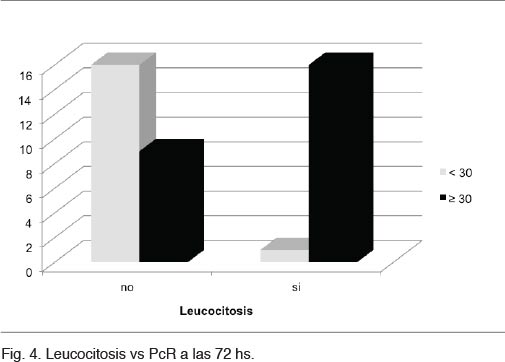
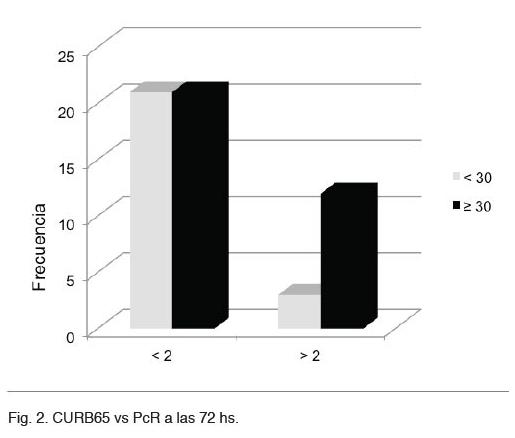
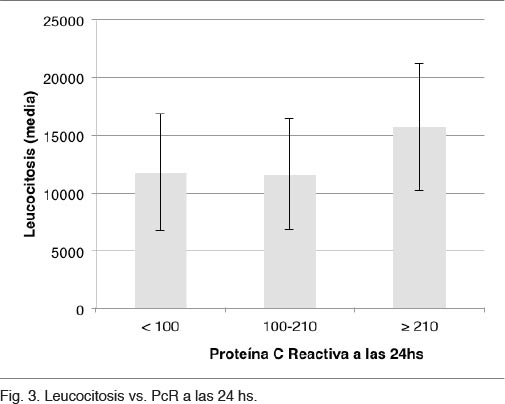
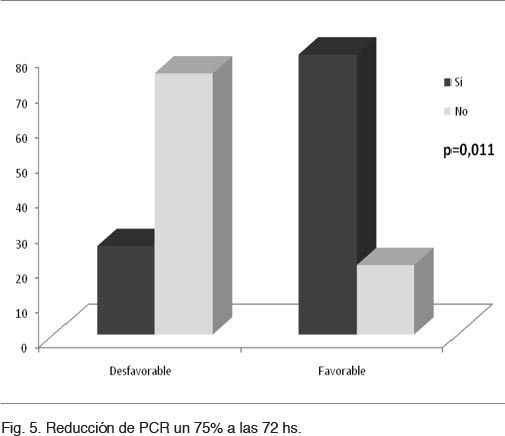
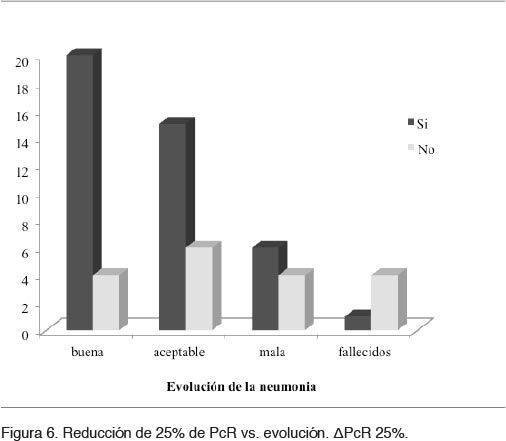
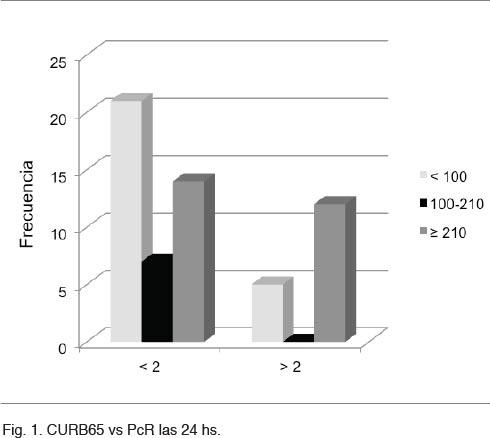
<body><![CDATA[<p style="margin-right: 42.25pt; text-align: justify; text-indent: 17pt; line-height: 120%;"> <font face="Verdana"><span style="font-size: 10pt; line-height: 120%; ">La ausencia de disnea se asocio con bajos niveles de PcR (p = 0,020). Los niveles de PcR no se correlacionaron con la extensi&oacute;n radiol&oacute;gica, temperatura axilar ni con dolor pleur&iacute;tico.</span></font><o:p></o:p></p>       <p style="margin-right: 42.25pt; text-align: justify; text-indent: 17pt; line-height: 120%;"> <font face="Verdana"><span style="font-size: 10pt; line-height: 120%; ">En cuanto a la comparaci&oacute;n con el score de CURB65 destacamos que 38 pacientes presentaron un CURB 65 &ge; 2 y &eacute;stos asociaron niveles de PcR &ge; 210 y 30 mg/l a las 24 y 72 hs. respectivamente (Figuras <a name="-fig1a6"></a><a href="#fig1">1</a> y <a href="#fig2">2</a>).</span></font><o:p></o:p></p>       <p style="margin-right: 42.25pt; text-align: justify; text-indent: 17pt; line-height: 120%;"> <font face="Verdana"><span style="font-size: 10pt; line-height: 120%; ">La elevaci&oacute;n de la PcR a las 24 hs. se correlacion&oacute; con el aumento significativo en la leucocitosis. A las 72 hs. en aquellos pacientes en los que la PcR persiste elevada tambi&eacute;n lo estaba la leucocitosis (p = 0,001) (Figuras <a href="#fig3">3</a> y <a href="#fig4">4</a>).</span></font><o:p></o:p></p>       <p style="margin-right: 42.25pt; text-align: justify; text-indent: 17pt; line-height: 120%;"> <span style="font-size: 10pt; line-height: 120%; font-family: Verdana;">Aquellos pacientes con niveles de PcR mayores a 30mg/l a las 72 hs. tuvieron<b> m&aacute;s</b> complicaciones (p = 0,011), y se asociaron con una mala evoluci&oacute;n. El 100% de los pacientes ingresados a UCI mostraron niveles elevados (mayores a 30 mg/l) de PcR a las 72 hs. (p = 0,040). Los pacientes tratados en forma ambulatoria, internados en sala de medicina y CI tuvieron una reducci&oacute;n significativa en los niveles de PcR (&Delta; PcR 25%) en las primeras 72 hs<b>. </b>(Figuras <a href="#fig5">5</a> y <a href="#fig6">6</a>)<b> </b>De los 5 pacientes que fallecieron, 4 no presentaron descenso significativo.</span></p>     <p style="margin-right: 42.25pt; text-align: justify; text-indent: 17pt; line-height: 120%;"> <font face="Verdana" size="2"><a name="fig1"></a><a href="#-fig1a6"><img style="border: 0px solid ; width: 490px; height: 438px;" alt="" src="/img/revistas/ami/v35n3/3a03f1.jpg"></a></font></p>     <p style="margin-right: 42.25pt; text-align: justify; text-indent: 17pt; line-height: 120%;"></p>     <p style="margin-right: 42.25pt; text-align: justify; text-indent: 17pt; line-height: 120%;"> <font face="Verdana" size="2"><a name="fig2"></a><a href="#-fig1a6"><img style="border: 0px solid ; width: 515px; height: 438px;" alt="" src="/img/revistas/ami/v35n3/3a03f2.jpg"></a></font></p>     <p style="margin-right: 42.25pt; text-align: justify; text-indent: 17pt; line-height: 120%;"></p>     <p style="margin-right: 42.25pt; text-align: justify; text-indent: 17pt; line-height: 120%;"> <font face="Verdana" size="2"><a name="fig3"></a><a href="#-fig1a6"><img style="border: 0px solid ; width: 505px; height: 404px;" alt="" src="/img/revistas/ami/v35n3/3a03f3.jpg"></a></font></p>     <p style="margin-right: 42.25pt; text-align: justify; text-indent: 17pt; line-height: 120%;"></p>     ]]></body>
<body><![CDATA[<p style="margin-right: 42.25pt; text-align: justify; text-indent: 17pt; line-height: 120%;"> <font face="Verdana" size="2"><a name="fig4"></a><a href="#-fig1a6"><img style="border: 0px solid ; width: 505px; height: 362px;" alt="" src="/img/revistas/ami/v35n3/3a03f4.jpg"></a></font></p>     <p style="margin-right: 42.25pt; text-align: justify; text-indent: 17pt; line-height: 120%;"></p>     <p style="margin-right: 42.25pt; text-align: justify; text-indent: 17pt; line-height: 120%;"> <font face="Verdana" size="2"><a name="fig5"></a><a href="#-fig1a6"><img style="border: 0px solid ; width: 505px; height: 436px;" alt="" src="/img/revistas/ami/v35n3/3a03f5.jpg"></a></font></p>     <p style="margin-right: 42.25pt; text-align: justify; text-indent: 17pt; line-height: 120%;"></p>     <p style="margin-right: 42.25pt; text-align: justify; text-indent: 17pt; line-height: 120%;"> <font face="Verdana" size="2"><a name="fig6"></a><a href="#-fig1a6"><img style="border: 0px solid ; width: 506px; height: 441px;" alt="" src="/img/revistas/ami/v35n3/3a03f6.jpg"></a></font></p>     <p style="margin-right: 42.25pt; text-align: justify; text-indent: 17pt; line-height: 120%;"><span style="font-size: 9pt; line-height: 120%; font-family: Helvetica;"> <o:p></o:p></span></p>       <p style="margin-right: 42.25pt; text-align: justify; text-indent: 17pt; line-height: 120%;"> <span style="font-size: 10pt; line-height: 120%; font-family: Verdana;"><o:p>&nbsp;</o:p></span></p>       <p style="margin-right: 42.25pt; line-height: 120%;"><b> <span style="font-size: 10pt; line-height: 120%; "><font face="Verdana">Discusi&oacute;n y Comentarios</font></span><o:p></o:p></b></p>       <p style="margin-right: 42.25pt; text-align: justify; text-indent: 17pt; line-height: 120%;"> <span style="font-size: 10pt; line-height: 120%; font-family: Verdana;"><o:p>&nbsp;</o:p></span></p>       <p style="margin-right: 42.25pt; text-align: justify; text-indent: 17pt; line-height: 120%;"> <font face="Verdana"><span style="font-size: 10pt; line-height: 120%; ">La presencia de comorbilidades, exceptuando las neoplasias, no se correlacion&oacute; con el aumento significativo de la PcR, esto apoya el rol independiente de este biomarcador en la NAC en el contexto de pacientes que no tengan un estado proinflamatorio basal.</span></font><o:p></o:p></p>       ]]></body>
<body><![CDATA[<p style="margin-right: 42.25pt; text-align: justify; text-indent: 17pt; line-height: 120%;"> <font face="Verdana"><span style="font-size: 10pt; line-height: 120%; ">Es por este motivo que ante la presencia de enfermedades inflamatorias cr&oacute;nicas, las variaciones en la concentraci&oacute;n en el tiempo de la PcR es m&aacute;s &uacute;til que un <b>&uacute;nico </b>valor. P&oacute;voa et al., en un estudio realizado en 112 pacientes procedentes de cuidados intensivos, demostraron que las concentraciones de PcR aumentaron con el tiempo en los pacientes infectados, pero permanecieron sin cambios en los pacientes no infectados<sup>(<a href="#9">9</a>)</sup>.<a name="-9"></a></span></font><sup><o:p></o:p></sup></p>       <p style="margin-right: 42.25pt; text-align: justify; text-indent: 17pt; line-height: 120%;"> <font face="Verdana"><span style="font-size: 10pt; line-height: 120%; ">Se pudo observar tambi&eacute;n que los niveles de PcR se correlacionaron con la elevaci&oacute;n de la leucocitosis y la severidad del CURB65, estos hallazgos son acordes a lo demostrado en el estudio CAPNETZ donde se encontr&oacute; que la elevaci&oacute;n de biomarcadores se correlaciona con la gravedad de la NAC y el score de severidad CURB 65<sup>(<a href="#10">10</a>)</sup>.<a name="-10"></a></span></font><sup><o:p></o:p></sup></p>       <p style="margin-right: 42.25pt; text-align: justify; text-indent: 17pt; line-height: 120%;"> <span style="font-size: 10pt; line-height: 120%; "><font face="Verdana">Otro dato que surge de este trabajo es que la variaci&oacute;n de los niveles de PcR de un 25% se vincula con una buena evoluci&oacute;n, independientemente de los niveles medidos a la 24 y 72 hs. y que la persistencia de niveles elevados de PcR a las 72 hs. de iniciado el tratamiento se asocia con una mala evoluci&oacute;n.</font></span><o:p></o:p></p>       <p style="margin-right: 42.25pt; text-align: justify; text-indent: 17pt; line-height: 120%;"> <span style="font-size: 10pt; line-height: 120%; "><font face="Verdana">Algunos estudios describen que un aumento o disminuci&oacute;n del rango de PcR en m&aacute;s/menos 40%<sup>(<a href="#6">6</a>) </sup>e inclusive para otros del 60%<sup>(<a href="#11">11</a>)</sup><a name="-11"></a> respecto a la primera muestra, se relaciona con una falta de respuesta y/o aparici&oacute;n de complicaciones&nbsp;<sup>(<a href="#12">12</a>)</sup>.<a name="-12"></a></font></span><sup><o:p></o:p></sup></p>       <p style="margin-right: 42.25pt; text-align: justify; text-indent: 17pt; line-height: 120%;"> <span style="font-size: 10pt; line-height: 120%; "><font face="Verdana">Por lo tanto este trabajo sugiere que la PcR es buen predictor de la evoluci&oacute;n de la NAC, sobre todo cuando se mide la variabilidad en su rango. De tenerlo disponible es recomendable su dosificaci&oacute;n al ingreso y 72 hs. de inciado el tratamiento.</font></span><o:p></o:p></p>       <p style="margin-right: 42.25pt; text-align: justify; text-indent: 17pt; line-height: 120%;"> <span style="font-size: 10pt; line-height: 120%; font-family: Verdana;"><o:p>&nbsp;</o:p></span></p>       <p style="margin-right: 42.25pt; line-height: 120%;"><b> <span style="font-size: 10pt; line-height: 120%; "><font face="Verdana">Bibliograf&iacute;a</font></span><o:p></o:p></b></p>       <p style="margin-right: 42.25pt; text-align: justify; text-indent: 17pt; line-height: 120%;"> <span style="font-size: 10pt; line-height: 120%; font-family: Verdana;"><o:p>&nbsp;</o:p></span></p>       <!-- ref --><p style="margin: 0cm 42.25pt 0.0001pt 17pt; text-align: justify; text-indent: -17pt; line-height: 120%;"> <span style="font-size: 10pt; line-height: 120%; "><font face="Verdana"><a href="#-1">1</a>.<span style="">&nbsp;&nbsp;&nbsp;&nbsp; </span>Mizgerd J P. Acute Lower Respiratory Tract Infection. N Engl J Med 2008; 358:716-27.    </font></span><o:p></o:p></p>       ]]></body>
<body><![CDATA[<!-- ref --><p style="margin: 0cm 42.25pt 0.0001pt 17pt; text-align: justify; text-indent: -17pt; line-height: 120%;"> <span style="font-size: 10pt; line-height: 120%; "><font face="Verdana"><a href="#-2">2</a>.<span style="">&nbsp;&nbsp;&nbsp;&nbsp; </span>Men&eacute;ndez R, Torres A. Neumon&iacute;a: predecir la mala evoluci&oacute;n. Arch Bronconeumol<i>. </i>2005;41(9):475-7 </font></span> <o:p></o:p><!-- ref --><p style="margin: 0cm 42.25pt 0.0001pt 17pt; text-align: justify; text-indent: -17pt; line-height: 120%;"> <span style="font-size: 10pt; line-height: 120%; "><font face="Verdana"><a href="#-3">3</a>.<span style="">&nbsp;&nbsp;&nbsp;&nbsp; </span>Tillett WS, Francis T Jr. Serological reactions in pneumonia with a non-protein somatic fraction of pneumococcus. J Exp Med 1930; 52:561-71.    </font></span><o:p></o:p></p>       <p style="margin: 0cm 42.25pt 0.0001pt 17pt; text-align: justify; text-indent: -17pt; line-height: 120%;"> <span style="font-size: 10pt; line-height: 120%; "><font face="Verdana"><a href="#-4">4</a>.<span style="">&nbsp;&nbsp;&nbsp;&nbsp; </span>Thomas-Rudolph D, Du Clos T, Snapper C, Molda C. C reactive Protein enhances immunity to Streptococcus pneumoniae by Targeting Uptake to F con Dendritic Cells. The Journal of Immunology 2007, 178: 7283&ndash;7291</font></span><o:p></o:p></p>       <!-- ref --><p style="margin: 0cm 42.25pt 0.0001pt 17pt; text-align: justify; text-indent: -17pt; line-height: 120%;"> <span style="font-size: 10pt; line-height: 120%; "><font face="Verdana"><a href="#-5">5</a>.<span style="">&nbsp;&nbsp;&nbsp;&nbsp; </span>Chalmers J, Singanayagam A, Hill A. C-Reactive Protein Is an Independent Predictor of Severity in Community-acquired Pneumonia. The American Journal of Medicine (2008) 121, 219-225 </font></span> <o:p></o:p><!-- ref --><p style="margin: 0cm 42.25pt 0.0001pt 17pt; text-align: justify; text-indent: -17pt; line-height: 120%;"> <span style="font-size: 10pt; line-height: 120%; "><font face="Verdana"><a href="#-6">6</a>.<span style="">&nbsp;&nbsp;&nbsp;&nbsp; </span> Menendez R et al Nneumonia adqurida en la comunidad. Nueva Normativa de la Sociedad espa&ntilde;ola de neumolog&iacute;a y Cirug&iacute;a tor&aacute;cica. (SEPAR) Arch Bronconeumol. 2010;(46:543-558).     </font></span> <o:p></o:p></p>       <!-- ref --><p style="margin: 0cm 42.25pt 0.0001pt 17pt; text-align: justify; text-indent: -17pt; line-height: 120%;"> <span style="font-size: 10pt; line-height: 120%; "><font face="Verdana"><a href="#-7">7</a>.<span style="">&nbsp;&nbsp;&nbsp;&nbsp; </span>Pando A, Lopez F, Molinos L, Miranda B, Gudiel P, Bedate P et al. Marcadores inflamatorios en la Neumonia Adquirida en la comunidad. Arch Bronconeumol. 2008; 44 (EspecCongr):1-216.    </font></span><o:p></o:p></p>       <!-- ref --><p style="margin: 0cm 42.25pt 0.0001pt 17pt; text-align: justify; text-indent: -17pt; line-height: 120%;"> <span style="font-size: 10pt; line-height: 120%; "><font face="Verdana"><a href="#-8">8</a>.<span style="">&nbsp;&nbsp;&nbsp;&nbsp; </span>Ruiz L, Camino J, Gastaminza A, Sanchez A, Freire L et al. Neumonia Adquirida en la Comunidad: comportamiento y utilidad de la prote&iacute;na C reactiva en el control evolutivo precoz. Arch Bronconeumol.2008; 44 (EspecCongr):1-216.    </font></span><o:p></o:p></p>       <!-- ref --><p style="margin: 0cm 42.25pt 0.0001pt 17pt; text-align: justify; text-indent: -17pt; line-height: 120%;"> <span style="font-size: 10pt; line-height: 120%; "><font face="Verdana"><a href="#-9">9</a>.<span style="">&nbsp;&nbsp;&nbsp;&nbsp; </span>P&oacute;voa P, Coelho L, Almeida E&nbsp;<i>et al</i>. Early identification of intensive care unit-acquired infections with daily monitoring of C-reactive protein: a prospective observational study.&nbsp;<i>Crit. Care</i>&nbsp;10(2), R63 (2006).    </font></span><o:p></o:p></p>       <!-- ref --><p style="margin: 0cm 42.25pt 0.0001pt 17pt; text-align: justify; text-indent: -17pt; line-height: 120%;"> <span style="font-size: 10pt; line-height: 120%; "><font face="Verdana"><a href="#-10">10</a>.<span style="">&nbsp;&nbsp; </span>Kruger S, Ewig S, Papassotiriou J et al. Inflammatory parameters predict etiologic patterns but do not allow for individual prediction of etiology in patient with CAP. Results from German competence network CAPNETZ. <i>Respir. Res.</i> 10, 65 (2009) </font></span> <o:p></o:p><p style="margin: 0cm 42.25pt 0.0001pt 17pt; text-align: justify; text-indent: -17pt; line-height: 120%;"> <span style="font-size: 10pt; line-height: 120%; "><font face="Verdana"><a href="#-11">11</a>.<span style="">&nbsp;&nbsp; </span>Bruns AH, Oosterheert JJ, Hak E, Hoepelman AI. Usefulness of consecutive C-reactive protein measurements in follow-up of severe community-acquired pneumonia<i>.</i>&nbsp;<i>Eur. Respir. J.</i>&nbsp;32(3), 726&ndash;732 (2008).</font></span><o:p></o:p></p>       <p style="margin: 0cm 42.25pt 0.0001pt 17pt; text-align: justify; text-indent: -17pt; line-height: 120%;"> <span style="font-size: 10pt; line-height: 120%; font-family: Verdana;"><a name="12"></a><a href="#-12">12</a>.<span style="">&nbsp;&nbsp; </span>Men&eacute;ndez R, Martinez R, Reyes S&nbsp;<i>et al.</i>&nbsp;Stability in community-acquired pneumonia: one step forward with markers. <i>Thorax</i>&nbsp;64, 987&ndash;992 (2009).</span></p>   </div>        ]]></body><back>
<ref-list>
<ref id="B1">
<label>1</label><nlm-citation citation-type="journal">
<person-group person-group-type="author">
<name>
<surname><![CDATA[Mizgerd]]></surname>
<given-names><![CDATA[J P]]></given-names>
</name>
</person-group>
<article-title xml:lang="en"><![CDATA[Acute Lower Respiratory Tract Infection]]></article-title>
<source><![CDATA[N Engl J Med]]></source>
<year>2008</year>
<volume>358</volume>
<page-range>716-27</page-range></nlm-citation>
</ref>
<ref id="B2">
<label>2</label><nlm-citation citation-type="journal">
<person-group person-group-type="author">
<name>
<surname><![CDATA[Menéndez]]></surname>
<given-names><![CDATA[R]]></given-names>
</name>
<name>
<surname><![CDATA[Torres]]></surname>
<given-names><![CDATA[A]]></given-names>
</name>
</person-group>
<article-title xml:lang="es"><![CDATA[Neumonía: predecir la mala evolución]]></article-title>
<source><![CDATA[Arch Bronconeumol]]></source>
<year>2005</year>
<volume>41</volume>
<numero>9</numero>
<issue>9</issue>
<page-range>475-7</page-range></nlm-citation>
</ref>
<ref id="B3">
<label>3</label><nlm-citation citation-type="journal">
<person-group person-group-type="author">
<name>
<surname><![CDATA[Tillett]]></surname>
<given-names><![CDATA[WS]]></given-names>
</name>
<name>
<surname><![CDATA[Francis]]></surname>
<given-names><![CDATA[T Jr]]></given-names>
</name>
</person-group>
<article-title xml:lang="en"><![CDATA[Serological reactions in pneumonia with a non-protein somatic fraction of pneumococcus]]></article-title>
<source><![CDATA[J Exp Med]]></source>
<year>1930</year>
<volume>52</volume>
<page-range>561-71</page-range></nlm-citation>
</ref>
<ref id="B4">
<label>4</label><nlm-citation citation-type="journal">
<person-group person-group-type="author">
<name>
<surname><![CDATA[Thomas-Rudolph]]></surname>
<given-names><![CDATA[D]]></given-names>
</name>
<name>
<surname><![CDATA[Du Clos]]></surname>
<given-names><![CDATA[T]]></given-names>
</name>
<name>
<surname><![CDATA[Snapper]]></surname>
<given-names><![CDATA[C]]></given-names>
</name>
<name>
<surname><![CDATA[Molda]]></surname>
<given-names><![CDATA[C]]></given-names>
</name>
</person-group>
<article-title xml:lang="en"><![CDATA[Creactive Protein enhances immunity to Streptococcus pneumoniae by Targeting Uptake to F con Dendritic Cells]]></article-title>
<source><![CDATA[The Journal of Immunology]]></source>
<year>2007</year>
<volume>178</volume>
<page-range>7283-7291</page-range></nlm-citation>
</ref>
<ref id="B5">
<label>5</label><nlm-citation citation-type="journal">
<person-group person-group-type="author">
<name>
<surname><![CDATA[Chalmers]]></surname>
<given-names><![CDATA[J]]></given-names>
</name>
<name>
<surname><![CDATA[Singanayagam]]></surname>
<given-names><![CDATA[A]]></given-names>
</name>
<name>
<surname><![CDATA[Hill]]></surname>
<given-names><![CDATA[A]]></given-names>
</name>
</person-group>
<article-title xml:lang="en"><![CDATA[C-Reactive Protein Is an Independent Predictor of Severity in Community-acquired Pneumonia]]></article-title>
<source><![CDATA[The American Journal of Medicine]]></source>
<year>2008</year>
<volume>121</volume>
<page-range>219-225</page-range></nlm-citation>
</ref>
<ref id="B6">
<label>6</label><nlm-citation citation-type="journal">
<person-group person-group-type="author">
<name>
<surname><![CDATA[Menendez]]></surname>
<given-names><![CDATA[R]]></given-names>
</name>
</person-group>
<article-title xml:lang="es"><![CDATA[Nneumonia adqurida en la comunidad: Normativa de la Sociedad española de neumología y Cirugía torácica]]></article-title>
<source><![CDATA[Arch Bronconeumol]]></source>
<year>2010</year>
<volume>46</volume>
<page-range>543-558</page-range></nlm-citation>
</ref>
<ref id="B7">
<label>7</label><nlm-citation citation-type="journal">
<person-group person-group-type="author">
<name>
<surname><![CDATA[Pando]]></surname>
<given-names><![CDATA[A]]></given-names>
</name>
<name>
<surname><![CDATA[Lopez]]></surname>
<given-names><![CDATA[F]]></given-names>
</name>
<name>
<surname><![CDATA[Molinos]]></surname>
<given-names><![CDATA[L]]></given-names>
</name>
<name>
<surname><![CDATA[Miranda]]></surname>
<given-names><![CDATA[B]]></given-names>
</name>
<name>
<surname><![CDATA[Gudiel]]></surname>
<given-names><![CDATA[P]]></given-names>
</name>
<name>
<surname><![CDATA[Bedate]]></surname>
<given-names><![CDATA[P]]></given-names>
</name>
</person-group>
<article-title xml:lang="es"><![CDATA[Marcadores inflamatorios en la Neumonia Adquirida en la comunidad]]></article-title>
<source><![CDATA[Arch Bronconeumol]]></source>
<year>2008</year>
<volume>44</volume>
<page-range>1-216</page-range></nlm-citation>
</ref>
<ref id="B8">
<label>8</label><nlm-citation citation-type="journal">
<person-group person-group-type="author">
<name>
<surname><![CDATA[Ruiz]]></surname>
<given-names><![CDATA[L]]></given-names>
</name>
<name>
<surname><![CDATA[Camino]]></surname>
</name>
<name>
<surname><![CDATA[Gastaminza]]></surname>
<given-names><![CDATA[A]]></given-names>
</name>
<name>
<surname><![CDATA[Sanchez]]></surname>
<given-names><![CDATA[A]]></given-names>
</name>
<name>
<surname><![CDATA[Freire]]></surname>
<given-names><![CDATA[L]]></given-names>
</name>
</person-group>
<article-title xml:lang="es"><![CDATA[Neumonia Adquirida en la Comunidad: comportamiento y utilidad de la proteína C reactiva en el control evolutivo precoz]]></article-title>
<source><![CDATA[Arch Bronconeumol]]></source>
<year>2008</year>
<volume>44</volume>
<page-range>1-216</page-range></nlm-citation>
</ref>
<ref id="B9">
<label>9</label><nlm-citation citation-type="journal">
<person-group person-group-type="author">
<name>
<surname><![CDATA[Póvoa]]></surname>
<given-names><![CDATA[P]]></given-names>
</name>
<name>
<surname><![CDATA[Coelho]]></surname>
<given-names><![CDATA[L]]></given-names>
</name>
<name>
<surname><![CDATA[Almeida]]></surname>
<given-names><![CDATA[E]]></given-names>
</name>
</person-group>
<article-title xml:lang="en"><![CDATA[Early identification of intensive care unit-acquired infections with daily monitoring of C-reactive protein: a prospective observational study]]></article-title>
<source><![CDATA[Crit. Care]]></source>
<year>2006</year>
<volume>10</volume>
<numero>2</numero>
<issue>2</issue>
<page-range>R63</page-range></nlm-citation>
</ref>
<ref id="B10">
<label>10</label><nlm-citation citation-type="journal">
<person-group person-group-type="author">
<name>
<surname><![CDATA[Kruger]]></surname>
<given-names><![CDATA[S]]></given-names>
</name>
<name>
<surname><![CDATA[Ewig]]></surname>
<given-names><![CDATA[S]]></given-names>
</name>
<name>
<surname><![CDATA[Papassotiriou]]></surname>
<given-names><![CDATA[J]]></given-names>
</name>
</person-group>
<article-title xml:lang="en"><![CDATA[Inflammatory parameters predict etiologic patterns but do not allow for individual prediction of etiology in patient with CAP: Results from German competence network CAPNETZ]]></article-title>
<source><![CDATA[Respir. Res]]></source>
<year>2009</year>
<volume>10</volume>
<numero>65</numero>
<issue>65</issue>
</nlm-citation>
</ref>
<ref id="B11">
<label>11</label><nlm-citation citation-type="journal">
<person-group person-group-type="author">
<name>
<surname><![CDATA[Bruns]]></surname>
<given-names><![CDATA[AH]]></given-names>
</name>
<name>
<surname><![CDATA[Oosterheert]]></surname>
<given-names><![CDATA[JJ]]></given-names>
</name>
<name>
<surname><![CDATA[Hak]]></surname>
<given-names><![CDATA[E]]></given-names>
</name>
<name>
<surname><![CDATA[Hoepelman]]></surname>
<given-names><![CDATA[AI]]></given-names>
</name>
</person-group>
<article-title xml:lang="en"><![CDATA[Usefulness of consecutive C-reactive protein measurements in follow-up of severe community-acquired pneumonia]]></article-title>
<source><![CDATA[Eur. Respir. J]]></source>
<year>2008</year>
<volume>32</volume>
<numero>3</numero>
<issue>3</issue>
<page-range>726-732</page-range></nlm-citation>
</ref>
<ref id="B12">
<label>12</label><nlm-citation citation-type="journal">
<person-group person-group-type="author">
<name>
<surname><![CDATA[Menéndez]]></surname>
<given-names><![CDATA[R]]></given-names>
</name>
<name>
<surname><![CDATA[Martinez]]></surname>
<given-names><![CDATA[R]]></given-names>
</name>
<name>
<surname><![CDATA[Reyes]]></surname>
</name>
</person-group>
<article-title xml:lang="en"><![CDATA[Stability in community-acquired pneumonia: one step forward with markers]]></article-title>
<source><![CDATA[Thorax]]></source>
<year>2009</year>
<volume>64</volume>
<page-range>987-992</page-range></nlm-citation>
</ref>
</ref-list>
</back>
</article>