<?xml version="1.0" encoding="ISO-8859-1"?><article xmlns:mml="http://www.w3.org/1998/Math/MathML" xmlns:xlink="http://www.w3.org/1999/xlink" xmlns:xsi="http://www.w3.org/2001/XMLSchema-instance">
<front>
<journal-meta>
<journal-id>1688-4221</journal-id>
<journal-title><![CDATA[Ciencias Psicológicas]]></journal-title>
<abbrev-journal-title><![CDATA[Cienc. Psicol.]]></abbrev-journal-title>
<issn>1688-4221</issn>
<publisher>
<publisher-name><![CDATA[Universidad Católica del Uruguay.]]></publisher-name>
</publisher>
</journal-meta>
<article-meta>
<article-id>S1688-42212015000100007</article-id>
<title-group>
<article-title xml:lang="es"><![CDATA[SENTIMIENTO Y AFECTO]]></article-title>
<article-title xml:lang="en"><![CDATA[FEELING AND AFFECT]]></article-title>
</title-group>
<contrib-group>
<contrib contrib-type="author">
<name>
<surname><![CDATA[Balladares]]></surname>
<given-names><![CDATA[Silvia]]></given-names>
</name>
</contrib>
<contrib contrib-type="author">
<name>
<surname><![CDATA[Saiz]]></surname>
<given-names><![CDATA[Mario]]></given-names>
</name>
<xref ref-type="aff" rid="A01"/>
</contrib>
</contrib-group>
<aff id="A01">
<institution><![CDATA[,Universidad Católica del Uruguay  ]]></institution>
<addr-line><![CDATA[ ]]></addr-line>
</aff>
<pub-date pub-type="pub">
<day>00</day>
<month>05</month>
<year>2015</year>
</pub-date>
<pub-date pub-type="epub">
<day>00</day>
<month>05</month>
<year>2015</year>
</pub-date>
<volume>9</volume>
<numero>1</numero>
<fpage>63­</fpage>
<lpage>71</lpage>
<copyright-statement/>
<copyright-year/>
<self-uri xlink:href="http://www.scielo.edu.uy/scielo.php?script=sci_arttext&amp;pid=S1688-42212015000100007&amp;lng=en&amp;nrm=iso"></self-uri><self-uri xlink:href="http://www.scielo.edu.uy/scielo.php?script=sci_abstract&amp;pid=S1688-42212015000100007&amp;lng=en&amp;nrm=iso"></self-uri><self-uri xlink:href="http://www.scielo.edu.uy/scielo.php?script=sci_pdf&amp;pid=S1688-42212015000100007&amp;lng=en&amp;nrm=iso"></self-uri><abstract abstract-type="short" xml:lang="es"><p><![CDATA[Se explora la relación de la función sentimiento (Jung, 1921; Millon, 2001), con el afecto positivo y negativo (Watson et al. 1988), y las metas motivacionales expansión -preservación (Millon, 2001), en una muestra de estudiantes universitarios (n=200). La función sentimiento y la expansión - preservación se estudia a través del Inventario de Estilos de Personalidad [MIPS] (Millon, 2001) y el afecto positivo y negativo a través de la Escala de Afecto Positivo y Negativo [PANAS] (Watson, Clark & Tellegen, 1988), siendo la presente investigación parte de su traducción y adaptación para Uruguay. Los resultados obtenidos muestran que existe una correlación inversa entre la función sentimiento y el afecto positivo, no encontrándose correlación con afecto negativo y tampoco con expansión y preservación]]></p></abstract>
<abstract abstract-type="short" xml:lang="en"><p><![CDATA[This research explores the relationship between feeling function (Jung, 1921; Millon, 2001) with positive and negative affect (Watson et al. 1988) and the expansion-preservation motivational goals (Millon, 2001) in a sample of 200 college students from Uruguay. The feeling function and expansion-preservation are studied through Millon Inventory of Personality Styles [MIPS] (Millon, 2001) and the positive and negative affect through the Positive and Negative Affect Scale [PANAS] (Watson, Clark & Tellegen, 1988). The PANAS has recently been translated and adapted to Uruguay. The results show an inverse correlation between feeling function and positive affect. However, the results do not show a correlation with negative affect nor with expansion and preservation]]></p></abstract>
<kwd-group>
<kwd lng="es"><![CDATA[función sentimiento]]></kwd>
<kwd lng="es"><![CDATA[afecto positivo]]></kwd>
<kwd lng="es"><![CDATA[afecto negativo]]></kwd>
<kwd lng="es"><![CDATA[psicología analítica]]></kwd>
<kwd lng="es"><![CDATA[tipos psicológicos]]></kwd>
<kwd lng="en"><![CDATA[feeling function]]></kwd>
<kwd lng="en"><![CDATA[positive affect]]></kwd>
<kwd lng="en"><![CDATA[negative affect]]></kwd>
<kwd lng="en"><![CDATA[analytical psychology]]></kwd>
<kwd lng="en"><![CDATA[psychological types]]></kwd>
</kwd-group>
</article-meta>
</front><body><![CDATA[ <div class="WordSection1">      <p style="margin: 5pt 89.55pt 0.0001pt 1cm; text-align: justify; line-height: 120%;"><b> <span style="line-height: 120%; font-family: &quot;Verdana&quot;;" lang="EN-US"> <font size="4">SENTIMIENTO Y AFECTO </font> </span></b> <font face="Verdana" size="2"><span style="" lang="EN-US"><o:p>&nbsp;</o:p></span></font></p>           <p style="margin: 5pt 89.55pt 0.0001pt 1cm; text-align: justify; line-height: 120%;"><b> <span style="line-height: 120%; font-family: &quot;Verdana&quot;;" lang="EN-US"> <font size="3">FEELING AND AFFECT</font></span></b></p>           <p style="margin: 5pt 89.55pt 0.0001pt 1cm; text-align: justify; line-height: 120%;">&nbsp;</p>           <p style="margin: 5.65pt 89.55pt 0.0001pt 1cm; text-align: justify; line-height: 120%;"><b><i> <span style="font-size: 10pt; line-height: 120%; font-family: &quot;Verdana&quot;;">Silvia Balladares</span></i></b></p>           <p style="margin: 5pt 89.55pt 0.0001pt 1cm; text-align: justify; line-height: 120%;"><b><i> <span style="font-size: 10pt; line-height: 120%; font-family: &quot;Verdana&quot;;">Mario Saiz</span></i></b></p>           <p style="margin: 5.65pt 89.55pt 0.0001pt 1cm; text-align: justify; line-height: 120%;"><i> <span style="font-size: 10pt; line-height: 120%; font-family: &quot;Verdana&quot;;">Universidad Cat&oacute;lica del Uruguay</span></i></p>           <p style="margin: 5pt 89.55pt 0.0001pt 1cm; text-align: justify; line-height: 120%;"> <font face="Verdana" size="2"><span style="" lang="ES-UY"><o:p>&nbsp;</o:p></span></font></p>           <p style="margin: 5pt 89.55pt 0.0001pt 1cm; text-align: justify; line-height: 120%; font-family: Verdana;"><b><span style="font-size: 10pt; line-height: 120%;" lang="ES-UY">Resumen: </span></b><span style="font-size: 10pt; line-height: 120%;">Se explora la relaci&oacute;n de la funci&oacute;n sentimiento (Jung, 1921; <a name="Millon"></a><a href="#Millon01">Millon</a></span><small>, 2001), con el afecto positivo y negativo (<a name="Watson88_"></a><a href="#WatsonClarkTellegen88">Watson et al.</a> 1988), y las metas motivacionales expansi&oacute;n -preservaci&oacute;n (<a href="#Millon01"><span class="SpellE">Millon</span></a>, 2001), en una muestra de estudiantes universitarios (n=200). La funci&oacute;n sentimiento y la expansi&oacute;n - preservaci&oacute;n se estudia a trav&eacute;s del Inventario de Estilos de Personalidad [MIPS] (<a name="Millon01_"></a><a href="#Millon01"><span class="SpellE">Millon</span></a>, 2001) y el afecto positivo y negativo a trav&eacute;s de la Escala de Afecto Positivo y Negativo [PANAS] (<a name="WatsonClarkTellegen88_"></a><a href="#WatsonClarkTellegen88">Watson, Clark &amp; <span class="SpellE">Tellegen</span></a>, 1988), siendo la presente investigaci&oacute;n parte de su traducci&oacute;n y adaptaci&oacute;n para Uruguay. Los resultados obtenidos muestran que existe una correlaci&oacute;n inversa entre la funci&oacute;n sentimiento y el afecto positivo, no encontr&aacute;ndose correlaci&oacute;n con afecto negativo y tampoco con expansi&oacute;n y preservaci&oacute;n.</small><font size="2"> </font> </p>           <p style="margin: 5pt 89.55pt 0.0001pt 1cm; text-align: justify; line-height: 120%; font-family: Verdana;"><span style="" lang="ES-UY"><o:p> <font size="2">&nbsp;</font></o:p></span></p>           ]]></body>
<body><![CDATA[<p style="margin: 5pt 89.55pt 0.0001pt 1cm; text-align: justify; line-height: 120%; font-family: Verdana;"><b><span style="font-size: 10pt; line-height: 120%;" lang="ES-UY">Palabras Clave: </span></b><span style="font-size: 10pt; line-height: 120%;" lang="ES-UY">funci&oacute;n sentimiento; afecto positivo; afecto negativo; psicolog&iacute;a anal&iacute;tica; tipos psicol&oacute;gicos</span></p>           <p style="margin: 5pt 89.55pt 0.0001pt 1cm; text-align: justify; line-height: 120%; font-family: Verdana;"><span style="" lang="ES-UY"><o:p> <font size="2">&nbsp;</font></o:p></span></p>           <p style="margin: 5pt 89.55pt 0.0001pt 1cm; text-align: justify; line-height: 120%; font-family: Verdana;"><b><span style="font-size: 10pt; line-height: 120%;" lang="EN-US">Abstract: </span></b><span style="font-size: 10pt; line-height: 120%;" lang="EN-US">This research explores the relationship between feeling function (Jung, 1921; <a href="#Millon01"><span class="SpellE">Millon</span></a>, 2001) with positive and negative affect (<a href="#WatsonClarkTellegen88">Watson et al.</a> 1988) and the expansion-preservation motivational goals (<a href="#Millon01"><span class="SpellE">Millon</span></a>, 2001) in a sample of 200 college students from Uruguay. The feeling function and expansion-preservation are studied through <span class="SpellE">Millon</span> Inventory of Personality Styles [MIPS] (<a href="#Millon01"><span class="SpellE">Millon</span></a>, 2001) and the positive and negative affect through the Positive and Negative Affect Scale [PANAS] (<a href="#WatsonClarkTellegen88">Watson, Clark &amp; <span class="SpellE">Tellegen</span></a>, 1988). The PANAS has recently been translated and adapted to Uruguay. The results show an inverse correlation between feeling function and positive affect. However, the results do not show a correlation with negative affect nor with expansion and preservation. </span></p>           <p style="margin: 5pt 89.55pt 0.0001pt 1cm; text-align: justify; line-height: 120%; font-family: Verdana;"><span style="" lang="EN-US"><o:p> <font size="2">&nbsp;</font></o:p></span></p>           <p style="margin: 5.65pt 89.55pt 0.0001pt 1cm; text-align: justify; line-height: 120%; font-family: Verdana;"><b><span style="font-size: 10pt; line-height: 120%;" lang="EN-US">Key Words: </span></b><span style="font-size: 10pt; line-height: 120%;" lang="EN-US">feeling function; positive affect; negative affect; analytical psychology; psychological types</span><span style="" lang="ES-UY"><o:p></o:p></span></p>           <p style="margin: 5.65pt 89.55pt 0.0001pt 1cm; text-align: justify; line-height: 120%; font-family: Verdana;"><span style="" lang="EN-US"><o:p> <font size="2">&nbsp;</font></o:p></span></p>           <p style="margin: 5pt 89.55pt 0.0001pt 1cm; text-align: justify; line-height: 120%; font-family: Verdana;"><span style="font-size: 10pt; line-height: 120%;">Correspondencia: Mario Saiz. Universidad Cat&oacute;lica del Uruguay. </span></p>           <p style="margin: 5pt 89.55pt 0.0001pt 1cm; text-align: justify; line-height: 120%; font-family: Verdana;"><span style="font-size: 10pt; line-height: 120%;">Correo electr&oacute;nico: <a href="esaiz@netgate.com.uy">esaiz@netgate.com.uy</a></span></p>           <p style="margin: 5.65pt 89.55pt 0.0001pt 1cm; text-align: justify; line-height: 120%; font-family: Verdana;"><span style="" lang="ES-UY"><o:p> <font size="2">&nbsp;</font></o:p></span></p>           <p style="margin: 5.65pt 89.55pt 0.0001pt 1cm; text-align: justify; line-height: 120%; font-family: Verdana;"><span style="font-size: 10pt; line-height: 120%;" lang="ES-UY">Recibido: 05/2014<o:p></o:p></span></p>           ]]></body>
<body><![CDATA[<p style="margin: 5.65pt 89.55pt 0.0001pt 1cm; text-align: justify; line-height: 120%; font-family: Verdana;"><span style="font-size: 10pt; line-height: 120%;" lang="ES-UY">Revisado: 12/2014<o:p></o:p></span></p>           <p style="margin: 5.65pt 89.55pt 0.0001pt 1cm; text-align: justify; line-height: 120%; font-family: Verdana;"><span style="font-size: 10pt; line-height: 120%;" lang="ES-UY">Aceptado: 04/2015<o:p></o:p></span></p>           <p style="margin: 5.65pt 89.55pt 0.0001pt 1cm; text-align: justify; line-height: 120%; font-family: Verdana;"><span style="" lang="ES-UY"><o:p> <font size="2">&nbsp;</font></o:p></span></p>           <p style="margin: 5pt 89.55pt 0.0001pt 1cm; text-align: justify; line-height: 120%; font-family: Verdana;"><b><span style="font-size: 10pt; line-height: 120%;" lang="ES-UY">Introducci&oacute;n</span></b><span style="" lang="ES-UY"><o:p></o:p></span></p>           <p style="margin: 5pt 89.55pt 0.0001pt 1cm; text-align: justify; text-indent: 19.85pt; line-height: 120%; font-family: Verdana;"><span style="font-size: 10pt; line-height: 120%;">La presente investigaci&oacute;n explora las relaciones entre la funci&oacute;n sentimiento (Jung, 1921/<a name="Jung45_"></a><a href="#Jung45">1945</a>) y la dimensi&oacute;n <span class="SpellE">bifactorial</span> de la afectividad: afecto positivo y afecto negativo (<a href="#WatsonClarkTellegen88">Watson, Clark &amp; <span class="SpellE">Tellegen</span></a> 1988), con el prop&oacute;sito de contribuir a su discriminaci&oacute;n en el abordaje cl&iacute;nico y sem&aacute;ntico. </span></p>           <p style="margin: 5pt 89.55pt 0.0001pt 1cm; text-align: justify; text-indent: 19.85pt; line-height: 120%; font-family: Verdana;"><span style="font-size: 10pt; line-height: 120%;">La Psicolog&iacute;a Anal&iacute;tica describe las funciones tipol&oacute;gicas como patrones de la conciencia que estructuran la forma de recibir y procesar la informaci&oacute;n, orientando la relaci&oacute;n con el otro, con el mundo y con uno mismo. Esto se logra en base a dos funciones perceptivas: sensaci&oacute;n e intuici&oacute;n y dos funciones evaluativas: el pensamiento y el sentimiento (<a name="Saiz09_"></a><a href="#Saiz09">Saiz et al.</a>, 2009). </span></p>           <p style="margin: 5pt 89.55pt 0.0001pt 1cm; text-align: justify; text-indent: 19.85pt; line-height: 120%; font-family: Verdana;"><span style="font-size: 10pt; line-height: 120%;">El sentimiento es una de las cuatro funciones adaptativas y evaluadoras de la conciencia, es una funci&oacute;n racional - aunque no l&oacute;gica - y de cualidad personal y subjetiva (<a name="Jung69_"></a><a href="#Jung69">Jung</a>, 1969). Conduce a evaluar la cualidad y el valor espec&iacute;fico de los objetos. Seg&uacute;n <a href="#Jung69">Jung</a> (1969), es objetivable con un juicio de agrado o desagrado y con una actitud de rechazo o acercamiento, pero no es reductible a la polaridad placer - displacer. Su juicio genera una memoria sentimental (<a name="Von_"></a><a href="#Von">Von Franz &amp; <span class="SpellE">Hillman</span></a>, 1971), que brinda unidad temporal y coherencia interna a las vivencias. &ldquo;El sentido del tiempo y del tacto es una tarea del sentimiento que muchas veces es incompatible con la raz&oacute;n del pensamiento&rdquo; (<a href="#Von">Von Franz &amp; <span class="SpellE">Hillman</span></a>, 1971, p. 133).</span></p>           <p style="margin: 5pt 89.55pt 0.0001pt 1cm; text-align: justify; text-indent: 19.85pt; line-height: 120%; font-family: Verdana;"><span style="font-size: 10pt; line-height: 120%;" lang="ES-UY">La teor&iacute;a integracionista de <a name="Millon06_"></a><a href="#Millon06">Millon</a></span><small> (2006), retoma la propuesta tipol&oacute;gica formulada por Jung y la incorpora en la construcci&oacute;n del Inventario de Estilos de Personalidad (MIPS). Las escalas se distribuyen en tres &aacute;reas: Metas Motivacionales, Modos Cognitivos y Conductas Interpersonales.</small><font size="2"> </font> <span style="" lang="ES-UY"><o:p></o:p></span></p>           <p style="margin: 5pt 89.55pt 0.0001pt 1cm; text-align: justify; text-indent: 19.85pt; line-height: 120%; font-family: Verdana;"><a href="#Millon06"><span class="SpellE"><span style="font-size: 10pt; line-height: 120%;" lang="ES-UY">Millon</span></span></a><span style="font-size: 10pt; line-height: 120%;" lang="ES-UY"> (2006) en la escala del Modo o Estilo</span><span style="font-size: 10pt; line-height: 120%; color: rgb(255, 102, 0);" lang="ES-UY"> </span><span style="font-size: 10pt; line-height: 120%;" lang="ES-UY">Cognitivo, describe un par de bipolaridades entre las cuales se destaca la diferencia entre "... los procesos que se basan esencialmente en el intelecto, la l</span><span style="font-size: 10pt; line-height: 120%;" lang="ZH-CN">&oacute;</span><span class="SpellE"><span style="font-size: 10pt; line-height: 120%;" lang="ES-UY">gica</span></span><span style="font-size: 10pt; line-height: 120%;" lang="ES-UY">, la <span class="SpellE">raz</span></span><span style="font-size: 10pt; line-height: 120%;" lang="ZH-CN">&oacute;</span><span style="font-size: 10pt; line-height: 120%;" lang="ES-UY">n y la objetividad (<span class="SpellE">reflexi</span></span><span style="font-size: 10pt; line-height: 120%;" lang="ZH-CN">&oacute;</span><span style="font-size: 10pt; line-height: 120%;" lang="ES-UY">n), y los procesos que dependen de la <span class="SpellE">empat</span></span><span style="font-size: 10pt; line-height: 120%;" lang="ZH-CN">&iacute;</span><span style="font-size: 10pt; line-height: 120%;" lang="ES-UY">a afectiva, los valores personales, los sentimientos y la subjetividad (afectividad)" (p. 20). Aclara que el tono emotivo de las palabras transmite m</span><span style="font-size: 10pt; line-height: 120%;" lang="ZH-CN">&aacute;</span><span style="font-size: 10pt; line-height: 120%;" lang="ES-UY">s que su contenido o l</span><span style="font-size: 10pt; line-height: 120%;" lang="ZH-CN">&oacute;</span><span class="SpellE"><span style="font-size: 10pt; line-height: 120%;" lang="ES-UY">gica</span></span><span style="font-size: 10pt; line-height: 120%;" lang="ES-UY">, cuanto m</span><span style="font-size: 10pt; line-height: 120%;" lang="ZH-CN">&aacute;</span><span style="font-size: 10pt; line-height: 120%;" lang="ES-UY">s acentuada la tendencia hacia la polaridad sentimiento. Expresa asimismo que </span><span style="font-size: 10pt; line-height: 120%;" lang="ZH-CN">&ldquo;&hellip;</span><span style="font-size: 10pt; line-height: 120%;" lang="ES-UY">los sentimientos activar</span><span style="font-size: 10pt; line-height: 120%;" lang="ZH-CN">&aacute;</span><span style="font-size: 10pt; line-height: 120%;" lang="ES-UY">n estados subjetivos tales como unir frente a desunir, sentirse bien frente a sentirse mal, bienestar frente a incomodidad, <span class="SpellE">atracci</span></span><span style="font-size: 10pt; line-height: 120%;" lang="ZH-CN">&oacute;</span><span style="font-size: 10pt; line-height: 120%;" lang="ES-UY">n frente a rechazo, aprecio frente a desprecio, y as</span><span style="font-size: 10pt; line-height: 120%;" lang="ZH-CN">&iacute;</span><span style="font-size: 10pt; line-height: 120%;" lang="ES-UY"> sucesivamente</span><span style="font-size: 10pt; line-height: 120%;" lang="ZH-CN">&rdquo;</span><span style="font-size: 10pt; line-height: 120%;" lang="ES-UY"> (<a href="#Millon01"><span class="SpellE">Millon</span></a> 2001, p. 40). Una <span class="SpellE">puntuaci</span></span><span style="font-size: 10pt; line-height: 120%;" lang="ZH-CN">&oacute;</span><span style="font-size: 10pt; line-height: 120%;" lang="ES-UY">n alta en la escala sentimiento implica que las personas "forman sus criterios <span class="SpellE">seg</span></span><span style="font-size: 10pt; line-height: 120%;" lang="ZH-CN">&uacute;</span><span style="font-size: 10pt; line-height: 120%;" lang="ES-UY">n sus propias respuestas afectivas ante las circunstancias, <span class="SpellE">eval</span></span><span style="font-size: 10pt; line-height: 120%;" lang="ZH-CN">&uacute;</span><span class="SpellE"><span style="font-size: 10pt; line-height: 120%;" lang="ES-UY">an</span></span><span style="font-size: 10pt; line-height: 120%;" lang="ES-UY"> subjetivamente la <span class="SpellE">repercusi</span></span><span style="font-size: 10pt; line-height: 120%;" lang="ZH-CN">&oacute;</span><span style="font-size: 10pt; line-height: 120%;" lang="ES-UY">n que <span class="SpellE">tendr</span></span><span style="font-size: 10pt; line-height: 120%;" lang="ZH-CN">&aacute;</span><span style="font-size: 10pt; line-height: 120%;" lang="ES-UY">n sus acciones sobre aquellos que <span class="SpellE">est</span></span><span style="font-size: 10pt; line-height: 120%;" lang="ZH-CN">&aacute;</span><span style="font-size: 10pt; line-height: 120%;" lang="ES-UY">n involucrados y siguen sus metas y valores personales" (<a href="#Millon01"><span class="SpellE">Millon</span></a> 2001, p. 13). En el proceso de evaluar por el sentimiento, la <span class="SpellE">informaci</span></span><span style="font-size: 10pt; line-height: 120%;" lang="ZH-CN">&oacute;</span><span style="font-size: 10pt; line-height: 120%;" lang="ES-UY">n que proporcionan los sentidos desencadena una respuesta o <span class="SpellE">reacci</span></span><span style="font-size: 10pt; line-height: 120%;" lang="ZH-CN">&oacute;</span><span style="font-size: 10pt; line-height: 120%;" lang="ES-UY">n subjetiva, que puede tener una <span class="SpellE">connotaci</span></span><span style="font-size: 10pt; line-height: 120%;" lang="ZH-CN">&oacute;</span><span style="font-size: 10pt; line-height: 120%;" lang="ES-UY">n afectiva neutra, positiva o negativa (<a href="#Millon01"><span class="SpellE">Millon</span></a>, 2001). </span><span style="" lang="ES-UY"><o:p></o:p></span></p>           <p style="margin: 5pt 89.55pt 0.0001pt 1cm; text-align: justify; text-indent: 19.85pt; line-height: 120%; font-family: Verdana;"><span style="font-size: 10pt; line-height: 120%;">En el camino de diferenciar entre sentimiento, emoci&oacute;n, estado de &aacute;nimo y evaluaciones afectivas, los aportes de <a name="Frijda_"></a><a href="#Frijda">Frijda</a></span><small><a href="#Frijda">, <span class="SpellE">Mesquita</span>, <span class="SpellE">Sonnemans</span> y Van <span class="SpellE">Goozen</span></a><a name="Ekman_"></a><a href="#Ekman"><span class="SpellE">Ekman</span></a> (2012) y <a name="Rosas_"></a><a href="#Rosas">Rosas</a> (2011), nos posibilitan distinguir</small><font size="2"> </font> <small>(1991)</small><font size="2">, </font><span style="font-size: 10pt; line-height: 120%;">sentimientos de otras experiencias afectivas. <a href="#Rosas">Rosas</a> (2011) define la especificidad fenomenol&oacute;gica de los sentimientos, argumentando a favor del isomorfismo parcial entre sentimientos y emociones, pero descartando la presunci&oacute;n de que los sentimientos sean epifen&oacute;menos de las emociones. </span><span style="" lang="ES-UY"><o:p></o:p></span></p>           ]]></body>
<body><![CDATA[<p style="margin: 5pt 89.55pt 0.0001pt 1cm; text-align: justify; text-indent: 19.85pt; line-height: 120%; font-family: Verdana;"><a href="#Frijda"><span class="SpellE"><span style="font-size: 10pt; line-height: 120%;">Frijda</span></span></a><span style="font-size: 10pt; line-height: 120%;"><a href="#Frijda"> el al.</a> (1991) discurren sobre la teor&iacute;a valorativa de las emociones, definiendo los sentimientos como aquella experiencia afectiva, con un car&aacute;cter de tipo <span class="SpellE">disposicional</span> e intencional, en tanto, es dirigida a un objeto espec&iacute;fico y no como una sensaci&oacute;n. Ese tipo de intencionalidad ser&iacute;a lo que lo diferencia del estado de &aacute;nimo; este &uacute;ltimo no posa en un objeto intencional preciso, es <span class="SpellE">mas</span>, su causa es vaga y difusa.</span></p>           <p style="margin: 5pt 89.55pt 9.9pt 1cm; text-align: justify; text-indent: 19.85pt; font-family: Verdana;"><span style="font-size: 10pt; line-height: 115%;">Actualmente el sentimiento<b> </b>es definido como disposici&oacute;n emocional o esquema afectivo (<a href="#Frijda"><span class="SpellE">Frijda</span> et al.</a>, 1991; <span class="SpellE">Ryle</span>, 2009) o como estructura <span class="SpellE">disposicional</span> (<a href="#Rosas">Rosas</a> 2011). Se lo diferencia de las emociones (<a href="#Ekman"><span class="SpellE">Ekman</span></a> 2012, <a href="#Rosas">Rosas</a> 2011) y del estado de &aacute;nimo (<a href="#Rosas">Rosas</a>, 2011) tanto por su duraci&oacute;n y estabilidad, como por estar dirigido a un objeto intencional espec&iacute;fico. Seg&uacute;n <a href="#Rosas">Rosas</a> (2011),    <br>      </span><span style="line-height: 115%"><font size="2">los sentimientos comprenden una visi&oacute;n global y asociativa de sus objetos intencionales, en que la valoraci&oacute;n inicial obtenida a trav&eacute;s de la emoci&oacute;n, junto a la presencia de pensamientos y recuerdos, genera creencias relevantes tanto para el establecimiento de los sentimientos como disposiciones, como para las pautas de acci&oacute;n subsecuentes (p. 16)</font></span><span style="font-size: 10pt; line-height: 115%;">.</span><span style="" lang="ES-UY"><o:p></o:p></span></p>           <p style="margin: 5pt 89.55pt 0.0001pt 1cm; text-align: justify; text-indent: 19.85pt; line-height: 120%; font-family: Verdana;"><span style="font-size: 10pt; line-height: 120%;"><a name="Castilla_"></a><a href="#Castilla">Castilla del Pino</a> (2009), considera los sentimientos como instrumentos que permiten vincularse eficazmente a los objetos mediante un lazo afectivo, permitiendo establecer una organizaci&oacute;n singular y jerarquizada de los valores.</span></p>           <p style="margin: 5pt 89.55pt 0.0001pt 1cm; text-align: justify; text-indent: 19.85pt; line-height: 120%; font-family: Verdana;"><span style="font-size: 10pt; line-height: 120%;">La tarea instrumental, vinculante y jer&aacute;rquica de la Funci&oacute;n Sentimiento queda de manifiesto luego</span><span style="font-size: 10pt; line-height: 120%; color: red;"> </span><span style="font-size: 10pt; line-height: 120%;">en sentimientos tales como la pertenencia, la culpa, el respeto, el amor, los celos, la soledad, el vac&iacute;o, y los sentimientos de s&iacute;. Estos pueden sentirse como agradables o desagradables, y tambi&eacute;n como amenazadores o tranquilizantes y esperanzadores. En todos los casos se diferencian por su fenomenolog&iacute;a y caracter&iacute;sticas tanto de las emociones, como de los afectos y estados de &aacute;nimo. </span><span style="" lang="ES-UY"><o:p></o:p></span></p>           <p style="margin: 5pt 89.55pt 0.0001pt 1cm; text-align: justify; text-indent: 19.85pt; line-height: 120%; font-family: Verdana;"><span style="font-size: 10pt; line-height: 120%;">El estado de &aacute;nimo, se define en el DSM IV (<a name="APA_"></a><a href="#American">APA</a>,1995) como una &ldquo;...emoci&oacute;n generalizada y persistente que colorea la percepci&oacute;n del mundo&rdquo;, y se describen cinco tipos: el <span class="SpellE">disf&oacute;rico</span>, elevado, <span class="SpellE">eut&iacute;mico</span>, expansivo e irritable. <a name="PaezCarbonero_"></a><a href="#Paez">P&aacute;ez y Carbonero</a> (1993) lo caracterizan como &ldquo;estados afectivos de baja intensidad y relativamente resistentes, con causas antecedentes no inmediatamente salientes, y por lo tanto, con escaso contenido cognitivo; es decir, no tienen una sola causa espec&iacute;fica y act&uacute;an de forma persistente en el tiempo&rdquo; (p.134), diferenci&aacute;ndolo as&iacute; de la emoci&oacute;n. Posteriormente, a partir de sus investigaciones de la expresi&oacute;n facial de las emociones, <a href="#Ekman"><span class="SpellE">Ekman</span></a> (2012) respecto a los estados de &aacute;nimo, concluye que no parecer&iacute;an mostrarse ni en la cara ni en la voz. Su causa difusa, activa emociones concretas y predispone la interpretaci&oacute;n del entorno y la respuesta ante las situaciones. </span></p>           <p style="margin: 5pt 89.55pt 0.0001pt 1cm; text-align: justify; text-indent: 19.85pt; line-height: 120%; font-family: Verdana;"><span style="font-size: 10pt; line-height: 120%;" lang="ES-UY">Los resultados de las investigaciones en el dominio de la afectividad hasta la d</span><span style="font-size: 10pt; line-height: 120%;" lang="ZH-CN">&eacute;</span><span style="font-size: 10pt; line-height: 120%;" lang="ES-UY">cada del 80 no <span class="SpellE">permit</span></span><span style="font-size: 10pt; line-height: 120%;" lang="ZH-CN">&iacute;</span><span class="SpellE"><span style="font-size: 10pt; line-height: 120%;" lang="ES-UY">an</span></span><span style="font-size: 10pt; line-height: 120%;" lang="ES-UY"> definir, evaluar y establecer claras diferencias entre sentimiento, <span class="SpellE">emoci</span></span><span style="font-size: 10pt; line-height: 120%;" lang="ZH-CN">&oacute;</span><span style="font-size: 10pt; line-height: 120%;" lang="ES-UY">n, y estado de </span><span style="font-size: 10pt; line-height: 120%;" lang="ZH-CN">&aacute;</span><span class="SpellE"><span style="font-size: 10pt; line-height: 120%;" lang="ES-UY">nimo</span></span><span style="font-size: 10pt; line-height: 120%;" lang="ES-UY">. Ser</span><span style="font-size: 10pt; line-height: 120%;" lang="ZH-CN">&aacute;</span><span style="font-size: 10pt; line-height: 120%;" lang="ES-UY"> precisamente a partir de las investigaciones de</span><span style="font-size: 10pt; line-height: 120%; color: rgb(255, 102, 0);" lang="ES-UY"> </span><a name="Zevon_"> <font size="2"></font></a><a href="#Zevon"><small>Zevon</small></a><span style="font-size: 10pt; line-height: 120%;" lang="ES-UY"><a href="#Zevon"><span style="font-family: Verdana;"> y </span><span style="font-family: Verdana;" class="SpellE">Tellegen</span></a> (1982), <a name="WatsonTellegen85_"></a><a href="#WatsonTellegen85">Watson y <span class="SpellE">Tellegen</span></a> (1985) y <a href="#WatsonClarkTellegen88">Watson et al.</a> (1988), que se obtienen descriptores lo m</span><span style="font-size: 10pt; line-height: 120%;" lang="ZH-CN">&aacute;</span><span style="font-size: 10pt; line-height: 120%;" lang="ES-UY">s puros posible del afecto, para poder evaluar el humor o estado de </span><span style="font-size: 10pt; line-height: 120%;" lang="ZH-CN">&aacute;</span><span class="SpellE"><span style="font-size: 10pt; line-height: 120%;" lang="ES-UY">nimo</span></span><span style="font-size: 10pt; line-height: 120%;" lang="ES-UY">. Sus investigaciones permiten caracterizar la estructura b</span><span style="font-size: 10pt; line-height: 120%;" lang="ZH-CN">&aacute;</span><span class="SpellE"><span style="font-size: 10pt; line-height: 120%;" lang="ES-UY">sica</span></span><span style="font-size: 10pt; line-height: 120%;" lang="ES-UY"> del afecto como</span><span style="font-size: 10pt; line-height: 120%; color: rgb(255, 102, 0);" lang="ES-UY"> </span><span style="font-size: 10pt; line-height: 120%;" lang="ES-UY">bidimensional, denominando cada <span class="SpellE">dimensi</span></span><span style="font-size: 10pt; line-height: 120%;" lang="ZH-CN">&oacute;</span><span style="font-size: 10pt; line-height: 120%;" lang="ES-UY">n como afecto positivo y afecto negativo. Cada una de estas dimensiones es relativamente</span><span style="font-size: 10pt; line-height: 120%; color: rgb(255, 102, 0);" lang="ES-UY"> </span><span style="font-size: 10pt; line-height: 120%;" lang="ES-UY">independiente y por tanto no correlacionada, siendo <span class="SpellE">bifactorial</span> a nivel descriptivo. El polo alto representa un estado de alto afecto, y el polo bajo, solo indica la ausencia relativa de <span class="SpellE">implicaci</span></span><span style="font-size: 10pt; line-height: 120%;" lang="ZH-CN">&oacute;</span><span style="font-size: 10pt; line-height: 120%;" lang="ES-UY">n afectiva (<a href="#WatsonTellegen85">Watson &amp; <span class="SpellE">Tellegen</span></a>, 1985). El afecto positivo (AP) refleja el punto hasta el cual una persona se siente entusiasta, activa, alerta, con <span class="SpellE">energ</span></span><span style="font-size: 10pt; line-height: 120%;" lang="ZH-CN">&iacute;</span><span style="font-size: 10pt; line-height: 120%;" lang="ES-UY">a y <span class="SpellE">participaci</span></span><span style="font-size: 10pt; line-height: 120%;" lang="ZH-CN">&oacute;</span><span style="font-size: 10pt; line-height: 120%;" lang="ES-UY">n gratificante. El afecto negativo (AN) representa una <span class="SpellE">dimensi</span></span><span style="font-size: 10pt; line-height: 120%;" lang="ZH-CN">&oacute;</span><span style="font-size: 10pt; line-height: 120%;" lang="ES-UY">n general de <span class="SpellE">distr</span></span><span style="font-size: 10pt; line-height: 120%;" lang="ZH-CN">&eacute;</span><span style="font-size: 10pt; line-height: 120%;" lang="ES-UY">s subjetivo y <span class="SpellE">participaci</span></span><span style="font-size: 10pt; line-height: 120%;" lang="ZH-CN">&oacute;</span><span style="font-size: 10pt; line-height: 120%;" lang="ES-UY">n desagradable que incluye una variedad de estados emocionales <span class="SpellE">aversivos</span> como disgusto, miedo, ira, culpa y nerviosismo. </span><span style="" lang="ES-UY"><o:p></o:p></span></p>           <p style="margin: 5pt 89.55pt 0.0001pt 1cm; text-align: justify; text-indent: 19.85pt; line-height: 120%; font-family: Verdana;"><span style="font-size: 10pt; line-height: 120%;" lang="ES-UY"><a href="#WatsonClarkTellegen88">Watson et al.</a> (1988) validan en Estados Unidos, en una <span class="SpellE">poblaci</span></span><span style="font-size: 10pt; line-height: 120%;" lang="ZH-CN">&oacute;</span><span style="font-size: 10pt; line-height: 120%;" lang="ES-UY">n de n = 4.217, compuesta por estudiantes universitarios y adultos no universitarios,</span><span style="font-size: 10pt; line-height: 120%; color: red;" lang="ES-UY"> </span><span style="font-size: 10pt; line-height: 120%;" lang="ES-UY">un cuestionario de <span class="SpellE">autoinforme</span> denominado Positive and <span class="SpellE">Negative</span> <span class="SpellE">Affect</span> Schedule (PANAS), aislando 10 descriptores de afecto positivo (AP) y 10 de afecto negativo (AN); constructos que constituyen los 20 </span><span style="font-size: 10pt; line-height: 120%;" lang="ZH-CN">&iacute;</span><span class="SpellE"><span style="font-size: 10pt; line-height: 120%;" lang="ES-UY">tems</span></span><span style="font-size: 10pt; line-height: 120%;" lang="ES-UY"> de su <span class="SpellE">versi</span></span><span style="font-size: 10pt; line-height: 120%;" lang="ZH-CN">&oacute;</span><span style="font-size: 10pt; line-height: 120%;" lang="ES-UY">n actual. <a href="#WatsonClarkTellegen88">Watson et al.</a> (1988) comprueban que ambas <span class="SpellE">subescalas</span> del PANAS (AP y AN); poseen niveles adecuados de fiabilidad y validez (factorial convergente y discriminante), <span class="SpellE">manteni</span></span><span style="font-size: 10pt; line-height: 120%;" lang="ZH-CN">&eacute;</span><span class="SpellE"><span style="font-size: 10pt; line-height: 120%;" lang="ES-UY">ndose</span></span><span style="font-size: 10pt; line-height: 120%;" lang="ES-UY"> las propiedades <span class="SpellE">psicom</span></span><span style="font-size: 10pt; line-height: 120%;" lang="ZH-CN">&eacute;</span><span class="SpellE"><span style="font-size: 10pt; line-height: 120%;" lang="ES-UY">tricas</span></span><span style="font-size: 10pt; line-height: 120%;" lang="ES-UY"> a</span><span style="font-size: 10pt; line-height: 120%;" lang="ZH-CN">&uacute;</span><span style="font-size: 10pt; line-height: 120%;" lang="ES-UY">n cuando se modifiquen las instrucciones temporales de <span class="SpellE">aplicaci</span></span><span style="font-size: 10pt; line-height: 120%;" lang="ZH-CN">&oacute;</span><span style="font-size: 10pt; line-height: 120%;" lang="ES-UY">n (estado-rasgo). </span><span style="" lang="ES-UY"><o:p></o:p></span></p>           <p style="margin: 5pt 89.55pt 0.0001pt 1cm; text-align: justify; text-indent: 19.85pt; line-height: 120%; font-family: Verdana;"><span style="font-size: 10pt; line-height: 120%;" lang="ES-UY">La estructura <span class="SpellE">bifactorial</span> del afecto postulada por Watson y sus colaboradores, se ha visto corroborada en diferentes culturas y pa&iacute;ses, con la traducci&oacute;n y adaptaci&oacute;n de PANAS. En los pa&iacute;ses de habla hispana encontramos las publicaciones de <a name="Sandin_"></a><a href="#Sandin">Sand&iacute;n</a></span><a href="#Sandin"><font size="2"> </font> </a><small><a href="#Sandin">et al.</a>, 1999; <a name="RoblesPaez_"></a><a href="#Robles">Robles y P&aacute;ez</a>, 2003; <a name="Moral_"></a><a href="#Moral">Moral</a>, 2011 y <a name="Gargurevich_"></a><a href="#Gargurevich">Gargurevich y Matos</a>, 2012. En poblaci&oacute;n uruguaya la presente investigaci&oacute;n ha contribuido a la traducci&oacute;n y adaptaci&oacute;n del PANAS (<a name="Saiz13_"></a><a href="#Saiz13">Saiz, Palacios, Balladares, &amp; Mach&iacute;n</a>, 2013) brindando as&iacute; un instrumento valioso tanto para la investigaci&oacute;n de la afectividad, como para su aplicaci&oacute;n en el campo de la Psicolog&iacute;a C&iacute;nica.</small><font size="2"> </font> <span style="" lang="ES-UY"><o:p></o:p></span></p>           <p style="margin: 5pt 89.55pt 0.0001pt 1cm; text-align: justify; text-indent: 19.85pt; line-height: 120%; font-family: Verdana;"><span style="font-size: 10pt; line-height: 120%;" lang="ES-UY">En el proceso de <span class="SpellE">integraci</span></span><span style="font-size: 10pt; line-height: 120%;" lang="ZH-CN">&oacute;</span><span style="font-size: 10pt; line-height: 120%;" lang="ES-UY">n te</span><span style="font-size: 10pt; line-height: 120%;" lang="ZH-CN">&oacute;</span><span style="font-size: 10pt; line-height: 120%;" lang="ES-UY">rica y <span class="SpellE">emp</span></span><span style="font-size: 10pt; line-height: 120%;" lang="ZH-CN">&iacute;</span><span style="font-size: 10pt; line-height: 120%;" lang="ES-UY">rica realizado al crear el instrumento MIPS de medida de la personalidad, <a href="#Millon01"><span class="SpellE">Millon</span></a> (2001)</span><span style="font-size: 10pt; line-height: 120%; color: red;" lang="ES-UY"> </span><span style="font-size: 10pt; line-height: 120%;" lang="ES-UY">explora las relaciones entre las expresiones afectivas de la bipolaridad placer - dolor y lo que llama el factor de la emocionalidad positiva que fuera descrito por autores como <span class="SpellE">Matson</span>, Clark y <span class="SpellE">Tellegen</span> (1985; 1988) y <a href="#WatsonTellegen85">Watson</a> y <span class="SpellE">Tellegen</span> (1985). Decide integrar en la escala Metas Motivacionales, el constructo bipolar <span class="SpellE">expansi</span></span><span style="font-size: 10pt; line-height: 120%;" lang="ZH-CN">&oacute;</span><span style="font-size: 10pt; line-height: 120%;" lang="ES-UY">n-<span class="SpellE">preservaci</span></span><span style="font-size: 10pt; line-height: 120%;" lang="ZH-CN">&oacute;</span><span style="font-size: 10pt; line-height: 120%;" lang="ES-UY">n, relacionadas a lo que posteriormente se <span class="SpellE">denomin</span></span><span style="font-size: 10pt; line-height: 120%;" lang="ZH-CN">&oacute;</span><span style="font-size: 10pt; line-height: 120%;" lang="ES-UY"> AP y AN. Ser</span><span style="font-size: 10pt; line-height: 120%;" lang="ZH-CN">&iacute;</span><span style="font-size: 10pt; line-height: 120%;" lang="ES-UY">a <span class="SpellE">expansi</span></span><span style="font-size: 10pt; line-height: 120%;" lang="ZH-CN">&oacute;</span><span style="font-size: 10pt; line-height: 120%;" lang="ES-UY">n el constructo que compone el concepto de AP, y <span class="SpellE">preservaci</span></span><span style="font-size: 10pt; line-height: 120%;" lang="ZH-CN">&oacute;</span><span style="font-size: 10pt; line-height: 120%;" lang="ES-UY">n el que compone AN. Si el supuesto del que parte <a href="#Millon01"><span class="SpellE">Millon</span></a> (2001) se verifica, entonces la <span class="SpellE">correlaci</span></span><span style="font-size: 10pt; line-height: 120%;" lang="ZH-CN">&oacute;</span><span style="font-size: 10pt; line-height: 120%;" lang="ES-UY">n entre la escala de metas motivacionales (<span class="SpellE">expansi</span></span><span style="font-size: 10pt; line-height: 120%;" lang="ZH-CN">&oacute;</span><span style="font-size: 10pt; line-height: 120%;" lang="ES-UY">n-<span class="SpellE">preservaci</span></span><span style="font-size: 10pt; line-height: 120%;" lang="ZH-CN">&oacute;</span><span style="font-size: 10pt; line-height: 120%;" lang="ES-UY">n) y modos cognitivos (sentimiento-pensamiento), es esperable que presente similares <span class="SpellE">caracter</span></span><span style="font-size: 10pt; line-height: 120%;" lang="ZH-CN">&iacute;</span><span class="SpellE"><span style="font-size: 10pt; line-height: 120%;" lang="ES-UY">sticas</span></span><span style="font-size: 10pt; line-height: 120%;" lang="ES-UY"> a la <span class="SpellE">correlaci</span></span><span style="font-size: 10pt; line-height: 120%;" lang="ZH-CN">&oacute;</span><span style="font-size: 10pt; line-height: 120%;" lang="ES-UY">n existente entre AP y AN con la escala modos cognitivos (sentimiento-pensamiento). </span><span style="" lang="ES-UY"><o:p></o:p></span></p>           ]]></body>
<body><![CDATA[<p style="margin: 5pt 89.55pt 0.0001pt 1cm; text-align: justify; text-indent: 19.85pt; line-height: 120%; font-family: Verdana;"><span style="font-size: 10pt; line-height: 120%;" lang="ES-UY">Seg&uacute;n <a href="#Millon01"><span class="SpellE">Millon</span></a> (2001), cuando se habla de alta puntuaci&oacute;n en expansi&oacute;n, se describe a personas que buscan experiencias y desaf&iacute;os, a la vez que, son impulsados por el deseo de enriquecer sus vidas. En tanto, cuando se habla de preservaci&oacute;n, lo que se muestra es un tendencia a la evitaci&oacute;n exitosa de riesgos y peligros que son innecesarios. </span><span style="" lang="ES-UY"><o:p></o:p></span></p>           <p style="margin: 5pt 89.55pt 0.0001pt 1cm; text-align: justify; text-indent: 19.85pt; line-height: 120%; font-family: Verdana;"><span style="font-size: 10pt; line-height: 120%;">La interrogante que persiste es &iquest;qu&eacute; relaci&oacute;n existe entre el afecto positivo y negativo (<a href="#WatsonClarkTellegen88">Watson et. al.</a> 1988) o entre expansi&oacute;n &ndash; preservaci&oacute;n (<a href="#Millon01"><span class="SpellE">Millon</span></a>, 2001) y la funci&oacute;n sentimiento (<a href="#Jung69">Jung</a>, 1969). </span></p>           <p style="margin: 5pt 89.55pt 0.0001pt 1cm; text-align: justify; text-indent: 19.85pt; line-height: 120%; font-family: Verdana;"><span style="font-size: 10pt; line-height: 120%;">El objetivo del presente trabajo es describir las relaciones de la funci&oacute;n sentimiento (<a href="#Jung69">Jung</a> 1969, <a href="#Millon01"><span class="SpellE">Millon</span></a> 2001) con el afecto positivo y negativo (<a href="#WatsonClarkTellegen88">Watson et al.</a>, 1988), as&iacute; como con expansi&oacute;n - preservaci&oacute;n (<a href="#Millon01"><span class="SpellE">Millon</span></a>, 2001), en una poblaci&oacute;n de estudiantes universitarios, reflexionando a partir de los resultados obtenidos acerca de los aportes que podr&iacute;an ser de inter&eacute;s en el dominio de la afectividad y en la pr&aacute;ctica de la Psicolog&iacute;a Cl&iacute;nica. </span></p>           <p style="margin: 5pt 89.55pt 0.0001pt 1cm; text-align: justify; line-height: 120%; font-family: Verdana;"><o:p> <font size="2">&nbsp;</font></o:p></p>           <p style="margin: 5pt 89.55pt 0.0001pt 1cm; text-align: justify; line-height: 120%; font-family: Verdana;"><o:p> <font size="2">&nbsp;</font></o:p></p>           <p style="margin: 5pt 89.55pt 0.0001pt 1cm; text-align: justify; line-height: 120%; font-family: Verdana;"><b><span style="font-size: 10pt; line-height: 120%;">M&eacute;todo</span></b></p>           <p style="margin: 5pt 89.55pt 0.0001pt 1cm; text-align: justify; line-height: 120%; font-family: Verdana;"><o:p> <font size="2">&nbsp;</font></o:p></p>           <p style="margin: 5pt 89.55pt 0.0001pt 1cm; text-align: justify; line-height: 120%; font-family: Verdana;"><b><span style="font-size: 10pt; line-height: 120%;">Participantes</span></b></p>           <p style="margin: 5pt 89.55pt 0.0001pt 1cm; text-align: justify; text-indent: 19.85pt; line-height: 120%; font-family: Verdana;"><span style="font-size: 10pt; line-height: 120%;">Se utiliz&oacute; un muestreo no probabil&iacute;stico intencional de N = 200 participantes, provenientes de</span><span style="font-size: 10pt; line-height: 120%; color: rgb(255, 102, 0);"> </span><span style="font-size: 10pt; line-height: 120%;">instituciones universitarias privadas. La muestra se dividi&oacute; entre estudiantes de Psicolog&iacute;a, un 50.5 % (n= 101) y estudiantes de Ciencias Econ&oacute;micas, un 49.5 % (n = 99), que se seleccionaron en forma aleatoria. </span><span style="" lang="ES-UY"><o:p></o:p></span></p>           <p style="margin: 5pt 89.55pt 0.0001pt 1cm; text-align: justify; text-indent: 19.85pt; line-height: 120%; font-family: Verdana;"><span style="font-size: 10pt; line-height: 120%;">La poblaci&oacute;n de la muestra se integra con un 71 % (n= 142) de individuos de sexo femenino y un 29 % (n=58) de sexo masculino. La media de edad es de 23,65 (DE=4,85) y el rango de edades se encuentra entre los 18 y 48 a&ntilde;os. </span></p>           ]]></body>
<body><![CDATA[<p style="margin: 5pt 89.55pt 0.0001pt 1cm; text-align: justify; text-indent: 19.85pt; line-height: 120%; font-family: Verdana;"><span style="font-size: 10pt; line-height: 120%;">En referencia a su lugar de residencia, un 53.5% (n = 107) se radica</span><span style="font-size: 10pt; line-height: 120%; color: rgb(255, 102, 0);"> </span><span style="font-size: 10pt; line-height: 120%;">en la ciudad de Montevideo y un 46.50 % (n= 93) en la ciudad de Maldonado, en Uruguay. Un 52% (n= 104) trabajan mientras cursan sus estudios y un 48% (n = 96) no trabajan. </span><span style="" lang="ES-UY"><o:p></o:p></span></p>           <p style="margin: 5pt 89.55pt 0.0001pt 1cm; text-align: justify; text-indent: 19.85pt; line-height: 120%; font-family: Verdana;"><o:p> <font size="2">&nbsp;</font></o:p></p>           <p style="margin: 5pt 89.55pt 0.0001pt 1cm; text-align: justify; line-height: 120%; font-family: Verdana;"><b><span style="font-size: 10pt; line-height: 120%;">Instrumentos</span></b></p>           <p style="margin: 5pt 89.55pt 0.0001pt 1cm; text-align: justify; line-height: 120%; font-family: Verdana;"><o:p> <font size="2">&nbsp;</font></o:p></p>           <p style="margin: 5pt 89.55pt 0.0001pt 1cm; text-align: justify; text-indent: 19.85pt; line-height: 120%; font-family: Verdana;"><span style="font-size: 10pt; line-height: 120%;">- Inventario <span class="SpellE">Millon</span> de Estilos de Personalidad [<span class="SpellE">Millon</span> <span class="SpellE">Index</span> of <span class="SpellE">Personality</span> <span class="SpellE">Styles</span> por sus siglas en ingl&eacute;s, MIPS], (<a href="#Millon01"><span class="SpellE">Millon</span></a>, 2001).<b> </b>La t&eacute;cnica fue elaborada por <span class="SpellE">Theodor</span> <span class="SpellE">Millon</span>, junto a Lawrence <span class="SpellE">Weiss</span>, <span class="SpellE">Carrie</span> <span class="SpellE">Millon</span> y Roger Davis. Se publica en USA como inventario, con la denominaci&oacute;n <span class="SpellE">Millon</span> <span class="SpellE">Index</span> of <span class="SpellE">Personality</span> <span class="SpellE">Styles</span> (MIPS) en 1994. Sus fundamentos te&oacute;ricos est&aacute;n basados en un modelo de personalidad profundamente arraigado en la teor&iacute;a <span class="SpellE">biosocial</span> y evolutiva, integrando contribuciones de Freud, Jung, Meyer, <span class="SpellE">Leary</span> y Sullivan. La</span><span style="font-size: 10pt; line-height: 120%; color: red;"> </span><span style="font-size: 10pt; line-height: 120%;">primera edici&oacute;n en castellano proviene de la traducci&oacute;n y adaptaci&oacute;n del instrumento original ingl&eacute;s (<a name="Millon94_"></a><a href="#Millon">Millon</a></span><a href="#Millon"><font size="2">,</font></a><font size="2"> </font> <small>1994) al espa&ntilde;ol en 1997, publicado en el 2000 por <a name="Casullo_"></a><a href="#Casullo">Casullo y Castro</a>, primero en Argentina y posteriormente en Espa&ntilde;a (<a name="Sanchez98_"></a><a href="#Sanchez98">S&aacute;nchez-L&oacute;pez &amp; Aparicio</a>, 1998).</small><span style="" lang="ES-UY"><o:p></o:p></span></p>           <p style="margin: 5pt 89.55pt 0.0001pt 1cm; text-align: justify; text-indent: 19.85pt; line-height: 120%; font-family: Verdana;"><span style="font-size: 10pt; line-height: 120%;">El MIPS est&aacute; compuesto por 180 &iacute;tems que se responden con verdadero o falso. Fue dise&ntilde;ado para medir estilos de personalidad en adultos normales de entre 18 y 65 a&ntilde;os de edad. Se incluyen 24 escalas agrupadas en 12 pares y cada par contiene dos escalas yuxtapuestas. A su vez los 12 pares est&aacute;n organizados en tres &aacute;reas: Metas Motivacionales, Modos o Estilos Cognitivos y Relaciones Interpersonales. De estas tres &aacute;reas, la presente investigaci&oacute;n analizar&aacute; las dos primeras. En el &aacute;rea Metas Motivacionales,</span><span style="font-size: 10pt; line-height: 120%; color: red;"> </span><span style="font-size: 10pt; line-height: 120%;">respecto a la escala expansi&oacute;n &ndash; preservaci&oacute;n, se investiga la relaci&oacute;n que mantiene con el afecto positivo y el afecto negativo descriptos por <a name="Tellegen_"></a><a href="#Tellegen">Tellegen</a></span><font size="2"> </font>  <small>(1985),<a name="Clark_"></a><a href="#Clark">Clark &amp; Watson</a> (1988).</small><font size="2"> </font> <span style="" lang="ES-UY"><o:p></o:p></span></p>           <p style="margin: 5pt 89.55pt 0.0001pt 1cm; text-align: justify; text-indent: 19.85pt; line-height: 120%; font-family: Verdana;"><span style="font-size: 10pt; line-height: 120%;">En el &aacute;rea Modos Cognitivos, respecto a la escala pensamiento - sentimiento (Jung 1921/<a href="#Jung45">1945</a>) (<a href="#Millon01"><span class="SpellE">Millon</span></a>, 2001) del constructo bipolar intelecto-afecto (<a href="#Millon01"><span class="SpellE">Millon</span></a>, 2001) se investiga el comportamiento del sentimiento como funci&oacute;n. Esta escala atiende a los procesos a trav&eacute;s de los cuales se recibe, organiza y asimila la informaci&oacute;n. Se refiere a si esta informaci&oacute;n desencadena una evaluaci&oacute;n reflexiva, l&oacute;gica, coherente (pensamiento) , o si por el contrario, la evaluaci&oacute;n se almacena afectivamente como neutra, positiva o negativa (sentimiento).</span><span style="" lang="ES-UY"><o:p></o:p></span></p>           <p style="margin: 5pt 89.55pt 0.0001pt 1cm; text-align: justify; text-indent: 19.85pt; line-height: 120%; font-family: Verdana;"><span style="font-size: 10pt; line-height: 120%;">Se obtienen puntajes de prevalencia (PP) que indican la presencia o ausencia de la escala medida. Un PP superior a 75 es un coeficiente de confiabilidad que indica presencia del rasgo en estudiantes universitarios (<a href="#Millon06"><span class="SpellE">Millon</span></a>, 1997/2006). Para la correcci&oacute;n del MIPS, se utiliz&oacute; el soporte inform&aacute;tico que se gener&oacute; a tales efectos.</span></p>           <p style="margin: 5pt 89.55pt 0.0001pt 1cm; text-align: justify; text-indent: 19.85pt; line-height: 120%; font-family: Verdana;"><o:p> <font size="2">&nbsp;</font></o:p></p>           <p style="margin: 5pt 89.55pt 0.0001pt 1cm; text-align: justify; text-indent: 19.85pt; line-height: 120%; font-family: Verdana;"><span style="font-size: 10pt; line-height: 120%;">- Escala de Afecto Positivo y Afecto Negativo [Positive and <span class="SpellE">Negative</span> <span class="SpellE">Affect</span> Schedule por sus siglas en ingl&eacute;s, PANAS],(<a name="WatsonClarkTellegens88"></a><a href="#WatsonClarkTellegen88">Watson, Clark, &amp;<span class="SpellE"> Tellegen</span></a>, 1988). Es un cuestionario de <span class="SpellE">autoinforme</span> de 20 &iacute;tems, que consta de dos sub-escalas. Las sub escalas miden el afecto positivo (AP) y el afecto negativo (AN), preguntando al sujeto como se siente y solicitando su valoraci&oacute;n en relaci&oacute;n a los diez adjetivos o constructos que corresponden al afecto positivo (interesado, fuerte, entusiasmado, orgulloso, excitado, inspirado, decidido, atento, activo, alerta), y al afecto negativo (asustado, disgustado, culpable, atemorizado, hostil, angustiado, nervioso, irritable, avergonzado, inquieto). </span><span style="" lang="ES-UY"><o:p></o:p></span></p>           ]]></body>
<body><![CDATA[<p style="margin: 5pt 89.55pt 0.0001pt 1cm; text-align: justify; text-indent: 19.85pt; line-height: 120%; font-family: Verdana;"><span style="font-size: 10pt; line-height: 120%;" lang="ES-UY">El formato de respuesta es de tipo <span class="SpellE">Likert</span>: muy poco o nada (1); algo (2); moderadamente (3); bastante (4); extremadamente (5). La <span class="SpellE">puntuaci</span></span><span style="font-size: 10pt; line-height: 120%;" lang="ZH-CN">&oacute;</span><span style="font-size: 10pt; line-height: 120%;" lang="ES-UY">n alcanzada se obtiene sumando los valores de respuesta asignados a cada </span><span style="font-size: 10pt; line-height: 120%;" lang="ZH-CN">&iacute;</span><span class="SpellE"><span style="font-size: 10pt; line-height: 120%;" lang="ES-UY">tem</span></span><span style="font-size: 10pt; line-height: 120%;" lang="ES-UY"> de cada una de las escalas respectivamente. En nuestro caso, de los dos per</span><span style="font-size: 10pt; line-height: 120%;" lang="ZH-CN">&iacute;</span><span class="SpellE"><span style="font-size: 10pt; line-height: 120%;" lang="ES-UY">odos</span></span><span style="font-size: 10pt; line-height: 120%;" lang="ES-UY"> de tiempo evaluados por el PANAS: estado (referidos a como se ha sentido en la </span><span style="font-size: 10pt; line-height: 120%;" lang="ZH-CN">&uacute;</span><span class="SpellE"><span style="font-size: 10pt; line-height: 120%;" lang="ES-UY">ltima</span></span><span style="font-size: 10pt; line-height: 120%;" lang="ES-UY"> semana) y rasgo (referido a como se siente generalmente), se <span class="SpellE">seleccion</span></span><span style="font-size: 10pt; line-height: 120%;" lang="ZH-CN">&oacute; </span><span style="font-size: 10pt; line-height: 120%;" lang="ES-UY">rasgo, dado que permite apreciar el estado de </span><span style="font-size: 10pt; line-height: 120%;" lang="ZH-CN">&aacute;</span><span class="SpellE"><span style="font-size: 10pt; line-height: 120%;" lang="ES-UY">nimo</span></span><span style="font-size: 10pt; line-height: 120%;" lang="ES-UY"> con mejor nivel de <span class="SpellE">discriminaci</span></span><span style="font-size: 10pt; line-height: 120%;" lang="ZH-CN">&oacute;</span><span style="font-size: 10pt; line-height: 120%;" lang="ES-UY">n de la <span class="SpellE">emoci</span></span><span style="font-size: 10pt; line-height: 120%;" lang="ZH-CN">&oacute;</span><span style="font-size: 10pt; line-height: 120%;" lang="ES-UY">n y el sentimiento. </span><span style="" lang="ES-UY"><o:p></o:p></span></p>           <p style="margin: 5pt 89.55pt 0.0001pt 1cm; text-align: justify; text-indent: 19.85pt; line-height: 120%; font-family: Verdana;"><span style="font-size: 10pt; line-height: 120%;" lang="ES-UY">La presente <span class="SpellE">investigaci</span></span><span style="font-size: 10pt; line-height: 120%;" lang="ZH-CN">&oacute;</span><span style="font-size: 10pt; line-height: 120%;" lang="ES-UY">n contribuye al primer estudio de <span class="SpellE">traducci</span></span><span style="font-size: 10pt; line-height: 120%;" lang="ZH-CN">&oacute;</span><span style="font-size: 10pt; line-height: 120%;" lang="ES-UY">n y <span class="SpellE">adaptaci</span></span><span style="font-size: 10pt; line-height: 120%;" lang="ZH-CN">&oacute;</span><span style="font-size: 10pt; line-height: 120%;" lang="ES-UY">n de la escala PANAS al espa&ntilde;ol para Uruguay (<a href="#Saiz13">Saiz, Palacios, Balladares &amp; Mach</a></span><a href="#Saiz13"><span style="font-size: 10pt; line-height: 120%;" lang="ZH-CN">&iacute;</span></a><span style="font-size: 10pt; line-height: 120%;" lang="ES-UY"><a href="#Saiz13">n</a>, 2013).</span><span style="font-size: 10pt; line-height: 120%; color: red;" lang="ES-UY"> </span><span style="font-size: 10pt; line-height: 120%;" lang="ES-UY">En primer lugar se desarrolla el<b> </b>proceso de <span class="SpellE">traducci</span></span><span style="font-size: 10pt; line-height: 120%;" lang="ZH-CN">&oacute;</span><span style="font-size: 10pt; line-height: 120%;" lang="ES-UY">n - <span class="SpellE">retrotraducci</span></span><span style="font-size: 10pt; line-height: 120%;" lang="ZH-CN">&oacute;</span><span style="font-size: 10pt; line-height: 120%;" lang="ES-UY">n<b> </b>(back-<span class="SpellE">translation</span>)<b> </b>y <span class="SpellE">adaptaci</span></span><span style="font-size: 10pt; line-height: 120%;" lang="ZH-CN">&oacute;</span><span style="font-size: 10pt; line-height: 120%;" lang="ES-UY">n<b> </b>de la escala<b> </b>(<a name="NunnallyBernstein_"></a><a href="#Nunnally"><span class="SpellE">Nunnally</span> &amp; <span class="SpellE">Bernstein</span></a>, 1995)<b>. </b>En segundo lugar se <span class="SpellE">eval</span></span><span style="font-size: 10pt; line-height: 120%;" lang="ZH-CN">&uacute;</span><span class="SpellE"><span style="font-size: 10pt; line-height: 120%;" lang="ES-UY">an</span></span><span style="font-size: 10pt; line-height: 120%;" lang="ES-UY"> las propiedades <span class="SpellE">psicom</span></span><span style="font-size: 10pt; line-height: 120%;" lang="ZH-CN">&eacute;</span><span class="SpellE"><span style="font-size: 10pt; line-height: 120%;" lang="ES-UY">tricas</span></span><span style="font-size: 10pt; line-height: 120%;" lang="ES-UY"> del PANAS, en una muestra de estudiantes uruguayos (n=200), con la expectativa de encontrar resultados similares al reporte original de <span class="SpellE">validaci</span></span><span style="font-size: 10pt; line-height: 120%;" lang="ZH-CN">&oacute;</span><span style="font-size: 10pt; line-height: 120%;" lang="ES-UY">n. </span><span style="" lang="ES-UY"><o:p></o:p></span></p>           <p style="margin: 5pt 89.55pt 0.0001pt 1cm; text-align: justify; text-indent: 19.85pt; line-height: 120%; font-family: Verdana;"><span style="font-size: 10pt; line-height: 120%;" lang="ES-UY">El examen de la consistencia interna del instrumento resulto aceptable en t</span><span style="font-size: 10pt; line-height: 120%;" lang="ZH-CN">&eacute;</span><span class="SpellE"><span style="font-size: 10pt; line-height: 120%;" lang="ES-UY">rminos</span></span><span style="font-size: 10pt; line-height: 120%;" lang="ES-UY"> de fiabilidad, entendida como la exactitud o <span class="SpellE">precisi</span></span><span style="font-size: 10pt; line-height: 120%;" lang="ZH-CN">&oacute;</span><span style="font-size: 10pt; line-height: 120%;" lang="ES-UY">n de una <span class="SpellE">medici</span></span><span style="font-size: 10pt; line-height: 120%;" lang="ZH-CN">&oacute;</span><span style="font-size: 10pt; line-height: 120%;" lang="ES-UY">n, o el grado en que las puntuaciones del test <span class="SpellE">est</span></span><span style="font-size: 10pt; line-height: 120%;" lang="ZH-CN">&aacute;</span><span style="font-size: 10pt; line-height: 120%;" lang="ES-UY">n libres de errores de <span class="SpellE">medici</span></span><span style="font-size: 10pt; line-height: 120%;" lang="ZH-CN">&oacute;</span><span style="font-size: 10pt; line-height: 120%;" lang="ES-UY">n (<a name="Tornimbeni_"></a><a href="#Tornimbeni">Tornimbeni</a></span><a href="#Tornimbeni"><font size="2">, P</font><span style="font-size: 10pt; line-height: 120%;" lang="ZH-CN">&eacute;</span><span class="SpellE"><span style="font-size: 10pt; line-height: 120%;" lang="ES-UY">rez</span></span></a><span style="font-size: 10pt; line-height: 120%;" lang="ES-UY"><a href="#Tornimbeni"> &amp; <span class="SpellE">Olaz</span></a>, 2008). El procedimiento utilizado para la <span class="SpellE">estimaci</span></span><span style="font-size: 10pt; line-height: 120%;" lang="ZH-CN">&oacute;</span><span style="font-size: 10pt; line-height: 120%;" lang="ES-UY">n del coeficiente de confiabilidad, fue el Alfa de <span class="SpellE">Cronbach</span> que presenta en la <span class="SpellE">subescala</span> del afecto negativo un valor de 0,77 en la modalidad temporal rasgo-generalmente y de 0,76 en la modalidad estado-</span><span style="font-size: 10pt; line-height: 120%;" lang="ZH-CN">&uacute;</span><span class="SpellE"><span style="font-size: 10pt; line-height: 120%;" lang="ES-UY">ltima</span></span><span style="font-size: 10pt; line-height: 120%;" lang="ES-UY"> semana. En la <span class="SpellE">subescala</span> afecto positivo presento un valor de 0,79 (rasgo-generalmente) y 0,86 (estado-</span><span style="font-size: 10pt; line-height: 120%;" lang="ZH-CN">&uacute;</span><span class="SpellE"><span style="font-size: 10pt; line-height: 120%;" lang="ES-UY">ltima</span></span><span style="font-size: 10pt; line-height: 120%;" lang="ES-UY"> semana). Esto sugiere que ambas escalas muestran un grado adecuado de homogeneidad entre los </span><span style="font-size: 10pt; line-height: 120%;" lang="ZH-CN">&iacute;</span><span class="SpellE"><span style="font-size: 10pt; line-height: 120%;" lang="ES-UY">tems</span></span><span style="font-size: 10pt; line-height: 120%;" lang="ES-UY">, lo cual aumenta la <span class="SpellE">precisi</span></span><span style="font-size: 10pt; line-height: 120%;" lang="ZH-CN">&oacute;</span><span style="font-size: 10pt; line-height: 120%;" lang="ES-UY">n del instrumento (<a name="Cohen_"></a><a href="#Cohen">Cohen &amp; <span class="SpellE">Swerdlik</span></a>, 2006). Las escalas de afecto positivo y negativo demostraron ser confiables. De esta manera tuvimos evidencia de la presencia de dos factores que representan el afecto positivo y negativo (<a href="#WatsonClarkTellegen88">Watson et al.</a>, 1988). El <span class="SpellE">an</span></span><span style="font-size: 10pt; line-height: 120%;" lang="ZH-CN">&aacute;</span><span style="font-size: 10pt; line-height: 120%;" lang="ES-UY">lisis factorial (AFE) <span class="SpellE">mostr</span></span><span style="font-size: 10pt; line-height: 120%;" lang="ZH-CN">&oacute;</span><span style="font-size: 10pt; line-height: 120%;" lang="ES-UY"> la <span class="SpellE">agupaci</span></span><span style="font-size: 10pt; line-height: 120%;" lang="ZH-CN">&oacute;</span><span style="font-size: 10pt; line-height: 120%;" lang="ES-UY">n de </span><span style="font-size: 10pt; line-height: 120%;" lang="ZH-CN">&iacute;</span><span class="SpellE"><span style="font-size: 10pt; line-height: 120%;" lang="ES-UY">tems</span></span><span style="font-size: 10pt; line-height: 120%;" lang="ES-UY"> en dos factores luego de aplicar <span class="SpellE">rotaci</span></span><span style="font-size: 10pt; line-height: 120%;" lang="ZH-CN">&oacute;</span><span style="font-size: 10pt; line-height: 120%;" lang="ES-UY">n ortogonal <span class="SpellE">Varimax</span> para las dos modalidades: rasgo-generalmente y estado-</span><span style="font-size: 10pt; line-height: 120%;" lang="ZH-CN">&uacute;</span><span class="SpellE"><span style="font-size: 10pt; line-height: 120%;" lang="ES-UY">ltima</span></span><span style="font-size: 10pt; line-height: 120%;" lang="ES-UY"> semana, mostrando coherencia con la estructura te</span><span style="font-size: 10pt; line-height: 120%;" lang="ZH-CN">&oacute;</span><span style="font-size: 10pt; line-height: 120%;" lang="ES-UY">rica del PANAS.</span><span style="" lang="ES-UY"><o:p></o:p></span></p>           <p style="margin: 5pt 89.55pt 0.0001pt 1cm; text-align: justify; text-indent: 19.85pt; line-height: 120%; font-family: Verdana;"><span style="font-size: 10pt; line-height: 120%;" lang="ES-UY">En el estudio del coeficiente de correlaci&oacute;n de <span class="SpellE">Pearson</span> se observa que dos &iacute;tems &ldquo;alerta&rdquo; e &ldquo;inquieto&rdquo; ten&iacute;an un r&lt;0,40 por lo cual se plantea su seguimiento en el An&aacute;lisis Factorial Exploratorio (AFE). Los resultados muestran que ellos merecen una consideraci&oacute;n aparte, porque a excepci&oacute;n de ellos, todos los dem&aacute;s &iacute;tems de la escala PANAS presentaron saturaci&oacute;n factorial coherente y con claro significado te&oacute;rico. </span><span style="" lang="ES-UY"><o:p></o:p></span></p>           <p style="margin: 5pt 89.55pt 0.0001pt 1cm; text-align: justify; line-height: 120%; font-family: Verdana;"><span style="font-size: 10pt; line-height: 120%;" lang="ES-UY">Por tanto, se ha presentado en este estudio una versi&oacute;n del PANAS adaptada al espa&ntilde;ol de Uruguay.</span><span style="" lang="ES-UY"><o:p></o:p></span></p>           <p style="margin: 5pt 89.55pt 0.0001pt 1cm; text-align: justify; line-height: 120%; font-family: Verdana;"><o:p> <font size="2">&nbsp;</font></o:p></p>           <p style="margin: 5pt 89.55pt 0.0001pt 1cm; text-align: justify; line-height: 120%; font-family: Verdana;"><b><span style="font-size: 10pt; line-height: 120%;">Procedimiento y an&aacute;lisis de datos</span></b></p>           <p style="margin: 5pt 89.55pt 0.0001pt 1cm; text-align: justify; text-indent: 19.85pt; line-height: 120%; font-family: Verdana;"><span style="font-size: 10pt; line-height: 120%;">Los instrumentos PANAS y MIPS se aplican a la muestra de estudiantes universitarios en forma auto administrada y colectiva, en sus centros de estudio. Los participantes firman voluntariamente un consentimiento informado aceptando ser parte de la investigaci&oacute;n. Los datos recogidos son cargados y analizados en el paquete SPSS 21, comenzando en primer lugar con un an&aacute;lisis descriptivo<b> </b>de los mismos, incluyendo los resultados de</span><span style="font-size: 10pt; line-height: 120%; color: red;"> </span><span style="font-size: 10pt; line-height: 120%;">la media (&#7819;) y la desviaci&oacute;n t&iacute;pica (&sigma;). </span><span style="" lang="ES-UY"><o:p></o:p></span></p>           <p style="margin: 5pt 89.55pt 0.0001pt 1cm; text-align: justify; text-indent: 19.85pt; line-height: 120%; font-family: Verdana;"><span style="font-size: 10pt; line-height: 120%;">En segundo lugar, se explora la presencia de correlaci&oacute;n entre afecto positivo y afecto negativo (PANAS), en su versi&oacute;n rasgo-generalmente y el tipo psicol&oacute;gico sentimiento (MIPS).</span><span style="" lang="ES-UY"><o:p></o:p></span></p>           <p style="margin: 5pt 89.55pt 0.0001pt 1cm; text-align: justify; text-indent: 19.85pt; line-height: 120%; font-family: Verdana;"><span style="font-size: 10pt; line-height: 120%;">En tercer lugar, se explora la correlaci&oacute;n entre afecto positivo y negativo (PANAS) en su versi&oacute;n rasgo-generalmente, con preservaci&oacute;n y expansi&oacute;n (MIPS).</span><span style="" lang="ES-UY"><o:p></o:p></span></p>           ]]></body>
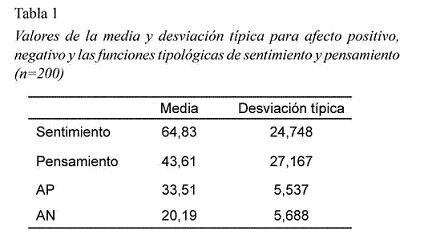
<body><![CDATA[<p style="margin: 5pt 89.55pt 0.0001pt 1cm; text-align: justify; text-indent: 19.85pt; line-height: 120%; font-family: Verdana;"><span style="font-size: 10pt; line-height: 120%;" lang="ES-UY">Para estudiar en ambos casos la correlaci&oacute;n se calcula el coeficiente de correlaci&oacute;n de <span class="SpellE">Pearson</span>. Para calificar el grado de asociaci&oacute;n entre las variables estudiadas se utiliza el criterio de correlaci&oacute;n sugerido por <a name="MoralesVallejo08_"></a><a href="#Morales">Morales Vallejo</a> ( 2008). La escala de correlaci&oacute;n lineal bilateral propuesta describe la correlaci&oacute;n como muy baja (0 y .20), baja (.20 y .40), moderada (.40 y .60), apreciable, m&aacute;s bien alta (.60 y .80), alta o muy alta (.80 y 1). </span><span style="" lang="ES-UY"><o:p></o:p></span></p>           <p style="margin: 5pt 89.55pt 0.0001pt 1cm; text-align: justify; text-indent: 19.85pt; line-height: 120%; font-family: Verdana;"><span style="font-size: 10pt; line-height: 120%;">Finalmente, se eval&uacute;a la fiabilidad mediante la consistencia interna de cada escala medida por el coeficiente alfa de <span class="SpellE">Cronbach</span>.</span></p>           <p style="margin: 5pt 89.55pt 0.0001pt 1cm; text-align: justify; line-height: 120%; font-family: Verdana;"><o:p> <font size="2">&nbsp;</font></o:p></p>           <p style="margin: 5pt 89.55pt 0.0001pt 1cm; text-align: justify; line-height: 120%; font-family: Verdana;"><b><span style="font-size: 10pt; line-height: 120%;">Resultados</span></b></p>           <p style="margin: 5pt 89.55pt 0.0001pt 1cm; text-align: justify; text-indent: 19.85pt; line-height: 120%; font-family: Verdana;"><span style="font-size: 10pt; line-height: 120%;">En la muestra de poblaci&oacute;n estudiada (n=200) encontramos que el modo cognitivo m&aacute;s utilizado para procesar la informaci&oacute;n es la funci&oacute;n sentimiento, presentando una media sensiblemente mayor que la funci&oacute;n pensamiento. Esto indica que entre estudiantes universitarios de la muestra, es mayor la tendencia a registrar lo que sienten en relaci&oacute;n con las cosas y no lo que piensan acerca de las mismas, Tabla <a href="#t1">1</a>. </span><o:p> <font size="2">&nbsp;</font></o:p></p>       <font size="2">     <br style="font-family: Verdana;">     </font>         <p style="margin: 5pt 89.55pt 0.0001pt 1cm; text-align: justify; line-height: normal; font-family: Verdana;"><a name="t1"> <font size="2"></font></a><font size="2"><img style="width: 424px; height: 235px;" alt="" src="/img/revistas/cp/v9n1/1a07t1.jpg"></font></p>           <p style="margin: 5pt 89.55pt 0.0001pt 1cm; text-align: justify; text-indent: 19.85pt; line-height: 120%; font-family: Verdana;"><o:p> <font size="2">&nbsp;</font></o:p></p>           <p style="margin: 5pt 89.55pt 0.0001pt 1cm; text-align: justify; text-indent: 19.85pt; line-height: 120%; font-family: Verdana;"><o:p> <font size="2">&nbsp;</font></o:p></p>           <p style="margin: 5pt 89.55pt 0.0001pt 1cm; text-align: justify; text-indent: 19.85pt; line-height: 120%; font-family: Verdana;"><span style="font-size: 10pt; line-height: 120%;">Seg&uacute;n surge de la Tabla <a href="#t2">2</a>, la escala sentimiento como funci&oacute;n superior (sentimiento &ge; pensamiento, sensaci&oacute;n e intuici&oacute;n), se presenta en un 44 % (n=88) de los casos analizados, siendo significativamente mayor en personas de sexo femenino. </span><span style="" lang="ES-UY"><o:p></o:p></span></p>           <p style="margin: 5pt 89.55pt 0.0001pt 1cm; text-align: justify; text-indent: 19.85pt; line-height: 120%; font-family: Verdana;"><o:p> <font size="2">&nbsp;</font></o:p></p>     <font size="2">     <br style="font-family: Verdana;">     </font>         ]]></body>
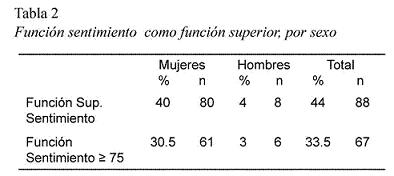
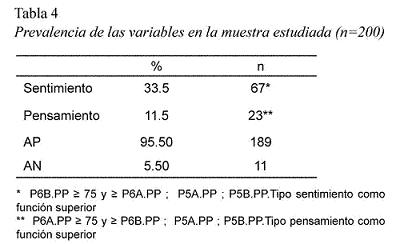
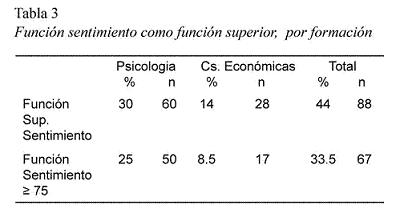
<body><![CDATA[<p style="margin: 5pt 89.55pt 0.0001pt 1cm; text-align: justify; text-indent: 19.85pt; line-height: 120%; font-family: Verdana;"><o:p> <font size="2">&nbsp;<a name="t2"></a><img style="width: 394px; height: 176px;" alt="" src="/img/revistas/cp/v9n1/1a07t2.jpg"></font></o:p></p>           <p style="margin: 5pt 89.55pt 12pt 1cm; text-align: justify; font-family: Verdana;"><span style="" lang="ES-UY"><o:p> <font size="2">&nbsp;</font></o:p></span></p>           <p style="margin: 5pt 89.55pt 0.0001pt 1cm; text-align: justify; text-indent: 19.85pt; line-height: 120%; font-family: Verdana;"><o:p> <font size="2">&nbsp;</font></o:p></p>           <p style="margin: 5pt 89.55pt 0.0001pt 1cm; text-align: justify; text-indent: 19.85pt; line-height: 120%; font-family: Verdana;"><span style="font-size: 10pt; line-height: 120%;">El modo cognitivo sentimiento es el preferido para procesar la informaci&oacute;n, present&aacute;ndose como funci&oacute;n superior con un puntaje de prevalencia &ge; 75, en un 33.5 % (n=67) de los casos. Esto reafirma la confiabilidad en la medici&oacute;n de la variable analizada. Asimismo es mayor su prevalencia entre quienes estudian Psicolog&iacute;a (30%), comparativamente con quienes estudian Ciencias Econ&oacute;micas (14 %), Tabla <a href="#t3">3</a>.</span><span style="" lang="ES-UY"><o:p></o:p></span></p>           <p style="margin: 5pt 89.55pt 0.0001pt 1cm; text-align: justify; line-height: 150%; font-family: Verdana;"><o:p> <font size="2">&nbsp;</font></o:p></p>     <font size="2">     <br style="font-family: Verdana;">     </font>         <p style="margin: 5pt 89.55pt 0.0001pt 1cm; text-align: justify; text-indent: 19.85pt; line-height: 120%; font-family: Verdana;"><o:p> <font size="2">&nbsp;<a name="t3"></a><img style="width: 396px; height: 209px;" alt="" src="/img/revistas/cp/v9n1/1a07t3.jpg"></font></o:p></p>           <div style="font-family: Verdana;" align="center">&nbsp;</div>                       <p style="margin: 5pt 89.55pt 0.0001pt 1cm; text-align: justify; text-indent: 19.85pt; line-height: 120%; font-family: Verdana;"><o:p> <font size="2">&nbsp;&nbsp;</font></o:p></p>           <p style="margin: 5pt 89.55pt 0.0001pt 1cm; text-align: justify; text-indent: 19.85pt; line-height: 120%; font-family: Verdana;"><o:p> <font size="2">&nbsp;</font></o:p></p>           <p style="margin: 5pt 89.55pt 0.0001pt 1cm; text-align: justify; text-indent: 19.85pt; line-height: 120%; font-family: Verdana;"><span style="font-size: 10pt; line-height: 120%;">En relaci&oacute;n a la funci&oacute;n pensamiento (modo cognitivo) como funci&oacute;n superior, se sigui&oacute; el mismo criterio de an&aacute;lisis (pensamiento &ge; 75), resultando que un 11.5 % (n= 23) procesa la informaci&oacute;n interpretando la realidad a partir de datos objetivos e impersonales, producto del pensamiento l&oacute;gico en primer lugar, Tabla <a href="#t4">4</a>. En el comportamiento de la prevalencia de ambas variables, por una parte la funci&oacute;n sentimiento y por otra el afecto (positivo y negativo), se encuentran diferencias significativas que ratifican la discriminaci&oacute;n entre ambos constructos. Existe una marcada preponderancia del afecto positivo, frente a quienes presentan afecto negativo, a diferencia de los resultados obtenidos por la funci&oacute;n sentimiento. </span><span style="" lang="ES-UY"><o:p></o:p></span></p>     <font size="2">     <br style="font-family: Verdana;">     </font>         ]]></body>
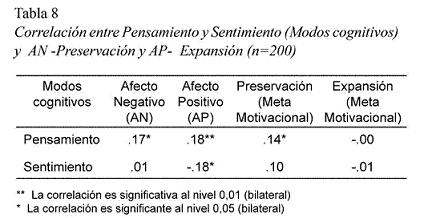
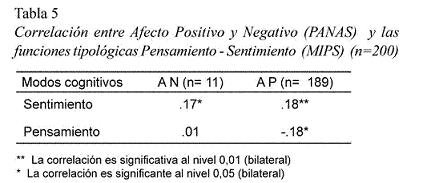
<body><![CDATA[<p style="margin: 5pt 89.55pt 0.0001pt 1cm; text-align: justify; line-height: 150%; font-family: Verdana;"><a name="t4"> <font size="2"></font></a><font size="2"><img style="width: 412px; height: 244px;" alt="" src="/img/revistas/cp/v9n1/1a07t4.jpg"></font><o:p></o:p></p>           <div style="font-family: Verdana;" align="center"><font size="2">    <br>       </font>     </div>           <p style="margin: 5pt 89.55pt 0.0001pt 1cm; text-align: justify; text-indent: 19.85pt; line-height: 120%; font-family: Verdana;"><span style="" lang="ES-UY"><o:p> <font size="2">&nbsp;</font></o:p></span></p>           <p style="margin: 5pt 89.55pt 0.0001pt 1cm; text-align: justify; text-indent: 19.85pt; line-height: 120%; font-family: Verdana;"><o:p> <font size="2">&nbsp;</font></o:p></p>           <p style="margin: 5pt 89.55pt 0.0001pt 1cm; text-align: justify; text-indent: 19.85pt; line-height: 120%; font-family: Verdana;"><o:p> <font size="2">&nbsp;</font></o:p></p>           <p style="margin: 5pt 89.55pt 0.0001pt 1cm; text-align: justify; text-indent: 19.85pt; line-height: 120%; font-family: Verdana;"><span style="font-size: 10pt; line-height: 120%;">Al analizar la relaci&oacute;n existente entre el sentimiento y el afecto (positivo y negativo), encontramos que el sentimiento correlaciona en forma inversa y negativa muy baja con el afecto positivo (r= -.18). Tambi&eacute;n que no correlaciona con afecto negativo (r=.01), seg&uacute;n se muestra en la Tabla <a href="#t5">5</a>. Respecto al pensamiento, observamos que correlaciona en forma positiva con AP (r=.18) y en forma positiva tambi&eacute;n con AN (r=.17).</span><span style="" lang="ES-UY"><o:p></o:p></span></p>           <p style="margin: 5pt 89.55pt 0.0001pt 1cm; text-align: justify; text-indent: 19.85pt; line-height: 120%; font-family: Verdana;"><o:p> <font size="2">&nbsp;</font></o:p></p>           <p style="margin: 5pt 89.55pt 0.0001pt 1cm; text-align: justify; text-indent: 19.85pt; line-height: 120%; font-family: Verdana;"><o:p> <font size="2">&nbsp;</font></o:p></p>     <font size="2">     <br style="font-family: Verdana;">     </font>         <p style="margin: 5pt 89.55pt 0.0001pt 1cm; text-align: justify; text-indent: 19.85pt; line-height: 120%; font-family: Verdana;"><o:p> <font size="2">&nbsp;<a name="t5"></a><img style="width: 423px; height: 183px;" alt="" src="/img/revistas/cp/v9n1/1a07t5.jpg"></font></o:p></p>     <font size="2">     <br style="font-family: Verdana;">     </font>         ]]></body>
<body><![CDATA[<p style="margin: 5pt 89.55pt 12pt 1cm; text-align: justify; font-family: Verdana;"><span style="" lang="ES-UY"><o:p> <font size="2">&nbsp;</font></o:p></span></p>           <p style="margin: 5pt 89.55pt 0.0001pt 1cm; text-align: justify; text-indent: 19.85pt; line-height: 120%; font-family: Verdana;"><span style="" lang="ES-UY"><o:p> <font size="2">&nbsp;</font></o:p></span></p>           <p style="margin: 5pt 89.55pt 0.0001pt 1cm; text-align: justify; text-indent: 19.85pt; line-height: 120%; font-family: Verdana;"><span style="font-size: 10pt; line-height: 120%;">En la Tabla <a href="#t6">6 </a>se presentan los resultados obtenidos, encontrando entre AP y Expansi&oacute;n una correlaci&oacute;n baja (r=.27), aunque estad&iacute;sticamente significativa (positiva). En cuanto a AN y Preservaci&oacute;n, encontramos una correlaci&oacute;n moderada (r=.44) y estad&iacute;sticamente significativa (positiva). Respecto a la correlaci&oacute;n entre AP y Preservaci&oacute;n (r=-.25), y entre AN y Expansi&oacute;n (r=-.40), ambas son inversas o negativas, siendo baja y moderada respectivamente.</span></p>           <p style="margin: 5pt 89.55pt 0.0001pt 1cm; text-align: justify; text-indent: 19.85pt; line-height: 120%; font-family: Verdana;"><o:p> <font size="2">&nbsp;</font></o:p></p>           <p style="margin: 5pt 89.55pt 0.0001pt 1cm; text-align: justify; text-indent: 19.85pt; line-height: 120%; font-family: Verdana;"><o:p> <font size="2">&nbsp;<a name="t6"></a><img style="width: 423px; height: 203px;" alt="" src="/img/revistas/cp/v9n1/1a07t6.jpg"></font></o:p></p>           <p style="margin: 5pt 89.55pt 0.0001pt 1cm; text-align: justify; text-indent: 19.85pt; line-height: 120%; font-family: Verdana;"><o:p> <font size="2">&nbsp;</font></o:p></p>               <p style="margin: 5pt 89.55pt 0.0001pt 1cm; text-align: justify; text-indent: 19.85pt; line-height: 120%; font-family: Verdana;"><o:p> <font size="2">&nbsp;    <br>     </font>     </o:p></p>         <p style="margin: 5pt 89.55pt 0.0001pt 1cm; text-align: justify; text-indent: 19.85pt; line-height: 120%; font-family: Verdana;"><o:p></o:p></p>           <p style="margin: 5pt 89.55pt 0.0001pt 1cm; text-align: justify; text-indent: 19.85pt; line-height: 120%; font-family: Verdana;"><span style="font-size: 10pt; line-height: 120%;">En la Tabla <a href="#t7">7</a> se muestra la correlaci&oacute;n entre sentimiento y expansi&oacute;n. Encontramos que no existe correlaci&oacute;n (r=-.01) entre ambas. En el caso del pensamiento hay una correlaci&oacute;n estad&iacute;sticamente significativa aunque muy baja (r=.14) con Preservaci&oacute;n.</span></p>         ]]></body>
<body><![CDATA[<p style="margin: 5pt 89.55pt 0.0001pt 1cm; text-align: justify; text-indent: 19.85pt; line-height: 120%; font-family: Verdana;"></p>         <p style="margin: 5pt 89.55pt 0.0001pt 1cm; text-align: justify; text-indent: 19.85pt; line-height: 120%; font-family: Verdana;"><a name="t7"> <font size="2"></font></a><font size="2"><img style="width: 422px; height: 218px;" alt="" src="/img/revistas/cp/v9n1/1a07t7.jpg"></font><span style="" lang="ES-UY"><o:p></o:p></span></p>     <font size="2">     <br style="font-family: Verdana;">     <br style="font-family: Verdana;">     </font>         <p style="margin: 5pt 89.55pt 12pt 1cm; text-align: justify; font-family: Verdana;"><span style="" lang="ES-UY"><o:p> <font size="2">&nbsp;</font></o:p></span></p>           <p style="margin: 5pt 89.55pt 0.0001pt 1cm; text-align: justify; text-indent: 19.85pt; line-height: 120%; font-family: Verdana;"><span style="font-size: 10pt; line-height: 120%;">En la Tabla <a href="#t8">8</a> se muestra la correlaci&oacute;n de sentimiento y pensamiento con los constructos del afecto (AP, AN, Expansi&oacute;n y Preservaci&oacute;n). La correlaci&oacute;n entre sentimiento y AP es estad&iacute;sticamente significativa, aunque muy baja y de car&aacute;cter negativo e inverso (r=-.18).</span></p>           <p style="margin: 5pt 89.55pt 0.0001pt 1cm; text-align: justify; text-indent: 19.85pt; line-height: 120%; font-family: Verdana;"><span style="font-size: 10pt; line-height: 120%;">En cambio, pensamiento correlaciona con AN (r=.17), AP (r=.18) y Preservaci&oacute;n (r=.14), en forma positiva y estad&iacute;sticamente significativa, aunque muy baja.</span></p>     <p style="margin: 5pt 89.55pt 0.0001pt 1cm; text-align: justify; text-indent: 19.85pt; line-height: 120%; font-family: Verdana;">&nbsp;</p>      <p style="margin: 5pt 89.55pt 0.0001pt 1cm; text-align: justify; text-indent: 19.85pt; line-height: 120%; font-family: Verdana;">&nbsp;</p>       <p style="margin: 5pt 89.55pt 0.0001pt 1cm; text-align: justify; text-indent: 19.85pt; line-height: 120%; font-family: Verdana;">&nbsp;</p>        <p style="margin: 5pt 89.55pt 0.0001pt 1cm; text-align: justify; text-indent: 19.85pt; line-height: 120%; font-family: Verdana;">&nbsp;</p>         <p style="margin: 5pt 89.55pt 0.0001pt 1cm; text-align: justify; text-indent: 19.85pt; line-height: 120%; font-family: Verdana;">&nbsp;</p>         ]]></body>
<body><![CDATA[<p style="margin: 5pt 89.55pt 0.0001pt 1cm; text-align: justify; text-indent: 19.85pt; line-height: 120%; font-family: Verdana;"><span style="font-size: 10pt; line-height: 120%;"><a name="t8"></a><img style="width: 432px; height: 218px;" alt="" src="/img/revistas/cp/v9n1/1a07t8.jpg"></span></p>         <p style="margin: 5pt 89.55pt 0.0001pt 1cm; text-align: justify; text-indent: 19.85pt; line-height: 120%; font-family: Verdana;">&nbsp;</p>     <o:p style="font-family: Verdana;"></o:p><span style="font-family: Verdana;" lang="ES-UY"><o:p></o:p></span>      <p style="margin: 5pt 89.55pt 0.0001pt 1cm; text-align: justify; line-height: 120%; font-family: Verdana;"><o:p> <font size="2">&nbsp;</font></o:p></p>           <p style="margin: 5pt 89.55pt 0.0001pt 1cm; text-align: justify; line-height: 120%; font-family: Verdana;"><o:p> <font size="2">&nbsp;</font></o:p></p>           <p style="margin: 5pt 89.55pt 0.0001pt 1cm; text-align: justify; line-height: 120%; font-family: Verdana;"><b><span style="font-size: 10pt; line-height: 120%;">Discusi&oacute;n </span></b></p>           <p style="margin: 5pt 89.55pt 0.0001pt 1cm; text-align: justify; line-height: 120%; font-family: Verdana;"><o:p> <font size="2">&nbsp;</font></o:p></p>           <p style="margin: 5pt 89.55pt 0.0001pt 1cm; text-align: justify; text-indent: 19.85pt; line-height: 120%; font-family: Verdana;"><span style="font-size: 10pt; line-height: 120%;">Se considera importante se&ntilde;alar que no se han encontrado investigaciones previas que indaguen las relaciones entre la funci&oacute;n sentimiento y el afecto positivo y negativo. La presente investigaci&oacute;n pretende contribuir tanto al conocimiento espec&iacute;fico de cada una, encontrando posibles correlaciones, as&iacute; como en la discriminaci&oacute;n entre ambas de acuerdo al comportamiento observado. </span></p>           <p style="margin: 5pt 89.55pt 0.0001pt 1cm; text-align: justify; text-indent: 19.85pt; line-height: 120%; font-family: Verdana;"><span style="font-size: 10pt; line-height: 120%;" lang="ES-UY">El instrumento PANAS en su proceso de traducci&oacute;n y adaptaci&oacute;n para Uruguay ha demostrado un buen comportamiento psicom&eacute;trico y adecuaci&oacute;n al constructo te&oacute;rico que valora. Los resultados han sido similares a los observados en estudios antecedentes en la lengua espa&ntilde;ola (<a href="#Sandin"><span class="SpellE">Sand&iacute;n</span> et al.</a> 1999; <a href="#Robles">Robles &amp; P&aacute;ez</a>, 2003; <a href="#Gargurevich"><span class="SpellE">Gargurevich</span> &amp; Matos</a>, 2012; <a name="Moriondo12_"></a><a href="#Moriondo">Moriondo, De Palma, Medrano &amp; Murillo</a> 2012), que muestran que el PANAS tiene una estructura te&oacute;rica <span class="SpellE">bifactorial</span>. Tales caracter&iacute;sticas lo convierten en un instrumento inicialmente v&aacute;lido y confiable, para ser usado tanto en investigaci&oacute;n como en cl&iacute;nica en la poblaci&oacute;n de adultos estudiados en nuestro pa&iacute;s. </span><span style="" lang="ES-UY"><o:p></o:p></span></p>           <p style="margin: 5pt 89.55pt 0.0001pt 1cm; text-align: justify; text-indent: 19.85pt; line-height: 120%; font-family: Verdana;"><span style="font-size: 10pt; line-height: 120%;">Respecto a los resultados obtenidos a partir de la muestra estudiada (n=200), se encuentra que un 95.5 % (n=189) de los individuos presenta afecto positivo (AP), caracterizado por sentirse entusiasta, activo, alerta, decidido, con fortaleza y aumento del inter&eacute;s, con energ&iacute;a y participaci&oacute;n gratificante, orgullo e inspiraci&oacute;n. Asimismo un 5.5. % (n=11) presenta afecto negativo (AN), caracterizado por desinter&eacute;s subjetivo y participaci&oacute;n desagradable que incluye una variedad de estados emocionales <span class="SpellE">aversivos</span> como disgusto, ira, culpa, miedo y nerviosismo (<a href="#WatsonClarkTellegen88">Watson et al.</a>, 1988).</span><span style="" lang="ES-UY"><o:p></o:p></span></p>           <p style="margin: 5pt 89.55pt 0.0001pt 1cm; text-align: justify; text-indent: 19.85pt; line-height: 120%; font-family: Verdana;"><span style="font-size: 10pt; line-height: 120%;">En cuanto al an&aacute;lisis de la funci&oacute;n sentimiento, &eacute;sta se presenta como funci&oacute;n superior o prevalente (sentimiento &ge; pensamiento, sensaci&oacute;n e intuici&oacute;n) en el 44 % (n=88) del total de los casos. La funci&oacute;n superior, seg&uacute;n explica la Psicolog&iacute;a Anal&iacute;tica es aquella funci&oacute;n m&aacute;s desarrollada y discriminada (<a href="#Von">Von Franz &amp; <span class="SpellE">Hillman</span></a>, 1971) que organiza y orienta la actitud del individuo. <a href="#Millon01"><span class="SpellE">Millon</span></a> (2001) expresa que en estos casos la evaluaci&oacute;n subjetiva se realiza en base a valores y metas personales que determinan la respuesta afectiva, pudiendo entonces estar ante una &ldquo;actitud <span class="SpellE">disposicional</span>&rdquo; de la funci&oacute;n racional. En un 33.5 % (n=67) del total de los casos, estamos adem&aacute;s ante un puntaje elevado y significativo (&ge; 75), distribuido en un 30.5 % de sexo femenino y un 3 % de sexo masculino, as&iacute; como el 25 % son estudiantes de Psicolog&iacute;a y el 8,5 % de Ciencias Econ&oacute;micas. Del 44 % tipo sentimiento, un 75.5 % (n=46) son del tipo sentimiento-intuici&oacute;n y un 23.9 % (n= 14) del tipo sentimiento - sensaci&oacute;n.</span><span style="" lang="ES-UY"><o:p></o:p></span></p>           ]]></body>
<body><![CDATA[<p style="margin: 5pt 89.55pt 0.0001pt 1cm; text-align: justify; text-indent: 19.85pt; line-height: 120%; font-family: Verdana;"><span style="font-size: 10pt; line-height: 120%;">Observamos, en base a los resultados obtenidos, que existe un comportamiento diferente de ambas variables (afecto y sentimiento) en una misma muestra de poblaci&oacute;n (n=200). En este sentido, el 95.5 % presenta generalmente afecto positivo, mientras el 33.5 % presenta sentimiento como funci&oacute;n superior, con un puntaje elevado y significativo. Un primer an&aacute;lisis conduce al punto de inflexi&oacute;n a partir del cual <a href="#Jung69">Jung</a> (1969) y posteriormente <a href="#Millon01"><span class="SpellE">Millon</span></a> (2001), conciben el sentimiento como una funci&oacute;n tipol&oacute;gica de la conciencia diferente del afecto a nivel estructural y <span class="SpellE">psicodin&aacute;mico</span>. Reconocemos que la correlaci&oacute;n entre dos variables es relativa a los instrumentos utilizados (<a href="#MoralesVallejo08_">Morales Vallejo</a> 2008). No puede establecerse una causalidad o relaci&oacute;n directa entre ambas variables, pero los resultados nos invitan a focalizar en la correlaci&oacute;n encontrada. </span></p>           <p style="margin: 5pt 89.55pt 0.0001pt 1cm; text-align: justify; text-indent: 19.85pt; line-height: 120%; font-family: Verdana;"><span style="font-size: 10pt; line-height: 120%;">Se analiza entonces la correlaci&oacute;n bilateral entre la funci&oacute;n sentimiento y el afecto positivo, encontrando que es estad&iacute;sticamente significativa e inversa (r=-18). Esto nos indica que cuando una aumenta la otra disminuye. Entonces un individuo con afecto positivo elevado ver&iacute;a disminuida su capacidad para valorar a trav&eacute;s de la funci&oacute;n sentimiento o si aumenta la actividad de la funci&oacute;n sentimiento, disminuye la presencia del afecto positivo. Para ilustrar los resultados dir&iacute;amos que cuanto mayor es el entusiasmo (descriptor de AP) o el inter&eacute;s (descriptor de AP) del individuo, menor ser&iacute;a su capacidad para valorar a trav&eacute;s de la funci&oacute;n sentimiento como agradable o desagradable, o para tomar posteriormente una actitud racional de rechazo o acercamiento. </span><span style="" lang="ES-UY"><o:p></o:p></span></p>           <p style="margin: 5pt 89.55pt 0.0001pt 1cm; text-align: justify; text-indent: 19.85pt; line-height: 120%; font-family: Verdana;"><span style="font-size: 10pt; line-height: 120%;">La estructura <span class="SpellE">bifactorial</span> del afecto conduce a analizar la dimensi&oacute;n del afecto negativo en forma relativamente independiente. No se encontr&oacute; correlaci&oacute;n entre el afecto negativo y la funci&oacute;n sentimiento ( r=.01), lo que invita a la reflexi&oacute;n sobre sus implicaciones cl&iacute;nicas. </span><span style="" lang="ES-UY"><o:p></o:p></span></p>           <p style="margin: 5pt 89.55pt 0.0001pt 1cm; text-align: justify; text-indent: 19.85pt; line-height: 120%; font-family: Verdana;"><span style="font-size: 10pt; line-height: 120%;">En el orden de la especificidad fenomenol&oacute;gica de la funci&oacute;n sentimiento, &eacute;sta se discrimina del afecto positivo y negativo. </span></p>           <p style="margin: 5pt 89.55pt 0.0001pt 1cm; text-align: justify; text-indent: 19.85pt; line-height: 120%; font-family: Verdana;"><span style="font-size: 10pt; line-height: 120%;">Esta discriminaci&oacute;n presente en el MIPS en la diferencia entre el modo cognitivo pensamiento - sentimiento y las metas motivacionales expansi&oacute;n - preservaci&oacute;n, se profundiza en el paralelismo planteado por <a href="#Millon01"><span class="SpellE">Millon</span></a> (2001) dentro del constructo bipolar placer -dolor, entre expansi&oacute;n (meta motivacional) y afecto positivo, as&iacute; como entre preservaci&oacute;n (meta motivacional) y afecto negativo. Se analiza entonces esta correlaci&oacute;n a efectos de verificar dicha hip&oacute;tesis. Los resultados indican respecto a expansi&oacute;n, una correlaci&oacute;n estad&iacute;sticamente significativa con afecto positivo (r=+.27) y moderada e inversa con AN (r=-.44). Respecto a la correlaci&oacute;n entre preservaci&oacute;n y afecto negativo, se confirma que es estad&iacute;sticamente significativa (r=+.44), as&iacute; como baja e inversa con AP (r=-.25). Su cruzamiento sostiene la condici&oacute;n <span class="SpellE">bifactorial</span> y bidimensional entre AP y preservaci&oacute;n as&iacute; como entre AN y expansi&oacute;n. Este hallazgo adviene desde los instrumentos PANAS y MIPS a una analog&iacute;a factible entre los constructos bipolares del placer-dolor (modos motivacionales expansi&oacute;n - preservaci&oacute;n) y la estructura bidimensional del afecto (positivo-negativo). Se confirma la hip&oacute;tesis de <a href="#Millon01"><span class="SpellE">Millon</span></a> (2001) por la cual hab&iacute;a integrado la escala metas motivacionales asimilando la expansi&oacute;n al afecto positivo y la preservaci&oacute;n al afecto negativo, ambas dentro del constructo bipolar placer - dolor. </span><span style="" lang="ES-UY"><o:p></o:p></span></p>           <p style="margin: 5pt 89.55pt 0.0001pt 1cm; text-align: justify; text-indent: 19.85pt; line-height: 120%; font-family: Verdana;"><span style="font-size: 10pt; line-height: 120%;">En funci&oacute;n de esta analog&iacute;a, se explora la correlaci&oacute;n entre expansi&oacute;n - preservaci&oacute;n (modo motivacional) con la funci&oacute;n sentimiento, encontrando que no es estad&iacute;sticamente significativa. </span></p>           <p style="margin: 5pt 89.55pt 0.0001pt 1cm; text-align: justify; text-indent: 19.85pt; line-height: 120%; font-family: Verdana;"><span style="font-size: 10pt; line-height: 120%;">Los resultados de la presente investigaci&oacute;n reafirman la diferencia en el comportamiento <span class="SpellE">psicodin&aacute;mico</span> de los constructos afecto y funci&oacute;n sentimiento. Esto contribuye a su discriminaci&oacute;n e implica que tanto en desarrollos te&oacute;ricos como t&eacute;cnico-instrumentales, su utilizaci&oacute;n como sin&oacute;nimos o denominaciones intercambiables ser&iacute;a incorrecta. </span></p>           <p style="margin: 5pt 89.55pt 0.0001pt 1cm; text-align: justify; text-indent: 19.85pt; line-height: 120%; font-family: Verdana;"><span style="font-size: 10pt; line-height: 120%;">Autores contempor&aacute;neos (Jung 1969, <a href="#Millon01"><span class="SpellE">Millon</span></a> 2001, <a href="#Ekman"><span class="SpellE">Ekman</span></a> 2012, <a href="#Rosas">Rosas</a> 2011, <a href="#Castilla">Castilla del Pino</a> 2009) discriminan el estado de &aacute;nimo (afecto positivo y negativo) de la funci&oacute;n sentimiento y de la emoci&oacute;n, a partir de criterios como duraci&oacute;n, estabilidad y direcci&oacute;n, de lo espec&iacute;fico o no de su objeto intencional y de su relaci&oacute;n con la fijaci&oacute;n de creencias generadoras de emociones subyacentes (<a href="#Rosas">Rosas</a> 2011). Sus diferencias pueden ser observadas tambi&eacute;n a trav&eacute;s de la presencia o ausencia de la expresi&oacute;n facial de las mismas (<a href="#Ekman"><span class="SpellE">Ekman</span></a>, 2012). Estos criterios se encuentran vehiculizando puentes en la actualidad que re-significan sus funciones en el proceso evolutivo del desarrollo de la personalidad, as&iacute; como en el comportamiento y semiolog&iacute;a cl&iacute;nica. Los resultados concuerdan con la concepci&oacute;n <span class="SpellE">psicodin&aacute;mica</span> de <a href="#Jung69">Jung</a> (1969) y posteriormente de <a href="#Millon01"><span class="SpellE">Millon</span></a> (2001), respecto al componente <span class="SpellE">disposicional</span> de la funci&oacute;n sentimiento, que <a href="#Rosas">Rosas</a> (2011) reafirma defini&eacute;ndola como una estructura <span class="SpellE">disposicional</span> dirigida a un objeto intencional espec&iacute;fico, diferenci&aacute;ndola a su vez del estado de &aacute;nimo. </span></p>           <p style="margin: 5pt 89.55pt 0.0001pt 1cm; text-align: justify; line-height: 120%; font-family: Verdana;"><o:p> <font size="2">&nbsp;</font></o:p></p>           <p style="margin: 5pt 89.55pt 0.0001pt 1cm; text-align: justify; line-height: 120%; font-family: Verdana;"><b><span style="font-size: 10pt; line-height: 120%;">Referencias </span></b></p>           ]]></body>
<body><![CDATA[<p style="margin: 5pt 89.55pt 0.0001pt 1cm; text-align: justify; line-height: 120%; font-family: Verdana;"><o:p> <font size="2">&nbsp;</font></o:p></p>           <!-- ref --><p style="margin: 5pt 89.55pt 0.0001pt 1cm; text-align: justify; line-height: 150%; font-family: Verdana;"><span style="font-size: 10pt; line-height: 150%;" lang="ES-UY"><a name="American"></a><a href="#APA_">American</a> <span class="SpellE">Psychiatric</span> <span class="SpellE">Association</span> (1995). Manual Diagn&oacute;stico y Estad&iacute;stico de los Trastornos Mentales, DSM VI. Barcelona: <span class="SpellE">Masson</span> S.A.    <!-- ref --> </span><span style="font-size: 10pt; line-height: 150%;">Carretero-Dios, H., &amp; <span class="SpellE">Perez</span>, C. (2005). Normas para el desarrollo y revisi&oacute;n de estudios instrumentales. </span><span style="font-size: 10pt; line-height: 150%;" lang="EN-US">International Journal of Clinical and Health Psychology, 5 (3), pp. 521-551.     </span><span style="" lang="ES-UY"><o:p></o:p></span></p>           <!-- ref --><p style="margin: 5pt 89.55pt 0.0001pt 1cm; text-align: justify; line-height: 150%; font-family: Verdana;"><span class="SpellE"><span style="font-size: 10pt; line-height: 150%;" lang="EN-US"><a name="Castilla"></a><a href="#Castilla_">Castilla</a></span></span><span style="font-size: 10pt; line-height: 150%;" lang="EN-US"> <span class="GramE">del</span> <span class="SpellE">Pino</span>, C. (2009). </span><span style="font-size: 10pt; line-height: 150%;" lang="ES-UY">Teor&iacute;a de los sentimientos. (4.&ordf; ed.) Barcelona: Fabula <span class="SpellE">Tusquets</span></span><span style="" lang="ES-UY"><o:p></o:p></span><!-- ref --><p style="margin: 5pt 89.55pt 0.0001pt 1cm; text-align: justify; line-height: 150%; font-family: Verdana;"><span style="font-size: 10pt; line-height: 150%;" lang="ES-UY"><a name="Casullo"></a><a href="#Casullo_">Casullo</a> M. M., &amp; Castro Solano A. (2000). Adaptaci&oacute;n del MIPS en Argentina. En M.P. S&aacute;nchez - L&oacute;pez y M.M. Casullo. Estilos de Personalidad: Una perspectiva Iberoamericana. </span><span style="font-size: 10pt; line-height: 150%;" lang="EN-US">Madrid: <span class="SpellE">Mi&ntilde;o</span> y <span class="SpellE">D&aacute;vila</span>.    </span><span style="" lang="ES-UY"><o:p></o:p></span></p>           <!-- ref --><p style="margin: 5pt 89.55pt 0.0001pt 1cm; text-align: justify; line-height: 150%; font-family: Verdana;"><span class="GramE"><span style="font-size: 10pt; line-height: 150%;" lang="EN-US"><a name="Clark"></a><a href="#Clark_">Clark</a> L. A., &amp; Watson D. (1988).</span></span><span style="font-size: 10pt; line-height: 150%;" lang="EN-US"> Mood and the mundane: Relations between daily life events and self-reported mood. Journal of Personality and Social Psychology, 54, pp. 296-308.    </span><span style="" lang="ES-UY"><o:p></o:p></span></p>           <!-- ref --><p style="margin: 5pt 89.55pt 0.0001pt 1cm; text-align: justify; line-height: 150%; font-family: Verdana;"><span class="GramE"><span style="font-size: 10pt; line-height: 150%;" lang="EN-US"><a name="Cohen"></a><a href="#Cohen_">Cohen</a>, R., &amp; <span class="SpellE">Swerdlik</span>, M. (2006).</span></span><span style="font-size: 10pt; line-height: 150%;" lang="EN-US"> </span><span style="font-size: 10pt; line-height: 150%;" lang="ES-UY">Pruebas y Evaluaci&oacute;n Psicol&oacute;gicas. (6&ordf; ed.) Espa&ntilde;a: <span class="SpellE">Mc.</span> <span class="SpellE">Graw</span> Hill Interamericana.     </span><span style="" lang="ES-UY"><o:p></o:p></span></p>           <!-- ref --><p style="margin: 5pt 89.55pt 0.0001pt 1cm; text-align: justify; line-height: 150%; font-family: Verdana;"><span class="SpellE"><span style="font-size: 10pt; line-height: 150%;" lang="ES-UY"><a name="Ekman"></a><a href="#Ekman_">Ekman</a></span></span><span style="font-size: 10pt; line-height: 150%;" lang="ES-UY">, P. (2012). El rostro de las emociones. (2 &ordf; ed.). Barcelona: RBA.     </span><span style="" lang="ES-UY"><o:p></o:p></span></p>           <!-- ref --><p style="margin: 5pt 89.55pt 0.0001pt 1cm; text-align: justify; line-height: 150%; font-family: Verdana;"><span class="SpellE"><span style="font-size: 10pt; line-height: 150%;" lang="ES-UY"><a name="Emde"></a>Emde</span></span><span style="font-size: 10pt; line-height: 150%;" lang="ES-UY">, R. (1998). Yendo hacia adelante: Las influencias integradoras de los procesos afectivos en el desarrollo y en el psicoan&aacute;lisis. Revista <span class="SpellE">APdeBA</span>, XX (3), pp. 473-516.     </span><span style="" lang="ES-UY"><o:p></o:p></span></p>           <!-- ref --><p style="margin: 5pt 89.55pt 0.0001pt 1cm; text-align: justify; line-height: 150%; font-family: Verdana;"><span class="SpellE"><span style="font-size: 10pt; line-height: 150%;" lang="ES-UY"><a name="Frijda"></a><a href="#Frijda_">Frijda</a></span></span><span style="font-size: 10pt; line-height: 150%;" lang="ES-UY"> N, <span class="SpellE">Mesquita</span> B., <span class="SpellE">Sonnemans</span> J., &amp; Van <span class="SpellE">Goozen</span> S. (1991). </span><span class="GramE"><span style="font-size: 10pt; line-height: 150%;" lang="EN-US">The Duration of Affective Phenomena or Emotions, Sentiments and Passions.</span></span><span style="font-size: 10pt; line-height: 150%;" lang="EN-US"> <span class="GramE">International Review of Studies on Emotion.</span> 1, pp. 187-<span class="GramE">225 .    </span> </span><span style="" lang="ES-UY"><o:p></o:p></span></p>           <!-- ref --><p style="margin: 5pt 89.55pt 0.0001pt 1cm; text-align: justify; line-height: 150%; font-family: Verdana;"><span class="SpellE"><span style="font-size: 10pt; line-height: 150%;" lang="EN-US"><a name="Gargurevich"></a><a href="#Gargurevich_">Gargurevich</a></span></span><span style="font-size: 10pt; line-height: 150%;" lang="EN-US"> <span class="GramE">R.,</span> &amp; Matos L. (2012). </span><span style="font-size: 10pt; line-height: 150%;" lang="ES-UY">Validez y confiabilidad de escala de afecto positivo y negativo (SPANAS) en estudiantes universitarios peruanos. <span class="SpellE">Psicol</span>., 14 (2), pp. 208 - 217.     </span><span style="" lang="ES-UY"><o:p></o:p></span></p>           <!-- ref --><p style="margin: 5pt 89.55pt 0.0001pt 1cm; text-align: justify; line-height: 150%; font-family: Verdana;"><span style="font-size: 10pt; line-height: 150%;" lang="ES-UY"><a name="Green73"></a>Green, A (1973). El discurso vivo. Una concepci&oacute;n psicoanal&iacute;tica del afecto. Valencia: <span class="SpellE">Promolibro</span>.     </span><span style="" lang="ES-UY"><o:p></o:p></span></p>           <!-- ref --><p style="margin: 5pt 89.55pt 0.0001pt 1cm; text-align: justify; line-height: 150%; font-family: Verdana;"><span style="font-size: 10pt; line-height: 150%;" lang="ES-UY"><a name="Green98"></a>Green, A (1998). Acerca de la discriminaci&oacute;n e indiscriminaci&oacute;n afecto-representaci&oacute;n. Revista <span class="SpellE">APdeBA</span>, XX (3), pp. 517-587.     </span><span style="" lang="ES-UY"><o:p></o:p></span></p>           <!-- ref --><p style="margin: 5pt 89.55pt 0.0001pt 1cm; text-align: justify; line-height: 150%; font-family: Verdana;"><span class="SpellE"><span style="font-size: 10pt; line-height: 150%;" lang="ES-UY"><a name="Grinberg03"></a>Grinberg</span></span><span style="font-size: 10pt; line-height: 150%;" lang="ES-UY">, <span class="SpellE">Luiz</span> P. (2003). Jung O <span class="SpellE">Homem</span> <span class="SpellE">Criativo</span>, Sao Paulo: FTD.     </span><span style="" lang="ES-UY"><o:p></o:p></span></p>           <!-- ref --><p style="margin: 5pt 89.55pt 0.0001pt 1cm; text-align: justify; line-height: 150%; font-family: Verdana;"><span class="SpellE"><span style="font-size: 10pt; line-height: 150%;" lang="ES-UY"><a name="Hillman05"></a>Hillman</span></span><span style="font-size: 10pt; line-height: 150%;" lang="ES-UY">, J (2005). El pensamiento del coraz&oacute;n (3a. reimpresi&oacute;n). Espa&ntilde;a: <span class="SpellE">Siruela</span>.     </span><span style="" lang="ES-UY"><o:p></o:p></span></p>           <!-- ref --><p style="margin: 5pt 89.55pt 0.0001pt 1cm; text-align: justify; line-height: 150%; font-family: Verdana;"><span style="font-size: 10pt; line-height: 150%;" lang="ES-UY"><a name="Jung45"></a><a href="#Jung45_">Jung</a>, C. (1921/1945). Tipos Psicol&oacute;gicos. Buenos Aires: Latinoamericana.     </span><span style="" lang="ES-UY"><o:p></o:p></span></p>           <!-- ref --><p style="margin: 5pt 89.55pt 0.0001pt 1cm; text-align: justify; line-height: 150%; font-family: Verdana;"><span style="font-size: 10pt; line-height: 150%;" lang="ES-UY"><a name="Jung69"></a><a href="#Jung69_">Jung</a>, C. (1969). Los Complejos y el Inconsciente. Madrid: Alianza.     </span><span style="" lang="ES-UY"><o:p></o:p></span></p>           <!-- ref --><p style="margin: 5pt 89.55pt 0.0001pt 1cm; text-align: justify; line-height: 150%; font-family: Verdana;"><span style="font-size: 10pt; line-height: 150%;" lang="ES-UY"><a name="Jung98"></a>Jung, C. (1998). S&iacute;mbolos de Transformaci&oacute;n (4a. reimpresi&oacute;n). Barcelona. <span class="SpellE">Paid&oacute;s</span> Ib&eacute;rica S.A.     </span><span style="" lang="ES-UY"><o:p></o:p></span></p>           <!-- ref --><p style="margin: 5pt 89.55pt 0.0001pt 1cm; text-align: justify; line-height: 150%; font-family: Verdana;"><span class="SpellE"><span style="font-size: 10pt; line-height: 150%;" lang="ES-UY"><a name="Leivi98"></a>Leivi</span></span><span style="font-size: 10pt; line-height: 150%;" lang="ES-UY">, B.M. (1998). El inconsciente y los afectos. Revista <span class="SpellE">APdeBA</span>, XX (3), pp. 651 -681.     </span><span style="" lang="ES-UY"><o:p></o:p></span></p>           <!-- ref --><p style="margin: 5pt 89.55pt 0.0001pt 1cm; text-align: justify; line-height: 150%; font-family: Verdana;"><span style="font-size: 10pt; line-height: 150%;" lang="ES-UY"><a name="Lerner"></a>Lerner, H. (1998) Afectos, afecciones, afectaciones. Revista <span class="SpellE">APdeBA</span>, XX (3), pp. 683 - 704.     </span><span style="" lang="ES-UY"><o:p></o:p></span></p>           <!-- ref --><p style="margin: 5pt 89.55pt 0.0001pt 1cm; text-align: justify; line-height: 150%; font-family: Verdana;"><span style="font-size: 10pt; line-height: 150%;" lang="ES-UY"><a name="Lopez"></a>L&oacute;pez, A. ; <span class="SpellE">Rondon</span>, J. ; Alfano, S., &amp; <span class="SpellE">Cellerino</span>, C. (2012). Relaciones entre esquemas tempranos inadaptados y afectividad positiva y negativa. Ciencias Psicol&oacute;gicas; VI (2), pp.149-173.     </span><span style="" lang="ES-UY"><o:p></o:p></span></p>           <!-- ref --><p style="margin: 5pt 89.55pt 0.0001pt 1cm; text-align: justify; line-height: 150%; font-family: Verdana;"><span style="font-size: 10pt; line-height: 150%;" lang="ES-UY"><a name="Marina"></a>Marina, J.L., &amp; L&oacute;pez, M. (1999/2011). Diccionario de los sentimientos. (5&ordf; ed.) Barcelona: Anagrama.     </span><span style="" lang="ES-UY"><o:p></o:p></span></p>           <!-- ref --><p style="margin: 5pt 89.55pt 0.0001pt 1cm; text-align: justify; line-height: 150%; font-family: Verdana;"><span class="SpellE"><span style="font-size: 10pt; line-height: 150%;" lang="ES-UY"><a name="Millon01"></a><a href="#Millon01_">Millon</a></span></span><span style="font-size: 10pt; line-height: 150%;" lang="ES-UY">, <span class="SpellE">Theodore</span>. (2001): MIPS. Inventario de Estilos de Personalidad. Manual Madrid: Tea.    </span><span style="" lang="ES-UY"><o:p></o:p></span></p>           <!-- ref --><p style="margin: 5pt 89.55pt 0.0001pt 1cm; text-align: justify; line-height: 150%; font-family: Verdana;"><span class="SpellE"><span style="font-size: 10pt; line-height: 150%;" lang="ES-UY"><a name="Millon06"></a><a href="#Millon06_">Millon</a></span></span><span style="font-size: 10pt; line-height: 150%;" lang="ES-UY">, <span class="SpellE">Theodore</span>. (2006) MIPS. Inventario <span class="SpellE">Millon</span> de Estilos de Personalidad. (2 &ordf; reimpresi&oacute;n). Buenos Aires: <span class="SpellE">Paid&oacute;    s</span>.</span><span style="" lang="ES-UY"><o:p></o:p></span></p>           <!-- ref --><p style="margin: 5pt 89.55pt 0.0001pt 1cm; text-align: justify; line-height: 150%; font-family: Verdana;"><span style="font-size: 10pt; line-height: 150%;" lang="ES-UY"><a name="Moral"></a><a href="#Moral_">Moral</a> J. (2011). La escala de afecto positivo y negativo (PANAS) en parejas casadas mexicanas. Ciencia Ergo <span class="SpellE">Sum</span>, 18 (2), pp. 117 - 125.     </span><span style="" lang="ES-UY"><o:p></o:p></span></p>           <!-- ref --><p style="margin: 5pt 89.55pt 0.0001pt 1cm; text-align: justify; line-height: 150%; font-family: Verdana;"><span style="font-size: 10pt; line-height: 150%;" lang="ES-UY"><a name="Morales"></a><a href="#MoralesVallejo08_">Morales</a> Vallejo, P. (2008). Estad&iacute;stica Aplicada a las Ciencias Sociales. Espa&ntilde;a: Pujol &amp; Amado.     </span><span style="" lang="ES-UY"><o:p></o:p></span></p>           <!-- ref --><p style="margin: 5pt 89.55pt 0.0001pt 1cm; text-align: justify; line-height: 150%; font-family: Verdana;"><span style="font-size: 10pt; line-height: 150%;" lang="ES-UY"><a name="Moriondo"></a><a href="#Moriondo12_">Moriondo</a> M., De Palma P, Medrano L., &amp; Murillo P. (2012). Adaptaci&oacute;n de la Escala de Afectividad Positiva y Negativa a la poblaci&oacute;n de adultos de la ciudad de C&oacute;rdoba: an&aacute;lisis psicom&eacute;tricos preliminares. <span class="SpellE">Universitas</span> <span class="SpellE">Psychologica</span>, 11 (1), pp. 187 - 196.     </span><span style="" lang="ES-UY"><o:p></o:p></span></p>           <!-- ref --><p style="margin: 5pt 89.55pt 0.0001pt 1cm; text-align: justify; line-height: 150%; font-family: Verdana;"><span class="SpellE"><span style="font-size: 10pt; line-height: 150%;" lang="ES-UY"><a name="Nunnally"></a><a href="#NunnallyBernstein_">Nunnally</a></span></span><span style="font-size: 10pt; line-height: 150%;" lang="ES-UY"> J. C., &amp; <span class="SpellE">Bernstein</span> I.J. (1995). Teor&iacute;a Psicom&eacute;trica. Madrid: McGraw-Hill.    </span><span style="" lang="ES-UY"><o:p></o:p></span></p>           <!-- ref --><p style="margin: 5pt 89.55pt 0.0001pt 1cm; text-align: justify; line-height: 150%; font-family: Verdana;"><span class="SpellE"><span style="font-size: 10pt; line-height: 150%;" lang="ES-UY"><a name="Paez"></a><a href="#RoblesPaez_">Paez</a></span></span><span style="font-size: 10pt; line-height: 150%;" lang="ES-UY">, D., &amp; Carbonero, A. (1993). Afectividad, cognici&oacute;n y conducta social. </span><span class="SpellE"><span class="GramE"><span style="font-size: 10pt; line-height: 150%;" lang="EN-US">Psicothema</span></span></span><span class="GramE"><span style="font-size: 10pt; line-height: 150%;" lang="EN-US">, 5, pp.133-150.    </span></span><span style="font-size: 10pt; line-height: 150%;" lang="EN-US"> </span><span style="" lang="ES-UY"><o:p></o:p></span></p>           <!-- ref --><p style="margin: 5pt 89.55pt 0.0001pt 1cm; text-align: justify; line-height: 150%; font-family: Verdana;"><span class="SpellE"><span style="font-size: 10pt; line-height: 150%;" lang="EN-US"><a name="Rayle"></a>Rayle</span></span><span style="font-size: 10pt; line-height: 150%;" lang="EN-US"> G. (2009). The Concept of Mind .<span class="SpellE">Londres</span>: <span class="SpellE">Routledge</span>.     </span><span style="" lang="ES-UY"><o:p></o:p></span></p>           <!-- ref --><p style="margin: 5pt 89.55pt 0.0001pt 1cm; text-align: justify; line-height: 150%; font-family: Verdana;"><span style="font-size: 10pt; line-height: 150%;" lang="ES-UY"><a name="Robles"></a><a href="#RoblesPaez_">Robles</a> R., &amp; <span class="SpellE">Paez</span> F. (2003). Estudio sobre la traducci&oacute;n al espa&ntilde;ol y las propiedades psicom&eacute;tricas de las escalas de afecto positivo y negativo (PANAS). </span><span class="SpellE"><span style="font-size: 10pt; line-height: 150%;" lang="EN-US">Salud</span></span><span style="font-size: 10pt; line-height: 150%;" lang="EN-US"> Mental; 26 (1), pp. 69 - 75.     </span><span style="" lang="ES-UY"><o:p></o:p></span></p>           <!-- ref --><p style="margin: 5pt 89.55pt 0.0001pt 1cm; text-align: justify; line-height: 150%; font-family: Verdana;"><span style="font-size: 10pt; line-height: 150%;" lang="ES-UY"><a name="Rosas"></a><a href="#Rosas_">Rosas</a>, O. (2011). La estructura <span class="SpellE">disposicional</span> de los sentimientos. Ideas y valores , 145 pp. 5 - 31.     </span><span style="" lang="ES-UY"><o:p></o:p></span></p>           <!-- ref --><p style="margin: 5pt 89.55pt 0.0001pt 1cm; text-align: justify; line-height: 150%; font-family: Verdana;"><span style="font-size: 10pt; line-height: 150%;" lang="ES-UY"><a name="Saiz09"></a><a href="#Saiz09_">Saiz</a> M., <span class="SpellE">Botelho</span> C., <span class="SpellE">Gali&aacute;s</span> I., de Souza Vargas N., Alves de <span class="SpellE">Ara&uacute;jo</span> C., Arancibia M., ..., <span class="SpellE">Perissinoto</span> J. (2009) Psicopatolog&iacute;a <span class="SpellE">Psicodin&aacute;mica</span> Simb&oacute;lico-<span class="SpellE">Arquetipica</span> 2. Montevideo: Prensa M&eacute;dica Latinoamericana.    </span><span style="" lang="ES-UY"><o:p></o:p></span></p>           <!-- ref --><p style="margin: 5pt 89.55pt 0.0001pt 1cm; text-align: justify; line-height: 150%; font-family: Verdana;"><span style="font-size: 10pt; line-height: 150%;" lang="ES-UY"><a name="Saiz13"></a><a href="#Saiz13_">Saiz</a> M. ,Palacios T., Balladares S., &amp; Mach&iacute;n D. (2013, octubre). Traducci&oacute;n y Adaptaci&oacute;n de la Escala de Afecto Positivo y Negativo (PANAS) en Estudiantes Universitarios en Uruguay. An&aacute;lisis Psicom&eacute;tricos Preliminares. En IV Simposio de Investigaci&oacute;n en Psicolog&iacute;a. Posibilidades y Realidades de Innovaci&oacute;n. Montevideo: UCU (en prensa).    </span><span style="" lang="ES-UY"><o:p></o:p></span></p>           <!-- ref --><p style="margin: 5pt 89.55pt 0.0001pt 1cm; text-align: justify; line-height: 150%; font-family: Verdana;"><span style="font-size: 10pt; line-height: 150%;" lang="ES-UY"><a name="Sanchez98"></a><a href="#Sanchez98_">S&aacute;nchez</a> - L&oacute;pez M.P., &amp; Aparicio Garc&iacute;a M. (1998). El Inventario <span class="SpellE">Millon</span> de Personalidad : su fiabilidad y validez en Espa&ntilde;a y Argentina. Revista Iberoamericana de Diagn&oacute;stico y Evaluaci&oacute;n psicol&oacute;gica, 4 (2), pp. 87- 110.     </span><span style="" lang="ES-UY"><o:p></o:p></span></p>           <!-- ref --><p style="margin: 5pt 89.55pt 0.0001pt 1cm; text-align: justify; line-height: 150%; font-family: Verdana;"><span style="font-size: 10pt; line-height: 150%;" lang="ES-UY"><a name="Sanchez01"></a>S&aacute;nchez <span class="SpellE">Lopez</span> M.P., D&iacute;az J., &amp; Garc&iacute;a A. (2001). MIPS Inventario de Estilos de Personalidad de <span class="SpellE">Millon</span>. Adaptaci&oacute;n Espa&ntilde;ola. Madrid. TEA.     </span><span style="" lang="ES-UY"><o:p></o:p></span></p>           <!-- ref --><p style="margin: 5pt 89.55pt 0.0001pt 1cm; text-align: justify; line-height: 150%; font-family: Verdana;"><span class="SpellE"><span style="font-size: 10pt; line-height: 150%;" lang="ES-UY"><a name="Sandin"></a><a href="#Sandin_">Sand&iacute;n</a></span></span><span style="font-size: 10pt; line-height: 150%;" lang="ES-UY"> B., <span class="SpellE">Chorot</span> P., <span class="SpellE">Lostao</span> L., <span class="SpellE">Joiner</span> T., <span class="SpellE">Santed</span> M., &amp; Valiente R. (1999). Escalas PANAS de afecto positivo y negativo: validaci&oacute;n factorial y convergencia transcultural. </span><span class="SpellE"><span style="font-size: 10pt; line-height: 150%;" lang="EN-US">Psicothema</span></span><span style="font-size: 10pt; line-height: 150%;" lang="EN-US">; 11 (1), pp. 37-51.     </span><span style="" lang="ES-UY"><o:p></o:p></span></p>           <!-- ref --><p style="margin: 5pt 89.55pt 0.0001pt 1cm; text-align: justify; line-height: 150%; font-family: Verdana;"><span class="SpellE"><span style="font-size: 10pt; line-height: 150%;" lang="EN-US"><a name="Tellegen"></a><a href="#Tellegen_">Tellegen</a></span></span><span style="font-size: 10pt; line-height: 150%;" lang="EN-US"> A. (1985). Structures of mood and personality end their relevance to assessing anxiety, with emphasis on self-report. <span class="GramE">En <span class="SpellE">A.H.Tuma</span> y D. Maser (Eds.) Anxiety and the anxiety disorders.</span> Hillsdale, NJ: <span class="SpellE">Erbaum</span>, pp. 21- 49.     </span><span style="" lang="ES-UY"><o:p></o:p></span></p>           <!-- ref --><p style="margin: 5pt 89.55pt 0.0001pt 1cm; text-align: justify; line-height: 150%; font-family: Verdana;"><span class="SpellE"><span class="GramE"><span style="font-size: 10pt; line-height: 150%;" lang="EN-US"><a name="Tornimbeni"></a><a href="#Tornimbeni_">Tornimbeni</a></span></span></span><span class="GramE"><span style="font-size: 10pt; line-height: 150%;" lang="EN-US"> S., <span class="SpellE">P&eacute;rez</span> E., &amp; <span class="SpellE">Olaz</span> F. (2008).</span></span><span style="font-size: 10pt; line-height: 150%;" lang="EN-US"> </span><span style="font-size: 10pt; line-height: 150%;" lang="ES-UY">Introducci&oacute;n a la Psicometr&iacute;a. Buenos Aires: <span class="SpellE">Paid&oacute;s</span>.     </span><span style="" lang="ES-UY"><o:p></o:p></span></p>           <!-- ref --><p style="margin: 5pt 89.55pt 0.0001pt 1cm; text-align: justify; line-height: 150%; font-family: Verdana;"><span style="font-size: 10pt; line-height: 150%;" lang="ES-UY"><a name="Von"></a><a href="#Von_">Von</a> Franz, Marie-<span class="SpellE">Louise</span> &amp; <span class="SpellE">Hillman</span>, J. (1971): A Tipolog&iacute;a de Jung, Sao Paulo: <span class="SpellE">Cultrix</span>.    </span><span style="" lang="ES-UY"><o:p></o:p></span></p>           <!-- ref --><p style="margin: 5pt 89.55pt 0.0001pt 1cm; text-align: justify; line-height: 150%; font-family: Verdana;"><span style="font-size: 10pt; line-height: 150%;" lang="EN-US"><a name="Watsonvicissitudes88"></a><a href="#WatsonClarkTellegen88_">Watson</a>, D. (in press.) (1988) <span class="GramE">The</span> vicissitudes of mood measurement: Effects of varying descriptors, time frames, and response formats on measures of Positive and Negative Affect. <span class="GramE">Journal of Personality and Social Psychology, 55 (1), pp 128-41.    </span> </span><span style="" lang="ES-UY"><o:p></o:p></span></p>           <!-- ref --><p style="margin: 5pt 89.55pt 0.0001pt 1cm; text-align: justify; line-height: 150%; font-family: Verdana;"><span style="font-size: 10pt; line-height: 150%;" lang="EN-US"><a name="WatsonIntraindividual88"></a>Watson, D. (1988). <span class="SpellE">Intraindividual</span> and <span class="SpellE">interindividual</span> analyses of Positive and Negative Affect: Their relation to health complaints, perceived stress, and daily activities. Journal of Personality and Social Psychology, 54 (6), pp. 1020 - 30.    </span><span style="" lang="ES-UY"><o:p></o:p></span></p>           <!-- ref --><p style="margin: 5pt 89.55pt 0.0001pt 1cm; text-align: justify; line-height: 150%; font-family: Verdana;"><span style="font-size: 10pt; line-height: 150%;" lang="EN-US"><a name="WatsonClark84"></a>Watson <span class="GramE">D.,</span> &amp; Clark L. A. (1984). Negative Affectivity: The disposition to experience aversive emotional states. Psychological Bulletin, 96 (3), pp. 465-490.    </span><span style="" lang="ES-UY"><o:p></o:p></span></p>           <!-- ref --><p style="margin: 5pt 89.55pt 0.0001pt 1cm; text-align: justify; line-height: 150%; font-family: Verdana;"><span class="GramE"><span style="font-size: 10pt; line-height: 150%;" lang="EN-US"><a name="WatsonClarkTellegen84"></a>Watson, D., Clark, L. A., &amp; <span class="SpellE">Tellegen</span> A. (1984).</span></span><span style="font-size: 10pt; line-height: 150%;" lang="EN-US"> Cross-cultural convergence in the structure of mood: A Japanese replication and a comparison with U.S. findings. Journal of Personality and Social Psychology, 47 (1), pp. 127-144.    </span><span style="" lang="ES-UY"><o:p></o:p></span></p>           <!-- ref --><p style="margin: 5pt 89.55pt 0.0001pt 1cm; text-align: justify; line-height: 150%; font-family: Verdana;"><span style="font-size: 10pt; line-height: 150%;" lang="EN-US"><a name="WatsonClarkTellegen88"></a><a href="#WatsonClarkTellegen88_">Watson</a> D., Clark L.A., &amp; <span class="SpellE">Tellegen</span> A. (1988) Development and validation of brief measures of Positive and Negative Affect: The PANAS scales. Journal of Personality and Social Psychology, 54 (6), pp. 1063 - 70.    </span><span style="" lang="ES-UY"><o:p></o:p></span></p>           <!-- ref --><p style="margin: 5pt 89.55pt 0.0001pt 1cm; text-align: justify; line-height: 150%; font-family: Verdana;"><span style="font-size: 10pt; line-height: 150%;" lang="EN-US"><a name="WatsonTellegen85"></a><a href="#WatsonTellegen85_">Watson</a>, D., &amp; <span class="SpellE">Tellegen</span> A. (1985) <span class="GramE">Toward</span> a consensual structure of mood. Psychological Bulletin, 98 (2), pp. 219 - 235.    </span><span style="" lang="ES-UY"><o:p></o:p></span></p>           <!-- ref --><p style="margin: 5pt 89.55pt 0.0001pt 1cm; text-align: justify; line-height: 150%; font-family: Verdana;"><span class="SpellE"><span style="font-size: 10pt; line-height: 150%;" lang="EN-US"><a name="Zevon"></a><a href="#Zevon_">Zevon</a></span></span><span style="font-size: 10pt; line-height: 150%;" lang="EN-US"> M., &amp; <span class="SpellE">Tellegen</span> A. (1982<span class="GramE">) .</span> The structure of mood change: An idiographic/<span class="SpellE">nomothetic</span> analysis. <span class="GramE">Journal of Personality and Social Psychology 43.</span> pp. 111-122</span><span style="" lang="ES-UY"><o:p></o:p></span><p style="margin: 5pt 89.55pt 0.0001pt 1cm; text-align: justify; line-height: 120%; font-family: Verdana;"><span style="" lang="EN-US"><o:p> <font size="2">&nbsp;</font></o:p></span></p>           <p style="margin: 5pt 89.55pt 0.0001pt 1cm; text-align: justify; line-height: 120%; font-family: Verdana;"><span style="font-size: 10pt; line-height: 120%;" lang="EN-US">Para <span class="SpellE">citar</span> <span class="SpellE"><span class="GramE">este</span></span> <span class="SpellE">art&iacute;culo</span>: </span><span style="" lang="EN-US"><o:p></o:p></span></p>           <p style="margin: 5pt 89.55pt 0.0001pt 1cm; text-align: justify; line-height: 120%; font-family: Verdana;"><span style="font-size: 10pt; line-height: 120%;"><a name="Balladares"></a>Balladares, S., &amp; Saiz, M. (2015). Sentimiento y Afecto. Ciencias Psicol&oacute;gicas 9(1): 63 - 71</span></p>           <p style="margin: 5pt 89.55pt 0.0001pt 1cm; text-align: justify; line-height: 120%;"> <font face="Verdana" size="2"><o:p>&nbsp;</o:p></font></p>       </div>            ]]></body><back>
<ref-list>
<ref id="B1">
<nlm-citation citation-type="book">
<collab>American Psychiatric Association</collab>
<source><![CDATA[Manual Diagnóstico y Estadístico de los Trastornos Mentales: DSM VI]]></source>
<year>1995</year>
<publisher-loc><![CDATA[Barcelona ]]></publisher-loc>
<publisher-name><![CDATA[Masson S.A.]]></publisher-name>
</nlm-citation>
</ref>
<ref id="B2">
<nlm-citation citation-type="journal">
<person-group person-group-type="author">
<name>
<surname><![CDATA[Carretero-Dios]]></surname>
<given-names><![CDATA[H.]]></given-names>
</name>
<name>
<surname><![CDATA[Perez]]></surname>
<given-names><![CDATA[C.]]></given-names>
</name>
</person-group>
<article-title xml:lang="es"><![CDATA[Normas para el desarrollo y revisión de estudios instrumentales]]></article-title>
<source><![CDATA[International Journal of Clinical and Health Psychology]]></source>
<year>2005</year>
<volume>5</volume>
<numero>3</numero>
<issue>3</issue>
<page-range>pp. 521-551</page-range></nlm-citation>
</ref>
<ref id="B3">
<nlm-citation citation-type="book">
<person-group person-group-type="author">
<name>
<surname><![CDATA[Castilla del Pino]]></surname>
<given-names><![CDATA[C.]]></given-names>
</name>
</person-group>
<source><![CDATA[Teoría de los sentimientos]]></source>
<year>2009</year>
<edition>4.ª ed.</edition>
<publisher-loc><![CDATA[Barcelona ]]></publisher-loc>
<publisher-name><![CDATA[Fabula Tusquets]]></publisher-name>
</nlm-citation>
</ref>
<ref id="B4">
<nlm-citation citation-type="book">
<person-group person-group-type="author">
<name>
<surname><![CDATA[Casullo]]></surname>
<given-names><![CDATA[M. M.]]></given-names>
</name>
<name>
<surname><![CDATA[Castro Solano]]></surname>
<given-names><![CDATA[A.]]></given-names>
</name>
</person-group>
<article-title xml:lang="es"><![CDATA[Adaptación del MIPS en Argentina]]></article-title>
<person-group person-group-type="editor">
<name>
<surname><![CDATA[Sánchez - López]]></surname>
<given-names><![CDATA[M.P.]]></given-names>
</name>
<name>
<surname><![CDATA[Casullo]]></surname>
<given-names><![CDATA[M.M.]]></given-names>
</name>
</person-group>
<source><![CDATA[Estilos de Personalidad: Una perspectiva Iberoamericana]]></source>
<year>2000</year>
<publisher-loc><![CDATA[Madrid ]]></publisher-loc>
<publisher-name><![CDATA[Miño y Dávila]]></publisher-name>
</nlm-citation>
</ref>
<ref id="B5">
<nlm-citation citation-type="journal">
<person-group person-group-type="author">
<name>
<surname><![CDATA[Clark]]></surname>
<given-names><![CDATA[L. A.]]></given-names>
</name>
<name>
<surname><![CDATA[Watson]]></surname>
<given-names><![CDATA[D.]]></given-names>
</name>
</person-group>
<article-title xml:lang="en"><![CDATA[Mood and the mundane: Relations between daily life events and self-reported mood]]></article-title>
<source><![CDATA[Journal of Personality and Social Psychology]]></source>
<year>1988</year>
<volume>54</volume>
<page-range>pp. 296-308</page-range></nlm-citation>
</ref>
<ref id="B6">
<nlm-citation citation-type="book">
<person-group person-group-type="author">
<name>
<surname><![CDATA[Cohen]]></surname>
<given-names><![CDATA[R.]]></given-names>
</name>
<name>
<surname><![CDATA[Swerdlik]]></surname>
<given-names><![CDATA[M.]]></given-names>
</name>
</person-group>
<source><![CDATA[Pruebas y Evaluación Psicológicas]]></source>
<year>2006</year>
<edition>6ª ed.</edition>
<publisher-name><![CDATA[Mc. Graw Hill Interamericana]]></publisher-name>
</nlm-citation>
</ref>
<ref id="B7">
<nlm-citation citation-type="book">
<person-group person-group-type="author">
<name>
<surname><![CDATA[Ekman]]></surname>
<given-names><![CDATA[P.]]></given-names>
</name>
</person-group>
<source><![CDATA[El rostro de las emociones]]></source>
<year>2012</year>
<edition>2 ª ed.</edition>
<publisher-loc><![CDATA[Barcelona ]]></publisher-loc>
<publisher-name><![CDATA[RBA]]></publisher-name>
</nlm-citation>
</ref>
<ref id="B8">
<nlm-citation citation-type="journal">
<person-group person-group-type="author">
<name>
<surname><![CDATA[Emde]]></surname>
<given-names><![CDATA[R.]]></given-names>
</name>
</person-group>
<article-title xml:lang="es"><![CDATA[Yendo hacia adelante: Las influencias integradoras de los procesos afectivos en el desarrollo y en el psicoanálisis]]></article-title>
<source><![CDATA[Revista APdeBA]]></source>
<year>1998</year>
<volume>XX</volume>
<numero>3</numero>
<issue>3</issue>
<page-range>pp. 473-516</page-range></nlm-citation>
</ref>
<ref id="B9">
<nlm-citation citation-type="journal">
<person-group person-group-type="author">
<name>
<surname><![CDATA[Frijda]]></surname>
<given-names><![CDATA[N]]></given-names>
</name>
<name>
<surname><![CDATA[Mesquita]]></surname>
<given-names><![CDATA[B.]]></given-names>
</name>
<name>
<surname><![CDATA[Sonnemans]]></surname>
<given-names><![CDATA[J.]]></given-names>
</name>
<name>
<surname><![CDATA[Van Goozen]]></surname>
<given-names><![CDATA[S.]]></given-names>
</name>
</person-group>
<article-title xml:lang="en"><![CDATA[The Duration of Affective Phenomena or Emotions, Sentiments and Passions]]></article-title>
<source><![CDATA[International Review of Studies on Emotion]]></source>
<year>1991</year>
<volume>1</volume>
<page-range>pp. 187-225</page-range></nlm-citation>
</ref>
<ref id="B10">
<nlm-citation citation-type="journal">
<person-group person-group-type="author">
<name>
<surname><![CDATA[Gargurevich]]></surname>
<given-names><![CDATA[R.]]></given-names>
</name>
<name>
<surname><![CDATA[Matos]]></surname>
<given-names><![CDATA[L.]]></given-names>
</name>
</person-group>
<article-title xml:lang="es"><![CDATA[Validez y confiabilidad de escala de afecto positivo y negativo (SPANAS) en estudiantes universitarios peruanos]]></article-title>
<source><![CDATA[Psicol]]></source>
<year>2012</year>
<volume>14</volume>
<numero>2</numero>
<issue>2</issue>
<page-range>pp. 208 - 217</page-range></nlm-citation>
</ref>
<ref id="B11">
<nlm-citation citation-type="book">
<person-group person-group-type="author">
<name>
<surname><![CDATA[Green]]></surname>
<given-names><![CDATA[A]]></given-names>
</name>
</person-group>
<source><![CDATA[El discurso vivo: Una concepción psicoanalítica del afecto]]></source>
<year>1973</year>
<publisher-loc><![CDATA[Valencia ]]></publisher-loc>
<publisher-name><![CDATA[Promolibro]]></publisher-name>
</nlm-citation>
</ref>
<ref id="B12">
<nlm-citation citation-type="journal">
<person-group person-group-type="author">
<name>
<surname><![CDATA[Green]]></surname>
<given-names><![CDATA[A]]></given-names>
</name>
</person-group>
<article-title xml:lang="es"><![CDATA[Acerca de la discriminación e indiscriminación afecto-representación]]></article-title>
<source><![CDATA[Revista APdeBA]]></source>
<year>1998</year>
<volume>XX</volume>
<numero>3</numero>
<issue>3</issue>
<page-range>pp. 517-587</page-range></nlm-citation>
</ref>
<ref id="B13">
<nlm-citation citation-type="book">
<person-group person-group-type="author">
<name>
<surname><![CDATA[Grinberg]]></surname>
<given-names><![CDATA[Luiz P.]]></given-names>
</name>
</person-group>
<source><![CDATA[Jung O Homem Criativo]]></source>
<year>2003</year>
<publisher-loc><![CDATA[Sao Paulo ]]></publisher-loc>
<publisher-name><![CDATA[FTD]]></publisher-name>
</nlm-citation>
</ref>
<ref id="B14">
<nlm-citation citation-type="book">
<person-group person-group-type="author">
<name>
<surname><![CDATA[Hillman]]></surname>
<given-names><![CDATA[J]]></given-names>
</name>
</person-group>
<source><![CDATA[El pensamiento del corazón]]></source>
<year>2005</year>
<edition>3a. reimpresión</edition>
<publisher-name><![CDATA[Siruela]]></publisher-name>
</nlm-citation>
</ref>
<ref id="B15">
<nlm-citation citation-type="book">
<person-group person-group-type="author">
<name>
<surname><![CDATA[Jung]]></surname>
<given-names><![CDATA[C.]]></given-names>
</name>
</person-group>
<source><![CDATA[Tipos Psicológicos]]></source>
<year>1921</year>
<month>/1</month>
<day>94</day>
<publisher-loc><![CDATA[Buenos Aires ]]></publisher-loc>
<publisher-name><![CDATA[Latinoamericana]]></publisher-name>
</nlm-citation>
</ref>
<ref id="B16">
<nlm-citation citation-type="book">
<person-group person-group-type="author">
<name>
<surname><![CDATA[Jung]]></surname>
<given-names><![CDATA[C.]]></given-names>
</name>
</person-group>
<source><![CDATA[Los Complejos y el Inconsciente]]></source>
<year>1969</year>
<publisher-loc><![CDATA[Madrid ]]></publisher-loc>
<publisher-name><![CDATA[Alianza]]></publisher-name>
</nlm-citation>
</ref>
<ref id="B17">
<nlm-citation citation-type="book">
<person-group person-group-type="author">
<name>
<surname><![CDATA[Jung]]></surname>
<given-names><![CDATA[C.]]></given-names>
</name>
</person-group>
<source><![CDATA[Símbolos de Transformación]]></source>
<year>1998</year>
<edition>4a. reimpresión</edition>
<publisher-loc><![CDATA[Barcelona ]]></publisher-loc>
<publisher-name><![CDATA[Paidós Ibérica S.A.]]></publisher-name>
</nlm-citation>
</ref>
<ref id="B18">
<nlm-citation citation-type="journal">
<person-group person-group-type="author">
<name>
<surname><![CDATA[Leivi]]></surname>
<given-names><![CDATA[B.M.]]></given-names>
</name>
</person-group>
<article-title xml:lang="es"><![CDATA[El inconsciente y los afectos]]></article-title>
<source><![CDATA[Revista APdeBA]]></source>
<year>1998</year>
<volume>XX</volume>
<numero>3</numero>
<issue>3</issue>
<page-range>pp. 651 -681</page-range></nlm-citation>
</ref>
<ref id="B19">
<nlm-citation citation-type="journal">
<person-group person-group-type="author">
<name>
<surname><![CDATA[Lerner]]></surname>
<given-names><![CDATA[H.]]></given-names>
</name>
</person-group>
<article-title xml:lang="es"><![CDATA[Afectos, afecciones, afectaciones]]></article-title>
<source><![CDATA[Revista APdeBA]]></source>
<year>1998</year>
<volume>XX</volume>
<numero>3</numero>
<issue>3</issue>
<page-range>pp. 683 - 704</page-range></nlm-citation>
</ref>
<ref id="B20">
<nlm-citation citation-type="journal">
<person-group person-group-type="author">
<name>
<surname><![CDATA[López]]></surname>
<given-names><![CDATA[A.]]></given-names>
</name>
<name>
<surname><![CDATA[Rondon]]></surname>
<given-names><![CDATA[J.]]></given-names>
</name>
<name>
<surname><![CDATA[Alfano]]></surname>
<given-names><![CDATA[S.]]></given-names>
</name>
<name>
<surname><![CDATA[Cellerino]]></surname>
<given-names><![CDATA[C.]]></given-names>
</name>
</person-group>
<article-title xml:lang="es"><![CDATA[Relaciones entre esquemas tempranos inadaptados y afectividad positiva y negativa]]></article-title>
<source><![CDATA[Ciencias Psicológicas]]></source>
<year>2012</year>
<volume>VI</volume>
<numero>2</numero>
<issue>2</issue>
<page-range>pp.149-173</page-range></nlm-citation>
</ref>
<ref id="B21">
<nlm-citation citation-type="book">
<person-group person-group-type="author">
<name>
<surname><![CDATA[Marina]]></surname>
<given-names><![CDATA[J.L.]]></given-names>
</name>
<name>
<surname><![CDATA[López]]></surname>
<given-names><![CDATA[M.]]></given-names>
</name>
</person-group>
<source><![CDATA[Diccionario de los sentimientos]]></source>
<year>1999</year>
<month>/2</month>
<day>01</day>
<edition>5ª ed.</edition>
<publisher-loc><![CDATA[Barcelona ]]></publisher-loc>
<publisher-name><![CDATA[Anagrama]]></publisher-name>
</nlm-citation>
</ref>
<ref id="B22">
<nlm-citation citation-type="book">
<person-group person-group-type="author">
<name>
<surname><![CDATA[Millon]]></surname>
<given-names><![CDATA[Theodore]]></given-names>
</name>
</person-group>
<source><![CDATA[MIPS: Inventario de Estilos de Personalidad]]></source>
<year>2001</year>
<publisher-loc><![CDATA[Madrid ]]></publisher-loc>
<publisher-name><![CDATA[Tea]]></publisher-name>
</nlm-citation>
</ref>
<ref id="B23">
<nlm-citation citation-type="book">
<person-group person-group-type="author">
<name>
<surname><![CDATA[Millon]]></surname>
<given-names><![CDATA[Theodore]]></given-names>
</name>
</person-group>
<source><![CDATA[MIPS: Inventario Millon de Estilos de Personalidad]]></source>
<year>2006</year>
<edition>2 ª reimpresión</edition>
<publisher-loc><![CDATA[Buenos Aires ]]></publisher-loc>
<publisher-name><![CDATA[Paidós]]></publisher-name>
</nlm-citation>
</ref>
<ref id="B24">
<nlm-citation citation-type="journal">
<person-group person-group-type="author">
<name>
<surname><![CDATA[Moral]]></surname>
<given-names><![CDATA[J.]]></given-names>
</name>
</person-group>
<article-title xml:lang="es"><![CDATA[La escala de afecto positivo y negativo (PANAS) en parejas casadas mexicanas]]></article-title>
<source><![CDATA[Ciencia Ergo Sum]]></source>
<year>2011</year>
<volume>18</volume>
<numero>2</numero>
<issue>2</issue>
<page-range>pp. 117 - 125</page-range></nlm-citation>
</ref>
<ref id="B25">
<nlm-citation citation-type="book">
<person-group person-group-type="author">
<name>
<surname><![CDATA[Morales Vallejo]]></surname>
<given-names><![CDATA[P.]]></given-names>
</name>
</person-group>
<source><![CDATA[Estadística Aplicada a las Ciencias Sociales]]></source>
<year>2008</year>
<publisher-name><![CDATA[Pujol & Amado]]></publisher-name>
</nlm-citation>
</ref>
<ref id="B26">
<nlm-citation citation-type="journal">
<person-group person-group-type="author">
<name>
<surname><![CDATA[Moriondo]]></surname>
<given-names><![CDATA[M.]]></given-names>
</name>
<name>
<surname><![CDATA[De Palma]]></surname>
<given-names><![CDATA[P]]></given-names>
</name>
<name>
<surname><![CDATA[Medrano]]></surname>
<given-names><![CDATA[L.]]></given-names>
</name>
<name>
<surname><![CDATA[Murillo]]></surname>
<given-names><![CDATA[P.]]></given-names>
</name>
</person-group>
<article-title xml:lang="es"><![CDATA[Adaptación de la Escala de Afectividad Positiva y Negativa a la población de adultos de la ciudad de Córdoba: análisis psicométricos preliminares]]></article-title>
<source><![CDATA[Universitas Psychologica]]></source>
<year>2012</year>
<volume>11</volume>
<numero>1</numero>
<issue>1</issue>
<page-range>pp. 187 - 196</page-range></nlm-citation>
</ref>
<ref id="B27">
<nlm-citation citation-type="book">
<person-group person-group-type="author">
<name>
<surname><![CDATA[Nunnally]]></surname>
<given-names><![CDATA[J. C.]]></given-names>
</name>
<name>
<surname><![CDATA[Bernstein]]></surname>
<given-names><![CDATA[I.J.]]></given-names>
</name>
</person-group>
<source><![CDATA[Teoría Psicométrica]]></source>
<year>1995</year>
<publisher-loc><![CDATA[Madrid ]]></publisher-loc>
<publisher-name><![CDATA[McGraw-Hill]]></publisher-name>
</nlm-citation>
</ref>
<ref id="B28">
<nlm-citation citation-type="journal">
<person-group person-group-type="author">
<name>
<surname><![CDATA[Paez]]></surname>
<given-names><![CDATA[D.]]></given-names>
</name>
<name>
<surname><![CDATA[Carbonero]]></surname>
<given-names><![CDATA[A.]]></given-names>
</name>
</person-group>
<article-title xml:lang="es"><![CDATA[Afectividad, cognición y conducta social]]></article-title>
<source><![CDATA[Psicothema]]></source>
<year>1993</year>
<volume>5</volume>
<page-range>pp.133-150</page-range></nlm-citation>
</ref>
<ref id="B29">
<nlm-citation citation-type="book">
<person-group person-group-type="author">
<name>
<surname><![CDATA[Rayle]]></surname>
<given-names><![CDATA[G.]]></given-names>
</name>
</person-group>
<source><![CDATA[The Concept of Mind]]></source>
<year>2009</year>
<publisher-loc><![CDATA[Londres ]]></publisher-loc>
<publisher-name><![CDATA[Routledge]]></publisher-name>
</nlm-citation>
</ref>
<ref id="B30">
<nlm-citation citation-type="journal">
<person-group person-group-type="author">
<name>
<surname><![CDATA[Robles]]></surname>
<given-names><![CDATA[R.]]></given-names>
</name>
<name>
<surname><![CDATA[Paez]]></surname>
<given-names><![CDATA[F.]]></given-names>
</name>
</person-group>
<article-title xml:lang="en"><![CDATA[Estudio sobre la traducción al español y las propiedades psicométricas de las escalas de afecto positivo y negativo (PANAS)]]></article-title>
<source><![CDATA[Salud Mental]]></source>
<year>2003</year>
<volume>26</volume>
<numero>1</numero>
<issue>1</issue>
<page-range>pp. 69 - 75</page-range></nlm-citation>
</ref>
<ref id="B31">
<nlm-citation citation-type="journal">
<person-group person-group-type="author">
<name>
<surname><![CDATA[Rosas]]></surname>
<given-names><![CDATA[O.]]></given-names>
</name>
</person-group>
<article-title xml:lang="es"><![CDATA[La estructura disposicional de los sentimientos]]></article-title>
<source><![CDATA[Ideas y valores]]></source>
<year>2011</year>
<volume>145</volume>
<page-range>pp. 5 - 31</page-range></nlm-citation>
</ref>
<ref id="B32">
<nlm-citation citation-type="book">
<person-group person-group-type="author">
<name>
<surname><![CDATA[Saiz]]></surname>
<given-names><![CDATA[M.]]></given-names>
</name>
<name>
<surname><![CDATA[Botelho]]></surname>
<given-names><![CDATA[C.]]></given-names>
</name>
<name>
<surname><![CDATA[Galiás]]></surname>
<given-names><![CDATA[I.]]></given-names>
</name>
<name>
<surname><![CDATA[de Souza Vargas]]></surname>
<given-names><![CDATA[N.]]></given-names>
</name>
<name>
<surname><![CDATA[Alves de Araújo]]></surname>
<given-names><![CDATA[C.]]></given-names>
</name>
<name>
<surname><![CDATA[Arancibia]]></surname>
<given-names><![CDATA[M.]]></given-names>
</name>
<name>
<surname><![CDATA[Perissinoto]]></surname>
<given-names><![CDATA[J.]]></given-names>
</name>
</person-group>
<source><![CDATA[Psicopatología Psicodinámica Simbólico-Arquetipica 2]]></source>
<year>2009</year>
<publisher-loc><![CDATA[Montevideo ]]></publisher-loc>
<publisher-name><![CDATA[Prensa Médica Latinoamericana]]></publisher-name>
</nlm-citation>
</ref>
<ref id="B33">
<nlm-citation citation-type="confpro">
<person-group person-group-type="author">
<name>
<surname><![CDATA[Saiz]]></surname>
<given-names><![CDATA[M.]]></given-names>
</name>
<name>
<surname><![CDATA[Palacios]]></surname>
<given-names><![CDATA[T.]]></given-names>
</name>
<name>
<surname><![CDATA[Balladares]]></surname>
<given-names><![CDATA[S.]]></given-names>
</name>
<name>
<surname><![CDATA[Machín]]></surname>
<given-names><![CDATA[D.]]></given-names>
</name>
</person-group>
<article-title xml:lang="es"><![CDATA[Traducción y Adaptación de la Escala de Afecto Positivo y Negativo (PANAS) en Estudiantes Universitarios en Uruguay: Análisis Psicométricos Preliminares]]></article-title>
<source><![CDATA[]]></source>
<year>2013</year>
<month>, </month>
<day>oc</day>
<conf-name><![CDATA[IV Simposio de Investigación en Psicología. Posibilidades y Realidades de Innovación]]></conf-name>
<conf-loc>Montevideo </conf-loc>
</nlm-citation>
</ref>
<ref id="B34">
<nlm-citation citation-type="journal">
<person-group person-group-type="author">
<name>
<surname><![CDATA[Sánchez - López]]></surname>
<given-names><![CDATA[M.P.]]></given-names>
</name>
<name>
<surname><![CDATA[Aparicio García]]></surname>
<given-names><![CDATA[M.]]></given-names>
</name>
</person-group>
<article-title xml:lang="es"><![CDATA[El Inventario Millon de Personalidad: su fiabilidad y validez en España y Argentina]]></article-title>
<source><![CDATA[Revista Iberoamericana de Diagnóstico y Evaluación psicológica]]></source>
<year>1998</year>
<volume>4</volume>
<numero>2</numero>
<issue>2</issue>
<page-range>pp. 87- 110</page-range></nlm-citation>
</ref>
<ref id="B35">
<nlm-citation citation-type="book">
<person-group person-group-type="author">
<name>
<surname><![CDATA[Sánchez Lopez]]></surname>
<given-names><![CDATA[M.P.]]></given-names>
</name>
<name>
<surname><![CDATA[Díaz]]></surname>
<given-names><![CDATA[J.]]></given-names>
</name>
<name>
<surname><![CDATA[García]]></surname>
<given-names><![CDATA[A.]]></given-names>
</name>
</person-group>
<source><![CDATA[MIPS Inventario de Estilos de Personalidad de Millon: Adaptación Española]]></source>
<year>2001</year>
<publisher-loc><![CDATA[Madrid ]]></publisher-loc>
<publisher-name><![CDATA[TEA]]></publisher-name>
</nlm-citation>
</ref>
<ref id="B36">
<nlm-citation citation-type="journal">
<person-group person-group-type="author">
<name>
<surname><![CDATA[Sandín]]></surname>
<given-names><![CDATA[B.]]></given-names>
</name>
<name>
<surname><![CDATA[Chorot]]></surname>
<given-names><![CDATA[P.]]></given-names>
</name>
<name>
<surname><![CDATA[Lostao]]></surname>
<given-names><![CDATA[L.]]></given-names>
</name>
<name>
<surname><![CDATA[Joiner]]></surname>
<given-names><![CDATA[T.]]></given-names>
</name>
<name>
<surname><![CDATA[Santed]]></surname>
<given-names><![CDATA[M.]]></given-names>
</name>
<name>
<surname><![CDATA[Valiente]]></surname>
<given-names><![CDATA[R.]]></given-names>
</name>
</person-group>
<article-title xml:lang="es"><![CDATA[Escalas PANAS de afecto positivo y negativo: validación factorial y convergencia transcultural]]></article-title>
<source><![CDATA[Psicothema]]></source>
<year>1999</year>
<volume>11</volume>
<numero>1</numero>
<issue>1</issue>
<page-range>pp. 37-51</page-range></nlm-citation>
</ref>
<ref id="B37">
<nlm-citation citation-type="book">
<person-group person-group-type="author">
<name>
<surname><![CDATA[Tellegen]]></surname>
<given-names><![CDATA[A.]]></given-names>
</name>
</person-group>
<article-title xml:lang="en"><![CDATA[Structures of mood and personality end their relevance to assessing anxiety, with emphasis on self-report]]></article-title>
<person-group person-group-type="editor">
<name>
<surname><![CDATA[Tuma]]></surname>
<given-names><![CDATA[A.H.]]></given-names>
</name>
<name>
<surname><![CDATA[Maser]]></surname>
<given-names><![CDATA[D.]]></given-names>
</name>
</person-group>
<source><![CDATA[Anxiety and the anxiety disorders]]></source>
<year>1985</year>
<page-range>pp. 21- 49</page-range><publisher-loc><![CDATA[Hillsdale, NJ ]]></publisher-loc>
<publisher-name><![CDATA[Erbaum]]></publisher-name>
</nlm-citation>
</ref>
<ref id="B38">
<nlm-citation citation-type="book">
<person-group person-group-type="author">
<name>
<surname><![CDATA[Tornimbeni]]></surname>
<given-names><![CDATA[S.]]></given-names>
</name>
<name>
<surname><![CDATA[Pérez]]></surname>
<given-names><![CDATA[E.]]></given-names>
</name>
<name>
<surname><![CDATA[Olaz]]></surname>
<given-names><![CDATA[F.]]></given-names>
</name>
</person-group>
<source><![CDATA[Introducción a la Psicometría]]></source>
<year>2008</year>
<publisher-loc><![CDATA[Buenos Aires ]]></publisher-loc>
<publisher-name><![CDATA[Paidós]]></publisher-name>
</nlm-citation>
</ref>
<ref id="B39">
<nlm-citation citation-type="book">
<person-group person-group-type="author">
<name>
<surname><![CDATA[Von Franz]]></surname>
<given-names><![CDATA[Marie-Louise]]></given-names>
</name>
<name>
<surname><![CDATA[Hillman]]></surname>
<given-names><![CDATA[J.]]></given-names>
</name>
</person-group>
<source><![CDATA[A Tipología de Jung]]></source>
<year>1971</year>
<publisher-loc><![CDATA[Sao Paulo ]]></publisher-loc>
<publisher-name><![CDATA[Cultrix]]></publisher-name>
</nlm-citation>
</ref>
<ref id="B40">
<nlm-citation citation-type="journal">
<person-group person-group-type="author">
<name>
<surname><![CDATA[Watson]]></surname>
<given-names><![CDATA[D.]]></given-names>
</name>
</person-group>
<article-title xml:lang="en"><![CDATA[The vicissitudes of mood measurement: Effects of varying descriptors, time frames, and response formats on measures of Positive and Negative Affect]]></article-title>
<source><![CDATA[Journal of Personality and Social Psychology]]></source>
<year>1988</year>
<volume>55</volume>
<numero>1</numero>
<issue>1</issue>
<page-range>pp 128-41</page-range></nlm-citation>
</ref>
<ref id="B41">
<nlm-citation citation-type="journal">
<person-group person-group-type="author">
<name>
<surname><![CDATA[Watson]]></surname>
<given-names><![CDATA[D.]]></given-names>
</name>
</person-group>
<article-title xml:lang="en"><![CDATA[Intraindividual and interindividual analyses of Positive and Negative Affect: Their relation to health complaints, perceived stress, and daily activities]]></article-title>
<source><![CDATA[Journal of Personality and Social Psychology]]></source>
<year>1988</year>
<volume>54</volume>
<numero>6</numero>
<issue>6</issue>
<page-range>pp. 1020 - 30</page-range></nlm-citation>
</ref>
<ref id="B42">
<nlm-citation citation-type="journal">
<person-group person-group-type="author">
<name>
<surname><![CDATA[Watson]]></surname>
<given-names><![CDATA[D.]]></given-names>
</name>
<name>
<surname><![CDATA[Clark]]></surname>
<given-names><![CDATA[L. A.]]></given-names>
</name>
</person-group>
<article-title xml:lang="en"><![CDATA[Negative Affectivity: The disposition to experience aversive emotional states]]></article-title>
<source><![CDATA[Psychological Bulletin]]></source>
<year>1984</year>
<volume>96</volume>
<numero>3</numero>
<issue>3</issue>
<page-range>pp. 465-490</page-range></nlm-citation>
</ref>
<ref id="B43">
<nlm-citation citation-type="journal">
<person-group person-group-type="author">
<name>
<surname><![CDATA[Watson]]></surname>
<given-names><![CDATA[D.]]></given-names>
</name>
<name>
<surname><![CDATA[Clark]]></surname>
<given-names><![CDATA[L. A.]]></given-names>
</name>
<name>
<surname><![CDATA[Tellegen]]></surname>
<given-names><![CDATA[A.]]></given-names>
</name>
</person-group>
<article-title xml:lang="en"><![CDATA[Cross-cultural convergence in the structure of mood: A Japanese replication and a comparison with U.S. findings]]></article-title>
<source><![CDATA[Journal of Personality and Social Psychology]]></source>
<year>1984</year>
<volume>47</volume>
<numero>1</numero>
<issue>1</issue>
<page-range>pp. 127-144</page-range></nlm-citation>
</ref>
<ref id="B44">
<nlm-citation citation-type="journal">
<person-group person-group-type="author">
<name>
<surname><![CDATA[Watson]]></surname>
<given-names><![CDATA[D.]]></given-names>
</name>
<name>
<surname><![CDATA[Clark]]></surname>
<given-names><![CDATA[L.A.]]></given-names>
</name>
<name>
<surname><![CDATA[Tellegen]]></surname>
<given-names><![CDATA[A.]]></given-names>
</name>
</person-group>
<article-title xml:lang="en"><![CDATA[Development and validation of brief measures of Positive and Negative Affect: The PANAS scales]]></article-title>
<source><![CDATA[Journal of Personality and Social Psychology]]></source>
<year>1988</year>
<volume>54</volume>
<numero>6</numero>
<issue>6</issue>
<page-range>pp. 1063- 70</page-range></nlm-citation>
</ref>
<ref id="B45">
<nlm-citation citation-type="journal">
<person-group person-group-type="author">
<name>
<surname><![CDATA[Watson]]></surname>
<given-names><![CDATA[D.]]></given-names>
</name>
<name>
<surname><![CDATA[Tellegen]]></surname>
<given-names><![CDATA[A.]]></given-names>
</name>
</person-group>
<article-title xml:lang="en"><![CDATA[Toward a consensual structure of mood]]></article-title>
<source><![CDATA[Psychological Bulletin]]></source>
<year>1985</year>
<volume>98</volume>
<numero>2</numero>
<issue>2</issue>
<page-range>pp. 219 - 235</page-range></nlm-citation>
</ref>
<ref id="B46">
<nlm-citation citation-type="journal">
<person-group person-group-type="author">
<name>
<surname><![CDATA[Zevon]]></surname>
<given-names><![CDATA[M.]]></given-names>
</name>
<name>
<surname><![CDATA[Tellegen]]></surname>
<given-names><![CDATA[A.]]></given-names>
</name>
</person-group>
<article-title xml:lang="en"><![CDATA[The structure of mood change: An idiographic/nomothetic analysis]]></article-title>
<source><![CDATA[Journal of Personality and Social Psychology]]></source>
<year>1982</year>
<volume>43</volume>
<page-range>pp. 111-122</page-range></nlm-citation>
</ref>
</ref-list>
</back>
</article>