




 Inglés (pdf)
 Articulo en XML
 Referencias del artículo
 Traducción automática
 Permalink

1. Introduction
In the arid and semi-arid ecosystems of northeastern Mexico, the harvesting of timber and non-timber forest resources has led to a decline in population size and genetic diversity due to anthropogenic pressure (Albuquerque et al., 2018; Ticktin, 2004). Leucaena greggii S. Watson (Leucaena), belonging to the Fabaceae family (Tropicos.org, n.d.), is a taxon native to North America (Agricultural Research Service, 2023) and endemic to northeastern Mexico. Its distribution occurs mainly in desert ecosystems and eroded soils with difficult access. It grows in areas with annual rainfall between 350 and 500 mm and experiences an extended drought period from October to May, withstanding frosts as low as -10 °C. It is distributed along the northern border of the Sierra Madre Oriental and restricted to the states of Coahuila and Nuevo León, Mexico, in areas of difficult access (Estrada Castillón et al., 2005; Zarate Pedroche, 1994). Herbarium records indicate collections of this species from several locations in these states, such as those made by researchers from the ANSM Herbarium of the Antonio Narro Autonomous Agrarian University (José A. Villarreal; J. Elizondo; M. A. Carranza P.; J. Webbe; J. C. Hinton; E. Palmer, among others), with specimens deposited in the TEX Herbarium (CNS-UT Department of Integrative Biology, College of Natural Sciences, University of Texas, Austin), the MEXU National Herbarium of Mexico (Plantas Vasculares IBUNAM, Instituto de Biología, Universidad Nacional Autónoma de México), and the NY Herbarium (New York Botanical Garden), among others (Comisión Nacional para el Conocimiento y Uso de la Biodiversidad, 2024).
Species of Leucaena are shrubs or evergreen trees reaching 3-8 m in height (Estrada Castillón et al., 2014). Their fruit is an oblong legume measuring 11.21 × 0.9-1.5 cm, dark brown, straight, pendulous, and attenuated at both the base and apex, with widened margins (Estrada Castillón et al., 2014). This species is considered an important forage plant for livestock during the dry season (Benítez-Bahena et al., 2010), with high palatability and a crude protein content of 19.2% (Stewart & Dunsdon, 1998). In the northeastern region of Mexico, it is used as a source of protein (leaves, tender stems, and pods) for feeding cattle and small ruminants.
Recently, this taxon has been subjected to increasing ecological pressure due to human activities in northeastern Mexico. Habitat destruction (International Union for Conservation of Nature and Natural Resources (IUCN), 2025) has significantly reduced population number, size, and genetic variability in wild populations, leading to its inclusion in 2020 on the Red List of Threatened Species of the International Union for Conservation of Nature (IUCN, 2025). Given this situation, studies on the morphological characterization of seeds are necessary to preserve and conserve the genetic diversity of this species through germplasm banks. This will also provide genetic material for implementing sexual propagation strategies to establish plantations or reforestation programs aimed at ecological restoration within its distribution range (Cochrane et al., 2007).
Knowledge of seed external morphology is essential for species identification (Montejo Valdes et al., 2011), as such studies provide multiple useful characteristics for botanical, taxonomic, and phylogenetic research across numerous species (Romero Saritama & Draper Munt, 2017), thereby contributing to resolving taxonomic problems (Ubiergo & Lapp, 2007). For in situ conservation, such as in germplasm banks of the Leguminosae (Fabaceae) family, studies on the external morphology of seeds are highly relevant for understanding the family’s taxonomy (Capitaine, 1912). Other authors have noted that specific seed traits are particularly useful for the taxonomic division of this family (Corner, 1976). Given this background, it is necessary to generate information on the morphological attributes of L. greggii pods and seeds, as this area remains largely unexplored. The morphological traits of seeds can serve as inputs for future studies on their physical and physiological quality, which will be valuable for sexual propagation and for use in conservation and restoration projects of degraded ecosystems. Therefore, the objective of this study was to evaluate the morphological characteristics of the pods and seeds of Leucaena greggii S. Watson located in a botanical garden. Due to the limited number of trees in the study area and its potential influence on intraspecific variability, this research will serve as a basis for future assessments in other wild populations with greater genetic variability across the natural distribution range of this taxon.
2. Materials and Methods
2.1 Collection of Biological Material
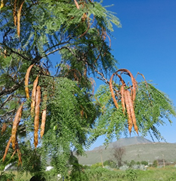
Pods and seeds of L. greggii (Figures 1 and 2) were collected from the Botanical Garden “Gustavo Aguirre Benavides,” located at the Agrarian University “Antonio Narro” (UAAAN) in Saltillo, Mexico (25°21′21″ N, 101°01′59″ W) at an altitude of 1776 m.a.s.l. The site has a semi-dry temperate climate (BS1kw), with an average annual temperature of 18 °C, cold winters, and an annual rainfall of 340 mm, predominantly during summer (García, 2004).
Dasometric values of four trees at the fruiting stage (August 2023) were evaluated. The specimens were planted in the botanical garden. For each tree, total height (m), canopy cover (m), and stem perimeter (cm) at a height of 50 cm above the ground were measured using a flexible tape. A total of 65 mature pods were manually collected from each tree before seed dispersal. The selected pods exhibited a mustard-brown color (Figure 1) and natural dehiscence, meaning they opened spontaneously, and released their seeds by gravity when ripe (barochory), a typical dispersal mechanism of the genus Leucaena (Aguirre-Dugua et al., 2012; Sánchez Paz & Ramírez-Villalobos, 2006) and related species. The collected pods were stored in brown paper bags and kept in the laboratory at a temperature of 25 °C until the morphological characterization of the pods and seeds.
The characterization work began in February 2024 at the Seed Technology Laboratory in the Training and Development Center of UAAAN, Saltillo Unit.
2.2 Morphological Characterization of Pods and Seeds of Leucaena
For the morphological characterization of the pod, 65 pods were randomly selected from each of the four trees. The following variables were measured: pod length (PL), corresponding to the distance from the base to the apex of the pod; pod width (PWi), the transverse distance measured at the center of the pod (Figure 2); and pod weight (PWe).
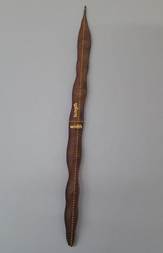
Figure 2: Morphological features of Leucaena greggii S. Watson pod in the “Gustavo Aguirre Benavides Botanical Garden” of the “Antonio Narro” Autonomous Agrarian University, Saltillo, Coahuila, México
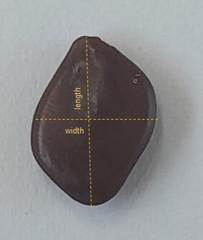
PL was recorded using a measuring tape and expressed in centimeters, PWi was measured with a Vernier caliper (Fisher Scientific®) with precision in millimeters, and PWe was measured in kilograms using a digital scale. The seeds were manually extracted from the pods and cleaned. For recording seed variables (Figure 4), only seeds with a dark-brown color (Figure 3) were considered, while black (immature) seeds located at the apical portion of the pod and those with mechanical damage or insect attack (holes) were discarded Sánchez Paz & Ramírez-Villalobos, 2006). From each individual tree, seeds were collected and subsequently mixed using a Boerner-type seed homogenizer. From the total mixed seeds per tree, 100 seeds were randomly selected for morphological characterization. For each seed, the following variables were measured: seed length (SL), from the hilar end to the chalazal end; seed width (SWi), measured at the middle and widest portion of the seed; and seed thickness (ST). Measurements were taken with a Vernier caliper (Fisher Scientific®), with precision in millimeters. Seed weight (SWe) was recorded using a digital analytical balance (Ohaus Adventurer™ Pro).
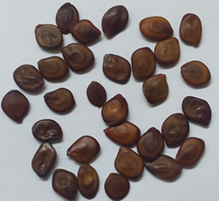
Figure 3: Seed of Leucaena greggii S. Watson collected at the Botanical Garden “Gustavo Aguirre Benavides” in the “Antonio Narro” Autonomous Agrarian University, Saltillo, Coahuila, Mexico
For evaluating qualitative traits such as seed shape, the roundness index (IR) was applied, obtained from the length-to-width ratio (Figure 4). When IR = 1, the seed is spherical; when IR > 1, it is large or oblong; and when IR < 1, it is ovoid (longer than wide) (Aguirre-Dugua et al., 2012). Seed color was evaluated visually using the Munsell color chart as a reference (Munsell, 2000) in a sample of 50 seeds. Finally, the number of seeds per kilogram was calculated by recording the weight of 1000 seeds (g) and using the formula:
Number of seeds per kg = (Number of seeds in the sample / Weight of the sample) × 1000, according to ISTA standards (International Seed Testing Association, 2014).
2.3 Statistical Analysis
A database was created in Microsoft Excel (Office 2016). To analyze and describe the morphological variables of pods and seeds (PL, PWi, PWe, SL, SWi, ST, and SWe), descriptive statistics were performed for each variable, including: a) frequency distribution, b) measures of central tendency (mean, median, and mode), and c) measures of dispersion (range, variance, standard deviation, and coefficient of variation). In addition, Pearson’s correlation analysis was performed at a 5% probability level to determine the degree of association between all quantified variables.
3. Results
3.1 Dasometric Values of the Evaluated Specimens
In general, the L. greggii specimens evaluated in the Botanical Garden showed average values of 4.09 m in height, 2.5 m in canopy coverage, and 11.4 cm in stem diameter.
3.2 Color and Shape of Seeds and Pods
The results for pod and seed color of L. greggii indicate that pods exhibit a mustard-brown color (YR 7/8) and an elongated shape. The seeds display a dark-brown color (YR 4/6), and according to the IR values, 100% of the seeds presented IR > 1, classifying them as oblong or elongated. Additionally, the estimated number of seeds per kilogram per plant was 10,885.12 (P1), 13,414.00 (P2), 11,757.00 (P3), and 11,907.80 (P4), respectively.
3.3 Pod Morphological Characterization of Leucaena greggii S. Watson
3.3.1 Frequency Distribution
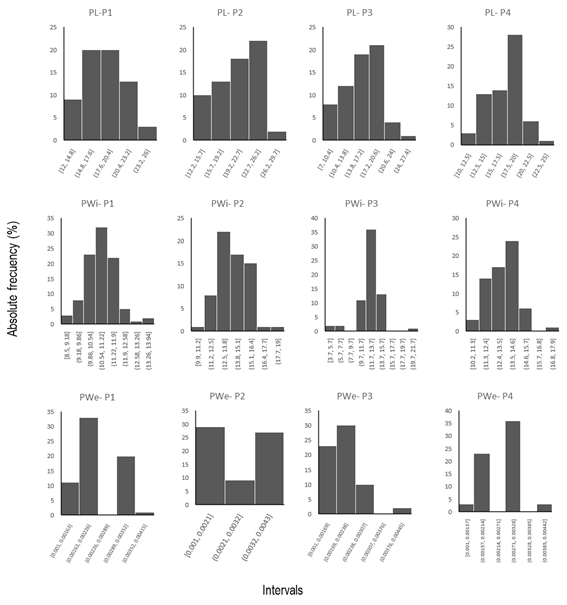
According to Table 1 and Figure 5, the frequency distribution of variables showed varying values. PL ranged from 7 cm to 28 cm, PWi ranged from 3.7 mm to 19.9 mm, and pod weight (PWe) ranged from 0.001 kg to 0.004 kg.
Table 1: Dispersion measures of pod morphological characteristics of Leucaena greggii S. Watson
| PL (cm) | PWi (mm) | PWe (kg) | |
|---|---|---|---|
| Media | 17.9292 | 12.6839 | 0.0023 |
| Error typical | 0.2449 | 0.1220 | 0.0001 |
| Median | 18.0000 | 12.6000 | 0.0020 |
| Mode | 18.0000 | 13.1000 | 0.0020 |
| Deviation standard | 3.9483 | 1.9676 | 0.0009 |
| Variance of the sample | 15.5892 | 3.8716 | 0.0000 |
| Kurtosis | -0.2672 | 2.4849 | -0.8354 |
| Coefficient of asymmetry | -0.1104 | -0.3829 | 0.1966 |
| Range | 21.0000 | 16.2000 | 0.0030 |
| Minimum Value | 7.0000 | 3.7000 | 0.0010 |
| Maxim Value | 28.0000 | 19.9000 | 0.0040 |
| N | 260.0000 | 260.0000 | 260.0000 |
| Confidence level (95.0%) | 0.4822 | 0.2403 | 0.0001 |
PL: pod length, PWi: pod width, PWe: pod weight
3.3.2 Measures of Central Tendency
Table 1 shows the values related to the measures of central tendency. The means for the variables PL, PWi, and PWe were 17.92 cm, 12.68 mm, and 0.002 kg, respectively.
3.3.3 Dispersion Measurements
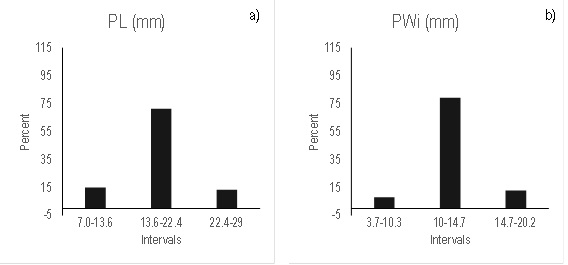
Figure 5 and Table 1 show the values associated with the dispersion measurements for Leucaena pods. For PL, the range was 7-28 cm, with a standard deviation of 3.94 mm and a coefficient of variation of 22.02%. For PWi, the range was 3.7-19.9 mm, with a standard deviation of 1.96 mm and a coefficient of variation of 15.51%. Finally, for PWe, the range was 0.001-0.004 kg, with a standard deviation of 0.0009 kg and a coefficient of variation of 40.10%. In addition, Figure 6 shows that about 71.53% of the pods had a length (PL) between 13.6 and 22.4 cm, and 79.23% had a width (PWi) between 10 and 14.7 mm.
3.4 Seed Morphological Characterization of Leucaena greggii S. Watson
3.4.1 Frequency Distribution
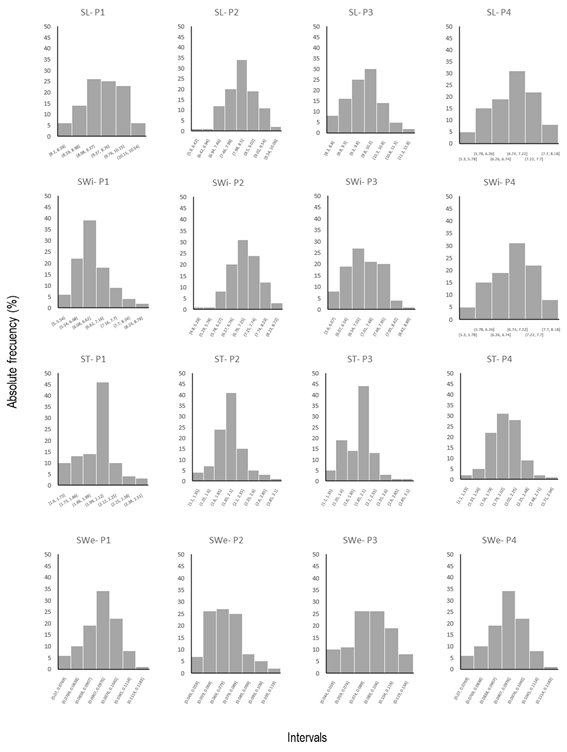
Table 2 and Figure 7 present the frequency distribution of the seed-related variables (SL, SWi, ST, and SWe). For SL, the observed values ranged from 5.9 to 11.66 mm; for SWi, values ranged from 4.8 to 8.63 mm. The ST values ranged from 1.10 to 3.0 mm, and the seed weight (SWe) ranged from 0.044 to 0.133 mg.
Figure 7 shows that about 76.25% of the seeds had a length (SL) between 8.43 and 10.52 mm, while 85.5% had a width (SWi) between 5.79 and 7.77 mm. Likewise, values between 0.044 and 0.13 mg were recorded for SWe, where 87% of the seeds fell within this range.
Table 2: Dispersion measures of seed morphological characteristics of Leucaena greggii S. Watson
| SL (mm) | SWi (mm) | ST (mm) | SWe (mg) | |
|---|---|---|---|---|
| Media | 9.300975 | 6.842075 | 1.946925 | 0.086655 |
| Error typical | 0.04419022 | 0.03476523 | 0.01464418 | 0.00081325 |
| Median | 9.4 | 6.9 | 1.96 | 0.087 |
| Mode | 9.3 | 6.4 | 2 | 0.085 |
| Deviation standard | 0.88380432 | 0.69530466 | 0.2928835 | 0.01626507 |
| Variance of the sample | 0.78111007 | 0.48344857 | 0.08578075 | 0.00026455 |
| Kurtosis | 0.32358046 | -0.45621359 | 1.13830286 | -0.07759525 |
| Coefficient of asymmetry | 0.48005136 | -0.0759504 | 0.07545504 | 0.01847529 |
| Range | 5.76 | 3.83 | 1.9 | 0.089 |
| Minimum Value | 5.9 | 4.8 | 1.1 | 0.044 |
| Maxim Value | 11.66 | 8.63 | 3 | 0.133 |
| N | 400 | 400 | 400 | 400 |
| Confidence level (95.0%) | 0.08687475 | 0.06834592 | 0.02878938 | 0.0015988 |
SL: seed length, SWi: seed width, ST: seed thickness, SWe: seed weight
3.4.2 Measures of Central Tendency
Table 2 shows the measures of central tendency for Leucaena seeds across the evaluated variables. The mean seed length (SL) was 9.30 mm, with a median of 9.4 mm and a mode of 9.3 mm. The mean seed width (SWi) was 6.84 mm, with a mode of 6.4 mm. The mean seed thickness (ST) was 1.94 mm, with a mode of 2.0 mm. Finally, the mean seed weight (SWe) was 0.0866 mg, with most values centered around a mode of 0.085 mg.
3.4.3 Dispersion Measurements
Table 2 presents the dispersion values for each variable measured in Leucaena seeds. The SL variable showed a range of 5.76 mm, a standard deviation of 0.8838, and a coefficient of variation of 9.5%. The SWi variable had a range of 3.83 mm and a coefficient of variation of 10.16%. The ST variable exhibited a range of 1.9 mm and a coefficient of variation of 15.04%. Finally, the SWe variable showed the highest variability, with a coefficient of variation of 18.67%.
3.5 Degrees of Association among Evaluated Variables
For Leucaena greggii pods, Pearson’s correlation analysis at a 5% probability level among the morphometric variable length (PL), width (PWi), and weight (PWe) showed that all associations were positive and statistically significant. The strongest linear association was observed between weight and length, with a Pearson’s correlation coefficient of 0.72 (Table 3).
Table 3: Pearson’s correlation analysis between pod size characteristics (length, width, and weight) of Leucaena greggii S. Watson collected in the Botanical Garden of UAAAN, Coahuila, Mexico (N = 260; α = 0.05)
| PL | PWi | PWe | |
|---|---|---|---|
| PL | 1 | ||
| PWi | 0.3757*** | 1 | |
| PWe | 0.7275*** | 0.4315*** | 1 |
PL: pod length, PWi: pod width, PWe: pod weight
For Leucaena greggii seeds, Pearson’s correlation analysis at a 5% probability level for the morphometric variables seed length (SL), seed width (SWi), seed thickness (ST), and seed weight (SWe) showed that all associations were positive and statistically significant. The strongest linear association was observed between weight and length, with a Pearson’s correlation coefficient of 0.31 (Table 4).
Table 4: Pearson’s correlation analysis between size characteristics (length, width, thickness, and weight) of Leucaena greggii S. Watson seeds collected at the Botanical Garden of UAAAN, Coahuila, Mexico (N = 400; α = 0.05)
| SL | SWi | ST | SWe | |
|---|---|---|---|---|
| SL | 1 | |||
| SWi | 0.1621*** | 1 | ||
| ST | 0.0045*** | 0.0368*** | 1 | |
| SWe | 0.3181*** | 0.0178*** | 0.046*** | 1 |
SL: seed length, SWi: seed width, ST: seed thickness, SWe: seed weight
4. Discussion
4.1 Dasometric Values of the Evaluated Specimens
In general terms the specimens of L. greggii evaluated in the Botanical Garden presented average values of 4.09 m in height, 2.5 m coverage and 11.4 cm in stem diameter. Estrada Castillón et al. (2014) mentioned that this taxon is a shrub or tree and can have a height of 3.0-8.0 m. The trees evaluated in this study show the ranges in dasometric limits as reported by the authors for natural populations in different locations in the state of Coahuila and Nuevo León, Mexico.
4.2 Color and Shape of Pods and Seeds
The characteristics observed in the pods in this study are consistent with those of the genus Leucaena, as described in previous works (Estrada Castillón et al., 2014; Zarate Pedroche, 1994). The fruits are elongated, straight, flat pods ranging from light to dark shiny brown, with longitudinal dehiscence. The color of the seeds also coincides with the report of Estrada Castillón et al. (2014), who noted that the seeds are dark brown.
The seed shape observed in this study differs from reports by other authors, who described them as ovoid to rhomboid (Zarate Pedroche, 1994), rhomboid to spherical (Estrada Castillón et al., 2014), or ovoid (Catálogo de semillas forestales, n.d.). The number of seeds per kilogram reported in literature ranges from 12 000 to 24 000 seeds kg-1 (Catálogo de semillas forestales, n.d.), which is similar to the value obtained in this study.
4.3 Pod Morphological Characterization of Leucaena greggii S. Watson
It is noteworthy that this research represents one of the few, and perhaps the first, studies focused on the morphological characterization of the pods and seeds of Leucaena greggii S. Watson, with no previous reports available for this taxon. The median values observed for pod length (PL) and pod width (PWi) were 17.2 cm and 1.2 cm, respectively. These results are consistent with those reported by Zarate Pedroche (1994) for the same species, based on herbarium specimens from Mexican collections, which showed pod dimensions of about 20 cm in length and 0.8-1.5 cm in width. Similarly, Estrada Castillón et al. (2014) reported comparable values of 11-21 × 0.9-1.5 cm from herbarium specimens collected in natural populations in Coahuila and Nuevo León, Mexico. Zarate Pedroche (1994) also reported pod dimensions for other Leucaena species distributed in Coahuila and Nuevo León, Mexico, including L. leucocephala (Lam.) de Wit ssp. glabrata (Rose), with values of 9-20 × 1.5-2.0 cm, brown, glabrous, and apically rounded, and L. pulverulenta (Schltdl.) Benth., with dimensions of 12-21 × 1.4-2.4 cm, acute at the base and apex, thin, brown, and glabrous.
4.4 Seed Morphological Characterization of Leucaena greggii S. Watson
The external seed morphology of L. greggii obtained in this study provided both quantitative (length, width, thickness, and weight) and qualitative (shape and color) data, which were previously unavailable for natural populations of this taxon. Such studies are important for conserving the genetic diversity of the species and ensuring its long-term survival within its distribution range. They also aid in population characterization, ex situ genetic material collection for germplasm banks, and potential genetic improvement studies. Since L. greggii was included in the 2020 IUCN Red List of Threatened Species, both in situ and ex situ conservation efforts are required to maintain its genetic diversity. These studies are also crucial for seed recognition in seed banks (Niembro, 1989). Knowledge of external seed morphology is valuable for species identification and taxonomic classification (Capitaine, 1912; Montejo Valdes et al., 2011). Such research provides useful tools for botanical, taxonomic, and phylogenetic studies (Romero Saritama & Draper Munt, 2017) and contributes to resolving taxonomic challenges (Ubiergo & Lapp, 2007). Furthermore, certain seed traits have proven useful for the taxonomic subdivision of the Fabaceae (Leguminosae) family.
The results of this study for seed length and width (5.9-11.66 × 4.8-8.63 mm) in L. greggii are very similar to those reported by Estrada Castillón et al. (2014), who found 7.5-9 × 5-7 mm, and by Zarate Pedroche (1994), who reported 6.4-9.6 × 4.4-7.4 mm. The BGVC (Catálogo de semillas forestales, n.d.) reported values of 5-8 × 4.2-6.0 mm, which are also comparable to those obtained here. Other authors reported seed dimensions for L. leucocephala (Lam.) de Wit ssp. glabrata (Rose) (Estrada Castillón et al., 2005) and L. pulverulenta (Schltdl.) Benth. Zarate Pedroche (1994) collected in Nuevo León, Mexico, with respective ranges of 7.2-8.2 × 5-5.6 mm and 6.5-7.9 × 3.2-4.2 mm. These differences are relevant when selecting and conserving seeds ex situ (Leishman et al., 2000).
According to various authors (Leishman et al., 2000; Sánchez-Salas et al., 2015), seed size within a species may vary by up to 50%. Sánchez-Salas et al. (2015) noted that seed size plays a key role in germination capacity, rate, and successful establishment within a population (Leishman et al., 2000). Van Mölken et al. (2005) reported that larger seeds tend to germinate more readily and produce more vigorous seedlings compared with smaller seeds. Similarly, Suárez-Vidal et al. (2017) found that larger seeds yield seedlings with greater vigor. Seed weight is an important ecological trait linking reproductive ecology and seedling establishment to vegetative growth (Leishman et al., 2000).
Huerta-Paniagua and Rodríguez-Trejo (2011) observed that in Quercus rugosa Née, larger seeds exhibited higher germination percentages. Tenorio-Galindo et al. (2008), studying Cecropia obtusifolia Bertol., found that larger seeds had nearly double the germination rate compared to smaller ones. Meyer and Carlson (2001) emphasized that seed thickness (ST) is a critical factor for species in arid and semi-arid ecosystems, as greater thickness promotes faster growth in juvenile stages and higher field establishment success. However, ST remains one of the least studied morphological traits in germination research (Tenorio-Galindo et al., 2008). In this study, values between 0.044 and 0.13 g were observed for SWe, with 87% of seeds falling within this range.
5. Conclusions
The morphological characterization of the pods and seeds of Leucaena greggii S. Watson is essential for supporting future studies on germination and mass propagation, as well as for facilitating plantation efforts within its natural habitat and promoting ex situ conservation of this threatened species. Given the small number of trees analyzed in this study, which may influence intraspecific variability, it is recommended that future research should include a larger sample covering the full genetic variability of natural populations throughout the species distribution range. The results obtained here can serve as an initial reference for future studies on the physiological quality of L. greggii seeds, including germination, vigor, and accelerated aging tests. Such studies are crucial for achieving successful nursery production, field establishment, conservation, ecological restoration, and the recovery of forest biomass for this species.

