




 Inglés (pdf)
 Articulo en XML
 Referencias del artículo
 Traducción automática
 Permalink

1. Introduction
The article aims to explore the concept of sustainability in family dairy farms in Uruguay, using a comprehensive approach that includes economic, social, and cultural dimensions. This analysis will be conducted from an interdisciplinary perspective, recognizing the importance of factors such as quality of life and generational succession in the sustainability of these productive units. A central aspect of this approach is the inclusion of a gender perspective, which will highlight the strategic role of women in the management and sustainability of family farms.
The study of sustainability in dairy production has traditionally focused on technical and economic aspects, overlooking the social and family dynamics that are also crucial for ensuring the continuity and viability of these systems. In this context, the gender approach provides a key tool to examine how labor and family responsibilities are distributed between men and women, and how these differences impact the sustainability of farms. Women work in family dairy farming has traditionally been invisible, despite their strategic role in both productive and reproductive work, which are essential for household well-being and the continuity of the business.
Throughout this article, three key dimensions related to the participation of women in family dairy farming are addressed. First, the organization of work and decision-making on farms is analyzed, identifying how women participate in these activities and the barriers they face in accessing leadership roles and strategic decision-making. This section includes a reflection on how the sexual division of labor conditions women’s participation in productive activities and how the invisibility of unpaid work reinforces gender inequalities.
Second, the perceptions of women regarding their quality of life in the rural environment. Both objective and subjective aspects of well-being are investigated, considering factors such as access to basic services, education, health, and free time. This approach seeks to capture how women experience the dual role of productive and reproductive work and how this affects personal and their family’s well-being.
Finally, the paper examined the role of women in the generational transmission of dairy farms. Despite their crucial role in daily management and family cohesion, women are often excluded from succession processes, limiting their ability to fully contribute to the future of family farms. This research highlights how greater inclusion of women in strategic decision-making and succession could strengthen the resilience and sustainability of family businesses, contributing to gender equity and ensuring the continuity and viability of rural productive systems.
In summary, this article contributes to expanding the understanding of sustainability in family dairy production, emphasizing the importance of integrating a gender perspective to improve both equity and efficiency in these productive systems.
2. Theoretical Framework
The theoretical approach is based on a multidimensional view of sustainability, which includes economic, social, and cultural aspects, with a particular focus on gender dynamics. In this context, sustainability is seen as the ability of family production systems to persist over time, ensuring economic viability and the well-being of those involved. It also aims to preserve natural and cultural resources for future generations1. This idea implies an economic dimension, but also gives significant importance on well-being, particularly when it comes to women's participation.
Sustainability is closely related to well-being, which is understood as a dynamic state that refuses the simply accumulating wealth or meeting basic material needs. Inspired by Amartya Sen's approach 2)(3) , well-being should be seen as the expansion of individuals’ capabilities to lead lives they value and find meaningful. This perspective implies that well-being cannot be measured by income or material goods alone; it must also take into account the freedom to make choices and fair access to resources and opportunities within families.
Martha Nussbaum 4)(5) 6 goes further into the connection between capabilities and social justice, stressing the importance of considering how family structures impact the development of each member's potential. Women, who are often limited to domestic or caregiving roles, may face restricted opportunities for personal and professional growth, affecting their own well-being and that of the entire family.
Family production, on the other hand, is defined by the interdependence between the household and the productive unit, creating what is known as the “family-farm system” 7)(8) . Unlike capitalist business models that prioritize capital accumulation, family production focuses on maximizing income for sustenance and reinvestment into the next agricultural cycle 9)(10) . This kind of production depends on patrimonial capital and the use of social and cultural capital, which includes the relationships and knowledge passed down within the family 11)(12) 13.
Generational succession is key for accumulating and maintaining these forms of capital. Women play an essential role in maintaining family bonds and passing down knowledge, yet their work often goes unnoticed, especially when it involves unpaid tasks. This invisibility creates challenges for long-term sustainability, as it limits women's involvement in strategic decision-making and the succession of family farms.
A gender-focused approach is needed to rethink the conversation around inequalities in labor distribution, decision-making and access to resources on family farms. Although women are central to family dairy farming, their work is often limited to domestic or caregiving roles, which reinforces gender stereotypes and reduces their participation in strategic decision-making14.
The work of women is essential for the functioning of farms, being key to the social and economic sustainability of families. However, there is a clear gender-based division of tasks. Men usually take on productive work in the field, while women are responsible for domestic and caregiving tasks 15)(16)17)(18) . This division is rooted in cultural norms and limited access to technology for women.
Generational succession in dairy farms is deeply ingrained in cultural norms that favor men in the transfer of responsibilities, excluding women from leadership roles and decision-making. Although women actively participate in the daily management of farms and the transmission of knowledge, it is common for continuity to be promoted through male offspring, perpetuating gender inequalities 14)(19)20)(21) .
The “three-circle” theory in family businesses, developed by Tagiuri and Davis22, illustrates how family and business dynamics can create tensions in succession. Leadership and management often fall to adult men, limiting opportunities for women to take on prominent roles in farm management. These tensions can affect not only the sustainability of the farms but also the well-being and capabilities of women in rural families.
The restriction of women's freedoms and capabilities, as argued by Sen, limits their personal well-being, leading to negative consequences for the development of the rural community.
In summary, the sustainability of family dairy farms cannot be fully understood without a gender approach that acknowledges the crucial role of women in productive work, decision-making, and generational succession. Gender equity is a fundamental component to ensuring the long-term well-being and viability of the farms. Rethinking power structures in these productive systems and promoting greater participation of women in strategic decision-making are key to ensuring comprehensive sustainability.
3. Materials and Methods
This study adopts an interdisciplinary and qualitative methodological approach, based on feminist and interpretative frameworks. The objective is to understand the social dynamics that shape the sustainability of family dairy enterprises, in particular the distribution of roles and responsibilities according to gender. The research design integrates multiple data collection strategies, including interviews, participatory workshops and field observations.
Among the modalities grouped under the interview technique, the semi-structured interview was chosen, which is characterized by being “guided by a set of questions and basic issues to be explored, but neither the exact wording nor the order of the questions is predetermined”23. For this reason, the interview guidelines varied according to the responses and the elements that emerged during the course of the interviews, as well as the characteristics of the interviewees24. The interviews were guided by a flexible script that explored topics such as work organization, decision making, quality of life, generational succession, among others.
A total of 48 family dairy farms were selected based on the official family farming criteria defined by Resolution No. 1013/2016 of Ministerio de Ganadería, Agricultura y Pesca25. This resolution considers family farmers to be those whose main source of income is agricultural production, who depend mainly on family labor and who live on the farm or within 50 kilometers from it. During the interview, the entire family was interviewed.
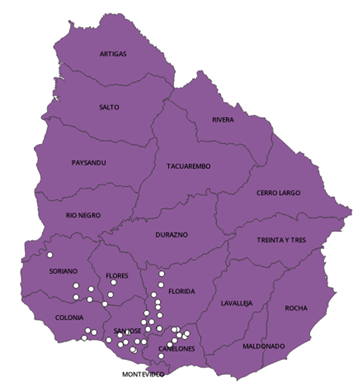
The survey was carried out in 2 periods, 24 families were interviewed in the year 2021 and another 24 families were interviewed in 2023. The interviews were carried out in the main dairy basins, namely the southern basin (comprising the departments of Canelones, Florida and San José) and the western coast (comprising Colonia, Soriano and Flores). This regional focus was intentional, as the study aimed to explore sustainability and gender roles specifically in the heart of Uruguay's dairy sector, where the density of family farmers is most significant.
The map included in this section (Figure 1) shows the localities where the interviewed families are located.
The participatory workshop brought together 50 rural women and was organized into small discussion groups to foster the exchange of experiences and identify common challenges. Through collective dialogue, the workshop explored perceptions of well-being, barriers to leadership and roles in decision-making processes.
Field visits to the companies were also conducted to observe daily routines, validate information gathered during interviews and workshops, and better understand family interactions in their natural environment. These visits focus on the intersection between productive and reproductive spaces, and how responsibilities are distributed and negotiated.
Data analysis was conducted using thematic content analysis. All interviews and workshop notes were transcribed and analyzed to identify patterns, regularities and emerging themes. This qualitative approach allowed for a deeper understanding of women's roles and perceptions, with particular attention to the intersection between productive and reproductive work, agency in decision-making, and perceptions of well-being. The analysis was complemented by secondary sources, including official agricultural statistics (DIEA-MGAP), the 2014 and 2019 Dairy Surveys (INALE) and policy reports, allowing triangulation between qualitative insights and national data. These sources also provided a broader context for understanding the structural and institutional conditions affecting the sustainability of family dairy farms in Uruguay.
4. Women's Participation in the Sustainability and Continuity of Dairy Farms
The latest data from Ministerio de Ganadería, Agricultura y Pesca, DIEA (UY)26 highlights a worrying trend: a decline in commercial dairy farms, especially family-owned ones. Between 2014/15 and 2021/22, the number of farms under 500 hectares dropped by 22%, going from 3,598 to 2,811. This decrease is more pronounced compared to farms over 500 hectares, which saw an 11% reduction during the same period. This decline expresses the vulnerability of the family dairy sector related with current economic conditions (Table 1).
Table 1: Evolution of the number of establishments with commercial dairy farming, by agricultural year, according to surface area ranges, period 2014/15 to 2021/22
| Surface Area Ranges (ha) | 2014/15 | 2015/16 | 2016/17 | 2017/18 | 2018/19 | 2019/20 | 2020/21 | 2021/22 |
| Number of Establishments | 3919 | 3873 | 3718 | 3688 | 3423 | 3320 | 3159 | 3094 |
| Up to 50 | 1162 | 1074 | 966 | 966 | 852 | 784 | 714 | 754 |
| 50 - 199 | 1835 | 1871 | 1795 | 1789 | 1634 | 1601 | 1542 | 1488 |
| 200 - 499 | 601 | 630 | 608 | 620 | 596 | 600 | 584 | 571 |
| 500 and more | 321 | 298 | 349 | 313 | 341 | 335 | 319 | 283 |
Source: Data extracted from Ministerio de Ganadería, Agricultura y Pesca, DIEA (UY)26.
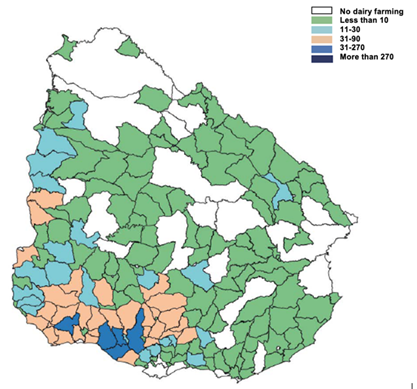
The highest concentration of commercial dairy farms is found in the southwest of the country, as shown in the DIEA-MGAP maps for 2020/21 (Figure 2). Although dairy farms are spread across the entire country, this regional concentration highlights the importance of territorial policies that support producers to remain in these key areas.
A key factor in understanding the sustainability and continuity of family farms is the integration of women in productive tasks. According to the 2014 INALE survey27, 64% of dairy farms had family women participating in their work. By 2019, it was found that, separately from salaried work (which made up 47% of the workforce), women in the household represented 36% of workers, compared to 64% for men.
The masculinity index in dairy farms shows that in those where women family members are actively involved in productive work, there are 1.6 men for each woman, suggesting a more balanced distribution of tasks between men and women within the household. On the other hand, in farms where family women do not participate and only paid women work, the ratio is 6.2 men for each woman, highlighting a strong division between productive and reproductive work27. These results reinforce the importance of women’s participation in productive tasks within the household, not only promoting equity but also raising the family's ability to adapt to challenges, which is linked to greater long-term sustainability.
The education level of women on dairy farms also plays a crucial role in sustainability. In 2019, 40% of women had no more than a primary education, another 40% had completed secondary education, and 20% had tertiary or university training, mostly in fields like veterinary science, agronomy, or dairy technology. Only 11% studied administration, which limits their ability to take part in strategic decision-making on the farms. In comparison, men had a similar educational profile, although a bit higher percentage -38%- had access to tertiary education.
The analysis of labor division by gender on family dairy farms shows a clear roles segregation. Women in the family are mostly in charge of administration (61%), cheese making (64%), and managing young animals (45%), while men tend to handle general management (83%), tractor operation (71%), and foreman duties (79%). This division reinforces the idea that while women are essential to the daily management of farms, they are often left out of strategic decision-making26.
One of the most remarkable findings from the 2019 INALE survey27 is the link between women's participation in farm work and the presence of generational succession. In farms where women actively take part in productive tasks, two out of three cases showed generational succession, indicating a stronger likelihood of continuity. By contrast, in farms without women's participation, 50% did not have guaranteed succession, posing a risk to long-term sustainability.
Women’s participation in family dairy farms is crucial for gender equity and is closely tied to the sustainability and continuity of these farms. Their roles in administration, management, and influencing strategic decisions could significantly support the economic and social stability of family farms. As the number of family farms declines, it becomes even more important to recognize women’s contributions not just in the present but also to assure generational continuity and the long-term viability of these farms.
5. Results
The results of this study emphasize the importance of women’s participation in family dairy farms and how it contributes to the sustainability and cohesion of families. Drawing from the testimonies collected in the interviews and workshop, several key findings emerge that highlight the strategic role women play in family dairy farming. These findings show how including or excluding women from decision-making and productive tasks could significantly affect the continuity of the farms.
5.1 Women’s Participation in Farm Management
The organization of work on dairy farms reflects a clearly gender-differentiated task allocation. In fact, in all analyzed cases, reproductive tasks -such as domestic work and caring for family members- drop on women. Furthermore, it is observed that women tend to show greater flexibility in their roles, participating in productive and reproductive activities, which requires them to balance both spheres simultaneously.
According to the analysis of various sources 14)(16)18)(21)27)(28) 29, it was found that in the organization of work on family dairy farms, there is a task allocation based on gender. Tasks considered “fieldwork” or “farm tasks” -such as tractor operation, planting, grazing, fertilization, and the use of herbicides- are predominantly performed by men. On the other hand, more routine and care-related tasks, such as milking and calf rearing, are mainly assigned to women. When additional help is needed, often due to the lack of salaried labor or male children actively involved, women step in for extra tasks such as fence building, herding cows, or purchasing supplies. In these cases, their participation is usually circumstantial, acting as a “wild card” rather than actively choosing these tasks. Additionally, in many cases, women are preferred for administrative tasks, such as handling paperwork, guides, and records.
Regarding decision-making, there are different levels of women participation, from vertical decision structures, where adult men concentrate tactical, operational, and strategic decisions, to more horizontal configurations. Decisions related to “farm tasks,” such as planting times, harvesting, or purchasing supplies, are mostly handled by men. Despite the presence of more horizontal structures in some cases, it is confirmed that leadership tends to remain to men, who assume the final responsibility for key decisions.
However, it is evident that, regardless of their direct participation in the productive unit, women often have significant influence in strategic decisions, either as decision-makers or by being consulted within the families. This highlights the strong link between the “business and the family,” as strategic decisions, such as the use of monetary surpluses or taking on debt, impact on the development of the productive unit and also at the household unit. Thus, financial decisions directly influence the overall direction of family income.
This productive system, however, is not free from inherent tensions and contradictions, as the needs and logic of the productive and domestic units may differ or even conflict. This creates a constant negotiation between investment priorities on the farm and household consumption. For example, in several of the interviewed families, the need to improve living conditions -such as expanding rooms or upgrading facilities- emerged, revealing differing priorities between partners regarding investment needs in both spheres. Although agreements were reached in most cases, the final word often remained with the man, especially concerning strategic decisions. Thus, even if women actively participate in the daily management of the farms, their influence on strategic and financial decisions is often limited. This pattern reflects traditional power structures that favor male authority in significant economic decisions, such as long-term investments or business expansion.
These findings illustrate how gendered labor structures and power dynamics within family farms limit women’s ability to fully exercise agency and influence key decisions. Although women often participate informally in management and are consulted on strategic issues, final decisions tend to remain in male hands. As one interviewee expressed: “They always ask me, but he decides” (2021 interview 9 with Productor of San José; unreferenced). This aligns with what Gallo and Peluso14 describe as “symbolic participation,” where women’s involvement is acknowledged but not empowered. Amartya Sen’s3 concept of development as the expansion of individual capabilities is particularly relevant here: when decision-making remains restricted to men, women's capabilities are constrained, not only in terms of agency, but also in their contribution to farm innovation and sustainability. Furthermore, this dynamic reflects the persistence of patriarchal norms that, as Nussbaum4 argues, limit women’s access to full citizenship and recognition, even within the family unit. Strengthening women’s roles in strategic decision-making is thus not only a matter of equity, but also of long-term sustainability.
5.2 Quality of Life on Family Dairy Farms
The quality of life on family dairy farms is a complex mix of both tangible and intangible factors. While material advancements, like better access to basic services, education, and technology, have improved significantly over recent decades, these improvements don’t always translate into better perceived well-being, especially for women. The persistence of traditional gender roles means that women face a double workload, taking on not only their productive responsibilities on the farm but also the bulk of domestic and caregiving duties.
From a productivity standpoint, using technology and automating labor-intensive and routine tasks can greatly enhance the quality of life for rural families. Automation of tasks like milking or operating heavy machinery reduces physical strain and frees up time for rest, leisure, or higher-value activities. In family farms, where everyone typically pitches in, these technological advances are particularly beneficial because they ease the workload and help with more efficient time management.
Recognizing that rural life includes both paid and unpaid work is essential for creating true equity in how responsibilities are shared. Tasks such as childcare, household maintenance, and caring for the elderly often fall to women, even though they are crucial for sustaining family production. This type of unpaid work supports the well-being of the family and helps ensure the continuity of productive activities but often goes unrecognized. These dynamics align with the analysis of Hirata and Kergoat28, who emphasize the ongoing centrality of women’s unpaid and emotional labor, even within productive systems traditionally perceived as male-dominated. Their work highlights how the sexual division of labor persists in shaping everyday inequalities and work overload for rural women.
The women interviewed pointed out how little social and economic recognition these responsibilities receive. One participant said: “It feels like what we do at home doesn’t count, but without us, nothing would work. The cows don’t milk themselves, and the house doesn’t take care of itself either” (2023 interview 17 with Productor of Florida; unreferenced). This lack of recognition reinforces gender inequalities and affects how women perceive their well-being, making them feel that their contributions, though essential, are undervalued and unnoticed. Martha Nussbaum4 points out that quality of life improves when individual capabilities are supported, which means that recognizing women’s economic contributions and making sure their unpaid work is visible and valued is essential.
Time management on family dairy farms is unique since work and family activities happen in the same space and often overlap. This blend makes it hard to separate work time from personal or leisure time, directly impacting quality of life. Automating routine tasks can help set clearer boundaries and give families, especially women, more opportunities for personal well-being and rest.
Balancing productive and domestic roles is a constant challenge for women and adds significantly to their workload. Long workdays and the ongoing effort to juggle both productive and reproductive responsibilities can leave them feeling like they are always busy and never have time for themselves. One woman commented: “There’s never a moment when my day ends. I go from the farm to the kitchen and then to taking care of my kids. Sometimes it feels like I never have time for myself” (2021 interview 12 with Productor of Florida; unreferenced).
This situation takes a toll on women’s subjective well-being, as many report lower levels of personal satisfaction and a sense of being stuck. Although technological progress and better access to services have objectively improved quality of life, the dual workload often leads to a perceived decline, with men and women experiencing it differently. Men generally mentioned quality-of-life improvements due to technologies that ease physical labor and better access to education and health services, while women tended to be more critical in their assessments.
The dual workload, combined with the lack of recognition for their work, negatively impacts women’s sense of well-being. One woman shared: “My kids are better off, they go to a good school, and my husband has more help on the farm, but for me, it’s the same -I only have time to work at home and in the dairy” (2023 interview 19 with Productor of Florida; unreferenced). This difference in how quality of life is perceived highlights the need to address gender inequalities on family farms. Even though objective measures like access to technology and services have improved, family and social dynamics still disproportionately affect women.
Subjective well-being is key to the long-term sustainability of dairy farming families. Farms that share responsibilities more equally and properly recognize everyone’s contributions are more likely to adopt sustainable practices and foster a stronger commitment to farming in future generations.
As mentioned in the interviews, women who feel acknowledged for both their productive and caregiving roles tend to have a greater sense of belonging and commitment to the farm. This sense of belonging strengthens family bonds and increases the chances that future generations, including both sons and daughters, will continue the farming tradition. “My daughters see everything we do at the dairy, and even though it’s tough, they are proud of what we’ve achieved. They know this is part of our life and want to continue it” (2021 interview 8 with Productor of Colonia; unreferenced).
Martha Nussbaum4 notes that living a dignified life depends greatly on having access to resources and opportunities as well as social recognition. On family dairy farms, women’s well-being is closely tied to their ability to develop their skills in both productive and domestic areas. However, current dynamics often limit these opportunities, affecting how they perceive their quality of life and, ultimately, the sustainability of the farm system.
Tackling gender disparities in how quality of life is perceived requires a comprehensive approach. This means focusing on improving material conditions like infrastructure and services, while also promoting a fairer distribution of responsibilities and benefits within dairy families. Recognizing unpaid work, providing access to training, and offering institutional support are key for creating a meaningful improvement in rural quality of life. Only then can development benefits be distributed more equitably, enabling women to fully realize their potential and contribute to their own well-being as well as the sustainability of family dairy farming.
The mismatch between material improvements and subjective well-being expressed by the women interviewed reflects the limitations of traditional indicators of rural development. While access to technology and services has increased, persistent gendered expectations and the double burden of productive and reproductive work continue to undermine women’s quality of life. As noted in Interview 12, “There’s never a moment when my day ends,” (2021 with Productor of Florida; unreferenced), indicating how blurred boundaries between work and personal life create continuous demands on women’s time. These findings are consistent with Nussbaum’s 4)(5) emphasis on the importance of recognizing care work and emotional labor as central to human dignity and flourishing. The invisibility of this unpaid work reinforces gender asymmetries and restricts women’s ability to expand their capabilities. Moreover, as the testimonies suggest, the perception of unequal recognition between men and women within the same household not only affects current well-being but also influences young women’s willingness to remain in or return to rural life. This dynamic challenges the long-term sustainability of family farms and highlights the need to integrate gender equity as a key dimension in rural development strategies.
5.3 Generational Transfer Dynamics and Gender Roles
The literature on family farming, including the work of Chayanov and other studies, emphasizes the importance of passing down social and cultural capital through generations. This multidimensional view sees production not just as an economic activity but also as a social and cultural practice, where gender roles and generational succession are vital for preserving and transferring values and knowledge. In this framework, gender relations play a significant role in ensuring the sustainability and continuity of family-run farms.
In family dairy farming, succession practices are often rooted in patriarchal traditions that favor men as the natural heirs. This approach frequently sidelines women from leadership roles, reinforcing a narrow view of who is capable of transferring knowledge and skills. Even though women are key in transmitting values and knowledge (cultural capital) and maintaining family connections, their contributions often remain invisible when deciding who will take the lead in the next generation.
Insights from the workshop with women showed that they are the main bearers and transmitters of knowledge related to both farm operations and family life. However, this role seldom translates into formal acknowledgment of their ability to lead farms. Other studies in the field confirm this pattern, noting that while women are involved in administrative tasks and everyday decision-making, they are generally excluded from formal succession plans, where male heirs are favored as the ones responsible for the farm's future.
Favoring men for succession perpetuates gender inequalities and limits innovation on family dairy farms. By restricting leadership roles to men, the skills women have developed in management and daily operations remain underused. This approach to generational transfer, which leaves out daughters as potential leaders, narrows the view of leadership and holds back the transfer of valuable knowledge to capable women. Excluding women from succession not only limits their development but also weakens the family’s ability to adapt and stay resilient in the face of challenges. Rural farms thrive on the diversity of perspectives and skills within the family unit. Excluding women from leadership deprives the farm of essential human resources and promotes a management style that may not be best equipped to handle future challenges and ensure long-term sustainability.
Reevaluating these old norms and moving beyond male-only succession could open up new opportunities for innovation and sustainability on farms. Many women already take on central roles in farm management, but their exclusion from succession processes prevents these capabilities from being fully realized. Amartya Sen has highlighted that intergenerational transmission of capabilities is essential for sustainable development. Limiting succession to men stifles women’s potential and reinforces traditional power structures, weakening the farm's ability to adapt to social and economic changes that are crucial for long-term survival.
Including women in succession shouldn’t be just symbolic, recognizing their roles at home or in day-to-day management. It should mean genuine access to strategic decision-making and the administration of the farm. Encouraging more female participation in leadership and succession could lead to more diverse and sustainable practices, helping farms better navigate market shifts, policy changes, and environmental challenges. Recent Latin American research supports these findings. Herrera and others29 for instance, analyze the roles of women in family farming through a feminist lens and demonstrate how gendered forms of management and decision-making influence the sustainability of rural livelihoods. These insights underscore the strategic importance of recognizing women not only as laborers, but as managers and visionaries within agro-productive systems.
A more inclusive approach to generational transfer could also strengthen family bonds and motivate future generations to keep farming. Recognizing daughters and other female family members as potential successors would foster a deeper sense of belonging and commitment to the family business, supporting its continuity and boosting rural production for years to come.
The testimonies and workshop discussions reveal a significant contradiction: while women are central to the everyday management of the farm and the transmission of knowledge, they are systematically excluded from formal succession processes. As one participant noted, “My daughters know, but they’re not seen as successors” (Workshop). This reflects what Graña21 and Malán19 have described as the symbolic resistance to female succession in family farming, where patriarchal norms continue to define leadership as a male attribute. From the perspective of Amartya Sen 2)(3) , such exclusion represents a structural limitation on women’s capabilities -not only in terms of property and authority, but also in their ability to shape the future of the family farm. Moreover, as Nussbaum6 has argued, denying women access to leadership and strategic participation undermines intergenerational justice, as it restricts the full use of the human capital available within families. By limiting succession to male heirs, farms lose the potential for diverse leadership styles, innovations, and adaptive strategies essential for facing future challenges. Therefore, including women in decision-making and succession is not merely an ethical imperative -it is a strategic condition for the long-term sustainability of rural production systems.
To complement the qualitative analysis and provide a concise overview of the main findings, the following table (Table 2) summarizes the thematic axes, subthemes, sources of information, and selected illustrative quotes identified during the research.
Table 2: Summary Table of Emerging Themes
| Thematic Axis | Identified Subthemes | Main Sources | Illustrative Quotes |
| Work organization | Gender-based division of labor, flexible roles for women, invisibility of reproductive work | Interviews, field observation | “I have to do everything, but no one sees it” (E17) |
| Decision-making | Vertical vs. horizontal structures, women’s consultative roles, male economic authority | Interviews, workshop | “They always ask me, but he decides” (E9) |
| Quality of life and well-being | Workload, lack of personal time, unequal perception of improvements, lack of recognition | Interviews, workshop | “My day never ends” (E12) |
| Technology and workload relief | Task automation, uneven benefits, limited access and adoption by women | Interviews, observation | “The dairy helps, but I’m still in charge of the house” (E19) |
| Generational succession and gender | Preference for male heirs, symbolic exclusion of women, informal knowledge transfer | Workshop, interviews | “My daughters know, but they’re not seen as successors” (Workshop) |
| Recognition and visibility | Administrative tasks, management of household and farm, overlooked contribution to sustainability | Interviews, observation, workshop | “Without us nothing works, but we’re invisible” (E5) |
6. Conclusions
Studies on the sexual division of labor in family farming highlight that traditional gender-assigned roles have deep implications for how contributions of women within rural establishments are valued and recognized. Women, despite their essential role in farm sustainability, are often pushed into tasks perceived as less technical or less relevant, reinforcing their invisibility in production and decision-making. This dynamic not only perpetuates gender inequalities but also undermines the efficiency and sustainability of family dairy farms.
On dairy farms, women often lead promoting sustainable practices. They manage resources efficiently and adopt farming techniques that minimize environmental impact. However, these contributions frequently go unacknowledged, discouraging women from fully participating in production and limiting the potential for innovation and improvement. Recognizing and formalizing the role of women in sustainable management is not only an issue of gender equity but also essential for improving the resilience and long-term viability of family production systems.
The integration of technology and automatization to handle routine or labor-intensive tasks has the potential to create more time for rest and leisure, especially for women who often shoulder the dual charge of productive and reproductive work. However, for these technological advancements to truly benefit women, there must be a shift in family dynamics and recognition of unpaid work. Without this change, the advantages of automatization may not translate into visible improvements in women's quality of life.
From a sustainability point of view, recognizing and valuing women's contributions on farms is strategically necessary. Ensuring gender equity in work distribution and decision-making could significantly increase the effectiveness of productive and environmental practices, improve farm competitiveness, and promote stronger family cohesion. By integrating women's skills in leadership and decision-making, farms could adopt more diverse and adaptable strategies, strengthening their ability to handle future socio-economic and environmental challenges.
However, significant cultural and structural barriers continue to limit women's participation in leadership and succession processes. Although there are programs and policies focused on promoting gender equality in the agricultural sector, their implementation and effectiveness vary fully, influenced by factors such as access to resources, political decisions, and the socio-cultural context. It is clear that overcoming these barriers requires more than just formal policies; a cultural shift is needed to value women's contributions and promote an equitable distribution of productive and reproductive responsibilities.
There are, nevertheless, promising opportunities to enhance inclusion through education and training programs specifically for women, as well as support policies that empower them within the agricultural sector. Building mentorship networks and providing access to financial and technical resources could help ease the way toward greater gender equity on family farms. For these policies to be truly effective, though, they must be backed by proper monitoring mechanisms and sufficient resources to ensure long-term sustainability.
Addressing these challenges is key to creating a more inclusive and equitable dairy sector, which can drive innovation, competitiveness, and long-term sustainability. Supporting the inclusion of women at all levels of family dairy production can lead to greater internal equity and a fairer distribution of leadership and productive roles. This, in turn, strengthens family cohesion and increases the likelihood that future generations will commit to maintaining the productive activity, securing the intergenerational sustainability of farms.
Improving gender equity in family dairy farming can be achieved through training programs, inclusive employment policies, and initiatives that shift cultural norms and perceptions of gender roles in rural areas. Only through a comprehensive and proactive approach that considers cultural and structural barriers can we build a dairy sector that is truly inclusive, resilient, and sustainable, positioning family farms to face future challenges successfully.
Although the environmental dimension was not explicitly addressed in our fieldwork, we recognize the potential relevance of this axis for future research. As Serpossian and others30 point out, women’s involvement in agroecological transitions has been central to reconfiguring farm work and production logics in ways that are both sustainable and inclusive. Exploring how Uruguayan women perceive and enact sustainability beyond the economic and social spheres could open new avenues of research.

