




 Inglés (pdf)
 Articulo en XML
 Referencias del artículo
 Traducción automática
 Permalink

1. Introduction
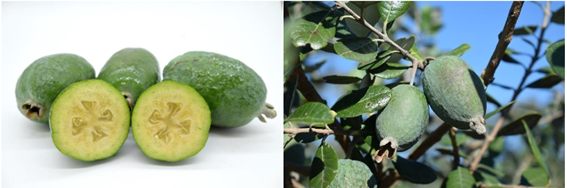
Feijoa sellowiana (O. Berg) O. Berg, also known as Acca sellowiana (O. Berg) Burret1, is a fruit species that has been given several common names depending on the country or region where it is grown. Among these are: feijoa, guayabo del país, guava, goiabeira-serrana, goiabeira-do-mato, goiaba-do-campo and pineapple guava2. This species belongs to the Myrtaceae family and is native to northeastern Uruguay and southern Brazil3. Its excellent organoleptic quality, fruit size and post-harvest life position it as a native fruit with high potential for commercialization as fresh fruit, compared to other local native fruits 2)(4) .
In addition to the feijoa, other Uruguayan native species produce edible fruits, such as pitanga (Eugenia uniflora L.), arazá (Psidium cattleyanum Sab.), guaviyú (Myrcianthes pungens (Berg) Legr.), cereza del monte (Eugenia involucrata L.), among others5. At the national level, these fruit trees are grouped under the category of “native fruit trees”, differentiating them from the “traditional fruit trees”, whose origins lie in other regions of the world and which were introduced by European immigrants.
Since 2000, the Facultad de Agonomía of the Universidad de la República (Fagro, Udelar), the Instituto Nacional de Investigación Agropecuaria (INIA), and the Dirección General Forestal del Ministerio de Ganadería, Agricultura y Pesca (DGF, MGAP) have promoted the first genetic improvement program for native fruit trees in Uruguay. This program began with the collection of plant materials from different areas of the country, including native forests, family gardens and parks, farmers’ fields, and even roadsides and avenues. Based on this survey, introduction and evaluation plots were established in the south and north of the country, where the feijoa stood out for being the species with the highest number of accessions incorporated5. When individuals with outstanding traits were identified, in some cases, plant material was collected for clonal propagation; however, given the difficulty of vegetative propagation of these plants, the main strategy consisted of collecting seeds from open-pollinated (OP) fruits, which allowed identifying the female parent but not the male parent. These plots grew both due to new prospecting and the incorporation of progeny from directed crosses (hybridizations) carried out by the feijoa breeding program. In 2008, 25 crosses were performed between feijoa plants of different characteristics and origins, all with white flesh, generating a total of 1350 plants. Later, in 2012, a population showing traces of pink flesh in the fruits was identified, an interesting characteristic to incorporate. With this objective, eight crosses were made between white-fleshed and pink-fleshed feijoas, producing 430 plants. In 2014, two pink-fleshed individuals were crossed. More recently, from 2019 to the present, 30 crosses have been carried out, resulting in more than 3000 seedlings that are currently in different stages of evaluation.
The feijoa breeding program is participatory, where, in addition to the fundamental role of the institutions, the growers’ participation has been key in this process. They have not only promoted and guided the course of genetic improvement but have also actively collaborated in the establishment of evaluation and validation plots, and their commitment has been decisive for the progress in the species improvement and the development of new cultivars. Currently, these growers are organized in the Productores de Frutos Nativos del Uruguay (FRUNATUR), whose vision is: “To develop and consolidate the production, the market and the consumption culture of native fruits of Uruguay”6.
As a result of this joint effort, three outstanding materials were identified: “FAS RN3VIII5”, “ILB 154”, and “CLA F3P17”, described by Cabrera and others7. In 2017, these genotypes were registered at the Instituto Nacional de Semillas (INASE) under the commercial names “INIA-Fagro Isleña”, “INIA-Fagro Cerrillana”, and “INIA-Fagro Artillera”. The evaluation process continued and, in 2024, a new material, “CLA F1P3”, was selected and released under the commercial name “INIA-Fagro Armonía”, described by Cabrera and others8. The present study aims to synthesize and describe the morphological and productive characteristics of the four registered feijoa cultivars currently available for commercial use.
2. Cultivar Origin and Development
The cultivar INIA-Fagro Isleña (FAS RN3VIII5) originated from the prospection carried out in 2004 in a feijoa population located in Isla del Naranjo, Río Negro, Uruguay. This population had been established by planting individuals derived from seeds collected from fruits of a plant identified as “JP Cerro Chato”, from the locality of Cerro Chato, Florida, in a work conducted by Agronomist Juan Pablo Nebel (DGF, MGAP). During the Isla del Naranjo population survey, several plants were selected, from which seeds were extracted and part of the resulting plants were incorporated into the introduction and evaluation garden of the Estación Experimental de la Facultad de Agronomía en Salto (EEFAS). These accessions were evaluated for seven years, highlighting one individual in particular, identified as FAS RN3VIII5. This accession was selected and registered at INASE in 2017 as one of the first three national feijoa cultivars, thanks to its outstanding flavor, fruit shape, and early harvest7. In 2020, it was assigned the commercial name INIA-Fagro Isleña.
The cultivar INIA-Fagro Cerrillana (ILB154) originated from the evaluation of an F1 progeny, generated by the crossing between two selections identified as “Tbo 85-04m (OP)” × “JP Cerro Chato (OP)”. The female parent “Tbo 85-04m (OP)” comes from a selection obtained by OP from a plant located in Laureles, Tacuarembó, Uruguay, identified as “Tbo 85-04m”. The male parent “JP Cerro Chato (OP)” comes from fruit seeds of a plant located in Cerro Chato, Florida, Uruguay, identified as “JP Cerro Chato”, the same plant that gave rise to the population of Isla del Naranjo, where INIA-Fagro Isleña originated. Both parents present very different traits, both in the fruit and the plant. The crossing aimed to combine the thin skin, small seeds, and sweet flavor of the female parent with the large size, intense green color, and good flavor of the male parent’s fruit. Although mother fruits can be eaten with the skin, their small size and yellowish-green color were considered traits to be improved. Part of the resulting F1 progeny was established and evaluated at the Wilson Ferreira Aldunate Experimental Station of INIA Las Brujas, Canelones, Uruguay. Among the evaluated individuals, “ILB 154” stood out, selected for its high and stable productivity, and for presenting an intermediate harvest time between the cultivars INIA-Fagro Isleña and INIA-Fagro Artillera. This individual was evaluated for seven years and, in 2017, was registered at INASE, beginning to be recommended for commercial plantations8. In 2020, it was assigned the commercial name INIA-Fagro Cerrillana.
The cultivar INIA-Fagro Artillera (CLA F3P17) arises from OP from a plant located in Camino Las Piedritas, Canelones, Uruguay, on the farm of grower Ricardo Marenco. This progeny was established and evaluated in the evaluation and validationplot “La Araucaria”, owned by Agronomist Domingo Luizzi, located in Artilleros, Colonia department, Uruguay. From this population, one individual was identified as “CLA F3P17” and evaluated for seven years. It was selected mainly for fruit quality and late harvest7. In 2017, it was registered at INASE, and in 2020, it was released under the commercial name INIA-Fagro Artillera.
Finally, the cultivar INIA-Fagro Armonía (CLA F1P3) originated from anOP of a plant identified as “Briano planta 2”, located on the farm of grower Leonardo Briano, Camino Los Pirinchos, Melilla, Montevideo, Uruguay. The OP progeny was established in 2009, in the evaluation module “La Araucaria”, owned by Agronomist Domingo Luizzi, located in Artilleros, Colonia, Uruguay. From this module, after the evaluation of three harvests, one plant was selected and coded CLA F1P3. Subsequently, an evaluation and validation plotwas established in the same property “La Araucaria”, composed of twenty plants clonally reproduced by cuttings. After evaluating the original CLA F1P3 plant for more than 10 years and the module of 20 clonal plants for four years, it was registered at INASE and launched as a new commercial cultivar under the fantasy name INIA-Fagro Armonía in 2024. This cultivar stood out for the uniformity in fruit quality and size, in addition to its late harvest. Its name “Armonía” alludes to this characteristic of fruit homogeneity8.
3. Cultivar Characteristics
It is important to consider that Feijoa sellowiana maintains traits characteristic of the species in their initial stages of domestication, such as high fruit heterogeneity within the same tree, low retention of fruits at maturity, and extended flowering and harvest periods, among others. In addition, its phenological behavior is strongly influenced by climatic conditions, which generate significant variations in flowering and harvest dates between years. Figure 1 shows photos of fruits from the four Uruguayan cultivars registered at INASE to appreciate the shape, color, details of the base and apex, sepal characteristics, and the cross-section of each fruit to assess their internal quality.
The cultivars evaluated share common traits of internal fruit quality, including flesh that does not oxidize rapidly, whitish or translucent in color, juicy, with well-defined locules and good organoleptic properties, standing out for their flavor.
The four cultivars are described below, using the traits and scales proposed by López and others9. The reported values correspond to averages calculated from the available data, obtained in different locations in the southern region of the country, with evaluation series that cover between 7 and 14 years. A significant portion of the data was obtained from the introduction and evaluation gardens established under non-commercial management conditions and without specific adjustment by cultivar. Variables such as fruit size and productivity tend to be higher under commercially oriented agronomic practices.
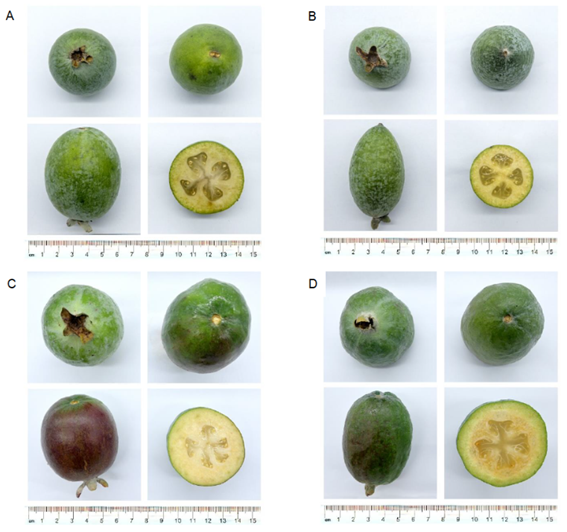
Figure 1: Photographs of the feijoa (Feijoa sellowiana) cultivars: INIA-Fagro Isleña (A), INIA-Fagro Cerrillana (B), INIA-Fagro Artillera (C), and INIA-Fagro Armonía (D). Details include the apex with the calyx, the base with the peduncular insertion, the lateral view of the fruit to appreciate its shape, and a cross-section to observe the internal characteristics of the fruit
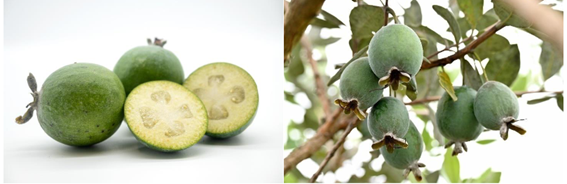
The INIA-Fagro Isleña cultivar (Figure 1 A and Figure 2) flowering period is between October and November, and it is harvested from mid-March to mid-April. It presents medium vigor and a low fruit load on the tree (10-15 kg per adult plant). The fruits are medium-sized with a weight between 30 and 50 g, the skin is green, with the position of the sepals generally open, and varies from smooth to slightly rough. The fruit shape is ellipsoidal with a rounded apex and base, measuring 50 mm in length and 40 mm in diameter, with a length:diameter ratio of 1.3. The skin thickness is thin (between 1.5 and 3 mm), the flesh yield (flesh-to-skin ratio) ranges between 40 and 60%, locules are well-defined and translucent, with 3 to 5 per fruit, most commonly 4. Total soluble solids (TSS) are between 11 and 15 Brix (°Bx), with titratable acidity (TA) between 0.3 and 0.4% citric acid and TSS:TA ratio between 30 and 50.
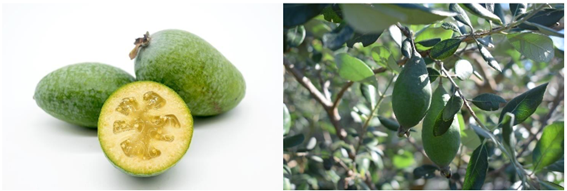
The INIA-Fagro Cerrillana cultivar (Figure 1 B and Figure 3) flowering period is from the end of October through the first days of December, and the harvest period is during April. The plant is very vigorous, and the fruit load on the tree is high to very high (30 -50 kg per adult plant). Fruits are medium-sized, weighing between 25 and 50 g. The skin color is light green and slightly rough, with sepals generally open. Fruit shape is obovoid or ellipsoid with a length of 60 mm by 40 mm in diameter, length:diameter ratio of 1.6. Internal quality is good with defined, transparent locules, with 4 to 7 locules per fruit, most commonly 5. Skin thickness is thin (between 2 and 3 mm). Flesh yield is between 40 and 60%, TSS between 10 and 13.5 °Bx, TA between 0.5 and 0.8% citric acid, and TSS:TA ratio between 15 and 20.
The cultivar INIA-Fagro Artillera (Figure 1 C and Figure 4) flowers in November and it is harvested from mid-to-late April to mid-late May. The plants exhibit low vigor, with low to very low tree fruit load (5-12 kg per adult plant). The fruits are medium-sized, weighing between 35 and 60 g. The skin color is green with a reddish area depending on its exposure to the sun, and it ranges from slightly rough to rough. Sepals are generally open. The shape of the fruit is spherical, sometimes ellipsoidal, measuring 50 mm in length by 40 mm in diameter, with a length:diameter ratio of 1.2. Locules are well-defined, translucent to whitish, with 3 to 5 locules per fruit, the most commonly 4. Flesh yield ranges between 30 and 40%, with thick to very thick skin (between 4 and 6 mm). TSS range from 10 to 13 °Bx, TA between 0.3 and 0.4% citric acid, and TSS:TA ratio between 25 and 35.
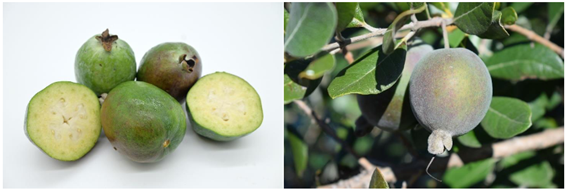
The cultivar INIA-Fagro Armonía (Figure 1 D and Figure 5) flowering period is from early November to early December, and is harvested between late April and May. It is vigorous, and the tree fruit load is medium to high (20 - 40 kg per adult plant). Fruits are medium to large, weighing between 45 and 75 g. The skin is green with a reddish area depending on exposure to the sun, and it ranges from slightly rough to rough. The fruit generally presents a calyx with erect sepals, although sometimes they can be open or semi-open. The fruit is oblong, measuring 60 mm in length by 45 mm in diameter, with a length:diameter ratio of 1.3. Regarding internal quality, fruits generally have well-defined and translucent locules, from 3 to 5 locules per fruit, most commonly 4. Flesh yield ranges between 25 and 45%. The fruit skin thickness is thick to very thick (4 to 7 mm), TSS ranges from 10 to 15 °Bx, TA from 0.4 to 0.5% citric acid, and TSS:TA ratio is 35.
The four feijoa cultivars show differences in their morphological and productive traits. One of the main considerations in selecting these materials is the harvest times. Ideally, harvest periods are staggered between the cultivars, which allows extending the period of fruit availability, a relevant aspect from the commercial and agronomic point of view. Figure 6 graphically illustrates the most frequent flowering and harvest periods for each cultivar. It is important to note that although the dates may present interannual variations due to climatic conditions, the relative order among cultivars remains constant: those classified as early maintain their relative earliness each year, while midseason and late cultivars also retain their respective timing.
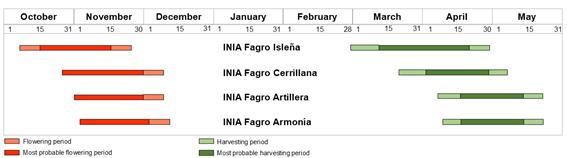
Table 1 summarizes the main traits of the four cultivars to facilitate comparison. In terms of vigor and fruit load, INIA-Fagro Cerrillana exhibited the most outstanding performance, while INIA-Fagro Artillera was the least vigorous and productive. INIA-Fagro Armonía produced the heaviest fruits with TSS reaching 15 °Bx, which suggests a high potential for superior organoleptic quality. The fruit shape varied between cultivars, with a spherical shape in INIA-Fagro Artillera, an oblong shape in INIA-Fagro Armonía, and an ellipsoidal shape in INIA-Fagro Isleña and INIA-Fagro Cerrillana. The latter has sharper angles between the base and the apex, and a more elongated shape, reflected in a higher length:diameter ratio, which gives it a very characteristic shape. The background skin color was predominantly green, although INIA-Fagro Cerrillana generally presented a lighter shade. Reddish overcoloration was observed only in INIA-Fagro Artillera and INIA-Fagro Armonía. Flesh yield was higher in INIA-Fagro Isleña and INIA-Fagro Cerrillana and lower in INIA-Fagro Artillera and INIA-Fagro Armonía, consistent with the thicker skin observed in the latter two (3 to 6 mm).
Table 1: Summary of traitsof the four Uruguayan feijoa (Feijoa sellowiana) cultivars
| Trait | INIA-Fagro Isleña | INIA-Fagro Cerrillana | INIA-Fagro Artillera | INIA-Fagro Armonía |
| Vigor | ++ | +++ | + | ++ |
| Yield (Kg plant-1) | 10 - 15 | 30 - 50 | 5 -12 | 20 - 40 |
| Fruit weight (g) | 30 - 50 | 25 - 50 | 35 - 60 | 45 - 75 |
| Skin color | Green | Light green | Green | Green |
| Overcolor | No | No | Yes | Yes |
| Sepals position | Open calyx | Open calyx | Open calyx | Erect calyx |
| Fruit shape | Spherical or ellipsoid | Obovoid or ellipsoid | Spherical or ellipsoid | Oblong |
| Length:diameter ratio | 1.3 | 1.6 | 1.2 | 1.3 |
| Flesh yield (flesh-to-skin ratio %) | 40 - 60 | 40 - 60 | 30 - 40 | 25 - 45 |
| Number of locules | 3 to 5 | 4 to 7 | 3 to 5 | 3 to 5 |
| Skin thickness (mm) | 1.5 - 3 | 2 - 3 | 3 - 6 | 4 - 7 |
| Total Soluble Solids (°Bx) | 11 - 15 | 10 - 13.5 | 10 - 13 | 10 - 14 |
| Titratable acidity (% citric acid) | 0.3 - 0.4 | 0.5 - 0.8 | 0.3 - 0.4 | 0.4 - 0,5 |
+ low; ++ medium; +++ high
4. Performance and Propagation
In recent years, it has been observed that none of the cultivars tolerates excessive soil moisture or compaction well, although INIA-Fagro Cerrillana seems to be the one that best adapts to these situations. Production generally takes place between the second and third year after planting, with INIA-Fagro Artillera being the least precocious. Under commercial growing conditions, with proper agronomic management, cultivars show improvements in quality, size, and yield. This crop is considered predominantly allogamous2, so planting at least two cultivars together is recommended. However, previous studies have indicated that the cultivars INIA-Fagro Isleña and INIA-Fagro Cerrillana present a certain degree of self-compatibility (unpublished data). The INIA-Fagro Isleña cultivar has shown larger fruit sizes compared to what is reported in this manuscript, especially when irrigation and fertilization are optimized. Nevertheless, its fruit load remains low, so it is necessary to continue evaluating management strategies to improve this limitation. This cultivar is especially valued for being the first to ripen and for its balanced sweet-acid flavor, which makes it attractive to consumers. For its part, INIA-Fagro Cerrillana responds very well to pruning and thinning practices, which result in larger and homogeneous fruits, while achieving better load control, reducing the risk of alternate bearing. Although its shape has been considered a disadvantage, it has been observed that, with proper management, the fruits manage to “fill” better and reduce the length:diameter ratio, thus reaching a more commercially acceptable shape. As for INIA-Fagro Artillera, it has shown a limited productive performance, with low vigor and low productivity per plant. Given that its harvest season coincides with that of INIA-Fagro Armonía, and that the latter produces larger fruits (>40 g) and achieves higher yield (>25 kg per plant-1), INIA-Fagro Armonía could become a suitable replacement for INIA-Fagro Artillera in future commercial plantations.
Vegetative propagation is a key feature for the commercial success and large-scale adoption of a fruit crop. In the case of the feijoa, the native fruit trees breeding program considers this trait as a fundamental criterion in the selection of new cultivars. Propagation has been carried out by cuttings, a technique that allows maintaining the genetic and phenotypic uniformity of the selected material. Among the currently registered cultivars, the rooting rate is on average 44% for INIA-Fagro Isleña, 37% for INIA-Fagro Cerrillana and INIA-Fagro Armonía, and 49% for INIA-Fagro Artillera. These values are considered suitable for nursery multiplication, although efforts continue to improve propagation success in future selections. In addition, the cultivars are registered and protected by INASE, so their reproduction is subject to specific regulations. Nurseries must be duly registered and licensed for multiplication and commercialization. This regulatory framework guarantees traceability, varietal identity and the proper dissemination of the genetic material developed in the public sector.
5. Future Prospects
The INIA and Fagro Native Fruit Trees Breeding Program continues to advance in the development of new feijoa cultivars, with emphasis on increasing fruit size, expanding the harvest window, increasing productivity, and introducing traces of pink flesh, a possibly attractive trait for consumers. In this new stage of the program, priority is given to directed crosses that enhance these key traits, seeking to combine genotypes that have demonstrated good agronomic performance and fruit quality. However, the success of these cultivars does not depend only on their genetic potential, but also on the proper implementation of management practices in production systems. Practices such as pruning, thinning, fertilization, pollination, and irrigation can have a significant impact on the quality and quantity of production. In this regard, the interaction between genotype and management is a priority area of research. To advance in the adoption of these new cultivars, their validation in different agroecological zones of the country is key, considering variations in soil, climate, and management, in order to identify the most favorable environments to express their productive and quality potential. Likewise, further studies on consumer preferences are planned, exploring sensory attributes, flesh color, and post-harvest shelf life, to align the supply with market demands and reinforce the identity of the feijoa as a native fruit of differentiated value. The combination of genetic improvement with adjusted and adapted agronomic management will allow the consolidation of new materials with larger, higher-quality fruit, as well as more stable and predictable yields. These advances will contribute to the development and appreciation of native fruit growing in Uruguay, positioning feijoa as a differentiated fruit option with territorial identity.

