




 Español (pdf)
 Articulo en XML
 Referencias del artículo
 Traducción automática
 Permalink

1. Introduction and Overview
The humanity has always learned from the previous experiences for many reasons and through time. The national heritage proves to be a great way to discover a nation's history. Tangible and intangible cultural heritage is crucial for understanding societies and their history and therefore needs a special attention. The wide adoption of new digital technologies, documenting, storing, visualizing and exhibiting cultural heritage assets became more affordable and reliable. Access to Information and Knowledge are considered as a Human Right (Beghtol 2002). From Paul Otlet (1868-1944) the Belgian visionary to the UNESCO WSIS, efforts have been made to guarantee and promote this right. From an ethical point of view, there is a need for a global and local access to information in any language, at any time and for any purpose for any individual, culture, ethnic groups, or domains. (Beghtol, ibid). All human activity takes place in definable social domains in which people share customs, habits, language and therefore also perceptions. Perception shapes how we comprehend what we know and therefore also how we know what we know (Smiraglia, 2014). Perception is shaped by culture. The concept of “culture” is essential given its impact on cultural heritage preservation. “Culture” describes, in general, the various phenomena that make up the collective beliefs and activities of a certain group of people. Discussions of culture refer generally to shared values, history, language, collective memory, social attitudes, preferences and practices”, (Beghtol 2002).
We first define culture, cultural heritage and more related concepts and the place of museums as a knowledge space and one of the GLAM’s sector. The need for digital preservation and accessibility as an urgent measure for preserving and promoting the access is reviewed. The main questions we raise in this respect are how the cultural heritage is preserved and made accessible in knowledge spaces through the immersive museum’s initiatives? How is it possible to assess the preservation and the accessibility of the cultural heritage, namely in immersive museums as an emergent knowledge space? To answer these questions, we have chosen a methodology based on examining TNMOC app immersive museum which will be the core of our proposal. The purpose is to evaluate the accessibility of the cultural heritage and the actions to be undertaken with a focus on immersive museums. The paper concludes by insisting on the importance of museum education in order to promote and guarantee the preservation and accessibility to cultural heritage. Regarding Information Science it is crucial to undertake more research on museums as one of the major knowledge spaces and clearly link Digital Humanities Research and the LAMs to bridge the gaps between knowledge organization and cultural heritage through museums.
2. Preserving Cultural Heritage
Culture is an unwritten set of common values, norms, beliefs, and ideas shared by members of the same group and as such it is considered as a social phenomenon. Hofstede et al. (2010) describe culture as a collective programming of the society’s thought system which distinguishes humans from other populations; in more general terms it is a relatively permanent system of meanings, shared by a group of people living in a particular geographic area during the same time period.
The term ‘Cultural Heritage’ has changed content considerably in recent decades and it is not limited to monuments and museums or library collections. It also incorporates traditions or living expressions inherited from ancestors and passed on to future generations and mainly includes oral traditions, performing arts, social practices, rituals, festive events, knowledge and practices concerning nature and the universe or the knowledge and skills to produce traditional crafts (UNESCO)1. Coordinated efforts and experiences in the form of initiatives and projects are gaining momentum towards digitization of cultural heritage. Digitization facilitates the preservation of original heritage item in optimal circumstances and also provides a digital equivalent available for use by the public at large. The potential of digital technologies in safeguarding and preserving valuable assets have been established over time, predominantly in preserving our increasingly threatened heritage such as wars, natural disasters and spoliation. Technological advancements in digitization and preservation aspects in the form of more sophisticated digitization gadgets have resulted in the practical implications of many digital preservation initiatives.
2.1. The Place of Immersive Museums in the Information Science Landscape
Museums, together with Galleries, Libraries, and Archives (GLAM), are part of the cultural heritage institutions. It varies in types and sizes across the globe, but in the last decade almost all of them use digital resources (Sotirova & al 2014). In the recent years, museums developed their virtual websites that became part and parcel of those memory institutions. Those virtual museums providing free access to collections as well as street-view tours through archeological sites, are becoming an important tool of knowledge transformation. Museum objects are considered documents according to the documentation tradition (Briet 195, Buckland 1991), and the issue whether some types of documents should be kept in libraries rather than museums was also discussed in our KO community.
The GLAM (Galleries, Libraries, and Archives & Museums) movement is a denomination more common in Digital Humanities literature. In LIS communities it is the LAMs which is a more common denomination. Some authors indicate that the LAMs (Libraries, Archives and Museums) formerly were not separated, and they therefore consider contemporary tendencies towards convergence to be a re-convergence of LAMs (see also Briet 1951). On the other hand, the separate developments of LAMs also seem to be deeply rooted in historically developed cultural practices, probably most clearly seen in how archives developed as necessary collections for administrations to maintain social order by different spheres of society. It was also discussed (ISKO Encyclopedia) in https://www.isko.org/cyclo/lam, by Kyle (1959) among other authors whether some types of documents should be kept in libraries rather than museums.
Museums seem, like libraries, to have their primary roles as institutes for learning. Exhibitions and narratives are for them dominant ways of communicating information to users (..). ISKO Encyclopedia (ibid)
As memory institutions, museums are sites for continuous production and knowledge circulation. As for preserving knowledge, museum collections have been and continue to be used in exhibits to convey research discoveries to a wider public and thereby popularize scientific knowledge. A collection is more than the sum of its parts, as museums recontextualize objects by removing them from their original contexts and placing them in the new context of a collection (Macdonald 2006, 82: in Quoc-Tan 2023).
Museum representational practices have frequently been characterized as "excluding and oppressive" due to their capacity and proclivity for erasing, marginalizing, or silencing minority groups and identities (Sandell 2007: Quoc-Tan 2023). The recent debate on colonial collections and the necessity of restitution has fueled the discussion about the role and legitimacy of museums (Grigo & Laely 2022). The selection of objects to be exhibited, collections displays are also affected by a number of issues - such as museum targets, space limitations, aesthetic criteria, touristic programs and lack of funds (De Simone, 2014).
Recently, the digitization of heritage occupied a considerable place within cultural and tourist practices. “Museums around the world promote their cultural heritage by offering expanded access to the content of their collections on the Internet. (…) more than 600 institutions from 60 countries now exhibit on the web. Thanks to Google Art Project, put online in 2011, you can visit all or part of the collections of 151 museums across 40 countries (32,000 works) using Street View technology. The digital environment is based on a diversity of media devices and tools which provide access to cultural knowledge and make universal heritage accessible” (Baujard, 2020, p. 10).
2.2. Immersive Museums: Digital and Cultural Heritage Preservation
In order to more precisely illuminate how representation practices unfold in immersive museums and how convergent dynamics emerge between different collections, it is important to emphasize the growing importance of transdisciplinary collaborations among researchers, librarians, and information professionals. This collaborative work is essential for the design of immersive systems that simultaneously engage heritage specialists, interactive designers, developers, and artists. These projects rely on the integration of immersive technologies (360° projections, interactivity, multisensory devices) in heritage contexts, valuing collaborative creativity, technological flexibility, and educational mediation.
However, the evolution of immersive museums cannot be understood without revisiting the critique of traditional museum practices, often characterized as 'exclusive and oppressive' in their way of selecting, classifying, and presenting collections. In this regard, the promotion of participatory practices such as folksonomy or social tagging paves the way for a collective and dynamic reinterpretation of cultural objects, breaking away from classical modes of static classification. This movement of openness nevertheless meets persistent resistance in the Humanities domain questioning the adoption of digital technology, a phenomenon also found in museum institutions, both at the level of internal practices and public reception.
As McLaughlin et al. (2015) pointed out, digital tools offer new potential for project visibility and evaluation, notably through altmetrics and online engagement analysis methods, thus offering concrete paths for post-exhibition valorization and cultural impact measurement. In this perspective, Bernard Frischer and Premio Tartessos (2009) propose a theoretical legitimization of interdisciplinarity by deconstructing the dichotomy between art and science, seen as a recent historical construction. Their approach, which traces the common history of these two spheres from Antiquity to the Renaissance, fully justifies the integration of scientific technologies (VR, 3D, AI) and artistic approaches in contemporary immersive museography projects. By advocating an interactive design of knowledge, opposed to mimesis, Frischer and Tartessos put and consider the user as a co-actor of their experience, transforming immersive tools into cognitive and sensory spaces rather than mere faithful reproductions of reality. Virtual archaeology, perceived as a paradigmatic example of this fusion between scientific rigor and creative imagination shows the necessary hybridization. This dynamic aligns with the critique of the 'two cultures' (science versus humanities) formulated by the authors, calling for a transdisciplinary re-composition of knowledge.
Furthermore, the evolution of knowledge production models, from Antiquity to postmodernity, pertinently illuminates the cognitive role of contemporary immersive museums. While the symbolic limitations of Antiquity (Roman numerals, absence of zero) hindered the modeling of reality, comparable to classical museography, predominantly textual, the introduction of efficient formal systems liberated scientific thought during the Renaissance, just as immersive museums today liberate sensitive understanding through technology. Inspired by Copernicus and his quest for celestial geometric elegance, and extended by the Galilean revolution articulating logos, techne, and opsis (Frischer and Tartessos, 2009), the immersive museum fits into this lineage of augmented modelling and visualization of reality.
Inheritors of the linear perspective developed by Renaissance Art², immersive museums extend the geometrization of vision into spatialized, dynamic, and multisensory experiences. In this sense, they also shift away from the old cognitive models based solely on verbal abstraction (Art¹) 2to promote embodied and immersive learning. Within the modern paradigm, they no longer seek true representation but rather the construction of experimental and poetic models, while from a postmodern perspective, they become critical spaces of simulation, narrative plurality, and questioning of the dominant paradigms. Thus, immersive museums are fully engaged in the debates of Digital Humanities, emphasizing interactive visualization, modeling, and the use of immersive environments as vectors of knowledge. The methodologies and innovations of Digital Humanities, such as virtual reality, augmented reality, or interactive projection devices, are at the very core of the digital infrastructures for managing and presenting cultural data. However, the experimental modeling offered by these experiences, as well as the fragmentation of knowledge they imply, also raise critical questions about the aesthetic manipulation of historical and cultural reality, which directly echo contemporary inquiries into digital subjectivity and the ethics of Digital Humanities. Just as this domain questions the objectivity of data collection and analysis methods, immersive museums challenge the interpretation and representation of knowledge, inviting ongoing reflection on the epistemological and ethical issues of the digital age.
The integration of information and communication technologies and modern techniques into museums have transformed them into true repositories of heritage knowledge and are now perceived as comprehensive information systems. Immersive museums offer visitors a unique experience while adapting mediation to digital advancements. New challenges are emerging, particularly concerning knowledge accessibility and inclusion. It is important to distinguish between dissemination and accessibility, as these concepts are not synonymous. To explore these themes, we have focused on examining an immersive museum. Our methodology is based on the analysis of two interviews conducted with representatives of immersive museums, each using different technologies and techniques to achieve similar goals: the creation and management of an immersive museum. We interviewed the actors of TNMOC app immersive museum, Version 1, born from a collaboration between the National Museum of Computing in Milton Keynes, UK, and the company.
2.2.1. Digitizing Culture, a Step towards Immersive Museums
Digitizing museums for visitors create a bridge between the physical space and the individual, despite the virtual nature of the experience. This connection fosters a unique relationship between the museum and its audience. As early as 1951, Suzanne Briet foresaw the significance of technology for cultural institutions, now collectively known as GLAM (Galleries, Libraries, Archives, and Museums). These institutions are increasingly dedicated to the digital preservation and dissemination of heritage, enhancing accessibility to their collections.
In 2019, Corinne Baujard expanded on this vision, highlighting that museums, like libraries and archives, are evolving into dynamic information platforms transformed by digital technologies. They transcend traditional cultural mediation to become integral parts of the digital ecosystem. This shift positions museums within the realm of Digital Humanities, where science, heritage, and technology converge to redefine how knowledge is shared and how audiences interact. Immersive museums are part of the Digital Humanities (DH), which is not a single, unified field but a collection of converging practices. These practices re-invent how knowledge is produced and shared, addressing new challenges of knowledge and memory in the digital era. In this context, DH reshape knowledge creation and dissemination by embracing new public spheres like the Web and digital libraries, requiring suitable cyberinfrastructure and fostering a more inclusive and innovative approach (Julien-Saavedra & Citton, 2015).
The digital evolution of the society and the impact of technology led to a new trend towards dematerialization. The value of such new technology often lies in its ability to drive social change, creating new practices, skills, professions, and organizational forms (Vinck, 2016). However, the definition and very existence of digital humanities remain subjects of debate (Guichard, 2019). Like all mediological revolutions (Debray, 2000), digital technology is transforming museum visits, reshaping their mission and mediation. Beyond technological use, it requires a re-imagination of museography in response to the evolving knowledge dynamics (Baujard, 2019). Thus, technology is redefining heritage-making, i.e. transforming heritage into an interactive experience and challenging its authenticity and transmission. Heritage encompasses material and immaterial elements deemed valuable for preservation due to their historical, cultural, or symbolic significance. "Heritage-making" is the cultural, social, and political process by which something becomes heritage, to be safeguarded and passed on to future generations. This includes objects, social practices, sites, or species that acquire symbolic and identity value through heritage status, integrated into institutional, practical, and normative frameworks (Davallon, 2023).
Digital technologies play a pivotal role in the heritage-making of immersive museums, not only preserving cultural artefacts but redefining and re-displaying them in new media forms where public interaction transforms the museum experience. By reconfiguring both conservation and interaction with heritage, immersive museums open new perspectives while raising essential questions about the effects of these mediation modes. The challenge lies in balancing innovation with preservation, examining how they align with traditional museum practices. By moving from physical exhibits to digital avatars, immersive museums offer new ways to experience and engage with heritage. However, they face the growing challenge of attracting diverse audiences by providing increasingly interactive and inclusive cultural experiences.
3. Research Methodology
3.1. Methodological Approach: Research Design
In the context of this research, a qualitative approach has been chosen to deeply explore the dynamics of an immersive museum system integrating artificial intelligence (AI). An online interview based on a structured questionnaire, administered via email through Microsoft Forms has been conducted (Bonnie, 2017). Unlike a quantitative survey aiming at generalizing results, the qualitative interview seeks to understand the contexts, perceptions, and subjective meanings expressed by respondents. Rooted in a constructivist perspective, this approach considers participants as co-creators of meaning (Warren, 2002) and frames the analysis within a logic of co-construction of reality. This method is in line with recent methodological evolutions that question the boundaries between the object and subject of research (Fontana, 2002).
The chosen study site is the National Museum of Computing (TNMOC), an independent museum located at Bletchley Park, UK. Its main specialty is the history of computing, the TNMOC accommodates the world's largest collection of functional historic computers, including the Harwell Dekatron. The permanent exhibition follows a chronological logic, tracing the evolution of computing technologies. In 2023, this museum initiated a collaboration with Version 1, an Irish technology company founded by Keatinge & Mullen (1996), recognized for its expertise in cloud computing, software development, and digital transformation. This collaboration resulted in the creation of TNMOC Mate, an immersive mobile application based on four artificial intelligences: GPT-4 for text generation, Midjourney for image creation, Azure Speech Service for speech synthesis, and D-ID for video animation. The core interviews for our research was conducted with Filippo Sassi, head of the AI lab at Version 1 and project manager of the TNMOC Mate application. This in-depth exchange provided rich qualitative data on the genesis, objectives, technological choices, and uses of this application, thus offering valuable insights into the contributions and limitations of AI integration in a museum context.
3.2. Technological Context and Justification of the Field Choice
The study is set within a rapidly evolving museum landscape, marked by the emergence of immersive tools based on increasingly diverse technologies. Immersive museums today can be classified according to several technological categories, each category is employing specific modes of interaction, mediation, and perception. Augmented reality (AR), for example, enriches the real environment with superimposed digital elements via mobile interfaces. The Top Models exhibition at the Musée des Arts et Métiers in Paris is an example, using tablets and smartphones to display information about artifacts. Conversely, virtual reality (VR) offers total immersion in a simulated world. The OASIS Immersion setup, located at the Palais des Congrès in Montreal, provides a sensory journey through reconstructed paleontological environments via VR headsets. Mixed reality (MR), on the other hand, merges real and virtual in a shared and interactive space. The Musée de la Libération de Paris illustrates this technology, allowing visitors to discover historical sites from 1944 with augmented content integrated into their immediate environment using specialized headsets.
In parallel with these headset-based immersive setups, some museums favor visual and auditory projections (mapping, video, audio), such as the Harry Potter Experience or TeamLab Borderless in Tokyo. The latter combines digital art, AR, MR, and interactivity in a borderless space, where artworks react to visitors' movements, presence, or gestures. This type of experience, more fluid and sensory, shows the evolution towards hybrid immersive environments where the boundaries between different technologies are becoming increasingly interoperable.
Finally, more recent tools use artificial intelligence to enhance the museum experience. These systems often integrate conversational agents or personalized intelligent interfaces. The Historial Jeanne d’Arc (France), for example, offers a mobile application based on a conversational AI (Ask Mona), while the Dali Lives museum (United States) uses AI to animate an avatar (deepfake) of the famous artist. These approaches, though innovative, are limited to a single functional artificial intelligence. It is precisely this limitation that distinguishes TNMOC from its counterparts. Indeed, TNMOC Mate is the first known example of a museum simultaneously using multiple artificial intelligences integrated into a single coherent system. This technological configuration allows for a partially immersive, interactive, personalized, and constantly evolving experience, offering dynamic and adaptive scientific mediation. Thus, in light of this technological diversity, our methodological choice focused on a unique and innovative case, allowing for the analysis of an advanced form of interaction between digital humanities, immersive museology, and artificial intelligence. TNMOC thus emerges as a privileged site for contemplating the contemporary transformations of the museum, where technological innovation becomes a vector for accessibility, transmission, and renewed cultural engagement."
4. Interviews Transcription: Transcription of the Questions/Answers for the interview - TNMOC Mate application
4.1 Guide for Conducting our interviews with The National Museum of Computing regarding Version 1 of their tool
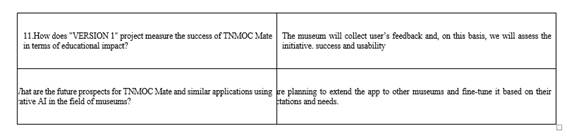
4.2 Findings
The qualitative analysis conducted from the interview with Filippo Sassi, project manager of the TNMOC Mate application, highlights the transformative impact of generative artificial intelligence on the museum experience. The case of the National Museum of Computing illustrates a significant evolution towards more inclusive, accessible, and personalized cultural mediation. The TNMOC Mate application, developed in partnership with the technology company Version 1, integrates four complementary artificial intelligences (GPT-4, Midjourney, Azure Speech Service, and D-ID), enabling the dynamic generation of textual, visual, audio, and video content. Our results interpretation shows that this technological solution meets concrete needs for audience diversification and it ultimately facilitates access to information for neurodivergent individuals, visitors who do not speak English, and those with varied cognitive or sensory preferences. Thanks to an adaptive system, the application adjusts the complexity and forms of the content according to each user's profile. It also offers automatic content translation, making the museum experience more inclusive on an international scale.
From an organizational standpoint, the project's development met some challenges related to resource mobilization, skills management, and budget limitation. However, these setbacks were overcome through an agile approach and a strategic distribution of responsibilities among the project stakeholders. The interview also identified several major issues: on one hand, the integration of AI as a channel for disseminating heritage knowledge, and on the other hand, the reflections to look forward for more equitable access to culture through innovative technological means. This convergence between digital humanities and immersive museology opens new perspectives for the entire museum sector. It demonstrates that a thoughtful and contextualized use of artificial intelligence can not only enrich visitors' experiences but also strengthen the fundamental missions of cultural transmission, mediation, and democratization.
5. Concluding Remarks and Research Perspectives
This case study shows that TNMOC Mate is much more than just a technological tool: it is a strategic lever for rethinking contemporary museography in light of the capabilities of artificial intelligence. By combining immersive technologies and community engagement, this tool fully illustrates the central role that immersive museums can play in digital culture and digital humanities through the lens of information sciences and knowledge organization. Far from being isolated cases, these museums offer relevant models for the preservation, accessibility, and transmission of heritage, not only material but also memorial and symbolic. The model tested here could thus serve as a basis for other heritage institutions looking forward to adopt a more interactive, immersive, and universally accessible mediation. Initiatives like Venice Revealed or Eternal Notre-Dame also demonstrate the power of these tools to reconstruct lost places, raise awareness of their history, and offer rich, sensitive, and inclusive experiences. These museums then become true living archives, guardians of a shared collective memory beyond expert circles. Finally, they contribute to the reconvergence of LAMs (Libraries, Archives, Museums), as major spaces for the production and dissemination of knowledge, made even more powerful by recent advances in digital technologies. This underscores the importance of strengthening interdisciplinary research to better integrate these institutions into the digital humanities ecosystem.
In line with the findings of our case study on the TNMOC Mate, it is essential to emphasize that the digital transformation of immersive museums is not merely a technological adaptation. It deeply involves issues related to Knowledge Organization (KO) as a fundamental mechanism for structuring, making accessible, and sustaining cultural information within LAM (Libraries, Archives, Museums). The analysis of interviews showed that the technologies used-smartphones, tablets, generative AI (GPT-4 for texts, Midjourney for images, Azure Speech Service for voices, D-ID for videos)-play a role not only in disseminating information but also in digital preservation. The content, tailored to visitor profiles, translated, and contextualized, serves as examples of organized knowledge processing, aiming to preserve not only cultural artifacts but also their interpretation and mediation over time. This phenomenon is fully in line with the dynamics identified by scientific literature: the emergence of the Internet has transformed society into a digital age, disrupting the cultural heritage sector and giving rise to new possibilities for integrated access to museum and archive collections (Cimadomo et al., 2013). By relying on online databases and the rise of web servers, cultural heritage institutions have expanded their audience and democratized access to knowledge (Stainforth, 2016). Today, digitization is an essential component of cultural heritage, driven by open-source communities and technical advances. As our case study shows, the TNMOC Mate application embodies this evolution by integrating immersive technologies to stimulate learning, encourage the construction of personal narratives, and transform the visitor into an active participant in their own museum experience (Warwick et al., 2012). Museum objects, enriched by interactive digital devices, become as such dynamic sources of innovation and personal development, precisely as analyzed in the literature: the construction of individual narratives, made possible by digital interaction, renews the mission of museums, traditionally focused on the top-down knowledge transfer (Baujard, 2019). This shift reflects a strategic reorientation of museums in the digital age, where Knowledge Organization ensures essential mediation between heritage content, access technologies, and the expectations of new audiences. Consequently, the link between KO and digital preservation emerges as a fundamental lever to ensure not only accessibility but also the sustainability of cultural heritage in LAMs. Immersive systems, while reinventing the museum experience, rely on sophisticated organizational processes to index, contextualize, and disseminate cultural content in response to the challenges posed by massive digitization and the explosion of digital uses. This articulation is therefore essential to understand the role of immersive museums as convergence points between memory, technological innovation, and cultural mediation.

