



 Inglés (pdf)
 Articulo en XML
 Referencias del artículo
 Curriculum ScienTI
 Traducción automática
 Permalink

Introduction
In a constantly-evolving profession such as English language teaching, it is essential for teachers and leaders to engage in professional development and learning activities that enable them to develop their understanding of theoretical pedagogical frameworks and practical teaching methods. Despite the many activities that teachers engage in on a daily basis, in-service teachers need to continue learning and to develop personally and professionally as well as to become life-long learners. Effective professional development requires thoughtful planning that combines current research with consideration for local contexts, addressing the specific needs of teachers (Cirocki et al., 2023). Research shows that the more professional development and learning that teachers engage in, the more likely their students are to succeed and the more likely they are to be effective and fulfilled in their careers (Cirocki et al., 2023; Christison & Murray, 2022).
Professional development and professional learning are often used interchangeably, and both terms refer to any activity that teachers take part in as a component of their continuous training. Professional development, as a continuous professional development (CPD) process is differentiated from professional learning in that CPD covers all activities that contribute to changing the attitudes and behaviors of language teachers, while professional learning is the output or result of these activities (Christison & Murray, 2022). CPD, then, should be “an interactive process that takes place among engaged professionals” (Christison & Murray, 2022, p. 210) over a sustained period of time. In this article, I employ the combined term professional development and learning (PDL) as a process that is continuous and that is best considered as taking place over the span of a teacher’s entire career. The essence of many PDL activities is an expansion of teachers’ knowledge and pedagogical skills with opportunities to try out new ideas, implement them in practice, and reflect on how well they work.
This article describes two instances of PDL carried out in collaboration with school districts from two different U.S. states. Both experiences focus on supporting the implementation of a functional approach to language development as school districts around the U.S. are applying this approach as part of the WIDA 2020 English Language Development Standards (henceforth, WIDA Standards or the Standards Framework; WIDA, 2020) implementation. The PDL activities described in this article drew on five key principles, described next.
Principles for Professional Development and Learning
Effective PDL activities draw on five guiding principles (Coombe, de Oliveira, & Rafi, 2025). These principles were used to guide the development of PDL activities with school districts and our continuing collaboration.
Principle 1: Significant and ongoing PDL builds on a foundation of knowledge and skills
PDL is rooted in what language teachers already know and are able to do, providing opportunities for language teachers to make connections between new information and activities with their existing knowledge and skills. Therefore, it is crucial that teachers’ experiences, needs, and backgrounds are considered when planning and implementing PDL. PDL should not consist of one-time workshops or webinars that are not meaningful to teachers’ real-world practices. In other words, PDL should be needs-based, informed by developments in the field, and grounded in teachers’ ongoing professional growth.
Principle 2: PDL should provide concrete examples through active participation
PDL should provide teachers with a range of meaningful learning opportunities as members of professional learning communities. Learning with and from colleagues involves active collaboration with other teachers to gain knowledge and skills and to learn new practices. Modeling is another effective strategy in PDL, as it allows teachers to observe specific practices being demonstrated and then apply them in their own classrooms. Connected to the first principle, the opportunity to rehearse and follow up on what has been learned is important, underscoring the role of follow-up activities.
Principle 3: PDL includes continuing support during implementation and reflection
PDL also should incorporate follow-up assistance as language teachers implement and reflect on specific classroom techniques. Other active learning opportunities include cooperative decision-making, collegial support groups in which peers work together, and mutual concern for teaching issues, among others.
Principle 4: PDL is based on a research base, aligned with standards and curricula
Research should underpin PDL activities. When based on research, PDL promotes specific practices that have been shown to be effective for particular groups of students. It is important to map PDL to standards and curricula, so that language teachers can understand how the PDL content can be used to address standards as they work with the curricula in use.
Principle 5: PDL should be offered through a variety of formats
PDL opportunities should take many forms and not be limited to the more formal PDL opportunities. These can include, but are not limited to: attending conferences, participating in classroom observations, engaging in individual reading or book clubs, working on standards development, curriculum and assessment projects, and participating in peer inquiry groups, among others.
The use of these principles guided our collaborative teamwork approaches to plan and deliver the PDL activities with school districts. While many PDL models may reflect a deficit-driven approach, our planning and careful consideration of teachers’ existing knowledge as a valued component helped sustain our collaboration and the development of continued, ongoing opportunities. Next, I provide the context for each school district.
Context for PDL Activities
Adams 12 Five-Star Schools in Colorado
My collaboration with the Adams 12 school district began in Spring 2023 when they approached me about working with English Language Development (ELD) leaders as they began developing a curriculum that integrates a functional approach for a designated ELD context. A designated ELD context refers to a set time during the school day when students classified as Non-English Proficient (NEP) or Limited English Proficient (LEP) receive targeted instruction to develop their English language skills. Adams 12 is a relatively small school district, with a total of 35,000 students. About 5,000 students are classified as NEP or LEP-also commonly referred to as English learners (ELs). These language proficiency designations apply to students who do not speak English as their primary language and therefore qualify for specialized language instruction. These students require additional support to develop their ability to read, write, speak, and understand English, and to participate fully in class. About 17% of the student population in the district is classified as NEP or LEP. A total of 6,200 students are multilingual learners-this includes students who have exited the LEP designation. There are 101 languages spoken in the school district, making it extremely diverse in terms of linguistic background.
The ELD team was composed of five ELD coordinators and the Director of the Culturally and Linguistically Diverse Education team. They engaged in developing units of study incorporating a functional approach and shared them with me for feedback. We met several times during the semester to discuss my feedback, and they made further revisions. In September 2024, I conducted an eight-hour PDL session on-site with over 100 ELD teachers from the school district. This was followed by additional work on the curriculum developed by ELD leaders and my continued feedback throughout the year. In October 2024, we gave two joint presentations at the WIDA 2024 Annual Conference, in which we shared sample units and discussed the progress of implementation. The units are being refined now and we will be presenting at the WIDA 2025 annual conference sharing results of curriculum implementation in the school districts and further refinements based on implementation by teachers. We are also working on disseminating the results through book chapters (see de Oliveira et al., in press; de Oliveira et al., in preparation) and articles.
Montgomery County Public Schools in Maryland
My collaboration with Montgomery County Public Schools (MCPS) began in Fall 2023. The ML Director attended a presentation I gave at the WIDA 2023 Annual Conference and contacted me shortly after to plan our collaboration. MCPS is the largest school district in Maryland, with 159,671 students attending. With over 32,000 students classified as ELs, MCPS has the second-largest ML/EL population in the state.
This collaboration has consisted of two two-day PDL sessions and ongoing planning as the district implements a functional approach in schools. The first session, conducted in April 2024, was offered to ELD and content central office members. The second two-day session took place in May 2024 and included summer facilitators such as ELD teachers, staff, and content teachers. They focused on developing their knowledge base to plan summer sessions for the entire school district, which led to local planning and facilitation of summer professional learning for all 6-12 instructional leadership teams. All instructional leadership teams from 40 middle schools and 25 high schools were invited to attend. A total of 1,346 leaders attended the PDL sessions facilitated by the ELD team in June and July. We shared some of the outcomes of the PDL sessions and ongoing classroom work at the Maryland TESOL Annual Conference in November 2024.
All PDL sessions for both districts focused on a functional approach in the context of the WIDA (2020) Standards. Next, I contextualize the work on this approach and its importance in the context of WIDA (2020).
A Functional Approach to Language Development in the WIDA 2020 ELD Standards Framework
All PDL sessions and activities with both school districts focused on developing ELD leaders and teachers’ knowledge of a functional approach to language development, guided by the five principles. To build on Principle 1, we used a foundation grounded in systemic functional linguistics (SFL) (Halliday & Matthiessen, 2014), focusing on ways of engaging students in exploring meaning in texts through classroom discussions and explicit attention to language. SFL is a social semiotic theory that views language as a resource for meaning-making in context to achieve social purposes (de Oliveira & Westerlund, 2021; de Oliveira & Schleppegrell, 2015; Schleppegrell, 2024). We use language for various purposes connected to situations, which realize systematic patterns of choices. This approach provides a metalanguage (Moore & Schleppegrell, 2014) for talking about the meanings in the choices authors make. A functional approach enables teachers to identify language patterns in order to help multilingual learners see how language works. Teachers and students explore authentic texts in their original form, without simplification. We drew on teachers’ experiences, needs, and backgrounds to plan and deliver PDL activities as more than single workshops.
To implement Principle 2, we planned for active participation and engagement as a community of learners. ELD leaders and teachers engaged with one another and participated actively in understanding and learning about practices for a functional approach. Principle 3 involved ongoing support during implementation and reflection on the PDL. With the publication of the WIDA Standards, the importance of adopting a functional approach has become even more evident. WIDA 2020 presents four Big Ideas that outline the essential components for creating culturally and linguistically sustaining learning environments where MLs can thrive and succeed. The new edition reaffirms a renewed commitment to equity for MLs through harnessing their linguistic and cultural strengths, integrating content and language in collaborative contexts, and making language visible through a practical, functional lens. The core principle, "A Functional Approach to Language Development," underscores that language is not only a means of communication but also a resource for establishing roles and relationships and for engaging with the world.
WIDA (2020) was grounded in a strong research base and aligned with the new standards, illustrating principle 4 as a key component of our collaboration with the school districts. Principle 5 was at the core of all PDL activities, as we engaged with school districts in specific sessions, participated and co-presented at conferences, participated in curriculum development alongside leaders. The following section highlights key ideas related to the functional approach that emerged from our collaboration.
An Explicit Pedagogy at the Core of Learning
Our goal is to involve MLs in examining how language is utilized and how meanings are conveyed in texts (de Oliveira et al., 2021; Harman, 2018). This approach offers educators a clear instructional strategy that places language at the center of the learning process. Viewing language development in this way involves understanding how the new language can be used to construct meaning for specific purposes across diverse contexts.
A functional approach promotes the development of academic language used for educational purposes by recognizing that it exists on the same continuum and arises from the same repertoire as everyday language used for communication in daily life (de Oliveira & Westerlund, 2021). By focusing on whole texts, a functional approach addresses academic language as more than just vocabulary. We advocate against pre-teaching vocabulary outside of texts and disconnected from the contexts in which the words occur (see Molle, de Oliveira, MacDonald, & Bhasin, 2021, for a full discussion on leveraging incidental and intentional vocabulary learning to support multilingual students’ disciplinary participation).
One of the key notions in a functional approach is genre, understood as culturally expected patterns of texts (Brisk, 2022; de Oliveira, 2023a; Gebhard, 2019) that reflect a recurring configuration of meanings and are described as staged, goal-oriented social processes. While genre reflects the broader cultural context, register refers to the immediate situational context. Register includes field, tenor, and mode. Field relates to the topic and content of the text. Tenor involves the roles and relationships among the people engaged in the text. Mode describes how the message is delivered, such as via email, spoken word, presentation, blog, or other communication channels. These three dimensions of register are always present in each instance of language use and help shape the overall message.
WIDA Key Language Uses
Within the WIDA Standards, functional language is depicted at the level of genre families through the Key Language Uses, and at the level of register through language functions and features that illustrate the Language Expectations. The Key Language Uses (see Figure 1) embody the core concept of the Big Idea: Functional Approach to Language Development.
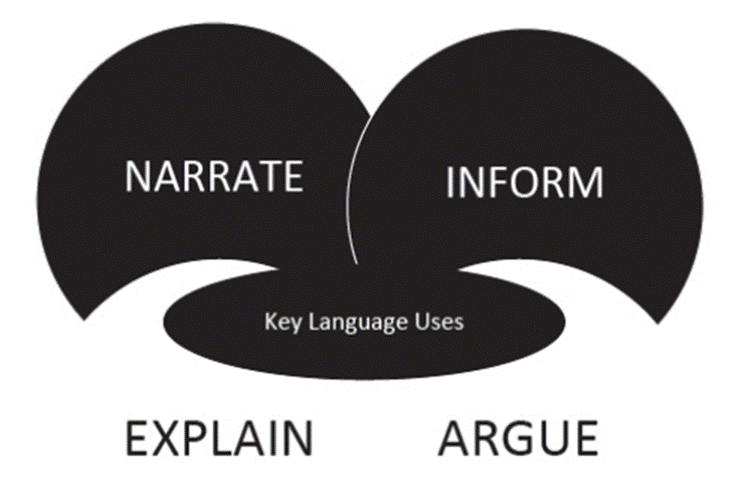
Key Language Uses share some common features across different disciplines, but each discipline also has distinct ways of applying them. Below are brief definitions for each Key Language Use:
- Narrate emphasizes language that is used to communicate real or imaginary experiences through stories and histories. Narratives serve various purposes, such as instructing, entertaining, teaching, or supporting argumentation.
- Inform focuses on language used to present factual information. When students convey information, they define, describe, compare, contrast, organize, categorize, or classify concepts, ideas, or phenomena.
- Explain highlights language used to account for how things work or why things happen. In explaining, students justify the inner mechanisms of natural, technological, or social phenomena.
- Argue emphasizes language used to justify claims with evidence and reasoning. Argumentation can be used to support or defend an idea, change perspectives, prompt action, or evaluate and accept a position on an issue.
The Teaching-Learning Cycle
The TLC is an approach to teaching that provides MLs with explicit knowledge about language in the service of a functional approach to writing. It responds to the principle of “guidance through interaction in the context of shared experience” (Martin & Rose, 2005, p. 253). That is, teachers guide students in speaking, reading, and writing about a particular text in the context of a shared activity (e.g., shared text, field trip, movie, science experiment, or reading) rather than about a particular experience that is individual to students. Shared experience is a fundamental principle for MLs.
The TLC includes activities to guide students through building shared knowledge of the topic, sustained reading, deconstruction, joint construction, collaborative construction, and independent construction (de Oliveira, 2023b). Students can enter the TLC at any point, and teachers may begin at any phase of the process; however, the first phase involves establishing shared knowledge of a new genre. If teachers follow these phases, students are then ready to write in the targeted genres. The assignment of a topic or prompt and request for a written response does not teach writing. It assesses students’ writing capabilities, but this does not constitute teaching. This process may be recursive and revisited as students become more familiar with particular genres.
Context is set at each stage to help students understand the situation for writing in a particular genre and context. Building shared knowledge of the topic is a pivotal phase because students expand their understanding of the content and context of texts. Students also gain a critical perspective on language through learning about language features and genre conventions, and teachers assess students’ understanding throughout all activity phases. The TLC provides students with teacher interaction, guidance, and support during the deconstruction phase. Brisk (2022) and de Oliveira (2017) introduced an optional collaborative construction phase based on their recent research with K-5 students, as shown in Figure 2 next to the independent construction phase. Collaborative construction can be an additional step within the TLC, as described in de Oliveira et al. (2020).
The TLC responds to conceptualizations that writing is a process through which drafting, free writing, and developing a writer identity are emphasized and all that it takes to be a successful writer, major components of Lucy Calkins’ writer’s workshop, a popular writing approach in the United States (Westerlund & Besser, 2021). The TLC, in contrast, develops students’ knowledge of how language works to make meaning in genres and through language resources.
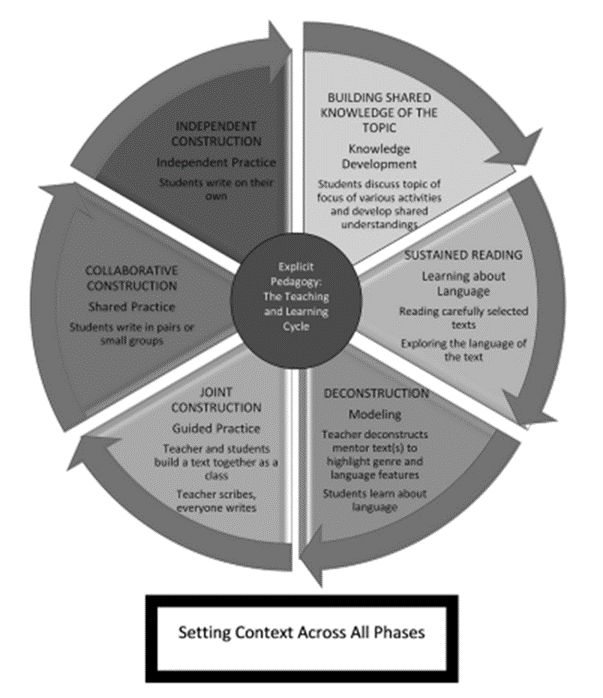
The TLC is highly effective for extended units of study but can also be applied to a shorter series of lessons over one or two weeks. The instructional practices used within each phase are flexible and can be adapted to fit your classroom. The focus of each phase is the whole text rather than single sentences or vocabulary lists so that teachers can scaffold students’ knowledge and understanding of school genres across subjects.
Building Shared Knowledge of the Topic involves having students discuss the focus of the upcoming activities, share what they know about the topic, and build shared understandings. Having this shared knowledge ensures that all students can contribute to content discussions.
Sustained Reading involves carefully reading selected texts to build knowledge of the topic and enrich MLs’ experiences. Teachers can use a range of reading strategies during this phase such as reading aloud, modeled reading, shared reading, guided reading, collaborative reading, and independent reading. During this phase, students analyze excerpts or short texts containing important content related to state standards, discuss how the authors used language to accomplish their purpose, and then analyze elements of the text to understand what to look for.
Following the reading, the teacher guides students in analyzing elements of the text to help them see what was important to the author.
During Deconstruction, the teacher provides a mentor text related to the specific genre, such as procedural recounts, descriptive reports, or discussions. The teacher leads students in analyzing the mentor text through demonstration and discussion of the purpose, stages, and typical language features while building students’ content knowledge and setting the context. These mentor texts are projected for the whole class and distributed to each student. During this phase, students develop a shared metalanguage for discussing texts (terms related to genre purpose, stages, and language features).
Joint Construction is where the teacher and students co-write a text in the same genre. The teacher and students co-construct texts similar to the mentor texts using the language features and structure studied. The teacher models while writing and guides students in choosing words, phrases, and sentences. This activity helps students see what it takes to write a good text in that genre, and the teacher facilitates and encourages contributions from all students. Through joint construction, students learn about the decisions involved in writing and in how to use language deliberately.
Collaborative Construction may serve as a transitional phase between joint and independent writing. It is particularly useful for students in grades K-2 who are beginning writers and need additional support in tackling challenging genres. During this phase, students work in pairs or small groups to brainstorm, draft, revise, and finalize a shared text-led by the teacher, as outlined in Jones and de Oliveira (2022).
Independent Construction is the final phase, where students write their own texts in a specific genre. The teacher takes a step back and provides minimal support to encourage independent writing. If students are writing on a new topic in the same genre, they may need to do additional research before writing. This phase helps students apply and practice their genre knowledge and writing skills independently.
Conclusion
With the inclusion of a functional approach in the WIDA (2020) Standards Framework, renewed attention to language development from a functional perspective has brought the need to provide school districts with additional information about this approach, and how it supports MLs in continuing to develop their language skills. Planning PDL activities alongside leaders and teachers has been an important step toward a successful model of sustained collaboration. While our collaboration is still ongoing, this article has shown some of the ways the PDL principles were used to design activities.
This article described two collaborative experiences with school districts in Colorado and Maryland. While the districts differ in overall student population and in the number of MLs specifically, both experiences provided support for implementing a functional approach to language development aligned with WIDA 2020. Both school districts’ commitment to supporting MLs and their teachers has been evident from the beginning of our collaboration, and it continues to guide our shared work toward sustaining a clear focus on continued learning and development.
Teachers are independent, lifelong learners who benefit from PDL activities that refine their skills and offer strategies to apply the knowledge they develop. Working with teachers to apprentice them into the TLC through PDL activities is essential so they can support their MLs in deconstructing texts and drawing on mentor texts when learning new genres. MLs will then be able to independently go through these steps as they encounter different types of texts throughout their lives. With scaffolding from teachers through the TLC during the course of K-12 education, MLs should be able to employ a wide range of genres for a variety of social purposes (Derewianka & Jones, 2016). As writing has become crucial to nearly every area of life-academic, social, or professional (National Commission on Writing, 2017)-it is imperative that we prepare teachers to critically address writing instruction in their classrooms. Genre-based pedagogy is a successful and flexible approach to writing instruction that teachers can adapt and implement to prepare K-12 students for their future academic and career paths

