




 Inglés (pdf)
 Articulo en XML
 Referencias del artículo
 Traducción automática
 Permalink

Creativity as a developable skill has been a focus of studies since the 1950s (Guilford, 1950; Torrance, 1974). This perspective has gained renewed importance recently, particularly in light of global challenges such as the COVID-19 pandemic. During this period, many organizational solutions emphasized the importance of creativity as a strategic skill (Kuckertz et al., 2020; Ratten, 2020) and discussed whether employees are more creative in social environments such as the office or at home (Form, 2024; Rücker, Pakos, Windschiegl y Voigt, 2024); or the role of digital creativity in future jobs (Bullini Orlandi, Pocek, Kraus, Zardini y Rossignoli, 2024). Moreover, the pandemic’s social isolation led to various introspection processes, highlighting creativity, emotional intelligence, and self-awareness as potential allies in challenging situations (Karwowski et al., 2021; Sharma y Tiwari, 2024). Recent studies have also examined the relationship between organizational culture and creativity (Chua, Zhao y Han, 2024). Islam y Assad (2024) examined the role of knowledge-sharing and creative self-efficacy in the relationship between entrepreneurial leadership and employee creativity. These studies highlight the growing recognition of creativity's importance in organizational settings.
Despite research having touched upon related concepts in organizational contexts, the design of psychological tools to assess and develop creativity and self-awareness in organizational contexts is increasingly necessary (Brás, Daniel y Fernandes, 2024). Hence, this paper contributes to this need by exploring the relationship between creativity and the self, potentially informing the development of such tools.
Creativity and self-awareness are distinguishing features of human cognition and are crucial in resolving complex problems (Kaufman y Gregoire, 2015). The interplay between these two concepts has been indirectly studied in various contexts, but direct investigations of their relationship are scarce. This study aims to address this gap by exploring possible relationships between creativity and self-awareness from the perspective of management students since Brás et al. (2024) already found that creativity mediates the relationship between risk-taking, proactivity, and entrepreneurial intention among higher education students.
Over the years, scientific research on creativity has intensified as its importance has become increasingly recognized. In contrast, research on self-awareness has followed a different trajectory. A search conducted on October 9, 2023, in the Scopus database for "creativity" in article titles, abstracts, or keywords yielded 91,110 published articles. When the term "self-awareness" was added to this search, it returned only 244 articles. A similar analysis on Scielo using "Creativity" search yielded 1,655 articles, while "self-awareness" returned only 2 articles. To explore the intersection of these concepts with management, we searched in Scopus database using the terms related to management, creativity, and self-knowledge. After several iterations, the final search string utilized the open terms such as ‘manag*’ ‘creativ*’ and ‘self-’ returning 1,521 results. The final search string is the following: TITLE-ABS-KEY ( manag* AND creativ* AND self-* ) AND ( LIMIT-TO ( DOCTYPE , "ar" ) ) AND ( EXCLUDE ( EXACTKEYWORD , "Human" ) OR EXCLUDE ( EXACTKEYWORD , "Article" ) OR EXCLUDE ( EXACTKEYWORD , "Humans" ) OR EXCLUDE ( EXACTKEYWORD , "Female" ) OR EXCLUDE ( EXACTKEYWORD , "Male" ) OR EXCLUDE ( EXACTKEYWORD , "Adult" ) OR EXCLUDE ( EXACTKEYWORD , "Middle Aged" ) OR EXCLUDE ( EXACTKEYWORD , "Human Experiment" ) ) AND ( LIMIT-TO ( SRCTYPE , "j" ) OR LIMIT-TO ( SRCTYPE , "d" ) ) AND ( EXCLUDE ( SUBJAREA , "MEDI" ) OR EXCLUDE ( SUBJAREA , "HEAL" ) OR EXCLUDE ( SUBJAREA , "AGRI" ) OR EXCLUDE ( SUBJAREA , "BIOC" ) OR EXCLUDE ( SUBJAREA , "IMMU" ) OR EXCLUDE ( SUBJAREA , "PHAR" ) OR EXCLUDE ( SUBJAREA , "PHYS" ) OR EXCLUDE ( SUBJAREA , "CENG" ) OR EXCLUDE ( SUBJAREA , "CHEM" ) OR EXCLUDE ( SUBJAREA , "NURS" ) ).
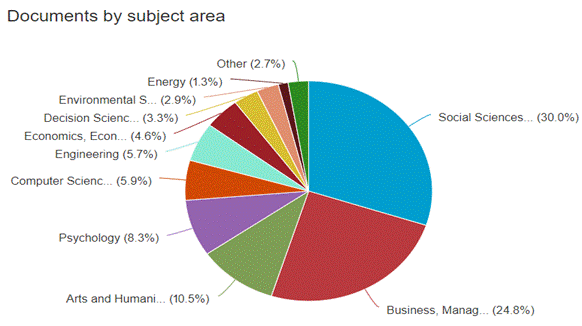
Social Science and Management fields contribute significantly to the development of knowledge surrounding the concepts of self-knowledge or self-awareness in conjunction with management and creativity (Figure 1). Figure 2 presents a scientific landscape generated using VOSviewer software, illustrating the network formed by the analysis of the 1,521 papers identified. This visualization displays the co-occurrence of 51 terms appearing 11 times across the papers. To focus on conceptual rather than methodological aspects, we excluded words describing specific sample groups (e.g., age, gender, nationality) or research methods (e.g., qualitative, case study) from the analysis, aiming to produce a more conceptually rich result. The yellow clusters in the landscape represent more recent approaches to investigating creativity, connected to concepts such as self-efficacy, creative self-efficacy, resilience, and self-determination. The presence and interconnection of these keywords suggest a relationship between creativity and self-knowledge, the nature of which warrants further exploration and understanding.
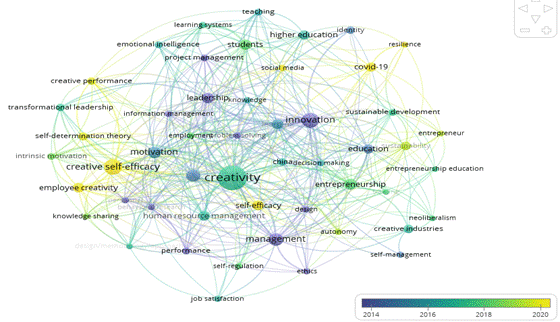
Figure 2: Key Word network done by VosViewer software according to timelapse. Note. Source Scopus Database.
Viewing the landscape as a clustered network, we observe distinct groupings formed around frequently repeated terms (Figure 3). These clusters are color-coded and include:
1. Creativity (red cluster, 5 items)
2. Students (green cluster, 13 items)
3. Education (blue cluster, 10 items)
4. Management (mustard cluster, 9 items)
5. Innovation (violet cluster, 4 items)
This clustering reveals the primary themes and their interconnections within the literature on creativity, self-awareness, and management. The size of each cluster indicates the relative prominence of these themes in the analyzed body of research.
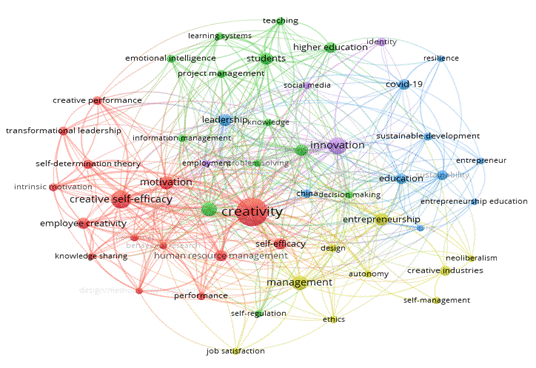
Figure 3: Key Word network done by VosViewer software according to the cluster. Note. Source Scopus Database.
Seeking to understand the relationship between creativity and self-knowledge and how they can impact management, some recent investigations have touched on this matter. As mentioned, Brás et al. (2024) have investigated personal traits on entrepreneurial intention amongst higher education students, finding out that creativity mediates the relationship between risk-taking and proactivity, and both of them added to self-efficacy to predict entrepreneurial intention. Their findings have implications for entrepreneurial education. Further on the concept of leadership, Islam and Assad (2024) examined knowledge sharing as an explanatory variable between entrepreneurial leadership and employee creativity, which ends the moderating role of creative self-efficacy. It was found that entrepreneurial leaders positively affect creativity through knowledge sharing recommending that hiring individuals with creative self-efficacy further encourage creativity. Zheng and Ahmed (2024) revealed the moderating role of humble leadership and the mediating role of boundary-spanning behavior on employee creative performance. Wang, Guan y Cai (2024) studied the mediating role of reflection and ruminating and the moderating role of psychological capital, showing that authentic leadership positively influences reflection but negatively influences rumination - both of them impacting employees´ green creativity.
So far, recent studies are emphasizing that creativity is important for organizations, and much of the psychological theories such as Social Exchange Theories (Islam y Assad, 2004; Zheng y Ahmed, 2024) and Psychological Capital (Wang et al., 2004). Therefore, the design of psychological tools is needed (Brás et al., 2024). This paper adds the importance of designing pedagogical tools to teach creativity and explore the nature of its relation to the self. In this direction, scientists indirectly study tangent topics about self-awareness and creativity. Sacchetti (2023) studied economic coordination, focusing on creativity due to the connections that were identified with people’s well-being. The author explains that coordinated activities based only on hierarchies and command-and-control can “potentially limit the creativity and the well-being of individuals”. Directly associating creativity and well-being is a relationship that could be noticed with self-awareness and its improvement. Pinkow (2022) affirms that thinking creatively requires different kinds of knowledge. The focus is on the cognitive process occurring during creative thinking and the multidisciplinary nature of creativity, bringing complexity to the studies of creativity.
Ollila (2000) studied reflection in leadership, a cognitive process where leaders think about their own behavior and how it affects others’ behaviors. Ollila (2000) affirms that the reflection could be an explanatory variable and, depending on each leader, can interfere with creativity and innovativeness on projects. An example of how learning and self-awareness are correlated processes, and both interfere on organization.
None of those studies uses terms as “self-awareness”, “self-knowledge” neither “self-disclosure”, but “self-actualization”, term described by Maslow. The self-actualization person can be deeply associated with a person with high levels of self-awareness. Maslow (1961, 1977 cited by Wicklund y Eckert, 1992) describes a person with self-actualization as autonomous, unstoppable, feels like your own chef, highly motivated, the same characteristics used to describe the self-knower, a person with well-developed self-awareness.
This study explored possible relationships between self-awareness and creativity. It employs a novel approach by using OpenAI's ChatGPT, a large language model based on the GPT-3.5 turbo architecture, to analyze qualitative data alongside human interpretation. This dual analysis method provides a unique perspective on the relationship between creativity and self-awareness, contributing to the ongoing discussion about AI's role in qualitative research (Guzik, Byrge y Gilde, 2023; Runco, 2023). Recent studies have explored the use of AI in qualitative analysis. Li et al. (2024) compared the performance of GPT-4 with human researchers in analyzing healthcare data, finding moderate agreement between AI and human analyses. Bijker, Merkouris, Dowling y Rodda (2024) investigated the utility of ChatGPT in conducting qualitative content analysis, finding that ChatGPT performed better in developing an inductive coding scheme than in adapting an existing framework. Hitch (2024) explored the use of ChatGPT to augment reflexive thematic analysis, arguing that AI can augment, but not replace, the work of human researchers in producing rigorous reflexive thematic analysis.
The study shows some relationship between self-awareness and creativity. Moreover, it contributes with a validation protocol of GPT 3.5 turbo to analyzes primary qualitative data. Both analyses have similarities, indicating that AI can help to demonstrate the relationships between self-awareness and creativity.
The relevance of this research lies in its potential to inform organizational strategies for developing creativity as intellectual capital. Organizations may be better equipped to foster innovative thinking and problem-solving among their employees by understanding the relationship between self-awareness and creativity. Moreover, the present study touches on discussions about artificial intelligence products. Runco (2023) used artificial intelligence in creative studies to understand if artificial products could be considered creative or not. Runco (2023) affirms that AI creativity is a pseudo-creativity, an artificial creativity. Guzik et al. (2023) investigated the creative abilities of Chat-GPT based on the GPT-4 architecture. Guzik et al. (2023) applied the Torrance Test, GPT-4 demonstrated high flexibility, originality, and fluency on GPT-4.
The main data of this study was collected through a semi-structured questionnaire about creativity and self-awareness, applied seven times for undergraduate students of a business course at a public university in Brazil. The object under analysis was the open written answer to the question “Is there any relationship between creativity and self-awareness? If yes, what kind of relationship and how?”.
The present research innovation consists of analyzing creativity and self-awareness together and applying artificial intelligence for content analysis. The relevance of this research is associated with the organization’s needs to develop creativity as an intellectual capital. The premises are that promoting self-awareness processes could facilitate creative processes, as much as developing creativity could promote self-awareness processes that enhance management. Together creativity and self-awareness might improve organizational innovation.
Creativity and Self-awareness
The creativity concept is often associated with developing something new that is ideal for the moment. The prevailing notion is that creativity is an all-or-nothing issue. However, creativity can also be viewed as a matter of degree, with some individuals being more creative than others (Alencar, 1993). Creativity is inherent to humans (Alencar y Galvão, 2007). Its realization is one of its needs (Ostrower, 2014). We all possess certain creative abilities that can be developed and refined (Alencar, 1993). Human creative behaviors are based on sensory, conscious, and cultural integration, with internal and external influences shaping their actions (Ostrower, 2014).
As Pinkow (2022) asserts creativity requires different kinds of knowledge. Herrmann (1990 cited by Alencar, 1993, p.55) proposed that creativity combines many forms of thinking, enclosing both verbal and analytical, as well as intuitive and emotional aspects. Rogers (1959, 1962 cited by Alencar, 1993, pp. 50-51) regarded the source of creativity as the individual’s tendency to actualize his potentialities, to self-realize. Rogers believes that one of the fruits of individual uniqueness is the creative process, the essence of creativity.
Creativity is present in various fields of knowledge, not only in the arts (Ostrower, 2014, p.39). MacKinnon (1965, 1967, 1975 cited by Alencar, 1993, p. 19) studied architects who considered creative and highlighted characteristics of creative individuals such as a sense of responsibility, cognitive flexibility, intuition, spontaneity, independent thinking, and enthusiasm. According to Barron (1969 cited by Alencar, 1993, p. 20), creative individuals performed higher tolerance for disorder and complexity, rejection of suppression as a mechanism for impulse control, independent judgment, the presence of typically female interests in more creative male samples, and a higher degree of originality, spontaneity, and intuition. Guilford (1950, 1967, 1971, 1979 cited by Alencar, 1993, pp. 24-27) and Torrance (1965, 1974 cited by Alencar, 1993, pp. 24-27) emphasize characteristics of creative individuals such as elaboration, redefinition, sensitivity to problems, fluency, flexibility, and originality.
Promoting creativity process also involves influencing the social environment and the individuals within it (Alencar y Galvão, 2007). Ostrower (2014, p. 101) affirms that perception itself is not free from evaluative projections, so it is crucial to consider the environment. Some of these values are collective, arising from the historical context in which the individual lives through social interrelations. Thus, the individual is both a product of his environment and a shaper of it. “In acting, he interacts with the world. Eventually, he will act upon his own cultural context.” (Ostrower, 2014, pp. 103-104, translated by the author). Maslow (cited by Stephens, 2003, pp. 47-48) asserts that self-discovery process is fraught with challenges and that progressive development requires courage, will, permission, and encouragement from the environment to unfold.
There are many terms to express self-awareness. Words such as “self-knowledge”, “self-awareness”, “self-disclosure”, “self-knowingness”, “self-directedness”, “self-actualization” all refer to self-knowledge. Similarly, there are numerous ways to refer to an individual with well-developed self-awareness or in the process of developing their self-awareness, such as “perceiver”, “self-knower”, “self-righteous dynamic”, “self-orientation”, “finding the authentic self”, “evocation of inner wisdom”, “true self”, “authentic self”, “self-oriented”, among others. These terms can be found in the book “The Self-Knower: A Hero Under Control” written by Robert A. Wicklund and Martina Eckert in 1992. According to the International Encyclopedia of the Social Sciences “Self-awareness is the capacity to take oneself as the object of thought (…) self-awareness is needs for people to reduce disparities between their action and their ideals.” (Silvia, n.d., p. 397).
Tasha Eurich, an organizational psychologist, defines self-awareness in two dimensions: internal self-awareness and external self-awareness (Eurich, 2018). The external aspect involves a clear perception of oneself form an outside perspective, while the internal aspect pertains to self-perception. Between internal and external self-awareness, there is a tendency for one to overshadow the other; however, individuals with well-developed self-awareness actively focus on balancing this scale (Eurich, 2018).
The Self-Knower School asserts that external influences do not interfere with the process of self-discovery. Contrary to this notion, McGuire y McGuire (1981 cited by Wicklund y Eckert, 1992, p. 81) and McGuire y Padawer-Singer (1976 cited by Wicklund y Eckert, 1992, p. 82) demonstrated by empirical studies that personal identification or the lack thereof directly impacts behavior and self-image, even when not explicitly focusing on these aspects.
Self-awareness is a psychological variable that enables certain individuals to be highly attentive to specific personal characteristics and relevant behavioral traits (Wicklund y Eckert, 1992, pp. 04-05). Some behavioral traits associated with indicators of self-awareness include a sense of humor, autonomy, the presence of intensity in feelings, openness, freedom from facades, flexibility, occupational success, consistency, and readiness to acknowledge one’s shortcomings (Wicklund y Eckert, 1992, p. 76).
Rogers (1951 cited by Wicklund y Eckert, 1992, p. 23) asserted that fundamental respect and a permissive environment are essential for developing a sense of responsibility, self-directedness, and cultivating byproducts such as creativity. Through lived and appropriate experiences, we develop repertoires for any creation or formation (Ostrower, 2014). All relationships, attitudes, and formations have limitations; however, they are an inexhaustible source for creation, encouraging and guiding human action (Ostrower, 2014).
Ostrower (2014) indirectly associates creative expression with self-awareness by stating that self-understanding is achieved through questioning, redefinitions, and portrayed through creative expressions, reflecting individuals’ internal states and environmental aspects. As Ostrower (2014) puts it, “Creating is as difficult or as easy as living. And it is just as necessary.” (translated by the author, p. 166). It is crucial to recognize and challenge these spaces, discovering oneself, determining new boundaries, appreciating life, creation, and creativity.
Methodology
This research employs a qualitative, exploratory, and empirical approach with a cross-sectional design. The study aims to comprehend potential relationships between self-awareness and creativity by analyzing perceptions of Management students who took the course "Creativity and Innovation in Organizations" from the first semester of 2020 to the first semester of 2023 at a public university in Brazil.
Our methodological approach was informed by recent studies incorporating AI into the qualitative analysis. Li et al. (2024) used GPT-4 to perform qualitative content analysis on interview transcripts, comparing the results with human analysis. Bijker et al. (2024) explored the use of ChatGPT for qualitative content analysis, comparing inductive and deductive approaches. Hitch (2024) demonstrated the use of ChatGPT to augment reflexive thematic analysis, providing a worked example of its application.
The data was collected through a semi-structured questionnaire, administered seven times over three years. Each administration was preceded by a roundtable discussion on the research topic facilitated by the professor. In total, 224 responses were collected, with 200 responses selected for this study based on the inclusion of the key question: “Is there any relationship between creativity and self-awareness? If yes, what kind of relationship and how?”.
The questionnaire was developed based on a comprehensive literature review of creativity and self-awareness concepts. It underwent a pilot testing phase with a small group of students to ensure clarity and relevance of the questions. The instrument's reliability was assessed using Cronbach's alpha, yielding a coefficient of 0.82, indicating good internal consistency.
The analysis comprised two distinct approaches: a) Human Interpretation: The authors conducted a thematic analysis, developing categories of potential relationships between creativity and self-awareness. This process involved multiple rounds of coding and category refinement to ensure consistency and comprehensiveness. b) AI-Assisted Analysis: ChatGPT, an AI model developed by OpenAI, was used as an analytical tool. This approach involved the development of approximately 37 distinct prompts to mitigate potential AI ‘hallucinations’: six separate interactions with ChatGPT, each analyzing responses from one questionnaire administration, a total of 18 prompts across all interactions.
To address potential biases or 'hallucinations' in the AI's responses, the following strategies were implemented: providing clear context about the research and instructions for analysis in each prompt; separating the analysis by semester to reduce the likelihood of response conflation; requesting keyword identification for each category to enable cross-verification; conducting a manual review of AI-generated categories and recategorizing excluded responses. The combination of human interpretation and AI-assisted analysis allowed for a comprehensive examination of the data, leveraging both human expertise and the pattern recognition capabilities of AI.
Results
Human Interpretation
The human interpretation analysis resulted in 22 categories, of which 8 account for 91% of the responses. The categories with the highest frequencies are:
1. Creativity as a consequence of self-awareness (29,50%);
2. Creativity as a cause of self-awareness (24,50%);
3. Dialogical relationship between self-awareness and creativity (19%);
4. Unable to classify (9%);
5. Self-awareness as a differential for expressing creativity (3%);
6. Creativity as expression (2,50%);
7. Self-awareness in the perception of boundaries (2%);
8. Relationship of dependence between self-awareness and creativity (1,50%).
Some responses categorized under “creativity as a consequence of self-awareness” associate self-perception, self-presence, and understanding. Responses such as “When we know our potentials, we become more creative within our boundaries” and “Yes, when you know yourself well, you have the courage to step out of the box and think differently”. The category “creativity as a cause of self-awareness” was developed through responses such as “Creativity puts you in a place that demands self-awareness” and “Yes, through creative expression, you have access to your own exteriorized interior allowing for self-analysis based on what has been ‘created’”.
The dialogical relationship provides dynamism, as each of their components is part of the other, composing and recreating the whole with each interaction involving any of the agents in the relationship (Santos, y Almeida, 2020). Examples of responses classified as “Dialogical relationship between self-awareness and creativity” included “Yes. We become more creative when we explore our self-awareness, and we enhance our self-awareness when we explore our creativity” and “Yes, the creative process simultaneously requires self-awareness (before) and transforms self’ (during and after)”. The category “creativity as expression” emerged from responses such as “Yes, creativity is a form of self-awareness expression”; “Yes, I believe that through creativity, you express feelings that you didn’t even know existed with you”.
AI-Assisted Analysis
The AI-Assisted analysis was conducted using ChatGPT. In six separate interactions with ChatGPT, it analyzed and categorized 198 responses. It generated 159 distinct categories, with one category representing responses it could not classify, accounting for 8% of the sample. Among the categories developed by artificial intelligence and the two provided, 111 distinct keywords that represent them were selected.
Among the 159 categories developed by ChatGPT in analyzing the responses from the questionnaire applications, 15 categories represent 16 responses regarding possible relationships between self-awareness and creativity from the perspective of management students at the referred public university. Therefore, the 15 categories were consolidated into: “Creativity, Self-awareness, and Expression”. Below is this grouped category and the other categories with higher frequencies according to ChatGPT’s analysis, totaling 29.50% of the sample:
1. Creativity, Self-awareness, and Expression (8%);
2. Unable to classify (8%);
3. Synergy between creativity and self-awareness (6%);
4. Creative self-expression (5%);
5. Interaction between creativity and self-awareness (1,50%);
6. Self-reflection (1%).
The sample was clustered based on classifications established by ChatGPT and by identification of keywords. ChatGPT identified 111 keywords, each corresponding to one of the 159 categories it generated. Presented below (Table 1) are the seven macro-categories formed by clustering these keywords.
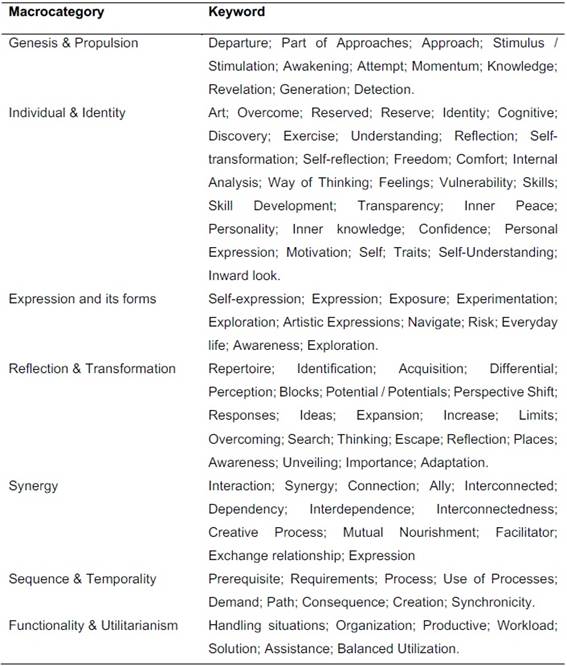
Comparison between both analysis
Despite being different approaches to data analysis, both avenues resulted in the creation of related categories. The following compares the macro-categories derived from the AI-Assisted analysis and the categories with higher frequencies identified in the human interpretation (Table 2).
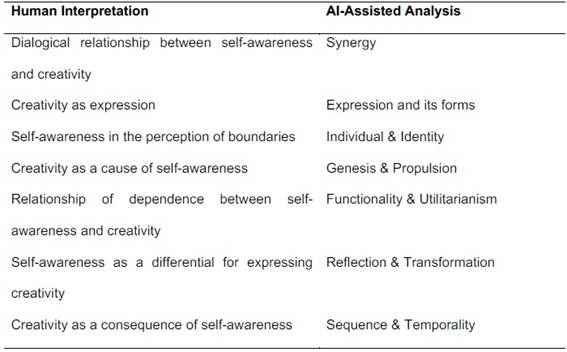
It is possible to identify correlations, such as in the case of the macro-category 'Synergy,' aggregated through keywords that examine the relationship between self-awareness and creativity from a more synergistic, interdependent perspective. It is associated with the category developed in the human interpretation analysis 'Dialogical relationship between self-awareness and creativity.' Both categories address this relationship as interdependent.
Another illustrative instance of interconnected categories is evident on “Creativity as expression” and “Expression and its forms”. Both categories closely tie this relationship to the act of expression, impacting and influencing creativity and self-awareness. Additionally, a correlation can be drawn between the categories “Self-awareness in the perception of boundaries” and “Individual and Identity”. Both delve into the repercussions of the relationship between creativity and self-awareness, echoing within the individual and shaping their identity and perception of personal boundaries. Moreover, connections can be drawn between the macro-category “Reflection y Transformation” and “Self-awareness as a differential for expressing creativity”. In the latter, creativity is seen as a reflection of self-awareness, implying that the more one understands oneself, the better the connection with creativity and one’s unique mode of expression.
The results show some similarities and differences with recent studies that have used AI for qualitative analysis. Li et al. (2024) found moderate agreement between GPT-4 and human researchers' analyses consistent with this studies observation of moderate to substantial agreement between ChatGPT and human analyses. Bijker et al. (2024) found that ChatGPT performed better in developing an inductive coding scheme than in adapting an existing framework, which is in line with our results showing better agreement for the inductive approach. Hitch (2024) argued that AI can augment, but not replace, the work of human researchers in reflexive thematic analysis, which is consistent with our observation that human interpretation is still necessary to capture nuances and context.
Discussion
The experience applying AI to reflexive thematic analysis identified several advantages and disadvantages for this approach. AI may identify patterns and themes in the data not immediately apparent to human researchers, leading to potentially novel insights. In the worked example, this prompted to reflect on the stance and assumptions, which prompted a return to the source material and further investigation. Reflexive thematic analysis is not a linear process (Braun y Clarke, 2021), and the choice to return to an earlier stage provided an additional opportunity to engage and develop insights.
This potential benefit of AI augmented reflexive thematic analysis should not be mistaken as a means to increase 'objectivity'. AI has been proposed to validate qualitative analysis, reflecting the detached perspectives of the neo-positivistic paradigm (Cresswell, 2014). Positivist approaches may adopt AI more readily due to this perceived alignment to their underlying values. However, in most qualitative research methodologies "there is no dichotomy between subjectivity and objectivity, there is only a dynamic in-between" (Van Wijngaarden, Meide y Dahlberg, 2017, p. 1741).
The results are consistent with those of Li et al. (2024), who found moderate agreement between GPT-4 and human researchers' analyses of healthcare data. Similarly, Bijker et al. (2024) found that ChatGPT performed better in developing an inductive coding scheme than in adapting an existing framework, consistent with our results showing better agreement for the inductive approach. These studies, along with ours, suggest that AI can be a valuable tool for augmenting qualitative analysis, but should not be seen as a replacement for human interpretation.
Hitch (2024) argued that AI can augment, but not replace, the work of human researchers in producing rigorous reflexive thematic analysis. Our experience supports this view. While ChatGPT was able to identify themes and patterns in the data, the interpretation of these themes and their contextualization within the broader research framework still required human insight.
An important consideration when using AI in qualitative analysis is the need for a critical and reflexive approach. As Hitch (2024) points out, researchers must maintain a critical stance toward AI outputs and assess each on their relative merits. In our analysis, we chose to incorporate some ChatGPT outputs into the analysis but discarded others that were assessed to be not relevant to the context of the data.
The use of AI in qualitative analysis also raises important ethical considerations. Researchers must ensure that all data uploaded to AI platforms is thoroughly de-identified to protect participant privacy. Additionally, the use of AI should be disclosed to participants as part of the informed consent process. These ethical considerations are particularly important given AI technologies' rapid development and increasing integration into research practices.
Our study demonstrates the potential of AI to enhance the efficiency of qualitative analysis, particularly in the initial stages of coding and theme identification. However, it also highlights the continued importance of human interpretation and reflexivity in the research process. The combination of AI-assisted analysis and human interpretation may offer a powerful approach to qualitative research, allowing researchers to leverage the strengths of both methods.
Conclusion
The present study aimed to outline potential relationships between self-awareness and creativity as presented by Management students at a public university in Brazil. This was achieved through the analysis of 200 responses obtained from the question, “Is there any relationship between creativity and self-awareness? If yes, what kind of relationship and how?”. The analysis was conducted through two distinct approaches by the authors and ChatGPT.
In the first analysis route, eight categories with the highest frequencies accounted for 91% of the sample, with one category representing responses that could not be categorized. Meanwhile, seven macro-categories were formed in the second Route of analysis by clustering the keywords for each category developed by ChatGPT.
Throughout the development of this study, several limitations emerged, such as examining the perspective of Management students through a sample already connected with creativity. All respondents had taken the “Creativity and Innovation in Organizations” course in the Department of Management at a public university in Brazil. This implies that all respondents enrolled in this elective course, constituting a sample of Management students already interested in creativity. While it may represent part of the Management students, it might not reflect a universal perspective.
Another limitation was the lack of scientific publications on the topic. Thus, there are numerous possibilities for future research. For instance, one could conduct a content analysis of responses using alternative tools or language models and compare the results with those obtained form GPT-3.5 turbo. Additionally, GPT could be employed as an interviewer, engaging with participants, collecting data and comparing responses obtained with the chat as a mediator and those acquired through a human interviewer. Alternatively, one could continue the chats developed with ChatGPT in the analysis of this study, gaining further insights into the perspective of artificial intelligence on these relationships.
In summary, in the present study, both analyses reveal numerous connections between self-awareness and creativity that touch upon expression, being, as well as creativity and self-awareness separately and together. Through these relationships, it is possible to enhance intrapersonal, interpersonal, expressive, functionalist, and utilitarian aspects. There are various approaches and reflections on the potential relationship between self-awareness and creativity.
This study demonstrates the potential of AI, specifically ChatGPT, to augment qualitative analysis in health and management research. Our findings, along with those of recent studies (Bijker et al., 2024; Hitch, 2024; Li et al., 2024), suggest that AI can be a valuable tool for identifying themes and patterns in qualitative data. However, interpreting these themes and their contextualization within the broader research framework still requires human insight.
The use of AI in qualitative analysis raises important ethical considerations, particularly regarding data privacy and the potential for bias in AI algorithms. Researchers must ensure that all data uploaded to AI platforms is thoroughly de-identified and that the use of AI is disclosed to participants as part of the informed consent process.
Future research should continue to explore the potential of AI in qualitative analysis, particularly in developing more sophisticated prompts and combining AI insights with human interpretation. There is also a need for further investigation into the ethical implications of using AI in qualitative research and developing best practices for its use.
In conclusion, while AI shows promise in augmenting qualitative analysis, it should be seen as a tool to enhance, rather than replace, human researchers. Qualitative researchers' critical thinking and interpretive skills remain essential in producing high-quality, contextually rich analyses. As AI technologies continue to evolve, researchers in management studies must remain engaged in discussions about their ethical and practical implementation.

