ISSN 1688-9339 online version
ISSN 0797-0374 printed version
ISSN 2301-1947 (Ed. in english)
|
|
|
|
INSTRUCTIONS FOR AUTHORS Submissions Unpublished articles are accepted: research, updates, case reports, and
articles of institutional interest. Odontoestomatología will evaluate
the acceptance of preprints registered on preprint servers. Articles that
comply with Vancouver Standards and the Committee on Publication Ethics (COPE)
are accepted. Submissions are open year-round, and manuscripts can be sent to
unipubli@odon.edu.uy. Articles must be original and must not have been previously published in
another journal or be under review for another publication simultaneously.
Authors may archive the final published version of the article (PDF) in open
access repositories as "postprints." Authors must mention that the
article was published in Odontoestomatología. Odontoestomatología adheres to the philosophy of open access journals and
double-blind peer review. There are no subscription fees or payment to view full-text publications,
nor is there a publication fee. The content of the publications in Spanish and
English is free of charge. The costs of editorial production and translation
are not transferred to the authors. Authors must be familiar with the journal's regulations, detailed in the
"About the Journal" section. Submission Submissions must be made by sending the following files to
unipubli@odon.edu.uy:
I.
Publication Request The request must fully address the following points: •
Title of the article in Spanish, English, and
Portuguese. •
Full names of each author, one per line, with their
ORCID number and current institutional affiliation. Regarding the latter, refer
to the legally established institution related to the development of the
article (it may also be another type of entity such as a program, project,
network, etc.); up to three hierarchical or programmatic levels may be included
in its specification, for example: University, Faculty, Department. The names
Institutions and programs must be submitted in full, in the institution's
original language. The institution's geographic location (city, state, and
country) must also be included. For
example: -
Universidad
de São Paulo, Facultad de Medicina, Departamento de Pediatría, São Paulo, SP,
Brasil. -
Universidad
Nacional Autónoma de México, Instituto de Investigaciones Biomédicas. -
Departamento
de Pediatría, Ciudad de México, México -
Name, postal address, and email address of the
corresponding author. •
Declaration
of conflicting interests. •
Source of funding. If the study received funding, it
must be stated as follows: “This study was supported in part or in full by
XXX [grant numbers xxxx, yyyy].” If no funding was received, it must be
stated as follows: “This research did not receive any specific grant from
funding agencies in the public, commercial, or nonprofit sectors.” •
Approval by the Ethics Committee, where applicable,
with the protocol number confirming Institutional Review Board approval in the
"Materials and Methods" section of the manuscript. •
Data availability. This section applies to research
papers; this section must specify whether the dataset is available and, if so,
where. -
When all the data were included in the article, this
section will include the following sentence: "The dataset that supports
the results of this study are published in the article itself." -
When all the data are not found in the article, but
are available on a server, the following sentence will be specified: "The
dataset that supports the results of this study are available at..." -
Otherwise, if they are not available, the following
sentence will be used: "The dataset that supports the results of this
study are not available." •
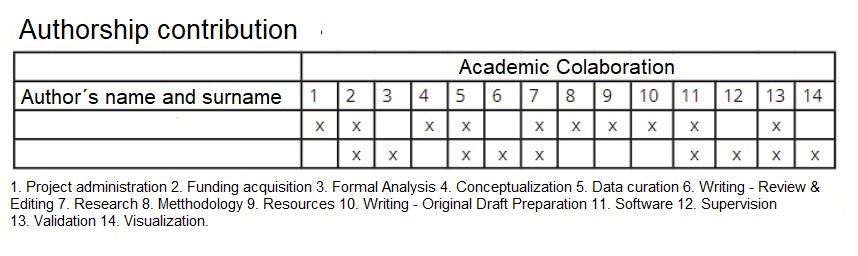
Authorship contribution according to the CRediT
taxonomy (https://credit.niso.org/) with the aim of giving greater visibility
to the way in which each co-author collaborates by specifying their
participation in the following activities: 1. Project administration:
responsibility for managing and coordinating the planning and execution of the
research activity. 2. Funding Acquisition: Acquisition
of financial support for the project that led to this publication. 3. Formal Analysis: Application of
statistical, mathematical, computational, or other formal techniques to analyze
or synthesize study data. 4. Conceptualization: Ideas,
formulation, or development of overall research objectives and goals. 5. Data Curation: Management
activities related to annotating (producing metadata), deleting, and
maintaining research data, including the use and reuse phases (including
writing software code, where these activities are necessary to interpret the
data itself). 6. Writing - Reviewing &
Editing: Preparation, creation, and/or presentation of published work by those
in the research group, specifically critical review, commentary, or revisions,
including pre- or post-publication stages. 7. Research: Development of a
research process, specifically experiments or data collection/testing. 8. Methodology: Development or
design of methodology, creation of models. 9. Resources: Provision of study
materials, reagents, materials of any kind, patients, laboratory samples.
Animals, instrumentation, computing resources, or other analytical tools 10. Writing - original draft:
Preparation, creation, and/or presentation of the published work, specifically,
writing the initial draft (including, if relevant to the volume of translated
text, translation work) 11. Software: Programming, software
development, software design, implementation of computer code and supporting
algorithms, testing of existing code components 12. Supervision: Responsibility for
supervising and leading the planning and execution of the research activity,
including external mentoring 13. Validation: Verification,
either as part of the activity or separately, of the overall replication/reproducibility
of the results/experiments and other research outputs 14. Visualization: Preparation,
creation, and/or presentation of the published work, specifically, data
visualization/presentation It is suggested that the application form be presented as follows:
II. Article Articles must be written in Spanish, clearly and concisely, using
simple, direct, and academic vocabulary, without footnotes, appendices, or
annexes. The requested submission format is as follows: Word document, A4 size,
with 25 mm margins on all sides. The recommended font is Arial 11, Verdana 11,
or Calibri 12. Line spacing must be double-spaced. Pages must be numbered
consecutively, starting from the title page. Review papers should not exceed 18
pages, research papers 15 pages, and clinical cases 12 pages, excluding
references. Furthermore, in order to maintain double-blind peer review, the
authors' names and affiliations must not appear in this file. •
Initial Page 1. Title:
in Spanish, English, and Portuguese, avoiding abbreviations, and may include a
subtitle. 2. Abstract:
Spanish, English, and Portuguese, with a maximum length of 250 words,
highlighting objectives, methods, results, and main conclusions. Abbreviations should
be avoided (except for well-known acronyms such as WHO, AIDS, etc.). References
should not be included in the abstract. In the case of research papers, the
place where the paper was conducted must be stated. 3. Keywords:
Spanish, English, and Portuguese, minimum three and maximum five. Their
selection should consider the terms in the Medical Subject Heading (MeSH) and
Descriptors in Health Sciences (DeCS) lists. •
Structure Research papers should include the following sections: introduction and
background, materials and methods, results, discussion, conclusions, data
availability, and references. Literature review or update articles should be organized as follows:
introduction, review and methodology used to obtain the data, development,
discussion, conclusions, and references. Case reports should be organized as follows: introduction, background,
description, discussion, conclusions, and references. •
Illustrations Diagrams, graphs, tables, drawings, or photographs must be inserted into
the article itself, in the space deemed appropriate by the author and in an
editable format. They must also be numbered consecutively and include concise
explanatory captions. Illustrations must be the property of the authors or
properly cited. Illustrations that have already been published in books or
journals may not be reproduced without the express authorization of the author.
•
References Vancouver style should be used. Bibliographic sources should be numbered
consecutively in the order in which they appear in the text, identifying each
with superscript Arabic numerals in parentheses: (1), (2-5). It is important to
keep in mind that only works that have been read in their entirety and that
contribute to the ideas expressed should be cited. Examples: Journal Article: Wilbur O. Alternate occlusal schemes. J. Prosth. Dent.
1991; 65 (1): 54-5. Books: Dawson P. Evaluation, diagnosis, and treatment of occlusal
problems. 1st ed. Barcelona: Salvat; 1991, 506p Book Chapter: Carranza FA. Diagnosis, prognosis, and treatment. In:
Glickman's Clinical Periodontics. 7th ed. Mexico: Interamericana, 1993. pp.
31-75 Congresses, conferences, seminars, roundtables: Dartora PC, Watcher HF,
Campomanes RM. New alternative for PVC separation in PET recycling performance.
[DVD]. In: XVII Conference of Young Researchers, Montevideo Group Association
of Universities. Concordia, Entre Ríos, Argentina. October 27, 28, and 29, 2009 |
[Home] [About the journal] [Editorial Board] [Subscription]
 This work is licensed under a Creative Commons License BY 4.0 International
© 2014 Facultad de Odontología
Universidad de la República
Las Heras 1925
Tel: 2487 30 48