
ISSN 2730-5066
|
ISSN 2730-5066
|
|
|
|
|
About the Journal The journal Agrociencia Uruguay is an academic and professional publication with over 25 years of experience, which publishes advances and experiences in agricultural sciences to promote and disseminate progress, communication and exchange. The target audience of the journal are researchers and producers in agricultural sciences. As well as anyone interested in the subject. Within the agricultural sciences, the following disciplines are contemplated: agroecology, plant and microbial biotechnology, forestry and landscape management, social sciences, rural sociology and agrarian economics, animal production and pastures, plant production, plant protection, natural and environmental resources, and food technology. The journal is edited and financed by the Agronomy College (FAgro), Universidad de la República (Udelar), together with the National Institute of Agricultural Research (INIA) of Uruguay. Its standard abbreviated title is: Agrocienc. Urug. Agrociencia Uruguay is an open access journal, which means that it is free to consult. Readers are able to make use of the contents for free and without the need to ask permission from the publisher or authors. It does not charge APC (Article Processing Charge) and is identified with the diamond path of open access. The journal is advertising free. The publisher does not release personal information of the users to advertisers. It publishes regular articles in English only and provides bibliographical information (title, authors, abstract and keywords) in three languages: English, Spanish and Portuguese. However, the special issues accept articles in the three languages mentioned above. The journal is presented in virtual format at the rate of one volume per year and special issues belonging to events or thematic issues related to the disciplines of Agrociencia Uruguay. Manuscripts are peer-reviewed in a double-blind mode and in accordance with the code of ethics of "COPE" (Committee on Publication Ethics). The publication is continuous, which implies that once the editorial process is finished, the articles are published, not having to wait for a specific date. This allows for shortening publication times and collecting updated information. The published documents can follow the following modality: Editorial: a brief introduction/analytical comment on some current and relevant topic of the journal’s subject area. This modality is only accepted by invitation. Scientific article: it presents original research results. It can be presented as a short communication. Review: it corresponds to the analysis and systematization of research results in a field in which the author or authors have a proven track record. This modality is only accepted by invitation. Technical note: it includes the results of interpretative and critical perspectives on a specific topic, from original sources. Some examples can be the description of a region, a rural socioeconomic problem, or the situation of agricultural production items. Studies sent to Agrociencia Uruguay must be original and not previously published or evaluated by another publication, regardless of the language. All products derived from theses, publications in institutional or pre-print repositories will be considered original and must be indicated and cited in the article’s body, as well as extended versions of contributions to previously published events. These should significantly provide new content. Articles identified as part of a series of publications of the same research, commonly referred to as "salami publication", will be rejected by the journal or they will be asked to be rewritten. History of the journal The journal Agrociencia (ISSN 1510-0839; e-ISSN: 2301-1548) was first published in 1997 at the rate of one volume per year, until 2002, when the journal began to publish two annual issues, with the sporadic publication of special issues belonging to events (congresses, symposia, among others). Articles were published in Spanish and, occasionally, in English and Portuguese. Since 2007 it has been published jointly by the Agronomy College (FAgro) of the Universidad de la República (Udelar) and the National Institute of Agricultural Research (INIA). This has allowed the consecration of a publication with the institutional support of two entities with relevant thematic specificity. As of 2018, the publication is in electronic format and since the beginning of 2020 it has been published entirely in English and as a continuous publication. In 2021, it began a consolidation process of the title in order to differentiate itself from other journals with similar titles. Thus, the new title Agrociencia Uruguay (ISSN 2730-5066) emerges, maintaining its history and commitment to knowledge communication in the area. Currently, the journal is identified with the diamond open access (free consultation and APC), it publishes regular issues in English and in continuous publication mode. For more information, we recommend reading the following article: Writing from Uruguay to the world: Agrociencia Uruguay twenty-five years by Daniele Bonfanti and Verónica Sanz.
Editorial process Manuscripts will be received only by the platform through the link "Send an article" and will correspond to the document type of editorial (only by invitation), scientific article, review (only by invitation) and technical note. They must be sent in the journal’s template. For regular issues see here. For special issues see here. All manuscripts will be examined by a plagiarism detection software, called Compilatio, and filtered from author identification data, before starting the editorial process. Subsequently, the editors-in-chief will assign a section editor, who will declare no conflict of interest with the authors. The editors of Agrociencia Uruguay are periodically evaluated and have a proven scientific track record. The manuscript will then be sent to at least two peer reviewers external to the publishing institutions (Agronomy College and INIA), in a double-blind system and in accordance with the code of ethics of "COPE". Double-blind peer review is a process in which both authors and reviewers remain anonymous to each other, ensuring an impartial evaluation of manuscripts. This process aims to prevent bias and/or discrimination, including those related to gender, institutional affiliation, and other factors. Double-blind review promotes fairness and ensures that editorial decisions are based solely on the scientific quality of the submissions, fostering an inclusive and equitable environment in scientific communication. This system reinforces the journal's commitment to integrity and equality in academic publishing. The authors are responsible for the content presented in the article and do not represent the opinion or position of the journal. At any stage of the editorial process, authors may be asked to make corrections. Once the manuscript has been accepted by the section editors, the bibliographic and style corrections begin, as well as the layout. Finally, the article is published and broadcasted correspondingly. 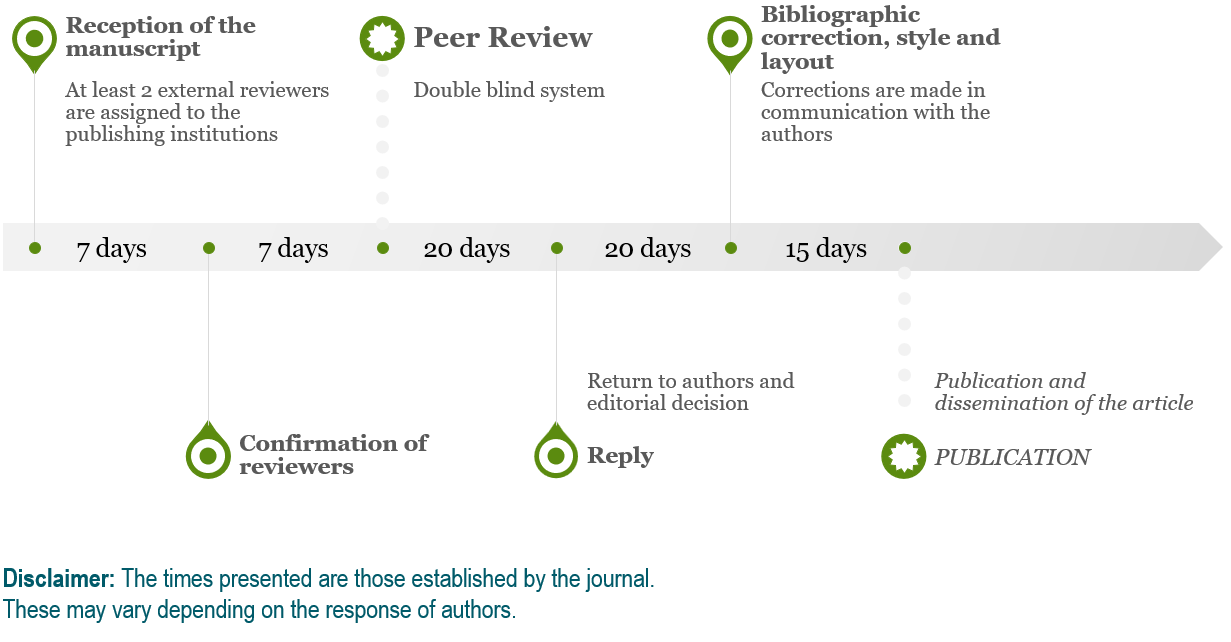 Journal Policies Agrociencia Uruguay journal adheres to the following policies: Privacy & Rights Statement The publishers (Agronomy College, Udelar, and National Institute of Agricultural Research) hold the economic rights (copyright) of the published articles, and favor and allow their reuse under the Creative Commons 4.0 Attribution license. The acceptance of the articles implies that the authors allow Agrociencia Uruguay to carry out dissemination and communication activities through the internet, social networks, databases, repositories, as well as any other site for content consultations. The authors are responsible for the content presented in the article and do not represent the opinion or position of the journal. Personal data provided to this journal will be used exclusively for its set purposes and will not be provided to third parties or used for other purposes. Code of Ethics Agrociencia Uruguay adheres to the COPE (Committee on Publication Ethics) guidelines regarding good practices in transparency, editing and publication of academic journals. For example, the Principles of Transparency and Best Practice in Scholarly Publishing, which promote transparency in communications throughout the editorial process, and assurance that decisions are based on academic rather than personal aspects.
We recommend editors, authors and reviewers know the following guides: COPE Ethical Guidelines for Peer Reviewers Ethical oversight (Policies on consent to publication, publication on vulnerable populations, ethical conduct of research using animals, ethical conduct of research using human subjects, handling confidential data and ethical business/marketing practices). Ethics toolkit for a successful editorial office Guidance for Editors: research, audit and service evaluations Principles of Transparency and Best Practice in Scholarly Publishing Reuse Policy Agrociencia Uruguay is an Open Access journal. Open Access is the condition where the copyright holder of a scholarly work (in this case Agrociencia Uruguay) grants usage rights to others using an open license (Creative Commons 4.0 Attribution license) allowing for immediate free access to the work and permitting any user to read, download, copy, distribute, print, search, or link to the full texts of articles, crawl them for indexing, pass them as data to software, or use them for any other lawful purpose. For this reason, Agrociencia Uruguay approves and encourages the dissemination of its publications in post-print format in institutional repositories, social networks, personal websites, blogs and the like, as long as they do not pursue commercial purposes. Total or partial reproduction of the material that appears in Agrociencia Uruguay is also authorized, with the obligation to cite the source. Digital Preservation Policy  Agrociencia Uruguay has a digital preservation policy to back up its collection every 6 months through Portico. Backups are made at the metadata and file level of the articles. Portico ensures 4 preservation factors: 1- Usability: ensuring access to information regardless of technological changes. 2- Authenticity: copies are made on the originals and these remain unchanged. 3- Discoverability: the metadata provided by the articles must be retrievable over time 4- Accessibility: the stored contents must be usable.
To check the preservation status, you must access the ISSN Portal. In the record for Agrociencia Uruguay, under the "Archival Status" tab, you can view the issues that are preserved. Please note that the most recently preserved content may take up to six months to be reflected. Anti-plagiarism Policy Agrociencia Uruguay considers plagiarism to be the appropriation of words, ideas, data, images, or works of others without proper attribution, whether explicit or implicit, and presenting them as one’s own. All sources used must be cited and referenced in accordance with the journal’s established guidelines. All manuscripts, without exception, will be evaluated using the plagiarism detection software Compilatio. This process identifies matches and similarities between submitted texts and those previously published in other sources. The results of the analysis will be assessed according to the following similarity ranges:
Sanctions:
Agrociencia Uruguay remains committed to ethics and scientific integrity and appreciates the cooperation of authors in adhering to these policies. Interoperability Protocol Agrociencia Uruguay provides an OAI-PMH (Open Archive Initiative-Protocol for Metadata Harvesting) interoperability protocol in order to be collected by other content distribution systems, such as digital repositories and harvesters.
Protocol: OAI-PMH Version 2.0 Metadata formats: OAI_DC; RFC1807; OAI_MARC; MARCXML Route for harvesters: https://agrocienciauruguay.uy/index.php/agrociencia/oai Use of Artificial Intelligence (AI) Agrociencia Uruguay acknowledges the increase in the use of AI and AI-assisted tools in research. However, this policy focuses solely on the use of AI in the preparation of articles. The journal does not recognize AI or AI-assisted technologies as authorship. Thus, they cannot appear as authors, co-authors, or citations in articles published in Agrociencia Uruguay. Authors, whether individuals or institutions, are ultimately responsible parties for the content of their works. The use of these tools for assistance in writing and improving the readability of papers is allowed, as well as for enhancing the quality of images and tables to be published. The incorporation of AI-generated images is not allowed, as it may lead to legal and ethical issues. All use of AI must be verified and controlled by a human. The use of AI and assisted technologies must be explicitly stated in a note titled “Use of Artificial Intelligence” and the ways in which they were carried out must be documented. Upon detecting non-compliance with this policy, authors will be asked to make the necessary modifications. If the violation persists, the manuscript will be rejected. Preprint Policy Agrociencia Uruguay recognizes the growing importance of preprints in scientific communication. In this context, the journal accepts the submission of manuscripts that have been previously published as preprints, provided they meet certain quality and provenance criteria. For this policy, a preprint is considered to be the version of a scientific manuscript before undergoing peer review and formal publication in a journal. Preprints previously deposited in open-access institutional repositories associated with research and higher education institutions, and preferably recognized by the academic community, will be accepted. It is important to note that Agrociencia Uruguay does not authorize the submission of manuscripts that are deposited in other types of preprint repositories or similar platforms. To submit a manuscript to the journal, any preprint version must first be withdrawn from these sites. Articles derived from undergraduate final projects, dissertations, or doctoral theses will also be identified as preprints. This includes both manuscripts based on the research conducted and formatted articles published as annexes to these works. In the latter case, it is recommended to request an editorial embargo on the annex during the editorial process to avoid conflicts in the subsequent publication of the article. In all cases, authors must indicate in the cover letter and in the manuscript that the work has been previously deposited in an institutional repository. Additionally, if possible, they should provide the permanent link to the preprint. The submission of a preprint does not guarantee the acceptance of the manuscript in the journal. Like all manuscripts, it will be subject to the peer review process and must meet the required quality and originality standards. If the manuscript is accepted and published in Agrociencia Uruguay, authors are encouraged to update the entry in the institutional repository to include the bibliographic reference to the journal and the link to the published article. If possible, and to avoid ambiguities, it is recommended to remove the full text from the repository. Indexs and
directories
Member  Databases  Digital
Libraries   Directories         Indexs (Subscription required)     Repositories  Others
  Contact Chief Editors Dra. Amabelia del Pino Universidad de la República, Facultad de Agronomía. Av. Garzón 780, 11900 Montevideo, Uruguay. Teléfono: (+598) 91 397 378, e-mail: amabelia@fagro.edu.uy Dr. Alejandro Mendoza Instituto Nacional de Investigación Agropecuaria (INIA). Ruta 50 km 11, CP 70600 Colonia, Uruguay. Teléfono: (+598) 91 397 378. e-mail: amendoza@inia.org.uy Editorial office Secretary: Br. Niza Trujillo. agrociencia@fagro.edu.uy Lic. Laura Orrego agrociencia@fagro.edu.uy Technical Editor: Dra. Stephanie Colombo colombo@fagro.edu.uy Editing for Grammar and Style: Corr.a y trad.a Martina Gancio martinagancio@gmail.com IT support: Biteca, agrociencia@fagro.edu.uy Community Manager Br. Federico Basso, redesagrociencia@fagro.edu.uy |
[Home] [Editorial Board] [Instructions to Authors] [Subscription]
 All the contents of this journal, except where otherwise noted, is licensed under a Creative Commons Attribution License
©
2014 Facultad de
Agronomía-Universidad de la República
Instituto Nacional de Investigación Agropecuaria
Av. Garzón 780
C.P 12.900 Montevideo Uruguay
Tel: (598) - 2356 2224
Fax: (598) - 2902 0550